Comparison is an essential part of business decision-making. Organizations regularly evaluate their performance against competitors, industry standards, and market leaders to identify opportunities for improvement. However, comparisons do not always provide a fair or accurate picture.
One of the most common mistakes is making an apples-to-oranges comparison—evaluating two things that may appear similar but differ significantly in their characteristics, circumstances, or objectives.
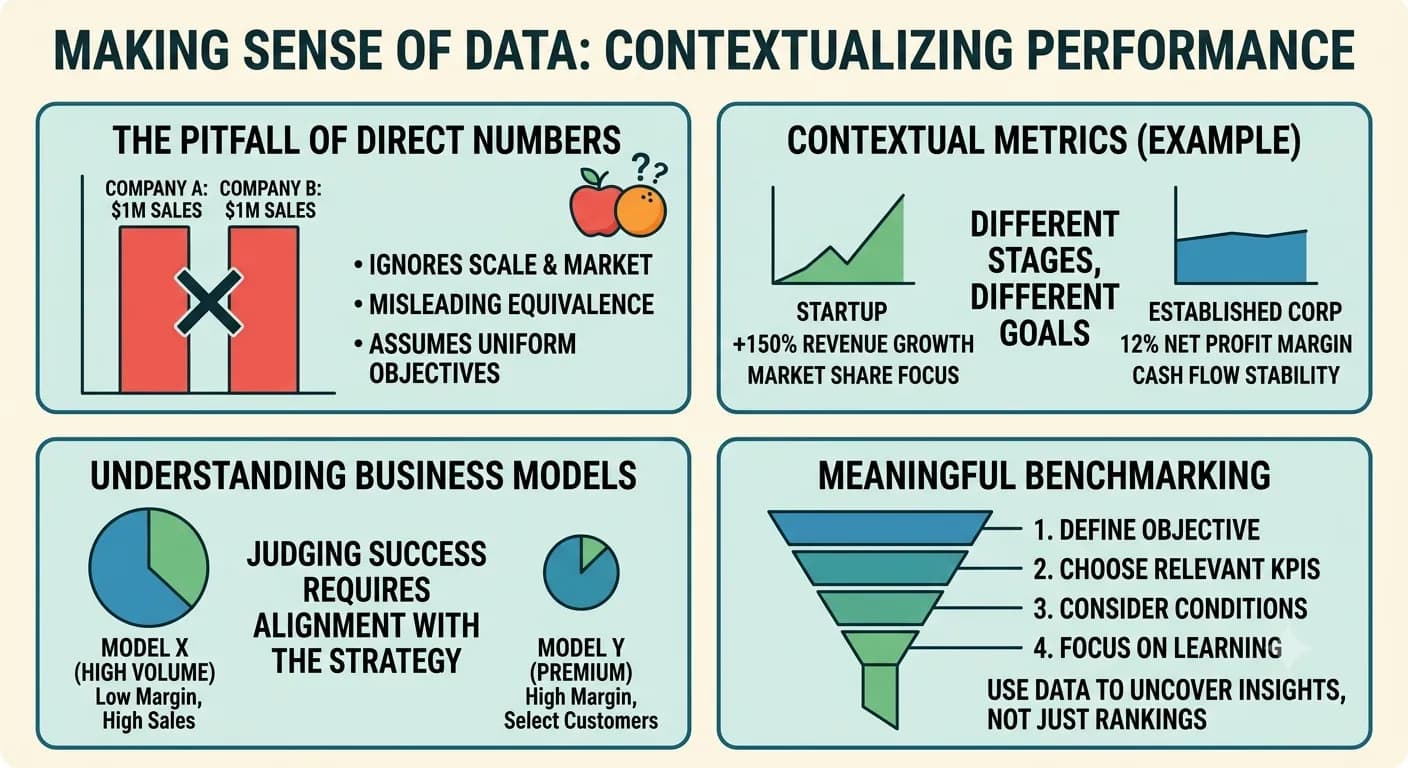
For instance, comparing the revenue of a growing startup with that of an established multinational company may reveal a significant difference in numbers, but it does not necessarily reflect differences in efficiency or business potential.
The real value of comparison lies not in identifying who performs better, but in understanding the factors that influence performance.
Understanding the Apples-to-Oranges Concept
An apples-to-oranges comparison occurs when two organizations, products, processes, or situations are evaluated using the same criteria without considering their fundamental differences.
Consider two retail businesses. One focuses on affordable products and high sales volumes, while the other specializes in premium products with higher profit margins.
Judging their success solely by the number of products sold would overlook their different business strategies. The first may lead in sales volume, while the second may generate greater profit per transaction.
Both businesses can be successful in their respective markets.
This highlights a simple but important principle: similar numbers do not always represent similar business realities.
Why Such Comparisons Can Be Misleading
In business, performance is influenced by several interconnected factors. Company size, available resources, market conditions, customer expectations, technology, and operational strategies all shape results.
When these factors are ignored, comparisons can create unrealistic expectations and lead to poor decisions.
For example, a small manufacturing business may compare its production costs with those of a large corporation. The corporation might benefit from advanced automation, bulk purchasing, and established supply chains.
Expecting the smaller business to achieve identical cost efficiency without comparable resources would be unrealistic.
Similarly, comparing two marketing agencies solely by their number of clients may overlook differences in project complexity, client value, service quality, and long-term relationships.
The problem is not the comparison itself, but the absence of context.
The Challenge in Business Benchmarking
Benchmarking is designed to help organizations learn from successful practices and improve their performance. However, its effectiveness depends heavily on selecting appropriate reference points.
When businesses compare themselves with organizations operating under completely different conditions, benchmarking can become misleading.
A company may identify a performance gap without understanding the structural reasons behind it. As a result, management might introduce unnecessary cost reductions, unrealistic targets, or strategies that do not align with the organization's capabilities.
This is why benchmarking should go beyond surface-level indicators.
Rather than simply asking, "Why are they performing better than us?" businesses should ask, "What factors contribute to their performance, and which of those practices are relevant to our situation?"
This shift in perspective transforms benchmarking from a competitive exercise into a meaningful learning process.
How to Make Comparisons More Meaningful
Effective comparisons require a balance between measurable data and practical understanding.
1. Establish a Clear Purpose
Before comparing performance, organizations should identify what they want to evaluate, whether it is profitability, productivity, operational efficiency, or customer satisfaction.
2. Compare Relevant Performance Indicators
The selected metrics should reflect the actual business objective. Revenue alone, for example, may not provide a complete picture without considering costs and profitability.
3. Consider Differences in Business Conditions
Factors such as company size, market reach, resources, customer segments, and operating environments should be considered before drawing conclusions.
4. Maintain Consistency in Data
Comparisons should use clearly defined metrics, reliable information, and similar reporting periods to avoid misleading results.
5. Focus on Insights Rather Than Rankings
The objective should be to identify practical improvements rather than simply determine which organization performs better.
A Different Perspective: Is Every Comparison Necessary?
Businesses often assume that comparing themselves with industry leaders is the best way to achieve growth. While external comparisons can provide valuable insights, they should not become the only measure of success.
Every organization has its own strengths, priorities, and long-term vision.
A smaller company may offer personalized customer experiences that larger competitors struggle to provide. A business with slower growth may maintain stronger financial stability than one expanding aggressively.
These differences deserve recognition rather than being treated as weaknesses.
Sometimes, the most meaningful comparison is not between two competing businesses, but between an organization's current performance and its own previous achievements.
After all, sustainable progress is not always about outperforming others. It is about making better decisions, strengthening existing capabilities, and improving consistently.
Conclusion
Apples-to-oranges comparisons demonstrate why numbers alone cannot tell the complete story.
In business, benchmarking, and performance evaluation, meaningful comparisons require an understanding of the circumstances behind the results. Ignoring these differences can lead to unrealistic expectations and decisions that may harm long-term growth.
Organizations should therefore approach comparisons with clarity, fairness, and a willingness to look beyond surface-level performance.
The purpose of comparison should not be to prove who is better, but to understand what can be learned and how that knowledge can lead to meaningful improvement.
Ultimately, the smartest businesses are not those that compare everything. They are the ones that know what is worth comparing—and why.