How Businesses Can Prepare Product Requirements Before Approaching Indian Manufacturers
By BONC Editorial Team • Published on 29 Oct 2026
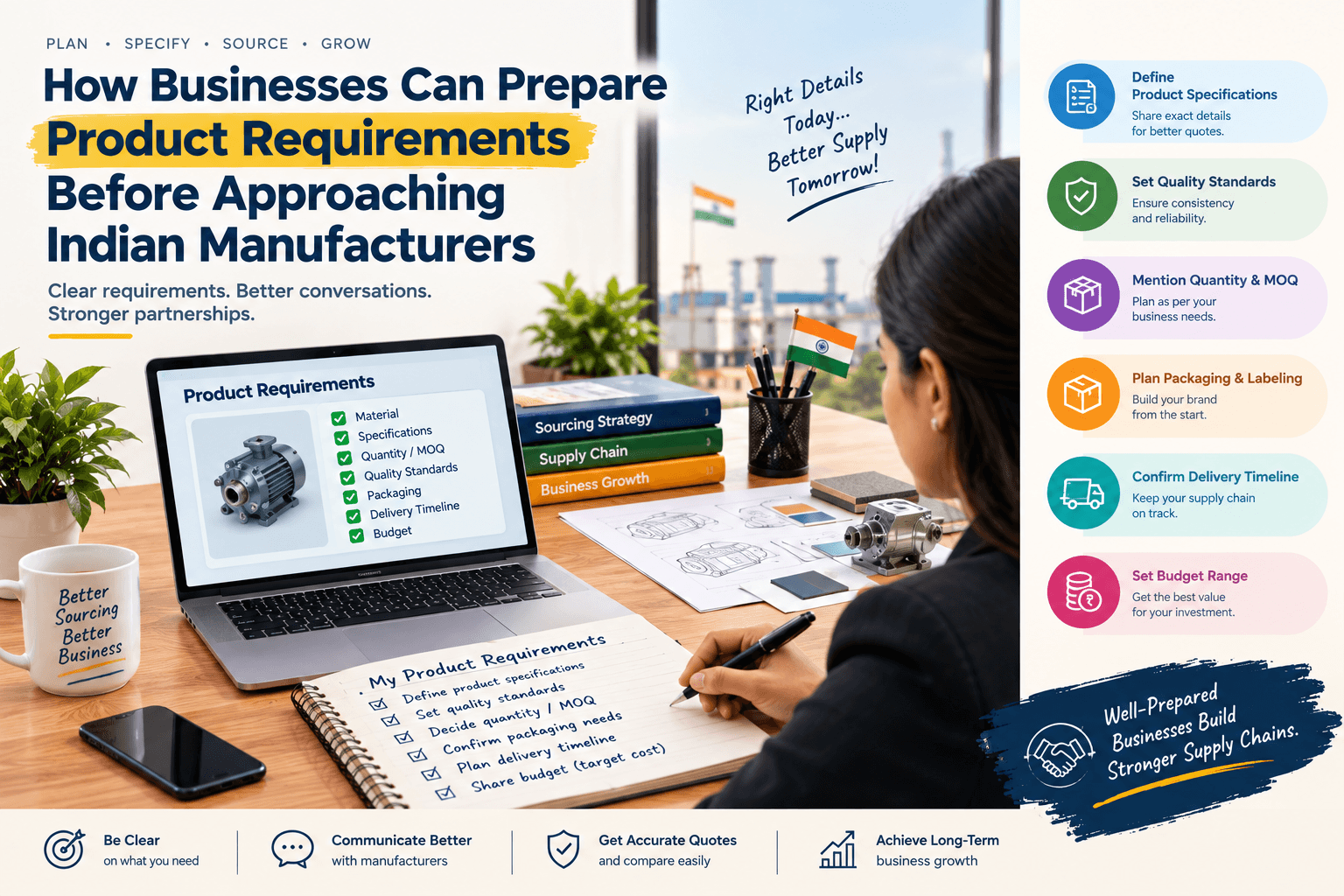
Introduction
India has a diverse manufacturing ecosystem that supports businesses across industries such as textiles, pharmaceuticals, engineering, electronics, furniture, packaging, chemicals, consumer goods, automotive components, and industrial equipment. For businesses looking to purchase products in bulk, develop customised goods, or establish long-term sourcing partnerships, Indian manufacturers can offer a wide range of potential opportunities.
However, finding a suitable manufacturer involves more than searching for a company that produces a particular product. Businesses must communicate exactly what they want to purchase, the quantity they require, the quality they expect, and the commercial conditions under which they intend to place an order.
This is where preparing product requirements becomes important.
When buyers approach manufacturers without clear specifications, they may receive inaccurate quotations, encounter unexpected costs, experience delays, or discover that the finished products do not meet their expectations. Manufacturers may also struggle to provide accurate information when important details about dimensions, materials, packaging, intended use, and production quantities are missing.
A well-prepared product requirement document helps both parties understand the proposed order from the beginning. It gives manufacturers a clearer basis for evaluating feasibility, estimating costs, identifying suitable materials, and determining whether their production capabilities match the buyer's expectations.
For businesses sourcing products from India, this preparation can make supplier discovery, quotation comparison, product development, and procurement planning more organised.
Digital B2B networking platforms such as BONC Network can also support the initial discovery process by helping businesses explore business profiles, product-related information, and potential commercial connections. However, identifying a possible supplier is only one part of procurement. Buyers must still communicate their requirements clearly and independently evaluate a manufacturer's suitability.
Understanding how to prepare product requirements before approaching Indian manufacturers can therefore help businesses make better sourcing decisions, reduce avoidable misunderstandings, and build stronger manufacturing relationships.
Understanding Product Requirements in Manufacturing
Product requirements describe the characteristics, performance expectations, quantities, and commercial conditions associated with a product that a business wants a manufacturer to supply or produce.
These requirements may cover physical dimensions, raw materials, product design, functionality, quality standards, packaging, labelling, delivery schedules, and other details relevant to the order.
For example, a business looking to purchase office furniture should not simply tell a manufacturer that it needs desks and chairs. It should provide information about the intended furniture type, dimensions, material preferences, colour, expected durability, quantity, packaging, and delivery location.
Similarly, a company sourcing electronic components may need to specify operating conditions, compatibility, electrical characteristics, applicable standards, and testing expectations.
The level of detail required depends on the product and the complexity of the manufacturing process.
A standard wholesale product may require a relatively simple specification sheet, while a customised industrial component may need technical drawings, material requirements, tolerances, testing procedures, and sample approval.
The purpose is not to make every request unnecessarily complicated. It is to provide enough reliable information for the manufacturer to understand the requirement and determine whether it can be fulfilled.
Why Businesses Should Prepare Product Requirements Before Contacting Manufacturers
Improving Communication With Potential Suppliers
Manufacturers often receive enquiries from buyers with different expectations, budgets, and purchasing objectives. An enquiry that contains only a product name may not provide enough information to prepare a useful quotation.
For example, the price of a storage rack may depend on its dimensions, load capacity, metal thickness, surface treatment, design, and order quantity. Without these details, a manufacturer may provide only an approximate price that changes after the buyer shares the complete requirements.
A clear product requirement document helps buyers communicate their expectations in a structured manner.
It also allows manufacturers to identify missing information early and ask relevant questions before investing time in detailed quotation preparation.
Receiving More Accurate Quotations
Product specifications influence manufacturing costs. Two products that appear similar may require different raw materials, production processes, finishing methods, or quality checks.
When businesses provide detailed requirements, manufacturers can prepare quotations based on a more consistent understanding of the proposed order.
Buyers can then compare quotations more meaningfully instead of evaluating prices that cover different product specifications.
A quotation should ideally clarify the product configuration, quantity, unit price, tooling or development charges where applicable, packaging, taxes, freight, payment conditions, and quotation validity.
The exact commercial terms will depend on the product, supplier, and transaction.
Reducing Production Errors
Unclear requirements can lead to incorrect dimensions, unsuitable materials, inconsistent finishes, or missing product features.
Such errors may be expensive to correct after production has started.
A documented specification provides a reference against which the manufacturer and buyer can review samples, approve designs, and inspect finished products.
It also creates a common understanding of what has been agreed.
Making Supplier Comparisons Easier
Businesses may approach several Indian manufacturers before selecting a supplier. If every manufacturer receives different information, the resulting quotations may not be directly comparable.
A standard requirement sheet helps businesses evaluate different suppliers against the same specifications.
This makes it easier to compare technical capabilities, production capacity, quality processes, delivery estimates, and commercial terms.
Identify the Purpose and Intended Use of the Product
Before contacting manufacturers, businesses should clearly understand why they need the product and how it will be used.
The intended application can influence nearly every major manufacturing decision, including material selection, design, durability, performance, and packaging.
For instance, a business purchasing plastic containers for dry goods may have different requirements from a company sourcing containers for liquids, chemicals, or food products.
Similarly, furniture designed for occasional household use may have different durability requirements from furniture intended for offices, schools, hospitals, or other commercial environments.
Buyers should begin by answering several important questions.
What problem will the product solve? Who will use it? Where will it be used? What operating conditions must it withstand? Is it intended for resale, internal business operations, industrial use, or a specific customer requirement?
These answers help establish the product's essential characteristics.
Businesses should also distinguish between mandatory requirements and optional preferences. A mandatory requirement may involve a particular load capacity or material grade, while an optional preference may involve a specific colour or decorative finish.
This distinction helps manufacturers understand which features cannot be changed and where alternative solutions may be acceptable.
Prepare a Detailed Product Specification Sheet
A product specification sheet is one of the most useful documents businesses can prepare before approaching Indian manufacturers.
It brings essential product information together in a format that suppliers can review quickly.
The specification sheet should be detailed enough to support an initial feasibility assessment and quotation. For complex products, it may be supported by separate technical drawings, reference images, testing requirements, or design files.
Include the Basic Product Information
Start with the product name, category, model number if applicable, and a short description.
If the business already has a product catalogue, reference number, or internal identification system, include the relevant details.
For example, a buyer sourcing industrial storage cabinets could specify the product category, intended environment, approximate dimensions, number of shelves, preferred material, and required load capacity.
Clear naming also helps businesses organise quotations when sourcing multiple products from different suppliers.
Specify Dimensions and Measurements
Dimensions should be stated using consistent measurement units.
Depending on the product, relevant measurements may include length, width, height, thickness, diameter, weight, volume, or capacity.
For components requiring precise manufacturing, buyers may also need to specify acceptable tolerances.
A tolerance defines the permissible variation from a stated measurement. It is especially important for machined parts, engineered components, moulded products, and items that must fit into an existing assembly.
If technical drawings are available, attach them to the requirement document. Make sure the drawings show the relevant dimensions and clearly identify any critical measurements.
Where measurements are not yet final, label them as provisional rather than presenting estimates as confirmed specifications.
Describe Materials and Construction
Material selection can affect product strength, durability, weight, appearance, safety, and manufacturing cost.
Businesses should identify the preferred material or grade wherever they have a clear requirement.
For metal products, this may include the type and grade of metal, thickness, coating, or corrosion-resistance expectations. For textiles, it may involve fibre composition, fabric weight, weave, colourfastness, and stitching requirements.
Plastic products may require details about the material type, flexibility, temperature resistance, or other performance characteristics.
When the buyer is uncertain about the most suitable material, the specification sheet can state the intended application and required performance instead. The manufacturer can then recommend alternatives for evaluation.
Any alternative should be reviewed against the product's intended use and applicable safety or regulatory requirements before approval.
Explain the Product's Functional Requirements
A product's appearance is not always enough to determine whether it will perform as expected.
Businesses should explain the essential functions the product must deliver.
For machinery, this might include operating capacity, expected output, power requirements, compatibility, or operating conditions. For packaging, it might involve protection from moisture, resistance to leakage, sealing performance, or suitability for transportation.
For electronic products, requirements may include power input, connectivity, compatibility, environmental conditions, and relevant performance limits.
Functional requirements should be specific and measurable wherever possible.
Statements such as "high quality," "strong material," or "long-lasting product" can be difficult to interpret consistently. Where practical, replace them with measurable expectations, recognised standards, test methods, or clearly defined acceptance criteria.
Separate Essential Specifications From Flexible Preferences
Not every product detail needs to be fixed before approaching a manufacturer.
Some requirements are essential because they determine whether the product can perform its intended function. Others may be flexible and open to discussion.
For example, a business sourcing promotional merchandise may require a specific logo, minimum dimensions, and a fixed delivery date while allowing the manufacturer to recommend suitable packaging materials.
A company purchasing industrial components may require exact technical dimensions and material properties but be open to alternative manufacturing methods if the finished component meets the approved specifications.
Businesses should classify their requirements into three categories.
Mandatory requirements are conditions the manufacturer must meet.
Preferred requirements describe the buyer's ideal option but may allow alternatives.
Open-to-discussion requirements identify areas where the manufacturer can suggest practical or cost-effective solutions.
This approach helps suppliers understand where they have flexibility to recommend alternatives without compromising the buyer's essential needs.
It also creates a better foundation for technical discussions and cost optimisation.
Determine the Required Order Quantity
Order quantity is a major factor in manufacturing quotations and production planning.
Before approaching suppliers, businesses should estimate how many units they require for the first order and whether future purchases are likely.
The initial quantity may depend on current customer demand, available working capital, storage capacity, sales forecasts, and product shelf life.
A business should distinguish between its ideal purchase quantity and the minimum quantity it can realistically accept.
Some manufacturers may have minimum order quantities because of raw-material purchasing requirements, production setup costs, tooling expenses, or packaging constraints.
For customised products, the minimum order may be higher than for standard products.
Businesses should therefore ask manufacturers about minimum order quantities, price breaks at different volumes, and whether a trial order is possible.
For example, a buyer could request quotations for several practical quantity levels rather than asking only for a single bulk price. This can reveal how unit costs change with production volume.
However, buyers should avoid placing unnecessarily large orders simply to obtain a lower unit price. Excess inventory, storage costs, damaged goods, changing customer preferences, and tied-up working capital can outweigh the apparent savings.
The most suitable order quantity balances unit economics with realistic demand and inventory capacity.
Establish a Realistic Budget and Cost Structure
Businesses should establish a budget before requesting quotations, even if the final price remains negotiable.
The budget should account for more than the manufacturer's quoted unit price.
Depending on the transaction, the total procurement cost may include product development, sample charges, tooling, customisation, packaging, transportation, insurance, taxes, inspection, warehousing, and other applicable expenses.
Businesses purchasing products from manufacturers in India should determine which costs are included in each quotation and which are charged separately.
A low unit price may not represent the most economical option if it comes with high freight costs, expensive tooling, longer lead times, or additional finishing charges.
Buyers should also consider the cost of defects, replacements, delays, and quality inspections when evaluating suppliers.
If the available budget is limited, businesses can explain their target price range and ask whether alternative materials, designs, packaging options, or order quantities could achieve a suitable balance between cost and performance.
Any proposed cost-saving change should be evaluated carefully. Reducing specifications without understanding their effect on safety, durability, or functionality may create greater expenses later.
Prepare Design Files, Samples, and Reference Images
Written descriptions are useful, but visual and physical references can make complex product requirements easier to understand.
If the business already has a design, it can share technical drawings, CAD files, product photographs, dimensions, or approved design documents.
Reference images should identify the features that matter rather than leaving the manufacturer to guess which details must be reproduced.
For example, a furniture buyer may provide images showing the desired shape, finish, colour, and construction. The buyer should also specify which features are essential and which can be adapted to suit manufacturing constraints.
When sourcing a customised product, a physical reference sample can help communicate texture, weight, finishing, assembly, and other characteristics that are difficult to describe in writing.
However, a sample should not automatically be treated as a complete specification. It may need to be supplemented with measurements, material details, performance requirements, and acceptance criteria.
Businesses should agree on how samples will be reviewed and approved before bulk production begins.
If intellectual property or confidential designs are involved, buyers should consider appropriate confidentiality arrangements before sharing sensitive files. They should also clarify how design ownership, tooling ownership, and permitted use of the design will be handled.
Define Product Quality Standards and Acceptance Criteria
Quality requirements should be established before a manufacturer starts production.
Businesses should determine what acceptable quality means for the product and how it will be assessed.
For some products, visual inspection may be sufficient for certain characteristics. Others may require dimensional measurements, performance tests, material certificates, functional testing, or independent inspection.
A product requirement document can identify critical quality characteristics and explain how the finished goods will be checked.
For example, a packaging buyer may specify acceptable dimensions, printing quality, sealing performance, and the absence of visible damage. An industrial buyer may require dimensional tolerances, material properties, and performance tests.
Where recognised industry standards apply, businesses should identify the relevant standard and confirm that the manufacturer understands the requirement.
Products in regulated categories may also require specific documentation, approvals, labelling, or testing. The exact obligations depend on the product, its intended use, and the applicable Indian and destination-market rules.
Businesses should not assume that a general statement such as "standard quality" provides sufficient protection.
Instead, they should define measurable acceptance criteria and agree on the process for handling non-conforming products.
This may include inspection before dispatch, documentation of defects, replacement arrangements, rework procedures, or other contractually agreed remedies.
Clarify Packaging, Labelling, and Branding Requirements
Packaging is often overlooked during the initial sourcing discussion, even though it can affect product protection, cost, storage, transportation, and the customer experience.
Before approaching manufacturers, businesses should decide whether they need standard packaging, protective packaging, retail-ready packaging, bulk packaging, or customised branded packaging.
Relevant details may include package dimensions, material preferences, units per carton, protective inserts, labelling, barcodes, product information, and shipping marks.
For branded products, businesses should provide the approved logo files, artwork, colours, placement instructions, and any required packaging text.
They should also confirm who is responsible for design preparation, artwork approval, printing plates, labels, and packaging setup charges.
If products are intended for sale in a particular market, packaging and labelling must be reviewed against the applicable requirements.
For example, certain products may require declarations, warnings, batch information, manufacturing details, or other mandatory information. The precise requirements vary by product category and market.
A clear packaging specification helps manufacturers estimate the full order cost and reduces the likelihood of needing to change packaging after production has begun.
Set Production and Delivery Expectations
A manufacturer may be technically capable of producing a product but unable to meet the buyer's preferred delivery schedule.
Businesses should therefore identify the date by which the products are needed and work backwards to establish a realistic procurement timeline.
The timeline may include requirement confirmation, quotation review, sample preparation, sample approval, raw-material procurement, production, quality inspection, packaging, and transportation.
Custom products usually require more preparation than standard items that are already available.
Buyers should ask manufacturers to distinguish between the estimated production lead time and the total delivery time.
The production lead time may begin only after the design, sample, payment terms, and other required approvals have been completed.
Businesses should also clarify whether the manufacturer can handle the full quantity in one production run or whether staged deliveries would be more practical.
For seasonal products or time-sensitive commercial orders, delivery planning is particularly important. Delayed products may miss sales windows, disrupt project schedules, or create problems for downstream customers.
A realistic timeline should account for the manufacturer's stated capacity, the complexity of the order, and the time needed for transportation and inspection.
Rather than relying on an informal verbal estimate, businesses should request a written delivery schedule and document any important milestones.
Research Potential Indian Manufacturers Before Sending Requirements
Preparing a product requirement document is only one part of the sourcing process. Businesses must also identify manufacturers whose capabilities are relevant to the product.
India's manufacturing landscape includes businesses of different sizes, specialisations, production capacities, and levels of technical expertise.
The most suitable supplier is not necessarily the largest company or the one offering the lowest price. It is the manufacturer whose capabilities, quality processes, commercial terms, and production capacity align with the buyer's requirements.
Businesses can begin by identifying the relevant industry, product category, manufacturing process, and geographic preferences.
They may explore industry directories, trade exhibitions, professional networks, business referrals, and digital B2B networking platforms.
Platforms such as BONC Network can support business discovery by providing an additional channel for exploring company profiles, product-related information, and potential supplier connections.
Buyers should use such platforms as a starting point for research rather than as a substitute for supplier evaluation.
Before progressing with a manufacturer, businesses should examine relevant experience, product specialisation, available facilities, production capacity, communication quality, and willingness to provide supporting documentation.
Where appropriate, they may also request references, arrange factory visits, or conduct independent inspections.
The purpose is to build a shortlist of suppliers that can realistically fulfil the documented requirements.
Prepare a Structured Manufacturer Enquiry
Once the requirements are ready and potential manufacturers have been identified, businesses should prepare a clear enquiry.
A structured enquiry helps suppliers understand the opportunity without requiring repeated clarification.
It should briefly introduce the buyer's business, identify the required product, summarise the essential specifications, state the estimated order quantity, and explain the intended application where relevant.
The enquiry should also identify whether the buyer needs a standard product, a customised design, a sample, or a new product development arrangement.
Businesses should attach the relevant specification sheet, technical drawings, images, or reference documents.
They should request information about unit pricing, minimum order quantity, sample availability, production lead time, payment terms, packaging options, and delivery arrangements.
For technically complex products, buyers may also ask the manufacturer to identify any specifications that require clarification or may affect feasibility.
The enquiry should avoid unnecessary complexity while including enough information for an initial evaluation.
A useful approach is to prepare one standard enquiry template and adapt it for each manufacturer. This keeps the core requirements consistent and makes supplier responses easier to compare.
Businesses should also maintain a record of the documents shared, the date of each enquiry, the manufacturer's response, and any changes made during discussions.
Compare Manufacturer Quotations on a Like-for-Like Basis
After receiving quotations, businesses should review them against the original requirement document.
Comparing prices alone can lead to poor sourcing decisions if the quotations cover different materials, specifications, quantities, or delivery conditions.
A quotation comparison sheet can include the manufacturer's name, product specification, unit price, minimum order quantity, sample charges, tooling costs, taxes, packaging, delivery estimates, payment conditions, and quotation validity.
It should also record any differences between the requested specification and the manufacturer's proposed alternative.
For example, one manufacturer may quote a lower price because it proposes a different material or simpler packaging. Another may include additional testing or protective packaging in its price.
These quotations should not be treated as equivalent until the differences have been understood.
Businesses should ask follow-up questions where information is missing or unclear.
They should also evaluate communication quality and the supplier's ability to explain technical or commercial issues. Clear communication during the quotation stage can be useful when evaluating how the manufacturer may handle future production questions.
The final decision should reflect the complete commercial and technical picture rather than a single price figure.
Request Samples and Validate Specifications Before Bulk Production
For many products, a sample provides an important opportunity to assess whether the manufacturer's interpretation matches the buyer's expectations.
Samples may be necessary when the product is customised, the material has specific performance characteristics, the design is new, or the order quantity is substantial.
Before requesting a sample, businesses should clarify its purpose.
Is it intended to assess appearance, dimensions, material, functionality, packaging, or all of these characteristics?
The sample should be reviewed against the agreed specification sheet, not simply against general expectations.
If the sample requires changes, those changes should be documented and communicated clearly.
Where practical, businesses should obtain written approval of the final sample or pre-production version before authorising bulk manufacturing.
They should also confirm that the approved sample represents the specification that will be used for the full order.
For complex products, additional validation may be required through testing, pilot production, or technical review.
Sample approval does not remove the need for quality control during bulk production. Businesses should establish suitable inspection and acceptance procedures for the actual order.
Protect Confidential Information and Intellectual Property
Businesses developing a new product or sharing proprietary designs should consider confidentiality before approaching manufacturers.
Sensitive information may include CAD drawings, formulas, technical processes, customer-specific designs, branding assets, and product development plans.
Before sharing such material, buyers should decide which information is necessary for the initial quotation and which details can be disclosed at a later stage.
A non-disclosure agreement may be appropriate in some circumstances, although its effectiveness depends on its terms, enforceability, and the relevant legal context.
Businesses should also clarify ownership of custom designs, tooling, moulds, prototypes, and any improvements created during product development.
For products involving patents, trademarks, copyrighted artwork, or other intellectual property, the buyer should determine what permissions are needed and how the manufacturer may use the supplied materials.
These matters are particularly important when a product is intended to be exclusive to a brand or when the design provides a competitive advantage.
Appropriate documentation helps both parties understand their responsibilities and reduces uncertainty during the manufacturing relationship.
Use Digital Tools to Organise Product Sourcing
Modern procurement often involves communicating with multiple suppliers, exchanging documents, tracking quotations, and coordinating approvals.
Without an organised system, businesses can lose track of product versions, pricing changes, or important commitments.
Digital tools can help maintain a central record of requirements, supplier contacts, quotations, samples, inspection reports, and order milestones.
A shared spreadsheet may be sufficient for a small sourcing project. Larger procurement operations may benefit from dedicated procurement software, product lifecycle management tools, or enterprise resource planning systems.
Digital B2B platforms can also support the discovery stage by helping businesses identify potential companies and explore product-related information.
BONC Network is one platform businesses can consider when exploring B2B connections and manufacturer-related opportunities. By using digital discovery alongside structured product requirements, businesses can make supplier enquiries more focused and easier to manage.
However, digital visibility should not be confused with proof of manufacturing capability. Buyers should independently confirm relevant business details, evaluate technical suitability, and agree on commercial conditions before committing to an order.
The most effective process combines digital discovery with clear documentation, direct communication, appropriate due diligence, and systematic quality checks.
Common Mistakes Businesses Should Avoid
Even experienced buyers can encounter sourcing problems when product requirements are incomplete or poorly organised.
One common mistake is approaching manufacturers with only a product photograph. An image may communicate appearance but usually does not explain the complete dimensions, material, functionality, tolerances, or packaging requirements.
Another mistake is using vague descriptions such as "premium quality" or "best material" without explaining the expected characteristics. Such language may mean different things to different suppliers.
Businesses should also avoid changing specifications repeatedly after receiving quotations without recording the changes. Different versions of a product requirement sheet can create confusion about which price and production plan remains valid.
Ignoring minimum order quantities and setup costs can lead to unrealistic budgeting. Similarly, focusing exclusively on unit price can overlook transport, packaging, inspection, and other procurement expenses.
A further mistake is placing a bulk order before approving a required sample or agreeing on acceptance criteria.
Businesses should also avoid assuming that every manufacturer can produce every requested product. A supplier may trade in products, outsource certain processes, or specialise in only one stage of production. Buyers should clarify the supplier's actual role and capabilities.
Finally, businesses should not treat online profiles or preliminary discussions as complete proof of reliability. Supplier verification, written agreements, appropriate inspections, and careful payment arrangements remain important.
Avoiding these mistakes helps businesses approach manufacturers with more realistic expectations and a stronger procurement process.
Building Long-Term Relationships With Indian Manufacturers
Preparing product requirements is not only useful for an individual order. It can also establish the foundation for a long-term manufacturing relationship.
When buyers provide clear specifications, communicate changes promptly, and make decisions within agreed timelines, manufacturers can plan production more effectively.
Over time, both parties may develop a better understanding of recurring product requirements, preferred materials, quality expectations, packaging formats, and delivery schedules.
This familiarity can make repeat orders easier to coordinate.
Businesses should maintain updated product specifications and record any approved revisions. If the product changes, the manufacturer should receive the latest version, and obsolete documents should be clearly identified to prevent accidental use.
Regular performance reviews can assess product quality, delivery reliability, responsiveness, documentation, and the handling of problems.
Buyers should also communicate demand forecasts where appropriate, while distinguishing forecasts from confirmed purchase orders.
Manufacturers may be better able to plan materials and capacity when they have reasonable visibility into future demand. However, both parties should agree on the status of forecasts and the commitments associated with them.
Long-term relationships should be based on transparent communication, fair commercial practices, documented expectations, and consistent performance.
A Practical Checklist Before Contacting Manufacturers
Before sending an enquiry to an Indian manufacturer, businesses should review whether they have prepared the essential information for the product.
The checklist may include:
- Product name, category, and intended application.
- Required dimensions, material, design, and functional characteristics.
- Technical drawings, reference images, or existing samples where relevant.
- Mandatory requirements and flexible preferences.
- Initial order quantity and possible repeat-order expectations.
- Target budget and the main cost components.
- Quality standards, testing needs, and acceptance criteria.
- Packaging, labelling, and branding requirements.
- Required delivery date and acceptable lead time.
- Applicable compliance and documentation requirements.
- A list of questions to ask potential manufacturers.
- A standard enquiry template and quotation comparison sheet.
- A plan for sample approval and bulk-order inspection.
- Appropriate confidentiality and intellectual property arrangements where necessary.
Not every product requires every item. Businesses should adapt the checklist to the product's complexity, intended use, and applicable regulations.
The objective is to ensure that the manufacturer receives enough information to assess the requirement and provide a useful response.
Conclusion
Preparing product requirements before approaching Indian manufacturers is an important step in building an effective sourcing strategy. It helps businesses communicate expectations clearly, receive more meaningful quotations, evaluate supplier capabilities, and reduce the risk of misunderstandings during production.
A strong preparation process begins with understanding the product's intended use. Businesses should then document the essential specifications, determine realistic order quantities, establish a budget, define quality expectations, and clarify packaging and delivery requirements.
Technical drawings, reference images, samples, and structured enquiry templates can make the process even more effective. When multiple manufacturers are being considered, sending the same core specifications to each supplier makes quotation comparison more consistent and transparent.
Businesses should also remember that product documentation and supplier selection work together. A detailed requirement sheet cannot compensate for an unsuitable manufacturer, just as a capable manufacturer cannot reliably fulfil expectations that have never been communicated clearly.
Digital B2B networking platforms, including BONC Network, can support the initial process of exploring business profiles, product information, and potential commercial connections. Buyers can combine these discovery opportunities with independent supplier evaluation, sample validation, written agreements, and suitable quality controls.
Ultimately, the goal is to approach manufacturers with a clear understanding of what is needed, why it is needed, and how the finished product will be evaluated. Businesses that prepare their requirements carefully can make sourcing discussions more productive, compare manufacturing options more effectively, and create a stronger foundation for dependable procurement relationships across India's diverse manufacturing ecosystem.