How Businesses Can Source Multiple Product Categories From Indian Manufacturing Partners
By BONC Editorial Team • Published on 29 Oct 2026
Introduction
Businesses that sell, distribute, or use products across different categories often face a complicated sourcing process. A wholesale distributor may need packaging materials, office supplies, electrical products, and industrial equipment. A retail business may purchase clothing, home furnishing products, kitchen accessories, and decorative items. Meanwhile, a manufacturing company may depend on several types of components, tools, raw materials, and packaging products to maintain its operations.
When these requirements are handled separately, procurement can become time-consuming and difficult to manage. Businesses may need to research different suppliers, request multiple quotations, evaluate product quality, negotiate separate commercial terms, and coordinate deliveries from different locations. Without a structured sourcing strategy, these activities can increase administrative work and make purchasing decisions less consistent.
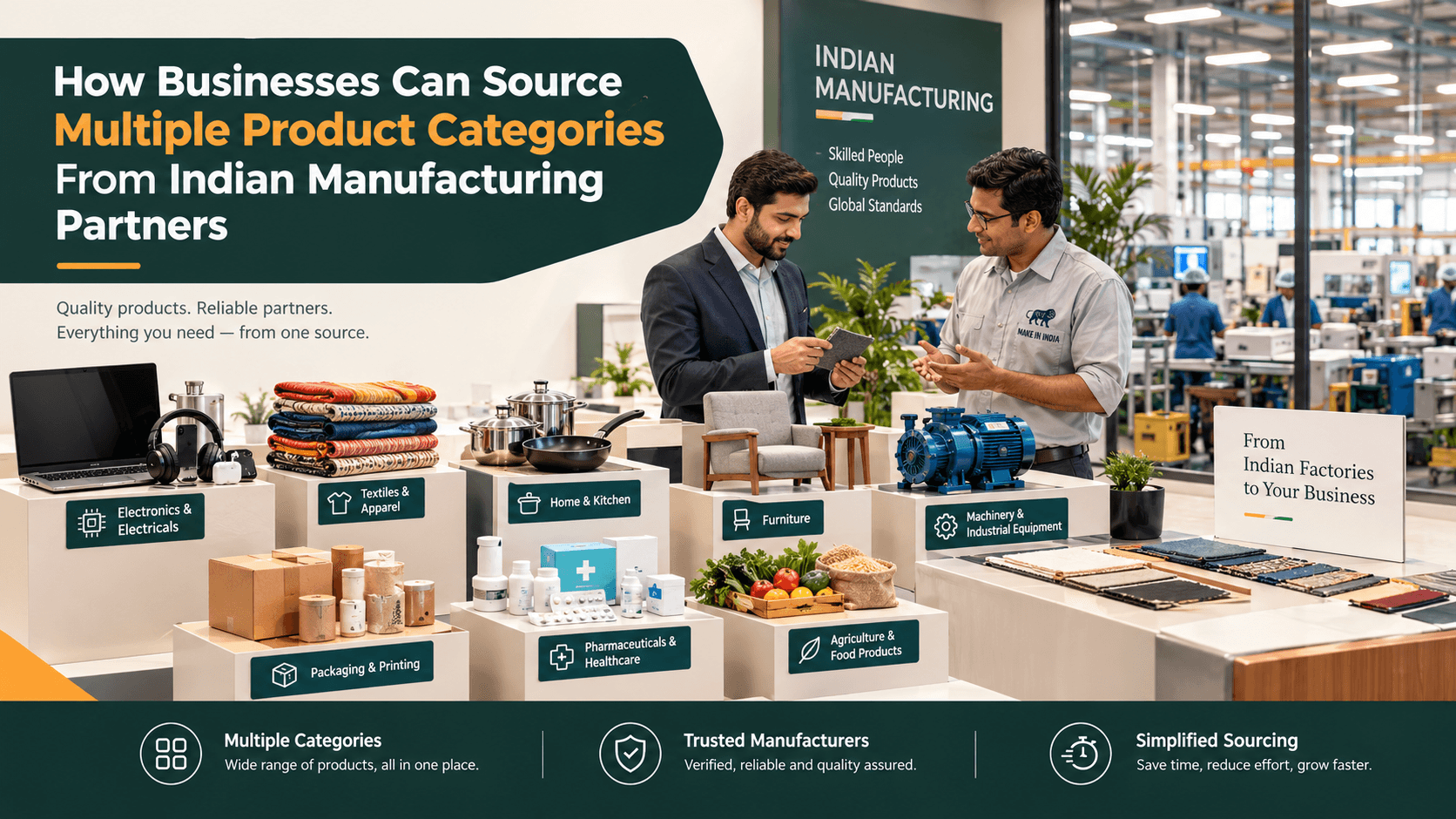
India offers a broad manufacturing ecosystem covering textiles, garments, furniture, electronics, packaging, consumer goods, industrial components, agricultural equipment, and many other product categories. This diversity provides businesses with opportunities to develop relationships with manufacturers that match their specific purchasing requirements.
However, sourcing multiple product categories does not necessarily mean purchasing everything from one supplier. Some manufacturers specialise in a narrow range of products, while others offer several related categories. Businesses need to determine which products can reasonably be sourced from the same manufacturing partner and which require specialised suppliers.
Digital B2B networking platforms such as BONC Network can support this process by helping businesses explore business profiles, product-related information, and potential commercial connections.
A well-planned multi-category sourcing strategy can help businesses organise procurement, compare supplier capabilities, manage inventory, and build stronger manufacturing relationships. This guide explains how companies can source multiple product categories from Indian manufacturing partners while maintaining quality, cost control, and operational efficiency.
Understanding Multi-Category Product Sourcing
Multi-category product sourcing refers to the process of identifying and purchasing products across different categories to meet a business's sales, distribution, manufacturing, or operational needs.
The approach varies according to the business model.
A wholesaler may source several categories of finished goods for resale to retailers. An institutional buyer may purchase furniture, stationery, cleaning supplies, and electrical products for its facilities. A manufacturer may require packaging materials, mechanical components, tools, and other production inputs.
In each case, procurement involves different product specifications, supplier capabilities, order quantities, delivery schedules, and quality requirements.
Some products may be available from manufacturers that operate across related categories. For example, a textile manufacturer may offer different types of garments and fabric products. A furniture manufacturer may produce tables, chairs, cabinets, and storage systems. A packaging manufacturer may offer cartons, printed boxes, paper bags, and other packaging solutions.
Other product categories may require completely different technical capabilities. A company sourcing furniture and electrical equipment, for instance, may need separate manufacturing partners because the products involve different production processes, testing requirements, and quality standards.
The objective is therefore not to force every purchasing requirement through one supplier. Instead, businesses should create a sourcing structure that balances supplier specialisation with procurement convenience.
Why Businesses Source Multiple Product Categories From Indian Manufacturers
Businesses may expand their product sourcing requirements for several reasons. They may want to introduce new products, serve a wider customer base, support additional business operations, or reduce the complexity of purchasing from multiple disconnected channels.
Expanding Product Portfolios
Retailers, distributors, and wholesalers frequently introduce new product categories to respond to customer demand.
For example, a business that initially sells home furnishing products may expand into decorative accessories, storage products, kitchen essentials, and household utility items.
Sourcing these categories from appropriate Indian manufacturing partners allows the business to explore different product options and evaluate potential additions to its catalogue.
However, each new category should be assessed according to customer demand, expected profitability, storage requirements, and operational complexity. Expanding the catalogue without understanding the market can create unnecessary inventory and purchasing risks.
Supporting Different Customer Requirements
Business customers rarely have identical purchasing needs. A retailer may require products in different price ranges, while a distributor may need a combination of standard products and specialised items.
Companies serving institutional customers may also purchase multiple categories to fulfil broader procurement requirements.
A diversified supplier network can help businesses respond to these needs without depending entirely on a single product line.
The important consideration is whether the business can manage the additional purchasing, storage, and distribution responsibilities associated with each category.
Developing Direct Manufacturer Relationships
Direct relationships with manufacturers can give buyers an opportunity to discuss product specifications, production schedules, minimum order quantities, packaging, and other commercial requirements.
When businesses source several categories, these relationships can also help them understand how different manufacturers operate and what purchasing arrangements suit their requirements.
Nevertheless, direct purchasing is not automatically more economical than buying through a wholesaler or distributor. Some intermediaries provide useful services, including consolidated deliveries, smaller order quantities, local inventory, and established distribution networks.
Businesses should compare the complete sourcing arrangement before deciding whether direct manufacturer purchasing is appropriate for each category.
Improving Procurement Visibility
A structured supplier network can help businesses understand where their products come from, how orders are progressing, and which suppliers are responsible for particular requirements.
This visibility becomes particularly important when a business purchases from several categories with different production cycles.
Maintaining organised supplier records, product specifications, purchase orders, and delivery schedules helps purchasing teams identify problems earlier and make more informed decisions.
Identify the Product Categories Your Business Needs
Before searching for manufacturing partners, businesses should clearly define the categories they intend to source.
A general requirement such as purchasing industrial products or consumer goods may be too broad to support effective supplier discovery. More precise categories make it easier to identify suitable manufacturers and compare their capabilities.
Prepare a Detailed Product Category List
Businesses should create a master list of their purchasing requirements.
Depending on the business, the list may include garments, textiles, furniture, packaging materials, electrical products, industrial components, tools, agricultural products, or household accessories.
Each category should be divided into specific product types where necessary.
For example, the furniture category could include office desks, storage cabinets, metal racks, chairs, and workstations. The packaging category could include corrugated cartons, printed boxes, protective packaging, and paper bags.
This level of detail helps businesses distinguish between products that share a broad category but require different manufacturing capabilities.
Separate Core and Additional Categories
Not every product category has the same commercial importance.
Core categories are directly connected to the business's primary operations or established customer demand. Additional categories may represent new opportunities that require further research.
Businesses should prioritise core categories when establishing their initial sourcing network.
New categories can be introduced gradually after evaluating customer interest, supplier availability, expected costs, and inventory implications.
This approach reduces the risk of committing too much capital to products with uncertain demand.
Define Specifications for Every Category
Different product categories require different specifications.
For garments, specifications may include fabric composition, size range, stitching, colours, and finishing. Furniture requirements may involve dimensions, materials, load capacity, surface finish, and packaging. Electrical products may require technical ratings, safety documentation, and applicable certifications.
Packaging materials may need specifications for dimensions, thickness, material strength, printing, and intended use.
Clear specifications allow manufacturers to prepare more accurate quotations and reduce the likelihood of misunderstandings during production.
Businesses should also identify mandatory requirements and distinguish them from optional preferences.
How to Find Manufacturing Partners Across Different Product Categories
Finding appropriate manufacturing partners is one of the most important stages of multi-category sourcing.
Businesses need to discover suppliers with the relevant production capabilities rather than simply collecting a large list of company names.
Use Digital B2B Platforms for Business Discovery
Digital B2B platforms provide a convenient starting point for exploring manufacturers and suppliers across different categories.
BONC Network is a B2B networking platform where businesses can explore business profiles, product-related information, and potential commercial connections. Companies planning multi-category sourcing can use digital business discovery as part of their research process.
For example, a wholesale business expanding its catalogue may research manufacturers associated with furniture, home accessories, packaging, or other relevant categories. An industrial purchasing team may explore businesses associated with tools, components, equipment, and related products.
The information available on any platform depends on its listings and features. Businesses should contact potential suppliers to confirm the products they manufacture, their production capabilities, minimum order quantities, and commercial terms.
A digital profile should be treated as an initial source of information rather than proof that a manufacturer is suitable for a particular transaction.
Search for Manufacturers by Specialisation
A broad supplier search may return companies with different production capabilities.
Businesses should refine their searches by identifying the product category, materials, technical requirements, intended application, and expected order quantity.
For example, a buyer sourcing metal racks should determine whether it needs retail display racks, industrial storage racks, or warehouse shelving. Although these products may appear similar, their load requirements, construction, and intended uses can differ considerably.
Similarly, a buyer searching for packaging manufacturers should distinguish between food packaging, industrial packaging, retail packaging, and customised gift boxes.
Precise searches improve the relevance of supplier research and help businesses avoid spending time on manufacturers that cannot meet their requirements.
Explore Industry Networks and Manufacturing Clusters
Industry associations, exhibitions, trade fairs, business referrals, and manufacturing clusters can provide additional opportunities to identify suppliers.
Some manufacturing regions specialise in particular product categories, making them useful starting points for industry-specific research.
Businesses can use these networks to understand available production capabilities, identify potential suppliers, and learn more about the market.
However, a manufacturer's location should not be the only selection criterion. Product quality, pricing, production capacity, logistics, and communication are equally important.
Build a Category-Wise Supplier Shortlist
Instead of maintaining one unstructured list of suppliers, businesses should organise potential manufacturing partners by category.
For example, the supplier database might have separate sections for textiles, furniture, packaging, electrical products, and industrial components.
Each record can include company details, product specialisation, contact information, quotations, minimum order quantities, production lead times, and evaluation status.
This structure helps procurement teams identify which suppliers are relevant to each purchasing requirement and makes future sourcing activities easier to manage.
Should Businesses Use One Manufacturer or Multiple Suppliers?
One of the main decisions in multi-category sourcing is determining how many suppliers the business should use.
Some manufacturers produce several related product categories, while others specialise in a single product type. Businesses should choose their supplier structure based on production capabilities, quality requirements, and purchasing objectives.
When a Multi-Category Manufacturer May Be Suitable
A manufacturer that produces several related categories may be useful when the products share materials, manufacturing processes, quality standards, or packaging requirements.
For example, a textile manufacturer may offer different garment types, while a furniture manufacturer may produce several kinds of tables, cabinets, and storage products.
Working with one manufacturer for related products can simplify communication and reduce the number of separate supplier relationships.
However, businesses should confirm that the manufacturer genuinely produces the required products and can maintain consistent quality across the entire order.
When Specialised Manufacturers Are Better
Some categories require different technical capabilities, production equipment, testing procedures, or regulatory compliance.
In such cases, specialised manufacturers may provide better product knowledge and more appropriate production processes.
A business purchasing furniture, electrical equipment, and industrial machinery may need separate manufacturing partners because the products involve substantially different requirements.
Using one supplier for convenience should never come at the expense of product suitability, quality, or safety.
Create a Balanced Supplier Network
A practical approach is to use manufacturers for related categories where their capabilities are appropriate and maintain specialised suppliers for products that require distinct expertise.
This arrangement can help businesses balance administrative convenience with supplier specialisation.
The right structure depends on the size of the business, the number of product categories, the value of each order, and the consequences of a supply disruption.
Businesses should periodically review the arrangement to determine whether their current supplier network remains suitable as purchasing needs change.
Evaluate Manufacturers Before Selecting Them
Supplier discovery creates a list of potential partners, but evaluation determines which companies are suitable for actual procurement.
The assessment should consider product quality, manufacturing capabilities, commercial terms, delivery reliability, and business credibility.
Verify Business Details
Businesses should confirm the supplier's legal business name, address, available registration information, and other details appropriate to the transaction.
Depending on the product category, buyers may need to review tax information, relevant licences, certifications, testing reports, or industry-specific approvals.
Important claims should be verified through appropriate sources when necessary.
An online profile, catalogue, or initial conversation does not independently establish a manufacturer's legitimacy or product quality.
For high-value orders, additional due diligence, professional advice, references, or a factory visit may be appropriate.
Request Samples and Product Documentation
Samples help buyers evaluate product quality before committing to a large order.
The sample should be checked against the specifications, intended application, and expected customer requirements.
Businesses should also request relevant product documentation, including technical specifications, material details, dimensions, operating information, or compliance documents where applicable.
For customised products, the approved sample and design should be documented so that both parties have a clear reference during production.
Assess Manufacturing Capacity
A manufacturer may offer the required product but lack the capacity to deliver the desired quantity within the buyer's schedule.
Businesses should discuss production capacity, current commitments, raw material availability, expected lead times, and the possibility of producing several categories simultaneously.
If the order involves different products, buyers should clarify whether all items will be manufactured at the same facility or whether some will be sourced from external suppliers.
This distinction matters because a company selling multiple categories may not manufacture every item itself.
Review Communication and Service
Procurement across several categories creates multiple opportunities for misunderstandings.
Businesses may need to discuss specifications, packaging, quantities, inspection procedures, and delivery dates for different products.
Manufacturers should provide clear and consistent information about these requirements.
Buyers should evaluate responsiveness, documentation quality, problem-solving, and willingness to clarify commercial terms before committing to a supplier.
Plan Your Multi-Category Procurement Budget
Sourcing multiple categories requires a clear understanding of the total purchasing budget.
A business may have a fixed amount available for procurement, but each product category can involve different prices, order quantities, transportation costs, and storage requirements.
Without a consolidated budget, individual purchases may appear affordable while the combined expenditure becomes difficult to manage.
Calculate the Total Cost for Each Category
The total procurement cost should include the manufacturer's quotation and other expenses associated with bringing the products to the required destination.
Depending on the transaction, these costs may include:
- Product price.
- Customisation and setup charges.
- Packaging and labelling.
- Transportation and handling.
- Inspection and testing.
- Applicable taxes and duties.
- Warehousing and storage.
- Insurance and other relevant expenses.
The applicable costs will differ by product and purchasing arrangement.
Businesses should compare suppliers using a consistent cost structure so that they can identify the most suitable commercial option for each category.
Establish Category-Wise Budget Limits
Businesses should determine how much capital can be allocated to each product category.
Core products with established demand may receive a larger share of the budget, while experimental categories may be tested with smaller quantities.
This approach helps businesses control financial exposure when introducing new products.
Budget limits should remain flexible enough to accommodate legitimate changes in demand or supplier pricing, but substantial changes should be reviewed before purchase orders are approved.
Consider Working Capital and Payment Terms
Different manufacturers may require different payment arrangements.
Some may request an advance payment, while others may accept milestone payments or payment after dispatch under agreed terms.
When multiple orders are placed simultaneously, these payment obligations can accumulate.
Businesses should create a consolidated payment schedule that identifies advance payments, expected balances, delivery dates, and anticipated customer receipts.
This helps procurement teams avoid committing more cash than the business can comfortably support.
Coordinate Purchase Orders Across Multiple Categories
A multi-category sourcing strategy requires clear documentation so that suppliers understand exactly what they must deliver.
Each order should specify the products, quantities, prices, specifications, delivery conditions, and payment terms.
Create Standardised Purchase Order Procedures
Businesses should use a consistent internal process for approving and issuing purchase orders.
The process may include reviewing the purchasing requirement, confirming budget availability, comparing quotations, approving samples, selecting the supplier, and documenting the final agreement.
Standardised procedures reduce errors and make it easier to track purchasing decisions.
However, purchase orders should remain specific to the relevant manufacturer and product requirements. A single template should not replace the need for accurate technical and commercial details.
Maintain Category-Wise Specifications
Each product category should have its own specification record.
For example, textile products may require fabric details and size charts, while industrial components may need drawings, tolerances, and material grades.
Packaging products may require artwork and dimensions, while electrical equipment may need technical ratings and compliance documentation.
Maintaining approved specifications helps businesses compare repeat orders with previous purchases and communicate changes clearly.
Track Order Status Across Suppliers
Businesses should maintain an order-tracking system that records confirmation dates, production status, inspection milestones, dispatch dates, and expected arrivals.
This is particularly important when multiple manufacturers are involved.
A delay in one category may affect the availability of another product or the completion of a customer order.
Regular tracking helps businesses identify potential problems and communicate with suppliers before delays become more disruptive.
Manage Logistics and Delivery Coordination
When products come from different manufacturers, transportation and receiving arrangements can become complicated.
Products may be ready on different dates, originate from different locations, or require different handling procedures.
Businesses should plan logistics alongside procurement rather than treating transportation as a final step.
Compare Separate and Consolidated Deliveries
Separate deliveries may allow products to arrive as soon as they are ready, but they can increase handling and transportation expenses.
Consolidated shipments may reduce some logistics costs when compatible goods can be collected and transported together. However, consolidation can delay products that are already ready for dispatch.
The appropriate option depends on shipment size, product characteristics, destination, delivery deadlines, and transportation costs.
Businesses should compare the total cost and timing of both approaches before deciding.
Coordinate Supplier Delivery Dates
If a business needs several categories for the same project, customer order, or retail launch, the products may need to arrive within a coordinated timeframe.
Procurement teams should communicate the required arrival dates to each manufacturer and confirm realistic production schedules.
They should also account for inspection, loading, transit, unloading, and receiving procedures.
A supplier's dispatch date should not be confused with the date when the products will be available for use or sale.
Plan Storage and Receiving Capacity
Receiving multiple categories simultaneously can place pressure on warehouse space and staff.
Businesses should determine where each product will be stored, how it will be identified, and whether special handling is required.
Fragile goods, electronics, textiles, and chemicals, where legally and safely handled, may require different storage conditions.
A receiving plan should also establish how delivered quantities and product quality will be checked before inventory records are updated.
Maintain Consistent Quality Across Product Categories
Quality management becomes more complicated when products come from different manufacturers.
A business may receive excellent-quality products in one category but encounter defects or inconsistent specifications in another.
A structured quality process helps ensure that each supplier is evaluated against the requirements of the products it provides.
Establish Category-Specific Quality Standards
Different products require different inspection criteria.
Textile products may need checks for fabric, stitching, colour consistency, and dimensions. Furniture may require inspection of materials, construction, finish, stability, and packaging.
Electrical products may require functional checks and applicable safety documentation. Packaging materials may need to meet dimensional, strength, printing, or product-protection requirements.
Businesses should define the relevant standards before production begins and communicate them clearly to manufacturers.
Inspect Samples and Bulk Deliveries
Samples should be reviewed before large orders are approved when appropriate.
For repeat orders, businesses can compare incoming goods against previously approved samples and specifications.
The extent of bulk inspection should depend on the order's value, product risk, supplier history, and consequences of defects.
For products requiring specialised testing, businesses may need qualified inspectors or accredited laboratories.
Document Defects and Corrective Actions
When products do not meet agreed specifications, buyers should record the issue and communicate it to the manufacturer.
The parties should follow the agreed procedure for resolving defects, shortages, or other discrepancies.
Businesses should maintain records of recurring issues and use them when deciding whether to continue, modify, or discontinue a supplier relationship.
Quality information should be reviewed across categories so that procurement teams can identify which suppliers consistently meet expectations.
Manage Inventory Across Different Product Categories
Multi-category sourcing can increase inventory complexity because products may differ in demand patterns, storage requirements, turnover rates, and useful life.
Some products sell regularly, while others experience seasonal demand or unpredictable purchasing patterns.
Businesses should manage each category according to its characteristics rather than applying the same inventory rules to every product.
Forecast Demand Separately for Each Category
Demand forecasts should be based on historical sales, customer orders, market research, and expected changes in purchasing behaviour.
A business selling clothing, furniture, and electrical products should not assume that all three categories will follow the same sales pattern.
Forecasting should also account for differences within a category. For example, certain sizes, colours, models, or specifications may sell faster than others.
Businesses with limited historical data can use small trial orders to understand demand before making larger commitments.
Establish Appropriate Reorder Levels
Regularly purchased products may benefit from defined reorder points based on expected consumption during supplier lead times.
However, a product with a long manufacturing cycle may require earlier ordering than a product available from ready stock.
Businesses should also consider minimum order quantities and the financial implications of holding additional inventory.
Reorder rules should be reviewed when supplier lead times, customer demand, or product specifications change.
Avoid Excessive Inventory Commitments
Bulk purchasing may provide favourable unit pricing, but the savings must be weighed against storage costs and the risk of unsold goods.
This is particularly important when businesses introduce unfamiliar categories or products with changing customer preferences.
A balanced approach may involve larger orders for established products and smaller test orders for new categories.
The goal is to maintain sufficient availability without tying up excessive working capital.
Use Digital B2B Networking to Discover Suppliers
Digital B2B networking can complement traditional supplier discovery methods by helping businesses explore companies and product categories beyond their existing contacts.
Businesses may use referrals, industry exhibitions, trade associations, online searches, and digital business platforms together to develop a broader understanding of the manufacturing market.
Explore Potential Partners Through BONC Network
BONC Network provides a digital B2B networking environment where businesses can explore business profiles, product-related information, and potential commercial connections.
For companies planning to source multiple categories, this can serve as one starting point for researching potential manufacturing partners.
For example, a distributor expanding its product range may explore manufacturers in relevant household, industrial, packaging, or furnishing categories. A purchasing team may research companies associated with specific product requirements before contacting them for quotations.
The next steps should include verifying business details, reviewing product specifications, checking production capabilities, requesting samples where appropriate, and comparing commercial terms.
The platform can support discovery, but buyers remain responsible for determining whether each supplier is suitable for their purchasing requirements.
Organise Supplier Information Digitally
A structured supplier database can make multi-category procurement easier to manage.
Businesses should record supplier specialisation, quotations, minimum quantities, payment terms, production schedules, inspection results, and delivery performance.
This information allows purchasing teams to compare manufacturers more consistently and identify suppliers that may be suitable for repeat orders.
It also reduces dependence on scattered emails, informal notes, and individual employees' memories.
Build a Wider Network of Business Connections
Businesses entering new industries or expanding into unfamiliar product categories may not have established supplier relationships.
Digital networking can help them begin exploring potential connections and identifying companies worth further investigation.
However, a wider network is valuable only when it leads to relevant, properly evaluated suppliers.
Businesses should prioritise supplier suitability, communication, quality, and commercial reliability rather than simply maximising the number of contacts in their database.
Build Long-Term Relationships With Manufacturing Partners
A multi-category sourcing strategy becomes more effective when businesses maintain reliable relationships with suitable manufacturers.
Long-term relationships can improve communication, support more consistent product specifications, and make repeat purchasing easier to organise.
Communicate Forecasts and Future Requirements
Manufacturers may benefit when buyers provide advance information about expected purchasing needs.
Forecasts can help suppliers assess raw material requirements, production capacity, and scheduling options.
Businesses should distinguish between indicative forecasts and confirmed orders so that manufacturers do not mistake potential demand for a guaranteed commitment.
Clear communication can support planning while allowing both parties to manage uncertainty.
Review Supplier Performance Regularly
Businesses should evaluate suppliers after completed orders.
The review may include product quality, delivery reliability, pricing accuracy, responsiveness, documentation, and the handling of problems.
The evaluation should be specific to each category. A supplier may perform well for one product type but be unsuitable for another.
Maintaining category-wise performance records helps procurement teams make better decisions when renewing agreements or allocating future orders.
Develop Mutual Commercial Understanding
Strong supplier relationships depend on realistic expectations and fair terms.
Buyers should communicate specifications and deadlines clearly, make payments according to agreed conditions, and provide timely feedback.
Manufacturers should communicate capacity limitations, production changes, and potential delays as early as possible.
This approach supports more productive business relationships without assuming that either party can eliminate every supply-chain risk.
Common Challenges in Multi-Category Product Sourcing
Businesses may encounter several challenges when sourcing products across different manufacturing sectors.
Managing Different Minimum Order Quantities
Manufacturers establish minimum quantities according to their production processes, material requirements, and commercial models.
The minimum quantity for one category may be manageable, while another may require a much larger commitment.
Businesses should review these conditions before finalising their purchasing budget.
Where possible, they can investigate standard product options, phased deliveries, or alternative suppliers. The availability of these arrangements depends on the manufacturer and product.
Coordinating Different Production Lead Times
Products across different categories rarely follow identical production schedules.
Custom furniture may require different preparation and manufacturing time from standard packaging materials or ready-stock consumer goods.
Businesses should plan backward from the required arrival date and coordinate each order according to its actual lead time.
A single deadline applied to every supplier may be unrealistic unless the production and delivery requirements have been assessed individually.
Maintaining Quality Across Suppliers
Different manufacturers may interpret specifications, packaging standards, or finishing requirements differently.
Businesses should establish category-specific quality criteria and communicate them before production begins.
Samples, documented specifications, inspection procedures, and performance records help reduce inconsistencies.
Controlling the Total Procurement Budget
Purchasing multiple categories can create overlapping advance payments, freight charges, and inventory commitments.
A consolidated procurement budget helps businesses understand the total financial exposure.
Orders should be reviewed together before approval so that an attractive individual quotation does not lead to excessive overall spending.
Handling Supply Disruptions
Production delays, material shortages, transportation problems, and changing market conditions can affect different categories at the same time.
Businesses should identify which products are most critical and determine whether alternative suppliers or contingency inventory are justified.
The appropriate response depends on the commercial impact of a disruption and the cost of maintaining backup arrangements.
Measure the Success of Your Multi-Category Sourcing Strategy
Procurement should be reviewed regularly to determine whether the sourcing network is supporting the business's objectives.
Useful performance indicators include total landed cost, supplier delivery performance, product quality, inventory turnover, procurement cycle time, and working capital utilisation.
Businesses can also monitor the time required to identify suppliers, compare quotations, approve purchase orders, and resolve discrepancies.
These measures help identify opportunities for improvement.
For example, frequent delivery delays may indicate that production schedules need to be revised or that the supplier network requires additional flexibility. Excess inventory may indicate inaccurate forecasts, oversized minimum orders, or insufficient coordination between sales and procurement.
The business should also evaluate whether adding a new product category has generated sufficient customer interest and commercial value to justify the additional procurement effort.
Reviewing these results helps companies refine their sourcing strategy over time.
Conclusion
Sourcing multiple product categories from Indian manufacturing partners requires more than finding suppliers for individual items. Businesses need a coordinated approach that connects product requirements, supplier discovery, procurement budgets, quality standards, inventory planning, logistics, and long-term relationship management.
India's diverse manufacturing ecosystem provides opportunities for businesses to explore a broad range of product categories, from textiles and furniture to packaging, consumer goods, and industrial components. However, not every manufacturer is suitable for every product, and businesses should distinguish between companies that produce related categories and suppliers that specialise in particular areas.
A well-designed supplier network balances convenience with manufacturing expertise. Businesses can work with multi-category manufacturers when their capabilities genuinely match the requirements and use specialised suppliers for products that need distinct technical knowledge or quality controls.
Digital B2B networking platforms such as BONC Network can support the initial discovery process by helping businesses explore business profiles and potential commercial connections. Buyers should combine this discovery with independent verification, samples, clear specifications, quotation comparisons, and documented purchasing terms.
Once orders are placed, effective coordination of production schedules, transportation, inventory, and quality inspections helps ensure that products arrive in suitable condition and at the required time.
Businesses should also evaluate supplier performance regularly and use procurement data to improve future decisions. By organising supplier information, forecasting demand, controlling costs, and building reliable manufacturing relationships, companies can create a more flexible and efficient multi-category sourcing strategy.
Ultimately, successful multi-category sourcing is not about purchasing everything from one supplier. It is about building the right network of manufacturing partners to meet business requirements with appropriate quality, cost, reliability, and operational control.