How Businesses Can Source Products From Indian Manufacturers for Seasonal Market Demand
By BONC Editorial Team • Published on 29 Oct 2026
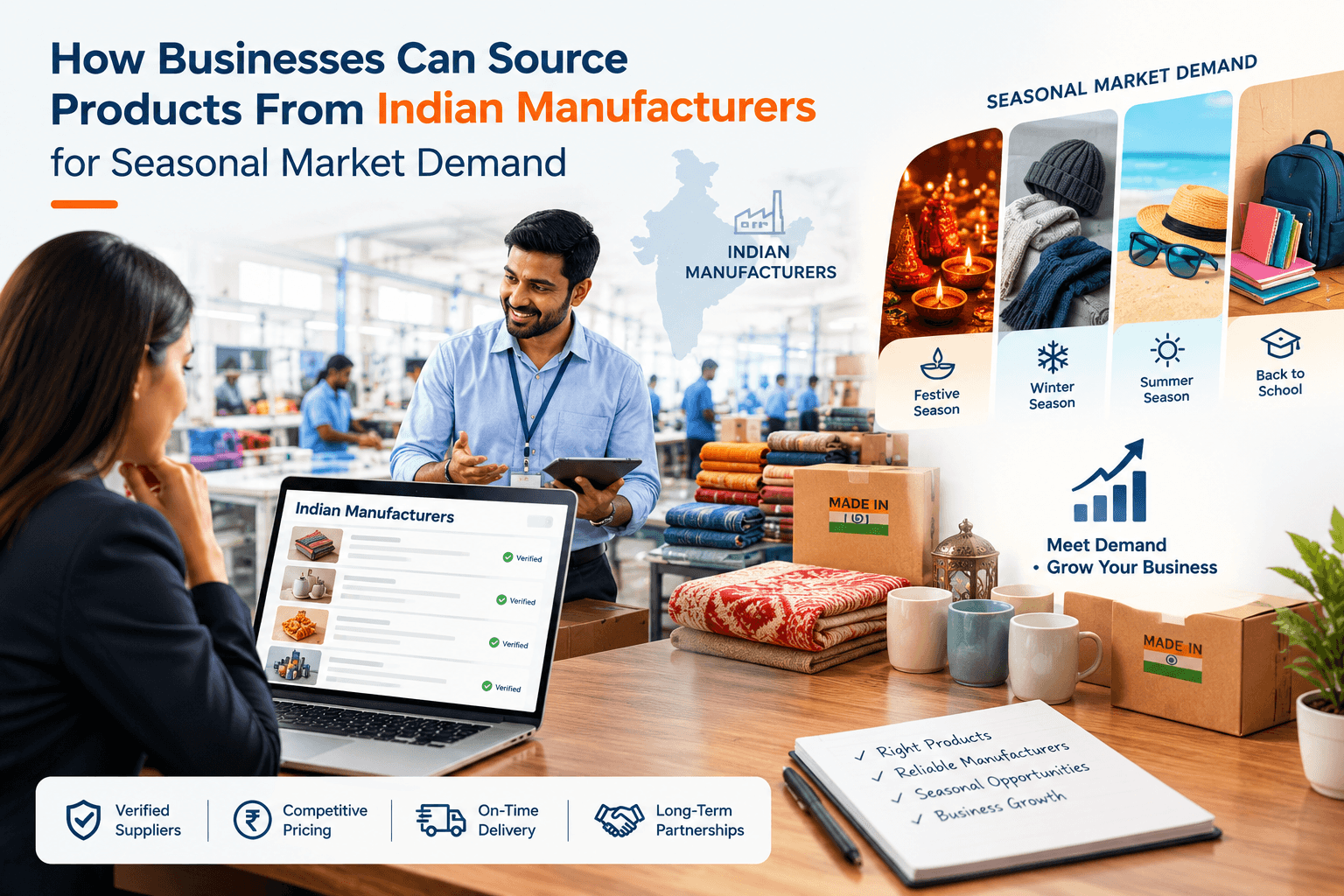
Introduction
Seasonal market demand creates important business opportunities for manufacturers, wholesalers, retailers, distributors, and other commercial buyers. Throughout the year, customer purchasing patterns change because of festivals, weather conditions, agricultural cycles, school schedules, wedding seasons, holidays, and special occasions. These changes influence which products customers need, how much they purchase, and when businesses must make those products available.
For example, demand for warm clothing and heating accessories may increase during winter, while fans, coolers, cotton garments, and other summer-related products may attract greater attention during hot weather. Similarly, festivals can increase demand for decorative items, gift products, packaging materials, clothing, lighting, and household accessories. Businesses serving schools, hotels, restaurants, and event organizers may also experience seasonal purchasing cycles.
To respond effectively, businesses need a reliable sourcing strategy. Purchasing products too late can result in missed sales opportunities, while ordering excessive quantities can leave companies with unsold inventory after the season ends. Working directly with suitable Indian manufacturers can help businesses evaluate product options, discuss bulk requirements, understand production timelines, and plan purchasing decisions more effectively.
India has a diverse manufacturing ecosystem covering textiles, garments, furniture, handicrafts, consumer goods, packaging, electrical products, agricultural equipment, and many other categories. This diversity provides businesses with opportunities to explore products that match their seasonal requirements.
Digital B2B platforms such as BONC Network can also support the product discovery process by helping businesses explore business profiles, product offerings, and potential commercial connections.
Understanding how to source products from Indian manufacturers for seasonal market demand allows businesses to prepare earlier, manage purchasing costs, and build stronger supplier relationships.
Understanding Seasonal Market Demand Before Sourcing Products
Before contacting manufacturers, businesses should understand the nature of the demand they want to serve. Seasonal demand refers to changes in purchasing activity during particular periods of the year. These changes may follow predictable patterns, although their intensity can vary depending on customer preferences, economic conditions, weather, and regional buying habits.
Businesses should distinguish between recurring seasonal demand and temporary market trends.
Recurring demand may occur around established festivals, school reopening periods, winter, summer, or the annual wedding season. Temporary demand, on the other hand, may emerge because of a popular product trend, an unexpected weather event, or a short-term change in consumer behaviour.
This distinction matters because it affects purchasing quantities, supplier commitments, and inventory decisions.
Study Previous Sales and Purchasing Records
Businesses that have operated for several seasons should begin by examining their historical sales data. Previous sales records can indicate which products performed well, when demand started increasing, and when purchasing activity began to decline.
For example, a retailer selling rainwear can examine sales from previous monsoon seasons to identify the most popular product types, sizes, price ranges, and purchasing periods.
Businesses should also examine unsold inventory, customer returns, delayed deliveries, and stock shortages. These details can reveal problems that simple sales figures may not show.
New businesses without historical records can use competitor observations, customer enquiries, regional market research, distributor feedback, and small trial orders to develop an initial estimate.
Historical performance should guide decisions rather than determine them completely. Market conditions can change from one season to another, so businesses must update their expectations regularly.
Identify the Seasonal Buying Calendar
Different industries follow different purchasing calendars. A garment wholesaler may need to place orders well before winter, while a business selling festival decorations must prepare according to the dates of relevant celebrations.
Businesses should create a calendar that includes expected demand periods, product selection deadlines, supplier discussions, production schedules, quality inspections, transportation, and stock arrival dates.
This calendar helps identify how early procurement should begin.
The purchasing schedule must account for the manufacturer's production capacity, the complexity of the product, the availability of raw materials, and transportation requirements. Products requiring custom designs or special components may need more preparation time than standard goods already available in inventory.
Why Indian Manufacturers Can Be Valuable Seasonal Sourcing Partners
India's manufacturing sector includes businesses of different sizes, capabilities, and specialisations. Some manufacturers focus on large production runs, while others serve specialised markets or provide customised products. This variety can help commercial buyers explore sourcing options suited to their requirements.
Access to Different Product Categories
Indian manufacturers operate across a broad range of industries, giving buyers opportunities to explore products for different seasonal markets.
Textile and garment manufacturers may supply summer clothing, winter apparel, uniforms, festive garments, and other seasonal collections. Home furnishing businesses may manufacture curtains, bedsheets, blankets, cushions, and decorative products. Electrical and consumer-product manufacturers may offer fans, lighting products, appliances, and other goods associated with seasonal purchasing.
Packaging manufacturers can also support businesses that need gift boxes, retail packaging, food packaging, or customised seasonal packaging.
The appropriate manufacturer depends on the product's technical requirements, expected order quantity, quality standards, and delivery schedule. Buyers should avoid assuming that a manufacturer specialising in one product category can automatically meet requirements in another.
Opportunities for Bulk Purchasing
Seasonal markets sometimes require businesses to purchase larger quantities within a limited period. Direct discussions with manufacturers can help buyers understand minimum order quantities, available production capacity, bulk pricing structures, and order scheduling.
However, a large order is not always the most economical choice.
Businesses should compare the overall cost of purchasing different quantities, including storage, transportation, financing, possible wastage, and the risk of unsold stock. In some situations, a smaller initial order followed by a planned replenishment may provide greater flexibility.
The goal is to obtain sufficient inventory for expected demand without committing excessive capital to products that may lose relevance after the season.
Greater Scope for Product Customisation
Seasonal customers often look for products that match specific designs, colours, packaging styles, sizes, or regional preferences.
Working with an appropriate manufacturer may allow buyers to discuss custom specifications, private-label packaging, product variations, and design requirements.
For example, a retailer preparing for a festival season may want decorative products in particular colour combinations. A corporate gifting business may require customised packaging and branding, while a clothing distributor may need a collection designed for a particular customer segment.
Customisation can create differentiation, but it also introduces additional requirements. Businesses should confirm design approval procedures, sample availability, tooling or setup charges, minimum quantities, and production timelines before placing an order.
How to Identify the Right Seasonal Products to Source
Choosing the right products is one of the most important parts of seasonal procurement. A product may be popular in one region but have limited demand in another. Similarly, a product that sells well at a premium price may not perform as expected in a market dominated by price-sensitive customers.
Businesses should evaluate potential products using a combination of demand research, commercial calculations, and supplier information.
Research Customer Preferences and Regional Demand
India's seasonal markets vary considerably across regions. Weather, cultural practices, local festivals, income levels, and customer preferences influence purchasing behaviour.
A business serving customers in northern India may require a different winter product range from a business operating in a region with relatively mild winters. Likewise, the products popular during a festival may differ according to local traditions and customer segments.
Businesses should study their target market before selecting products. Customer enquiries, retailer feedback, search trends, previous orders, distributor discussions, and competitor product ranges can all provide useful information.
The research should also identify the price range customers are willing to pay, the quality they expect, and the features that influence purchasing decisions.
Evaluate Competition and Product Differentiation
Entering a seasonal market with the same products offered by every competitor can create intense price competition.
Businesses should consider whether they can differentiate through quality, design, packaging, product combinations, reliable availability, or service.
For example, a wholesaler sourcing festive lighting products may explore different sizes, energy requirements, decorative styles, and packaging formats. A clothing distributor may compare fabric types, patterns, stitching quality, and available sizes.
Product differentiation should reflect genuine customer demand rather than assumptions about what might appear attractive.
Calculate the Commercial Potential
Before approaching manufacturers, businesses should estimate the likely selling price, landed cost, expected sales volume, and potential profit margin.
The landed cost may include the product price, packaging, transportation, insurance where applicable, taxes, inspection expenses, storage, and other procurement-related charges.
Businesses should also consider discounts, returns, damaged goods, and the possibility that some products will remain unsold.
A product with a low manufacturing price may still be commercially unattractive if transportation costs are high or demand is uncertain. Conversely, a product with a higher purchase price may offer better commercial potential if customers value its quality and are willing to pay an appropriate selling price.
How to Find Manufacturers in India for Seasonal Products
Once businesses understand their product requirements, they can begin searching for suitable manufacturing partners.
The objective is not simply to find a company that produces the desired item. Buyers need to identify manufacturers whose capabilities, production schedules, commercial terms, and quality standards align with the seasonal purchasing plan.
Use Digital B2B Platforms for Manufacturer Discovery
Digital B2B platforms have become useful starting points for businesses exploring manufacturers, suppliers, and product categories.
Instead of relying exclusively on personal contacts or travelling between industrial locations, buyers can use online business information to begin researching potential suppliers.
BONC Network is a B2B networking platform where businesses can explore business profiles, product-related information, and potential commercial connections. Buyers seeking seasonal products can use digital business discovery to identify companies worth researching and contacting.
For instance, a distributor preparing for the summer season might explore manufacturers associated with fans, cooling equipment, cotton garments, or related product categories. A business preparing for the festive season may research suppliers of decorative products, gift items, packaging, and household accessories.
The usefulness of any platform depends on the information available, the relevance of its listings, and the buyer's own evaluation process. Businesses should independently confirm a manufacturer's capabilities, credentials, product quality, and commercial terms before making a purchasing commitment.
Search by Product Category and Manufacturing Specialisation
A broad search for seasonal products may return many businesses with different capabilities. Buyers can improve their research by defining the product category more precisely.
For example, instead of searching only for winter products, a buyer could identify requirements such as knitted winter garments, thermal clothing, blankets, or specific textile products.
Similarly, a buyer sourcing festival packaging might distinguish between cardboard boxes, rigid gift boxes, printed paper bags, and protective packaging.
Clear specifications make it easier to compare manufacturers and reduce the time spent discussing unsuitable products.
Businesses should also distinguish between manufacturers, wholesalers, distributors, and trading companies. These business models serve different purposes, and the right choice depends on the order size, customisation requirements, pricing, and urgency.
Explore Manufacturing Clusters and Industry Networks
India has established manufacturing centres associated with particular industries. Depending on the product category, buyers may research relevant industrial areas, manufacturing clusters, trade associations, exhibitions, and industry networks.
These channels can help businesses understand the range of suppliers operating within a sector.
However, geographical proximity should not be the only selection criterion. A manufacturer located farther away may offer better product suitability, quality controls, production capacity, or delivery reliability.
Businesses should compare the full sourcing proposition rather than choosing a supplier only because it operates nearby.
Prepare a Manufacturer Shortlist
After initial research, businesses should create a shortlist of manufacturers that appear capable of meeting their requirements.
Useful comparison criteria include:
- Product range and technical capabilities.
- Manufacturing capacity and current workload.
- Minimum order quantity.
- Indicative pricing and payment terms.
- Sample availability.
- Quality-control procedures.
- Production and dispatch timelines.
- Customisation options.
- Communication and after-sales support.
A structured comparison makes procurement decisions more consistent. It also helps businesses identify missing information before negotiating an order.
How to Evaluate Manufacturers Before Placing a Seasonal Order
Seasonal sourcing often operates under time pressure. Nevertheless, rushing through supplier evaluation can create problems that are difficult to correct once production begins.
Businesses should verify important information before making substantial financial commitments.
Request Product Samples and Specifications
A product photograph or online description may not fully communicate material quality, dimensions, finishing, durability, or performance.
Where practical, buyers should request samples before approving a large order. They should also obtain written product specifications that clearly define the expected product.
Depending on the category, these specifications may include dimensions, materials, colour, weight, performance requirements, packaging, labelling, and applicable standards.
If the final order differs from the approved sample, businesses may face returns, customer complaints, or delays during the selling season.
For customised products, the approved design and sample should be documented so that both parties understand the expected outcome.
Check Business Credentials and Relevant Compliance
Supplier verification should match the nature and value of the transaction.
Businesses may review the supplier's legal business name, available registration information, tax details where applicable, business address, references, and relevant industry certifications. Depending on the product category, specific licences, testing reports, or regulatory approvals may also be necessary.
Buyers should verify information through appropriate official channels when required. They should not assume that an online business profile or platform listing independently proves the authenticity or quality of a manufacturer.
For high-value orders, additional due diligence, a factory visit, an independent inspection, or professional assistance may be worthwhile.
Assess Production Capacity and Current Commitments
A manufacturer may have the technical ability to produce a product but lack sufficient capacity to deliver the required quantity within the buyer's deadline.
This issue is especially important before major festivals and other peak purchasing periods, when multiple buyers may place orders simultaneously.
Businesses should ask about available production capacity, current order commitments, raw material availability, production lead times, and contingency arrangements.
They should also clarify whether the manufacturer will produce the entire order at once or deliver it in batches.
These discussions help establish realistic expectations and reduce the likelihood of last-minute shortages.
Review Communication and Documentation
Reliable communication is essential when product specifications, quantities, delivery dates, or packaging requirements change.
Businesses should assess whether the manufacturer responds clearly to questions and provides consistent information.
Important agreements should be documented through quotations, purchase orders, specifications, delivery schedules, and agreed payment terms.
Verbal discussions may help establish a relationship, but written documentation reduces misunderstandings and provides a reference if a dispute arises.
Planning Seasonal Inventory and Order Quantities
Inventory planning connects demand forecasting with purchasing decisions. Businesses need to determine how much stock to order, when to place the order, and whether additional replenishment will be possible.
An inaccurate forecast can create two opposite problems: stockouts that prevent businesses from fulfilling demand, or excess inventory that ties up working capital after the season ends.
Estimate Expected Sales
Businesses should begin by estimating demand during the intended selling period.
Established companies can use previous sales, seasonal growth rates, customer orders, and current market information. New businesses may need to rely on smaller test orders, distributor feedback, and conservative forecasts.
Forecasts should account for uncertainty. Instead of preparing only one estimate, businesses can model low-demand, expected-demand, and high-demand scenarios.
This approach makes it easier to consider different purchasing strategies before committing funds.
Calculate Safety Stock Carefully
Safety stock is additional inventory maintained to help manage unexpected demand or supply delays.
Seasonal businesses may benefit from a suitable buffer when replenishment lead times are long or demand fluctuates significantly. However, excessive safety stock can become expensive when products have limited usefulness after a particular date.
The appropriate buffer depends on demand uncertainty, supplier reliability, storage capacity, product shelf life, and the time remaining in the season.
Products with short selling windows require especially careful planning because leftover inventory may need to be discounted or stored until the next season.
Consider Phased Purchasing
Where manufacturers and logistics arrangements allow it, phased purchasing can reduce the risk associated with committing to the entire expected quantity at once.
A business might place an initial order for the core product range and schedule a later order after reviewing early sales.
This strategy is most useful when the manufacturer can accommodate additional production within the remaining selling window. It may be less effective for highly customised products that require long production lead times or minimum manufacturing quantities.
Businesses should agree on replenishment conditions before the season begins rather than assuming that a supplier will automatically have additional stock available.
Manage Storage and Product Handling
Seasonal products may require specific storage conditions. Textiles need protection from moisture and pests, electronic products may require careful handling, and some goods have shelf-life or temperature considerations.
Businesses should understand storage requirements before deciding how much inventory to purchase.
Warehouse capacity, packaging durability, stock rotation, insurance, and transportation access can all influence the total cost of seasonal procurement.
Good storage practices help preserve product quality until goods reach customers.
Negotiating Pricing and Commercial Terms With Indian Manufacturers
Pricing negotiations should consider the complete purchasing arrangement rather than focusing only on the unit price.
Manufacturers may offer different prices depending on quantity, materials, product specifications, packaging, production complexity, and delivery requirements.
Compare Total Procurement Costs
Businesses should request quotations that clearly describe what is included in the price.
The comparison should consider product cost, packaging, transport, taxes, inspection, handling, and other applicable charges. Buyers should also confirm whether prices remain valid for a specified period and whether changes in material costs can affect the final quotation.
A lower quotation may not represent better value if it involves weaker quality controls, unsuitable packaging, or unreliable delivery arrangements.
The aim is to identify a commercially sustainable sourcing option that meets customer expectations.
Discuss Minimum Order Quantities
Manufacturers often establish minimum order quantities based on production economics, material purchases, machine setup, and packaging requirements.
Seasonal buyers should discuss these limits early because a minimum order that is too large can create excess inventory risk.
Possible alternatives may include selecting standard products, simplifying customisation, combining compatible variants, or negotiating phased deliveries. Whether these options are available depends on the manufacturer and the nature of the product.
Buyers should not assume that a supplier will accept small quantities without additional costs.
Agree on Payment and Delivery Terms
Payment terms influence working capital and the financial risk of a seasonal order.
Businesses should clarify advance payments, milestone payments, payment deadlines, dispatch conditions, and any balance payable after inspection or delivery, as agreed between the parties.
Delivery terms should identify the expected dispatch date, destination, transportation responsibilities, packaging requirements, and procedures for handling delays or damaged goods.
For significant orders, the parties should also agree on how changes, cancellations, shortages, and quality disputes will be managed.
Clear commercial terms protect both sides and support a more predictable purchasing process.
Managing Seasonal Supply Chain Risks
Even a carefully planned sourcing strategy can face unexpected problems. Material shortages, transportation disruptions, changing customer preferences, production delays, and sudden demand fluctuations can affect the availability of seasonal goods.
Businesses should identify the risks most relevant to their products and develop practical contingency plans.
Avoid Depending Entirely on One Supplier
A single supplier may be appropriate for specialised products, but exclusive dependence can create challenges if production is interrupted.
Where feasible, businesses can identify alternative manufacturers or maintain relationships with suppliers capable of producing comparable items.
This does not mean splitting every order between multiple companies. Maintaining several suppliers may increase administrative work, inspection costs, and coordination requirements.
Instead, buyers should determine whether a backup supplier is commercially justified by the value of the order and the consequences of a supply interruption.
Build Realistic Delivery Schedules
Businesses should work backward from the date when products need to be available for sale.
The schedule should include production, quality inspection, packing, transportation, receiving, and any required preparation before distribution.
A product arriving on the first day of the intended selling period may already be late if retailers need time to distribute it across multiple locations.
Buyers should therefore establish an arrival deadline rather than focusing exclusively on the manufacturer's dispatch date.
Prepare for Changes in Demand
Seasonal forecasts are estimates, not guarantees.
Businesses should monitor sales, customer enquiries, competitor activity, inventory levels, and supplier updates throughout the season.
If demand is stronger than expected, buyers can investigate replenishment or substitute products. If demand weakens, they may reduce future orders, adjust marketing, or redirect inventory toward appropriate customer segments.
The earlier a change is identified, the more options the business is likely to have.
Using Digital B2B Networking to Improve Seasonal Sourcing
Digital tools can help businesses organise product research and expand their access to potential suppliers.
Traditional sourcing often depends heavily on existing relationships, physical visits, exhibitions, and recommendations. These channels remain useful, but they may not provide enough information for businesses exploring unfamiliar product categories or new manufacturing regions.
Digital B2B networking can complement these methods by making it easier to begin researching businesses and identifying potential commercial connections.
Improve Manufacturer Discovery
Businesses can explore online business profiles and product information to identify manufacturers that may match their seasonal requirements.
BONC Network provides a digital B2B networking environment where businesses can explore business-related information and potential connections. For buyers researching seasonal product categories, this can serve as one starting point in a wider sourcing process.
For example, a wholesale business preparing for winter can investigate manufacturers associated with relevant clothing, textile, or home furnishing categories. A retailer preparing for a festival may research suppliers offering decorative products, packaging, or gift-related items.
After identifying potential suppliers, buyers should contact them directly to confirm product availability, specifications, pricing, minimum quantities, and production schedules.
Make Business Information Easier to Compare
A well-prepared sourcing process requires clear product information.
Buyers can improve their research by maintaining records of supplier profiles, product specifications, quotations, samples, delivery commitments, and verification results.
This information can be organised into a comparison sheet so that purchasing decisions are based on consistent criteria.
Digital platforms can help initiate discovery, while internal procurement records support evaluation and decision-making.
Develop Relationships Beyond Individual Transactions
Seasonal sourcing can become more efficient when businesses maintain relationships with suitable manufacturers across multiple purchasing cycles.
After a successful order, buyers should document product quality, delivery performance, communication, and any issues that arose.
This information helps determine whether the supplier is suitable for future seasons.
Manufacturers also benefit when buyers communicate forecasts, product changes, and expected purchasing periods early enough to support production planning.
Digital networking can help businesses explore potential relationships, but reliable long-term partnerships still depend on consistent performance, fair commercial terms, and effective communication.
Industry Examples of Seasonal Product Sourcing
Different industries require different approaches to seasonal procurement. Understanding these differences can help businesses build sourcing strategies that match their products and customers.
Apparel and Textile Businesses
Clothing businesses often prepare seasonal collections months before products reach customers.
They may need to coordinate fabric selection, design approvals, sampling, size ranges, production, packaging, and distribution.
A winter clothing wholesaler, for example, should estimate demand by product type, size, colour, and price range. Ordering excessive quantities of unpopular sizes can create inventory problems even when total demand appears strong.
Buyers should evaluate stitching, fabric composition, colour consistency, sizing, and finishing before approving bulk production.
Festival and Gift Product Businesses
Festival-related businesses may experience a concentrated period of demand, leaving little time to recover from delayed deliveries.
Buyers should identify popular product categories, packaging needs, regional preferences, and delivery deadlines well in advance.
They should also consider whether products can be sold after the festival or have limited value outside the event period.
Where designs are customised, approval deadlines should be agreed upon early to avoid production bottlenecks.
Home and Consumer Product Retailers
Home-related seasonal products can include fans, cooling accessories, blankets, heaters, bedding, and decorative items.
Retailers should consider the relationship between regional weather patterns and purchasing schedules.
They should also examine product safety, applicable compliance requirements, warranty arrangements, packaging, and after-sales support.
For electrical products or other regulated categories, relevant certifications and technical requirements should be checked before procurement.
Packaging and Commercial Supply Businesses
Packaging suppliers may serve food businesses, retailers, gift companies, event organisers, and manufacturers whose requirements change throughout the year.
Seasonal demand can involve customised dimensions, printing, branding, and delivery schedules.
Buyers should provide accurate artwork, material specifications, order quantities, and quality expectations. Errors in printed packaging can be expensive because large quantities may become unusable if information or designs are incorrect.
Measuring the Success of Seasonal Sourcing
A sourcing strategy should be evaluated after the season ends. Reviewing results helps businesses identify which decisions worked and where improvements are needed.
Important measures include:
Supplier delivery performance: Compare promised delivery dates with actual arrivals and record the reasons for delays.
Product quality: Track defects, returns, damaged goods, and customer complaints to identify recurring problems.
Inventory turnover: Examine how quickly seasonal inventory sold and how much stock remained after demand declined.
Procurement cost: Compare the original sourcing budget with the actual landed cost, including unexpected expenses.
Profitability: Evaluate sales revenue and gross margins alongside storage, financing, markdowns, returns, and other relevant costs.
Forecast accuracy: Compare projected demand with actual sales to improve estimates for the next season.
Supplier responsiveness: Assess how effectively manufacturers handled questions, specification changes, quality issues, and replenishment requests.
These measures help businesses make evidence-based improvements instead of repeating the same purchasing assumptions every year.
Common Mistakes to Avoid When Sourcing Seasonal Products
One common mistake is beginning supplier research too late. Businesses that wait until demand is already increasing may face limited production capacity, higher transportation expenses, or missed selling opportunities.
Another mistake is choosing manufacturers solely on the basis of the lowest quoted price. Poor quality or unreliable delivery can create costs that outweigh the initial savings.
Overestimating demand is equally risky. Excess inventory can occupy warehouse space, reduce available working capital, and require substantial discounts after the season.
Businesses should also avoid placing large customised orders without approving samples and specifications. Changes made after production begins can lead to delays and additional costs.
Finally, buyers should not treat digital listings or initial supplier conversations as a substitute for verification. They should check relevant business details, agree on written terms, and confirm that the manufacturer can realistically meet the required deadline.
A disciplined approach to sourcing reduces avoidable risks and makes seasonal purchasing more manageable.
Building a Long-Term Seasonal Sourcing Strategy
Businesses that experience recurring seasonal demand should treat procurement as a continuing process rather than an isolated annual activity.
After each season, they can update sales forecasts, revise supplier evaluations, identify successful products, and record inventory problems.
Several months before the next season, the purchasing team can review these records and begin supplier discussions.
Businesses should also maintain updated product specifications, approved samples, packaging designs, and supplier contact information. Keeping these details organised can reduce preparation time when the next buying cycle begins.
Relationships with manufacturers may become more productive when businesses share realistic forecasts and communicate their requirements early. Manufacturers can then assess material availability, production capacity, and scheduling options.
Digital B2B platforms such as BONC Network can complement this process by helping businesses explore potential commercial connections and research relevant business profiles. Combining digital discovery with direct communication, due diligence, product testing, and sound procurement planning creates a more complete sourcing strategy.
The best approach will differ by industry, but the underlying principles remain consistent: understand customer demand, select suitable manufacturers, verify quality, calculate the full cost, and establish realistic delivery schedules.
Conclusion
Sourcing products from Indian manufacturers for seasonal market demand requires preparation, market understanding, careful supplier selection, and effective inventory management. Businesses must identify which products customers are likely to need, determine when those products should be available, and calculate how much inventory they can purchase without creating unnecessary financial risk.
India's diverse manufacturing ecosystem offers opportunities to explore products across textiles, garments, home furnishings, consumer goods, packaging, and many other categories. However, choosing the right supplier requires more than finding a company that manufactures the desired item. Buyers must evaluate product quality, production capacity, pricing, minimum order quantities, compliance requirements, and delivery reliability.
Digital B2B networking can support the initial discovery process. Platforms such as BONC Network provide another way for businesses to explore business information and potential commercial connections while researching suitable suppliers.
Businesses should combine these digital resources with independent verification, samples, written agreements, demand forecasts, and realistic procurement schedules. They should also review each season's results to improve future purchasing decisions.
Ultimately, successful seasonal sourcing is about balancing availability, quality, cost, and timing. Businesses that plan ahead and build dependable supplier relationships are better positioned to respond to changing customer needs, manage inventory responsibly, and pursue sustainable growth across seasonal markets.