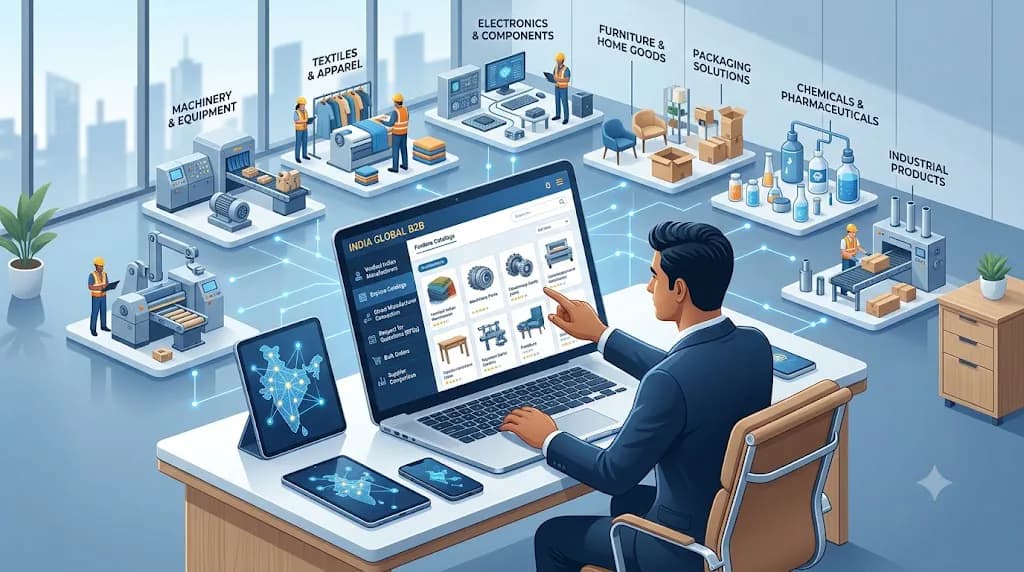
How Digital Business Visibility Can Help Manufacturers Enter New Industry Markets
By BONC Editorial Team • Published on 26 Oct 2026

Introduction
Manufacturing businesses often begin their commercial journey by serving a specific group of customers, supplying a particular industry or operating within a limited geographical market. Over time, however, manufacturers may want to expand their reach, attract different types of buyers and explore new industries where their products or production capabilities could be useful.
For example, a metal fabrication company that primarily supplies local furniture businesses may discover opportunities in warehousing, commercial interiors or industrial storage. A packaging manufacturer serving food businesses may identify potential customers in cosmetics, electronics or e-commerce. Similarly, a manufacturer of electrical components may find that its products are relevant to multiple industrial applications.
The challenge is not always the ability to manufacture a suitable product. In many cases, the challenge is making the business visible to the right potential customers.
Manufacturers may possess valuable production capabilities but remain largely unknown outside their established customer networks. Traditional sales relationships, referrals, exhibitions and direct outreach can help businesses find customers, but these methods may not provide sufficient exposure to every potential market.
This is where digital business visibility becomes important.
Digital business visibility refers to how easily prospective customers can discover, understand and evaluate a business through online channels. It may involve a company's website, digital product catalogue, search visibility, business profiles, B2B marketplace listings and professional networking activities.
For manufacturers, a stronger digital presence can make product information accessible to buyers who might never encounter the business through traditional channels. It can also help manufacturers communicate their capabilities, research new customer segments and identify opportunities beyond their existing markets.
Platforms such as BONC Network provide a digital environment where businesses can present their offerings and explore potential B2B connections. When combined with accurate product information, clear positioning and a focused market-entry strategy, digital business visibility can become a useful part of manufacturing expansion.
This article explains how manufacturers can improve their online presence, identify new industry markets and build a stronger foundation for sustainable B2B growth.
Understanding Digital Business Visibility in Manufacturing
Digital business visibility is more than simply having a website or publishing occasional content online. It involves making a company's products, capabilities and business information discoverable to relevant audiences.
A manufacturer may have excellent production facilities, skilled employees and competitive products. However, if potential buyers cannot find the company or understand what it offers, those capabilities may not translate into new commercial opportunities.
A strong digital presence helps communicate the information buyers need when evaluating potential suppliers.
This may include the manufacturer's product categories, technical capabilities, production processes, industry applications, location, contact information and relevant certifications.
The precise information required depends on the business. A manufacturer producing industrial machinery may need detailed technical documentation, while a packaging manufacturer may need to explain material options, printing capabilities, dimensions and customisation services.
Digital visibility also involves consistency. Information published on a company website, business profile, product catalogue and B2B platform should accurately describe the same business and its offerings.
When these channels work together, potential buyers have more opportunities to discover the manufacturer and understand whether its products may suit their requirements.
However, visibility alone does not guarantee sales. It creates opportunities for discovery, while product quality, pricing, operational capacity, communication and commercial suitability determine whether those opportunities develop into lasting business relationships.
Why Manufacturers Need to Explore New Industry Markets
Reducing Dependence on Existing Customers
Manufacturers sometimes rely heavily on a small group of established customers or one dominant industry.
This arrangement may work well while demand remains stable. However, changes in customer purchasing patterns, market competition or industry conditions can affect sales.
Exploring additional industries can help manufacturers investigate opportunities to diversify their customer base.
For example, a manufacturer producing precision metal components for one industrial segment may possess capabilities that could also serve equipment manufacturers, automotive suppliers or machinery businesses.
Before entering another market, the company must confirm that its products meet the new industry's specifications, compliance requirements and commercial expectations.
Digital visibility can help the manufacturer investigate these possibilities and introduce its capabilities to a wider audience.
Discovering New Applications for Existing Products
A product developed for one customer group may have applications in other industries.
Manufacturers do not always need to create an entirely new product to explore a new market. In some cases, they may be able to adapt an existing product, change its configuration or communicate its benefits to a different customer segment.
For example, a manufacturer of storage racks may serve retailers but also investigate opportunities among warehouses, factories, distribution centres and commercial facilities.
Similarly, an industrial packaging supplier may find opportunities among electronics manufacturers that require protective packaging for transportation and storage.
Digital research can help businesses identify potential applications and understand the requirements of different customer groups.
Manufacturers should validate these opportunities through technical evaluation and discussions with prospective buyers before making significant investments.
Identifying Opportunities Beyond Familiar Markets
Traditional business networks are valuable, but they may limit a manufacturer's exposure to unfamiliar industries or geographical regions.
A company that depends entirely on existing relationships may overlook businesses that need its products but do not know the manufacturer exists.
Online business discovery gives manufacturers another way to explore potential customers beyond their usual networks.
Searchable product categories, digital catalogues, company websites and B2B networking platforms can help businesses investigate new markets without relying exclusively on physical introductions.
This approach does not eliminate the need for direct sales or relationship-building. Instead, it expands the range of opportunities manufacturers can investigate.
How Digital Visibility Helps Manufacturers Reach New Buyers
Making Product Information Accessible
Potential buyers often research suppliers before contacting them.
They may want to understand the product range, technical specifications, available configurations, manufacturing capabilities and commercial requirements.
A manufacturer with limited online information may find it difficult to communicate these details to buyers outside its established network.
A detailed digital presence makes important information easier to access.
For example, a manufacturer producing industrial valves could present relevant product categories, material options, pressure ratings, connection types and technical documents where applicable.
This information helps prospective buyers determine whether the manufacturer may be suitable for their requirements.
Manufacturers should ensure that technical information is accurate, current and supported by appropriate documentation. Incorrect specifications can create serious compatibility or operational problems.
Increasing Discoverability Through Search
Search engines allow buyers to investigate products, manufacturers and industry-specific solutions.
Manufacturers can improve their discoverability by creating useful pages that clearly describe their products, capabilities and applications.
For example, a company producing industrial shelving may create product pages that explain the available configurations, materials, applications and customisation options.
Relevant keywords can help search engines understand the subject of each page, but content should primarily be written for buyers.
Manufacturers should avoid filling product pages with repetitive phrases or unsupported claims. Clear descriptions, useful specifications and well-organised information are more valuable than keyword repetition.
Search visibility generally develops over time and depends on multiple factors, including content quality, competition, technical website performance and external references.
It should therefore be treated as a long-term business-development activity rather than an immediate guarantee of new customers.
Reaching Buyers Through Digital Business Profiles
A professional business profile can introduce a manufacturer to potential customers who may not know the company's name.
Profiles may include the company description, location, product categories, contact information and other details supported by the platform.
When these details are accurate, buyers can quickly determine whether the manufacturer operates in a relevant category.
Manufacturers should avoid overly broad descriptions that make it difficult to understand their actual capabilities.
For example, a company specialising in stainless steel commercial kitchen equipment should clearly identify its products instead of describing itself only as a general industrial supplier.
A focused profile makes it easier for buyers to recognise the business's relevance to their requirements.
Supporting Discovery Through B2B Networking Platforms
B2B networking platforms provide another route for businesses to present their products and explore potential commercial relationships.
For manufacturers, these platforms can complement company websites, direct sales and traditional networking activities.
A manufacturer entering a new industry can use its digital presence to communicate the products it offers and provide prospective buyers with an initial understanding of its capabilities.
Buyers, in turn, can explore business profiles and identify companies that may be relevant to their sourcing needs.
BONC Network is one example of a B2B networking platform that provides businesses with a digital environment to present their offerings and explore potential connections.
Manufacturers can consider BONC Network as part of a broader strategy for business visibility, product discovery and B2B networking.
The effectiveness of a platform depends on its features, audience relevance, the accuracy of published information and the manufacturer's follow-up process. A listing does not guarantee inquiries or commercial results.
Identifying the Right Industry Markets Before Expanding
Improving visibility is most effective when manufacturers understand which markets they want to reach.
Publishing the same general message to every possible audience can make it difficult for buyers to recognise the product's relevance.
Manufacturers should first identify industries where their existing capabilities may offer a realistic advantage.
Evaluate Existing Manufacturing Capabilities
The first step is to understand what the business can produce reliably.
Manufacturers should review their equipment, production processes, workforce skills, materials, available capacity and quality-control systems.
They should also identify which products can be adapted for other applications and which would require significant redesign.
For example, a manufacturer with precision machining capabilities may investigate several industries that use machined components. However, each potential application may require different tolerances, materials, testing procedures or compliance standards.
A realistic capability assessment prevents the company from pursuing markets it cannot serve effectively.
Research Industry-Specific Buyer Requirements
Different industries evaluate suppliers according to different priorities.
An automotive-related customer may require particular technical standards, quality documentation and process consistency. A commercial furniture buyer may focus on design, durability, dimensions and delivery capacity.
A packaging buyer may prioritise material performance, print quality, product compatibility and order quantities.
Manufacturers should research these differences before developing their market-entry strategy.
Useful sources of information may include industry publications, trade associations, exhibitions, company websites, product specifications and direct discussions with prospective buyers.
Digital research can help establish an initial understanding, but specialised technical or regulatory requirements should be verified through authoritative sources and qualified professionals where necessary.
Analyse Competitors and Existing Suppliers
Understanding the competitive environment helps manufacturers evaluate whether a market offers a realistic opportunity.
They should investigate the types of products already available, the capabilities competitors emphasise and the problems buyers may be trying to solve.
The objective is not simply to offer a lower price than existing suppliers.
A manufacturer may be able to differentiate itself through customisation, specialised production capabilities, product consistency, flexible order quantities or responsive communication.
However, these advantages should be genuine and commercially sustainable.
Digital research can help manufacturers identify how competing businesses present their products and what information buyers may expect to see.
Assess Market Entry Costs
Entering a new industry may require more than marketing.
Manufacturers may need new tooling, product testing, certification, employee training, additional inventory, packaging changes or specialised sales support.
They should estimate these costs before committing significant resources.
A market may appear attractive in terms of potential demand but still be unsuitable if the cost of meeting its requirements exceeds the expected commercial benefit.
Manufacturers should compare the likely investment, time required and operational risks across potential markets.
Digital visibility can support this evaluation by helping businesses investigate market participants and initiate preliminary discussions before making major commitments.
Developing Industry-Specific Product Positioning
Explain How Products Solve Relevant Problems
Product positioning describes how a manufacturer communicates the value and relevance of its offering to a particular audience.
When entering a new industry, manufacturers should explain why their products may be useful to that industry's buyers.
A general description such as "high-quality metal products" provides limited information.
A more specific description might explain that the company manufactures customised metal storage systems for commercial warehouses, subject to its actual capabilities.
The second description helps buyers understand the product's potential application.
Manufacturers should ensure that claims about performance, savings, durability or suitability are accurate and supported by evidence.
Adapt Product Information to the Target Audience
Different buyers may need different information about the same product.
An engineer may focus on technical specifications, compatibility and performance limits. A procurement manager may need pricing, delivery schedules and documentation. A distributor may want to understand product variants, packaging and the commercial terms available for bulk orders.
Manufacturers should make core product information available while tailoring supporting content to the needs of each audience.
This does not mean creating conflicting descriptions. The underlying product specifications must remain consistent.
Instead, the company should emphasise the details that matter most to each type of buyer.
Create Relevant Industry Landing Pages
Manufacturers with a website can consider creating dedicated pages for the industries they serve or want to enter.
A landing page should explain the relevant product categories, applications, technical capabilities and purchasing considerations.
For example, a packaging manufacturer could create separate pages explaining its offerings for food businesses, e-commerce operations and electronics manufacturers, provided it can genuinely serve those markets.
Each page should contain useful, accurate information rather than simply repeating the same text with different industry names.
Industry-specific pages help prospective customers understand how the manufacturer's products relate to their needs.
Use Case Studies and Practical Examples
When manufacturers have permission to share customer examples, case studies can demonstrate how their products have been used in real situations.
A useful case study explains the customer's requirement, the product or process involved and the outcome that can be substantiated.
Manufacturers should protect confidential information and obtain permission before identifying customers or publishing commercially sensitive details.
If the company has not yet served the target industry, it should not invent case studies or imply that it has experience it does not possess.
Instead, it can provide technical examples, prototypes or clearly labelled demonstrations to explain its capabilities.
Building Trust With Buyers in New Industries
Entering a new industry often means approaching buyers who have no previous experience with the manufacturer.
These buyers may be unfamiliar with the company's production standards, service quality and ability to fulfil orders.
Digital visibility can introduce the business, but trust must be supported by evidence and reliable communication.
Present Accurate Company Information
Manufacturers should provide consistent business details across their website, digital catalogues and business profiles.
Information may include the company's location, product range, contact details, manufacturing capabilities and relevant business documentation.
Where certifications or quality standards are important, the company should provide accurate details about their scope and validity.
Manufacturers should not imply that a certification applies to every product or facility if that is not the case.
Accurate information gives buyers a more reliable starting point for evaluating the business.
Provide Samples and Technical Documentation
Depending on the product, potential buyers may request samples, drawings, specifications or testing information before making a purchasing decision.
Manufacturers should establish a process for providing relevant documentation and confirming whether a sample represents the final production configuration.
For technical products, documentation should identify the correct model and include current specifications.
Sample evaluation can help both parties determine whether the product meets the required standards before a larger order is placed.
Communicate Clearly and Professionally
A new buyer may have questions about production capacity, lead times, minimum order quantities, payment conditions and delivery arrangements.
Manufacturers should respond clearly and avoid making commitments they cannot fulfil.
If a requirement falls outside the company's current capabilities, it is better to explain the limitation than to accept an unsuitable order.
Professional communication helps establish realistic expectations and makes it easier to determine whether the business relationship is viable.
Demonstrate Reliability Through Small Projects
When appropriate, a manufacturer can begin with a sample order, pilot project or limited initial quantity.
This allows both parties to evaluate product quality, communication, delivery performance and commercial processes before committing to a larger arrangement.
The suitability of a trial order depends on the product, industry and purchasing requirements. Some sectors require formal qualification or testing before any commercial use.
Manufacturers should follow the buyer's applicable procedures and avoid assuming that a small trial automatically satisfies all qualification requirements.
Using Digital Content to Support Market Expansion
Publish Useful Industry Information
Manufacturers can create informative content that answers questions relevant to their target industries.
This may include product selection guides, explanations of technical specifications, maintenance considerations, material comparisons or information about manufacturing processes.
For example, a manufacturer of industrial packaging could explain how different packaging materials are selected according to product weight, fragility and transportation conditions.
Such content can help buyers understand the company's knowledge and identify whether its products may be relevant.
Content should remain informative and accurate. Manufacturers should avoid presenting general information as specialised engineering advice when a particular application requires professional evaluation.
Develop Product-Focused Articles
Product-focused articles can explain applications, limitations, selection criteria and factors buyers should consider when evaluating a product.
A company producing industrial pumps, for instance, could publish an article explaining the importance of flow requirements, fluid compatibility and operating conditions when selecting a pump.
This type of content can attract readers who are researching a problem rather than searching for a specific manufacturer.
The article should provide genuine value and link naturally to the relevant product information where appropriate.
Maintain a Consistent Publishing Strategy
A single article or product announcement is unlikely to establish strong visibility across every target industry.
Manufacturers should develop a realistic publishing schedule that matches their resources and business objectives.
They can prioritise the industries and products most relevant to their expansion plans, then gradually build a useful collection of product pages, technical resources and business updates.
Content should be reviewed periodically to ensure that it remains accurate as products, capabilities and industry requirements change.
Consistency is important, but publishing useful information is more valuable than producing large volumes of repetitive material.
The Role of Digital B2B Platforms in Industry Expansion
Expanding Product Discovery
Manufacturers may have difficulty reaching buyers outside their existing sales networks.
B2B platforms provide an additional environment in which businesses can present product information and become discoverable through relevant categories or business profiles.
For a manufacturer entering a new industry, this can create another opportunity to introduce its offerings to potential commercial partners.
However, manufacturers should choose digital channels according to their target audience and available features rather than assuming that every platform will produce suitable inquiries.
Making Business Capabilities Easier to Understand
A business profile can communicate the manufacturer's product categories, location and capabilities in a structured format.
Detailed listings can provide further information about individual products.
Together, these elements help prospective buyers assess whether the manufacturer deserves further consideration.
Manufacturers should regularly review their profiles to ensure that product information is accurate, contact details are current and categories reflect the business's actual activities.
Supporting Business Networking
Entering a new industry often requires relationships with distributors, procurement teams, manufacturers, service providers and other commercial participants.
Digital networking can provide additional ways to discover and approach relevant businesses.
BONC Network offers a digital environment for B2B business networking and presenting business offerings. Manufacturers can explore its available features as part of a broader strategy to increase visibility, present products and investigate potential business connections.
For companies seeking to enter new industries, the value of such a platform depends on whether its available business-discovery and promotional features align with their target markets.
Manufacturers should continue using other appropriate channels, including direct outreach, industry events, referrals and their own websites.
Digital platforms can complement these activities, but they do not replace product qualification, buyer verification or relationship management.
Businesses can learn more about BONC Network through its official website and assess how its offerings fit their market-expansion plans.
Reaching New Buyers Through Targeted Digital Marketing
Identify the Right Buyer Groups
Manufacturers should identify the specific organisations and decision-makers they want to reach.
Depending on the product, relevant audiences may include procurement managers, distributors, engineering teams, wholesalers, plant managers or business owners.
Understanding the buyer group helps determine which information should be prioritised and which communication channels may be useful.
A manufacturer supplying technical components may benefit from engineering-focused content and direct communication with relevant procurement teams. A manufacturer selling wholesale consumer products may need to focus on distributors and retail businesses.
Targeting should be based on genuine product relevance rather than simply seeking the largest possible audience.
Use Search Engine Optimisation Strategically
Search engine optimisation can help manufacturers make relevant product and industry information easier to discover through search engines.
A practical SEO strategy begins with understanding the language buyers use when researching products and suppliers.
Manufacturers can use relevant product terms, technical phrases and industry-specific language in page titles, headings, descriptions and body content.
They should also ensure that their websites are technically accessible, mobile-friendly and organised in a way that helps users navigate between product categories.
SEO results can take time and depend on competition, content quality and other factors. It should be treated as one part of a broader market-entry strategy rather than the only source of prospective customers.
Use Professional Outreach Alongside Online Visibility
Digital visibility can help buyers discover a manufacturer, but direct outreach may still be necessary to establish relationships in a new industry.
Manufacturers can identify relevant businesses, research their product requirements and contact appropriate decision-makers with a focused introduction.
The message should explain why the manufacturer's capabilities may be relevant to that particular business.
Generic mass messages are less useful than communication based on a genuine understanding of the recipient's requirements.
Outreach should also respect applicable marketing, privacy and communication rules.
Measure the Quality of Business Inquiries
Manufacturers should evaluate whether digital activities are generating inquiries from relevant industries.
Useful indicators may include qualified inquiries, quotation requests, sample requests, meetings and opportunities that progress through the sales process.
Website visits and profile views can help measure exposure, but they do not necessarily indicate commercial interest.
If a campaign generates attention from businesses outside the intended market, the manufacturer may need to refine its content, product positioning or audience selection.
The objective is to build meaningful business opportunities rather than maximise activity without considering relevance.
Challenges Manufacturers May Face When Entering New Markets
Limited Awareness of Industry Requirements
A manufacturer may underestimate the technical, regulatory or operational requirements of a new industry.
Before pursuing major contracts, the company should investigate applicable standards, documentation, quality expectations and qualification procedures.
Some industries require extensive testing or formal supplier approval, which can increase the time and cost of market entry.
Manufacturers should evaluate these requirements early and seek qualified advice where necessary.
Strong Competition From Established Suppliers
New markets may already be served by suppliers with established customer relationships, specialised capabilities or recognised reputations.
A new entrant needs to identify a realistic reason for buyers to consider its products.
Possible areas of differentiation include customisation, specialised production capabilities, responsive service or suitability for a particular application.
Any claimed advantage should be supported by actual capabilities and evidence.
Competing solely on price may be difficult to sustain if the business cannot maintain acceptable margins.
Insufficient Production Capacity
Digital marketing may generate interest faster than a manufacturer can increase production.
Before expanding outreach, the company should assess available capacity, workforce requirements, raw material supply and delivery commitments.
If additional demand would strain existing operations, the manufacturer may need to expand gradually or limit the initial scope of its market-entry efforts.
Growth is most sustainable when marketing and operational planning are aligned.
Inadequate Digital Information
Manufacturers may struggle to attract relevant buyers if product descriptions are incomplete, images are poor or business profiles contain outdated details.
Improving digital information is often one of the most practical first steps toward better visibility.
The company should prioritise accurate product names, specifications, photographs, applications and contact information.
It should also ensure that its digital presence reflects the markets it genuinely wants to serve.
Difficulty Converting Interest Into Orders
Not every inquiry results in a purchase.
A buyer may be researching alternatives, comparing prices or seeking a product that the manufacturer cannot supply.
Manufacturers should qualify opportunities by confirming requirements, budget expectations, timelines and technical suitability where appropriate.
A structured follow-up process can help identify genuine opportunities without treating every inquiry as a likely sale.
Creating a Practical Digital Market-Entry Plan
Manufacturers can approach expansion systematically instead of attempting to enter multiple industries simultaneously.
Start With One or Two Priority Industries
The first step is to identify industries that closely match the company's existing capabilities.
Manufacturers should evaluate product relevance, market demand, competitive conditions, investment requirements and operational readiness.
Beginning with a limited number of markets makes it easier to develop focused product information and learn from buyer feedback.
The company can expand its scope after it has validated the initial opportunity.
Prepare Industry-Specific Digital Materials
Once the target industries are selected, manufacturers should review their product listings, website pages and business profiles.
They should make sure that the information clearly explains the relevant products, applications and capabilities.
Where necessary, the business can develop dedicated product pages, technical documents and industry-focused articles.
All information should remain accurate and consistent across digital channels.
Build a List of Potential Buyers
Manufacturers can research distributors, procurement teams, industrial companies and other organisations that may use their products.
The list should focus on businesses with a genuine need for the product and a purchasing process the manufacturer can support.
Company websites, industry directories, trade events and relevant B2B platforms can provide starting points for research.
Potential buyers should be evaluated individually rather than treated as interchangeable contacts.
Begin Conversations and Validate Demand
Manufacturers should contact suitable businesses, explain the relevance of their products and ask questions about the buyer's requirements.
These discussions can reveal whether the product meets current market needs or requires changes.
Buyers may request samples, technical details or quotations before proceeding.
The manufacturer should use this feedback to refine its product positioning and determine whether the market opportunity justifies further investment.
Review Results and Improve the Strategy
After an initial period, manufacturers should evaluate the quality of inquiries, quotation requests, buyer feedback and conversion rates.
They should identify which product pages or communication channels are attracting relevant attention.
If the response is limited, the company should investigate possible reasons rather than automatically increasing marketing expenditure.
The problem may involve product suitability, pricing, incomplete information, limited audience relevance or the time required to establish relationships.
A process of testing, learning and adjustment helps manufacturers make better-informed expansion decisions.
The Future of Digital Visibility in Manufacturing
Digital business visibility is likely to remain an important part of how manufacturers present their capabilities and explore commercial opportunities.
Buyers increasingly have access to digital product information, online company profiles and industry research resources. Manufacturers that communicate clearly can make it easier for prospective customers to understand their offerings before initiating direct discussions.
Digital catalogues, improved search tools, online networking and more structured product information may continue to support supplier discovery.
At the same time, manufacturing remains a capability-driven business. Buyers still need products that meet technical requirements, arrive on time and deliver consistent quality.
The most effective market-expansion strategy therefore combines digital visibility with operational readiness, industry research and direct relationship-building.
Manufacturers should also remain realistic about the time required to enter unfamiliar markets. Some opportunities can be explored through existing products, while others may require significant investment, testing or formal supplier qualification.
Digital tools can help businesses investigate these possibilities, but careful planning and evidence-based decisions remain essential.
Conclusion
Digital business visibility can help manufacturers explore new industry markets by making their products, capabilities and business information easier for prospective buyers to discover.
For manufacturers that depend heavily on existing customers or traditional sales networks, a stronger digital presence can provide additional opportunities to reach unfamiliar buyer groups, investigate new applications and communicate their offerings beyond established markets.
Achieving meaningful results requires more than publishing a company profile. Manufacturers need accurate product information, industry-specific positioning, relevant search content and a clear understanding of the requirements of their target markets.
They must also assess competition, confirm technical and regulatory requirements, evaluate production capacity and communicate honestly with prospective buyers.
Digital B2B networking platforms such as BONC Network can support this process by providing an additional environment for business visibility, product discovery and potential commercial connections. When combined with direct outreach, industry research and reliable operational processes, these channels can contribute to a broader market-expansion strategy.
Ultimately, manufacturers can approach new industry markets more effectively by making their capabilities visible, understanding what buyers need and validating opportunities before making major investments. Digital visibility opens the door to discovery, while product quality, professional communication and dependable fulfilment help turn that discovery into lasting business relationships.