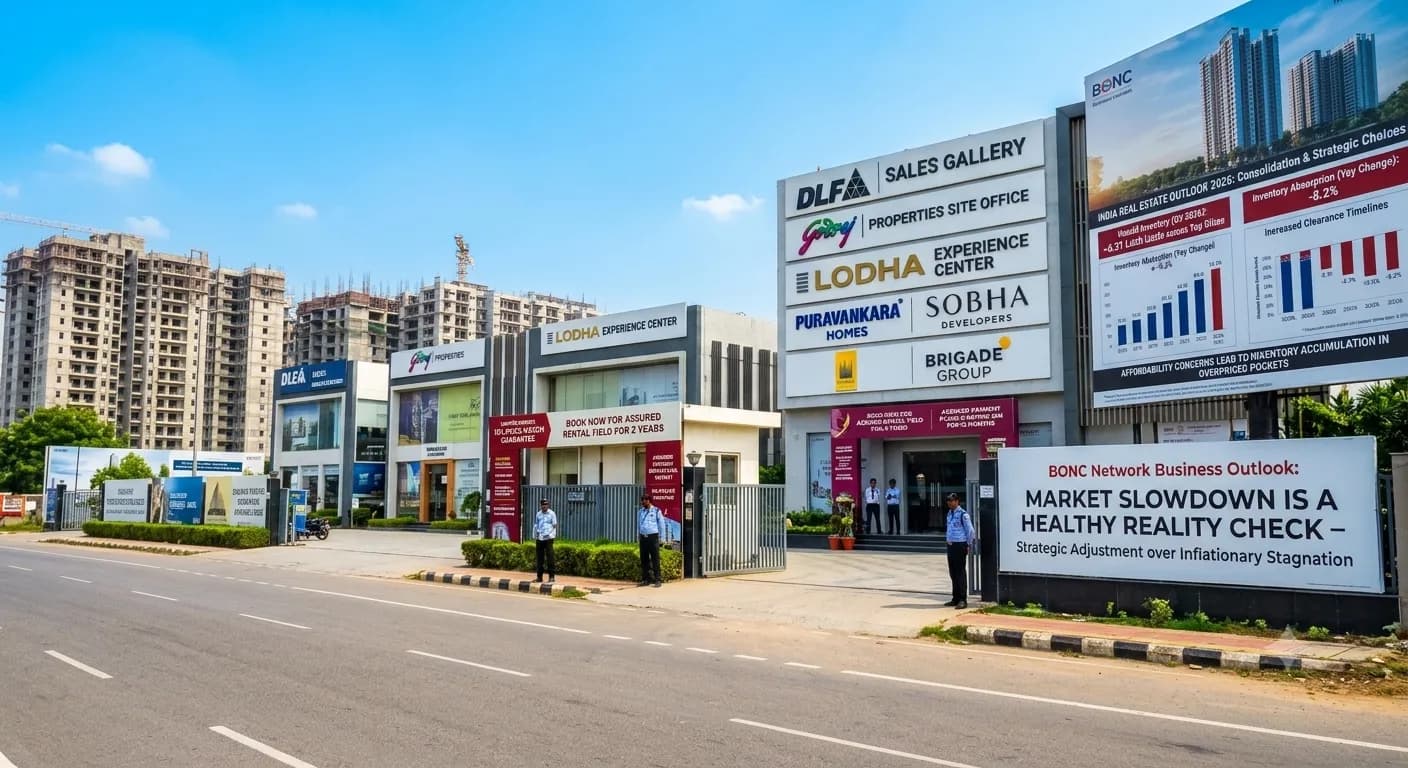
India’s real estate market has experienced an extended phase of robust expansion, but 2026 presents a more nuanced picture. With property price appreciation outpacing wage growth in key urban hubs, affordability hurdles, and rising inventory in selective segments, a critical question emerges: Is the property market moving toward a recession, or simply entering a disciplined correction and consolidation phase?
What Is Happening in the Market?
The national numbers for 2026 show steady resilience mixed with localized caution. Across the top eight primary cities, cumulative housing sales for the first nine months reached 258,238 units, holding flat compared to the previous year. Meanwhile, overall residential inventory across major urban centers ticked upward, with available stock hovering near 5.31 lakh to 6.31 lakh units, driven by aggressive new project launches. Average residential prices across top markets have crossed the ₹9,700 per sq. ft. mark (reflecting a ~7% year-on-year increase).
This divergence indicates that overall buyer demand has not collapsed, but the velocity of absorption varies drastically by city, micro-market, and price bracket.
Why Is the Market Slowing Down?
Several fundamental economic pressures are tempering market momentum:
The Affordability Gap: In several high-growth micro-markets, capital values have surged faster than household disposable incomes, compressing the pool of active, first-time home buyers.
Financing and Cost of Capital: With broader monetary tightening cycles keeping borrowing costs elevated, home loan interest rates demand a higher out-of-pocket commitment, leading buyers to exercise greater caution before finalizing transactions.
Supply Mismatch: New project completions have heavily favored luxury and ultra-luxury configurations, whereas mid-income and affordable housing supply has faced tighter demand compression.
Micro-Market Trends & Price Appreciation (2026 Data Analysis)
Real estate performance in 2026 is hyper-local. Evaluating specific city trends reveals stark differences in pricing and momentum:
Delhi-NCR & Gurugram: NCR has experienced distinct movements, with overall sales adjusting dynamically (recording 10,712 units in Q3), while price appreciation remains among the highest nationally at 12% to 15% year-on-year. Gurugram continues to do the heavy lifting: premium corridors like Golf Course Extension Road, Southern Peripheral Road (SPR), and Dwarka Expressway have witnessed massive long-term gains (30% to 50%+ appreciation over recent cycles), pushing average prices in prime sectors near ₹18,500+ per sq. ft. Noida has also maintained steady traction with ~7% to 11% price growth, backed by commercial expansion and proximity to the upcoming Jewar Airport region.
Mumbai Metropolitan Region (MMR): MMR remains India's undisputed volume and revenue leader, recording approximately 31,750 units sold in recent quarters and holding the largest share of national real estate revenue (~28.4%). Driven by continuous infrastructure upgrades and redevelopment projects, average prices stand firm around ₹37,064 per sq. ft. in core zones, alongside active supply in peripheral nodes like Navi Mumbai and Thane.
Bengaluru: Bengaluru stands out as one of the country's most resilient markets, registering a 11% to 24% year-on-year price appreciation alongside steady sales growth (~12% increase in key quarters). Powered by stable GCC and tech sector employment, micro-markets along expanding metro lines continue to see healthy end-user absorption, though new launches lean increasingly into the ₹80 lakh to ₹2.5 crore bracket.
Hyderabad: Hyderabad has displayed aggressive supply dynamics, recording a 15% year-on-year sales jump in key quarters alongside a massive surge in new launches (up over 120% annually). With average prices appreciating at a steady ~3% to 8% and 97% of new supply targeted above ₹80 lakh, the city is betting heavily on premium and upscale integrated developments.
Will Property Prices Fall in 2026?
A broad, nationwide price crash remains unlikely. Instead, the market is displaying stark bifurcation:
High-Demand Micro-Markets: Premium properties backed by robust infrastructure delivery—such as upcoming metro lines and expressway expansions—continue to command steady end-user absorption.
Correction-Prone Pockets: Overpriced projects or over-supplied micro-markets are facing extended inventory clearance times. In these segments, developers are increasingly relying on flexible payment subventions, festive discounts, and customized incentives to move inventory.
My Take: A Healthy Reality Check
The core concern for 2026 is not an imminent market crash, but whether asset valuations are disconnecting from what ordinary, salaried homebuyers can realistically sustain.
A resilient real estate ecosystem requires a fine equilibrium between developer pricing expectations and consumer purchasing power. While macro pressures and higher inventory create localized stagnation, disciplined adjustments by developers can stabilize the market organically.
Ultimately, India’s real estate landscape in 2026 is navigating a phase of structural adjustment rather than a confirmed nationwide recession. For both home-buyers and long-term capital allocators, data-backed research, careful asset selection, and long-term horizons remain the ultimate safeguards against market noise.