Find the Right Suppliers, Build Stronger Business Connections
Published on: 16 Sep 2026
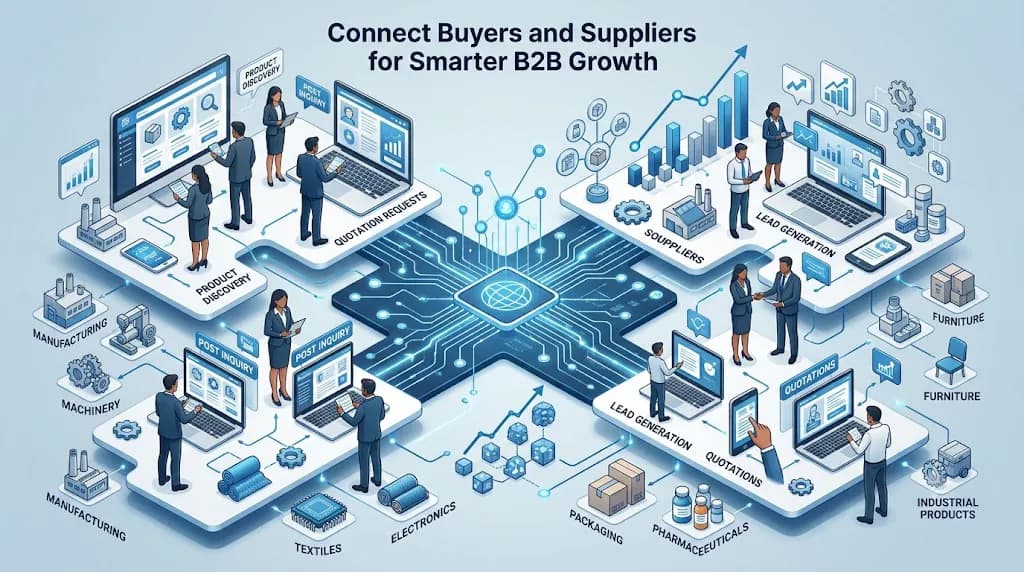
Connect Buyers With Suppliers in India Through Digital B2B Platforms
Introduction
Business transactions depend on strong connections between buyers and suppliers. Whether a company is looking for raw materials, finished products, industrial equipment, packaging solutions, machinery, textiles, furniture, electronics, or specialized services, finding the right supplier is an important part of the procurement process. At the same time, manufacturers and suppliers need consistent access to relevant buyers who are actively searching for their products.
Traditionally, these connections were built through personal networks, industry associations, trade fairs, referrals, distributors, local markets, and direct sales teams. These methods continue to play an important role, but the growth of digital commerce has introduced a more scalable way to connect businesses.
Digital B2B platforms provide an online environment where buyers can discover products and suppliers while manufacturers and suppliers can showcase their businesses to potential customers. This changes the way companies approach supplier discovery, product sourcing, business networking, and lead generation.
The need to connect buyers with suppliers in India has become particularly important because India's business ecosystem includes manufacturers, wholesalers, distributors, exporters, importers, retailers, MSMEs, startups, and service providers operating across a wide range of industries.
Instead of limiting business opportunities to a local network, companies can use digital B2B platforms to discover businesses across cities, states, and industries.
Platforms such as BONC Network are designed around digital business networking and product discovery, helping businesses create an online presence where their products and business information can be discovered by other businesses.
However, successful buyer-supplier connections require more than simply putting two businesses together. Relevant product information, clear requirements, supplier capabilities, communication, pricing, quality, delivery, and trust all influence whether a connection develops into a successful business relationship.
Understanding Buyer Supplier Connections in B2B
A buyer-supplier connection exists when a business that needs a product or service identifies a business capable of providing it.
The relationship can take different forms.
A retailer may connect with a manufacturer for inventory.
A distributor may connect with a factory for bulk purchasing.
A manufacturer may connect with a component supplier for raw materials.
An exporter may connect with an Indian manufacturer for products.
A startup may connect with a supplier for customized production.
Therefore, buyer-supplier networking is not limited to one type of business transaction. It supports multiple stages of the B2B supply chain.
Buyers and Suppliers Have Different Goals
Buyers generally want to:
- Find suitable products
- Identify reliable suppliers
- Compare options
- Understand pricing
- Check availability
- Request quotations
- Evaluate quality
- Negotiate commercial terms
- Build long-term supply relationships
Suppliers generally want to:
- Increase product visibility
- Reach relevant buyers
- Generate inquiries
- Expand into new markets
- Build distribution relationships
- Increase orders
- Develop long-term customers
A successful B2B platform needs to create value for both sides.
Why Businesses Need Better Buyer Supplier Networks
Business growth often depends on the strength of a company's commercial network.
A buyer with access to more relevant suppliers has greater flexibility when sourcing products. A supplier with access to more relevant buyers has more opportunities to generate business.
This creates a two-sided ecosystem.
Better Supplier Discovery
Buyers can explore businesses beyond their existing contacts.
This is particularly useful when a company enters a new product category or geographical market.
Greater Buyer Reach
Suppliers can showcase their products to businesses outside their immediate local market.
A manufacturer based in one city may potentially discover buyers from other regions through digital networking.
More Business Opportunities
Digital networking can create opportunities for new supplier relationships, distribution partnerships, wholesale transactions, and repeat orders.
Reduced Dependence on Personal Networks
Personal connections remain valuable, but digital platforms can expand the network beyond people a business already knows.
How Digital B2B Platforms Connect Buyers With Suppliers
Digital B2B platforms combine business profiles, product listings, search functionality, communication tools, and networking features to make business discovery more structured.
The basic process can be represented as:
Buyer Requirement → Product Search → Supplier Discovery → Business Profile → Inquiry → Communication → Evaluation → Transaction
The process may differ depending on the platform and business category, but the basic objective remains the same: make it easier for relevant businesses to discover one another.
Product Discovery as the Starting Point
Many B2B relationships begin with a product requirement.
A buyer may search for:
- Industrial machinery
- Packaging materials
- Furniture
- Electrical products
- Textiles
- Chemicals
- Pharmaceutical products
- Construction materials
- Food products
- Automotive components
Instead of searching for a specific company name, the buyer can begin by identifying the product category.
This allows businesses to discover suppliers they may not have previously known.
Business Profiles Improve Supplier Discovery
A detailed business profile gives buyers useful information before they initiate contact.
A supplier profile may include:
- Company description
- Product categories
- Product listings
- Business location
- Manufacturing information
- Industry specialization
- Contact details
- Business capabilities
For suppliers, an updated profile can function as a digital business identity.
For buyers, it can provide an initial basis for evaluating whether a supplier is relevant.
The Importance of Accurate Product Information
Product information plays an important role in buyer-supplier matching.
A supplier should clearly communicate:
- Product name
- Product category
- Specifications
- Features
- Available variants
- Packaging
- Minimum order quantity
- Customization options
- Application
- Availability
Clear product information reduces unnecessary communication and helps buyers understand whether a product matches their requirements.
How Buyers Can Find Suppliers in India
Businesses looking to find suppliers can begin with a clearly defined procurement requirement.
Instead of searching for "supplier" as a broad term, buyers can combine the product with relevant specifications or categories.
For example:
Product + Manufacturer
Product + Supplier
Product + Location
Product + Bulk Supplier
Product + Wholesale
This approach can make the search more targeted.
How Suppliers Can Find Buyers in India
The supplier side of the ecosystem is equally important.
Manufacturers and suppliers need to make their products discoverable to relevant businesses.
A strong digital presence can include:
- Detailed company information
- Product listings
- Accurate categories
- Product images
- Specifications
- Contact information
- Business location
- Industry information
When this information is available, buyers can better understand the supplier before sending an inquiry.
The Role of BONC Network in Buyer Supplier Connections
BONC Network provides a digital B2B networking environment where businesses can showcase products and discover other businesses.
For buyers, the platform can be used as part of a supplier and product discovery process. Businesses can explore product categories and business listings to identify potential suppliers relevant to their requirements.
For manufacturers and suppliers, maintaining product listings and business information can improve their digital visibility among businesses looking for products.
The value of a business networking platform goes beyond a simple directory. When product discovery, business profiles, inquiries, and networking work together, businesses have more opportunities to turn digital discovery into meaningful commercial conversations.
BONC Network can therefore be considered as one component of a broader digital B2B sourcing and networking strategy.
Connecting Buyers With Manufacturers
Manufacturers are particularly important in B2B sourcing because many buyers prefer to establish direct relationships with production companies.
Direct manufacturer connections may be useful for:
- Bulk purchasing
- Customized products
- Private labeling
- OEM requirements
- Long-term supply
- Product development
- Industrial procurement
However, buyers should always determine whether the business is actually a manufacturer, distributor, wholesaler, or another type of supplier before making procurement decisions.
Connecting Buyers With Wholesalers and Distributors
Not every buyer needs to work directly with a manufacturer.
Wholesalers and distributors can be useful when businesses require:
- Smaller quantities
- Faster availability
- Multiple brands
- Consolidated purchasing
- Local inventory
- Regional distribution
A digital B2B platform can provide opportunities to discover different types of suppliers based on the buyer's specific requirements.
The Importance of Location in Supplier Connections
Although digital platforms allow businesses to connect across geographical boundaries, location can still matter.
Supplier location may affect:
- Transportation costs
- Delivery time
- Freight availability
- Warehousing
- Product inspection
- Regional market access
- Logistics planning
A buyer searching for suppliers in India can therefore use location as one of several factors when developing a supplier shortlist.
Creating a Strong Buyer Requirement
The quality of the buyer's requirement can directly affect the quality of supplier responses.
A buyer should ideally provide:
- Product name
- Quantity
- Specifications
- Material
- Quality expectations
- Delivery location
- Required delivery timeline
- Packaging requirements
- Customization requirements
- Budget or commercial expectations where appropriate
For example, a requirement for "metal racks" is broad.
A more detailed requirement might specify dimensions, material thickness, load capacity, quantity, finish, packaging, and delivery location.
The second requirement gives suppliers a much better understanding of what the buyer actually needs.
Why Clear Communication Matters
A buyer-supplier connection becomes valuable when both sides can communicate effectively.
Suppliers should respond with relevant information rather than generic promotional messages.
Buyers should clearly explain their requirements rather than asking only for a price.
Good communication can clarify:
- Product specifications
- MOQ
- Price
- Delivery
- Payment
- Customization
- Packaging
- Warranty
- Quality standards
Clear communication can reduce misunderstandings during procurement.
Request for Quotation and Buyer Supplier Matching
An RFQ can provide a structured way for buyers to communicate procurement requirements.
For example, a buyer may require 1,000 units of a particular product with specific materials, dimensions, packaging, and delivery requirements.
Instead of sending a vague inquiry, the buyer can communicate the complete requirement and ask relevant suppliers to provide quotations.
This creates a more organized procurement process.
Comparing Multiple Suppliers
Businesses should avoid assuming that the first supplier they discover is automatically the right supplier.
A supplier comparison can consider:
FactorBuyer Consideration
Product
Does it match the requirement?
Quality
Does it meet expected standards?
Price
Is it commercially viable?
MOQ
Is the minimum quantity suitable?
Capacity
Can the supplier support demand?
Delivery
Can timelines be met?
Location
Does logistics work efficiently?
Customization
Can specifications be adapted?
Communication
Are responses clear and timely?
Reliability
Can business information be verified?
This creates a more structured approach to supplier evaluation.
Building Trust Between Buyers and Suppliers
Trust is one of the most important elements of long-term B2B relationships.
Digital platforms can make business discovery easier, but trust still needs to be established through business communication and appropriate verification.
Businesses can consider:
- Company information
- Registration details
- Relevant certifications
- Product samples
- References
- Factory information
- Previous experience
- Commercial documentation
The appropriate level of verification depends on the nature and value of the transaction.
Verified Business Information and Digital B2B Platforms
When supplier information is clear and consistently presented, buyers have a stronger starting point for research.
A supplier should keep its digital profile updated.
Important information can include:
- Current products
- Correct contact information
- Updated business description
- Accurate location
- Current product specifications
- Relevant categories
Outdated information can create confusion and result in missed business opportunities.
Benefits for Indian Manufacturers
Digital buyer-supplier networks can provide manufacturers with several opportunities.
Expand Market Reach
A manufacturer can showcase products to businesses beyond its immediate geographical market.
Improve Product Visibility
Digital product listings make it easier for potential buyers to discover what a company produces.
Generate Business Inquiries
Relevant buyers can initiate conversations when they find suitable products.
Build New Distribution Networks
Manufacturers can identify distributors and wholesalers in new markets.
Develop Long-Term Relationships
A digital inquiry can become the beginning of a longer business relationship when both parties find a suitable commercial fit.
Benefits for Buyers
Buyers can also benefit from a broader digital supplier ecosystem.
Wider Supplier Choice
Businesses can explore more suppliers instead of depending only on existing contacts.
Faster Research
Digital search can reduce the time required to identify potential suppliers.
Product Comparison
Buyers can compare different businesses and products before contacting suppliers.
Geographic Expansion
Businesses can discover suppliers from different parts of India.
Better Procurement Planning
A broader supplier network can provide businesses with additional sourcing options.
How MSMEs Can Use Digital B2B Networking
Micro, small, and medium enterprises often operate with limited sales and procurement resources.
Digital B2B platforms can help MSMEs create visibility without depending entirely on physical networking.
A small manufacturer can list products, describe capabilities, and make its business discoverable to potential buyers.
Similarly, an MSME buyer can use digital supplier discovery to identify businesses that may not already be part of its existing network.
This can help create a more connected B2B ecosystem.
How Startups Can Connect With Suppliers
Startups frequently need suppliers for prototypes, small production runs, packaging, components, and customized products.
A startup can use a digital B2B platform to research potential suppliers before committing to larger production.
The process can involve:
Requirement Definition → Supplier Search → Shortlist → Communication → Sample → Evaluation → Initial Order → Long-Term Relationship
This reduces the need to depend exclusively on personal introductions.
Connecting Buyers With Suppliers for Bulk Orders
Bulk procurement requires additional attention to production capacity and delivery.
Before placing a large order, buyers should understand:
- Production capacity
- MOQ
- Lead time
- Quality control
- Packaging
- Logistics
- Payment terms
- Repeat-order capability
A supplier that can support a small order may not necessarily have sufficient capacity for a much larger requirement.
Private Label and Customized Manufacturing Connections
Digital B2B networking can also support customized sourcing.
Businesses may search for suppliers that can provide:
- Private-label products
- Custom packaging
- Custom designs
- OEM products
- Custom formulations
- Product modifications
The buyer should communicate customization requirements clearly from the beginning because they can affect pricing, MOQ, tooling, production timelines, and quality checks.
Supplier Networks and Business Growth
A strong supplier network can contribute to business resilience.
If a company depends entirely on one supplier, unexpected production or logistics issues may create operational challenges.
Maintaining relationships with multiple relevant suppliers can provide additional sourcing options.
However, this does not mean businesses should continuously change suppliers. Long-term relationships with reliable suppliers can be valuable.
The goal is to create a balanced supplier network with dependable primary suppliers and suitable alternatives.
Buyer Supplier Networks Beyond Transactions
A B2B connection does not always begin or end with a single order.
Businesses can develop relationships around:
- Product development
- Distribution
- Joint marketing
- Export opportunities
- Private labeling
- Strategic sourcing
- Long-term contracts
- Industry partnerships
Digital business networking can therefore support a wider range of commercial relationships.
Common Challenges in Buyer Supplier Connections
Despite the benefits of digital platforms, businesses can still face challenges.
Incomplete Information
Some business profiles may not provide enough detail to evaluate the supplier.
Poor Product Descriptions
Unclear specifications can lead to irrelevant inquiries.
Price Differences
Supplier quotations can vary significantly based on quality, volume, specifications, and commercial terms.
Communication Gaps
Delayed or incomplete responses can slow procurement.
Quality Issues
A digital profile cannot guarantee product quality. Buyers may need samples or additional verification.
Delivery Problems
Production delays and logistics challenges can affect order fulfillment.
Digital platforms improve discovery, but businesses still need appropriate due diligence.
Avoiding Common Buyer Mistakes
Buyers can improve their sourcing process by avoiding several common mistakes.
They should not select suppliers only because of the lowest price.
They should not place large orders without understanding specifications and commercial terms.
They should not assume that every online listing represents the same type of business.
They should not ignore delivery and logistics costs.
They should not rely on incomplete product information.
They should also avoid limiting supplier research to a single company when the requirement allows multiple options to be explored.
Avoiding Common Supplier Mistakes
Suppliers also need to maintain a professional digital presence.
Common problems include:
- Incomplete product information
- Outdated listings
- Incorrect contact details
- Poor-quality product images
- Generic descriptions
- Slow inquiry responses
- Unclear pricing information
- Lack of specifications
A buyer should be able to understand the supplier's product offering without unnecessary confusion.
Improving Digital B2B Visibility
Suppliers looking to connect with more buyers can improve their digital presence by organizing their business information.
A strong B2B profile can include:
Clear Business Description
Explain what the company manufactures or supplies and which industries it serves.
Detailed Product Listings
Each product should have accurate specifications and relevant information.
Correct Categories
Products should be listed under relevant categories so buyers can discover them more easily.
Updated Contact Information
Buyers should have a clear way to initiate communication.
Consistent Product Information
Information should remain accurate across the company's digital presence.
The Role of Business Networking Platforms in India's B2B Ecosystem
India's B2B market includes businesses of different sizes, industries, and geographic locations.
A business networking platform can help bring these businesses into a common digital environment.
For manufacturers, it can provide product visibility.
For buyers, it can provide supplier discovery.
For distributors, it can create new sourcing and sales opportunities.
For startups, it can provide access to established businesses.
For MSMEs, it can create opportunities to expand beyond local networks.
This makes business networking an important component of modern B2B commerce.
How Digital Platforms Can Improve Procurement Efficiency
Traditional procurement may require businesses to make multiple phone calls, visit markets, attend events, request referrals, and manually collect supplier information.
Digital platforms can simplify the early stages of this process.
A procurement team can:
- Search for products
- Discover suppliers
- Review business profiles
- Compare companies
- Send inquiries
- Request quotations
- Organize supplier information
- Continue communication digitally
This does not eliminate the need for physical verification or negotiations, but it can make supplier discovery more efficient.
The Future of Connecting Buyers With Suppliers in India
The B2B ecosystem is becoming increasingly digital.
Future platforms are likely to place greater emphasis on:
- AI-powered supplier discovery
- Personalized product recommendations
- Intelligent buyer-supplier matching
- Digital RFQs
- Business verification
- Automated notifications
- Product recommendation systems
- Data-driven procurement
- Integrated communication
- Cross-region business networking
Artificial intelligence may help businesses move from simple keyword searches toward requirement-based discovery.
For example, instead of searching for a specific supplier category, a buyer could describe the complete product requirement and receive potentially relevant businesses based on product capabilities.
This could make supplier discovery more efficient while still requiring businesses to conduct their own commercial evaluation.
Creating a Better Buyer Supplier Connection Strategy
Businesses can create a repeatable digital sourcing strategy.
Start by defining the exact requirement.
Then search relevant product and supplier categories.
Build a shortlist of potentially suitable businesses.
Review their product and company information.
Send clear inquiries.
Request quotations or additional information.
Compare suppliers using relevant commercial and operational factors.
Verify important business details.
Test the relationship with appropriate samples or initial orders.
Finally, develop long-term relationships with suppliers that consistently meet business requirements.
This process turns supplier discovery from a random activity into a structured business function.
Conclusion
The ability to connect buyers with suppliers in India has become increasingly important as businesses look for faster product discovery, broader supplier networks, and new commercial opportunities. India's diverse manufacturing and business ecosystem creates a large potential network, but businesses need effective methods to discover and evaluate relevant connections.
Digital B2B platforms provide an organized environment where buyers can search for products and suppliers while manufacturers and suppliers can showcase their businesses to potential customers. Business profiles, product listings, digital inquiries, RFQs, and networking features can make the early stages of B2B sourcing more efficient.
For buyers, the process begins with clearly defining requirements and discovering multiple relevant suppliers. For suppliers, it begins with maintaining accurate business information and making products easy to discover. Both sides benefit when communication is clear and expectations are properly understood.
BONC Network fits into this broader digital B2B ecosystem by bringing business networking and product discovery together. Manufacturers and suppliers can create digital visibility for their products, while buyers can explore businesses and potential supplier connections based on their requirements.
Ultimately, effective buyer-supplier networking is not simply about generating more connections. It is about creating relevant, transparent, and useful business relationships that can develop into sourcing partnerships, distribution opportunities, repeat orders, and long-term B2B growth.