How B2B Businesses Can Maximize Growth Through Digital Advertising and Product Promotion
Published on: 05 Sep 2026
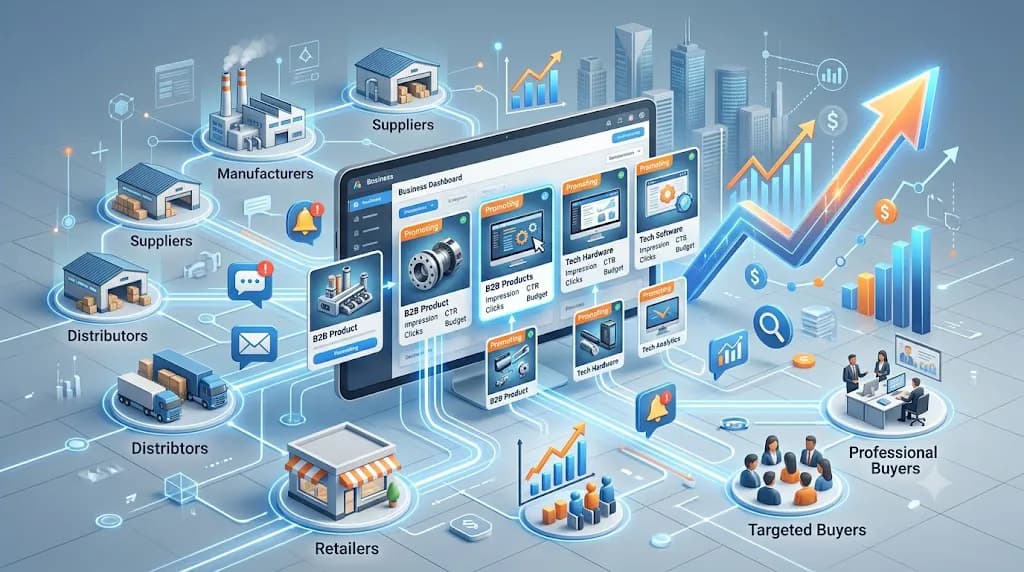
How B2B Businesses Can Maximize Growth Through Digital Advertising and Product Promotion
A strong product does not automatically guarantee strong market demand. In a competitive B2B environment, businesses also need to make sure that their products, services and capabilities are visible to the right audience at the right time. Manufacturers, suppliers, distributors, wholesalers and service providers are increasingly competing not only on quality and pricing, but also on discoverability, digital presence and the ability to communicate their value effectively.
This is where B2B digital advertising and product promotion become important.
Digital channels allow businesses to introduce their products to potential buyers, strengthen brand visibility, promote new launches, support sales activities and create opportunities for business relationships. Instead of relying entirely on traditional sales methods, companies can combine digital promotion with product discovery, business networking, content marketing and lead generation.
However, successful digital promotion is not simply about placing advertisements. Businesses need a strategy that connects advertising with their overall growth objectives.
A company may want to promote a particular product, enter a new market, find distributors, increase inquiries, promote an upcoming exhibition or simply strengthen its presence among B2B buyers. Each objective requires a slightly different approach.
The real opportunity lies in creating a connected digital growth strategy where advertising creates awareness, product promotion creates discovery, networking creates relationships and lead management creates business opportunities.
Why Digital Advertising Is Becoming Important for B2B Businesses
B2B buyers have become increasingly comfortable researching businesses and products online before initiating direct communication. Before contacting a supplier, a buyer may explore product information, compare alternatives, check company capabilities and look for relevant business partners.
This has changed the role of marketing.
Previously, sales teams could be the primary source of information about a company. Today, a potential buyer may already have significant information before speaking to a salesperson.
As a result, businesses need to make their information available digitally.
B2B digital advertising can support this process by helping businesses increase visibility around specific products, services, brands and campaigns.
For example, an industrial equipment manufacturer can promote a particular machine instead of advertising only the company name. A furniture supplier can highlight a new collection. A packaging company can promote a specialized packaging solution. An event organizer can promote an upcoming trade exhibition.
This makes digital advertising more specific and measurable.
Businesses can align promotional activities with objectives such as:
- Increasing product visibility
- Building brand awareness
- Generating business inquiries
- Reaching new buyers
- Finding distributors
- Supporting new product launches
- Promoting trade shows
- Increasing event visibility
- Entering new markets
- Strengthening digital branding
The most effective campaigns begin with a clearly defined objective.
Digital Advertising and Product Promotion: What Is the Difference?
Although these terms are closely connected, they are not exactly the same.
Digital advertising is the broader activity of promoting a business, product, service or campaign through digital channels.
Product promotion focuses specifically on increasing awareness and interest around individual products or product categories.
For example, a company may run a digital branding campaign to increase awareness of its business. At the same time, it may run a product promotion campaign for a newly launched product.
Both activities can work together.
Brand advertising tells buyers who the business is.
Product promotion tells buyers what the business offers.
When combined, they create a stronger digital presence.
This is especially valuable for B2B companies that have large product portfolios. A buyer may recognize the company name but still be unaware of a particular product that could meet their requirement.
Product-focused promotion can bring those products into the spotlight.
Why Product Visibility Matters in B2B Marketing
Product visibility is one of the fundamental components of B2B growth.
Consider a manufacturer with 100 products. If only five products receive regular online visibility, potential buyers may never discover the remaining 95.
This does not necessarily mean those products have weak demand. It may simply mean that buyers are unaware of them.
This is why businesses should think beyond company-level marketing.
They should also ask:
- Which products need more visibility?
- Which products have growth potential?
- Which products are new?
- Which products are suitable for a new market?
- Which products can attract distributors?
- Which products should be highlighted to existing buyers?
A product promotion platform can help businesses give specific products additional exposure instead of relying only on general company advertising.
Product visibility becomes particularly useful for new launches, innovative products, specialized products and products entering new geographical markets.
How B2B Businesses Can Build a Strong Digital Promotion Strategy
A successful B2B promotion campaign starts with planning.
Rather than promoting everything simultaneously, businesses should create a structured approach.
1. Define the Promotion Objective
The first step is deciding what the campaign should accomplish.
For example:
Goal: Product awareness
Promote a new product to relevant business audiences.
Goal: Lead generation
Generate inquiries from potential buyers or distributors.
Goal: Market expansion
Increase visibility in a new city, state or industry.
Goal: Event promotion
Attract visitors, exhibitors or business participants to an upcoming event.
Goal: Branding
Increase recognition of the company among potential customers.
A clear objective makes it easier to choose the right promotional format and evaluate results.
2. Identify the Target B2B Audience
Not every buyer is relevant to every product.
A manufacturer selling industrial machinery may target procurement managers, engineering companies, distributors, factories or OEMs.
A commercial furniture supplier may target offices, hotels, institutions, architects, interior designers or dealers.
A technology company may focus on businesses looking for software, hardware or IT solutions.
Therefore, businesses should define their audience before launching a campaign.
Important factors may include:
- Industry
- Location
- Business type
- Company size
- Buyer role
- Product requirement
- Application
- Purchasing capacity
- Distribution requirements
The better the audience definition, the more focused the campaign can become.
Create Product Listings That Help Buyers Make Decisions
Advertising may attract attention, but product information helps buyers evaluate the offering.
A poorly presented product can lose potential interest even if the advertising itself performs well.
Every product promoted online should ideally include:
- Clear product name
- Product category
- Detailed description
- Key features
- Technical specifications
- Applications
- Available variants
- Industry use cases
- Business information
- Inquiry or contact option
The goal should be to answer the buyer's initial questions before the sales conversation begins.
For B2B buyers, detailed information can be particularly important because purchasing decisions may involve multiple stakeholders.
Features Should Be Connected With Business Benefits
One common mistake in product marketing is focusing only on specifications.
Specifications are important, but buyers also want to understand their practical value.
Instead of simply listing a technical feature, businesses should explain how it can help the customer.
For example, if a product is designed for high-efficiency industrial operations, the marketing message should communicate why that matters to the intended user.
This makes product promotion more buyer-oriented.
A strong product message should answer:
What does the product do?
Who is it for?
What problem does it address?
What makes it relevant?
Why should the buyer explore it further?
Use Featured Product Promotion Strategically
Businesses with extensive catalogs can benefit from highlighting selected products.
A featured product promotion strategy allows companies to prioritize products that deserve additional attention.
These could include:
- Newly launched products
- Best-selling products
- Innovative products
- High-demand products
- Products with improved specifications
- Products entering a new market
- Products available for distribution
- Products aligned with current business campaigns
Instead of giving every product the same promotional priority, businesses can allocate additional visibility to products connected to current growth objectives.
This can make the overall marketing strategy more focused.
Digital Advertising Can Support B2B Lead Generation
For many businesses, visibility is only the first step.
The ultimate objective may be to create relevant business inquiries.
This is where B2B lead generation becomes important.
A potential lead could be:
- A buyer looking for a supplier
- A distributor seeking products
- A manufacturer searching for components
- A business looking for a service provider
- An importer searching for a supplier
- A company looking for a manufacturing partner
Product promotion can help bring these potential opportunities into the discovery stage.
However, businesses should avoid measuring success only by the number of inquiries.
The quality and relevance of inquiries matter.
Ten highly relevant inquiries may be more valuable than hundreds of unrelated messages.
Therefore, businesses should focus on reaching audiences that are genuinely connected to their product category.
Combine Product Promotion With Business Networking
Advertising can create awareness, but B2B growth often depends on relationships.
This is where a business networking platform can complement digital advertising.
Suppose a manufacturer promotes an industrial product online. Advertising may help a potential buyer discover the product. Business networking can then provide an opportunity to explore the company, understand its capabilities and potentially initiate communication.
This creates a broader growth journey:
Advertising → Product Discovery → Business Discovery → Inquiry → Communication → Relationship
Not every interaction will immediately become a transaction, and businesses should not expect every promotion to generate instant sales.
B2B relationships often develop over multiple interactions.
Consistent visibility can help keep the business discoverable throughout that journey.
The Role of a B2B Advertising Platform
A dedicated B2B advertising platform can provide a business-focused environment for promoting products, companies, services and events.
This can be useful for businesses that want to reach an audience interested in commercial products and services rather than relying entirely on broad consumer-oriented channels.
Depending on the platform, businesses may promote:
- Company profiles
- Individual products
- Featured products
- New launches
- Business services
- Trade shows
- Expos
- Exhibitions
- Events
- Brand campaigns
BONC Network, for example, provides a B2B business ecosystem where companies can showcase their businesses and products while connecting with other businesses. Its promotional opportunities can be used by businesses for activities such as product promotion, advertising, branding and event-related visibility.
For businesses using such an ecosystem, the important consideration is to connect promotional activity with a specific business objective rather than treating promotion as an isolated activity.
How to Promote New Products Through Digital Channels
New product launches require visibility.
A business may invest significant resources in developing a product, but potential customers cannot respond to something they do not know exists.
A digital product launch can be divided into several stages.
Awareness Stage
Introduce the new product and create initial visibility.
Information Stage
Communicate specifications, features, applications and benefits.
Promotion Stage
Use digital advertising and product promotion to reach relevant audiences.
Engagement Stage
Provide potential buyers with opportunities to ask questions or request information.
Follow-Up Stage
Sales teams can communicate with relevant prospects and understand their requirements.
This approach helps connect marketing activity with sales activity.
Digital Branding Strengthens Product Promotion
Product marketing becomes more powerful when it is supported by strong branding.
Imagine two businesses offering similar products.
One has a clear company profile, professional communication, consistent branding and detailed product information.
The other has incomplete information and limited digital presence.
Even if both offer comparable products, the first business may appear more established and easier to evaluate.
This is why digital branding should be part of a broader B2B promotion strategy.
Businesses should maintain consistency in:
- Company name
- Logo
- Product descriptions
- Visual identity
- Business information
- Brand messaging
- Contact details
- Industry positioning
Brand consistency helps create recognition across different digital touchpoints.
Promote Trade Shows and Expos Digitally
B2B growth is not limited to online transactions.
Trade shows, expos, exhibitions and industry events continue to provide opportunities for businesses to meet customers, suppliers, distributors and potential partners.
However, an event needs visibility to attract the right audience.
This makes trade show promotion and expo promotion important parts of B2B digital marketing.
Businesses can use digital channels to communicate:
- Event date
- Venue
- Industry
- Exhibitor details
- Product categories
- Networking opportunities
- Registration information
- Special announcements
A company exhibiting at an industrial expo, for instance, can promote its participation before the event and highlight its products or booth after the event.
This creates a connection between event marketing and product promotion.
Use Event Marketing Alongside Product Marketing
Events can become a promotional opportunity for products.
For example, a machinery company participating in an exhibition may use the event to demonstrate a new machine.
A furniture company may showcase a new collection.
A technology company may introduce a new solution.
Therefore, businesses can combine:
Event Promotion + Product Promotion + Brand Promotion
This creates a more comprehensive campaign.
The event attracts the audience.
The product creates interest.
The brand creates long-term recognition.
Local Visibility Can Lead to Wider Market Reach
Many B2B businesses begin locally.
A supplier may initially serve customers within one city. A manufacturer may have a strong regional customer base. A distributor may operate within a particular state.
Digital promotion can help these businesses gradually increase visibility beyond their immediate market.
The growth journey may look like:
Local Visibility → Regional Discovery → National Reach → New Business Opportunities
This can be particularly valuable for MSMEs and growing businesses that want to expand without immediately building physical operations in every market.
A strong online business profile, detailed product information and consistent promotion can help communicate capabilities to potential buyers outside the company's existing network.
Build a Consistent B2B Content Strategy
Advertising works better when supported by useful content.
Businesses can create content around:
- Product education
- Industry trends
- Product applications
- Buyer guides
- Company capabilities
- Manufacturing processes
- Case studies
- New launches
- Event announcements
- Industry insights
Content gives businesses an opportunity to educate potential buyers rather than constantly asking them to purchase.
This is especially important in B2B markets where buyers may require detailed information before making a decision.
A business that consistently provides useful information can strengthen its digital authority and visibility.
Create a Promotional Calendar
Consistency is one of the most important parts of digital business promotion.
Instead of running promotions randomly, businesses can create a monthly calendar.
For example:
Week 1 – Brand Promotion
Highlight company capabilities and industry experience.
Week 2 – Product Promotion
Feature an important product.
Week 3 – Educational Content
Publish useful information related to the industry.
Week 4 – Event or New Product Promotion
Promote an upcoming event, exhibition or product launch.
The exact schedule will depend on the business.
The main objective is to maintain consistent digital visibility.
How Recharge-Based Promotion Models Can Fit Into B2B Marketing
Some B2B platforms offer recharge-based promotional models through which businesses can access selected promotional benefits.
Depending on the available platform services, businesses may use promotional resources for activities such as:
- Advertising
- Product promotion
- Featured product visibility
- Branding
- Trade show promotion
- Expo promotion
- Event marketing
- Product pushing
- Business visibility
The strategic question should not simply be, "How much should a business recharge?"
A better question is:
Which promotional activity can best support the current business objective?
For example, a business launching a new product may prioritize product promotion.
A company preparing for an exhibition may focus on trade show promotion.
A business entering a new market may prioritize branding and business visibility.
A company looking to increase awareness of a specific product may select featured product promotion.
This approach makes promotional spending more purposeful.
Connect Marketing With Sales Follow-Up
One of the biggest opportunities in B2B marketing is connecting promotional campaigns with sales teams.
Suppose an advertisement generates interest in a product.
The process should continue through:
Promotion → Inquiry → Qualification → Follow-Up → Proposal → Negotiation → Conversion
If marketing and sales operate independently, valuable opportunities may be missed.
Sales teams should know which products are being promoted and what audience the campaign is targeting.
Marketing teams should also understand the type of leads sales teams consider valuable.
This creates better coordination.
Measure the Right Digital Marketing Metrics
A B2B campaign should be evaluated using metrics relevant to its objective.
Potential metrics include:
- Product views
- Profile visits
- Website traffic
- Inquiries
- Qualified leads
- Buyer interactions
- New business connections
- Event registrations
- Engagement
- Repeat inquiries
For a branding campaign, visibility and engagement may be useful indicators.
For a lead generation campaign, qualified inquiries may matter more.
For event promotion, registrations and participation may be more meaningful.
Businesses should avoid assuming that one metric can measure every type of campaign.
Common Mistakes Businesses Should Avoid
Promoting Without a Goal
Advertising without a clear objective can make it difficult to understand whether the campaign is useful.
Promoting Every Product Equally
Not every product needs the same level of promotion.
Prioritize strategically.
Using Incomplete Product Information
Missing specifications or unclear descriptions can make it harder for buyers to evaluate a product.
Ignoring Buyer Intent
A campaign should be relevant to the people most likely to need the product.
Failing to Follow Up
An inquiry has limited value if it is not handled professionally and promptly.
Focusing Only on Short-Term Sales
B2B marketing should also support brand recognition, relationships and long-term market presence.
Inconsistent Branding
Conflicting business information across platforms can reduce clarity and professionalism.
A Practical Framework for B2B Digital Growth
Businesses can use the following framework to create a structured digital promotion strategy.
Step 1: Build Your Digital Presence
Create a complete business profile with accurate information.
Step 2: Organize Your Product Portfolio
Create detailed and easy-to-understand product listings.
Step 3: Identify Priority Products
Choose products that deserve additional promotional attention.
Step 4: Define Your Audience
Identify industries, buyers, distributors and markets that are relevant.
Step 5: Launch Targeted Promotion
Use digital advertising and product promotion according to the campaign objective.
Step 6: Promote Events
Use digital channels to increase awareness of trade shows, expos and exhibitions.
Step 7: Strengthen Branding
Maintain consistent messaging and business identity.
Step 8: Manage Inquiries
Create a process for responding to potential buyers.
Step 9: Measure Results
Track relevant engagement, visibility and lead metrics.
Step 10: Improve Continuously
Use campaign insights to refine future promotional activities.
The Future of B2B Digital Advertising
The future of B2B marketing is likely to become increasingly digital, personalized and data-driven.
Businesses will need to provide better product information and create easier ways for buyers to discover suppliers and solutions.
Product-level visibility will become increasingly important because buyers do not always begin their search with a company name. They may begin with a product, category, application or business requirement.
This means businesses should think beyond traditional company advertising.
They need to make individual products discoverable.
They need to communicate their capabilities clearly.
They need to build digital relationships.
And they need to remain visible consistently.
Technology, automation and AI-powered discovery can further influence how buyers find products and suppliers. Businesses that maintain organized digital information and consistent online visibility will be better positioned to participate in this evolving B2B environment.
Final Thoughts: Turn Digital Visibility Into Business Opportunity
B2B growth is no longer based only on having a good product or competitive price. Businesses also need to make their offerings easy to discover and understand.
Digital advertising and product promotion provide an important pathway toward achieving that visibility.
When used strategically, digital promotion can help businesses showcase products, build brand recognition, reach new audiences, support product launches, promote events and create potential B2B sales opportunities.
But successful promotion requires more than simply placing an advertisement.
Businesses need to understand their audience, define clear objectives, create useful product information, prioritize important products and maintain consistent communication.
The strongest approach combines multiple elements:
Digital Advertising + Product Promotion + Branding + Business Networking + Lead Generation + Follow-Up
Each element supports a different part of the B2B growth journey.
Advertising creates awareness.
Product promotion creates discovery.
Branding creates recognition.
Networking creates relationships.
Lead generation creates opportunities.
Sales follow-up helps move relevant opportunities forward.
Platforms that bring these activities into a connected B2B ecosystem can provide businesses with additional ways to build digital visibility. BONC Network can be considered as part of this broader strategy, particularly for businesses looking to showcase products, increase business visibility and explore promotional opportunities such as advertising, branding, product promotion and event-related marketing.
Ultimately, the objective of digital promotion should not be to simply generate more views. The objective should be to create meaningful visibility among relevant business audiences.
A product that reaches the right buyer can create a conversation.
A conversation can create a relationship.
A relationship can create a business opportunity.
And consistent digital visibility can help businesses build a stronger foundation for sustainable B2B growth.
The businesses that succeed in the evolving B2B marketplace will not necessarily be the ones that advertise the most. They will be the ones that understand what to promote, whom to reach, how to communicate value and how to turn digital discovery into meaningful business relationships.
Conclusion
In an increasingly competitive B2B marketplace, having quality products is only one part of achieving business growth. Businesses also need to ensure that their products, services and brand remain visible to the right audience. This is where B2B digital advertising and product promotion can make a meaningful difference.
A well-planned digital promotion strategy can help businesses increase product visibility, introduce new offerings, strengthen brand awareness, reach potential buyers, promote trade shows and events, and create new B2B sales opportunities. However, effective promotion is not about advertising everything to everyone. It is about understanding the target audience, selecting the right products, communicating their value clearly and choosing promotional activities that support specific business objectives.
The most effective approach combines digital advertising, product promotion, digital branding, business networking and lead generation into one connected strategy. Advertising can create awareness, product promotion can encourage discovery, branding can build recognition, networking can create relationships, and consistent follow-up can help turn relevant inquiries into potential business opportunities.
For businesses looking to strengthen their digital presence, a B2B promotion and networking ecosystem such as BONC Network can provide opportunities to showcase businesses and products while supporting promotional activities such as advertising, branding, product pushing and event or trade show promotion.
Ultimately, sustainable B2B growth depends on more than visibility alone. Businesses need to turn visibility into discovery, discovery into conversations and conversations into long-term business relationships. By using digital advertising and product promotion strategically, companies can create a stronger online presence, reach new markets and build a more sustainable path toward future growth.