How to Buy Products From Manufacturers in India Through Digital B2B Platforms
Published on: 16 Sep 2026
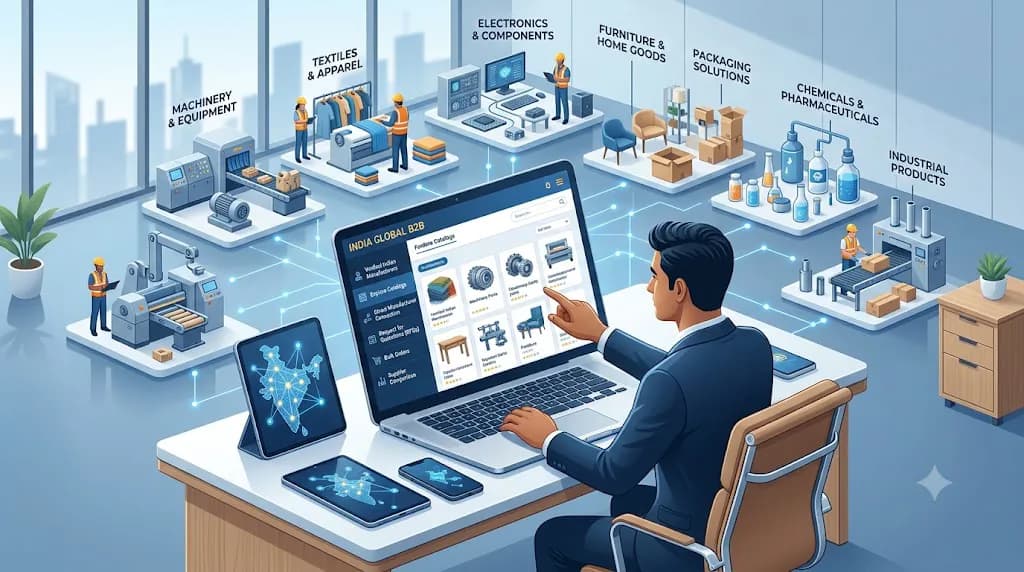
How to Buy Products From Manufacturers in India Through Digital B2B Platforms
Introduction
Finding the right manufacturer is one of the most important steps in B2B purchasing. Whether a business needs industrial equipment, furniture, electrical products, packaging materials, textiles, chemicals, consumer goods or specialized components, choosing the right manufacturing partner can influence product quality, pricing, supply continuity and long-term business relationships.
Traditionally, businesses have relied on trade shows, referrals, local markets, distributors, printed directories and personal networks to discover manufacturers. While these methods can still be useful, digital technology has created another route for product sourcing. Digital B2B platforms allow buyers to discover businesses, explore product categories, compare potential suppliers and initiate business conversations online.
For businesses looking to buy products from manufacturers in India, digital B2B platforms can simplify the initial supplier-discovery process. Instead of searching through multiple disconnected sources, buyers can explore companies and products through a centralized digital environment.
However, finding a manufacturer online is only the beginning. Buyers still need to evaluate product information, manufacturing capabilities, business details, specifications, minimum order requirements, pricing, delivery terms and communication before making a purchasing decision.
Platforms such as BONC Network can form part of this digital B2B ecosystem by helping businesses discover companies and products and create opportunities for professional business connections.
This article explains how businesses can use digital B2B platforms to find Indian manufacturers, evaluate suppliers, compare products and develop a more structured B2B purchasing process.
Understanding Digital B2B Platforms
A digital B2B platform is an online environment designed to facilitate interactions between businesses.
Unlike consumer marketplaces, B2B platforms generally focus on business-oriented transactions and relationships. Their users may include manufacturers, suppliers, distributors, wholesalers, exporters, importers, service providers and institutional buyers.
A digital B2B platform can bring together information about:
- Businesses
- Products
- Categories
- Manufacturing capabilities
- Supplier profiles
- Business contact information
- Product specifications
- Buyer requirements
- Business inquiries
This creates a digital starting point for businesses looking for new suppliers.
Why Businesses Buy Directly From Manufacturers
Buying directly from manufacturers can be relevant for businesses that purchase products in larger quantities or require specific product specifications.
When a buyer communicates directly with a manufacturer, the buyer may be able to discuss requirements related to:
- Product specifications
- Quantity
- Customization
- Packaging
- Manufacturing capacity
- Delivery schedules
- Quality requirements
- Commercial terms
The exact advantages depend on the product, supplier and transaction structure.
Direct manufacturer relationships can also create opportunities for long-term procurement partnerships rather than one-time purchases.
Why India Is an Important Manufacturing Market
India has a broad manufacturing base covering numerous industries and product categories.
Businesses can find manufacturers across sectors such as:
- Textiles and garments
- Furniture
- Pharmaceuticals
- Food processing
- Chemicals
- Electrical equipment
- Electronics
- Industrial machinery
- Automotive components
- Packaging
- Construction materials
- Home and kitchen products
- Agricultural equipment
- Renewable-energy-related products
For buyers, this diversity creates significant sourcing opportunities.
At the same time, the wide range of manufacturers can make supplier discovery challenging. A buyer may need to search across different cities, industrial clusters and product categories.
Digital B2B platforms can help organize this discovery process.
How Digital B2B Platforms Change Manufacturer Discovery
One of the biggest changes introduced by digital B2B platforms is the way buyers search for suppliers.
Instead of beginning with a physical location, buyers can begin with a product requirement.
For example, a buyer looking for industrial pumps can search for relevant manufacturers and explore companies offering those products.
Similarly, a furniture buyer can look for manufacturers specializing in a particular furniture category.
This product-first approach can make supplier discovery more focused.
From Local Search to Digital Discovery
The traditional process may look like:
Market Search → Referrals → Supplier Contacts → Product Inquiry
A digital approach can look like:
Product Search → Manufacturer Discovery → Product Evaluation → Supplier Inquiry → Business Discussion
The second process can help buyers discover businesses beyond their immediate geographic network.
Define Your Product Requirement Before Searching
Before using a digital B2B platform, buyers should clearly define what they need.
A vague requirement can produce a large number of irrelevant results.
Businesses should identify:
- Product category
- Product type
- Required quantity
- Technical specifications
- Intended application
- Quality requirements
- Target price range
- Delivery location
- Expected delivery timeline
- Customization requirements
The more specific the requirement, the easier it becomes to identify relevant manufacturers.
Search for Manufacturers by Product Category
Digital B2B platforms commonly organize products and businesses into categories.
Buyers can use category-based searches to narrow their options.
For example, instead of searching broadly for "manufacturers in India," a buyer could search for:
Industrial Pumps → Pump Manufacturers → Relevant Indian Suppliers
Similarly:
Office Furniture → Furniture Manufacturers → Relevant Businesses
This approach reduces irrelevant results and helps buyers focus on companies with relevant product capabilities.
Explore Manufacturer Business Profiles
Once potential manufacturers are identified, buyers should examine their business profiles carefully.
A useful manufacturer profile can provide information about the company's products, industry, location and capabilities.
Buyers should look for details such as:
- Company name
- Business category
- Manufacturer status
- Location
- Product range
- Manufacturing specialization
- Company description
- Contact information
- Product listings
- Relevant business information
A detailed profile can provide a better starting point for supplier evaluation.
Examine Product Information Carefully
Finding a manufacturer does not necessarily mean finding the right product.
Buyers should examine individual product listings to understand what is being offered.
Important information can include:
- Product name
- Product model
- Product description
- Features
- Specifications
- Materials
- Dimensions
- Capacity
- Applications
- Packaging information
- Available variants
Technical products require especially careful evaluation because seemingly similar products may have significant differences in specifications.
Look for Relevant Manufacturing Experience
A manufacturer may list many products, but buyers should consider whether the company has relevant experience with the specific product or industry requirement.
For example, a buyer looking for specialized industrial equipment may need a manufacturer experienced in that particular application.
Questions to consider include:
- Does the manufacturer specialize in this product?
- Does the company serve the relevant industry?
- Can the manufacturer handle the required quantity?
- Does it offer customization?
- Does it have experience with similar requirements?
These questions can help move the process beyond basic product discovery.
Compare Multiple Manufacturers
One of the biggest benefits of digital B2B platforms is the ability to discover multiple potential suppliers.
Instead of immediately choosing the first manufacturer found, buyers can create a shortlist.
The shortlist can then be compared based on:
Evaluation FactorWhat Buyers Can Check
Product
Specification and suitability
Manufacturer
Relevant manufacturing experience
Quantity
Ability to meet required volume
Quality
Quality requirements and documentation
Pricing
Quotation and commercial terms
Delivery
Lead time and delivery capability
Customization
Availability of required modifications
Communication
Responsiveness and clarity
Location
Logistics and transportation considerations
The comparison should be based on the buyer's specific requirements.
Ask Manufacturers the Right Questions
After identifying potential suppliers, buyers should initiate a detailed business conversation.
A good inquiry should include the information the manufacturer needs to provide an accurate response.
For example:
Product Required: Industrial Pump
Quantity: 500 units
Application: Commercial Water Systems
Required Specification: Defined technical parameters
Delivery Location: Buyer location
Expected Delivery: Required timeline
Customization: If applicable
The manufacturer can then respond based on the actual requirement.
This is more effective than sending a generic message such as "Send price."
Request a Detailed Quotation
Price is an important part of B2B purchasing, but buyers should not evaluate price in isolation.
A quotation may include:
- Unit price
- Minimum order quantity
- Taxes
- Packaging
- Transportation
- Delivery charges
- Payment terms
- Lead time
- Warranty
- Installation requirements
- Additional services
Buyers should make sure quotations are comparable before making a commercial decision.
Understand Minimum Order Quantity
Minimum Order Quantity, or MOQ, is particularly important when buying directly from manufacturers.
Manufacturers may establish MOQs based on production economics, raw materials, packaging and manufacturing processes.
A buyer should ask:
- What is the minimum order quantity?
- Can smaller quantities be supplied?
- Does pricing change with volume?
- Is the MOQ different for customized products?
Understanding MOQ early can prevent misunderstandings later.
Evaluate Product Quality
Quality evaluation is essential when buying from manufacturers.
Digital platforms can help buyers discover potential suppliers, but online discovery should not replace appropriate due diligence.
Depending on the product, buyers may request:
- Product samples
- Technical documents
- Test reports
- Certifications
- Quality specifications
- Manufacturing information
- Warranty details
The type of verification required depends on the industry and product.
For regulated or safety-critical products, buyers may need additional professional or regulatory checks.
Consider Manufacturer Location and Logistics
India has manufacturing clusters across different states and cities.
A manufacturer's location can affect transportation costs, delivery time and logistics planning.
For example, a buyer may find relevant manufacturers in:
- Delhi NCR
- Mumbai
- Pune
- Ahmedabad
- Surat
- Rajkot
- Bengaluru
- Chennai
- Hyderabad
- Kolkata
- Coimbatore
- Ludhiana
- Jaipur
- Faridabad
The appropriate location depends on the product category.
However, digital platforms can make it possible to discover manufacturers beyond the buyer's immediate geographic area.
Use Digital Platforms to Expand Supplier Networks
One of the major advantages of digital B2B platforms is broader supplier discovery.
A buyer who traditionally works with three or four suppliers may discover additional manufacturers through digital search.
This can be useful for:
- Backup supplier development
- New product sourcing
- Price comparison
- Geographic diversification
- New market entry
- Customized manufacturing requirements
Building a broader supplier network can give businesses more options when market conditions change.
How BONC Network Can Support Manufacturer Discovery
BONC Network provides a B2B networking environment where businesses can discover companies, showcase products and explore business connections.
For buyers looking to find manufacturers in India, a platform such as BONC Network can serve as a digital starting point for exploring relevant businesses and product listings.
The process can involve discovering a product category, reviewing business information, exploring products and initiating communication with potential suppliers.
For manufacturers, maintaining a complete digital business presence can help make their products more discoverable to businesses searching for relevant suppliers.
This creates a two-sided ecosystem where buyers can explore products and manufacturers can present their capabilities.
Product Discovery and Supplier Discovery Can Work Together
A buyer does not always begin with a manufacturer name.
Sometimes the buyer knows exactly what product is required but does not know who manufactures it.
Digital B2B platforms can connect these two needs.
The buyer searches for the product and discovers businesses associated with it.
This creates a useful process:
Product Requirement → Product Search → Manufacturer Discovery → Supplier Evaluation → Inquiry
This is particularly useful when buyers are entering an unfamiliar product category.
Use RFQs for Specific Requirements
For larger or more technical purchases, buyers may need quotations from multiple suppliers.
An RFQ, or Request for Quotation, can help communicate a structured requirement.
A useful RFQ can include:
- Product details
- Required quantity
- Specifications
- Quality standards
- Delivery requirements
- Packaging requirements
- Location
- Commercial expectations
Digital B2B environments that support buyer-supplier communication can make this process more organized.
The objective is to ensure that manufacturers understand the requirement before providing commercial information.
Evaluate Communication Quality
Communication is an important part of supplier selection.
A manufacturer may have an appropriate product, but unclear communication can create challenges during procurement.
Buyers should observe whether the supplier:
- Responds within a reasonable timeframe
- Understands the requirement
- Provides complete information
- Answers technical questions
- Communicates commercial terms clearly
- Provides realistic timelines
Good communication can become particularly important when orders involve customization or large quantities.
Check Business Information Before Ordering
Digital discovery should be followed by appropriate verification.
Before placing a significant order, buyers may want to verify relevant business information depending on the transaction.
This can include:
- Legal business details
- GST information where applicable
- Business address
- Relevant certifications
- Product documentation
- Manufacturing capability
- References where appropriate
- Payment details
The exact checks depend on the value, industry and nature of the transaction.
Understand Payment and Delivery Terms
Before confirming an order, buyers should understand the commercial terms.
Important considerations include:
- Advance payment requirements
- Balance payment
- Payment milestones
- Delivery terms
- Shipping responsibility
- Insurance
- Taxes
- Cancellation terms
- Return or replacement conditions
- Warranty
Clear documentation can reduce the possibility of misunderstandings.
Consider Long-Term Supplier Relationships
B2B purchasing is often more valuable when it develops into a long-term relationship.
A reliable manufacturer can become an important part of a company's supply chain.
After a successful initial order, businesses can evaluate the supplier based on:
- Product consistency
- Delivery performance
- Communication
- Pricing stability
- Ability to scale
- Problem resolution
- Customer support
A digital B2B platform can help initiate the relationship, but the long-term relationship depends on actual business performance.
Benefits of Buying Through Digital B2B Platforms
Digital B2B platforms can offer several practical benefits for buyers.
Wider Supplier Discovery
Buyers can discover manufacturers beyond their existing networks.
Faster Product Research
Digital product listings can make initial research more convenient.
Easier Business Comparison
Buyers can create a shortlist of potential suppliers.
Better Product Visibility
Detailed product information can help buyers understand available options.
Business Networking
Buyers can discover companies and initiate professional conversations.
Market Expansion
Businesses can explore suppliers from different regions and manufacturing clusters.
These benefits make digital B2B platforms useful for the early and middle stages of procurement.
Challenges Buyers Should Still Consider
Digital platforms can simplify supplier discovery, but they do not eliminate procurement risks.
Buyers should remain aware of challenges such as:
- Incomplete product information
- Outdated listings
- Unclear pricing
- Different quality standards
- MOQ restrictions
- Delivery limitations
- Communication gaps
- Verification requirements
- Product specification differences
This is why buyers should combine digital discovery with proper supplier due diligence.
Avoid Choosing a Manufacturer Based Only on Price
Price is important, but the lowest quotation may not always represent the most suitable option.
A buyer should consider the total purchasing requirement.
For example:
Product Quality + Price + Delivery + MOQ + Warranty + Communication + Service
A supplier offering a lower unit price may have longer delivery times or different specifications.
Therefore, buyers should compare the complete commercial proposition rather than one number.
How to Build a Manufacturer Shortlist
A practical shortlist can contain three to five relevant manufacturers.
For each supplier, record:
- Company name
- Product
- Location
- Manufacturer category
- Key specifications
- MOQ
- Quoted price
- Delivery timeline
- Customization options
- Quality documentation
- Communication status
This makes comparison easier and creates a clear procurement record.
Digital B2B Platforms and Procurement Efficiency
Procurement teams often spend significant time searching for suppliers and gathering information.
Digital platforms can reduce some of the manual effort involved in initial supplier discovery.
Instead of repeatedly searching through unrelated sources, buyers can use categories, product searches and business profiles to build a supplier pipeline.
This can make procurement more systematic.
However, efficiency should not come at the expense of verification.
The ideal approach combines digital convenience with responsible procurement practices.
Buying From Manufacturers for Bulk Requirements
Bulk purchasing requires additional planning.
Before placing a large order, buyers should evaluate:
- Production capacity
- Raw material availability
- Lead time
- Quality consistency
- Packaging
- Transportation
- Storage
- Payment terms
- Scalability
A manufacturer capable of supplying 100 units may not necessarily be able to supply 10,000 units under the same timeline.
Therefore, production capacity should be discussed before confirming a large order.
Customized Product Manufacturing
Some businesses require products that are not available as standard catalog items.
Digital B2B platforms can help buyers discover manufacturers that may be able to discuss customization.
A buyer should provide:
- Drawings
- Dimensions
- Materials
- Technical specifications
- Required quantity
- Quality standards
- Packaging requirements
- Expected delivery timeline
The manufacturer can then assess whether the requirement is technically and commercially feasible.
Using Digital Platforms for Supplier Expansion
Businesses should not necessarily use digital B2B platforms only when they urgently need a supplier.
They can also use them for continuous supplier research.
For example, a procurement team can periodically identify:
- New manufacturers
- Alternative suppliers
- New products
- New manufacturing regions
- Emerging businesses
- Alternative product categories
This creates a stronger supplier-development process.
Creating a Better Digital Buying Workflow
Businesses can establish a simple workflow for buying from manufacturers through digital B2B platforms.
Requirement Definition
Clearly establish what needs to be purchased.
Digital Search
Search relevant products and manufacturers.
Shortlisting
Identify businesses that appear relevant.
Product Evaluation
Review specifications and product information.
Supplier Inquiry
Send detailed requirements.
Quotation Comparison
Compare commercial and technical responses.
Verification
Conduct appropriate supplier and product checks.
Order Discussion
Finalize commercial, delivery and quality terms.
Purchase
Place the order after completing necessary due diligence.
Performance Review
Evaluate the supplier after delivery.
This workflow provides structure without making the procurement process unnecessarily complicated.
The Role of Business Networking in B2B Purchasing
Purchasing is not always a simple transaction.
Many B2B relationships involve repeated communication, technical discussions and negotiation.
Business networking platforms can create opportunities for these relationships to begin.
A buyer may discover a manufacturer, communicate about a product and eventually develop a longer-term relationship.
This makes digital networking relevant to procurement as well as marketing.
The Importance of Maintaining Updated Supplier Information
Manufacturers should also recognize the importance of maintaining accurate digital profiles.
Buyers rely on business information when evaluating potential suppliers.
Manufacturers can improve their digital presence by keeping:
- Company information updated
- Product listings accurate
- Specifications current
- Contact details correct
- Business categories relevant
- Product images professional
- Manufacturing information clear
For buyers, updated information makes supplier discovery more useful.
Future of Buying Products From Indian Manufacturers Online
Digital procurement is likely to become increasingly important as businesses become more comfortable researching suppliers online.
The future of B2B purchasing may involve greater integration between:
- Product discovery
- Supplier search
- Digital catalogs
- Buyer requirements
- RFQs
- Business networking
- Communication
- Data and analytics
This could make the initial stages of procurement more efficient while giving businesses access to broader supplier networks.
However, human judgment and appropriate verification will remain important for significant B2B purchases.
Making Digital B2B Buying More Effective
The best way to use a digital B2B platform is not simply to search and immediately order.
Businesses should use the platform as a supplier discovery and evaluation environment.
The process should combine:
Search + Research + Comparison + Communication + Verification + Negotiation
This creates a more informed procurement process.
Digital platforms provide access to information and connections, while businesses remain responsible for evaluating suppliers and making purchasing decisions according to their requirements.
Conclusion
Buying products from manufacturers in India through digital B2B platforms has created a more convenient way for businesses to discover products and potential suppliers. Instead of relying entirely on traditional networks, buyers can search by product category, explore manufacturer profiles, compare different suppliers and initiate business conversations online.
The process becomes particularly valuable when businesses have specific sourcing requirements, bulk purchasing needs, customized product requirements or plans to expand their supplier network.
However, digital discovery should always be combined with careful evaluation. Buyers should examine product specifications, manufacturing capabilities, MOQ, pricing, quality requirements, delivery timelines, payment terms and relevant business documentation before placing significant orders.
Platforms such as BONC Network can contribute to this ecosystem by bringing businesses and products into a connected B2B environment where manufacturers can showcase their offerings and buyers can discover potential suppliers.
Ultimately, successful B2B purchasing is not simply about finding the lowest price or the first manufacturer available. It is about finding a supplier whose product, quality, capacity, commercial terms, communication and delivery capabilities match the buyer's requirements.
With a structured approach, digital B2B platforms can turn manufacturer discovery from a time-consuming search into a more organized process—helping businesses move from product requirement to supplier discovery, from inquiry to negotiation, and from an initial connection toward a potential long-term B2B relationship.