How to Find Manufacturers in India and Build Reliable Business Connections
Published on: 16 Sep 2026
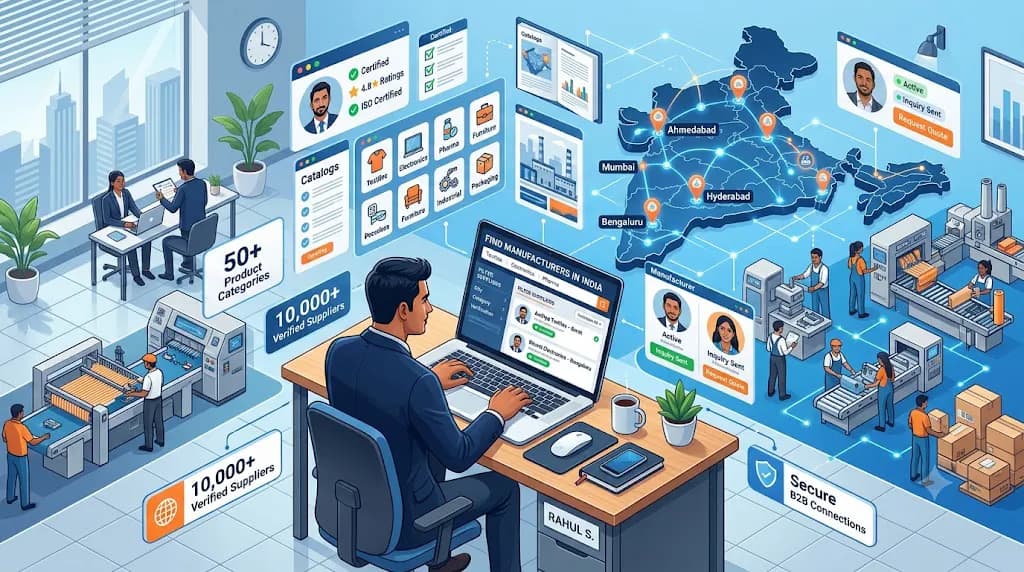
Find manufacturers in India
Introduction
Finding the right manufacturer is one of the most important steps for businesses involved in wholesale, retail, distribution, private labeling, product development, or industrial procurement. A reliable manufacturer can influence product quality, pricing, production capacity, delivery schedules, customization options, and the long-term stability of a supply chain. However, identifying suitable manufacturers is not always simple, especially when businesses need suppliers from a particular industry, location, product category, or production capability.
India has a large and diverse manufacturing ecosystem covering sectors such as textiles, pharmaceuticals, chemicals, engineering, machinery, automotive components, electronics, furniture, food processing, packaging, construction materials, consumer goods, and many other industries. For buyers, the challenge is often not whether manufacturers exist, but how to find manufacturers in India that match their exact requirements.
Traditional methods such as referrals, trade fairs, local markets, industry associations, and offline networks remain useful. At the same time, digital B2B platforms have changed how businesses discover manufacturers and suppliers. Instead of depending entirely on personal contacts or physical visits, buyers can use online business directories and networking platforms to explore companies, products, business profiles, categories, locations, and potential supplier connections.
A digital B2B platform can make manufacturer discovery more structured by bringing businesses and product information together in one digital environment. Platforms such as BONC Network are designed around business networking and digital product discovery, giving manufacturers opportunities to present their businesses while helping buyers explore potential connections.
The objective is not simply to find the largest number of manufacturers. The real objective is to identify manufacturers whose products, capabilities, commercial terms, location, production capacity, and communication approach align with the buyer's requirements.
Why Businesses Need to Find the Right Manufacturers
Manufacturers are an important part of almost every B2B supply chain. A retailer may need a manufacturer for private-label products, a distributor may require bulk inventory, and an industrial company may need specialized equipment or components.
Choosing a manufacturer can affect several areas of business performance.
Product Quality
Product quality directly influences customer satisfaction, returns, reputation, and repeat business. A manufacturer that understands required specifications and maintains consistent production standards can become an important long-term supply-chain partner.
Pricing and Margins
Buying directly from a manufacturer may provide businesses with an opportunity to understand factory-level pricing and negotiate based on order volume, specifications, packaging, or long-term requirements.
However, the lowest quoted price should not automatically determine the final decision. Transportation, packaging, quality, taxes, minimum order quantities, payment terms, and delivery schedules can all influence the actual procurement cost.
Production Capacity
A manufacturer may be suitable for small orders but unsuitable for a business that requires large-scale production. Therefore, buyers need to understand whether the manufacturer's production capacity matches their expected demand.
Customization
Many businesses require customized products, private labeling, specific dimensions, packaging, materials, colors, or technical specifications. The ability to customize can therefore be an important manufacturer-selection factor.
Supply Continuity
A manufacturer that can consistently supply products according to agreed specifications can help businesses maintain inventory and serve customers more reliably.
Why Finding Manufacturers in India Can Be Challenging
India's manufacturing ecosystem is extensive and geographically distributed. Manufacturers operate across metropolitan cities, industrial clusters, smaller cities, and specialized production regions.
This diversity creates opportunities but also creates a discovery challenge.
A buyer searching for a particular product may encounter manufacturers, distributors, wholesalers, traders, importers, and service providers using similar product terminology. Distinguishing between these business types can require additional research.
Another challenge is incomplete information. Some businesses may have limited digital presence, outdated product information, or insufficient details about their manufacturing capabilities.
This is where digital B2B platforms can provide a more organized starting point.
How Digital B2B Platforms Help Find Manufacturers in India
Digital B2B platforms provide an online environment where businesses can discover companies, products, suppliers, and potential commercial connections.
Instead of searching randomly across multiple sources, buyers can begin with product categories, business categories, locations, keywords, or supplier requirements.
Product-Based Discovery
If a buyer already knows the required product, product-based search can narrow the manufacturer discovery process.
For example, a business searching for industrial pumps can look specifically for companies dealing with pumps, pump components, industrial equipment, or related machinery.
Similarly, a furniture buyer can search within furniture and interior-related categories rather than exploring unrelated businesses.
Business Profile Discovery
Business profiles can help buyers understand what a company offers before initiating communication.
Relevant information may include:
- Business name
- Product categories
- Manufacturing capabilities
- Business location
- Product range
- Company description
- Contact information
- Industry specialization
- Business experience
- Product specifications
The availability of such information can reduce unnecessary communication with businesses that do not match the requirement.
Location-Based Discovery
Location can be important for procurement because transportation costs, delivery time, production clusters, and logistics networks vary by region.
A buyer may therefore search for manufacturers in a specific city, state, or industrial region.
For example, a business sourcing textiles may explore established textile manufacturing regions, while an industrial buyer may search around engineering and machinery clusters.
Define Your Requirement Before Searching
Before using a manufacturer directory or B2B platform, businesses should clearly define what they need.
A vague requirement can produce a large number of irrelevant results.
A useful manufacturer-search requirement may include:
- Product name
- Product category
- Required quantity
- Product specifications
- Material requirements
- Quality standards
- Customization requirements
- Packaging requirements
- Target price range
- Delivery location
- Expected delivery timeline
- Minimum order expectations
For example, instead of searching simply for "furniture manufacturer," a buyer could define the requirement as commercial metal furniture, specific dimensions, bulk quantity, customized finish, and delivery to a particular region.
The more precise the requirement, the easier it becomes to identify relevant manufacturers.
Search Manufacturers by Product Category
One of the simplest approaches to finding Indian manufacturers is category-based discovery.
Digital B2B platforms can organize businesses into industries and product categories, allowing buyers to narrow their search.
Common manufacturing categories include:
Industrial Products
- Machinery
- Pumps
- Electrical equipment
- Automation systems
- Industrial tools
- Process equipment
- Material-handling equipment
Consumer Products
- Home appliances
- Furniture
- Kitchen products
- Personal care products
- Lifestyle products
- Consumer electronics
Textiles and Apparel
- Fabrics
- Garments
- Home textiles
- Industrial textiles
- Accessories
Construction and Building Materials
- Plywood
- Laminates
- Sanitary products
- Hardware
- Flooring
- Construction equipment
Pharmaceuticals and Healthcare
- Pharmaceutical products
- Nutraceuticals
- Healthcare equipment
- Medical supplies
Searching by category can make supplier discovery more relevant than using broad generic searches.
Examine Manufacturer Profiles Carefully
Finding a manufacturer is only the beginning. Buyers should examine available business information before starting serious procurement discussions.
A business profile can provide useful context about the company and its product range.
Look for information related to:
- Product categories
- Manufacturing activities
- Product specifications
- Location
- Industry served
- Business description
- Available product listings
- Contact channels
If a profile contains detailed and consistent information, it can provide a stronger starting point for further communication.
However, online information should not be treated as a complete substitute for business verification.
Evaluate the Manufacturer's Product Range
A manufacturer may specialize in one product or offer a broad portfolio.
Understanding the product range can help determine whether the supplier can support current and future requirements.
For example, a distributor purchasing industrial components may benefit from working with a manufacturer that produces several compatible products. This can simplify future sourcing and reduce the need to search for separate suppliers.
At the same time, specialization can be valuable when the requirement involves technically complex or highly customized products.
Compare Multiple Manufacturers
A common mistake in supplier discovery is contacting only one manufacturer and making an immediate decision.
A better approach is to create a shortlist.
The shortlist can contain manufacturers that appear relevant based on:
- Product compatibility
- Manufacturing capability
- Location
- Product quality
- Pricing
- MOQ
- Production capacity
- Customization
- Delivery capability
- Communication
- Business requirements
Comparing multiple manufacturers gives buyers a broader understanding of the available market.
Ask Manufacturers the Right Questions
Once potential manufacturers have been identified, the next stage is communication.
A buyer should provide a clear requirement and ask relevant questions.
Important questions may include:
Are you the manufacturer or a distributor?
This helps establish the nature of the business relationship.
What is your minimum order quantity?
MOQ can significantly affect procurement planning.
Can you provide customized products?
This is particularly important for private-label and customized manufacturing.
What are your production timelines?
Lead time matters when inventory planning is important.
What specifications can you support?
Technical compatibility should be established before placing an order.
What packaging options are available?
Packaging can matter for retail products, exports, and branded goods.
Can you provide product samples?
Samples may help buyers evaluate product quality before making larger commitments.
Request Quotations From Manufacturers
A quotation provides a clearer picture of procurement costs.
When requesting a quotation, businesses should provide complete information rather than simply asking for a price.
A useful quotation request can include:
- Product
- Quantity
- Specifications
- Customization
- Packaging
- Delivery location
- Required delivery date
- Payment expectations
This allows manufacturers to provide more relevant commercial information.
Comparing quotations should also go beyond the headline price.
A slightly higher product price may sometimes be associated with better specifications, packaging, quality control, or delivery terms.
Understand Minimum Order Quantity
Minimum Order Quantity is an important factor when selecting manufacturers.
A large manufacturer may have a higher MOQ because its production model is optimized for bulk manufacturing.
A smaller manufacturer may offer lower MOQs but potentially have different production capacity or pricing structures.
Businesses should select MOQ requirements based on their inventory needs and working capital rather than choosing a supplier solely because of a low minimum order.
Evaluate Manufacturing Capacity
Manufacturing capacity becomes especially important when a business expects rapid growth.
A supplier that handles small orders successfully may not necessarily have the capacity to support significantly larger future requirements.
Ask about:
- Monthly production capacity
- Current order commitments
- Production lead time
- Additional capacity
- Equipment
- Workforce
- Scalability
This information can help businesses assess whether a manufacturer could become a long-term supplier.
Consider Manufacturer Location and Logistics
Location remains relevant even in digital B2B procurement.
A manufacturer's location can influence:
- Freight costs
- Delivery times
- Transportation availability
- Regional supply chains
- Warehousing
- Inspection visits
- Logistics planning
Digital platforms make it easier to discover manufacturers across India, but buyers should still consider how the manufacturer's location fits into their overall supply chain.
How BONC Network Can Support Manufacturer Discovery
Digital business networking platforms can play a useful role in connecting manufacturers, suppliers, buyers, and other businesses.
BONC Network provides a digital environment where businesses can showcase their profiles and products while other businesses can discover relevant companies and commercial opportunities.
For buyers trying to find manufacturers in India, a business networking platform can serve as one part of the supplier-discovery process. Product listings and business information can help buyers identify companies according to their product interests and requirements.
For manufacturers, maintaining a detailed digital presence can make their products easier for potential buyers to discover.
The broader value comes from creating a digital business ecosystem where product discovery and business networking can work together.
Use Product Discovery Alongside Supplier Discovery
Sometimes buyers begin with a product rather than a company.
For example, a buyer may know that they need a specific industrial component but may not know which manufacturer produces it.
In this situation, product discovery can lead to supplier discovery.
The process can look like:
Product Requirement → Product Search → Relevant Manufacturers → Business Profile → Communication → Quotation → Evaluation
This approach is useful because it starts with the actual procurement requirement rather than assuming which supplier should be contacted.
Use RFQs for Specific Requirements
Request for Quotation systems can make B2B procurement more structured.
An RFQ allows a buyer to communicate a defined requirement and invite relevant suppliers to respond.
For larger procurement requirements, RFQs can help businesses communicate:
- Product specifications
- Quantity
- Quality requirements
- Delivery expectations
- Packaging
- Commercial requirements
Digital B2B platforms that support structured business interactions can make this process easier to organize.
Verify Manufacturer Information Before Ordering
Digital discovery is useful, but businesses should conduct appropriate verification before entering significant commercial relationships.
Depending on the transaction, buyers may evaluate:
- Business registration details
- GST information where applicable
- Product certifications
- Factory information
- Quality documentation
- References
- Sample products
- Previous business experience
- Commercial terms
- Payment conditions
The level of verification should correspond to the value and risk of the transaction.
A small trial order may require a different verification process from a long-term high-value procurement contract.
Do Not Choose a Manufacturer Only on Price
Price is an important procurement factor, but it should be considered alongside other business requirements.
A very low price may not represent the lowest total procurement cost if it comes with:
- Higher defect rates
- Longer delivery times
- Poor packaging
- Unreliable communication
- Inconsistent quality
- High transportation costs
Businesses should therefore consider the complete supplier proposition.
Building a Manufacturer Shortlist
A structured shortlist can simplify manufacturer selection.
A simple comparison framework can include:
FactorWhat to Evaluate
Product
Does the manufacturer produce the required product?
Quality
Does the product meet required specifications?
MOQ
Is the minimum order suitable?
Price
Is the quotation commercially viable?
Capacity
Can the manufacturer handle expected demand?
Customization
Can the product be modified if required?
Location
Does the location work for logistics?
Lead Time
Can the supplier meet delivery requirements?
Communication
Are responses clear and timely?
Verification
Can relevant business information be validated?
This framework does not replace detailed due diligence, but it provides a practical starting point for comparison.
Benefits of Finding Manufacturers Through Digital B2B Platforms
Digital manufacturer discovery can provide several advantages.
Wider Supplier Reach
Businesses can explore manufacturers beyond their existing local network.
This is particularly useful for companies looking to expand their supplier base.
Faster Discovery
Digital search can reduce the time required to identify potential suppliers compared with relying entirely on offline networking.
Better Product Visibility
Manufacturers can showcase multiple products through digital listings, making it easier for buyers to understand their offerings.
Business Networking
B2B platforms can create opportunities for businesses to connect beyond individual transactions.
A manufacturer discovered through one product may become a supplier for additional products in the future.
Location-Based Opportunities
Buyers can explore manufacturers from different cities and regions instead of depending only on nearby suppliers.
Digital Communication
Businesses can initiate communication through digital channels and organize supplier discussions more efficiently.
Challenges Businesses Should Still Consider
Digital platforms improve discovery, but they do not eliminate procurement risks.
Businesses may still encounter:
- Incomplete information
- Outdated listings
- Miscommunication
- Quality differences
- Unrealistic quotations
- Capacity limitations
- Delivery delays
- Payment risks
- Product specification differences
Therefore, digital platforms should be considered a discovery and networking tool rather than a replacement for due diligence.
How Small Businesses Can Find Manufacturers in India
Small businesses often have limited procurement teams and budgets.
For them, digital manufacturer discovery can provide access to a broader supplier network without requiring extensive physical travel.
A small business can start by defining its product requirement, searching relevant categories, creating a shortlist, contacting several manufacturers, requesting quotations, and testing suitable suppliers through samples or smaller orders where appropriate.
This process can gradually help the business develop a reliable supplier network.
How Startups Can Find Indian Manufacturers
Startups often need flexibility because their product demand may change quickly.
A startup may require:
- Small initial quantities
- Product customization
- Private labeling
- Prototype development
- Flexible production
- Packaging support
- Scalable manufacturing
When searching for manufacturers, startups should therefore look beyond price and consider whether the manufacturer is capable of supporting product development and future scale.
Digital B2B platforms can help startups discover companies that may not already be part of their personal or professional network.
Finding Manufacturers for Bulk Orders
Bulk buyers generally have different requirements from small buyers.
They may prioritize:
- Large production capacity
- Competitive pricing
- Consistent quality
- Reliable delivery
- Long-term contracts
- Packaging
- Logistics
- Repeat-order capability
For these businesses, manufacturer discovery should focus heavily on production capacity and supply reliability.
Finding Manufacturers for Private Label Products
Private-label businesses need manufacturers that can produce goods according to specific brand requirements.
Potential requirements may include:
- Custom formulation
- Custom design
- Branding
- Packaging
- Labeling
- Product specifications
- Minimum order quantities
Therefore, the buyer should clearly communicate private-label requirements when contacting manufacturers.
The Role of Business Networking in Manufacturer Discovery
Manufacturing relationships often extend beyond a single transaction.
A manufacturer may introduce a buyer to another supplier, component producer, packaging company, logistics provider, or industry partner.
This makes business networking an important part of supplier development.
A digital B2B networking platform can help businesses build connections around products, industries, and commercial requirements.
Instead of treating manufacturer discovery as a one-time search, businesses can approach it as the development of a broader supplier ecosystem.
Keeping Your Supplier Search Organized
When searching for multiple manufacturers, organization becomes important.
Businesses can maintain a supplier database containing:
- Company name
- Product category
- Location
- Contact details
- Products
- MOQ
- Quotation
- Lead time
- Quality information
- Sample status
- Communication status
- Final evaluation
This helps procurement teams avoid repeated research and makes future supplier comparisons easier.
Digital B2B Platforms and the Future of Manufacturer Discovery
The process of finding manufacturers in India is increasingly moving toward digital discovery.
Businesses now expect to search for products, explore suppliers, communicate with companies, request information, and evaluate potential partnerships online.
As digital B2B ecosystems develop, manufacturer discovery may become increasingly connected with product catalogs, business profiles, digital inquiries, RFQs, recommendation systems, data-driven search, and business networking.
Artificial intelligence can further improve discovery by helping businesses identify relevant suppliers based on product requirements rather than relying only on exact keyword matches.
However, technology will remain most useful when combined with proper business verification and clear procurement processes.
Creating a Smarter Manufacturer Discovery Strategy
Businesses looking to find manufacturers in India can create a repeatable process rather than treating every supplier search as a completely new activity.
Start with a clearly defined product requirement. Search manufacturers through multiple relevant channels, including digital B2B platforms. Shortlist companies based on product compatibility and business information. Contact multiple manufacturers. Request quotations and samples where necessary. Compare commercial and operational factors. Verify important business information. Start with an appropriate order size and monitor performance.
Over time, the businesses that consistently document supplier performance can build stronger and more reliable procurement networks.
Conclusion
Learning how to find manufacturers in India is an important capability for businesses involved in wholesale, distribution, retail, private labeling, industrial procurement, and product development. India's large manufacturing ecosystem offers opportunities across numerous industries, but identifying the right manufacturer requires more than simply finding a company that sells a particular product.
Digital B2B platforms have made manufacturer discovery more accessible by bringing businesses, products, categories, and supplier information into a searchable online environment. They can help buyers expand beyond traditional networks, discover manufacturers in different regions, compare potential suppliers, and initiate business conversations more efficiently.
Platforms such as BONC Network can contribute to this digital ecosystem by connecting businesses through product discovery and business networking. Manufacturers can build digital visibility by showcasing their products and business information, while buyers can use these digital resources as a starting point for supplier research.
Ultimately, successful manufacturer sourcing depends on combining digital discovery with careful evaluation. Businesses should define their requirements, explore multiple manufacturers, compare relevant factors, communicate clearly, verify important information, and develop supplier relationships based on quality, reliability, capacity, and commercial suitability.
The future of B2B procurement is not simply about finding more suppliers. It is about finding relevant manufacturers faster, understanding their capabilities better, and building stronger business connections through smarter digital tools.