RFP vs RFQ: What They Mean, When to Use Them, and How to Raise Them Online
Published on: 25 Apr 2026
Introduction
If you have spent any time in procurement or business development, you have encountered the acronyms RFP and RFQ. You may have used them interchangeably. You may have been confused about when to use one versus the other. Or you may have been on the receiving end of one — as a supplier asked to respond to a document you did not fully understand.
This guide clears up the confusion. It explains exactly what an RFP and an RFQ are, when each is the right tool for the job, why managing them over email and spreadsheets costs more than most companies realise, and how raising them on a modern cloud procurement platform like BONC Network transforms the process from administrative burden to strategic advantage.
Understanding the Definitions
RFP stands for Request for Proposal. An RFQ stands for Request for Quotation. The distinction sounds simple, but the difference in application is significant.
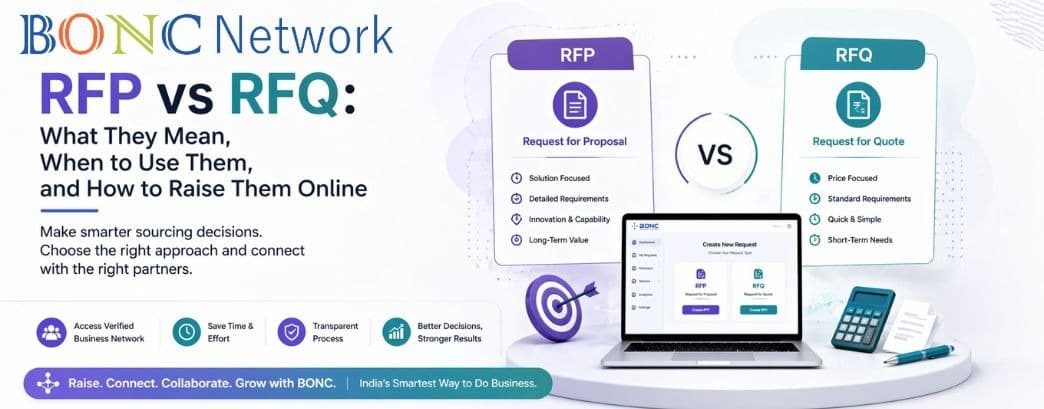
An RFP is used when you know what outcome you need, but you are open to different approaches for achieving it. You are asking vendors or partners to propose how they would solve your problem, deliver your project, or fulfil your requirement. The proposals you receive will differ in methodology, scope, timeline, and pricing — and your evaluation will weigh multiple factors beyond price alone.
An RFQ is used when you know exactly what you need and you want to compare prices across multiple suppliers. You are not asking for creative proposals. You are asking for like-for-like quotations for a defined specification. A simple way to remember: an RFP is for when you are buying a solution; an RFQ is for when you are buying a commodity or a well-defined deliverable.
When to Use an RFP
Use an RFP when the scope of what you need is complex, when the approach matters as much as the price, or when you want to invite innovation from potential vendors.
Common RFP scenarios in an Indian B2B context include: procuring IT system development or technology services where different vendors may offer fundamentally different architectural approaches; engaging a logistics or supply chain management partner where methodology and network coverage vary significantly; hiring a marketing or consulting agency where strategy and creative thinking are being evaluated; or sourcing a manufacturing partner for a new product where design-for-manufacture capability and process quality are part of the evaluation.
When you issue an RFP, your document should define the problem clearly, describe the context and constraints, specify evaluation criteria, and set a timeline. You are inviting vendors to think, not just price.
When to Use an RFQ
Use an RFQ when the specification is fully defined and what you need is competitive pricing across qualified suppliers. Common RFQ scenarios include: sourcing raw materials at defined specifications; procuring office equipment, machinery, or fleet vehicles; requesting quotations for packaging materials or standard components; or getting competitive bids for maintenance, repair, or routine operational services.
The clarity of an RFQ is its strength. Because you have defined exactly what you need, the responses are directly comparable, and the selection process is efficient. The risk of an RFQ is that it is only as good as your specification — an ambiguous spec produces ambiguous quotations that are impossible to compare meaningfully.
The Hidden Costs of Managing RFPs and RFQs Over Email
Most Indian SMEs manage their procurement processes through email, WhatsApp, and spreadsheets. This approach works — until it does not. Version control is a persistent problem. When an RFP goes out to ten vendors via email and then gets revised twice, managing which vendors have the latest version is a manual exercise prone to error. Vendors responding to different versions produce incomparable proposals.
Response tracking is another drain. Knowing which vendors have responded, which have asked for clarification, and which have gone silent requires someone to maintain a manually updated tracker. Confidentiality is frequently compromised — email-based procurement is easy to forward and share, undermining your negotiating position. Audit trails are absent — when a procurement decision is challenged, the ability to demonstrate a fair, documented, transparent process is essential. A structured procurement platform provides this; email threads do not.
How to Raise Your First RFP or RFQ on BONC Network
A cloud-native procurement platform like BONC Network changes the procurement process fundamentally. Centralisation removes fragmentation. Structured templates reduce error. Vendor management becomes proactive — rather than emailing a static list of known suppliers, you can use BONC Network's deal discovery capabilities to identify and invite new vendors who meet your qualification criteria.
Raising a procurement document on BONC Network is a structured, guided process. Create or log in to your BONC Network account at boncnetwork.com. From your procurement dashboard, select whether you are raising an RFP or an RFQ. The platform guides you through structured document creation, prompting you for all the information vendors will need to respond effectively.
Define your specification. Set your vendor list — you can invite existing suppliers from your network, or use BONC Network's discovery tools to identify new qualified vendors. Set your timeline and publish. Vendors receive the document through the platform and submit responses directly. You receive instant notification of submissions and can track response status in real time. BONC Network's side-by-side comparison tools allow you to evaluate submissions against your stated criteria, document your evaluation rationale, and issue award notifications — all within the platform.
Post your first RFQ or RFP free at boncnetwork.com today.