Why Account Balance Management Matters for Businesses on BONC Network
Published on: 25 Sep 2026
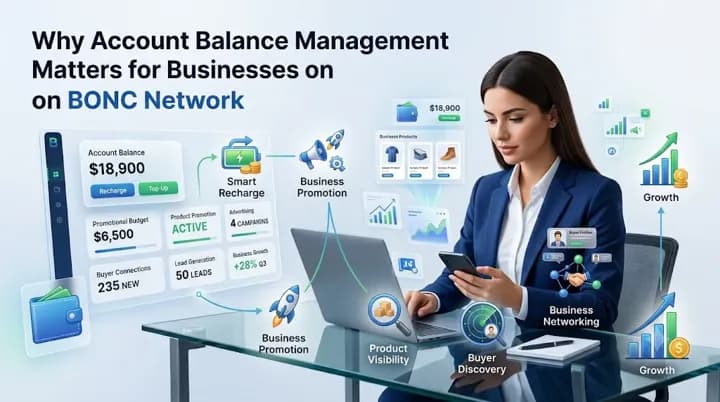
Why Account Balance Management Matters for Businesses on BONC Network
Introduction
Managing a modern business involves much more than maintaining inventory, handling customer relationships or monitoring financial transactions. As businesses increasingly depend on digital platforms for visibility, promotion, networking and lead generation, managing the resources allocated to these activities has also become important. One area that deserves greater attention is account balance management.
For businesses operating in a digital B2B environment, an account balance can represent access to different platform-based promotional and business opportunities. When businesses use account recharge or top-up facilities, they need a clear understanding of how their available balance can support their objectives. Instead of treating recharge as a routine transaction, companies can approach it as part of their wider digital marketing and business development strategy.
BONC Network provides a B2B environment where businesses can showcase their companies and products, discover other businesses and explore opportunities for networking and promotion. Within such an ecosystem, effective account balance management can help businesses organize their promotional activities according to their individual requirements.
Whether a company wants to promote a new product, improve product visibility, support business branding, advertise an event, promote a trade show or increase its overall digital presence, having a structured approach to account balance can make these activities easier to plan.
The importance of account balance management is therefore not limited to knowing how much balance is available. It is about understanding where, when and why available resources should be used to support business objectives.
Understanding Account Balance Management for Businesses
Account balance management refers to the process of monitoring and planning the balance available within a digital business account. For businesses using online platforms, this balance may be connected with different services, promotional activities or platform benefits.
In a traditional business environment, companies often create separate budgets for advertising, branding, events and customer acquisition. Digital platforms can bring several of these activities into one ecosystem, making balance management an important part of overall planning.
A business should know its current balance, understand the activities it wants to undertake and determine when additional balance may be required.
This creates a simple relationship:
Available Balance → Planned Activity → Business Objective → Performance Review
The objective is not simply to use the balance. The objective is to use it in a way that supports meaningful business activities.
Why Account Balance Management Matters in a Digital B2B Environment
B2B businesses operate in highly competitive markets. Manufacturers compete for distributors, suppliers look for buyers, service providers seek new clients and startups try to establish their presence among established competitors.
Digital visibility has become an important part of this environment.
However, businesses often have multiple promotional requirements at the same time. A company may want to promote products while also building its brand and participating in an upcoming industry event.
Without proper account balance management, promotional activities can become difficult to prioritize.
Effective management helps businesses decide which activities deserve attention and how available resources should be distributed.
Better Control Over Digital Resources
A business that regularly monitors its balance can plan future activities more effectively. It can avoid unexpected shortages and make timely decisions about recharge.
This is particularly useful when businesses are preparing for product launches, seasonal campaigns, exhibitions or important events.
The Growing Importance of Digital Recharge and Top-Up Solutions
Digital recharge has become a familiar concept across many online services. For businesses, however, recharge can have a more strategic purpose when connected to promotional and networking activities.
A top-up allows a business to add balance when it needs additional resources for platform benefits.
The key is to connect every recharge with a specific business requirement.
For example, a company may recharge before launching a major product promotion campaign. Another company may top up its balance before promoting an upcoming trade show or event.
This approach allows businesses to maintain greater control over their digital promotional resources.
How BONC Network Creates a Connected B2B Environment
BONC Network is designed around the idea of bringing businesses, products and business opportunities into a connected digital environment.
Businesses can use a B2B networking platform to improve their digital presence, showcase their offerings and discover potential business connections.
Within this environment, account balance management can support activities that contribute to business visibility and promotion.
Instead of treating account recharge as a separate financial task, businesses can include it within their broader strategy for product marketing, branding, advertising, event promotion and networking.
This makes account management part of a larger business-growth framework.
Account Balance and Business Promotion
Business promotion is one of the areas where effective balance management can have practical value.
A company may have excellent products, but buyers need to discover those products before they can consider purchasing them. Digital promotion can help businesses increase awareness and bring greater attention to their offerings.
However, promotional activities should be planned according to business priorities.
For example, if a company has recently launched a new product, it may choose to focus more resources on that product rather than spreading its promotional efforts across its entire catalog.
This allows businesses to use their available balance with greater purpose.
Supporting Product Visibility Through Account Management
Product visibility is an important part of B2B marketing.
Buyers frequently compare products, suppliers and manufacturers before initiating business conversations. A company therefore needs to make sure that its products are presented clearly and remain discoverable within relevant digital environments.
Businesses can use promotional resources to support product visibility while ensuring that their product information is complete.
Important information may include:
- Product name
- Product description
- Key features
- Technical specifications
- Applications
- Product images
- Industry category
- Business details
- Contact information
A strong product presence combined with planned promotion can create a better foundation for buyer discovery.
Account Balance Management for New Product Launches
New product launches require careful timing.
A business may spend significant resources developing a product, but the launch can only create opportunities if the right audience becomes aware of it.
Digital platforms can support launch campaigns by providing opportunities for product visibility and promotion.
Account balance management becomes relevant because businesses can plan their promotional resources around the launch timeline.
Before Launch
Businesses can prepare product information, branding material and promotional messaging.
During Launch
The focus can move toward product visibility, advertising and buyer discovery.
After Launch
Businesses can continue promotion while following up with potential buyers and evaluating the response.
This approach helps businesses connect their account resources with the different stages of a product campaign.
Managing Balance for Business Branding
Brand awareness plays an important role in B2B relationships.
Businesses often prefer to work with companies that appear professional, reliable and established. Consistent branding can help create this perception.
Account balance management can support branding activities by allowing businesses to plan promotional resources over time.
Instead of investing heavily in branding for a short period and then stopping completely, businesses can consider a consistent approach.
This can include:
- Company promotion
- Product visibility
- Digital advertising
- Event participation
- Business networking
- Industry-focused content
The goal is to maintain a recognizable business presence.
Account Top-Up and Digital Advertising
Digital advertising can provide businesses with opportunities to promote products and services to relevant audiences.
However, advertising should always be connected to a clear objective.
Businesses can consider several factors before allocating balance toward advertising:
- Target audience
- Product being promoted
- Campaign duration
- Market being targeted
- Business objective
- Expected buyer response
This helps prevent promotional resources from being used without direction.
A well-managed account balance can therefore support more structured advertising decisions.
Trade Show and Expo Promotion
Trade shows and expos remain valuable for B2B companies because they bring industry participants together.
Manufacturers, suppliers, distributors, buyers and service providers can use these events to discover new opportunities and strengthen professional relationships.
Digital promotion can complement physical participation.
A company attending an expo may want to create awareness before the event, promote its products during the event and maintain visibility afterward.
Account balance management can support this complete promotional cycle.
Pre-Event Promotion
Businesses can focus on creating awareness about their participation.
Event-Time Visibility
Businesses can promote products and business offerings while industry professionals are actively looking for relevant companies.
Post-Event Engagement
Businesses can continue communicating with prospects and maintaining visibility after the event.
Event Promotion and Promotional Balance
Events often operate within specific timelines.
If a business wants to maximize visibility around an event, promotional planning should begin before the event date.
Account balance management can help businesses prepare for these time-sensitive activities.
A company can review its upcoming event calendar, identify important events and allocate its promotional resources accordingly.
This creates better coordination between event marketing and digital business promotion.
Account Balance and B2B Lead Generation
The ultimate purpose of many promotional activities is to generate business opportunities.
A buyer may discover a company through a digital platform, explore its products and then decide to make an inquiry.
This creates a journey from visibility to potential business.
Business Profile → Product Discovery → Buyer Interest → Inquiry → Business Conversation → Potential Opportunity
Account balance management supports the promotional activities that help businesses become more visible during this journey.
However, promotion is only one part of lead generation. Businesses must also provide accurate information and respond professionally to inquiries.
Why Quality Product Information Matters Alongside Promotion
A promotional campaign can attract attention, but incomplete product information may prevent a buyer from taking the next step.
Businesses should therefore make sure their product listings are informative and up to date.
A potential buyer should be able to understand:
- What the product is
- What industry it serves
- What features it provides
- Where it can be used
- What specifications are relevant
- How to contact the supplier
This creates a stronger connection between promotional activity and potential buyer action.
Account Balance Management for Small and Medium Businesses
Small and medium-sized businesses often have limited marketing resources.
For these businesses, effective balance management can be particularly valuable because every promotional decision needs to support a clear objective.
An SME may decide to focus on one product category rather than promoting everything at once.
For example, a manufacturer launching a new industrial product could prioritize product visibility and buyer discovery.
A distributor may focus on promoting its most important product lines.
A startup could prioritize business branding and awareness.
This objective-based approach can help businesses make better use of limited promotional resources.
Managing Account Balance According to Business Objectives
Different businesses have different priorities.
A manufacturer may want to increase product discovery. A distributor may want to find new buyers. A startup may need greater brand visibility.
Therefore, account balance management should be flexible.
Product-Focused Businesses
Prioritize product promotion and product discovery.
Service-Based Businesses
Focus on company visibility, branding and lead generation.
Startups
Prioritize awareness, networking and market entry.
Event Businesses
Focus on event and trade show promotion.
Established Companies
Use promotional resources to support new products, new markets and ongoing brand visibility.
This ensures that balance management reflects the company's actual business requirements.
Account Balance and Business Networking
B2B growth depends heavily on relationships.
Businesses need reliable suppliers, distributors, customers, service providers and strategic partners.
A B2B networking platform can provide an environment where these connections can begin.
Account balance management can support this process indirectly by helping businesses maintain visibility and promote their products and company profiles.
Greater visibility can increase opportunities for relevant businesses to discover one another.
The result is a stronger connection between promotion and networking.
Building Consistent Business Visibility
One-time promotion may create temporary attention, but long-term business growth generally requires consistency.
Businesses should therefore think beyond individual promotional campaigns.
Account balance management can help companies plan promotional activities across longer periods.
A company may establish monthly, quarterly and annual objectives.
Monthly Planning
Focus on current products, business visibility and buyer discovery.
Quarterly Planning
Plan product campaigns, seasonal promotions and event participation.
Annual Planning
Prepare for major launches, market expansion and long-term branding.
This creates a more organized approach to digital promotion.
Account Balance as a Business Budgeting Tool
A business account balance can also be viewed as a practical budgeting mechanism.
Instead of using promotional resources without tracking them, companies can create an internal allocation plan.
Business ActivityMain ObjectivePlanning Focus
Product Promotion
Increase product visibility
Priority products
Branding
Improve business awareness
Company visibility
Advertising
Reach target audiences
Campaign goals
Event Promotion
Increase event visibility
Event timeline
Networking
Discover business opportunities
Relevant connections
The exact allocation will depend on the business.
The important principle is to connect available balance with specific business objectives.
Monitoring Account Balance Regularly
Effective management requires regular monitoring.
Businesses should know their available balance and understand how it is being used.
Regular reviews can help companies:
- Plan upcoming activities
- Avoid unexpected balance shortages
- Identify high-priority campaigns
- Adjust promotional plans
- Decide when additional recharge may be required
This is particularly important for companies managing several promotional activities simultaneously.
Account Balance and Seasonal Business Campaigns
Many industries experience seasonal demand.
Businesses may see increased activity during certain festivals, procurement cycles, financial periods, industry events or specific market seasons.
These periods can create valuable opportunities for targeted promotion.
By planning account balance before important seasonal periods, businesses can be better prepared to support promotional campaigns when buyer activity increases.
This can make seasonal marketing more structured and predictable.
Supporting Expansion Into New Markets
Market expansion requires visibility.
A company entering a new region may have limited brand recognition among local buyers. Digital B2B platforms can help businesses present their company and products to a broader professional audience.
Account balance management can support this process by helping businesses plan promotional activities around the new market.
A simple framework can be:
New Market → Target Buyers → Relevant Products → Promotion → Buyer Discovery → Business Conversations
This makes digital promotion part of the market-entry strategy.
Combining Account Balance With Content Marketing
Content marketing can strengthen digital promotion.
Businesses can publish useful information about products, industries, applications and business solutions.
When content and promotion work together, potential buyers receive both visibility and information.
For example, a technical manufacturer can promote a product while also providing educational content explaining its applications and benefits.
This can help create a more informed buyer journey.
Account Balance and the Modern B2B Buyer Journey
Modern B2B buyers often conduct research before directly contacting a supplier.
They may discover a company online, review products, compare alternatives and then initiate a conversation.
This means businesses need a strong digital presence throughout the buyer journey.
Account balance management supports the promotional side of this process.
However, businesses should combine promotional activities with:
- Complete company profiles
- Accurate product information
- Professional communication
- Timely responses
- Strong branding
- Consistent follow-up
This creates a more complete B2B strategy.
Common Mistakes in Account Balance Management
Businesses can make several mistakes when managing digital account resources.
Recharging Without a Clear Objective
Adding balance without deciding how it will be used can result in poor planning.
Promoting Too Many Products
Businesses may spread their resources across too many products instead of focusing on priority offerings.
Ignoring Product Information
Promotion cannot replace accurate and complete product details.
Not Planning for Events
Waiting until the last minute to prepare for trade shows or events can reduce promotional opportunities.
Failing to Monitor Usage
Without regular reviews, businesses may lose track of how their resources are being used.
Ignoring Follow-Up
Generating an inquiry is only the beginning. Businesses must follow up professionally to develop the opportunity.
Best Practices for Business Account Balance Management
Businesses can follow several practical principles to improve their approach.
Set clear objectives: Know what you want to achieve before recharging.
Prioritize important products: Focus resources on products with strong business potential.
Plan ahead: Prepare balance requirements before major launches and events.
Monitor regularly: Review balance and promotional activity consistently.
Keep listings updated: Make sure buyers receive accurate information.
Measure outcomes: Review inquiries, visibility and business opportunities.
Adjust when required: Change promotional priorities when market conditions or business goals change.
How BONC Network Can Become Part of a Digital Growth Strategy
BONC Network can be included within a broader B2B strategy that combines networking, product discovery, business promotion and digital visibility.
Businesses can build their presence, showcase their products and explore connections with other businesses.
When account balance and promotional resources are managed strategically, companies can align these activities with their broader business objectives.
The key is not to treat each activity independently.
Product promotion can support buyer discovery.
Buyer discovery can create inquiries.
Inquiries can create conversations.
Conversations can develop into business relationships.
This connected approach can make a B2B platform more useful as part of a company's overall digital strategy.
From Account Balance to Business Opportunities
An account balance is simply a resource until a business uses it strategically.
When used for relevant promotional activities, it can contribute to greater visibility.
Greater visibility can improve product discovery.
Product discovery can create buyer interest.
Buyer interest can lead to inquiries.
Inquiries can develop into conversations.
Conversations can eventually create business opportunities.
The complete journey can be represented as:
Account Balance → Promotion → Visibility → Discovery → Inquiry → Networking → Business Opportunity
This is why account balance management should be considered a strategic activity rather than a routine administrative task.
The Future of Digital Account Management for Businesses
The future of B2B digital platforms is likely to involve greater integration between business promotion, account management, analytics and networking.
Businesses increasingly want digital ecosystems that help them perform multiple activities from one connected environment.
As platforms evolve, businesses may gain better visibility into how their promotional resources are being used and which activities are contributing to their objectives.
This could make account balance management more data-driven.
Instead of simply asking how much balance is available, businesses may increasingly focus on questions such as:
Which activity is creating the most relevant visibility?
Which products are attracting buyer interest?
Which campaigns deserve greater attention?
This shift can make digital account management more strategic.
Creating a Smarter Account Balance Framework
A practical framework can make account management easier.
Identify Business Goals
Start by defining the most important objective.
Plan Promotional Activities
Decide which products, services, events or branding activities require attention.
Estimate Balance Requirements
Determine the resources required for planned activities.
Recharge When Necessary
Top up the account according to the planned requirement.
Monitor Activities
Review how the balance is being used.
Evaluate Results
Look at visibility, inquiries, engagement and business opportunities.
Improve the Next Campaign
Use previous experience to make future decisions better.
This creates a continuous improvement cycle.
Account Balance Management as Part of Long-Term B2B Growth
Long-term business growth requires more than occasional promotion.
Companies need a consistent approach to visibility, networking and customer acquisition.
Account balance management can contribute to this consistency by helping businesses plan promotional resources over time.
Instead of making random recharge decisions, companies can develop monthly or quarterly strategies.
This can create greater control over digital marketing activities while allowing businesses to respond to changing market opportunities.
Why Smarter Account Management Matters
The real advantage of account balance management is not simply controlling expenditure.
It is about creating clarity.
Businesses can move from:
“We need to recharge our account.”
to:
“We need to recharge because we have a specific business objective that requires additional promotional resources.”
This change in approach can make digital spending more purposeful.
For businesses using a B2B ecosystem such as BONC Network, this type of planning can help connect account resources with product promotion, business visibility, networking and growth objectives.
Conclusion
Account balance management has become an important consideration for businesses operating in an increasingly digital B2B environment. As companies use online platforms for product promotion, advertising, branding, networking and event visibility, they need a structured way to manage the resources connected with these activities.
On BONC Network, businesses can consider account recharge and top-up as part of their broader promotional planning. Whether the objective is to promote a new product, increase business visibility, support a trade show, advertise an event, strengthen branding or create more opportunities for buyer discovery, effective balance management can help businesses organize their digital activities around clear goals.
The most effective strategy is not simply to maintain a balance. It is to manage that balance with purpose. Businesses should identify their objectives, prioritize important activities, monitor usage and evaluate outcomes before planning their next campaign.
In the modern B2B marketplace, successful growth depends on connecting visibility with opportunity. When account balance management works alongside strong product information, consistent promotion and meaningful business networking, businesses can create a more organized and sustainable digital growth strategy.
Ultimately, smart account management is about turning digital resources into meaningful business possibilities—from product discovery and buyer inquiries to stronger relationships and long-term B2B opportunities.