Why Businesses Need a Reliable Business Suppliers Directory in India
Published on: 16 Sep 2026
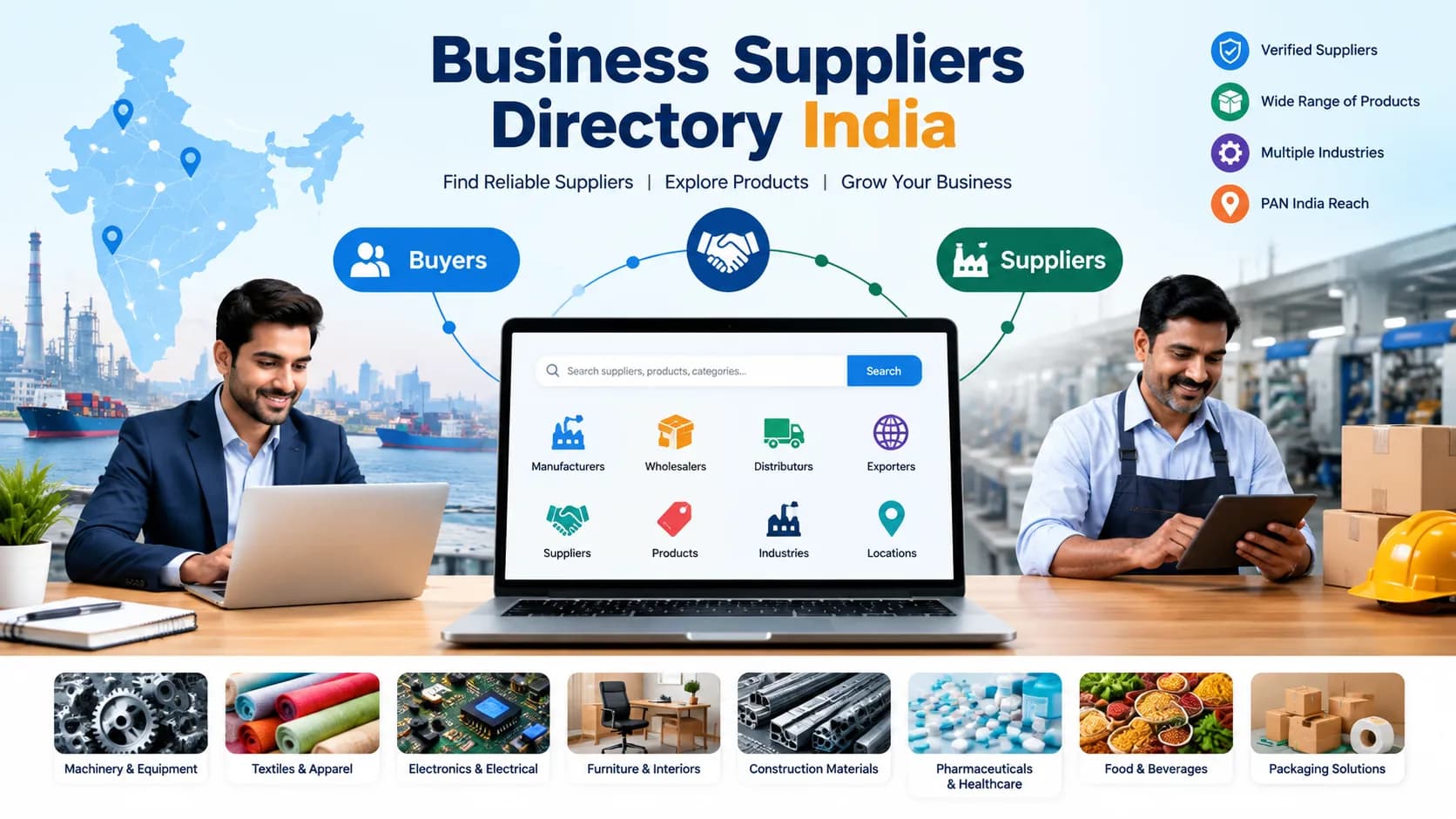
Business Suppliers Directory India A Smarter Way to Discover Reliable B2B Suppliers
Introduction
Finding the right supplier is a fundamental requirement for businesses involved in manufacturing, wholesale, retail, distribution, construction, hospitality, e-commerce, export, and industrial procurement. Every business that purchases products, raw materials, components, packaging, equipment, or other commercial requirements needs access to suitable suppliers.
India has a broad and diverse supplier ecosystem. Manufacturers, wholesalers, distributors, traders, exporters, importers, MSMEs, startups, and specialized businesses operate across different industries and regions. This creates significant sourcing opportunities, but it also creates a practical challenge: how can businesses discover the right suppliers efficiently?
A Business Suppliers Directory India can help address this challenge by bringing business and supplier information into an organized digital environment. Instead of depending entirely on personal contacts, referrals, local markets, or physical networking, businesses can use digital B2B platforms to search for companies according to products, categories, industries, and locations.
Modern supplier directories are increasingly becoming more than simple lists of company names and phone numbers. Digital B2B platforms can combine business profiles, product catalogs, supplier discovery, buyer inquiries, networking opportunities, and communication features.
For buyers, this creates a structured starting point for supplier research. For suppliers, it creates another channel through which their products and businesses can become visible to potential buyers.
Platforms such as BONC Network are part of this broader digital B2B ecosystem, where businesses can showcase their products and business information while discovering other companies and potential commercial connections.
However, a supplier directory should not be viewed as an automatic guarantee of supplier quality. Businesses still need to evaluate product suitability, pricing, quality, capacity, delivery terms, and relevant business information before entering into commercial relationships.
Understanding a Business Suppliers Directory in India
A business suppliers directory is an organized collection of supplier and business information that allows companies to discover potential suppliers.
A traditional directory might contain basic details such as:
- Company name
- Address
- Phone number
- Business category
- Product or service
A modern digital supplier directory can provide much more information.
It may include:
- Business profiles
- Product listings
- Product categories
- Business descriptions
- Locations
- Product specifications
- Contact options
- Inquiry features
- Supplier networking
- Buyer-supplier communication
The objective is to make supplier discovery easier and more relevant.
Why Supplier Discovery Matters for Businesses
Supplier selection can directly influence business operations.
A supplier affects not only the purchase price but also product quality, inventory availability, delivery schedules, customer satisfaction, and overall supply-chain efficiency.
Product Availability
Businesses need suppliers capable of providing products when required. Delays in supply can affect inventory and customer orders.
Product Quality
Consistent quality is important for businesses that resell products or use components in their own manufacturing processes.
Procurement Cost
Supplier pricing affects margins and operational costs. Businesses may need to compare multiple suppliers to understand available commercial options.
Production Continuity
Manufacturers often depend on suppliers for raw materials and components. Reliable sourcing can support consistent production.
Business Scalability
As a company grows, its supplier requirements may also increase. A supplier network that can scale with demand can become an important business asset.
Why Finding Suppliers in India Can Be Difficult
India's supplier ecosystem is highly diverse.
Two companies may offer similar products but operate very differently. One may be a manufacturer, another may be a wholesaler, and another may be a distributor.
Businesses may also face challenges such as:
- Limited product information
- Outdated contact details
- Unclear business categories
- Difficult supplier comparison
- Lack of information about capabilities
- Geographic limitations
- Limited digital presence
This makes structured supplier discovery increasingly useful.
How Digital Supplier Directories Change B2B Discovery
Digital platforms allow businesses to move from offline supplier discovery toward searchable online research.
A buyer can begin with a product requirement and explore relevant businesses without already knowing the supplier's name.
For example, a buyer looking for industrial pumps can search for relevant product categories and discover multiple businesses involved in pumps, pumping equipment, or related products.
Similarly, a retailer searching for furniture suppliers can explore businesses categorized around furniture manufacturing and supply.
This product-first approach can expand the buyer's sourcing possibilities.
Search by Product Category
One of the most useful features of a digital supplier directory is category-based discovery.
Businesses can search within relevant categories rather than browsing a large number of unrelated companies.
Common B2B supplier categories may include:
Industrial Products
- Machinery
- Industrial equipment
- Pumps
- Automation equipment
- Electrical products
- Tools
- Components
Furniture and Interior
- Office furniture
- Metal furniture
- Wooden furniture
- Racks
- Interior products
Textiles and Apparel
- Fabrics
- Garments
- Home textiles
- Accessories
- Industrial textiles
Construction Materials
- Plywood
- Laminates
- Sanitary products
- Hardware
- Flooring
- Building materials
Healthcare and Pharmaceuticals
- Pharmaceutical products
- Nutraceuticals
- Medical supplies
- Healthcare equipment
Consumer Products
- Home products
- Kitchen products
- Personal care
- Electronics
- Lifestyle products
Category-based discovery can make supplier research more focused.
Search Suppliers by Location
Location remains an important factor in B2B procurement.
Businesses may want suppliers close to their warehouse, manufacturing facility, customers, or logistics network.
A digital Business Suppliers Directory India can help buyers discover companies across different cities and regions.
Location can affect:
- Transportation costs
- Freight availability
- Delivery timelines
- Inspection possibilities
- Warehousing
- Regional distribution
However, businesses should compare logistics costs rather than automatically selecting the nearest supplier.
Review Business Profiles
A supplier profile provides an initial understanding of the company.
Buyers can examine:
- Business description
- Product categories
- Product listings
- Location
- Manufacturing or supply activities
- Product specifications
- Contact details
A detailed profile can help a buyer determine whether the business appears relevant before starting a conversation.
Why Product Listings Matter
Product listings make supplier discovery more specific.
A company name alone does not tell a buyer exactly what the business offers.
A detailed product listing can communicate:
- Product name
- Category
- Features
- Specifications
- Applications
- Variants
- Packaging
- Customization options
This allows buyers to assess relevance before sending an inquiry.
How Buyers Can Use a Business Suppliers Directory
The supplier discovery process can be structured around several stages.
Start by defining the product requirement.
Search for relevant suppliers.
Explore business profiles.
Review products and specifications.
Create a shortlist.
Contact potential suppliers.
Request quotations or additional information.
Compare commercial and operational factors.
Verify important business information.
Start an appropriate initial order.
This approach helps turn a directory search into a structured procurement process.
Define Your Requirement Before Searching
A clear requirement produces more relevant supplier results.
A buyer should ideally know:
- Product
- Quantity
- Specifications
- Material
- Quality requirements
- Packaging
- Customization
- Delivery location
- Expected delivery timeline
- MOQ requirements
For example, searching for "metal rack supplier" is broad.
A more detailed requirement could include dimensions, load capacity, material thickness, finish, quantity, and delivery location.
The supplier can then respond more accurately.
Create a Supplier Shortlist
Instead of selecting the first business found, buyers can create a shortlist of relevant suppliers.
A shortlist may include five or more companies depending on the requirement.
Compare:
- Product compatibility
- Quality
- Price
- MOQ
- Production capacity
- Location
- Lead time
- Customization
- Communication
- Business information
This provides a clearer basis for further evaluation.
How to Evaluate Suppliers
Supplier evaluation should be based on the specific requirements of the business.
Product Compatibility
Does the supplier actually offer the required product?
Quality
Can the supplier meet the required quality and specifications?
Production or Supply Capacity
Can the supplier provide the required quantity?
Pricing
Is the quotation commercially viable?
Delivery
Can the supplier meet the required delivery schedule?
Customization
Can the supplier modify products if required?
Communication
Does the supplier provide clear and relevant responses?
Why Price Should Not Be the Only Factor
Price is important, but selecting a supplier only because of the lowest price can create additional risks.
A lower quoted price may be offset by:
- Higher transportation costs
- Poorer product quality
- Longer delivery times
- Higher defect rates
- Unclear specifications
- Weak after-sales support
Businesses should therefore consider total procurement value rather than only the initial quoted price.
Request Quotations From Multiple Suppliers
An RFQ or detailed quotation request can make supplier comparison easier.
The buyer should provide:
- Product details
- Quantity
- Specifications
- Packaging requirements
- Delivery location
- Required timeline
- Customization requirements
Multiple quotations can provide useful market information and help businesses understand differences between suppliers.
Understanding MOQ
Minimum Order Quantity can have a major impact on procurement.
A large manufacturer may require higher quantities because its production system is optimized for bulk manufacturing.
A smaller supplier may provide lower quantities but potentially at a different price.
Businesses should evaluate MOQ based on their inventory requirements and cash flow.
Verify Supplier Information
A supplier directory is a discovery tool, not a substitute for due diligence.
Before placing a significant order, businesses may verify relevant information such as:
- Business registration
- GST details where applicable
- Certifications
- Product documentation
- Factory details
- References
- Samples
- Commercial terms
The level of verification should correspond to the value and risk associated with the transaction.
How BONC Network Supports Digital Supplier Discovery
BONC Network provides a digital business networking environment where businesses can showcase products, create business visibility, and discover other companies.
For buyers, BONC Network can be used as part of a broader supplier discovery process. Businesses can explore product listings and business profiles to identify potential suppliers relevant to their procurement needs.
For manufacturers and suppliers, maintaining a detailed presence on a B2B networking platform can help make their products and capabilities more discoverable to other businesses.
The combination of business networking and product discovery creates opportunities for buyers and suppliers to connect beyond traditional offline networks.
Rather than treating a supplier directory as only a database, digital B2B platforms can transform supplier discovery into an interactive business networking process.
Business Suppliers Directory and B2B Networking
Supplier discovery and business networking are closely connected.
A buyer may initially search for a product but later develop a relationship with the supplier for additional products or long-term procurement.
Similarly, a supplier may initially receive an inquiry for one product and eventually develop a broader relationship with the buyer.
This makes digital networking valuable beyond individual transactions.
Business connections can potentially develop into:
- Long-term supply agreements
- Distribution partnerships
- Private-label manufacturing
- OEM relationships
- Export opportunities
- Product development
- Strategic partnerships
Benefits for Buyers
A digital supplier directory can provide several benefits to buyers.
Wider Supplier Access
Businesses can explore suppliers beyond their existing personal networks.
Faster Discovery
Online search can reduce the time spent identifying potential suppliers.
Product-Based Research
Buyers can begin with the product instead of already knowing the company.
Geographic Expansion
Businesses can explore suppliers across different Indian regions.
Easier Comparison
Multiple supplier profiles can be researched before starting negotiations.
Benefits for Suppliers
A supplier directory can also create value for manufacturers and suppliers.
Digital Visibility
Suppliers can present their businesses to potential buyers.
Product Discovery
Buyers searching for relevant products can discover supplier listings.
New Buyer Opportunities
Digital visibility can expand the supplier's potential customer base.
Market Expansion
Suppliers can become visible to businesses outside their traditional geographic market.
Networking
Suppliers can build connections with buyers, distributors, manufacturers, and other businesses.
Importance for MSMEs
India's MSME ecosystem includes businesses operating across numerous industries and locations.
Many smaller businesses have strong products but limited access to large commercial networks.
Digital B2B platforms can provide another channel for these businesses to showcase products and connect with potential customers.
For buyers, the same ecosystem can create access to smaller specialized manufacturers and suppliers.
This can increase the range of sourcing possibilities available to businesses.
How Manufacturers Can Improve Their Directory Profiles
Suppliers should treat their digital profile as an extension of their business presence.
A useful profile should clearly communicate:
Who the Company Is
Provide an accurate business description.
What the Company Offers
List products under relevant categories.
What Makes the Products Relevant
Include specifications, features, applications, and available variants.
Where the Company Operates
Provide accurate location information.
How Buyers Can Contact the Company
Keep contact information updated.
A complete profile can reduce uncertainty during the initial supplier-discovery stage.
Product Discovery and Supplier Discovery Working Together
Product discovery often leads directly to supplier discovery.
A buyer may begin with:
"I need this product."
The next question becomes:
"Who can supply it?"
Digital B2B platforms can connect these two stages.
A product listing can lead to a supplier profile, which can lead to an inquiry, quotation, communication, and eventually a business relationship.
This creates a more connected procurement journey.
Using Supplier Directories for Wholesale Purchasing
Wholesale buyers typically require larger quantities and competitive commercial terms.
A supplier directory can help them discover:
- Manufacturers
- Wholesalers
- Distributors
- Importers
- Specialized suppliers
Wholesale buyers should pay particular attention to MOQ, pricing, stock availability, delivery capacity, and repeat-order capability.
Using Supplier Directories for Private Label
Private-label businesses need suppliers that can meet brand-specific requirements.
They may require:
- Custom packaging
- Branding
- Custom formulation
- Product modifications
- Labeling
- Specific materials
- OEM production
A supplier directory can help businesses discover potential manufacturers, but buyers should communicate customization requirements directly and evaluate the supplier's actual capabilities.
Using Digital Supplier Discovery for Export Businesses
Export-oriented companies may need suppliers capable of meeting international product and documentation requirements.
Supplier evaluation may therefore include:
- Production capacity
- Product consistency
- Packaging
- Documentation
- Certifications
- Export experience
- Delivery reliability
A digital supplier directory can help create an initial supplier pool before detailed export-related evaluation begins.
Common Mistakes When Using Supplier Directories
Businesses can improve results by avoiding several common mistakes.
Searching With Very Broad Terms
A broad search can produce too many irrelevant businesses.
Ignoring Product Specifications
A company may offer the right product category but not the required specification.
Selecting the First Supplier
The first result is not necessarily the most suitable supplier.
Focusing Only on Price
Low pricing does not automatically mean better overall procurement value.
Not Checking MOQ
MOQ can make an otherwise attractive supplier unsuitable.
Skipping Verification
Businesses should verify relevant information before significant transactions.
How to Build a Reliable Supplier Network
A supplier directory is most useful when businesses use it to build relationships rather than simply collect contacts.
A structured approach can involve:
Discover → Shortlist → Contact → Evaluate → Test → Develop
Start by discovering potential suppliers.
Shortlist relevant businesses.
Contact them with clear requirements.
Evaluate their responses.
Test products or services where appropriate.
Develop long-term relationships with suppliers that consistently meet requirements.
Maintaining Multiple Supplier Relationships
Businesses may benefit from having multiple qualified suppliers for important product categories.
This can help provide alternatives if one supplier experiences:
- Production delays
- Inventory shortages
- Logistics problems
- Capacity limitations
However, maintaining multiple suppliers should be based on business needs and should not replace developing strong relationships with reliable primary suppliers.
The Future of Business Supplier Directories in India
Digital supplier directories are evolving from static databases into broader business ecosystems.
Future developments may include:
- AI-based supplier discovery
- Intelligent product matching
- Automated recommendations
- Digital RFQs
- Business verification
- Product comparison
- Automated inquiry management
- Data-driven supplier discovery
- Integrated business communication
Artificial intelligence may eventually allow businesses to describe their requirements in natural language and receive relevant supplier suggestions based on product specifications, location, capacity, and other factors.
The human element will remain important because procurement involves negotiation, trust, quality evaluation, and long-term relationship management.
Why Digital B2B Platforms Matter for Modern Businesses
The growth of digital commerce has changed how businesses research potential partners.
Businesses no longer have to depend exclusively on local networks.
A company in one Indian city can discover suppliers in another state. A manufacturer can potentially reach buyers in markets where it previously had limited visibility.
This creates a more connected national B2B ecosystem.
Digital platforms can therefore support:
- Supplier discovery
- Product discovery
- Buyer discovery
- Business networking
- Lead generation
- Procurement research
- Market expansion
Creating a More Efficient Supplier Search Process
Businesses can make supplier discovery more efficient by creating a consistent workflow.
Begin with a specific product requirement.
Use relevant keywords and categories.
Explore multiple supplier profiles.
Record important supplier information.
Contact shortlisted companies.
Request quotations.
Compare commercial and operational factors.
Verify relevant details.
Conduct samples or trial orders where appropriate.
Track supplier performance after the transaction.
This creates a repeatable sourcing system that can be used for future procurement requirements.
Conclusion
A Business Suppliers Directory India can serve as an important digital resource for companies looking to discover manufacturers, wholesalers, distributors, and other suppliers across the country. India's large and diverse business ecosystem provides significant sourcing opportunities, but businesses need an organized approach to identify relevant suppliers.
Digital B2B platforms make supplier discovery more accessible by combining business profiles, product listings, categories, locations, networking, and communication. Buyers can search according to their requirements, create supplier shortlists, request information, and evaluate potential business partners.
At the same time, suppliers can use digital platforms to improve product visibility, reach new buyers, expand their geographic market, and develop new business relationships.
BONC Network fits into this changing B2B environment by combining business networking and product discovery. Businesses can showcase their products and business information while exploring potential connections with other companies.
However, finding a supplier through a directory is only the beginning. Businesses should still evaluate quality, pricing, MOQ, production capacity, delivery, customization, communication, and relevant business information before making procurement decisions.
The most effective approach is to use digital supplier directories as a starting point for structured research and relationship building. When combined with clear requirements, proper evaluation, and consistent communication, a digital Business Suppliers Directory India can help businesses build broader supplier networks and create new opportunities in India's evolving B2B marketplace.