Executive Summary
The AI market has crossed a critical inflection point: the transition from conversational interfaces to autonomous multi-agent systems. While 2023–2024 centered on chat-based interfaces and retrieval-augmented generation (RAG), today's high-impact deployments orchestrate specialized AI agents capable of planning, tool use, and self-correcting task execution across enterprise software stacks.
The Challenge: Beyond Static Q&A
First-generation generative AI implementations faced significant limitations in enterprise environments:
Human-in-the-Loop Bottlenecks: Standard chat assistants still required human operators to manually transfer outputs into downstream systems (CRMs, ERPs, ticketing tools).
Hallucinations in Complex Logic: Single-prompt LLMs struggled when executing multi-step mathematical, procedural, or data-reconciliation tasks.
Siloed Context: Models operated in isolation from real-time enterprise APIs and internal state machines.
The Architecture: Coordinated Agentic Systems
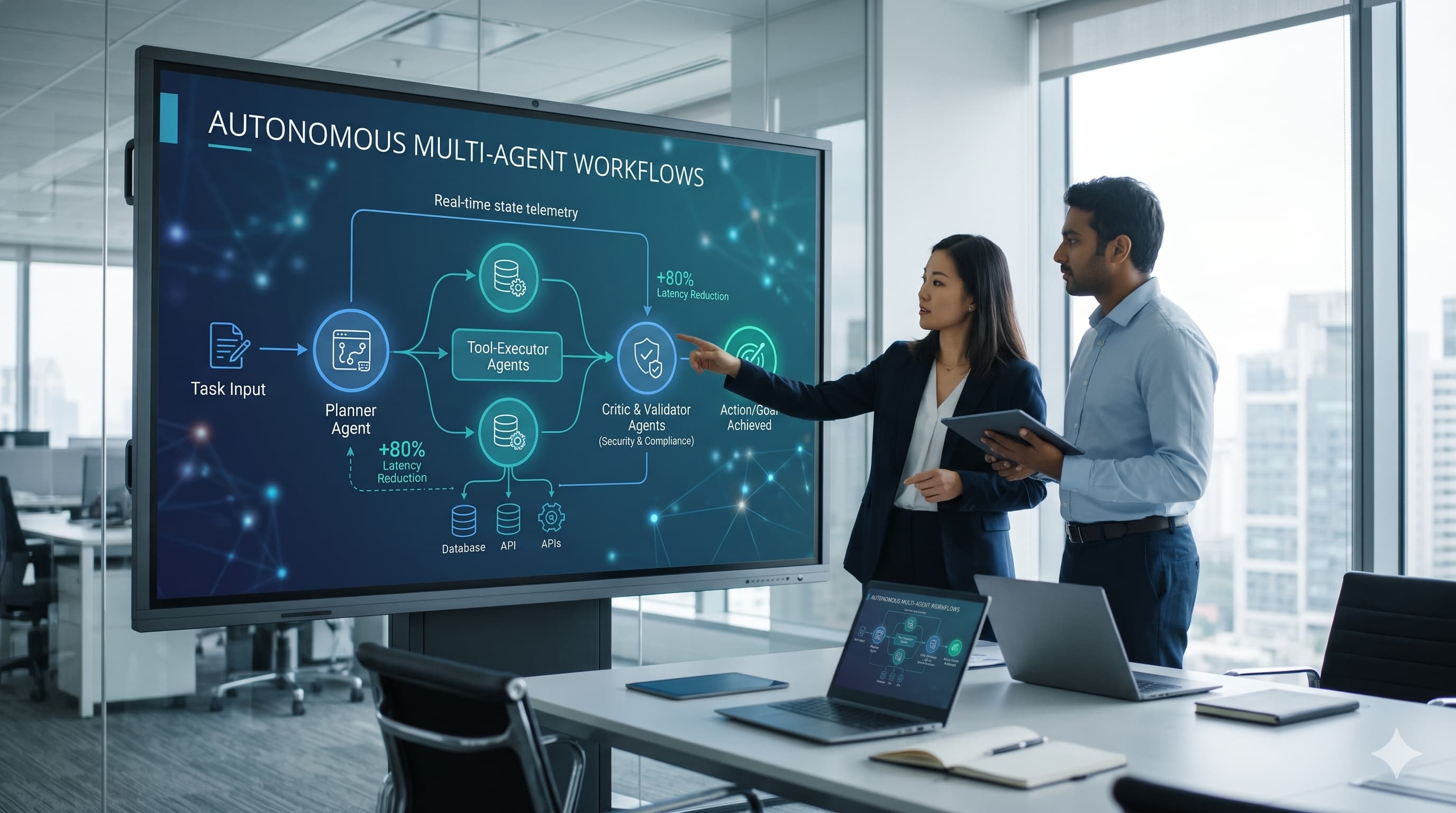
Modern agentic architectures address these bottlenecks by decomposing complex objectives into discrete, coordinated workflows:
Planner Agent: Ingests high-level business goals and breaks them into sequential sub-tasks.
Tool-Executor Agents: Interface directly with production APIs, SQL databases, and internal microservices using structured function calling.
Critic & Validator Agents: Continuously verify intermediate outputs against compliance rules, schema definitions, and guardrails before committing changes.
Key Outcomes & Market Impact
80%+ Reduction in Process Latency: Multi-agent workflows automate complex back-office workflows—such as automated threat triage in SecOps and multi-source vendor reconciliation in finance—reducing turnaround times from hours to seconds.
Lower Failure Rates: Deterministic validation layers reduce ungrounded outputs by anchoring every state transition to verifiable system telemetry.
Shift in Software Economics: Value is shifting away from generic LLM wrappers toward specialized platforms with deep domain integrations and reliable multi-step execution.