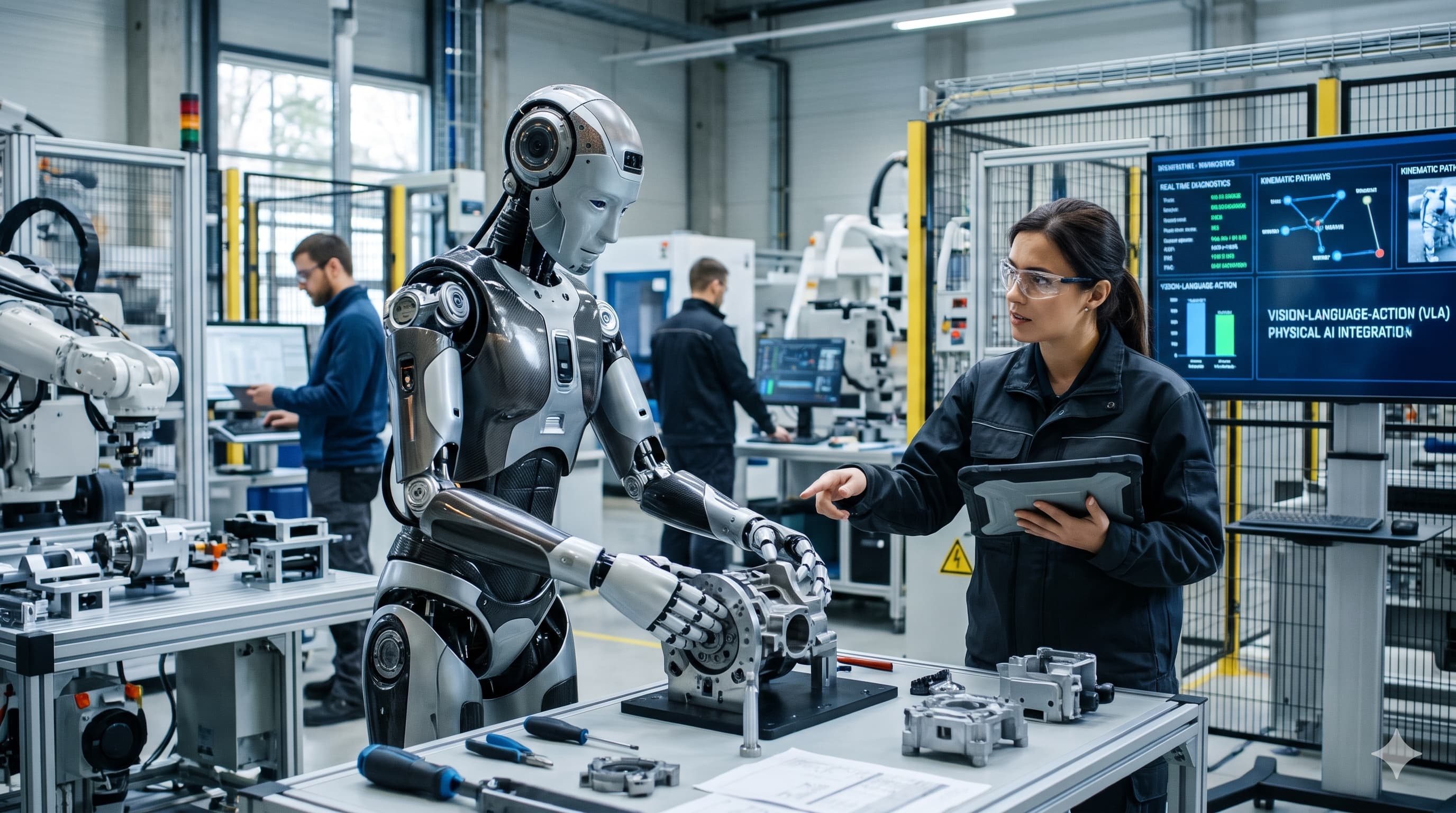
Executive Summary
For years, AI existed purely in the digital realm—generating text, analyzing data, and automating software workflows. Today, the most significant frontier is Physical AI: embedding complex Vision-Language-Action (VLA) models into mobile, humanoid, and industrial hardware to operate autonomously in the physical world.
The Challenge: From Screens to Physical Space
Bridging the gap between digital intelligence and physical execution has been a monumental hurdle:
Sensory-Motor Integration: Translating abstract instructions into precise, real-time physical movements (like grasping fragile objects or navigating uneven terrain) requires high-frequency feedback loops.
Varied and Unstructured Environments: Unlike static factory arms, humanoid robots must operate alongside humans in chaotic, unpredictable, and changing spaces.
Compute at the Edge: Training these systems requires vast simulated environments, while running them requires massive local processing power on on-board hardware.
The Architecture: Vision-Language-Action (VLA) Models
At the core of Physical AI is a shift away from pre-programmed trajectories to adaptive, general-purpose reasoning:
Perceptual Foundation: Large-scale vision-language models capture and understand 3D spaces, objects, and human gestures.
Physics and Action Simulation: Millions of iterations are practiced in physics-based simulation environments (like digital twins) to learn motor skills without risking hardware.
Real-Time Adaptation: On-board AI processors run neural networks that allow the robot to adjust its path, grip, and task sequence on the fly based on what it senses.
Market Impact
Labor Support in Hazardous Roles: Industries from logistics to heavy manufacturing are deploying humanoid robots for repetitive, physically demanding, or dangerous tasks, such as material handling and assembly.
The Autonomous Supply Chain: The line between software and physical task execution is blurring, with warehouse robots dynamically responding to inventory shifts.
Hardware-Software Convergence: Value is rapidly moving toward platforms that seamlessly integrate advanced AI with robust robotic hardware, creating a brand-new multi-billion-dollar industrial market.