How B2B Lead Generation Platforms Help Indian Businesses Find More Buyers
Published on: 16 Sep 2026
How B2B Lead Generation Platforms Help Indian Businesses Find More Buyers
Introduction
Finding buyers is one of the most important challenges for businesses operating in the B2B market. Manufacturers, suppliers, wholesalers, distributors, exporters, service providers, startups, and MSMEs may have strong products and competitive pricing, but reaching the right business customers can still be difficult. Traditional sales methods often depend on personal networks, field sales, trade events, referrals, phone calls, and repeated follow-ups. These methods can work, but they may require considerable time and resources.
Digital B2B platforms are changing how businesses approach buyer discovery and lead generation. Instead of depending entirely on offline networks, businesses can use online platforms to showcase products, create business profiles, discover potential buyers, respond to requirements, and build new commercial relationships.
A B2B lead generation platform creates a digital environment where businesses can become more discoverable to potential customers. Buyers searching for products, manufacturers, suppliers, or business services can explore relevant listings and contact businesses according to their requirements. This makes the process more structured and can expand a company's reach beyond its existing network.
For Indian businesses, this digital approach is particularly relevant because the country's business ecosystem includes manufacturers, traders, distributors, service providers, MSMEs, startups, exporters, and enterprises across numerous industries and locations.
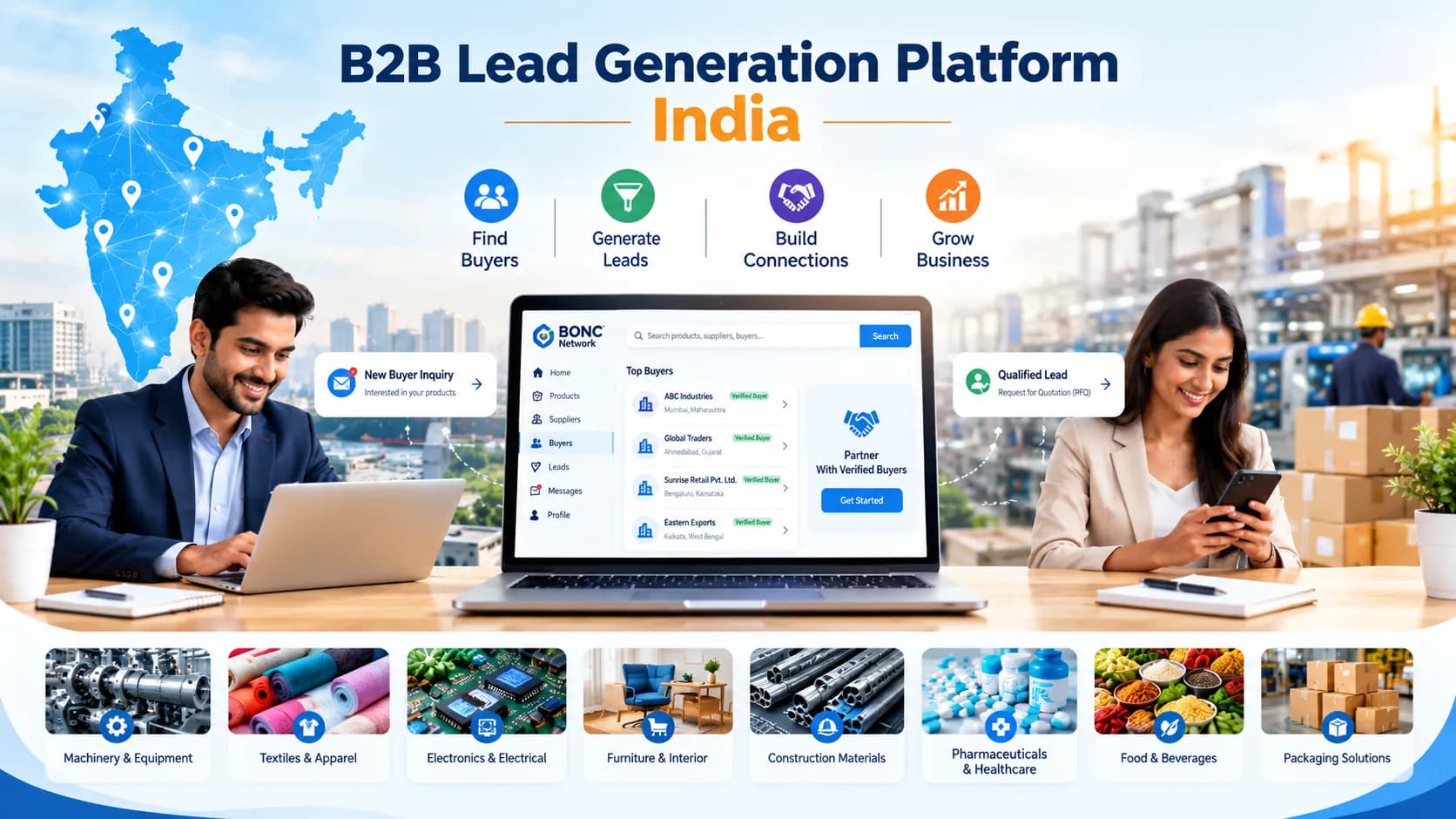
Platforms such as BONC Network can support this broader business discovery process by bringing business profiles, product discovery, networking, inquiries, and buyer-supplier connections into a digital B2B environment.
Understanding B2B Lead Generation
B2B lead generation refers to the process of identifying and attracting businesses that may have an interest in a company's products or services.
Unlike consumer marketing, where a company may target individual customers, B2B lead generation focuses on business decision-makers, procurement teams, distributors, retailers, manufacturers, wholesalers, institutions, and other commercial buyers.
A B2B lead may come from several sources. A potential buyer might discover a product through an online business listing, submit an inquiry, request a quotation, respond to an advertisement, contact a supplier directly, or show interest in a particular category.
The objective is not simply to generate a large number of contacts. Businesses also need relevant leads that have a genuine requirement and a reasonable possibility of becoming customers.
This is where digital B2B lead generation platforms can become useful.
Why Finding B2B Buyers Can Be Difficult for Indian Businesses
Indian businesses operate across a highly diverse market. A manufacturer in one state may have potential customers thousands of kilometers away. A supplier may serve multiple industries but have limited visibility among buyers searching for its products.
Traditional buyer discovery can create several challenges.
Limited Business Networks
A company may initially depend on existing customers, distributors, referrals, and personal connections. While these networks can be valuable, they may not expose the business to enough new buyers.
Digital B2B platforms can expand this network by making business information accessible to a wider audience.
Difficulty Reaching New Markets
A manufacturer serving customers in one city may want to expand into other states or regions. Finding new buyers independently can require extensive market research and sales activity.
Online B2B platforms can make it easier for businesses to present their products to buyers outside their existing geographical market.
High Competition
Many businesses offer similar products. Buyers can have numerous suppliers to choose from, making visibility an important part of digital B2B marketing.
An accurate business profile and detailed product information can help a company communicate what it offers more effectively.
Unorganized Lead Management
Leads may arrive through phone calls, email, social media, messaging applications, websites, and personal contacts. Managing all these sources can become difficult.
A structured B2B platform can bring discovery and inquiries into a more organized digital environment.
How B2B Lead Generation Platforms Help Businesses Find More Buyers
A B2B lead generation platform can contribute to buyer acquisition at multiple stages of the purchasing journey.
It can help businesses become discoverable, present their products, connect with relevant companies, receive inquiries, and develop commercial relationships.
Business Profiles Improve Online Visibility
A business profile works as a digital identity for a company.
Instead of explaining the business from scratch every time a potential buyer makes contact, companies can provide essential information through their online profile.
A useful B2B profile may include:
- Company name
- Business category
- Location
- Products and services
- Company description
- Manufacturing or supply capabilities
- Contact options
- Product images
- Business-related information
For buyers, this information provides an initial understanding of whether a company is relevant to their requirement.
Product Listings Make Businesses Easier to Discover
Product discovery is an important component of B2B lead generation.
A buyer may not know the name of a particular supplier but may know exactly what product they need. If businesses maintain detailed product listings, they have more opportunities to appear during relevant product searches.
For example, a buyer looking for industrial pumps may discover several businesses offering pumps, pump controllers, or related equipment.
Detailed product information can help buyers understand the available options before initiating an inquiry.
Category-Based Discovery Improves Relevance
B2B platforms often organize businesses and products into categories.
This allows buyers to narrow their search based on business requirements rather than browsing unrelated companies.
A manufacturer can therefore position products within relevant categories, while buyers can explore businesses according to their purchasing needs.
This category-based discovery can make the initial stage of lead generation more focused.
Connecting Businesses With Relevant Buyers
One of the major advantages of digital B2B platforms is the ability to create connections between businesses that may not have discovered each other through traditional networking.
A manufacturer may be looking for distributors.
A distributor may be looking for manufacturers.
A retailer may be searching for wholesale suppliers.
An importer may be looking for Indian manufacturers.
A service company may be searching for corporate clients.
These different requirements create opportunities for digital business networking.
Buyer Intent Matters
Not every visitor is a potential customer.
A person casually browsing a product is different from a business actively searching for a supplier.
Lead generation becomes more useful when platforms help businesses identify interactions that indicate commercial interest, such as inquiries, product requests, quotation requirements, or direct business communication.
Understanding buyer intent helps sales teams prioritize their efforts.
How Manufacturers Can Find More Buyers Online
Manufacturers often have extensive production capabilities but may not have direct access to every potential buyer.
A digital B2B platform can help manufacturers present their products to businesses looking for manufacturing partners.
Manufacturers can use digital profiles to highlight:
- Product categories
- Manufacturing capabilities
- Product specifications
- Industries served
- Production-related information
- Location
- Product range
- Inquiry options
For example, an industrial equipment manufacturer can list different machinery products separately. Buyers searching for specific machinery can then discover the relevant products and initiate communication.
This approach can help manufacturers move beyond depending exclusively on distributors or local sales networks.
How Suppliers Can Connect With More Buyers
Suppliers can also use B2B lead generation platforms to increase their business visibility.
A supplier's digital presence can communicate what products are available, which markets they serve, and how buyers can initiate discussions.
A supplier dealing in packaging materials, for example, may want to reach food manufacturers, pharmaceutical companies, retailers, exporters, or e-commerce businesses.
Instead of targeting each industry completely independently, a well-structured digital presence can allow different types of buyers to discover the supplier through product and category searches.
The Role of BONC Network in B2B Lead Generation
BONC Network provides a digital B2B environment where businesses can showcase their companies and products while discovering other businesses and potential commercial opportunities.
For businesses focused on lead generation, a platform like BONC Network can support several stages of the buyer discovery process.
Businesses can create digital business visibility, showcase products, discover other businesses, and receive inquiries from interested parties. Features related to business networking, product discovery, RFQs, RFIs, RFPs, and communication can contribute to a broader B2B connection process.
The value of such a platform is not simply the presence of a company listing. The effectiveness of digital lead generation also depends on how accurately businesses present their products, how clearly they communicate their capabilities, and how consistently they respond to buyer inquiries.
This makes B2B lead generation a combination of visibility, discovery, communication, and relationship building.
Creating Better Product Listings for Lead Generation
A product listing should answer the basic questions a buyer is likely to have.
A strong listing can include the product name, category, description, specifications, applications, features, and relevant images.
Use Clear Product Names
Avoid unnecessarily complicated product titles.
A buyer should be able to understand what the product is from the product name itself.
Provide Useful Specifications
Technical specifications are particularly important for industrial and commercial products.
Depending on the category, information may include:
- Size
- Material
- Capacity
- Model
- Application
- Dimensions
- Performance
- Packaging
- Available variants
Accurate information helps buyers determine whether the product matches their requirement.
Add Relevant Product Images
Visual information can make product discovery easier, especially when the product has physical characteristics that buyers need to understand.
Clear images should represent the actual product and should avoid unnecessary visual clutter.
Using Buyer Requirements for Lead Generation
Another important aspect of B2B lead generation is understanding what buyers are actively requesting.
Instead of businesses only publishing products and waiting for customers, digital B2B platforms can support requirement-based interactions.
A buyer may publish a requirement for:
- Machinery
- Raw materials
- Packaging
- Furniture
- Electronics
- Chemicals
- Textiles
- Construction products
- Industrial equipment
- Business services
Suppliers that match the requirement can then explore the opportunity and communicate with the buyer.
This creates a two-way model of lead generation.
RFQs and B2B Lead Generation
Request for Quotation, commonly known as RFQ, is an important part of B2B purchasing.
A buyer may know what product is required but still need pricing, quantity information, delivery details, specifications, or other commercial information.
Digital platforms can make the RFQ process more structured.
For example, a buyer looking for 1,000 units of a particular product can communicate the requirement instead of contacting suppliers without providing sufficient information.
Relevant suppliers can then evaluate the requirement and respond accordingly.
This can make the lead more meaningful than a general inquiry.
Why Qualified Leads Matter More Than Lead Volume
Businesses sometimes measure lead generation only by the number of inquiries received.
However, 100 irrelevant inquiries may provide less business value than 10 relevant inquiries.
A qualified B2B lead may have characteristics such as:
- Relevant product requirement
- Appropriate purchasing quantity
- Suitable industry
- Genuine business interest
- Defined location
- Commercial intent
- Need for quotation
- Requirement for regular supply
Digital platforms can contribute to discovery, but businesses still need to evaluate and qualify leads before investing significant sales resources.
How Indian MSMEs Can Use B2B Lead Generation Platforms
Micro, small, and medium businesses often have limited sales and marketing resources.
Digital B2B platforms can give smaller companies an additional channel for business visibility without requiring them to build a large physical sales network immediately.
An MSME can use a platform to:
- Create an online business presence
- Showcase products
- Reach buyers beyond its local market
- Discover suppliers
- Build business connections
- Receive inquiries
- Explore new industries
- Develop new customer relationships
For smaller businesses, this can complement traditional sales channels.
B2B Lead Generation for Startups
Startups often face a different challenge: they may have innovative products but limited market recognition.
A digital B2B platform can help startups introduce their products to businesses that may need their solutions.
For example, a startup offering industrial software, packaging innovation, manufacturing solutions, or business services can use digital business networking to become visible among potential commercial customers.
However, startups should focus on explaining their value proposition clearly rather than simply publishing promotional content.
Expanding Beyond Local Buyers
One of the most important opportunities offered by digital B2B platforms is geographic expansion.
A business based in Delhi can potentially connect with buyers in Maharashtra, Gujarat, Karnataka, West Bengal, Tamil Nadu, or other markets.
Similarly, a supplier based in a smaller industrial city can use digital visibility to reach businesses outside its immediate area.
This does not guarantee sales, but it can expand the pool of potential business connections.
How Businesses Can Improve Their B2B Lead Generation Strategy
A successful digital lead-generation strategy requires more than creating a profile.
Keep Business Information Updated
Outdated phone numbers, product information, addresses, or business descriptions can create friction for potential buyers.
Businesses should regularly review their digital profiles.
Maintain Accurate Product Data
Product information should match what the business can actually supply.
This reduces confusion and creates a better starting point for buyer conversations.
Respond Quickly to Inquiries
A buyer contacting multiple suppliers may continue with the businesses that respond clearly and promptly.
Fast communication can therefore become an important part of lead management.
Understand Buyer Requirements
Sales teams should avoid sending generic responses to every inquiry.
A better approach is to understand quantity, specifications, application, location, timeline, and other relevant requirements.
Comparing Multiple Buyer Opportunities
Digital platforms can generate inquiries from different types of businesses.
Companies should evaluate these opportunities according to their own business objectives.
Relevant considerations may include:
- Product fit
- Order quantity
- Location
- Delivery requirements
- Industry
- Payment expectations
- Potential for repeat business
- Customization requirements
This helps businesses prioritize leads based on practical commercial considerations.
Building Long-Term Buyer Relationships
Lead generation should not end when an inquiry is received.
A successful B2B relationship often develops through multiple interactions.
The buyer may initially ask for a quotation, then request samples, discuss specifications, negotiate terms, and eventually place an order.
After the first transaction, businesses can continue building the relationship through consistent service, communication, product updates, and reliable fulfillment.
Digital platforms can initiate the connection, while businesses are responsible for developing the relationship.
B2B Lead Generation and Product Promotion
Product promotion and lead generation are closely connected.
A business needs visibility to attract attention, but visibility becomes more valuable when it reaches an audience that could actually require the product.
Digital B2B platforms can combine product discovery with business networking.
For example, a manufacturer can promote a product while maintaining a business profile that gives buyers more context about the company.
This creates a broader journey from product discovery to business discovery to inquiry.
B2B Lead Generation for Different Industries
Digital lead generation is relevant across multiple sectors.
Manufacturing
Manufacturers can connect with distributors, wholesalers, retailers, exporters, and industrial buyers.
Textiles
Textile manufacturers and suppliers can reach garment businesses, retailers, exporters, and other commercial buyers.
Electronics
Electronics suppliers can showcase components, equipment, accessories, and finished products to businesses searching for relevant products.
Furniture
Furniture manufacturers can connect with dealers, interior businesses, offices, hospitality companies, and institutional buyers.
Pharmaceuticals and Healthcare
Businesses in healthcare-related categories can create digital visibility among relevant distributors, institutions, and commercial buyers, subject to applicable regulatory requirements.
Packaging
Packaging companies can connect with manufacturers across food, cosmetics, pharmaceuticals, retail, e-commerce, and other industries.
Common Mistakes in B2B Lead Generation
Digital platforms can create opportunities, but poor execution can reduce their effectiveness.
Incomplete Business Profiles
An incomplete profile may not provide enough information for a buyer to understand the company.
Generic Product Descriptions
A product description that says only “high-quality product at affordable price” provides limited practical information.
Targeting Everyone
Trying to appeal to every possible buyer can make communication unclear.
Businesses should understand their relevant industries and customer segments.
Ignoring Inquiries
Generating leads without responding to them defeats the purpose of lead generation.
Focusing Only on Price
B2B buyers may consider quality, delivery, technical specifications, reliability, service, customization, and long-term supply in addition to price.
How Digital B2B Platforms Improve Sales Efficiency
Traditional prospecting can involve searching for businesses individually, collecting contact details, making calls, sending emails, and manually explaining products.
Digital B2B platforms can bring some of these activities into a more centralized environment.
A buyer can discover a business through its profile.
The buyer can explore products.
The buyer can review available information.
The buyer can initiate an inquiry.
The supplier can evaluate the requirement and respond.
This can reduce some of the friction associated with the initial discovery stage.
The Importance of Business Networking
Lead generation is not only about acquiring customers. It is also about creating business relationships.
A company may initially connect with another business as a supplier, but the relationship could later develop into distribution, partnership, sourcing, manufacturing, export, or another commercial opportunity.
This is why business networking platforms have broader potential than simple product directories.
They can create an environment where companies discover one another based on products, capabilities, categories, locations, and requirements.
How Businesses Can Turn Digital Leads Into Opportunities
Generating a lead is only the beginning.
Businesses can improve the possibility of meaningful conversations by following a structured process.
When a new inquiry arrives, the business can first understand the buyer's requirement. It can then provide relevant product information, confirm availability, share pricing or quotation details where appropriate, discuss delivery requirements, and answer technical questions.
Clear communication is particularly important in B2B transactions because purchasing decisions may involve multiple people and several stages.
The goal should be to move from an initial inquiry toward a useful business conversation rather than immediately pushing a sales message.
The Future of B2B Lead Generation in India
B2B lead generation is increasingly becoming digital.
Businesses are becoming more comfortable researching suppliers, comparing products, communicating with manufacturers, and discovering commercial opportunities online.
Future B2B platforms are likely to place greater emphasis on intelligent product discovery, business matching, personalized recommendations, digital inquiries, data organization, and automated communication.
AI-powered search and recommendation systems may also make it easier for buyers to identify businesses based on detailed requirements rather than simple keywords.
For Indian businesses, this development can create opportunities to reach customers beyond traditional geographic and industry networks.
The businesses that maintain accurate digital information, understand their target buyers, and consistently engage with relevant inquiries can create a stronger foundation for digital B2B growth.
Creating a Sustainable B2B Lead Generation Strategy
A sustainable approach combines several elements rather than depending on one source of leads.
Businesses can combine:
- Digital B2B platforms
- Business networking
- Product listings
- Search visibility
- Product promotion
- RFQs
- Direct inquiries
- Trade events
- Distributor relationships
- Referrals
- Existing customer relationships
Digital lead generation should complement these activities rather than necessarily replace them.
The most important objective is to create a consistent process through which potential buyers can discover the business, understand its offerings, initiate communication, and develop a commercial relationship.
Why B2B Lead Generation Platforms Matter for Indian Businesses
India's B2B ecosystem includes millions of businesses across manufacturing, trading, distribution, services, technology, agriculture, construction, healthcare, textiles, electronics, packaging, and numerous other sectors.
A traditional business network cannot always provide access to every potential buyer.
Digital B2B lead generation platforms create another pathway.
They allow businesses to make their products and capabilities visible to a wider business audience. They also give buyers another way to discover suppliers and manufacturers according to their requirements.
For manufacturers and MSMEs especially, this digital visibility can support market expansion and new business discovery.
The platform itself does not replace product quality, pricing, service, delivery, or relationship management. Instead, it can improve the discovery and connection stage that comes before those commercial decisions.
Conclusion
B2B lead generation platforms are changing how Indian businesses discover and connect with potential buyers. Instead of depending entirely on traditional sales networks, businesses can use digital platforms to showcase their companies, publish products, reach new markets, receive inquiries, respond to buyer requirements, and develop new commercial relationships.
For manufacturers, suppliers, wholesalers, distributors, startups, and MSMEs, the ability to become digitally discoverable can be particularly valuable. A well-maintained business profile, accurate product information, clear communication, and consistent inquiry management can help create a stronger foundation for digital lead generation.
Platforms such as BONC Network bring business discovery, product visibility, networking, inquiries, and buyer-supplier connections into a common B2B environment. Businesses can use such platforms as part of a broader strategy for finding relevant buyers and expanding their business network.
Ultimately, successful B2B lead generation is not simply about getting more contacts. It is about finding relevant buyers, understanding their requirements, creating meaningful conversations, and building long-term business relationships. As India's business ecosystem continues to become more digitally connected, B2B lead generation platforms can play an increasingly important role in helping businesses discover new markets and commercial opportunities.