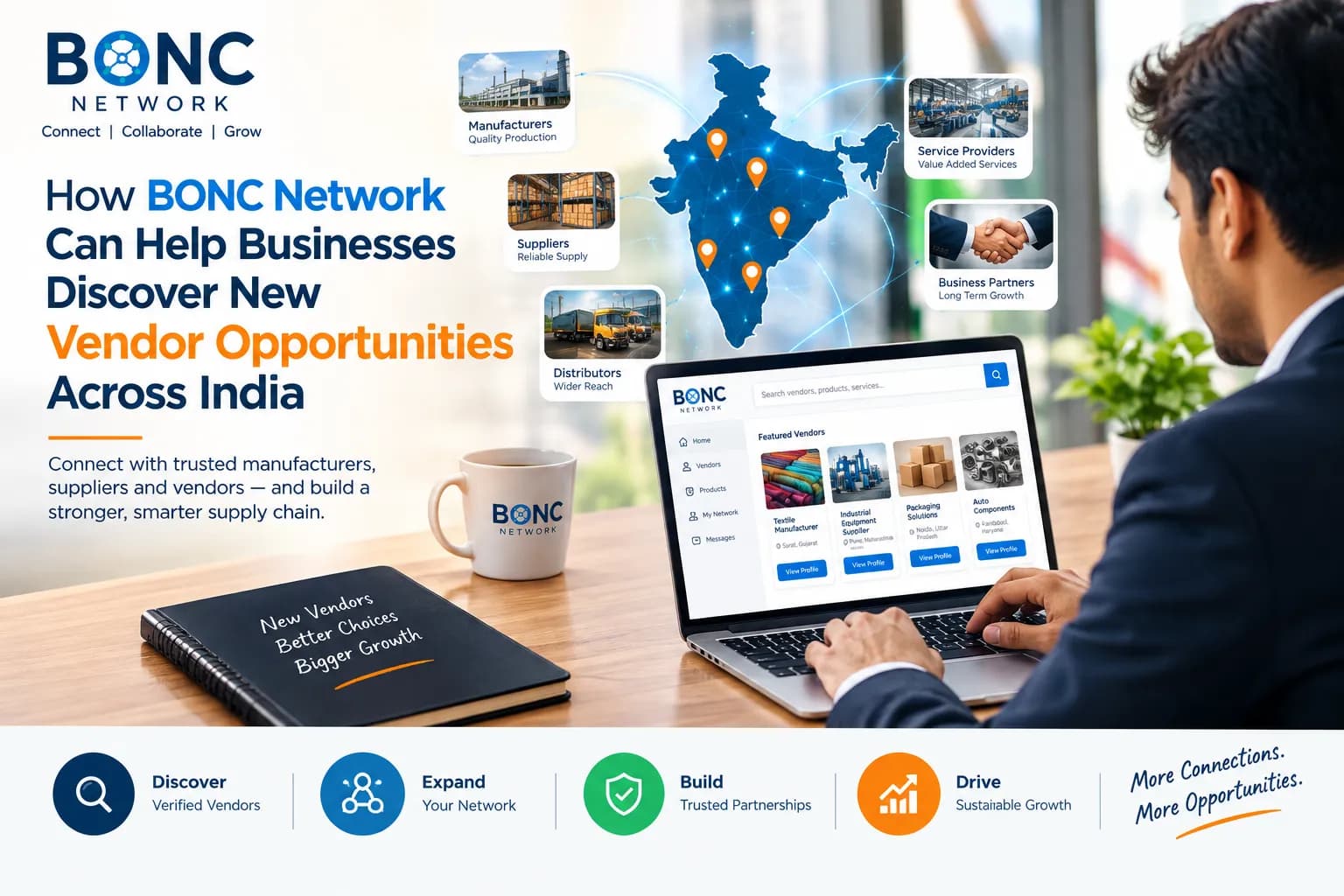
How BONC Network Can Help Businesses Discover New Vendor Opportunities Across India
By BONC Editorial Team • Published on 13 Oct 2026
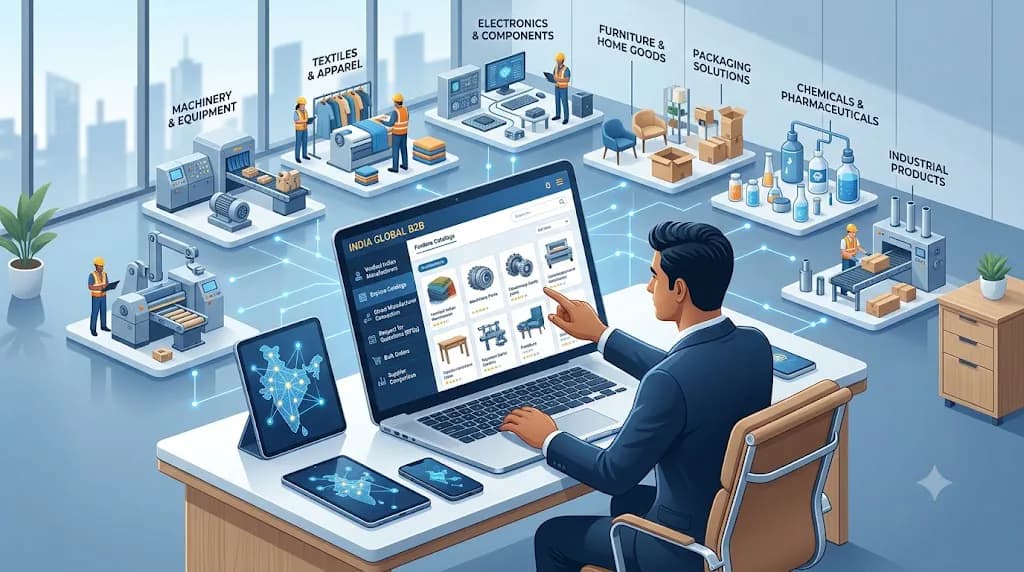
Introduction
Finding the right vendors is an important part of running and expanding a business. Whether a company operates in manufacturing, wholesale, retail, construction, e-commerce, distribution, or industrial services, its success often depends on having access to suitable suppliers and business partners. The right vendor network can help businesses explore new products, compare sourcing options, manage procurement requirements, and respond to changing market demands.
India offers a diverse business environment with manufacturers, wholesalers, distributors, service providers, traders, and other enterprises operating across different states and industrial regions. However, discovering relevant vendors across such a large market can be challenging. Businesses may have limited contacts outside their local area, struggle to identify companies in specialised categories, or spend considerable time researching potential partners.
Traditional methods such as referrals, trade exhibitions, industrial directories, and direct outreach continue to be useful. At the same time, digital platforms are creating additional ways for businesses to explore companies, discover products, and develop professional connections.
This is where BONC Network, a B2B Business Networking Platform, can become part of a business's vendor discovery strategy. By providing a digital environment for businesses to present their profiles, showcase products, and explore potential connections, BONC Network offers another channel through which companies can research business opportunities.
For growing enterprises, the objective is not simply to find more vendors. It is to discover relevant businesses, evaluate their suitability, and build a network that supports long-term growth. Combining digital discovery with careful verification and relationship management can help Indian businesses approach vendor sourcing more systematically.
Understanding Vendor Discovery in the Indian Business Market
Vendor discovery is the process of identifying businesses that can provide the products, materials, components, or services required by another company. A vendor may be a manufacturer, wholesaler, distributor, trader, or service provider, depending on the business requirement.
For example, a furniture retailer may need vendors supplying finished furniture, while a furniture manufacturer may require wood, metal components, hardware, upholstery, and packaging materials. An industrial company may look for equipment suppliers, maintenance providers, or specialised component manufacturers.
Each business has different sourcing requirements, which means vendor discovery should begin with a clear understanding of what the company needs.
In India, vendor discovery can involve exploring businesses in established industrial centres as well as companies operating in smaller cities and emerging commercial regions. A business that searches only within its immediate geographical area may overlook suppliers elsewhere that could meet its product, pricing, or production requirements.
Digital business networking can help expand the initial search. Instead of relying entirely on existing contacts, businesses can explore additional companies and product categories before deciding which vendors deserve further evaluation.
However, discovery and selection are two separate activities. Finding a business online does not automatically establish its quality, reliability, or suitability. Effective vendor discovery identifies possible partners; proper evaluation determines whether they are appropriate for a particular transaction.
Why Businesses Need to Discover New Vendor Opportunities
Expanding Beyond Existing Business Contacts
Many businesses initially depend on vendors introduced through friends, industry contacts, previous employers, or established commercial relationships. These connections can be valuable, but relying on a limited network may restrict the number of available sourcing options.
Discovering new vendors allows businesses to explore alternatives, compare offerings, and identify companies that specialise in particular products or services.
For example, a distributor looking for a new product category may discover manufacturers that were not previously part of its network. A retailer may find additional wholesalers who offer different product ranges or commercial terms.
BONC Network can complement existing sourcing methods by giving businesses another digital channel to explore companies and potential business connections.
Exploring Opportunities Across Different Indian Markets
India's business landscape includes a wide range of manufacturing, trading, and service ecosystems. Different regions may have specialised industries, established supplier networks, or companies serving particular product categories.
Businesses that expand their vendor search beyond their local market may discover additional sourcing options. This can be especially useful when a local vendor has limited capacity, does not offer a required product, or cannot meet a particular specification.
A broader search can also help companies compare transportation expenses, delivery schedules, minimum order quantities, and supplier capabilities before selecting a partner.
The goal is not always to source from the farthest location. It is to identify the most suitable vendor based on the complete business requirement.
Finding Alternatives for Better Procurement Planning
Depending on a single vendor for a critical product can create risks. Unexpected production problems, stock shortages, price changes, or delivery delays may affect business operations.
Discovering alternative vendors can help businesses prepare for these situations. A company may maintain a primary vendor for regular orders while evaluating other suitable businesses as backup options.
This approach can be particularly valuable for manufacturers, wholesalers, retailers, and businesses that depend on consistent material availability.
A wider vendor network does not eliminate supply-chain risks, but it can give businesses more options when circumstances change.
Identifying New Product and Business Opportunities
Vendor discovery is not limited to purchasing existing products. It can also help businesses identify opportunities to expand their product range or explore new markets.
A retailer researching suppliers may discover complementary products that appeal to its existing customers. A distributor may identify manufacturers whose products fit a new regional market. A business developing a new product may discover vendors capable of supplying specialised components.
Exploring different businesses and product categories can therefore support both procurement planning and business development.
What Makes BONC Network Relevant to Vendor Discovery?
BONC Network is a B2B Business Networking Platform designed to provide businesses with a digital environment to present their business information, showcase products, and explore potential business connections.
For companies looking to discover new vendors, the platform can serve as one of several channels for initial business research. Rather than depending entirely on local contacts or offline networking, businesses can use digital discovery to explore potential companies and identify those worth contacting.
A Digital Space for Business Information
When businesses search for vendors, they need initial information to understand what different companies offer. Business profiles and product information can help buyers identify potential matches before beginning detailed discussions.
For vendors, an informative digital presence can make it easier to communicate product categories, business offerings, and relevant details to prospective partners.
BONC Network can support this initial discovery process by providing a platform where businesses can present their offerings and explore networking opportunities.
The usefulness of any listing depends on the accuracy, completeness, and relevance of the information provided. Businesses should keep their details current and clearly describe what they offer.
Supporting Product Discovery
A business may know the type of product it needs but may not know all the manufacturers, suppliers, or distributors operating in that category.
Digital product discovery can help companies explore available offerings and identify businesses for further research.
For example, a buyer looking for industrial equipment may use business listings and product information to identify possible suppliers. A retailer expanding its catalogue may research vendors operating in additional product categories.
BONC Network can be included in this research process as an additional source for exploring businesses and their offerings. Buyers should then contact suitable vendors to confirm product availability, specifications, pricing, and delivery conditions.
Creating Opportunities for Business Connections
Vendor discovery becomes more useful when it leads to relevant professional conversations.
After identifying a potential vendor, a business may need to discuss order quantities, product specifications, samples, pricing, delivery schedules, and payment terms. These conversations help determine whether a potential connection can develop into a practical commercial relationship.
BONC Network's business networking role can complement this process by helping companies explore potential connections with other businesses.
However, a digital connection should be treated as the beginning of the relationship rather than a guarantee of a successful transaction. Both parties must establish whether their requirements, capabilities, and expectations are compatible.
How Businesses Can Use BONC Network to Explore Vendor Opportunities
Define Your Vendor Requirements Before Searching
The first step is to identify exactly what the business needs. A company searching for vendors without clear requirements may spend time reviewing businesses that are not suitable for its operations.
Before starting the search, prepare a list of key details, including:
- Product or service category
- Required specifications and quality standards
- Expected order quantity
- Target price range
- Delivery location and timeline
- Packaging or customisation requirements
- Minimum and maximum order quantities
- Expected frequency of repeat purchases
These details help businesses determine which vendors are worth contacting.
For example, a manufacturer requiring specialised metal components will need different vendor criteria from a retailer sourcing packaged consumer products. Clear requirements make the search more focused and the evaluation process more consistent.
Explore Relevant Business Categories
Once requirements are clear, businesses should explore companies that operate in relevant product or service categories.
A buyer should avoid selecting vendors simply because they appear in a broad search. Instead, the buyer should assess whether the vendor's stated offerings match the actual requirement.
BONC Network can serve as one of the digital channels used to explore business offerings and identify potential companies for further research.
Businesses should maintain a shortlist of promising vendors and record the information needed to compare them. This creates a more organised sourcing process and reduces the likelihood of overlooking important details.
Review Business and Product Information
Before contacting a potential vendor, review the information available about its products and business activities.
Look for details that help establish whether the company may be relevant to the requirement. Where information is incomplete, prepare specific questions rather than making assumptions.
Vendors can also improve their discovery potential by maintaining clear and accurate business information. Product descriptions should explain what is being offered, while relevant specifications can help prospective buyers determine whether a product matches their needs.
A well-presented profile supports initial understanding, but it does not replace independent verification.
Contact Potential Vendors With Clear Questions
Once suitable candidates have been identified, businesses should communicate their requirements clearly.
A useful initial inquiry may explain the product needed, approximate quantity, delivery location, required specifications, and expected timeline. This allows the vendor to determine whether it can meet the request.
Businesses should ask about product availability, minimum order quantities, quotation validity, delivery schedules, payment conditions, and any additional charges.
Clear communication helps both parties decide whether further discussions are worthwhile and reduces confusion during later stages of sourcing.
Compare Vendors Before Making a Decision
After receiving information from multiple vendors, compare them using consistent criteria.
Consider product quality, total cost, delivery reliability, production capacity, communication, documentation, and the ability to handle repeat orders.
The cheapest quotation may not represent the best overall value if it involves longer delivery periods, unsuitable specifications, or additional costs.
A structured comparison helps businesses make decisions based on their actual requirements rather than relying on price alone.
How BONC Network Can Support Different Types of Businesses
Different industries have different vendor discovery requirements. A useful vendor strategy should reflect the nature of the products, services, and operations involved.
Manufacturers and Industrial Businesses
Manufacturers often depend on networks of raw material suppliers, component producers, equipment providers, packaging vendors, and maintenance service companies.
Finding suitable vendors can help manufacturers manage procurement requirements and identify alternatives when their existing sources cannot meet demand.
A manufacturer can use digital business discovery channels, including BONC Network, to explore companies operating in relevant categories and identify possible connections for further evaluation.
Before selecting a vendor, industrial buyers should verify technical specifications, material quality, production capacity, applicable standards, and delivery commitments.
Retailers and Wholesalers
Retailers and wholesalers often need access to a diverse range of products and dependable sources of supply.
Discovering new vendors may help them explore additional product categories, compare wholesale terms, and identify alternative sourcing options.
Businesses can use digital discovery as part of their research before discussing minimum order quantities, product variations, packaging, return conditions, and repeat-order availability.
For these businesses, the right vendor is one whose product range, pricing, delivery arrangements, and commercial terms align with customer demand and operational requirements.
Startups and Emerging Businesses
Startups may not have an established supplier network when they begin operations. They may need to identify manufacturers, packaging suppliers, component vendors, or service providers while working within limited budgets.
Digital business discovery can help startups research potential partners and identify companies worth contacting.
Platforms such as BONC Network can form part of this process by providing another channel for exploring business offerings and possible connections.
Startups should pay particular attention to minimum order quantities, upfront payments, sample costs, production lead times, and the flexibility to make changes as their products develop.
Distributors and Business Service Providers
Distributors may need relationships with manufacturers and wholesalers across multiple product categories. Service providers may need partners who can supply equipment, materials, technology, or complementary services.
A wider network can help these businesses explore additional offerings and respond to different customer requirements.
Digital networking can support the initial search, while direct discussions and due diligence help establish whether the potential partnership is commercially suitable.
Benefits of Expanding a Vendor Network Across India
More Sourcing Options
A broader vendor network gives businesses more choices when searching for products or services. Companies can compare alternative vendors instead of depending exclusively on existing contacts.
This can be useful when a particular supplier lacks stock, changes its commercial terms, or cannot meet the required specifications.
Better Market Understanding
Researching vendors across different regions can help businesses understand available products, manufacturing capabilities, and sourcing possibilities.
This information can support procurement planning and help companies decide whether to explore new product categories or markets.
Greater Supply-Chain Flexibility
Having suitable alternatives can improve flexibility when demand changes or an existing vendor encounters difficulties.
Businesses can evaluate multiple sourcing options and develop contingency arrangements for important products.
Opportunities for Long-Term Partnerships
Discovering new vendors creates opportunities to develop relationships with businesses that have compatible capabilities and commercial objectives.
Over time, effective partnerships may support more predictable ordering, improved communication, and better coordination.
These benefits depend on vendor performance and the quality of the relationship; they should not be assumed simply because a new connection has been established.
Best Practices for Evaluating New Vendors
Discovering a potential vendor is only the first step. Businesses should conduct appropriate checks before making a commercial commitment.
Verify Business Details
Review the vendor's business identity, relevant registrations, applicable licences, certifications, and other documentation as appropriate to the product and transaction.
The depth of verification should reflect the potential risks and value of the order.
Request Samples or Product Demonstrations
Where practical, samples or demonstrations can help buyers assess quality, functionality, materials, and suitability.
For technical or high-value products, independent testing or inspection may be appropriate.
Evaluate Total Procurement Costs
Consider the full cost of purchasing and receiving the product. This may include the unit price, packaging, transportation, taxes, inspection, storage, and other relevant expenses.
Comparing quotations based on consistent specifications makes the evaluation more meaningful.
Check Delivery and Supply Capacity
Ask whether the vendor can meet the required quantity and delivery schedule. Businesses with recurring needs should also assess whether the vendor can support future orders.
Document Important Agreements
Confirm product specifications, prices, payment conditions, delivery timelines, packaging, warranty terms where applicable, and procedures for handling defective goods.
Written records help reduce misunderstandings and provide a reference if disagreements arise.
Common Vendor Discovery Mistakes Businesses Should Avoid
One common mistake is choosing a vendor based only on a low price. A cheaper product may involve inconsistent quality, longer delivery times, or additional charges that affect the overall value of the purchase.
Another mistake is assuming that a digital listing or professional business profile guarantees reliability. Online information is useful for initial research, but businesses must verify relevant details before placing orders.
Some companies also limit their search to nearby vendors without checking whether suppliers in other regions may offer a better fit. Comparing local and wider-market options can help businesses make more informed decisions.
Failing to communicate specifications clearly can also create problems. Vendors need sufficient information to prepare accurate quotations and confirm whether they can meet the requirement.
Finally, businesses should avoid relying on a single vendor for every critical product when suitable alternatives are available. Maintaining a practical shortlist of qualified vendors can improve sourcing flexibility.
Integrating BONC Network Into a Long-Term Vendor Strategy
Vendor discovery should be treated as an ongoing business activity rather than a task performed only when a shortage occurs.
Businesses can periodically review their sourcing requirements, identify gaps in their existing vendor network, and explore potential companies operating in relevant categories.
BONC Network can be included in this wider strategy as a digital business networking and discovery channel. Businesses may use it alongside supplier directories, referrals, exhibitions, direct outreach, and other research methods.
A practical approach involves identifying relevant businesses, reviewing their information, contacting suitable candidates, comparing offers, verifying credentials, and documenting the results.
Businesses can also maintain a vendor database containing product categories, contact information, quotations, delivery terms, verification status, and past performance. This helps procurement teams organise information and make more consistent decisions.
Over time, a well-managed vendor network can support purchasing continuity, product expansion, and stronger business relationships.
BONC Network's role is to support business discovery and networking. The ultimate suitability of any vendor depends on the individual business's requirements, independent checks, and actual performance.
The Future of Digital Vendor Discovery in India
Digital tools are becoming an increasingly useful part of business research and procurement planning. Online business profiles, product catalogues, communication tools, and B2B networking platforms can help companies explore more options before contacting potential vendors.
As businesses become more comfortable with digital discovery, they may use online channels to research new suppliers, compare product categories, and identify potential partners across geographical boundaries.
For small and medium-sized businesses, digital visibility can be especially useful when they want to present their products and services beyond their immediate local network.
However, technology does not remove the need for practical judgement. Product verification, clear commercial terms, reliable communication, and performance monitoring remain essential.
Platforms such as BONC Network can complement these practices by providing an additional environment for businesses to showcase their offerings and explore potential connections.
The strongest approach combines the reach of digital discovery with careful evaluation and consistent relationship management.
Conclusion
Discovering new vendor opportunities across India can help businesses expand their sourcing options, explore additional products, improve procurement planning, and build a more flexible business network. However, successful vendor discovery requires a clear understanding of business needs and a structured approach to evaluating potential partners.
BONC Network, as a B2B Business Networking Platform, can support this process by providing a digital environment where businesses can present their profiles, showcase products, and explore potential business connections. It can complement traditional sourcing methods and provide another channel for identifying companies worth researching.
Businesses should use digital discovery alongside independent verification, quotation comparison, product evaluation, and clear written agreements. They should also maintain organised vendor records and review supplier performance over time.
Ultimately, a strong vendor network is built on relevant connections, dependable performance, transparent communication, and compatible business objectives. By combining digital networking with careful sourcing practices, Indian businesses can explore new opportunities and create a stronger foundation for long-term growth.