How BONC Network Can Simplify Account Recharge and Balance Top-up for Businesses
Published on: 09 Sep 2026
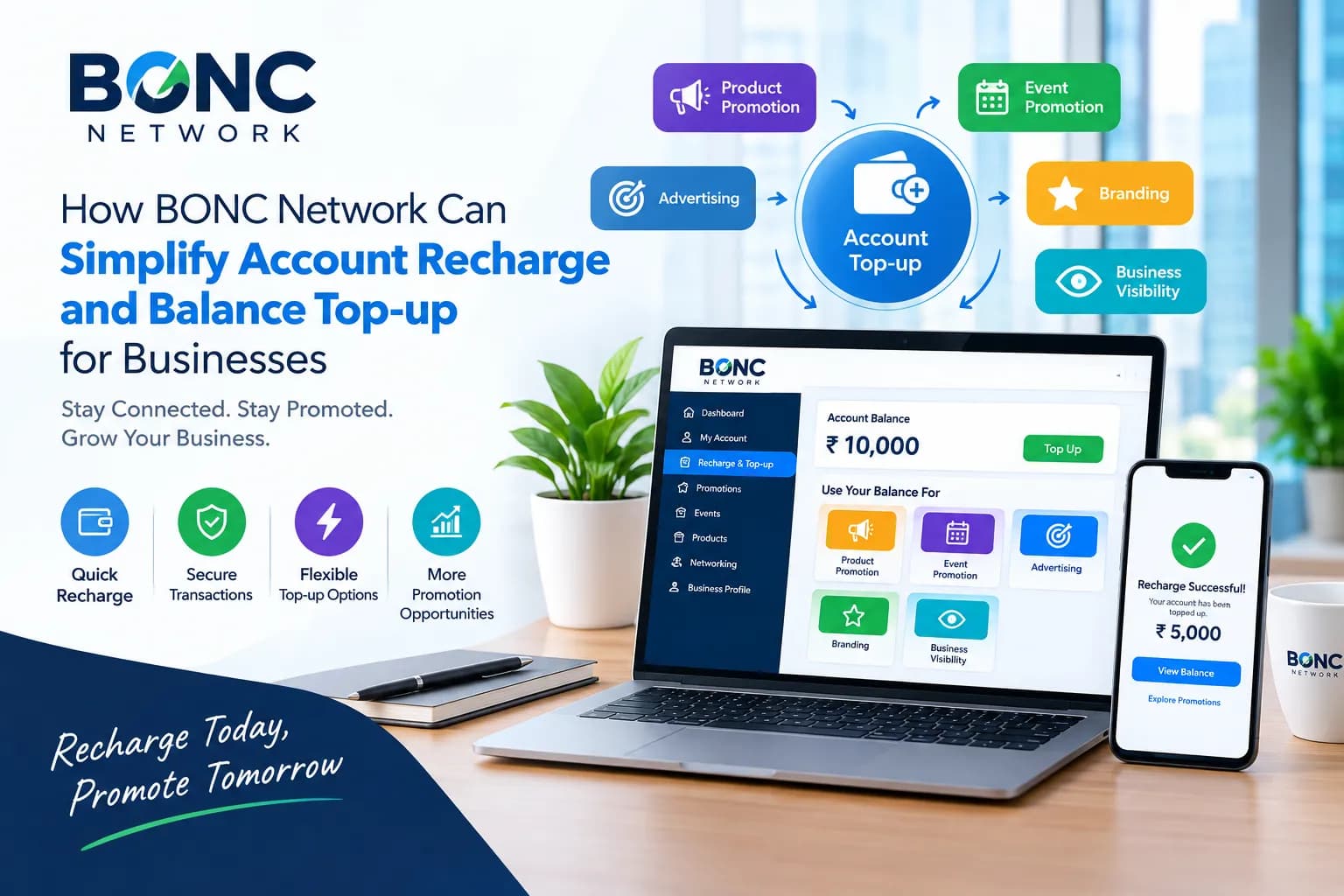
How BONC Network Can Simplify Account Recharge and Balance Top-up for Businesses
Managing business promotion in today's competitive B2B environment requires more than simply having a good product or service. Businesses need continuous visibility, effective product promotion, event marketing, branding, networking, and opportunities to connect with potential buyers.
As these activities increasingly move into digital environments, businesses also need convenient ways to manage the promotional services they use. This is where a simple and structured account recharge and balance top-up system can make a difference.
For businesses using a B2B platform, the ability to add balance to an account can make promotional activities easier to manage. Instead of handling every promotional requirement as a separate transaction, businesses can maintain an available balance and use it according to their marketing priorities.
BONC Network provides a B2B business ecosystem where businesses can showcase their profiles and products, discover other businesses, build connections, and access promotional opportunities. Within such an ecosystem, an account recharge or balance top-up model can provide businesses with a practical way to manage promotional activities such as advertising, event promotion, expo visibility, branding, and product pushing, depending on the available platform benefits.
The purpose of a recharge model is not simply to add money to an account. When structured properly, it can become part of a broader business promotion workflow—helping companies plan campaigns, activate promotional services, and manage their digital marketing activities more conveniently.
What Is Account Recharge for Businesses?
An account recharge is the process of adding funds or promotional balance to a business account so that the available balance can be used for eligible platform services.
In a consumer environment, people are familiar with recharge systems for mobile phones, digital wallets, subscriptions, and online services.
A business recharge model applies a similar concept to business-related activities.
Depending on the platform and its available services, a business may recharge its account and use the available balance for activities such as:
- Digital advertising
- Product promotion
- Featured product visibility
- Event promotion
- Trade show promotion
- Expo marketing
- Branding campaigns
- Product pushing
- Other promotional benefits
This can provide businesses with a more organized way to manage promotional spending within a B2B ecosystem.
Why Balance Top-up Matters for B2B Businesses
B2B businesses often have multiple marketing requirements running at the same time.
A company may want to:
- Promote a new product
- Increase company visibility
- Advertise an upcoming trade show
- Promote an exhibition
- Strengthen its brand
- Push a high-priority product
- Generate more inquiries
- Reach new business audiences
Managing every activity separately can become complicated.
A centralized balance top-up model can simplify the process by allowing businesses to maintain an available account balance and use it toward eligible promotional activities.
This can make promotional planning more structured.
Instead of thinking about individual payments every time a promotional activity is required, businesses can first plan their marketing budget and then use the available account balance based on campaign priorities.
1. Simplifying Business Promotion Through a Recharge Model
One of the key advantages of a recharge-based system is convenience.
Suppose a company has several products that need promotion during a particular month.
The company may want to allocate promotional resources across:
- Product A
- Product B
- Product C
- Company branding
- Event promotion
A centralized account balance can make it easier to manage these activities within one platform.
The business can recharge its account according to its planned requirements and then activate eligible promotional services.
This creates a simple process:
Plan → Recharge → Select Promotion → Activate → Monitor → Optimize
The exact services and balance requirements depend on the platform's available offerings.
2. Account Top-up Can Make Marketing More Flexible
Business marketing requirements are not always predictable.
A company may suddenly launch a new product.
An upcoming trade show may require additional promotion.
A seasonal campaign may need increased visibility.
A distributor opportunity may require quick product exposure.
A flexible account top-up model can help businesses respond to these requirements without redesigning their entire marketing process.
For example, if a company has already maintained an available balance, it may be able to allocate that balance toward an eligible promotional campaign when the need arises.
This provides greater flexibility in campaign planning.
3. Recharge Can Support Product Promotion
Product promotion is one of the most important activities for B2B companies.
Buyers often search for specific products rather than company names.
A manufacturer may want its machinery to be discovered.
A supplier may want visibility for a new product range.
A distributor may want to promote products it recently added.
A product promotion platform can help businesses increase the visibility of selected products.
Where supported, businesses can use promotional benefits associated with their available account balance to prioritize products that require additional exposure.
For example:
New Product → Product Listing → Promotional Campaign → Increased Visibility → Buyer Interest → Inquiry
The objective is to make relevant products easier for potential buyers to discover.
4. Balance Recharge Can Support New Product Launches
Launching a new B2B product requires coordinated marketing.
A business may need:
- Product visibility
- Company branding
- Digital promotion
- Event promotion
- Product content
- Buyer outreach
A recharge-based promotional model can become part of this launch strategy.
For example, a company preparing to launch an industrial product could plan its campaign around:
Week 1
Create and optimize the product profile.
Week 2
Promote the product digitally.
Week 3
Highlight product applications and features.
Week 4
Connect the product campaign with an upcoming industry event.
This allows the business to use promotional resources according to the launch timeline.
5. Supporting Trade Show and Expo Promotion
Trade shows and expos are important B2B networking opportunities.
Businesses participate in these events to:
- Meet buyers
- Find distributors
- Showcase products
- Launch new solutions
- Build relationships
- Increase brand awareness
But event success often depends on visibility before the event begins.
Businesses can promote:
- Event participation
- Booth information
- Product demonstrations
- New product launches
- Business announcements
- Meeting opportunities
For businesses using BONC Network's promotional ecosystem, an available account balance may be used toward eligible event, expo, advertising, branding, or product-promotion benefits.
This creates a connection between account recharge and event marketing.
6. Recharge Can Support Business Branding
Branding is another area where businesses need consistent visibility.
A company may want to promote:
- Company profile
- Product range
- Manufacturing capabilities
- Industry expertise
- New business initiatives
- Market expansion
Instead of treating branding as a one-time activity, businesses can include it in their broader promotional calendar.
A recharge model can help businesses plan promotional resources around branding campaigns where such services are available.
The goal should be consistent business visibility rather than occasional promotion.
7. Making Promotional Budgeting More Structured
One of the biggest challenges in digital marketing is budget management.
Businesses often have multiple campaigns and uncertain promotional requirements.
A recharge model can encourage businesses to think in terms of planned promotional budgets.
For example:
Monthly Promotion Budget
- 40% Product Promotion
- 25% Branding
- 20% Event Promotion
- 15% Business Visibility
The exact allocation should depend on the company's objectives.
A business launching a new product may allocate more toward product promotion.
A company attending a major exhibition may allocate more toward event visibility.
The important point is that recharge can become part of a structured marketing budget rather than an unplanned expense.
8. Account Balance Can Help Centralize Promotional Activities
B2B marketing can involve many different tools and platforms.
Businesses may use:
- Search advertising
- Social media
- Email marketing
- Business directories
- B2B platforms
- Event platforms
- Content marketing
- Trade show marketing
A B2B platform that combines several business promotion capabilities can simplify campaign coordination.
For example, if a business can manage company visibility, product promotion, event promotion, and networking within one ecosystem, it may reduce the complexity of managing separate activities.
A centralized account balance can complement this approach.
9. How Businesses Can Use Recharge Strategically
Recharge should not be treated as simply adding funds and spending them randomly.
Businesses should first define their objectives.
Objective 1: Increase Product Visibility
Allocate promotional resources toward priority products.
Objective 2: Generate More Business Inquiries
Promote products and company information relevant to target buyers.
Objective 3: Promote an Event
Use eligible event and expo promotion benefits.
Objective 4: Strengthen Branding
Focus promotional activity on company visibility.
Objective 5: Support a Product Launch
Combine product promotion, branding, and event marketing.
This objective-first approach can make account balance utilization more meaningful.
10. Recharge and B2B Lead Generation
The ultimate goal of many promotional activities is to create business opportunities.
A product advertisement may generate a product view.
A featured listing may attract buyer attention.
An event campaign may generate registrations or visits.
A branding campaign may increase company awareness.
These activities can contribute to B2B lead generation.
The process can be visualized as:
Promotion → Visibility → Buyer Discovery → Engagement → Inquiry → Lead → Sales Opportunity
Recharge supports the promotional stage of this journey.
It does not guarantee leads or sales. Results depend on factors such as product demand, targeting, content quality, pricing, competition, buyer intent, and campaign execution.
11. Why Product Information Still Matters After Recharge
A common misconception is that paid promotion alone creates business success.
Promotion can increase visibility, but the product presentation must still convince buyers.
A strong product profile should include:
- Accurate product name
- Detailed description
- Key features
- Specifications
- Applications
- Quality information
- Product images
- Relevant business details
- Inquiry or contact options
If a buyer discovers a product but cannot understand its specifications or application, increased visibility may not translate into meaningful inquiries.
Therefore:
Promotion + Quality Information = Better Buyer Experience
12. Recharge and Business Networking
B2B growth is not only about advertising.
Networking is equally important.
A business may discover a potential customer, distributor, supplier, or partner through a business networking platform.
BONC Network's broader B2B ecosystem is built around business discovery, product showcasing, and networking opportunities.
In such an environment, promotional activity can increase visibility while networking creates opportunities for relationship development.
The two activities can support each other:
Promotion Creates Visibility
Networking Creates Relationships
Relationships Create Business Opportunities
13. Using Recharge for Different Business Objectives
Different businesses have different priorities.
Manufacturers
May focus on product visibility, buyer discovery, and distributor relationships.
Distributors
May focus on promoting product ranges and reaching new business customers.
Exporters
May prioritize brand visibility and market discovery.
Startups
May focus on building awareness and introducing new products.
Event Organizers
May prioritize trade show and event promotion.
Established Brands
May focus on continuous branding and product campaigns.
A flexible promotional balance model can potentially accommodate different requirements.
14. Recharge Can Support Campaign-Based Marketing
Instead of promoting continuously without a plan, businesses can create campaigns.
For example:
Campaign 1: New Product Launch
Duration: 30 days
Goal: Product visibility and inquiries.
Campaign 2: Trade Show Promotion
Duration: 15 days
Goal: Increase event awareness.
Campaign 3: Brand Visibility
Duration: 30 days
Goal: Increase business discovery.
Campaign 4: Featured Product
Duration: 15 days
Goal: Promote a high-priority product.
This campaign-based approach can make account balance utilization easier to track.
15. The Importance of Monitoring Promotional Activity
Businesses should regularly evaluate their promotional campaigns.
Useful indicators can include:
- Product views
- Profile visits
- Clicks
- Inquiries
- Event engagement
- Lead quality
- Buyer interactions
- Campaign duration
- Promotional spend
These metrics help businesses understand where their promotional resources are producing the most useful engagement.
For example, if one product generates significantly more qualified inquiries than another, the company may decide to allocate more future promotional resources toward that product.
16. Recharge Models Can Encourage Better Marketing Planning
A structured account recharge system can encourage businesses to plan their marketing activities ahead of time.
Instead of asking:
“What should we promote today?”
Businesses can ask:
“What are our business objectives for this month?”
For example:
- Launch two new products
- Increase buyer inquiries
- Participate in one expo
- Improve brand visibility
- Expand into another region
The company can then decide how its promotional budget should support those goals.
This moves marketing from reactive promotion toward strategic planning.
17. Why Businesses Should Avoid Unplanned Promotion
Promoting everything at once can dilute marketing efforts.
If a business has 100 products, it may not be practical to give every product equal promotional attention.
Instead, businesses can identify:
- Best-selling products
- High-margin products
- New products
- Strategic products
- Seasonal products
- Products entering new markets
These products can receive greater promotional focus.
A recharge model can then be used strategically around these priorities where applicable.
18. Account Recharge and Digital Business Growth
Digital business growth requires consistency.
Businesses need to remain discoverable even when they are not actively running major campaigns.
Regular activity can include:
- Updating product information
- Adding new products
- Improving business profiles
- Participating in networking
- Promoting events
- Publishing useful content
- Running selected promotional campaigns
An available promotional balance can support planned activities while the business continues to improve its organic digital presence.
19. How BONC Network Can Fit Into a Business Promotion Strategy
BONC Network can be considered as one component of a broader B2B marketing strategy.
A business may use the platform to strengthen:
- Business visibility
- Product discovery
- Networking
- Product promotion
- Event promotion
- Business branding
The account recharge concept can provide an additional mechanism for accessing eligible promotional benefits.
This means businesses can approach the platform from two perspectives:
Organic Presence
Maintain accurate company and product information and participate in the business ecosystem.
Promotional Presence
Use available paid promotional benefits to give selected products, events, branding campaigns, or business activities additional visibility.
Combining these approaches can create a more balanced B2B marketing strategy.
20. Account Top-Up and the Buyer Journey
A buyer's journey may include several stages.
Discovery
The buyer discovers a company or product.
Evaluation
The buyer reviews product details.
Engagement
The buyer asks questions or contacts the business.
Consideration
The buyer compares alternatives.
Decision
The buyer selects a supplier.
Relationship
The buyer develops an ongoing business relationship.
Account top-up supports promotional activities mainly at the discovery and engagement stages.
Businesses should therefore combine promotional campaigns with strong product information and responsive sales follow-up.
21. Combining Recharge With Content Marketing
Content can make promotional campaigns more useful.
Instead of simply promoting a product, businesses can create supporting content.
For example:
Product: Industrial Pump
Supporting Content:
“How to Select the Right Pump for Manufacturing Applications”
The product promotion attracts attention while the content helps educate the buyer.
Similarly:
Event: Industrial Expo
Supporting Content:
“Top Manufacturing Technologies to Watch at This Year's Expo”
This approach can improve the informational value of marketing campaigns.
22. Recharge for Event Marketing: A Practical Example
Consider a company participating in an upcoming trade show.
The company could plan:
30 Days Before
Recharge the business account according to its promotional budget and activate suitable event-related promotion.
20 Days Before
Promote the products that will be showcased.
10 Days Before
Increase event and product visibility.
Event Week
Promote booth participation and demonstrations.
After the Event
Follow up with interested buyers and continue product visibility.
This turns event participation into a complete marketing campaign rather than a one-day activity.
23. Recharge for Product Promotion: A Practical Example
Imagine a manufacturer launching a new industrial component.
The business can structure its campaign as:
Step 1: Create a detailed product listing.
Step 2: Add high-quality images and specifications.
Step 3: Identify the target B2B audience.
Step 4: Use eligible product promotion benefits.
Step 5: Monitor product engagement.
Step 6: Respond quickly to inquiries.
Step 7: Evaluate lead quality.
This demonstrates an important principle:
Recharge provides promotional capability; strategy and execution determine the business outcome.
24. Recharge for Branding: A Practical Example
Suppose an established company wants to improve its visibility among new buyers.
It can combine:
- Company profile optimization
- Product updates
- Brand-focused promotion
- Business networking
- Event participation
- Content marketing
Where available, promotional balance can support selected paid visibility activities.
The objective is to increase the number of relevant business touchpoints.
25. Making Account Recharge More Business-Friendly
For a recharge system to be useful, businesses should ideally have clarity around:
- Available balance
- Recharge options
- Promotional services
- Usage
- Campaign duration
- Applicable benefits
- Transaction history
- Remaining balance
Transparency can help businesses understand how their promotional resources are being utilized.
A clear account system also makes internal budgeting easier because marketing teams can monitor promotional activity more systematically.
26. Recharge and Marketing Budget Control
Finance and marketing teams often need to work together.
A business can create a monthly or quarterly promotional budget.
For example:
Quarterly Promotional Budget
- Product promotion
- Event promotion
- Branding
- Advertising
- Business visibility
The business can then recharge according to its approved marketing budget and allocate promotional resources according to priorities.
This creates better alignment between marketing planning and financial management.
27. Why Recharge Should Be Part of a Larger B2B Strategy
Recharge alone is not a marketing strategy.
It is a mechanism that can support a marketing strategy.
A complete B2B approach should include:
Target Audience
Who are you trying to reach?
Product Positioning
What problem does your product solve?
Content
What information does the buyer need?
Promotion
How will the buyer discover you?
Networking
How will you build the relationship?
Sales
How will you convert the opportunity?
Measurement
How will you evaluate the result?
Recharge fits into the promotion component of this larger system.
28. Common Mistakes When Using Business Recharge
Businesses should avoid several mistakes.
Spending Without a Goal
Do not recharge simply because a promotional balance is available.
Promoting Every Product
Prioritize products based on business objectives.
Ignoring Product Quality
Promotion cannot compensate for incomplete product information.
Not Tracking Results
Monitor engagement and inquiries.
Forgetting Follow-Up
A lead has value only when the business responds effectively.
Ignoring Organic Visibility
Paid promotion should complement, not replace, strong business and product information.
29. Best Practices for Account Top-Up and Promotion
Businesses can follow a simple framework.
Define the Objective
Determine whether the goal is visibility, leads, branding, product promotion, or event promotion.
Set a Budget
Decide how much should be allocated.
Recharge Accordingly
Add the required balance according to the platform's available options.
Prioritize
Focus on important products, campaigns, or events.
Monitor
Track engagement and inquiries.
Optimize
Increase focus on activities producing better results.
Follow Up
Convert relevant inquiries into business conversations.
This makes recharge part of a structured marketing process.
30. The Future of Business Account Recharge
As B2B platforms become more integrated, account-based promotional systems may become increasingly useful.
Businesses are looking for simpler ways to manage:
- Advertising
- Product promotion
- Events
- Branding
- Networking
- Lead generation
A centralized account balance can potentially make these activities easier to coordinate.
Future B2B platforms may also provide more detailed analytics, campaign recommendations, personalized promotion options, and automated budget management.
This could make promotional spending more data-driven.
31. From Balance Top-Up to Business Growth
It is important to understand the complete relationship:
Balance Top-Up
↓
Promotional Activity
↓
Increased Visibility
↓
Product/Business Discovery
↓
Buyer Engagement
↓
Inquiry
↓
Lead
↓
Sales Opportunity
↓
Business Relationship
The recharge itself does not create growth.
It enables access to promotional activities that can contribute to visibility and opportunity creation.
The quality of the product, relevance of the target audience, strength of the campaign, and effectiveness of the sales team ultimately influence results.
32. Why BONC Network Can Be Useful for Businesses Looking for a Connected B2B Ecosystem
B2B businesses increasingly need more than a simple company listing.
They need a digital environment where they can:
- Showcase products
- Present business capabilities
- Discover companies
- Connect with buyers
- Promote products
- Promote business events
- Build brand visibility
- Manage promotional activities
BONC Network brings several of these business-oriented activities into a B2B ecosystem.
For businesses using its paid promotional options, the recharge and balance top-up model can provide a practical way to manage access to eligible promotional benefits.
This approach is particularly relevant for companies that want to connect business networking with advertising, product promotion, event marketing, and branding.
33. Creating a Balanced B2B Promotion Strategy
Businesses should ideally divide their efforts between organic and paid activities.
Organic Activities
- Product updates
- Business profile optimization
- SEO content
- Networking
- Industry participation
- Educational content
Paid Activities
- Advertising
- Featured product promotion
- Event promotion
- Branding campaigns
- Product pushing
The exact balance depends on the business.
A new company may require more awareness-building.
An established manufacturer may focus on selected products.
An event organizer may prioritize event promotion.
A seasonal business may increase promotion during specific periods.
34. A Simple Monthly Recharge Strategy
Businesses can create a monthly plan such as:
Week 1 — Product Visibility
Promote a priority product.
Week 2 — Brand Visibility
Focus on company awareness.
Week 3 — Networking
Engage with relevant businesses.
Week 4 — Event Promotion
Promote an upcoming trade show, expo, or business event.
At the end of the month, review:
- Which campaign generated engagement?
- Which product received attention?
- Which activity generated inquiries?
- Which audience responded?
- What should be promoted next month?
This creates a continuous improvement cycle.
Conclusion
For modern B2B businesses, digital promotion is becoming an increasingly important part of reaching potential buyers, building brand visibility, promoting products, and creating business opportunities. As companies manage multiple promotional activities, having a simple way to manage promotional spending can make campaign planning more organized.
An account recharge and balance top-up model can provide this structure by allowing businesses to add balance to their platform account and use it toward eligible promotional benefits according to their business requirements.
Within the BONC Network ecosystem, businesses can use the broader platform to showcase company information and products, discover other businesses, build professional connections, and explore promotional opportunities. Where applicable, account recharge can support activities such as advertising, product promotion, trade show and expo promotion, event marketing, branding, and product pushing.
However, recharge should never be viewed as a replacement for a complete marketing strategy. The strongest results come when promotional spending is combined with accurate product information, strong branding, relevant targeting, useful content, effective networking, fast inquiry response, and consistent sales follow-up.
The ideal approach is simple:
Plan Your Goals → Set Your Budget → Recharge → Promote Strategically → Monitor Results → Follow Up → Optimize.
By treating account balance as a planned promotional resource rather than an occasional expense, businesses can create a more organized approach to digital B2B marketing.
As B2B platforms continue to bring together business discovery, product promotion, networking, advertising, events, and branding, account recharge can become a convenient mechanism for businesses to activate the promotional opportunities that match their growth priorities.
Ultimately, the purpose of a balance top-up is not simply to increase an account balance. Its real value lies in how strategically that balance is used to improve visibility, support business promotion, connect with relevant audiences, and create opportunities for long-term B2B growth.
Recharge with a purpose. Promote with a strategy. Connect with the right businesses. Turn digital visibility into meaningful B2B opportunities.