The Role of BONC Network in Modern Account Recharge and Top-up Solutions
Published on: 09 Sep 2026
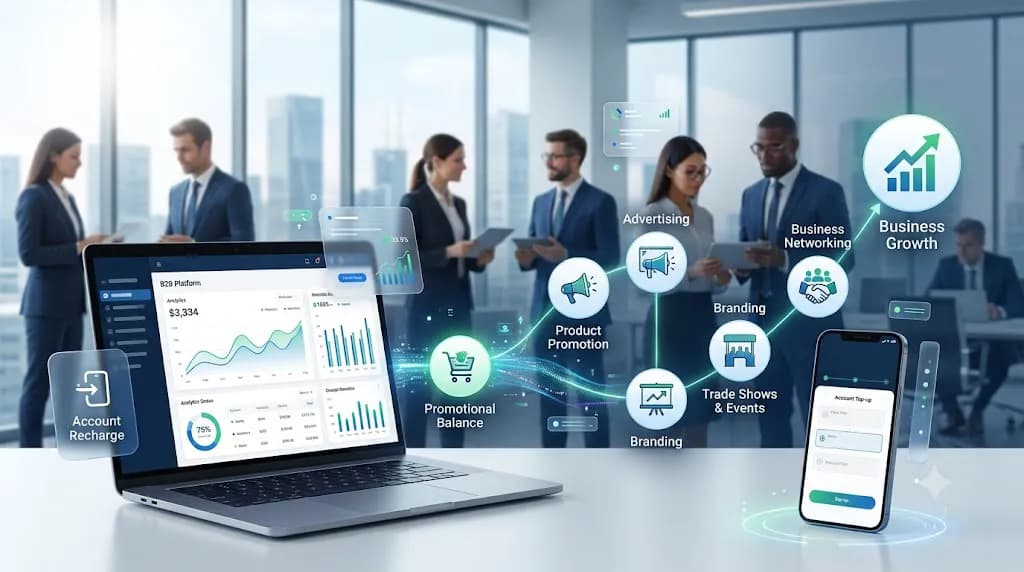
The Role of BONC Network in Modern Account Recharge and Top-up Solutions
Introduction
The way businesses manage marketing, promotion, networking, and customer acquisition has changed significantly with the growth of digital platforms. Businesses today are not only looking for places where they can create a profile or list their products. They also want convenient ways to access promotional opportunities, advertise their offerings, increase visibility, promote events, and connect with potential buyers.
This changing environment has created a growing need for flexible account recharge and balance top-up solutions for businesses. Instead of managing every promotional activity as a completely separate process, businesses can use an account-based model to maintain a promotional balance and utilize eligible services according to their objectives.
In the B2B environment, such a model can become particularly useful because businesses often have multiple promotional requirements. A manufacturer may want to promote a new product, an organizer may need to increase visibility for an upcoming trade show, while a supplier may want to strengthen its digital brand presence. These activities require planning, budgeting, execution, and monitoring.
This is where BONC Network can play an important role within a modern B2B ecosystem. BONC Network provides businesses with an environment to showcase their company and products, discover other businesses, build connections, and explore promotional opportunities. Within this ecosystem, account recharge and balance top-up can provide a structured mechanism for accessing available promotional benefits.
The value of such a system is not simply about adding money to an account. The larger objective is to make business promotion more organized, flexible, and aligned with specific growth goals.
Understanding Modern Account Recharge and Top-Up Solutions
An account recharge generally means adding a predetermined amount to a business account so that the available balance can be used for eligible services or promotional activities.
In a traditional marketing environment, businesses may separately arrange budgets for advertising, product promotion, events, branding, and other activities. A digital account-based model can simplify this process by giving businesses a centralized balance that can be used for applicable platform services.
A business account top-up can therefore support activities such as:
- Digital advertising
- Product promotion
- Featured visibility
- Business branding
- Event promotion
- Trade show promotion
- Expo visibility
- Product pushing
- Other eligible promotional activities
The exact benefits available depend on the platform's offerings and the selected promotional services.
A recharge model should not be viewed as a guarantee of sales or leads. Instead, it provides businesses with a convenient mechanism for accessing promotional opportunities.
Why Account Top-Up Is Becoming Relevant for B2B Businesses
B2B businesses usually have longer buying cycles than many consumer businesses. Buyers may compare suppliers, evaluate products, request quotations, verify capabilities, and discuss requirements before making a decision.
Because of this, business visibility becomes extremely important.
A company may have excellent products but still struggle to reach the right audience if its digital presence is limited. Similarly, a new product may require additional exposure before potential buyers become aware of it.
Account top-up solutions can help businesses allocate promotional resources more deliberately.
Instead of approaching promotion as an occasional activity, companies can think in terms of:
Business Goal → Budget → Recharge → Promotion → Monitoring → Follow-up → Optimization
This creates a more structured approach to digital business promotion.
Simplifying Business Promotion Through a Centralized Balance
One of the key advantages of an account-based promotional model is centralization.
Businesses often have multiple marketing objectives running simultaneously. Managing separate budgets for every small promotional requirement can become complicated.
A centralized account balance can provide a simpler framework.
For example, a business may decide to allocate its promotional budget toward:
- Product visibility during one period
- Brand promotion during another period
- Trade show promotion before an event
- New product promotion after launch
Rather than treating each activity as unrelated, the company can manage them as part of a broader promotional strategy.
This can be especially useful for small and medium-sized businesses that need better control over their marketing resources.
Account Recharge and Product Promotion
Product promotion is one of the most important applications of a B2B promotion platform.
Manufacturers, distributors, wholesalers, suppliers, and service providers continuously need to introduce their offerings to potential buyers.
A product listing provides basic information, but additional promotion can help increase its visibility.
Businesses can use promotional opportunities to highlight:
- New products
- High-demand products
- Seasonal products
- Industrial equipment
- Specialized solutions
- Product ranges
- Newly launched categories
However, promotion should always be supported by accurate product information.
A successful product promotion strategy requires more than simply increasing visibility. Buyers should be able to understand what the product does, who it is designed for, what specifications it offers, and how they can contact the business.
Supporting New Product Launches
Launching a new product can be challenging, particularly for businesses that do not already have strong market recognition.
A new product needs awareness before it can generate meaningful buyer interest.
This is where account recharge can become part of a new product promotion strategy.
A business can plan a promotional campaign around the launch period. It can first prepare the product information, images, specifications, company profile, and buyer communication process.
Once these foundations are ready, promotional resources can be used to increase product visibility.
For example:
Product Preparation → Listing → Promotional Campaign → Buyer Discovery → Inquiry → Follow-up
This approach helps businesses connect promotional activity with the wider sales process.
Account Top-Up for Business Branding
Branding is another important area where businesses can use digital promotional resources.
B2B buyers often evaluate the credibility and professionalism of a company before beginning a business conversation.
A strong digital business profile can communicate:
- Company identity
- Product categories
- Industry expertise
- Business capabilities
- Product portfolio
- Contact information
- Market presence
Promotional activities can then help increase the visibility of that business presence.
For companies competing in crowded industries, consistent B2B digital branding can help them remain visible to potential buyers.
Trade Show and Expo Promotion
Trade shows and expos remain important components of B2B marketing.
They provide opportunities for companies to demonstrate products, meet industry professionals, interact with buyers, and develop relationships.
However, simply participating in an event does not automatically guarantee strong attendance or business opportunities.
Effective trade show promotion should begin before the event.
Businesses and event organizers can use digital platforms to communicate:
- Event name
- Date and venue
- Industry focus
- Exhibitor information
- Product categories
- Registration details
- Business opportunities
An account recharge model can support promotional activities associated with eligible event and expo marketing services.
The objective is to create greater awareness before the event and encourage relevant businesses and professionals to discover it.
Event Marketing Through a B2B Ecosystem
Modern event marketing is no longer limited to physical invitations or traditional advertising.
Businesses can combine event promotion with digital networking.
For example, an exhibition focused on industrial machinery can be promoted to manufacturers, distributors, suppliers, engineers, procurement professionals, and other relevant businesses.
This makes the promotion more focused than simply advertising an event to a broad audience.
A B2B ecosystem can therefore connect event discovery, business discovery, product discovery, and networking within a single environment.
BONC Network and the Modern B2B Promotion Ecosystem
BONC Network fits into this broader transformation by bringing different business activities together within a B2B environment.
Businesses can use a platform such as BONC Network to showcase their business identity and products while discovering other companies and potential business connections.
Its ecosystem approach can support different aspects of digital business visibility, including product discovery, business networking, promotional activities, and business communication.
Within this environment, an account recharge or balance top-up model can serve as a practical mechanism for accessing eligible promotional benefits.
The important point is that recharge is only one part of the overall strategy.
The actual effectiveness of a promotional campaign can depend on factors such as:
- Product quality
- Market demand
- Target audience
- Product information
- Promotional placement
- Campaign timing
- Business responsiveness
- Follow-up process
Therefore, businesses should treat recharge as an enabler rather than the complete marketing strategy.
Account Recharge and B2B Lead Generation
Lead generation is one of the major objectives behind digital promotion.
A business may want to reach potential distributors, retailers, manufacturers, procurement teams, institutional buyers, or other companies.
In such cases, increased visibility can create opportunities for inquiries.
However, there is an important difference between visibility and lead generation.
Visibility helps more potential buyers discover a business or product.
Lead generation occurs when interested prospects take an action such as:
- Sending an inquiry
- Requesting product information
- Asking for pricing
- Requesting a quotation
- Contacting the company
- Starting a business conversation
Recharge can help activate promotional opportunities, but businesses still need to respond quickly and professionally when inquiries arrive.
Product Information Still Matters
No promotional system can compensate for poor product information.
When a potential buyer discovers a product, they need sufficient information to decide whether it is relevant.
A strong product presentation should ideally include:
- Product name
- Product category
- Description
- Key features
- Specifications
- Applications
- Images
- Availability information
- Company details
- Contact options
For industrial and B2B products, technical specifications can be particularly important.
Businesses should therefore optimize their product information before investing heavily in promotional activities.
Recharge and Buyer Discovery
Modern B2B buyers increasingly use digital channels to discover suppliers and products.
They may begin their search by looking for:
- Manufacturers
- Suppliers
- Distributors
- Dealers
- Service providers
- Product categories
- Industrial solutions
- Local vendors
This makes buyer discovery a critical component of B2B marketing.
A business that combines a complete digital profile with relevant product promotion can create a stronger foundation for buyer engagement.
Making Promotional Budgets More Structured
One of the practical advantages of a recharge model is that it can encourage businesses to think about promotion as a planned budget.
Instead of spending without a clear objective, businesses can define:
What do we want to promote?
Who do we want to reach?
When should we promote it?
How much should we allocate?
What result do we want to measure?
For example, a company may dedicate one portion of its promotional budget to product visibility and another portion to event promotion.
This creates greater discipline around marketing expenditure.
Recharge for Small and Medium-Sized Businesses
Large companies often have dedicated marketing teams and larger advertising budgets.
Small businesses may have limited resources and need to prioritize every marketing activity.
For them, flexible promotional solutions can be particularly valuable.
Instead of attempting to run multiple expensive campaigns simultaneously, a small business can identify its highest-priority objective and allocate its available promotional budget accordingly.
For example, a manufacturer entering a new market may prioritize product visibility.
A service provider may prioritize business branding.
An event organizer may focus on trade show promotion.
This objective-based approach can make digital marketing more manageable.
Using Recharge for Different Business Objectives
A single business may have different promotional needs throughout the year.
At one stage, the priority could be product launch.
Later, the company may focus on branding.
Before an exhibition, event marketing may become more important.
Therefore, businesses should not treat recharge as a one-time activity.
Instead, they can align their promotional balance with changing business objectives.
Common objectives include:
- Increasing product visibility
- Promoting new products
- Supporting event participation
- Increasing brand awareness
- Reaching new markets
- Supporting seasonal campaigns
- Promoting business capabilities
- Increasing buyer engagement
Combining Product Promotion With Business Networking
Promotion becomes more valuable when it is connected with networking.
A buyer discovering a product may also want to know who supplies it.
A supplier discovering another business may identify a potential partnership.
An event attendee may discover an exhibitor whose products match its requirements.
This is why the combination of product promotion and business networking can create a stronger B2B ecosystem.
The objective is not simply to display advertisements but to create opportunities for businesses to discover one another.
Recharge and Digital Marketing Campaigns
Businesses can also think about recharge within a campaign-based marketing model.
For example, consider a three-month product campaign.
During the first stage, the company prepares its product content.
During the second stage, promotional activities increase product visibility.
During the third stage, the company follows up with interested buyers and evaluates performance.
This creates a complete campaign cycle:
Preparation → Promotion → Engagement → Lead Management → Analysis
Such planning is more effective than promoting a product without a clear objective.
Monitoring Promotional Performance
Businesses should monitor the performance of promotional activities.
Important indicators can include:
- Number of views
- Product engagement
- Business profile visits
- Inquiries
- Buyer interactions
- Event interest
- Lead quality
- Follow-up rate
- Conversion opportunities
The objective is not simply to maximize numbers.
For B2B companies, lead quality can be more important than raw traffic.
Ten relevant business inquiries may be more valuable than hundreds of visitors who have no purchasing relevance.
Avoiding Unplanned Account Recharge
Businesses should avoid recharging an account simply because promotional services are available.
Every promotional investment should have a purpose.
Before recharging, businesses should ask:
- What product or service are we promoting?
- What is our target market?
- What is the campaign objective?
- What is our available budget?
- How will we handle incoming inquiries?
- What information needs improvement?
- How will we evaluate the campaign?
This helps prevent unnecessary spending.
Account Recharge and the Buyer Journey
The B2B buyer journey often involves multiple stages.
A potential buyer may first discover a business, then explore its products, compare alternatives, contact the company, request information, and finally begin negotiations.
Account recharge can support the visibility and discovery stages of this journey when used for eligible promotional activities.
But businesses must support the later stages with:
- Accurate information
- Quick communication
- Professional sales support
- Pricing information
- Product documentation
- Follow-up
Promotion can open the door, but business processes determine what happens after the door opens.
Combining Recharge With Content Marketing
Content remains an important part of B2B marketing.
Businesses can create:
- Product articles
- Industry guides
- Product comparisons
- Case studies
- Technical explainers
- Business updates
- Event-related content
Promotional activities can help bring additional visibility to important business content.
This creates a stronger connection between paid promotion and organic business communication.
A Practical Example: Product Promotion
Consider a manufacturer launching a new industrial product.
The company first prepares a detailed product listing containing specifications, applications, images, and company information.
It then identifies its target buyer segment.
After preparing the content, the company uses its available promotional resources to increase product visibility.
When inquiries begin arriving, the sales team responds quickly and records relevant prospects.
After the campaign, the company reviews engagement and inquiry quality.
This demonstrates how account top-up can become part of a larger B2B product promotion strategy rather than being an isolated financial activity.
A Practical Example: Trade Show Promotion
Imagine an organizer preparing an industry-specific expo.
The organizer wants manufacturers, suppliers, distributors, and buyers to discover the event.
The event details are prepared and published digitally.
Promotional resources are then allocated toward event visibility.
Potential attendees discover the event and explore its details.
Exhibitors receive greater awareness among relevant businesses.
Following the event, organizers can continue communication with participating businesses.
Here, recharge supports the promotional component of a wider event marketing strategy.
A Practical Example: Business Branding
Consider a small manufacturer entering a new regional market.
The company may already have quality products but limited digital recognition.
The company improves its business profile and product information.
It then uses promotional opportunities to increase its digital visibility.
As more businesses discover the company, the manufacturer can begin building new conversations and partnerships.
This demonstrates why business branding and product visibility should work together.
How Businesses Can Use BONC Network Strategically
Businesses using BONC Network can think about their presence in several layers.
The first layer is the business profile.
The second is product information.
The third is networking and business discovery.
The fourth is promotional activity.
The fifth is lead management and follow-up.
Account recharge can support the promotional layer when businesses choose eligible services.
A practical strategy can therefore look like:
Build Profile → Add Products → Improve Information → Recharge When Needed → Promote → Connect → Follow Up → Evaluate
This creates a more complete approach to B2B digital growth.
Account Top-Up and Business Growth
Business growth rarely comes from one activity.
It generally results from multiple elements working together.
These may include:
- Product quality
- Competitive pricing
- Distribution
- Branding
- Marketing
- Networking
- Customer service
- Lead management
- Market expansion
Account recharge can support the marketing and promotional component of this system.
It should therefore be considered part of a larger B2B business growth strategy.
The Importance of Consistent Promotion
Businesses often promote aggressively for a short period and then stop completely.
A more consistent approach can help maintain visibility over time.
This does not necessarily mean spending continuously.
Instead, businesses can create promotional cycles around important business events such as:
- Product launches
- Seasonal demand
- New market entry
- Trade shows
- Exhibitions
- New partnerships
- Business milestones
Recharge can then be planned around these important moments.
How BONC Network Can Support a Connected B2B Approach
A major advantage of a B2B ecosystem is the ability to bring different business activities closer together.
Instead of treating product discovery, networking, branding, advertising, and event promotion as completely separate activities, businesses can view them as connected parts of their digital presence.
BONC Network can fit into this model by providing businesses with an environment for business discovery, product showcasing, networking, and promotional opportunities.
The account recharge model can provide an additional layer of flexibility for businesses that want to activate eligible promotional services according to their needs.
Common Mistakes Businesses Should Avoid
Businesses can make several mistakes when using account recharge and promotional solutions.
Recharging Without a Goal
Adding balance without knowing what will be promoted can lead to inefficient spending.
Promoting Incomplete Products
A promotional campaign is less useful if the product page lacks essential information.
Ignoring Target Buyers
Businesses should identify the type of buyer they want to reach instead of promoting everything to everyone.
Failing to Follow Up
A business inquiry should receive timely attention.
Expecting Guaranteed Sales
Promotion can create visibility and opportunities, but sales depend on many other factors.
Not Measuring Results
Businesses should review campaign performance and adjust future strategies accordingly.
Best Practices for Modern Account Recharge Solutions
Businesses can follow several simple principles.
Start With Objectives: Clearly define what the promotion should achieve.
Prepare Your Content: Ensure business and product information is complete.
Know Your Audience: Identify the industries, locations, buyer types, and applications that matter.
Set a Budget: Determine how much can reasonably be allocated.
Recharge Strategically: Add balance according to planned promotional requirements.
Promote Selectively: Focus on high-priority products, services, events, or branding activities.
Respond Quickly: Follow up with relevant inquiries.
Measure Performance: Review engagement and business opportunities.
Optimize: Use the results of previous campaigns to improve future campaigns.
The Future of Business Account Recharge and Top-Up
Digital business platforms are increasingly moving toward integrated ecosystems.
In the future, businesses may expect platforms to offer more connected experiences across:
- Business discovery
- Product discovery
- Advertising
- Networking
- Events
- Lead generation
- Communication
- Analytics
- Promotional management
Account recharge can become one component of this broader digital ecosystem.
The emphasis is likely to move from simply adding balance to using promotional resources intelligently.
Businesses will increasingly ask not only, “How much should we recharge?” but also, “What business objective should this balance support?”
This shift can encourage more strategic marketing decisions.
From Recharge to Business Opportunities
An account balance by itself does not create business growth.
Its value comes from how intelligently the available promotional resources are used.
A business can recharge its account, but it must still have a strong product, accurate information, relevant targeting, effective communication, and consistent follow-up.
Therefore, the real journey is:
Recharge → Promotion → Visibility → Discovery → Inquiry → Conversation → Business Opportunity
This makes account recharge a supporting mechanism within a much larger business development process.
Why BONC Network Can Be Relevant to Modern Businesses
Modern B2B businesses need more than isolated promotional tools.
They need environments where they can present their businesses, showcase products, discover other companies, connect with potential partners, and explore promotional opportunities.
BONC Network can serve as part of this connected approach.
Its B2B ecosystem allows businesses to focus on visibility, product discovery, networking, and promotional activities in a more integrated environment.
The account recharge and top-up model can add flexibility by allowing businesses to access eligible promotional services according to their requirements and available plans.
This makes recharge more meaningful when it is connected to an actual business strategy.
Creating a Simple Monthly Recharge Strategy
Businesses can create a simple monthly planning cycle.
At the beginning of the month, identify the primary business objective.
Then select the products, services, events, or branding activities that need attention.
After that, establish a promotional budget and recharge according to the required activities.
During the campaign, monitor engagement and inquiries.
At the end of the month, evaluate what worked and what needs improvement.
A simple framework can be:
Plan → Budget → Recharge → Promote → Monitor → Follow Up → Improve
This approach can help businesses maintain better control over their digital promotion.
Account Recharge as Part of a Larger B2B Strategy
The most important point is that account recharge should not be treated as the entire marketing strategy.
It is a resource-management mechanism.
Its effectiveness depends on how it is integrated with:
- Product marketing
- Digital branding
- Business networking
- Event marketing
- Lead generation
- Content marketing
- Sales follow-up
- Customer relationship management
Businesses that combine these elements can create a stronger and more sustainable B2B growth system.
Conclusion
Modern businesses are moving toward more connected digital ecosystems where business discovery, product promotion, networking, advertising, branding, and event marketing can work together. Within this changing environment, account recharge and balance top-up solutions can provide businesses with a practical way to manage access to eligible promotional activities.
The role of BONC Network becomes relevant because it brings businesses, products, networking opportunities, and promotional possibilities into a B2B-focused ecosystem. Businesses can use their digital presence to showcase their capabilities, improve product visibility, discover potential connections, and plan promotional activities according to their objectives.
However, successful promotion should never be measured simply by how much an account is recharged. The real value comes from how strategically that balance is used. Businesses should define their objectives, prepare strong product and company information, identify relevant audiences, select appropriate promotional activities, monitor performance, and follow up with potential buyers.
The future of B2B promotion is likely to be more integrated, data-driven, and objective-focused. In that environment, recharge and top-up models can become useful tools for managing promotional resources efficiently.
Ultimately, the ideal approach is simple: Plan the objective, set the budget, recharge when required, promote strategically, monitor results, follow up with opportunities, and continuously optimize. When used as part of a complete B2B growth strategy, modern account recharge solutions can help businesses make their promotional activities more organized while building stronger visibility and better opportunities for long-term business growth.