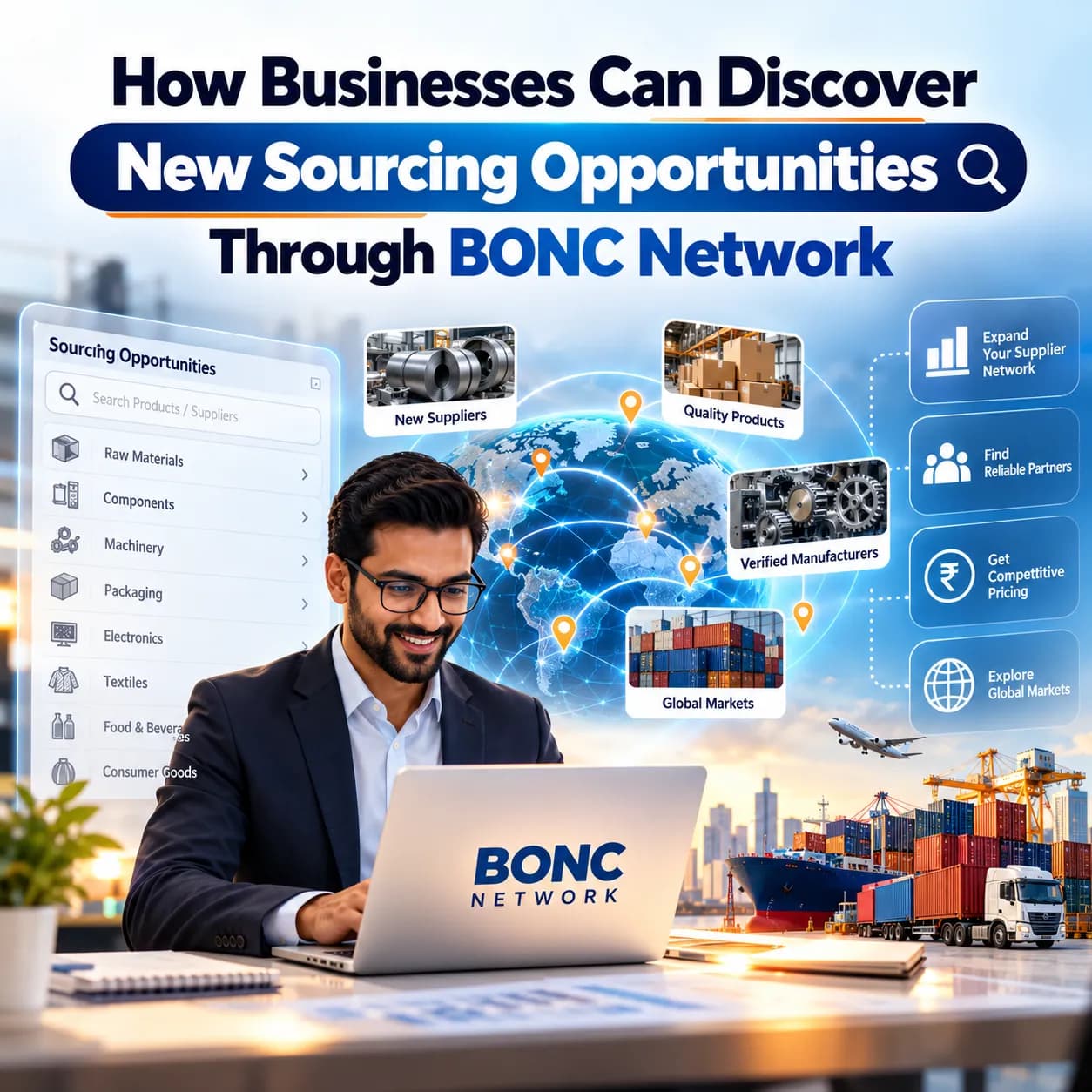
How Businesses Can Discover New Sourcing Opportunities Through BONC Network
By BONC Editorial Team • Published on 13 Oct 2026
Introduction
Sourcing is one of the most important activities in business operations. Whether a company manufactures products, operates a retail business, manages wholesale distribution, or provides services, it needs access to suitable suppliers, products, materials, and business partners. The quality of sourcing decisions can influence operating costs, product quality, delivery schedules, customer satisfaction, and long-term profitability.
However, finding suitable sourcing opportunities is not always easy. Businesses may depend on existing vendors, local markets, personal recommendations, industry directories, or trade exhibitions. Although these channels remain useful, they may not always provide access to the full range of available products, manufacturers, and suppliers. Companies looking to expand into new markets or introduce new product categories may need additional ways to discover relevant business opportunities.
Digital technology is changing how businesses approach sourcing. Online platforms make it easier to research companies, explore product categories, review business information, and initiate conversations with potential commercial partners. Instead of depending entirely on existing contacts, businesses can use digital discovery channels to explore a wider network of possible suppliers and buyers.
BONC Network is a B2B Business Networking Platform that provides businesses with a digital environment to present their profiles, showcase products, and explore potential business connections. For companies looking to discover new sourcing opportunities, it can serve as an additional channel alongside supplier directories, trade shows, referrals, and direct research.
Digital sourcing is not simply about finding the largest number of suppliers. It is about identifying businesses that can meet specific requirements, evaluating their capabilities, and building productive commercial relationships. A well-planned sourcing strategy combines digital discovery with independent verification, clear communication, and careful comparison.
This article explores how businesses can discover new sourcing opportunities through BONC Network, why digital supplier discovery matters, and how organisations can turn potential connections into meaningful business relationships.
Understanding Sourcing Opportunities in Modern Business
Sourcing refers to the process of identifying and evaluating suppliers, manufacturers, distributors, and service providers that can fulfil a business requirement. It may involve purchasing raw materials, finished products, industrial components, machinery, packaging, or professional services.
A sourcing opportunity exists when a business identifies a potential product, supplier, or commercial relationship that could meet its operational or growth objectives.
For example, a retailer may discover a manufacturer offering a new product category. A manufacturing company may identify an alternative supplier for an important component. A wholesaler may find a distributor that provides access to a different market. Each situation creates a potential opportunity that can be evaluated further.
Sourcing opportunities can also involve more than purchasing products. Businesses may discover potential manufacturing partners, private-label production arrangements, distribution relationships, or suppliers that support product development.
Modern sourcing increasingly combines traditional research with digital discovery. Personal relationships and physical inspections continue to matter, but online platforms can help businesses identify potential partners before investing time and resources in detailed discussions.
The objective is to make sourcing more systematic, flexible, and aligned with business requirements.
Why Businesses Need to Discover New Sourcing Opportunities
Reducing Dependence on Existing Suppliers
Relying on a small number of suppliers can create operational risks. A vendor may experience production delays, increase prices, face material shortages, or become unable to fulfil an order.
If a business has not researched alternatives, these problems can disrupt operations and affect customers.
Regularly exploring new sourcing opportunities helps businesses identify potential backup suppliers and understand the alternatives available in the market. A new supplier does not necessarily need to replace an existing partner. It may simply provide another option when requirements change.
Digital business platforms can support this process by giving procurement teams additional channels to research companies and product offerings.
Finding Competitive Commercial Options
Businesses need to balance cost, quality, delivery, and service when making sourcing decisions. The first supplier contacted may not always provide the most suitable overall offer.
Exploring multiple potential vendors can help businesses compare pricing structures, minimum order quantities, product specifications, payment conditions, and delivery arrangements.
The lowest quoted price should not automatically determine the final choice. Additional expenses such as packaging, transportation, inspection, taxes, and after-sales support may affect the total cost.
Digital discovery can help create an initial shortlist, while structured quotation comparisons support more informed decisions.
Expanding Product Categories
Retailers, wholesalers, distributors, and online sellers often need to introduce new products to respond to changing customer demand.
Discovering new manufacturers and suppliers can help them research product categories that are not available through their existing network.
For example, a retailer selling home products may explore additional kitchenware or storage categories. A distributor serving industrial customers may investigate new equipment or component manufacturers.
Before introducing a product, businesses should assess demand, product quality, regulatory requirements, expected margins, and supply continuity.
Entering New Geographic Markets
Businesses may initially source products from nearby suppliers because local procurement can simplify communication and transportation. However, a wider search may reveal additional manufacturers or vendors in other regions.
For Indian businesses, digital supplier discovery can help them research companies beyond their immediate city or state.
A buyer may investigate manufacturers in an established industrial region, while a supplier may research businesses in another state that could require its products.
Geographic expansion should be evaluated carefully. Transportation costs, delivery timelines, taxes, documentation, and after-sales service can influence whether a distant supplier is commercially suitable.
Supporting Long-Term Business Growth
As a company grows, its sourcing requirements often become more complex. It may need larger quantities, additional product categories, more specialised materials, or suppliers capable of supporting new production requirements.
Discovering potential partners early gives businesses more time to evaluate their capabilities and negotiate appropriate terms.
A broader sourcing network can also help businesses adapt when market conditions change. However, the value of a network depends on the suitability and reliability of its members, not simply the number of contacts.
How BONC Network Can Support Sourcing Discovery
BONC Network can form part of a business's digital sourcing strategy by providing an online environment for business visibility, product discovery, and potential B2B connections.
It offers another channel for businesses to research companies and present their offerings to prospective commercial partners.
Exploring Business Profiles and Product Offerings
The first stage of sourcing is identifying businesses that may offer the required products or services.
Digital business information can help buyers understand a company's product categories and determine whether its offerings deserve further investigation.
Through digital discovery channels such as BONC Network, businesses can explore relevant business information and identify potential manufacturers, suppliers, distributors, or other commercial partners.
For example, a wholesaler searching for a new product category may research businesses that offer related products. A manufacturer looking for packaging materials may investigate suppliers whose offerings appear suitable for its production needs.
The next step is direct communication to confirm specifications, availability, quantities, pricing, and other requirements.
Helping Manufacturers Showcase Their Offerings
Manufacturers need ways to communicate their capabilities to potential buyers. An organised digital presence can help them explain what they produce, which industries they serve, and what types of orders they may be able to fulfil.
BONC Network provides a digital business environment where companies can present business information and showcase products.
Manufacturers can strengthen their presentation by maintaining accurate descriptions, relevant specifications, clear product images, and current contact information wherever applicable.
For example, an industrial component manufacturer may need to explain the materials, dimensions, and intended applications of its products. A packaging manufacturer may describe its available packaging types and customisation options.
Clear information helps buyers decide whether to make an inquiry and makes subsequent conversations more focused.
Digital visibility does not guarantee inquiries, sales, or commercial success. Outcomes depend on market demand, product suitability, competition, pricing, communication, and follow-up.
Supporting Buyers in Supplier Research
Buyers need to identify potential vendors before comparing offers and choosing a supplier.
A B2B networking platform can provide another source of business information for this initial research.
BONC Network can be included in a broader discovery process that combines online research with direct supplier websites, industry directories, referrals, and trade exhibitions.
Once potential vendors have been identified, buyers should create a shortlist and evaluate each company against their actual requirements.
This process helps separate potentially relevant opportunities from companies that may not be able to meet the required specifications or order quantities.
Creating Opportunities for Business-to-Business Connections
Some sourcing opportunities begin when two businesses discover that their products or capabilities complement each other.
A manufacturer may need a distributor, a buyer may be looking for a new product supplier, or a supplier may want to reach customers in a different industry.
BONC Network can serve as an additional channel for exploring such business connections.
After identifying a potential partner, both parties can discuss requirements, commercial terms, samples, delivery conditions, and possible future collaboration.
A digital connection should be treated as the starting point of the relationship. The actual value depends on whether the companies can meet each other's needs and establish suitable terms.
Types of Sourcing Opportunities Businesses Can Explore
Product Sourcing
Product sourcing involves identifying products that a business can purchase, distribute, resell, or use in its operations.
Retailers and wholesalers may explore new product categories, while institutional buyers may look for equipment and supplies.
Digital product discovery can help businesses research available offerings and identify companies to contact for detailed information.
Before placing an order, buyers should assess product quality, demand, pricing, minimum quantities, packaging, and delivery conditions.
Raw Material Sourcing
Manufacturers depend on raw materials to maintain production. The quality and availability of these materials can influence product consistency, manufacturing costs, and delivery schedules.
Digital sourcing channels can help manufacturers research potential raw-material suppliers and investigate alternative sources.
The evaluation process should include material specifications, quality documentation, sample testing, supply capacity, and delivery reliability.
For specialised or regulated materials, additional technical and legal checks may be necessary.
Industrial Equipment and Component Sourcing
Businesses operating in manufacturing, construction, engineering, and other industrial sectors may need machinery, spare parts, tools, or specialised components.
These products often require detailed technical evaluation.
A buyer should confirm dimensions, compatibility, operating conditions, performance requirements, warranties, installation needs, and maintenance support before committing to a purchase.
Digital business profiles can support initial discovery, but technical documents and direct supplier discussions are essential for final evaluation.
Packaging and Logistics-Related Sourcing
Packaging suppliers support manufacturers, retailers, food businesses, e-commerce companies, and distributors.
Businesses may need cartons, labels, protective packaging, containers, or customised packaging solutions.
Digital sourcing can help them identify possible vendors and compare available options.
Businesses should also assess material suitability, durability, printing quality, order quantities, lead times, and transport arrangements.
Private-Label and Manufacturing Partnerships
Some businesses want to sell products under their own brand without operating their own manufacturing facilities.
They may look for contract manufacturers or private-label production partners that can produce goods according to agreed specifications.
This type of sourcing requires careful discussion of product quality, minimum order quantities, intellectual property, packaging, branding, confidentiality, production timelines, and contractual responsibilities.
Digital networking may help identify potential partners, but detailed verification and written agreements are especially important.
Distribution and Wholesale Opportunities
Manufacturers often need distributors to expand into new markets, while wholesalers may seek additional manufacturers whose products suit their customers.
Digital networking can help both parties discover potential commercial relationships.
Before entering a distribution arrangement, businesses should clarify territory, pricing, sales targets, inventory obligations, marketing responsibilities, payment terms, and any exclusivity conditions.
A Step-by-Step Process for Discovering New Sourcing Opportunities Through BONC Network
Define Your Sourcing Requirements
Before starting a search, determine exactly what the business needs.
Identify the product or service, specifications, required quantity, target price range, delivery timeline, and quality expectations.
For industrial products, include relevant technical requirements. For retail products, consider packaging, target customers, expected demand, and repeat-order availability.
Clear requirements help businesses focus on relevant suppliers rather than collecting a large number of unsuitable contacts.
Research Relevant Business Categories
Use digital business discovery channels to investigate companies whose offerings appear to match the requirement.
BONC Network can be one of the platforms included in this process, alongside supplier directories, company websites, referrals, and industry-specific resources.
Searches should focus on relevant product categories, supplier types, and business capabilities.
The aim is to find potential partners that deserve further investigation.
Create a Shortlist of Potential Vendors
After initial research, prepare a shortlist of suitable-looking companies.
Record available information such as company name, product category, location, contact details, specifications, and questions that remain unanswered.
A central record helps procurement teams compare vendors consistently and makes follow-up easier.
Do not assume that every listed business is suitable simply because it appears in a search result or has an online profile.
Contact Potential Suppliers Professionally
A clear inquiry should explain the business requirement and provide enough detail for the supplier to respond meaningfully.
For example, a buyer might specify the required product, quantity, technical specifications, delivery location, and expected delivery date.
The buyer should also request relevant commercial information, including pricing, minimum order quantities, payment terms, and quotation validity.
Suppliers can improve their responses by asking necessary clarification questions and providing accurate information about their capabilities.
Compare Quotations and Commercial Terms
Once quotations are received, compare them using the same requirements.
Consider the total cost, product specifications, quality standards, transport, packaging, taxes, payment conditions, lead times, and after-sales support.
If quotations differ significantly, ask suppliers to explain the differences before making a decision.
This approach helps businesses avoid choosing a vendor based solely on the lowest unit price.
Verify the Supplier Independently
Before making a commitment, carry out appropriate due diligence.
Depending on the transaction, this may include checking business registration details, references, certifications, product samples, manufacturing capacity, or facility information.
For higher-value orders, businesses may consider inspections, testing, staged payments, or professional advice.
A digital business profile is useful for discovery, but it is not proof of supplier reliability or product quality.
Begin With an Appropriate Order or Trial
Where practical, businesses can evaluate a new supplier through samples, a pilot order, or a limited initial purchase.
This allows them to assess product quality, communication, packaging, delivery performance, and the supplier's ability to follow agreed specifications.
The size and structure of the initial order should reflect the risk, product type, and commercial requirements.
Maintain Supplier Performance Records
After the transaction, record whether the supplier met the agreed conditions.
Track quality, delivery reliability, communication, pricing consistency, and issue resolution.
These records help businesses decide whether to place repeat orders, negotiate improvements, maintain the supplier as an alternative, or continue searching.
How Small Businesses and MSMEs Can Benefit From Digital Sourcing
Small businesses and micro, small, and medium enterprises often operate with limited budgets and smaller procurement teams. They may not have dedicated sourcing specialists or the resources to attend every relevant trade exhibition.
Digital sourcing can provide an additional way to research suppliers and explore product categories without relying exclusively on physical networking.
For example, a small retailer may research manufacturers offering new products, while a small manufacturer may explore alternative sources of packaging or components.
Platforms such as BONC Network can form part of this discovery process by helping businesses establish a digital presence and explore potential business connections.
However, small businesses should be particularly careful about working capital, advance payments, minimum order quantities, inventory risk, and transportation costs.
A supplier offering a low price may still be unsuitable if it requires a large order or cannot deliver within the required period.
A disciplined sourcing process can help smaller companies compare options, manage risk, and make purchasing decisions that fit their financial and operational capacity.
Common Mistakes to Avoid When Searching for New Sourcing Opportunities
Choosing Suppliers Only on Price
The lowest price does not always represent the best value. Differences in materials, specifications, quality, delivery, and after-sales support may explain why quotations vary.
Businesses should compare the total cost and evaluate whether each supplier can meet the required standards.
Depending on a Single Discovery Channel
Using only one platform or relying exclusively on personal referrals can limit the range of potential options.
Combining BONC Network with other appropriate sources can help businesses explore a broader set of opportunities.
Ignoring Supplier Verification
An attractive business profile or professional-looking website does not guarantee that a supplier is genuine, capable, or suitable.
Independent checks should be proportionate to the transaction's value and risk.
Providing Incomplete Requirements
If a buyer does not specify product details, quantities, or delivery expectations, suppliers may provide quotations that are difficult to compare.
A clear request reduces confusion and supports more useful responses.
Failing to Follow Up
A potential sourcing opportunity may be lost if businesses fail to respond to questions, clarify terms, or follow up on quotations.
Professional communication and organised records help keep the process moving.
Treating Every Connection as a Qualified Opportunity
Not every business discovered online will be a suitable partner. Some may offer different products, have incompatible minimum quantities, or operate under unsuitable commercial terms.
Businesses should evaluate relevance and capability before investing substantial time or money.
Building Long-Term Relationships From New Sourcing Opportunities
Discovering a supplier is only the first step. The long-term value comes from developing a relationship that supports both businesses.
Maintain Clear Communication
Both parties should communicate openly about requirements, timelines, specifications, and potential issues.
Important decisions should be documented to reduce misunderstandings.
Establish Clear Commercial Agreements
Written agreements should define product specifications, pricing, payment schedules, delivery responsibilities, inspection arrangements, warranties, and procedures for handling disputes where applicable.
For complex or high-value arrangements, professional legal or commercial advice may be appropriate.
Evaluate Performance Consistently
Businesses should monitor supplier performance against agreed expectations.
If problems arise, they should communicate promptly and determine whether corrective action is possible.
Consistent evaluation helps identify suppliers that provide dependable service over time.
Keep Exploring Alternatives
Maintaining a healthy supplier network does not mean constantly replacing vendors. It means understanding the available alternatives and being prepared for changing business needs.
Businesses can continue researching sourcing opportunities even when their current suppliers are performing well.
This approach supports resilience while allowing established relationships to remain valuable.
Measuring the Success of a Digital Sourcing Strategy
Businesses should evaluate whether digital sourcing activities are producing useful outcomes.
Possible measures include the number of relevant suppliers discovered, the proportion that respond to inquiries, the number of comparable quotations received, time spent on initial research, and the number of suppliers that pass the evaluation process.
Businesses can also monitor purchasing costs, defect rates, delivery performance, and supplier responsiveness after orders are placed.
These measurements help determine whether digital discovery is improving the sourcing process or simply increasing the number of contacts.
BONC Network can be included in a company's broader sourcing activity, with its contribution evaluated according to the opportunities and outcomes that can be reasonably attributed to that channel.
The most useful measures depend on the business's objectives. A manufacturer looking for distributors may focus on relevant buyer conversations, while a procurement team may prioritise qualified suppliers, quotation quality, and supply continuity.
The Future of Digital Sourcing and Business Networking in India
Digital business discovery is becoming an increasingly relevant part of how companies research products, suppliers, and commercial relationships.
As businesses become more comfortable with online tools, sourcing teams may combine digital profiles, product catalogues, supplier databases, communication tools, and procurement systems to organise their activities.
For Indian businesses, this creates opportunities to research companies in different regions and explore products beyond their established networks.
Manufacturers can improve their digital presence, suppliers can communicate their offerings more clearly, and buyers can research potential partners before beginning detailed discussions.
BONC Network can contribute to this digital ecosystem by providing a B2B networking environment for business visibility, product discovery, and potential connections.
At the same time, digital sourcing will continue to require sound judgement. Product quality, supplier capability, commercial terms, regulations, logistics, and business relationships remain important factors in successful procurement.
Companies that combine digital discovery with clear requirements, reliable verification, and consistent relationship management can build sourcing strategies that are more adaptable to changing market conditions.
Conclusion
Discovering new sourcing opportunities is essential for businesses that want to expand their product range, improve procurement options, reduce dependence on a limited number of vendors, and explore new markets.
Digital B2B networking offers an additional way to identify manufacturers, buyers, suppliers, distributors, and other potential commercial partners. It can help businesses research product offerings, initiate conversations, and create a shortlist of opportunities for further evaluation.
BONC Network can support this process by providing a digital environment where businesses can present their profiles, showcase products, and explore potential business connections. Used alongside other sourcing channels, it can form part of a broader strategy for discovering relevant commercial opportunities.
To turn discovery into practical value, businesses should define their requirements, compare suppliers consistently, verify company information, review total costs, and document agreements. They should also monitor performance and develop relationships with partners that meet their requirements over time.
The goal is not simply to find more suppliers. It is to discover the right sourcing opportunities for the business's needs and build dependable relationships that support long-term growth.
By combining digital discovery through platforms such as BONC Network with careful research and effective procurement practices, businesses can strengthen their sourcing networks and become better prepared for future opportunities.