How Businesses Can Reduce Sourcing Challenges With Better Manufacturer Discovery
By BONC Editorial Team • Published on 06 Oct 2026

Introduction
Sourcing the right manufacturer is one of the most important activities for businesses that depend on physical products, components, raw materials, customized goods or industrial solutions. Whether a company is a startup searching for its first manufacturing partner, an established business looking for additional suppliers, or a distributor trying to expand its product range, finding the right manufacturer can directly influence cost, quality, delivery and business growth.
However, manufacturer discovery is not always straightforward.
Businesses may struggle to identify suitable manufacturers, compare different capabilities, verify available information, understand minimum order quantities, communicate technical requirements or determine whether a manufacturer can support long-term demand. Traditional sourcing methods can also limit businesses to their existing contacts, local markets or recommendations.
Better manufacturer discovery can help address many of these challenges.
Instead of searching randomly for a supplier, businesses can follow a structured process that combines clear requirements, digital discovery, supplier evaluation, communication and relationship building. Digital B2B platforms are making this process more accessible by allowing businesses to discover manufacturers based on products, categories, locations and business requirements.
The goal is not simply to find a manufacturer that can supply a product today. The objective is to discover manufacturing partners that can provide consistent quality, reliable communication, suitable capacity and long-term business value.
Understanding the Main Challenges in Manufacturer Sourcing
Before discussing how businesses can improve manufacturer discovery, it is important to understand why sourcing can become difficult.
Manufacturing requirements can vary significantly between businesses. A company looking for standard products may have very different sourcing requirements from a business looking for customized components.
Some common sourcing challenges include:
- Finding manufacturers with relevant capabilities
- Identifying reliable suppliers
- Comparing multiple manufacturers
- Verifying product information
- Understanding manufacturing capacity
- Managing minimum order quantities
- Maintaining consistent quality
- Meeting delivery timelines
- Communicating technical specifications
- Finding manufacturers outside the local market
- Developing long-term supplier relationships
These challenges can increase procurement time and create uncertainty during supplier selection.
Better manufacturer discovery does not remove every sourcing problem, but it can improve the quality of the initial supplier search and help businesses make more informed decisions.
Why Manufacturer Discovery Matters for Business Success
The manufacturer a business chooses can influence much more than the purchase price.
A capable manufacturer can contribute to product consistency, supply continuity, customization, production scalability and faster response to changing requirements.
On the other hand, choosing an unsuitable manufacturer may result in:
- Inconsistent product quality
- Delayed deliveries
- Production limitations
- Communication problems
- Higher operational costs
- Difficulty handling increased demand
- Repeated quality complaints
- Limited customization options
This is why manufacturer discovery should be considered a strategic sourcing activity rather than a simple search exercise.
A better discovery process gives businesses more opportunities to compare capabilities and identify manufacturers that fit their specific requirements.
Start Manufacturer Discovery With Clear Product Requirements
One of the most common sourcing mistakes is beginning the manufacturer search before defining the requirement properly.
A business should first understand exactly what it needs.
Define Product Specifications
Product specifications may include:
- Dimensions
- Materials
- Design
- Grade
- Capacity
- Technical specifications
- Performance requirements
- Packaging
- Finishing
- Quality standards
Clear specifications help manufacturers understand the requirement and provide more relevant information.
Define Expected Order Quantity
The expected quantity is another important consideration.
A small business may need limited quantities, while an established distributor may require regular bulk production.
Manufacturers differ in their production models and minimum order requirements. Therefore, buyers should understand their expected volume before selecting potential manufacturing partners.
Define Delivery Requirements
A manufacturer may offer the right product but still not be suitable if it cannot meet the required delivery schedule.
Businesses should consider lead time, production timelines, logistics and expected delivery frequency while evaluating manufacturers.
Expand the Search Beyond Existing Supplier Contacts
Many businesses rely heavily on suppliers they already know.
Existing relationships can be valuable, but relying exclusively on them can limit sourcing opportunities.
A business may miss manufacturers that:
- Operate in another city
- Specialize in a specific product
- Offer better customization
- Have greater production capacity
- Serve a different industry
- Provide alternative materials
- Have recently expanded their capabilities
Expanding manufacturer discovery beyond existing contacts can therefore help businesses build a more diversified sourcing network.
Digital Platforms Are Changing Manufacturer Discovery
The growth of digital B2B platforms has changed how businesses search for manufacturing partners.
Instead of depending entirely on physical directories, trade references or personal networks, buyers can use digital platforms to explore businesses and products.
A digital B2B platform can bring product discovery and business discovery into one environment.
Businesses can search according to relevant product categories and then explore potential manufacturers.
This can make the initial discovery stage faster and more structured.
Search Manufacturers Based on Product Categories
Product-based discovery can make manufacturer sourcing more relevant.
For example, a business looking for industrial machinery does not need to search through unrelated supplier categories. Similarly, a buyer searching for packaging products can focus on manufacturers and suppliers associated with packaging.
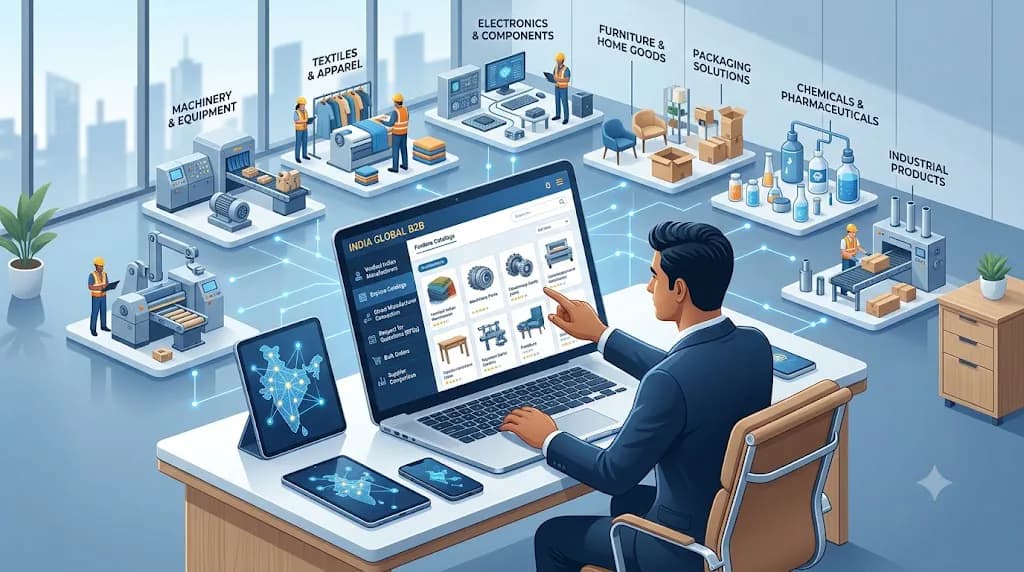
Depending on the industry, categories may include:
- Machinery and equipment
- Electronics
- Electrical products
- Textiles
- Furniture
- Packaging
- Chemicals
- Construction materials
- Automotive components
- Food products
- Pharmaceuticals
- Industrial products
Category-based discovery helps businesses narrow their search before beginning detailed supplier discussions.
Build a Manufacturer Shortlist
Finding a large number of manufacturers is not the same as finding the right manufacturer.
Once businesses identify potential manufacturers, they should create a shortlist.
A shortlist can include manufacturers that appear relevant based on:
- Product specialization
- Location
- Manufacturing capabilities
- Product range
- Business experience
- Production capacity
- Customization options
- Quality information
- Communication
- Commercial terms
Instead of immediately choosing the first manufacturer found, buyers can compare several suitable options.
This creates a stronger foundation for sourcing decisions.
Evaluate Manufacturing Capabilities Before Selecting a Supplier
A manufacturer should be evaluated according to its actual capabilities.
A product listing alone does not necessarily demonstrate whether a manufacturer can handle a particular requirement.
Examine Production Capacity
Businesses should understand whether the manufacturer can meet current and expected future demand.
This becomes particularly important when the buyer expects rapid business growth.
A manufacturer that can handle current orders but cannot scale production may become a limitation later.
Consider Customization Capability
Many businesses require products with specific designs, materials, dimensions or technical characteristics.
In such cases, customization capability can be an important selection criterion.
Businesses should clearly communicate their requirements and understand what the manufacturer can realistically provide.
Understand Manufacturing Specialization
Manufacturers often specialize in particular product categories or processes.
A manufacturer with relevant specialization may understand the technical requirements of a product more effectively than a general supplier.
Do Not Select Manufacturers Based Only on Price
Price is an important sourcing factor, but it should not be the only factor.
A low quotation may appear attractive initially but could become expensive if it results in poor quality, delays or additional operational costs.
Businesses should consider total value.
Important factors include:
- Product quality
- Production capacity
- Delivery reliability
- Communication
- Packaging
- Customization
- Minimum order quantity
- Payment terms
- Logistics
- After-sales support
A slightly higher price from a reliable manufacturer may sometimes provide greater overall value than a lower price from an inconsistent supplier.
Use Samples to Evaluate Product Quality
For many product categories, samples can help businesses evaluate quality before placing larger orders.
A sample can provide insight into:
- Material quality
- Finishing
- Dimensions
- Performance
- Packaging
- Design accuracy
- Manufacturing consistency
Samples are especially useful when businesses are considering long-term sourcing.
However, sample evaluation should be combined with other checks because one sample alone may not represent long-term production consistency.
Improve Supplier Communication During Discovery
Communication is one of the earliest indicators of a potential manufacturer relationship.
Businesses should pay attention to how manufacturers respond to inquiries.
Useful indicators include:
- Response time
- Clarity of answers
- Understanding of specifications
- Transparency about limitations
- Willingness to discuss requirements
- Ability to provide relevant information
A manufacturer that communicates clearly during the initial stage may be easier to work with later.
Make Manufacturer Inquiries More Specific
A detailed inquiry generally produces more useful responses than a vague request.
Instead of sending a short message such as "Please send price," buyers can explain:
- Product required
- Specifications
- Quantity
- Delivery location
- Expected timeline
- Customization needs
- Packaging requirements
This gives manufacturers enough context to prepare a more relevant response.
It also allows buyers to compare responses more accurately.
Compare Manufacturers Using the Same Criteria
Businesses can improve supplier evaluation by using a consistent comparison framework.
For example, a buyer can compare manufacturers based on:
Evaluation AreaWhat to Consider
Product Fit
Does the manufacturer produce the required product?
Quality
Can required quality standards be maintained?
Capacity
Can the manufacturer handle expected demand?
MOQ
Is the minimum order quantity suitable?
Lead Time
Can delivery timelines be supported?
Customization
Can specifications be modified when required?
Communication
Is the manufacturer responsive and clear?
Pricing
Is the overall commercial value competitive?
Reliability
Can the manufacturer support long-term requirements?
Using consistent criteria reduces the possibility of making decisions based only on one attractive factor.
Manufacturer Discovery Should Include Geographic Diversification
Businesses should not always limit their search to manufacturers located nearby.
India has a diverse manufacturing ecosystem, with different regions developing strong capabilities in different industries.
A wider search can help businesses discover manufacturers outside their immediate network.
Geographic diversification can also reduce dependence on a single local supply source.
However, location should still be evaluated based on logistics, delivery cost, lead time and product requirements.
The objective is not simply to find a distant manufacturer. It is to identify the most suitable manufacturing partner regardless of unnecessary geographic limitations.
Build a Diversified Manufacturer Network
A strong sourcing strategy should not depend entirely on one manufacturer.
Businesses can build a network containing:
- Primary manufacturers
- Secondary suppliers
- Specialized manufacturers
- Backup suppliers
- Regional suppliers
- Suppliers for customized requirements
This approach can provide greater flexibility when market conditions change.
For example, if one manufacturer temporarily reaches production capacity, the business may already have alternative relationships available.
Better Manufacturer Discovery Can Reduce Supply Chain Risk
Supply chain disruptions can affect production, sales and customer satisfaction.
Businesses cannot eliminate every supply-chain risk, but supplier diversification can help reduce dependence.
A diversified manufacturer network can provide alternatives when businesses face:
- Production delays
- Raw material shortages
- Sudden demand increases
- Transportation problems
- Capacity constraints
- Regional disruptions
This is one reason manufacturer discovery should be viewed as an ongoing activity rather than something businesses do only when their current supplier fails.
Develop Long Term Manufacturer Relationships
Finding a suitable manufacturer is only the beginning.
Once a business identifies a reliable partner, it should work toward developing a professional long-term relationship.
Long-term relationships can improve:
- Communication
- Production planning
- Quality understanding
- Demand forecasting
- Customization
- Problem solving
- Order coordination
Both buyers and manufacturers can benefit when expectations become clearer over time.
Maintain Consistent Communication With Manufacturers
Communication should continue after the first order.
Businesses can communicate about:
- Future demand
- Product changes
- Expected order volumes
- Quality feedback
- Delivery requirements
- New product opportunities
Regular communication helps manufacturers understand changing business needs.
It can also help buyers identify potential issues before they become major problems.
Provide Constructive Supplier Feedback
Feedback should be specific and professional.
If a product does not meet expectations, buyers should explain the issue clearly.
For example, feedback may concern:
- Packaging damage
- Material quality
- Product dimensions
- Finishing
- Delivery delays
- Documentation
Constructive feedback creates an opportunity for improvement and can strengthen the relationship when handled properly.
Use Performance Monitoring After Supplier Selection
Supplier discovery should not stop once a manufacturer is selected.
Businesses should continue monitoring performance.
Important performance indicators can include:
- On-time delivery
- Quality consistency
- Response time
- Order accuracy
- Production capacity
- Complaint resolution
- Commercial reliability
Regular evaluation helps businesses understand which manufacturers are providing consistent value.
How a Business Networking Platform Can Support Manufacturer Discovery
A Business Networking Platform can help businesses move from isolated supplier searches toward broader business discovery.
Instead of relying only on existing contacts, buyers can explore manufacturers and suppliers through a digital environment.
Platforms such as BONC Network provide a B2B networking environment where businesses can discover products and business profiles and connect with potential business partners.
For manufacturer discovery, the value of a digital platform is primarily in improving the discovery and connection stage.
Businesses can use digital information to identify potential manufacturers, conduct initial research and begin relevant conversations.
The final decision should still depend on the buyer's own evaluation of product quality, capabilities, commercial terms and business suitability.
How BONC Network Can Fit Into a Modern Manufacturer Search
BONC Network can support businesses looking for a more structured approach to digital business discovery.
A buyer may begin with a product requirement and use a B2B environment to discover businesses operating in the relevant category.
The process can then move through several stages:
Product Requirement → Manufacturer Discovery → Business Research → Inquiry → Evaluation → Communication → Supplier Relationship
This approach connects product discovery with business networking.
For manufacturers, digital visibility can provide opportunities to showcase products and business capabilities to potential buyers. For buyers, it can expand the pool of manufacturers they can research.
The platform therefore becomes part of the discovery process, while successful sourcing depends on what happens after the initial connection.
Use Requirement-Based Inquiries to Improve Manufacturer Matching
Requirement-based sourcing can make manufacturer discovery more effective.
Instead of searching broadly, businesses should explain what they actually need.
For example, a buyer searching for a packaging manufacturer may specify:
- Packaging type
- Material
- Dimensions
- Quantity
- Printing requirements
- Application
- Delivery location
- Expected timeline
The more relevant information a buyer provides, the easier it becomes to identify manufacturers that may be capable of fulfilling the requirement.
Manufacturer Discovery for Startups and MSMEs
Startups and MSMEs can particularly benefit from better manufacturer discovery.
Smaller businesses may not have large procurement teams or extensive supplier networks.
They may depend on a limited number of contacts, making supplier discovery difficult when they want to launch new products or expand into new markets.
Digital B2B platforms can give these businesses access to a wider discovery environment.
They can research manufacturers based on product categories and requirements instead of relying exclusively on personal networks.
This can make supplier discovery more accessible to businesses with limited procurement resources.
Manufacturer Discovery for Growing Businesses
As businesses grow, their sourcing requirements can change.
A company may initially need a small quantity but later require larger production volumes.
This creates a need for manufacturers with greater capacity.
Businesses should therefore evaluate manufacturers not only for current requirements but also for their ability to support future growth.
A manufacturing partner that can scale with the business can reduce the need for frequent supplier changes.
Common Manufacturer Discovery Mistakes
Businesses can improve their sourcing outcomes by avoiding common mistakes.
Searching Without Clear Requirements
Unclear requirements can produce irrelevant supplier results.
Choosing the First Manufacturer
The first suitable result is not necessarily the best long-term partner.
Focusing Only on Price
Low price does not automatically mean better sourcing value.
Ignoring Production Capacity
A manufacturer may be suitable for small orders but unable to support larger demand.
Not Checking Quality
Product quality should be evaluated before long-term commitments.
Depending on One Supplier
Single-source dependence can increase supply-chain risk.
Ignoring Communication
Poor communication can create problems throughout the relationship.
Failing to Monitor Performance
Supplier performance should be reviewed even after a successful onboarding.
Create a Repeatable Manufacturer Discovery Process
Businesses can make sourcing more efficient by developing a repeatable process.
A practical framework can look like:
Define Requirements → Search Manufacturers → Build Shortlist → Evaluate Capabilities → Request Information → Compare Options → Test Products → Start Initial Order → Monitor Performance → Develop Partnership
The advantage of a repeatable process is consistency.
Different employees can follow similar steps, making supplier selection easier to manage.
It can also help businesses maintain records of manufacturers that were previously evaluated.
Maintain a Digital Manufacturer Database
A manufacturer database can become a valuable sourcing asset.
Businesses can maintain information such as:
- Manufacturer name
- Product categories
- Location
- Contact information
- Capabilities
- MOQ
- Lead time
- Customization options
- Previous inquiries
- Quality observations
- Performance history
When a new requirement appears, the business does not have to start the search from zero.
Instead, it can review existing manufacturer information and identify potential partners more quickly.
Manufacturer Discovery and Product Innovation
Better manufacturer discovery can also support innovation.
Businesses sometimes avoid developing new products because they cannot identify manufacturers capable of producing them.
A wider manufacturer network can change this.
When businesses discover manufacturers with specialized capabilities, they may identify new possibilities for:
- Product customization
- New materials
- New designs
- Private-label products
- Improved packaging
- Specialized components
- New product categories
Therefore, manufacturer discovery can contribute to product development as well as procurement.
From Supplier Search to Strategic Manufacturing Partnerships
The long-term objective of manufacturer discovery should be stronger business relationships.
A supplier can become a strategic partner when both sides develop a deeper understanding of each other's requirements.
For buyers, this may result in:
- More predictable sourcing
- Better communication
- Faster problem solving
- Improved production planning
- Greater customization support
- Better supply continuity
For manufacturers, long-term buyers can provide more predictable demand and opportunities for business growth.
This creates a relationship based on mutual value rather than one-time transactions.
The Future of Digital Manufacturer Discovery
The future of manufacturer discovery is likely to become increasingly digital and data-driven.
Businesses are already moving toward online product discovery, digital business profiles, requirement-based inquiries and structured supplier evaluation.
As digital B2B ecosystems continue to develop, businesses may have more ways to discover manufacturers based on product requirements, capabilities, location, industry and business needs.
However, technology alone cannot guarantee a successful supplier relationship.
Human communication, quality management, transparency and trust will remain essential.
The most effective sourcing strategy will therefore combine digital discovery with careful supplier evaluation and relationship management.
Building a Future-Ready Manufacturer Network
A future-ready manufacturer network should provide businesses with both reliability and flexibility.
Businesses should continuously discover new manufacturers while maintaining strong relationships with proven partners.
This balanced approach can help companies:
- Reduce supplier dependency
- Explore new manufacturing capabilities
- Improve sourcing flexibility
- Respond to changing demand
- Support product innovation
- Enter new markets
- Strengthen supply continuity
Manufacturer discovery should therefore become an ongoing part of strategic procurement rather than an emergency activity.
Conclusion
Sourcing challenges often begin with one fundamental problem: businesses do not always have enough visibility into the manufacturers that could meet their requirements.
Better manufacturer discovery can help solve this problem by expanding supplier search, improving product-based discovery, creating structured shortlists and encouraging more informed evaluation.
Digital B2B platforms are making this process easier by connecting businesses with broader networks of manufacturers and suppliers. A Business Networking Platform can help buyers discover relevant businesses, explore product categories and initiate new supplier conversations.
However, finding a manufacturer is only one part of successful sourcing.
Businesses also need to evaluate manufacturing capabilities, compare suppliers based on total value, check product quality, communicate requirements clearly, monitor performance and build long-term relationships.
The strongest sourcing strategy is therefore not about finding the largest number of manufacturers. It is about discovering the right manufacturers, evaluating them carefully and developing a reliable network that can support business requirements over time.
When businesses combine better digital discovery with structured supplier evaluation and relationship management, they can reduce sourcing challenges, improve procurement decisions and create stronger foundations for long-term growth.
Better manufacturer discovery is not just about finding a supplier. It is about finding the right manufacturing partner for the future.