How Direct Manufacturer Purchasing Can Help Businesses Respond to Changing Customer Demand
By BONC Editorial Team • Published on 29 Oct 2026
Introduction
Customer demand is constantly evolving. Preferences change as new products enter the market, purchasing habits shift, technologies develop, prices fluctuate, and customers become more aware of the options available to them. Businesses that once relied on a stable product range may find that their customers now expect different designs, improved quality, more competitive pricing, customised solutions, or faster product availability.
For retailers, wholesalers, distributors, and commercial buyers, responding to these changes requires more than adjusting marketing campaigns. Businesses must also reconsider how they select products, manage inventory, communicate with suppliers, and plan future purchases.
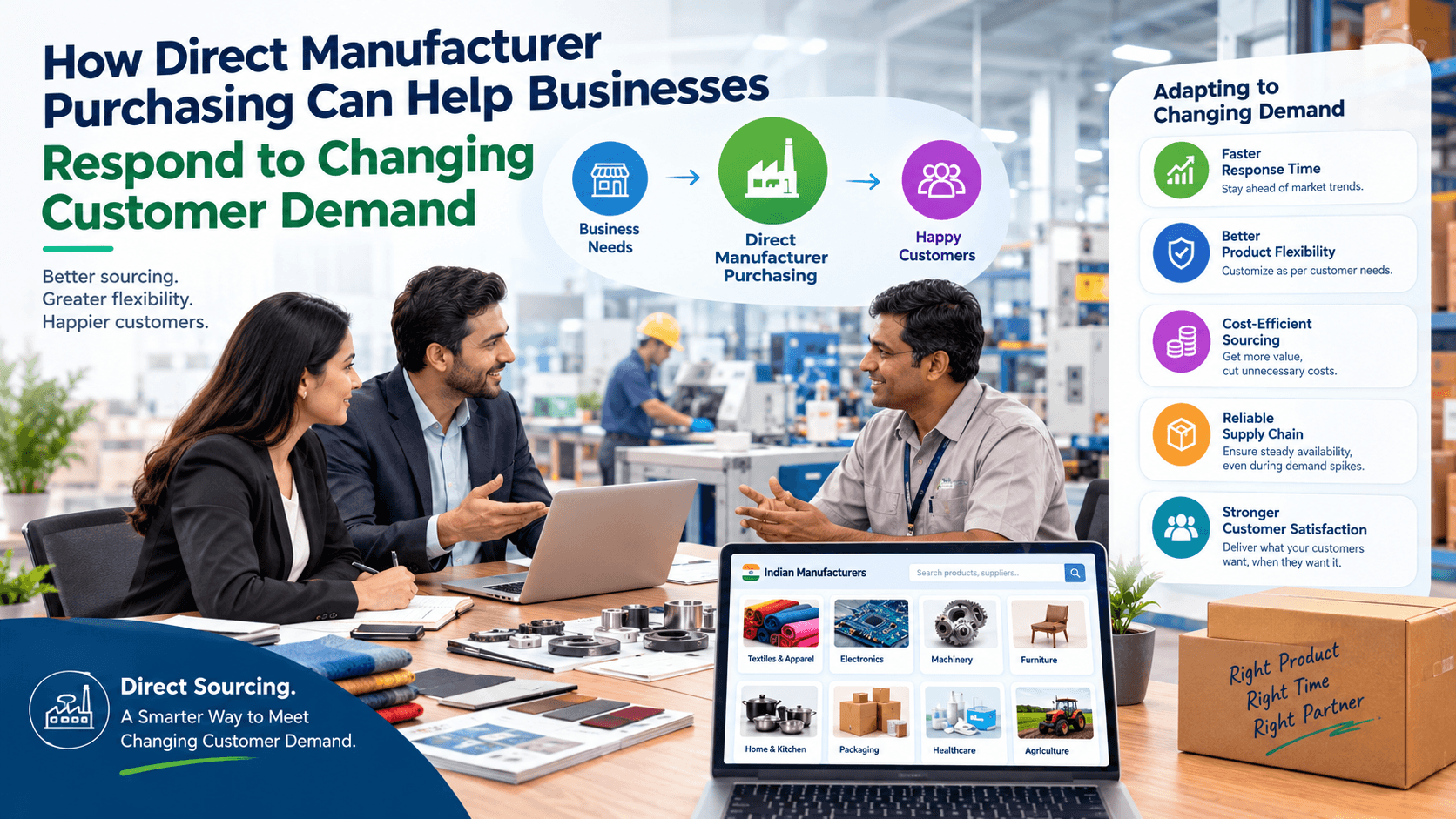
Direct manufacturer purchasing can be an important part of this process. By purchasing from the companies that produce the required goods, businesses may be able to discuss product specifications, production schedules, order quantities, packaging, and customisation more directly. These discussions can help buyers understand which changes are feasible and how suppliers can accommodate evolving requirements.
India's diverse manufacturing ecosystem provides opportunities for businesses to explore products across textiles, garments, furniture, packaging, electrical products, consumer goods, industrial components, and many other categories. However, the benefits of direct purchasing depend on the suitability of the manufacturer, the nature of the product, and the commercial terms involved.
Direct purchasing does not automatically guarantee lower costs, faster delivery, or greater flexibility. Manufacturers may have minimum order quantities, production constraints, and longer lead times than suppliers holding ready stock. Businesses therefore need a well-planned sourcing strategy that balances customer needs with operational and financial realities.
Digital B2B networking platforms such as BONC Network can complement this process by helping businesses explore business profiles, product-related information, and potential commercial connections.
This article explains how direct manufacturer purchasing can help businesses respond to changing customer demand, improve product planning, build stronger supplier relationships, and make more informed sourcing decisions.
Understanding Changing Customer Demand
Customer demand refers to the products and services that customers want to purchase, including the quantity, quality, price, features, and timing they expect.
Demand can change gradually or unexpectedly. Some changes follow predictable seasonal patterns, while others emerge because of new trends, technological developments, competitor activity, or shifts in purchasing power.
Businesses need to understand these changes before modifying their purchasing decisions.
Changing Product Preferences
Customers may develop new preferences for product designs, colours, materials, sizes, packaging, and functionality.
For example, customers shopping for home furnishings may begin preferring space-saving furniture, while clothing buyers may look for different fabric types or styles. Business customers may request industrial components with updated specifications or packaging that better suits their operational requirements.
When preferences change, businesses must determine whether their existing product range remains suitable.
Direct communication with manufacturers can help buyers explore whether alternative designs, materials, or specifications are available. However, any proposed changes should be evaluated against actual customer demand rather than assumptions about what might become popular.
Greater Attention to Value and Quality
Price remains important in many markets, but customers often evaluate products based on overall value rather than purchase price alone.
Durability, performance, reliability, appearance, warranty arrangements, and after-sales support can all influence purchasing decisions.
Businesses that respond only by choosing the lowest-cost supplier may struggle if product quality fails to meet customer expectations.
Direct manufacturer discussions can help buyers understand material options, production methods, product specifications, and available quality controls. This information supports better comparisons between purchasing options.
Demand for Customised Products
Some customers expect products to match specific requirements rather than accepting standard designs.
A retailer may want distinctive packaging, a distributor may need products in particular sizes, and an institutional buyer may require equipment suited to a specific environment.
Direct purchasing can provide an opportunity to discuss these requirements with the manufacturer responsible for production.
Nevertheless, customisation may increase costs, require minimum quantities, or extend production timelines. Businesses should confirm feasibility and obtain approval for samples or specifications before placing substantial orders.
Faster Changes in Product Trends
In some industries, customer interest shifts quickly. Products that sell well today may lose popularity as new designs, technologies, or alternatives become available.
Businesses that purchase large quantities without reviewing demand can end up with unsold inventory.
A more responsive sourcing strategy combines market research, demand forecasting, supplier communication, and controlled purchasing decisions.
Direct relationships with manufacturers may support this process by allowing buyers to discuss future product options and production constraints earlier.
What Is Direct Manufacturer Purchasing?
Direct manufacturer purchasing is the process of buying products from the company that manufactures them rather than relying exclusively on wholesalers, distributors, or other intermediaries.
The arrangement can involve finished products, components, raw materials, customised goods, or products intended for resale.
For example, a clothing wholesaler may purchase garments directly from a garment manufacturer. A retailer may source furniture from a furniture factory, while an industrial business may purchase components from a specialised manufacturing company.
Direct purchasing allows buyers and manufacturers to discuss requirements more directly. Depending on the agreement, these discussions may cover pricing, minimum order quantities, production capacity, product specifications, packaging, inspection, and delivery schedules.
However, direct purchasing is not necessarily the best option for every transaction. Intermediaries may provide benefits such as smaller order quantities, consolidated shipments, local inventory, credit arrangements, or access to multiple product categories through one supplier.
Businesses should compare the complete sourcing arrangement before deciding which purchasing model is most appropriate.
The main objective is to select a sourcing method that supports customer demand while maintaining acceptable quality, cost, availability, and operational efficiency.
How Direct Purchasing Helps Businesses Understand Customer Needs
Direct manufacturer purchasing can improve the flow of information between businesses and their production partners.
When buyers understand what customers want, they can communicate more precise requirements to manufacturers. Manufacturers, in turn, can explain which product changes are technically feasible and what those changes may mean for cost and production time.
Communicating Customer Feedback
Customer feedback provides valuable information about product performance and purchasing preferences.
Businesses may receive comments about product durability, packaging, dimensions, design, ease of use, or missing features. These observations can help identify improvements that may be worth discussing with manufacturers.
For example, a distributor selling storage products may discover that customers prefer a different size or stronger material. The distributor can discuss these requirements with a suitable manufacturer and determine whether the product can be adjusted.
The process should begin with clear evidence of customer demand. Not every individual request justifies changing a product specification, especially when the change would increase production costs or require a large minimum order.
Converting Customer Requirements Into Product Specifications
Customer feedback is useful only when it can be translated into clear purchasing requirements.
A general statement such as customers want better-quality products is not sufficiently precise for manufacturing purposes.
Businesses should identify the specific improvements required, such as material thickness, dimensions, finish, performance, packaging, or expected durability.
Written specifications help manufacturers evaluate feasibility and provide accurate quotations.
They also create a reference for checking whether the final products meet the agreed requirements.
Discussing Feasibility Before Making Commitments
Manufacturers can explain whether a proposed change requires new materials, different equipment, additional tooling, or revised production methods.
This information helps buyers decide whether the change is commercially practical.
For instance, a custom product design may appeal to customers but require a minimum order that exceeds the business's realistic demand.
By discussing feasibility early, businesses can explore alternatives before committing substantial funds.
Responding to Demand Changes Through Product Customisation
Product customisation is one way businesses can adapt to changing customer expectations.
Depending on the manufacturer's capabilities, buyers may be able to request changes to dimensions, materials, colours, packaging, branding, product combinations, or other specifications.
Adapting Product Designs
When customers prefer different designs or features, businesses can discuss possible adjustments with manufacturers.
A furniture retailer may explore different finishes, dimensions, or storage configurations. A clothing distributor may request changes to fabrics, colours, or size ranges. A packaging buyer may need new dimensions or printed designs to suit a customer's product.
The feasibility of these changes depends on the production process and the manufacturer's capabilities.
Businesses should request samples or prototypes where appropriate and confirm the final specifications before bulk production begins.
Developing Products for Specific Customer Segments
Different customer groups may value different product characteristics.
Industrial buyers may prioritise performance and durability, while retail customers may focus on appearance, convenience, and affordability. Institutional buyers may need standardised products that meet specific operational requirements.
Direct discussions with manufacturers can help businesses explore products suited to these distinct segments.
However, creating a separate product for every customer group can increase inventory complexity and procurement costs. Businesses should prioritise segments with sufficient demand to justify the additional effort.
Understanding the Cost of Customisation
Customisation can involve design work, setup expenses, specialised materials, new tooling, or additional inspection requirements.
These costs should be evaluated before the business promises a customised product to its customers.
The buyer should compare the expected commercial benefits with the additional investment and production time.
For new or uncertain products, a limited trial may be more appropriate than a large customised order, provided the manufacturer can accommodate the smaller quantity.
Improving Inventory Decisions With Direct Manufacturer Relationships
Changing customer demand makes inventory planning more challenging. Businesses need enough stock to fulfil customer orders without tying up excessive capital in products that may not sell.
Direct manufacturer relationships can support inventory planning by helping businesses understand production lead times, available capacity, and replenishment options.
Forecast Demand Before Purchasing
Businesses should use sales records, customer enquiries, market research, seasonal patterns, and other relevant information to estimate future demand.
Established businesses can compare current trends with previous purchasing periods. New businesses may need to rely on smaller test orders, customer feedback, and conservative forecasts.
Forecasts should account for uncertainty rather than assuming that demand will remain constant.
For products with unpredictable demand, businesses can prepare different scenarios and adjust purchasing quantities as better information becomes available.
Align Purchasing With Production Lead Times
A manufacturer may require several weeks to obtain raw materials, produce goods, inspect finished products, and prepare shipments.
Businesses should understand these lead times before making promises to customers.
If demand rises unexpectedly, a manufacturer may not be able to deliver additional products immediately. Direct communication can help buyers understand available options, but it cannot eliminate production constraints.
Purchasing plans should therefore account for the time required to replenish inventory.
Use Replenishment Strategies Where Feasible
Some businesses may benefit from an initial order followed by additional purchases as demand becomes clearer.
This approach can reduce the risk of overstocking unfamiliar products, especially when manufacturers can replenish them within an acceptable timeframe.
However, replenishment may not be practical when products require specialised materials, long production cycles, or large minimum quantities.
Businesses should discuss these conditions with manufacturers in advance and avoid assuming that additional stock will always be available.
Avoid Excess Inventory
Purchasing in large quantities may reduce the unit price, but it can also increase storage costs, financing requirements, and the risk of unsold goods.
Businesses should calculate the full cost of holding inventory before accepting a bulk discount.
When demand changes frequently, flexibility may be more valuable than achieving the lowest possible unit price.
The most suitable approach depends on product demand, shelf life, storage requirements, supplier lead times, and the business's financial position.
Managing Procurement Costs While Responding to Demand
Businesses must respond to customer needs without allowing procurement expenses to become unsustainable.
Direct manufacturer purchasing may create opportunities to discuss pricing and product specifications, but the final cost depends on many factors.
Compare Total Landed Cost
The manufacturer's quoted price is only one part of the purchasing cost.
Businesses should also consider transportation, packaging, inspection, insurance where applicable, taxes, storage, handling, and other relevant expenses.
For example, a manufacturer offering a lower unit price may require a large order that increases storage costs. Another supplier may charge more per unit but offer quantities and delivery terms that better suit the buyer's requirements.
Comparing total landed cost provides a more useful basis for purchasing decisions.
Negotiate Based on Clear Requirements
Manufacturers can provide more meaningful quotations when buyers specify quantities, product details, packaging, and delivery requirements clearly.
Businesses should communicate whether the order is recurring, seasonal, or a one-time purchase.
They can then discuss feasible pricing, minimum quantities, payment terms, and production schedules.
Negotiations should aim for sustainable commercial terms. Excessive pressure to reduce prices may be counterproductive if it makes the required quality or delivery schedule difficult to achieve.
Evaluate the Cost of Product Changes
When customers request new features, businesses should calculate how the changes affect purchasing and selling costs.
The evaluation may include additional materials, design charges, tooling, testing, packaging, and production time.
Businesses should also assess whether the intended customers are willing to pay a price that supports the additional cost.
This helps prevent companies from introducing customised products that attract interest but do not generate commercially sustainable results.
Finding Suitable Indian Manufacturers for Changing Requirements
Selecting the right manufacturing partner is essential when businesses need to adapt their product range.
A supplier must be capable of producing the required goods at an appropriate quality level and within a realistic schedule.
Use Digital B2B Platforms for Supplier Discovery
Digital B2B platforms can help businesses explore potential manufacturers and suppliers across different industries.
BONC Network is a B2B networking platform where businesses can explore business profiles, product-related information, and potential commercial connections.
For companies responding to changing customer demand, digital discovery can be a starting point for researching manufacturers associated with particular product categories.
For example, a business that wants to expand its home furnishing range may explore relevant manufacturing companies before contacting them to discuss product options. A distributor seeking alternative industrial components may research potential suppliers that appear to match its requirements.
Businesses should confirm the details directly with each manufacturer, including production capabilities, minimum order quantities, quality requirements, pricing, and lead times.
An online profile should not be treated as a guarantee of supplier suitability.
Search for Manufacturers With Relevant Specialisation
The right supplier is not necessarily the company offering the widest product range.
Businesses should look for manufacturers whose production capabilities match the specific requirements of the intended product.
For customised or technical products, buyers may need to examine machinery, material expertise, quality-control procedures, and relevant testing capabilities.
Clear specifications help narrow the search and make supplier comparisons more accurate.
Evaluate Samples and Business Information
Before placing a substantial order, buyers should review samples, technical documents, and other information relevant to the product.
They should also verify business details and applicable compliance requirements.
For high-value or high-risk purchases, additional due diligence, factory visits, or independent inspections may be appropriate.
The evaluation should consider the manufacturer's ability to meet current requirements and respond to foreseeable changes.
Maintain Alternative Supplier Options
Businesses may benefit from identifying alternative manufacturers for critical products.
A backup supplier can provide flexibility when demand increases, production is delayed, or the original supplier cannot meet revised requirements.
However, maintaining multiple suppliers may increase administrative work and quality-control costs. Businesses should determine whether the additional flexibility justifies these expenses.
Alternative suppliers should be evaluated before an urgent requirement arises, rather than being selected without sufficient checks during a disruption.
How Direct Purchasing Supports Faster Product Development
Businesses sometimes need to introduce new products to respond to customer expectations or emerging market opportunities.
Direct communication with manufacturers can help buyers understand how a product can be developed, tested, and produced.
Explore Product Concepts With Manufacturers
A business may identify a customer need that existing products do not fully satisfy.
It can discuss the proposed concept with manufacturers to understand available materials, production methods, technical limitations, and likely costs.
Manufacturers may suggest adjustments that make the product easier to produce or more suitable for the intended application.
These discussions should not replace customer research. A product concept still needs evidence of demand and a realistic commercial plan.
Develop and Approve Prototypes
For products involving new designs or specifications, prototypes can help identify problems before mass production.
Buyers should evaluate the prototype against the intended use, quality requirements, cost target, and customer expectations.
Any necessary revisions should be documented, and the final design should be approved before bulk production begins.
Prototype development can require additional time and investment, so businesses should incorporate these activities into the product launch schedule.
Test Market Demand Before Scaling
A small launch or limited order can help businesses assess whether customers respond positively to a new product.
The trial may reveal useful information about price acceptance, preferred features, packaging, and likely purchasing quantities.
Businesses can then decide whether to increase production, modify the product, or discontinue the offering.
This approach can reduce the financial risks associated with introducing unfamiliar products, although it depends on the manufacturer's ability to support trial quantities.
Building Stronger Communication Between Buyers and Manufacturers
Direct purchasing can improve the exchange of information between businesses and manufacturers, but only when communication is clear and consistent.
Both parties need to understand product requirements, delivery expectations, quality standards, and the process for handling changes.
Share Accurate Forecasts
Buyers can provide manufacturers with indicative demand forecasts to support production planning.
These forecasts may help manufacturers assess raw material requirements and available capacity.
However, forecasts should be clearly distinguished from confirmed orders. Businesses should not present uncertain customer demand as a guaranteed purchase commitment.
Regular updates help manufacturers understand whether requirements are changing and allow both sides to discuss practical adjustments.
Document Specifications and Changes
Verbal discussions can lead to different interpretations of product requirements.
Businesses should document approved specifications, samples, packaging, quantities, prices, and delivery conditions.
Changes should be recorded and approved by the relevant parties before implementation.
This is particularly important when customer feedback leads to changes after production has already been scheduled.
Written documentation reduces misunderstandings and provides a reference for inspection and dispute resolution.
Establish a Process for Managing Delays
Manufacturing schedules can be affected by material shortages, equipment issues, transportation problems, or unexpected order volumes.
Businesses should agree on how the manufacturer will communicate potential delays and what options may be available.
Depending on the product, alternatives may include revised delivery dates, partial shipments, or an adjusted production plan.
The appropriate response should be determined by the commercial agreement and the needs of the customer.
Using Digital B2B Networking to Adapt to Market Changes
Businesses often need to explore new manufacturers when customer preferences shift or existing suppliers cannot meet revised requirements.
Digital B2B networking can complement referrals, exhibitions, trade associations, and direct industry research by providing another starting point for discovering potential business connections.
Explore New Product Categories Through BONC Network
BONC Network provides a digital B2B networking environment where businesses can explore business profiles, product-related information, and potential commercial connections.
Companies looking to respond to changing demand can use this type of platform as one channel for researching potential manufacturers in relevant categories.
For instance, a wholesaler planning to add new household products may research businesses in the appropriate manufacturing categories. A retailer seeking customised packaging may explore potential suppliers before requesting quotations and samples.
The next step is to assess each manufacturer independently and confirm that the business can meet the required specifications, quantities, pricing, and delivery schedule.
Improve Product and Supplier Research
Digital business discovery can help purchasing teams begin research into unfamiliar product categories.
Businesses can compare potential suppliers, collect relevant product information, and identify questions that need to be addressed during direct discussions.
They should also maintain records of supplier evaluations, quotations, product samples, and past performance.
Organised information makes it easier to compare alternatives when market conditions change.
Connect Discovery With Practical Procurement Decisions
Identifying a potential manufacturer is only the beginning of the sourcing process.
Businesses still need to evaluate commercial terms, product quality, production capacity, and the feasibility of meeting customer requirements.
Digital networking is most useful when it forms part of a wider process that includes demand forecasting, supplier verification, purchasing controls, and performance reviews.
Managing Risks When Customer Demand Changes Unexpectedly
Demand changes can create both opportunities and risks. Businesses need to respond quickly enough to remain relevant without making purchasing decisions that expose them to unnecessary costs.
Avoid Overreacting to Short-Term Trends
A temporary increase in customer interest does not always justify a large manufacturing order.
Businesses should examine whether the change is supported by repeated sales, customer enquiries, broader market information, or confirmed orders.
For uncertain products, smaller trial purchases may provide useful evidence before a larger commitment is made.
The appropriate order size depends on the product, supplier terms, and the cost of holding unsold inventory.
Reduce Dependence on Unverified Suppliers
Urgent sourcing requirements can encourage businesses to choose the first supplier that appears available.
This can create risks involving product quality, business legitimacy, payment terms, and delivery reliability.
Even when time is limited, buyers should complete essential checks and confirm the terms of the transaction.
For critical products, maintaining a pre-evaluated list of alternative manufacturers can reduce the pressure to make rushed decisions.
Protect Cash Flow
A sudden demand increase may require additional inventory, but purchasing more products can also increase cash requirements.
Businesses should consider supplier advances, transport costs, inventory holding, and the time needed to receive payment from customers.
The decision to expand purchasing should reflect both market opportunity and financial capacity.
Review Product Performance Regularly
Businesses should track sales, returns, complaints, inventory levels, and customer feedback after introducing new products.
These indicators can reveal whether the sourcing strategy is working.
If a product underperforms, the business may need to adjust its pricing, marketing, product specifications, or future purchasing quantities.
Continuous review helps businesses adapt based on evidence rather than relying on assumptions.
Measuring the Results of Direct Manufacturer Purchasing
Businesses should evaluate whether direct purchasing is helping them respond more effectively to customer demand.
Several measures can support this assessment.
Product availability: Review how often the business can fulfil customer orders without unnecessary stock shortages.
Demand forecast accuracy: Compare expected sales with actual demand to identify forecasting improvements.
Total procurement cost: Track the complete cost of purchasing, transporting, inspecting, and storing products.
Product quality: Monitor defects, returns, customer complaints, and inspection results.
Supplier delivery performance: Compare actual delivery dates with agreed schedules.
Inventory turnover: Assess how efficiently products are sold or used after procurement.
Product development time: Measure the time required to move from an identified customer need to an approved product and completed order.
Customer satisfaction: Review customer feedback and repeat purchasing to understand whether products meet expectations.
These measures should be considered together. For example, reducing the unit purchase price may not be beneficial if it leads to slower delivery or higher defect rates.
Businesses should use the findings to improve supplier selection, inventory planning, product specifications, and purchasing schedules.
Conclusion
Direct manufacturer purchasing can help businesses respond to changing customer demand by creating opportunities for clearer communication, product customisation, more informed sourcing decisions, and closer coordination with production partners.
As customer preferences evolve, businesses need to understand what buyers want and translate that information into accurate product specifications and realistic purchasing plans. Direct discussions with manufacturers can help determine whether new designs, materials, packaging, or product features are feasible and commercially practical.
However, direct purchasing does not automatically guarantee lower costs, faster delivery, or greater flexibility. Minimum order quantities, production lead times, quality requirements, and cash-flow limitations must all be considered before a purchase is approved.
Businesses should begin with demand research, evaluate manufacturers carefully, compare total procurement costs, approve samples where appropriate, and maintain clear documentation. Inventory forecasts and regular performance reviews can help them respond to changes without creating unnecessary financial risk.
Digital B2B networking platforms such as BONC Network can complement traditional sourcing methods by helping businesses explore business profiles and potential commercial connections. Supplier discovery should always be followed by independent verification and a careful assessment of the manufacturer's suitability.
Ultimately, businesses respond most effectively to changing customer demand when they combine customer insight, disciplined procurement planning, reliable manufacturing relationships, and ongoing performance evaluation. By making these activities part of their regular operations, companies can build a more adaptable sourcing strategy and pursue sustainable business growth.