Smart Product Sourcing Strategies for Businesses Looking to Work With Indian Manufacturers
By BONC Editorial Team • Published on 06 Oct 2026
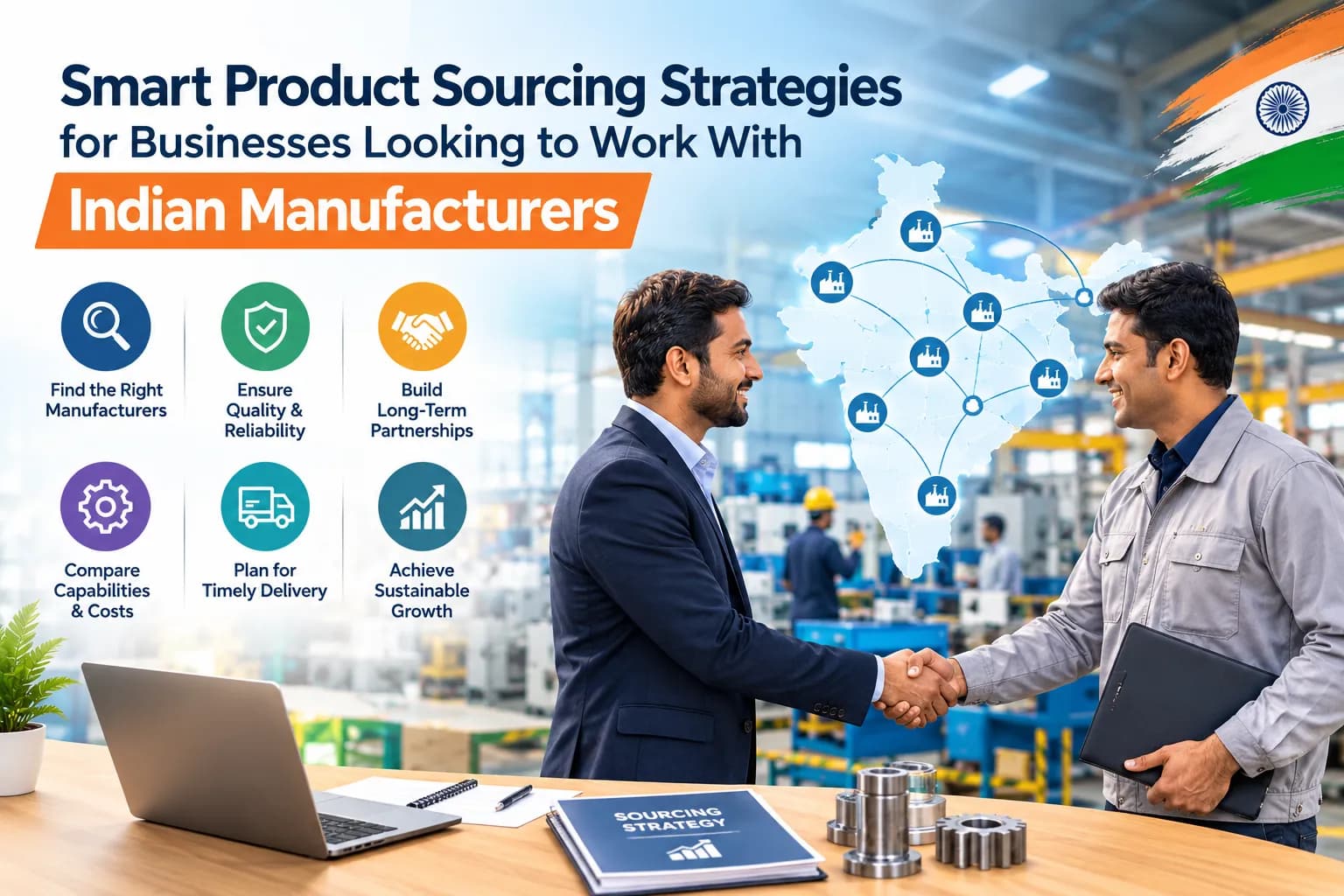
Introduction
Product sourcing is one of the most important activities for businesses that sell, distribute, manufacture or develop products. The right sourcing strategy can influence product quality, pricing, delivery timelines, inventory management and long-term profitability. For businesses looking to work with Indian manufacturers, having a structured sourcing approach can make the process more efficient and help reduce avoidable sourcing risks.
India has a broad and diverse manufacturing ecosystem covering textiles, pharmaceuticals, chemicals, food products, packaging, furniture, engineering products, electrical equipment, machinery, automotive components, consumer goods and many other categories. This gives domestic and international buyers a wide range of potential manufacturing partners to explore.
However, having access to a large manufacturing market does not automatically make product sourcing simple. Businesses still need to identify suitable manufacturers, understand their capabilities, compare options, evaluate product quality, discuss commercial terms and build reliable relationships.
Traditional sourcing methods such as referrals, trade exhibitions, industry contacts and direct outreach continue to have value. At the same time, digital B2B platforms have made it easier for businesses to discover manufacturers and products across different markets.
Smart product sourcing combines these approaches with clear requirements, structured research and long-term supplier management. Instead of selecting a manufacturer based only on price, businesses can evaluate the complete value of a potential manufacturing relationship.
Understanding Smart Product Sourcing
Smart product sourcing means using a systematic approach to identify, evaluate and work with manufacturers or suppliers that can meet a business's requirements.
It is not simply about finding the cheapest supplier.
A smart sourcing strategy considers multiple factors, including:
- Product quality
- Manufacturing capability
- Pricing
- Production capacity
- Delivery timelines
- Minimum order quantity
- Customization options
- Communication
- Quality standards
- Packaging
- Logistics
- Long-term scalability
The objective is to create a sourcing relationship that supports the overall business strategy.
For example, a business launching a new product may initially require smaller production quantities, while an established company may need a manufacturer capable of handling large and recurring orders. The right sourcing strategy should take these differences into account.
Define Your Product Requirements Before Searching
One of the most important steps in product sourcing is defining exactly what the business needs before approaching manufacturers.
A vague product requirement can lead to irrelevant quotations, misunderstandings and delays.
Businesses should document important product details such as:
- Product category
- Product specifications
- Materials
- Dimensions
- Design requirements
- Required quantity
- Quality expectations
- Packaging requirements
- Customization needs
- Target delivery timeline
- Intended market
The level of detail will depend on the product.
A buyer looking for standard packaging products may only need basic specifications, while a company sourcing industrial machinery may require detailed technical documentation.
Clear requirements allow manufacturers to understand the request more accurately and provide more relevant responses.
Identify the Right Type of Indian Manufacturer
Not every manufacturer is suitable for every sourcing requirement.
Indian businesses operate across different manufacturing models and product categories. Some manufacturers focus on high-volume production, while others specialize in customized products, private-label manufacturing, contract manufacturing or smaller production runs.
Before beginning the search, businesses should understand what type of manufacturing partner they need.
For example, a buyer may require:
- Original product manufacturing
- Customized manufacturing
- Private-label production
- Contract manufacturing
- Bulk production
- Small-batch production
- Component manufacturing
- Finished-product manufacturing
Identifying the appropriate manufacturing model can narrow the search and make supplier discovery more efficient.
Explore India's Diverse Manufacturing Ecosystem
India's manufacturing sector is distributed across many industrial regions, with different locations developing expertise in different product categories.
Businesses should not necessarily limit their sourcing search to one city or state.
Depending on the product, a buyer may discover relevant manufacturers in different parts of India.
A broader search can help businesses:
- Discover specialized manufacturers
- Compare production capabilities
- Explore different pricing options
- Identify alternative suppliers
- Find manufacturers with specific expertise
- Build a diversified sourcing network
Geographical distance should still be considered because transportation, logistics and delivery time can affect the overall sourcing cost.
However, digital manufacturer discovery makes it easier to identify potential suppliers before deciding whether the location is commercially practical.
Use Digital B2B Platforms for Manufacturer Discovery
Digital B2B platforms have become an important part of modern product sourcing.
Instead of relying only on personal contacts, businesses can use digital platforms to discover manufacturers, products and potential suppliers across different markets.
A Business Networking Platform can provide an environment where buyers can:
- Search for products
- Explore manufacturer profiles
- Discover suppliers
- Compare potential businesses
- Send inquiries
- Discuss requirements
- Build B2B connections
Digital platforms can reduce the time required for the initial supplier discovery stage.
However, businesses should remember that an online listing is only the starting point. Proper supplier evaluation and verification are still necessary before entering into significant commercial relationships.
Build a Shortlist Instead of Choosing the First Manufacturer
A common sourcing mistake is selecting the first manufacturer that appears to meet the requirement.
A more strategic approach is to create a shortlist of potential manufacturers.
Businesses can initially identify several companies and then compare them using consistent criteria.
A manufacturer comparison can include:
- Product suitability
- Manufacturing experience
- Production capacity
- Product quality
- Pricing
- Minimum order quantity
- Lead time
- Location
- Customization capabilities
- Communication
- Commercial terms
Creating a shortlist gives buyers a better understanding of the market and reduces dependence on a single sourcing option.
Evaluate Manufacturer Capabilities
Once potential manufacturers have been identified, businesses should investigate whether those manufacturers can actually support their requirements.
Manufacturing capability may include:
- Production equipment
- Manufacturing processes
- Workforce
- Production capacity
- Quality-control systems
- Technical expertise
- Customization capabilities
- Packaging capabilities
Production capacity is especially important for businesses expecting future growth.
A manufacturer may successfully handle a small initial order but struggle with significantly larger volumes later. Discussing scalability at the beginning can help businesses choose a partner capable of supporting long-term requirements.
Focus on Product Quality Before Price
Price is important, but product quality should not be overlooked.
A low purchase price may become expensive if the products have inconsistent quality, high rejection rates, poor packaging or frequent returns.
Businesses should therefore establish their quality expectations before placing orders.
Depending on the product category, buyers may evaluate:
- Product samples
- Material quality
- Product specifications
- Testing procedures
- Quality-control processes
- Certifications where relevant
- Packaging standards
- Consistency between batches
For regulated or technical products, additional quality and compliance checks may be necessary.
The appropriate evaluation process should depend on the product and its intended application.
Request Samples Before Large Orders
Samples can provide valuable information that cannot always be obtained from product descriptions or digital listings.
Before placing a significant order, businesses may consider requesting samples where appropriate.
Samples can help buyers evaluate:
- Physical quality
- Material
- Finish
- Design
- Functionality
- Packaging
- Product consistency
For customized products, samples can also help identify design or specification issues before full-scale production begins.
A sample evaluation can therefore reduce the risk of committing to large quantities before the product has been practically assessed.
Compare Total Sourcing Costs
Smart sourcing requires businesses to look beyond the manufacturer's quoted unit price.
The actual sourcing cost can include several additional components.
These may include:
- Product price
- Packaging
- Transportation
- Taxes
- Customization
- Tooling
- Quality inspection
- Warehousing
- Insurance
- Delivery charges
A manufacturer offering a lower unit price may not always provide the lowest overall sourcing cost.
For example, a distant supplier may have a lower product price but higher transportation expenses. Another manufacturer may have a slightly higher unit price but offer better packaging, shorter lead times or lower rejection rates.
Businesses should therefore evaluate total value rather than focusing on one cost figure.
Understand Minimum Order Quantities
Minimum Order Quantity, commonly known as MOQ, is another important factor in product sourcing.
Different manufacturers may have different MOQ requirements depending on their production process, raw materials and economies of scale.
Businesses should determine whether the manufacturer's MOQ matches their own sales volume and inventory capacity.
For startups and small businesses, very high MOQs can create inventory and cash-flow challenges.
For larger businesses, low MOQ may not necessarily be a major advantage if the manufacturer cannot provide sufficient production capacity.
The right MOQ depends on the business model, product demand and storage capabilities.
Evaluate Lead Times and Delivery Capabilities
Product sourcing is closely connected to inventory planning.
Even a high-quality manufacturer can create operational problems if production or delivery consistently takes longer than expected.
Businesses should discuss:
- Production lead time
- Order processing time
- Packaging time
- Shipping arrangements
- Expected delivery schedule
- Capacity during peak demand
Lead times should be evaluated realistically rather than based only on ideal conditions.
Businesses can also ask manufacturers how they handle sudden increases in demand or urgent production requirements.
Discuss Customization Requirements Clearly
Many businesses do not simply want standard products. They may require customized dimensions, materials, packaging, branding or product features.
Customization should be discussed clearly before production begins.
Important details may include:
- Design specifications
- Branding requirements
- Packaging
- Labels
- Materials
- Colors
- Dimensions
- Product functionality
- Minimum customized quantity
A clear specification document can reduce misunderstandings between the buyer and manufacturer.
For complex products, businesses may also need drawings, samples or technical documentation.
Build Strong Communication With Manufacturers
Communication is an important part of successful product sourcing.
Businesses should observe how potential manufacturers respond during the early stages.
Useful indicators can include:
- Response time
- Understanding of requirements
- Technical knowledge
- Clarity of quotations
- Willingness to answer questions
- Professional communication
- Ability to discuss problems
A manufacturer that communicates clearly can make future production planning easier.
Both buyers and manufacturers should establish clear communication channels and identify the appropriate people for commercial and technical discussions.
How BONC Network Can Support Product Sourcing
BONC Network is a B2B networking platform that connects businesses within a digital business ecosystem where companies can discover businesses, products and potential business opportunities.
For businesses looking to work with Indian manufacturers, a digital B2B platform can provide an additional channel for discovering manufacturers and exploring product categories.
Businesses can use the platform to research potential companies, review available business information and initiate inquiries with manufacturers that appear relevant to their sourcing requirements.
Manufacturers can also use a platform such as BONC Network to showcase their products and business capabilities to potential buyers.
The value of digital networking comes from combining product visibility with business discovery and communication. It can complement traditional sourcing methods such as referrals, trade shows, direct sales and industry networking.
Businesses should still conduct appropriate verification and due diligence before entering into major commercial agreements.
Use Requirement-Based Inquiries
Generic inquiries often result in generic responses.
Businesses can improve sourcing conversations by clearly communicating what they need.
A requirement-based inquiry may include:
- Product name
- Specifications
- Quantity
- Quality requirements
- Delivery location
- Required timeline
- Packaging
- Customization
- Expected order frequency
This gives manufacturers enough context to determine whether they can meet the requirement.
It can also help buyers receive more relevant quotations and technical responses.
Evaluate Commercial Terms Carefully
Before moving forward with a manufacturer, businesses should understand the commercial terms associated with the transaction.
These may include:
- Payment terms
- Advance payment
- Credit period
- MOQ
- Pricing structure
- Taxes
- Packaging
- Delivery charges
- Warranty or replacement terms
- Cancellation conditions
Commercial terms should be discussed clearly and documented appropriately.
For recurring business relationships, both parties may also need to establish processes for purchase orders, quality issues, delivery schedules and payment cycles.
Verify Manufacturers Before Long-Term Engagement
Digital discovery can help identify potential manufacturers, but businesses should not assume that every listed supplier is automatically suitable.
Before entering a significant sourcing relationship, businesses can conduct appropriate due diligence.
Depending on the transaction, buyers may evaluate:
- Business registration information
- Company location
- Manufacturing facilities
- Relevant certifications
- Product samples
- Quality documentation
- References
- Production capabilities
- Previous business experience
The level of verification should depend on the product, order value and associated business risks.
The objective is to build confidence before making a major commitment.
Start With a Controlled Initial Order
When working with a new manufacturer, businesses may consider beginning with a sample or controlled initial order where commercially appropriate.
This can provide an opportunity to evaluate actual performance.
The first order can help buyers assess:
- Product quality
- Delivery performance
- Packaging
- Order accuracy
- Communication
- Production consistency
- Issue resolution
If the manufacturer performs well, the business can gradually increase order volumes.
This approach can help build a relationship based on practical experience rather than assumptions.
Build Long-Term Manufacturer Relationships
Smart product sourcing is not only about finding manufacturers; it is also about developing strong business relationships.
Long-term manufacturer relationships can provide advantages such as:
- Better understanding of product requirements
- More predictable production
- Improved communication
- Better planning
- Easier problem resolution
- Potentially more efficient commercial coordination
- Greater sourcing stability
Businesses should maintain professional communication and provide manufacturers with clear expectations.
Manufacturers should also communicate production challenges, capacity limitations and delivery issues as early as possible.
Strong relationships are built through consistency and mutual understanding.
Maintain Multiple Sourcing Options
Even when a business has a strong relationship with one manufacturer, maintaining alternative sourcing options can be beneficial.
A diversified manufacturer network can help businesses respond to unexpected situations.
Alternative manufacturers may become useful when:
- Demand suddenly increases
- Production capacity is unavailable
- Delivery delays occur
- A new product category is introduced
- A manufacturer changes its commercial terms
- Raw material availability becomes a problem
This does not mean constantly changing manufacturers. Instead, businesses can maintain a strategic network of potential and active manufacturing partners.
Use Data to Improve Sourcing Decisions
As a sourcing network grows, businesses can collect information about manufacturer performance.
Useful information may include:
- Average lead time
- Quality performance
- Order accuracy
- Pricing history
- Delivery performance
- Response time
- MOQ
- Production capacity
Keeping organized records can make future sourcing decisions easier.
Instead of relying entirely on memory or informal communication, businesses can use historical information to compare manufacturers and identify reliable partners.
Create a Supplier Evaluation Framework
A structured evaluation framework can make sourcing decisions more consistent.
Businesses can assign importance to different criteria based on their requirements.
For example, a company sourcing food products may give greater importance to quality standards and compliance, while a business sourcing fashion products may focus heavily on design flexibility, materials, production capacity and delivery speed.
Possible evaluation categories include:
Product Fit
Does the manufacturer produce the exact product or a suitable version?
Quality
Can the manufacturer consistently meet the required quality standards?
Capacity
Can it support both current and future demand?
Commercial Terms
Are the pricing, MOQ and payment conditions suitable?
Reliability
Does the manufacturer demonstrate consistent delivery and communication?
Scalability
Can the relationship grow as the business grows?
A framework helps turn manufacturer selection into a structured business decision.
Product Sourcing for Startups and MSMEs
Startups and MSMEs often have different sourcing challenges from larger organizations.
They may have smaller order quantities, limited procurement resources and less negotiating power.
For these businesses, digital manufacturer discovery can provide a useful way to identify potential manufacturing partners without relying entirely on established industry networks.
A startup can use digital B2B networking to explore manufacturers before launching a product, while an MSME can use it to discover alternative suppliers or expand its product range.
The key is to match manufacturer capabilities with actual business requirements.
Avoid Common Product Sourcing Mistakes
Several mistakes can make product sourcing more expensive and complicated than necessary.
Common mistakes include:
- Choosing a manufacturer only because of low pricing
- Not defining specifications clearly
- Failing to compare multiple manufacturers
- Ignoring MOQ
- Not requesting samples when appropriate
- Overlooking delivery timelines
- Not discussing customization properly
- Failing to verify manufacturers
- Depending completely on one supplier
- Not maintaining supplier performance records
A structured sourcing strategy can help businesses reduce these risks.
Build a Scalable Sourcing Strategy
A sourcing strategy should be designed not only for today's requirements but also for future growth.
Businesses should consider what their sourcing needs might look like six months or several years from now.
Questions can include:
- Will order volumes increase?
- Will new product categories be introduced?
- Will customization requirements change?
- Will new markets be targeted?
- Will faster delivery become important?
- Will additional manufacturing capacity be required?
Manufacturers selected today should ideally be evaluated for their ability to support future requirements where possible.
The Role of Digital Networking in the Future of Product Sourcing
The way businesses discover manufacturers is becoming increasingly digital.
Buyers can now research products, explore companies and initiate B2B conversations without always requiring physical meetings during the initial discovery stage.
Digital B2B networking can help reduce geographical barriers and make manufacturer discovery more accessible.
However, technology does not eliminate the need for human relationships. Successful sourcing still depends on communication, quality, reliability and trust.
The future of product sourcing is likely to combine digital discovery with detailed supplier evaluation and long-term business relationship management.
Businesses that use digital tools strategically can potentially make the early stages of sourcing faster while continuing to apply traditional due diligence before major commitments.
Conclusion
Smart product sourcing requires businesses to look beyond simple price comparisons. For companies looking to work with Indian manufacturers, the right approach involves clearly defining product requirements, identifying suitable manufacturers, exploring multiple sourcing options and evaluating each potential partner carefully.
Digital B2B platforms can make the manufacturer discovery process more efficient by allowing businesses to explore products, company profiles and potential suppliers across different markets. This can be particularly useful for businesses that want to expand beyond their existing supplier networks.
However, successful sourcing depends on what happens after discovery. Product quality, manufacturing capability, capacity, pricing, MOQ, delivery, communication and commercial terms all need to be evaluated before establishing a long-term relationship.
Platforms such as BONC Network can support the discovery and networking stage by helping businesses connect with manufacturers and explore potential B2B opportunities within a digital ecosystem.
Ultimately, smart sourcing is a continuous process. Businesses should regularly review their manufacturer network, monitor supplier performance, maintain alternative sourcing options and build relationships with manufacturers that can support their long-term goals.
For businesses looking to source products from India, combining digital manufacturer discovery with structured evaluation and strong relationship management can create a more reliable, flexible and scalable sourcing strategy.