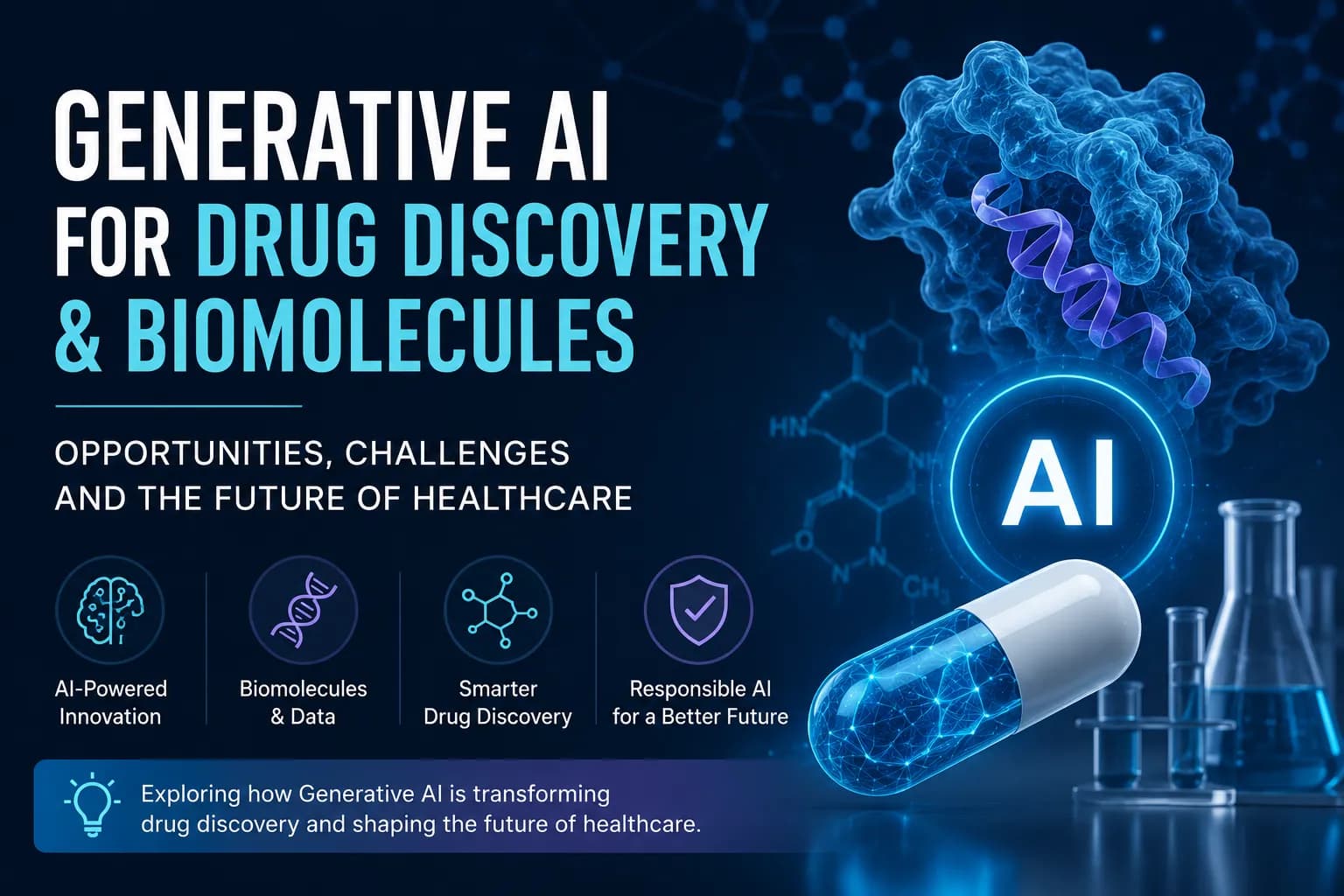
Generative Artificial Intelligence is becoming an important technology in drug discovery and life sciences. Traditional drug development can take many years and requires significant financial investment because researchers need to identify promising molecules, test their effectiveness, evaluate safety, and conduct multiple stages of clinical research.
Generative AI provides a new approach by learning patterns from biological, chemical, and molecular data and generating new possibilities that researchers can investigate. Rather than replacing scientists, I believe AI can act as a powerful research assistant that helps scientists explore a much larger number of possibilities in less time.
How Generative AI Can Support Drug Discovery
One of the most promising applications is molecule generation. Generative models can learn the structural patterns of existing compounds and propose new molecular structures with desired properties. Researchers can then evaluate these candidates through computational and laboratory experiments.
AI can also help with drug-target interaction prediction. Understanding how a potential drug molecule interacts with a protein or biological target is an important part of drug discovery. Machine learning and deep learning models can analyze large datasets to identify patterns that may not be easily discovered through conventional methods.
Another important area is protein structure and biomolecule analysis. Modern AI models can help researchers understand protein structures and relationships between biological sequences and functions. This can provide valuable information for identifying potential therapeutic targets.
Generative AI can also contribute to virtual screening and drug optimization. Instead of experimentally testing every possible compound, AI can prioritize candidates based on predicted characteristics such as binding affinity, toxicity, stability, and other relevant properties. Researchers can then focus laboratory resources on the most promising candidates.
Technologies Involved
A wide range of AI technologies can contribute to this field, including:
Machine Learning and Deep Learning
Generative AI models
Transformer architectures
Graph Neural Networks
Natural Language Processing
Molecular representation learning
Protein and DNA sequence modeling
Large-scale biological and chemical datasets
Graph-based approaches are particularly interesting because molecules can naturally be represented as graphs, where atoms are nodes and chemical bonds are edges. This allows machine learning models to learn relationships within molecular structures.
Potential Impact on Healthcare
The biggest potential advantage of Generative AI is accelerating the early stages of drug discovery. AI can help researchers search through enormous chemical and biological spaces more efficiently and identify promising candidates earlier.
It could also support the development of more personalized treatments by analyzing relationships between biological characteristics and treatment responses. In the long term, combining AI with laboratory automation, high-throughput screening, and biomedical research could create a much more efficient drug discovery pipeline.
However, I do not think AI should be viewed as a system that independently discovers and approves medicines. Healthcare requires extremely high levels of reliability, validation, and safety.
Challenges and Risks
Generative AI also introduces important challenges. The quality of an AI system depends heavily on the quality and diversity of its training data. Incomplete or biased datasets can result in unreliable predictions.
AI-generated molecules also cannot simply be assumed to be safe or effective. They must undergo computational validation, laboratory testing, preclinical evaluation, and clinical trials.
Another challenge is explainability. Researchers and regulators need to understand why a model recommends a particular molecule or biological target. Privacy, data security, intellectual property, regulatory compliance, and responsible AI governance are also important considerations.
There is also a risk of over-relying on AI-generated results. A model prediction should be treated as a hypothesis that requires scientific validation, not as a guaranteed scientific conclusion.
My Perspective
In my view, the most valuable role of Generative AI in drug discovery is to expand the capabilities of researchers rather than replace them. A scientist may have limited time and resources to investigate potential molecules, while an AI system can rapidly analyze large datasets and generate numerous hypotheses.
The strongest future approach will be a human-AI collaboration model where AI performs large-scale analysis, prediction, and candidate generation, while scientists provide domain expertise, experimental validation, interpretation, and ethical judgment.
I am particularly interested in this area because it demonstrates how AI can move beyond chatbots and content generation into fields where it can potentially address complex real-world problems. The combination of AI, biology, chemistry, and automation could significantly influence the future of healthcare.
Future Outlook
I believe the next stage of AI-driven drug discovery will involve increasingly integrated systems combining Generative AI, multimodal biological data, molecular simulations, laboratory automation, and continuous model improvement.
As these technologies mature, AI could help researchers explore previously difficult-to-reach areas of biology and identify promising therapeutic approaches more efficiently. However, responsible development, scientific validation, transparency, and regulatory oversight will remain essential.
Overall, Generative AI has the potential to transform drug discovery from a predominantly trial-and-error process into a more data-driven, computationally guided, and efficient scientific process. Its greatest impact will come when advanced AI capabilities are combined with human scientific expertise and rigorous experimental validation.