• Home

Business

  • Dashboard
  • My Products
  • Edit Business
  • My Groups

Explore

  • Articles
  • Community
  • Careers
  • Blogs
BONC logo
Get it on Google Play

Products

  • Pricing
  • Explore Industry
  • Explore Category
  • Explore Product
  • About Us

About BONC

  • FAQs
  • Terms and Condition
  • Privacy Policy
  • Refund Policy
  • Blogs

OFFICE LOCATION

Costipro Technologies Pvt. Ltd, Unit no. 235 to 245, Supremework Workspace, 2nd Floor, ILD Trade Center, Sector 47, Sohna Road, Gurgaon, Haryana - 122018

© 2025 - 2026 BONC Network. All rights reserved

BONC Logo
  • Home

Business

  • Dashboard
  • My Products
  • Edit Business
  • My Groups

Explore

  • Articles
  • Community
  • Careers
  • Blogs

Altria & Imperial Brands: The $157 Billion Consolidation of Big Tobacco

General UpdatesBy SevenO17 Technologies · 26 Nov 2026

A Mega-Merger Explored to Reshape Global Nicotine Markets, Redefine London’s Financial Landscape, and Confront Global Regulators

Key Timelines & Date of Imposition

  • Official Public Confirmation: November 26, 2026, following heightened market speculation and regulatory disclosures regarding a potential all-cash offer from US giant Altria Group.

  • UK Takeover Code Mandate: Under Rule 2.6 of the UK Takeover Code, the UK Panel on Takeovers and Mergers placed Altria under a formal "Put Up or Shut Up" (PUSU) deadline.

  • Formal Decision Window: Altria must either confirm a definitive intention to make an offer or formally announce its withdrawal by 5:00 PM London time on December 24, 2026.

  • Projected Completion Horizons: Should negotiations proceed to a binding agreement, anti-trust clearance, foreign direct investment screening, and shareholder votes would push deal closing into late 2027.

Potential Financial Impact

  • Enterprise Scale & Capitalization: Before the announcement, Altria carried a market capitalization of approximately $127 billion, whereas Imperial Brands held a market valuation of roughly £22.8 billion ($29.9 billion). Combined enterprise value projections and debt-financed takeover mechanics estimate the total deal package at up to $157 billion.

  • Equity Market Response: Imperial Brands' shares spiked over 13% to 14% on the London Stock Exchange immediately following confirmation of the talks, driving the company's valuation toward £26 billion.

  • Balance Sheet Restructuring: Altria funding an all-cash acquisition of this magnitude would require substantial debt issuance alongside structural partner syndication. Altria has explored co-funding arrangements or asset-split deals with international peers, including potential interest from Japan Tobacco.

  • Operational Synergies: The combination is structured to unlock billions in annual cost-efficiency run rates across global logistics, administrative overhead, manufacturing footprint, and raw material procurement.

What Will Change

  • Altria’s International Re-Entry: Since spinning off Philip Morris International in 2008, Altria has been limited to domestic US operations. Buying Imperial Brands grants Altria an immediate, operational footprint across Europe, Africa, Asia, and Latin America.

  • Unified Next-Generation Portfolio: The merger merges legacy combustibles with alternative nicotine platforms. Altria’s NJOY e-vapor line and on! oral nicotine pouches will unify with Imperial’s blu e-cigarettes, Skruf oral pouches, and Pulze heated-tobacco hardware.

  • Corporate Overhead Rationalization: Imperial Brands had already launched plans to trim up to 4,600 roles globally by 2030 to optimize operational margins. Merging into Altria will accelerate administrative and corporate workforce consolidation globally.

Practical Challenges

  • Complex Multi-Party Asset Carve-Outs: Altria’s strategy hinges on offloading specific international assets of Imperial Brands to a third-party suitor. Negotiating asset splits, regional trademark ownership, and cross-border tax liabilities among Altria, Imperial, and third-party buyers presents severe execution hurdles.

  • Cultural and Operational Integration: Blending a heavily US-centric corporate structure with Imperial’s decentralized international organization poses multi-jurisdictional operational risks.

  • FDI & National Security Reviews: The deal will require rigorous clearance under foreign direct investment frameworks, such as the UK’s National Security and Investment Act, given the scope of national infrastructure and workforce reorganization involved.

Historical Growth of Imperial Brands

  • Founding in Bristol (1901): Established as the Imperial Tobacco Company through the coalition of 13 British tobacco firms—including W.D. & H.O. Wills and John Player & Sons—to block aggressive American expansion into the UK market.

  • Demerger and LSE Listing (1996): Spun off from industrial conglomerate Hanson plc and listed on the London Stock Exchange, instantly becoming a founding cornerstone of the FTSE 100 index.

  • Aggressive International M&A Era:

    • 2002: Acquired Germany’s Reemtsma for €1.3 billion, securing brands like Davidoff and West.

    • 2007–2008: Expanded into North America by acquiring Commonwealth Brands ($1.9B) and executing a €11.7 billion takeover of Franco-Spanish rival Altadis (adding Gauloises and Fortuna).

    • 2015: Acquired US assets—including Winston, Kool, Salem, and blu—for $7.1 billion following the Reynolds-Lorillard merger, forming its US operating arm, ITG Brands.

  • Strategic Evolution (2016–2026): Rebranded to Imperial Brands PLC to signal a shift beyond traditional cigarettes into next-generation vapor, heated tobacco, and oral nicotine platforms.

Changing Dynamics in London and England

  • Depletion of the London Stock Exchange: The potential exit of Imperial Brands—a FTSE 100 constituent since the index launched in 1984—deals another psychological and financial blow to London's equity markets. It follows an ongoing flight of major UK-listed firms falling to overseas buyers or re-listing on US exchanges due to valuation disparities.

  • UK Capital Markets Liquidity: While an all-cash acquisition injects billions into UK institutional investor accounts, it removes a blue-chip, high-yielding defensive stock from the domestic market.

  • Regional Employment Impact: Imperial’s headquarters in Bristol and affiliated regional corporate centers across England face corporate consolidation, putting high-skilled administrative and executive roles at risk.

Monopolistic Concerns & Competition Constraints

  • Severe US Market Overlap: Altria’s Philip Morris USA commands a massive share of the US retail cigarette market via Marlboro. Imperial’s US division, ITG Brands, holds a notable market share with Winston, Kool, and Salem. Combining Altria and Imperial's US assets would create anti-competitive concentration, drawing immediate challenges from the US Federal Trade Commission (FTC) and Department of Justice (DOJ).

  • European and UK Regulatory Scrutiny: Regulatory bodies such as the UK Competition and Markets Authority (CMA) and the European Commission will evaluate horizontal dominance in the Next-Generation Product categories, focusing on e-vapor and oral nicotine pouch pricing power.

  • Mandatory Divestiture Remedies: To secure regulatory clearance, Altria will almost certainly be forced to execute structural divestitures—selling off Imperial’s US brand portfolio or specific European distribution rights to third-party competitors.

Current Market Capture Status

  • Altria Group: Maintains over 40% of the domestic US retail cigarette market through Marlboro, while holding strong positions in cigars (Black & Mild), oral nicotine (on!), and e-vapor (NJOY).

  • Imperial Brands: Operates as the world's fourth-largest international tobacco manufacturer, maintaining strong market share across the UK, Germany, Spain, France, and North America.

  • Combined Entity Potential: The combined firm would operate as a global behemoth, wielding dominant legacy market share across North America and Europe while establishing a consolidated footprint in next-generation reduced-harm products.

#Altria#ImperialBrands#BigTobacco#Marlboro#ITGBrands#LondonStockExchange#FTSE100#LSE#FTC#UKCapitalMarkets#DeListingTrend#TobaccoIndustry

Comments

No comments yet

Be the first to share your thoughts.

Latest Articles

View all

Company Articles

  • Wash Basins, Sanitaryware & Fittings Industry: India, China, USA, Japan and Europe Driving Growth Through Innovation and Modern Construction

    Wash Basins, Sanitaryware & Fittings Industry: India, China, USA, Japan and Europe Driving Growth Through Innovation and Modern Construction

    Bubai Roy · a day ago

  • PCB Modules and Electronic Components Market: Growth Drivers, Leading Brands and Future Outlook

    PCB Modules and Electronic Components Market: Growth Drivers, Leading Brands and Future Outlook

    RANA ELECTRONICS · a day ago

  • Commercial Furniture Industry: How India, China, Germany and Italy Are Shaping the Global Market

    Commercial Furniture Industry: How India, China, Germany and Italy Are Shaping the Global Market

    Md Ashfaque · a day ago

  • Industrial Piping Solutions Market: Global Growth, Major Manufacturers and Emerging Opportunities in India, China, Germany and the USA

    Industrial Piping Solutions Market: Global Growth, Major Manufacturers and Emerging Opportunities in India, China, Germany and the USA

    Sushil Shroff · a day ago

  • Domestic Fans, Air Conditioners and Coolers Market: Emerging Trends, Key Manufacturers and Future Opportunities

    Domestic Fans, Air Conditioners and Coolers Market: Emerging Trends, Key Manufacturers and Future Opportunities

    Nazakat ali · a day ago

Networking Articles

  • SpaceX & Starmind: The $250 Billion Orbital AI Hyperscale Revolution

    SpaceX & Starmind: The $250 Billion Orbital AI Hyperscale Revolution

    BONC NETWORK · few months ago

  • Poundland Collapse: 11,000 Jobs at Risk -  A 36-Year Retail Giant Falls

    Poundland Collapse: 11,000 Jobs at Risk - A 36-Year Retail Giant Falls

    BONC NETWORK · few months ago

  • Airbus & BYD: Two Strategic Moves Reshaping the Global Aerospace and Automotive Industries

    Airbus & BYD: Two Strategic Moves Reshaping the Global Aerospace and Automotive Industries

    Global Bserve · few months ago

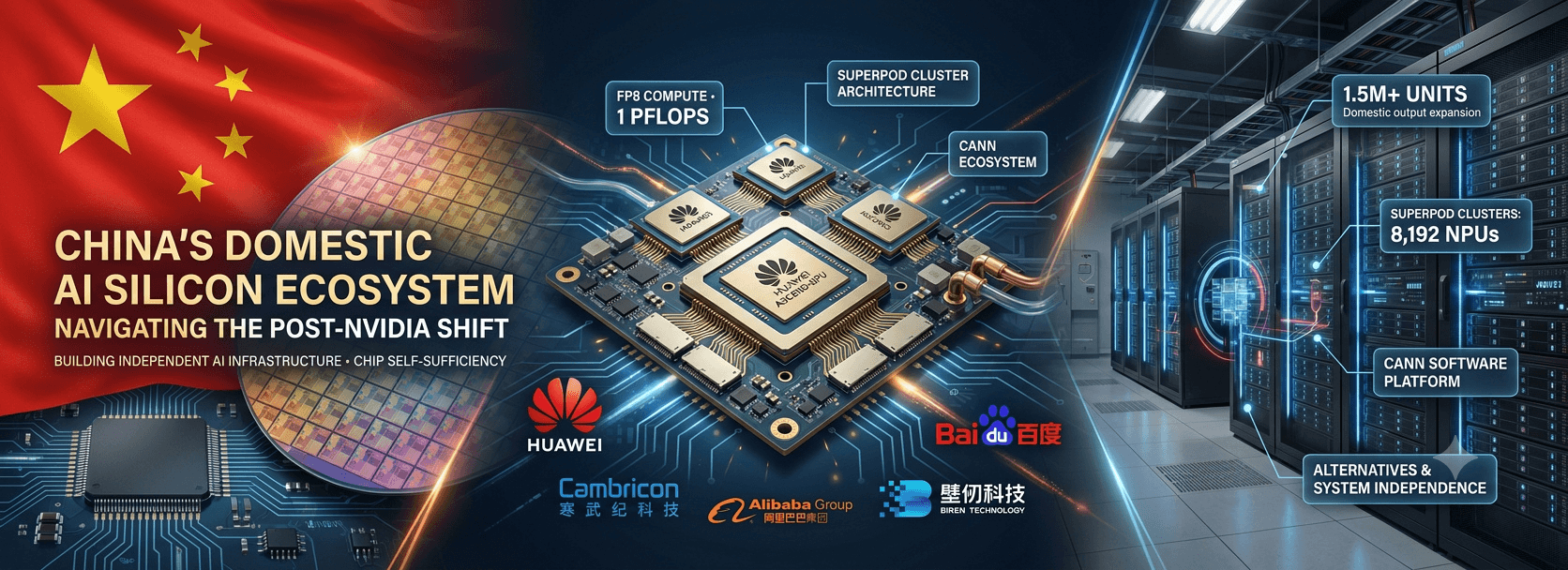
  • Huawei Ascend, Cambricon, and the Chinese AI Silicon Ecosystem: Navigating the Post-Nvidia Shift

    Huawei Ascend, Cambricon, and the Chinese AI Silicon Ecosystem: Navigating the Post-Nvidia Shift

    Vikas Garg · few months ago

  • Washington Tightens Nvidia GPU Access to Curb Chinese AI Expansion - Closing the Cloud Loophole

    Washington Tightens Nvidia GPU Access to Curb Chinese AI Expansion - Closing the Cloud Loophole

    Vikas Garg · few months ago

More Articles

View all
Wash Basins, Sanitaryware & Fittings Industry: India, China, USA, Japan and Europe Driving Growth Through Innovation and Modern Construction
Case Study

Wash Basins, Sanitaryware & Fittings Industry: India, China, USA, Japan and Europe Driving Growth Through Innovation and Modern Construction

Introduction The global wash basins, sanitaryware and fittings industry is becoming an increasingly important segment of the building and construction sector. Rapid urbanisation, population growth, residential development, commercial infrastructure expansion and rising hygiene awareness are creating new demand for modern bathroom and sanitation products. Countries such as India, China, the United States, Germany, Italy and Japan are playing significant roles in manufacturing, consumption, product innovation and international trade. Leading companies including Jaquar, Hindware, Cera Sanitaryware, Kohler, Roca, TOTO, LIXIL, Duravit and Villeroy & Boch are strengthening their market positions through advanced designs, water-efficient technologies, premium bathroom solutions and wider distribution networks. The industry covers a broad range of products, including ceramic wash basins, countertop basins, wall-mounted basins, pedestal basins, kitchen sinks, water closets, urinals, bathroom faucets, shower systems, taps, mixers, flush systems, bathroom accessories and other sanitary fittings. These products are no longer considered basic construction necessities alone. They have become important elements of interior design, property value, water conservation and modern lifestyle preferences. Global Market Size and Growth Trends The global sanitaryware market represents a substantial segment of the construction materials and bathroom products industry. Depending on the product categories and research methodology used, market estimates vary, but the broader sanitaryware market is generally valued in the tens of billions of US dollars. The industry is benefiting from multiple demand drivers: Increasing construction of residential apartments, independent houses and gated communities. Expansion of hotels, hospitals, shopping malls, airports and office buildings. Renovation of ageing bathrooms and replacement of traditional fittings. Growing consumer interest in premium bathroom interiors. Increasing adoption of water-saving and environmentally responsible products. Rising investment in sanitation infrastructure across developing economies. The broader global sanitaryware industry is expected to maintain a positive growth trajectory during the coming years, with many market forecasts indicating annual growth in the mid-single-digit range. Premium bathroom fittings, smart toilets, concealed flush systems and technologically advanced faucets are expected to grow faster than several conventional product categories. Renovation activity is another important contributor. In developed markets, homeowners are increasingly upgrading older bathrooms with contemporary designs, while emerging economies are experiencing first-time purchases driven by new housing construction. India: A Major Manufacturing and Consumption Hub India has emerged as one of the world's important sanitaryware manufacturing and consumption markets. Rapid urbanisation, government-backed housing development, infrastructure investment and rising middle-class purchasing power are supporting industry expansion. The Indian sanitaryware and bathware market was valued at approximately ₹331 billion in FY2025 , compared with ₹213 billion in FY2019. This represents an estimated historical CAGR of around 7.1%. The market is projected to reach approximately ₹483 billion by FY2029 , indicating an expected annual growth rate of nearly 9.9%. Some important Indian companies operating in this industry include: Jaquar Group: A major manufacturer of bathroom fittings, faucets, showers and sanitaryware. Hindware: Offers ceramic sanitaryware, wash basins, faucets and bathroom solutions. Cera Sanitaryware: Manufactures wash basins, water closets, faucets and related bathroom products. Somany Ceramics: Operates in sanitaryware, tiles and bathroom solutions. Varmora: Supplies sanitaryware, faucets and other bathroom products. Parryware: Known for ceramic sanitaryware and contemporary bathroom products. India also benefits from manufacturing clusters such as Morbi in Gujarat, which has developed into an important centre for ceramic and sanitaryware production. Domestic manufacturers are increasingly investing in automation, product quality, export capabilities and modern manufacturing facilities. The growing popularity of premium residential projects in Mumbai, Delhi, Bengaluru, Hyderabad, Pune and other urban centres is also creating opportunities for branded bathroom products. China: Global Manufacturing Powerhouse China remains one of the most influential countries in the global sanitaryware supply chain. Its large manufacturing ecosystem, established ceramic industry, advanced production infrastructure and extensive supplier networks allow manufacturers to serve both domestic and international markets. Chinese manufacturers produce ceramic wash basins, toilets, faucets, shower systems, stainless-steel sinks and bathroom accessories across different price categories. Companies such as JOMOO, Huida, Arrow Home Group and SSWW have developed strong positions in the domestic bathroom products market. China also hosts numerous smaller manufacturers supplying private-label products to international distributors and construction companies. The country's competitive advantage comes from manufacturing scale, component availability, production efficiency and extensive export infrastructure. However, rising labour costs, environmental regulations, changing property market conditions and international trade pressures are encouraging manufacturers to improve product differentiation and explore new export destinations. USA and Europe: Premium Products and Technology Innovation The United States represents an important market for premium sanitaryware, bathroom renovations and water-efficient plumbing fixtures. Consumers increasingly prefer products that combine modern aesthetics, durability, convenience and reduced water consumption. Major companies include Kohler, American Standard, Moen and Masco . These businesses offer a broad portfolio covering faucets, wash basins, toilets, showers, kitchen sinks and smart bathroom technologies. In Europe, Germany, Italy, Spain and France are important centres for bathroom design, engineering and premium sanitaryware manufacturing. Leading European companies include: Duravit (Germany): Premium ceramic sanitaryware and bathroom furniture. Villeroy & Boch (Germany): High-end bathroom and ceramic products. Hansgrohe (Germany): Faucets, showers and water-control technologies. Roca (Spain): Sanitaryware, bathroom fittings and integrated bathroom solutions. Ideal Standard (Europe): Bathroom ceramics and fittings. Geberit (Switzerland): Concealed cisterns, flushing systems and sanitary installation solutions. European manufacturers generally compete through product engineering, design quality, sustainability, precision manufacturing and premium brand positioning. Japan: Smart Sanitaryware and Advanced Bathroom Solutions Japan has established a strong international reputation for technologically advanced bathroom products. Its manufacturers focus on hygiene, water efficiency, user comfort and automation. TOTO and LIXIL are among the most recognised companies in this segment. Their product portfolios include advanced toilets, intelligent bidet systems, sensor-operated faucets, automated flushing technologies and integrated bathroom solutions. Smart toilets with heated seats, adjustable washing functions, automatic lids and electronic controls are gaining attention in premium residential and hospitality developments. Japanese innovation is also influencing international consumer expectations. Manufacturers in other countries are increasingly introducing electronic controls, touchless faucets and intelligent water-management systems to compete in the premium segment. Product Innovation and Changing Consumer Preferences Product innovation is one of the strongest growth drivers in the wash basins, sanitaryware and fittings industry. Traditional pedestal wash basins are increasingly being complemented by countertop, wall-mounted, under-counter and vessel-style designs. Consumers are paying greater attention to bathroom space utilisation, surface finishes, cleaning convenience and compatibility with modern interiors. Several important product trends are shaping the market: 1. Smart and Touchless Fittings Sensor-based faucets, automatic flushing systems and touchless soap dispensers are gaining popularity in hotels, hospitals, airports and premium residential properties. 2. Water-Efficient Technologies Water-saving faucets, dual-flush toilets, aerators and controlled-flow shower systems are becoming important purchasing considerations as water conservation receives greater attention. 3. Premium Ceramic and Composite Materials Manufacturers are exploring advanced ceramic glazing, solid-surface materials, engineered stone and other durable materials to improve product appearance and performance. 4. Contemporary Bathroom Designs Matte black, brushed gold, chrome, rose gold and other decorative finishes are creating new opportunities in the premium bathroom fittings segment. 5. Space-Saving Solutions Compact wash basins, wall-hung toilets, concealed cisterns and integrated bathroom cabinets are attracting demand in urban apartments where space optimisation is important. Major Challenges and Industry Bottlenecks Despite its positive growth outlook, the industry faces several operational and commercial challenges. High Energy Consumption: Ceramic sanitaryware manufacturing requires high-temperature kilns, making natural gas, electricity and fuel costs important components of production expenses. Raw Material Price Fluctuations: Manufacturers depend on clay, feldspar, silica, metals, brass, copper, plastics and specialised chemicals. Price volatility can affect production costs and profit margins. Intense Market Competition: Established brands compete with regional manufacturers, unorganised suppliers and low-cost imported products. This creates pricing pressure, particularly in entry-level categories. Quality and Standardisation: Inconsistent product quality, leakage problems, surface defects, poor plating and inadequate installation practices can affect customer satisfaction and brand reputation. Water Availability: Water scarcity and changing environmental requirements are increasing pressure on manufacturers to develop efficient products and adopt responsible production processes. Distribution and Logistics: Ceramic products are fragile and bulky. Transportation, packaging, warehousing and breakage risks can increase distribution costs, especially in international markets. Technology Investment: Smart sanitaryware and advanced manufacturing require investment in automation, electronics, research, skilled labour and after-sales support. Smaller manufacturers may struggle to match these requirements. Future Outlook: Opportunities Through 2030 and Beyond The future of the global wash basins, sanitaryware and fittings industry appears promising as construction, renovation, urban development and premium housing demand continue to create opportunities. The global sanitaryware market is estimated at approximately USD 62 billion in 2025 , with some industry forecasts indicating growth to around USD 104.8 billion by 2035. The projected CAGR of approximately 5.4% reflects the long-term potential of the sector, although estimates vary according to market definitions and product coverage. India is expected to remain an important growth market because of its expanding housing sector, rising disposable incomes, infrastructure development and increasing preference for branded bathroom products. China will continue to play an important role in global manufacturing and exports, while the United States and Europe will provide opportunities in premium products, renovation and technologically advanced fittings. Japan is likely to remain influential in smart bathroom technologies and hygiene-focused innovation. Some of the most promising opportunities for manufacturers include: Development of affordable smart toilets and intelligent bathroom fittings. Expansion of water-efficient faucets and flushing technologies. Increased demand for premium wash basins and designer sanitaryware. Greater adoption of environmentally responsible manufacturing. Growth in exports from India and other competitive manufacturing countries. Integration of bathroom products with smart-home systems. Increasing demand from hospitals, hotels, educational institutions and commercial infrastructure. Conclusion The wash basins, sanitaryware and fittings industry is evolving from a conventional construction materials segment into a technology-driven and design-oriented global business. India, China, the USA, Germany, Japan, Italy and Spain are contributing through manufacturing capabilities, product innovation, international trade and changing consumer preferences. Companies such as Jaquar, Hindware, Cera, Kohler, TOTO, LIXIL, Roca, Duravit and Villeroy & Boch are expected to remain important participants in the competitive landscape. Going forward, manufacturers that focus on product quality, water conservation, innovative designs, efficient production and strong distribution networks will be better positioned to capture emerging opportunities. With increasing investment in residential and commercial infrastructure, the industry is likely to remain an important contributor to the global building and construction ecosystem.

#WashBasins#Sanitaryware#BathroomFittings
Bubai Roy
PCB Modules and Electronic Components Market: Growth Drivers, Leading Brands and Future Outlook
Case Study

PCB Modules and Electronic Components Market: Growth Drivers, Leading Brands and Future Outlook

The Growing Importance of Printed Circuit Boards in Modern Electronics The Printed Circuit Board (PCB) modules and circuit boards industry is a fundamental part of the global electronics and electrical manufacturing ecosystem. Countries such as China, India, Japan, South Korea, Taiwan, Germany and the United States play significant roles in PCB production, electronic component manufacturing, research and technological development. Leading companies such as Zhen Ding Technology, Unimicron, TTM Technologies, Samsung Electro-Mechanics, Ibiden, AT&S, Meiko Electronics and Shennan Circuits are contributing to the development of advanced circuit board technologies. Printed Circuit Boards are essential components used to connect and support electronic components in smartphones, computers, televisions, automobiles, industrial machinery, medical equipment, telecommunications systems and consumer appliances. They provide electrical connections through conductive copper pathways mounted on insulating substrates. The growing adoption of artificial intelligence, electric vehicles, 5G communication, smart devices, automation and advanced computing is increasing demand for high-performance PCBs. Manufacturers are developing smaller, lighter, more complex and energy-efficient circuit boards to support next-generation electronic products. The industry is also moving towards advanced PCB modules, flexible circuits, high-density interconnect boards and multilayer designs. These developments are creating opportunities for manufacturers, electronic component suppliers, semiconductor companies and specialised engineering businesses. Global PCB Market Expansion and Emerging Demand The global PCB industry is experiencing significant development due to rising electronics production and increasing demand for advanced electronic systems. The worldwide PCB market generated approximately USD 73 billion in 2024 , with industry forecasts indicating potential growth towards USD 100 billion or more by the end of the decade, depending on market coverage and product categories. The industry is expected to experience an approximate annual growth rate of 5–8% over the coming years. Advanced PCB segments, particularly high-density interconnect (HDI), flexible PCBs, substrate-like PCBs and high-layer-count boards, are expected to experience stronger demand because of their specialised applications. Several factors are driving this expansion: Increasing production of smartphones, laptops and consumer electronics. Rising demand for AI servers and high-performance computing systems. Expansion of electric vehicle manufacturing. Growing adoption of 5G and advanced communication infrastructure. Increasing automation across manufacturing industries. Development of medical electronics and smart healthcare equipment. The increasing complexity of electronic devices is encouraging manufacturers to invest in advanced materials, precision drilling, multilayer production and automated inspection systems. India's PCB Manufacturing Industry and Electronics Growth India is emerging as an important destination for electronics manufacturing and PCB production. Government initiatives supporting domestic electronics manufacturing, semiconductor development and component ecosystems are encouraging investments in circuit board manufacturing facilities. The expansion of smartphone assembly, automotive electronics, telecommunications equipment, industrial automation and consumer appliances is increasing domestic PCB demand. India still depends on imports for a considerable portion of its advanced PCB requirements, creating opportunities for domestic manufacturers to strengthen production capabilities. Important Indian companies and manufacturers in the broader PCB ecosystem include: Syrma SGS Technology: Provides electronic manufacturing services, PCB assembly and electronic product solutions. Avalon Technologies: Offers electronics manufacturing services, PCB assembly and integrated electronic systems. Kaynes Technology: Operates in electronics manufacturing, PCB assembly and advanced electronic systems. Fine-Line Circuits: Specialises in printed circuit board manufacturing. Genus Electrotech: Manufactures electronic products and operates in the PCB and electronics manufacturing ecosystem. Vinyas Innovative Technologies: Provides electronic manufacturing and PCB assembly services. India's electronics manufacturing hubs in Bengaluru, Chennai, Noida, Hyderabad, Pune and other industrial locations are supporting the development of the sector. Government incentives, local supply-chain development and rising demand for domestically manufactured electronic components could improve India's competitiveness in the international PCB market. PCB Product Categories and Advanced Manufacturing Technologies Printed Circuit Boards are available in different configurations depending on the complexity, size, electrical performance and application requirements of electronic products. Single-Sided and Double-Sided PCBs: These are commonly used in household appliances, power supplies, basic electronic devices, LED lighting and simple control systems. Their relatively straightforward manufacturing process makes them suitable for high-volume applications. Multilayer PCBs: These boards contain multiple conductive copper layers separated by insulating materials. They are used in computers, telecommunications equipment, industrial machinery, automotive electronics and advanced consumer devices. High-Density Interconnect (HDI) PCBs: HDI boards use finer circuit patterns, microvias and compact connections to support smaller electronic devices with higher functionality. Smartphones, advanced computing equipment and medical electronics are important applications. Flexible PCBs: Manufactured using flexible insulating materials, these circuit boards can bend and fit into compact or irregular product designs. They are widely used in smartphones, cameras, wearable devices, automotive systems and portable electronics. Rigid-Flex PCBs: These combine rigid and flexible circuit sections in a single structure. They are useful in aerospace equipment, medical devices, defence electronics and specialised industrial systems. PCB Modules and Assembly: PCB assembly involves mounting electronic components such as resistors, capacitors, integrated circuits, connectors and microprocessors onto circuit boards. Surface Mount Technology (SMT) and automated inspection systems help improve production accuracy and efficiency. International Manufacturers and Key Production Centres Asia dominates the global PCB manufacturing ecosystem, with China, Taiwan, Japan and South Korea holding important positions in production capacity and advanced technology. Some of the leading international companies include: Zhen Ding Technology (Taiwan): A major manufacturer of flexible, rigid and advanced multilayer PCBs. Unimicron Technology (Taiwan): Specialises in multilayer boards, HDI products and semiconductor packaging substrates. TTM Technologies (USA): Manufactures advanced PCBs for aerospace, defence, automotive and communication applications. Samsung Electro-Mechanics (South Korea): Produces advanced circuit boards and semiconductor packaging substrates. Ibiden (Japan): Known for high-performance circuit boards and semiconductor package substrates. AT&S (Austria): Specialises in advanced interconnection technologies, HDI boards and high-end substrates. Shennan Circuits (China): Manufactures multilayer PCBs, packaging substrates and electronic circuit solutions. Meiko Electronics (Japan): Supplies PCBs for automotive, industrial and consumer electronics applications. China remains a major global manufacturing hub because of its extensive supplier networks, skilled workforce and large production facilities. Taiwan is particularly important in advanced PCB technologies, while Japan and South Korea have strong capabilities in high-precision boards and semiconductor-related substrates. Germany, Austria and the United States also contribute through specialised manufacturing, engineering and high-reliability electronics production. Growing Applications Across Major Industries PCB demand is expanding across several industries as electronic systems become more sophisticated. The consumer electronics sector uses circuit boards in smartphones, televisions, laptops, gaming equipment, cameras and household appliances. Increasing product miniaturisation is encouraging demand for flexible and high-density circuit designs. The automotive industry is becoming an important growth segment. Electric vehicles require PCBs for battery management systems, power electronics, charging equipment, navigation, sensors and vehicle control units. Advanced driver assistance systems are further increasing electronic content in modern vehicles. Artificial intelligence and data centres are creating demand for high-layer-count PCBs, advanced substrates and high-speed networking boards. Industrial automation requires reliable circuit boards for robotics, programmable controllers, monitoring equipment and manufacturing systems. Medical electronics, aerospace, defence and telecommunications are also important applications because they require specialised circuit boards with high reliability and precise electrical performance. Investment, Trade and New Business Opportunities The PCB industry offers significant opportunities for manufacturers, component suppliers, technology developers and electronics assembly companies. The global electronics supply chain is encouraging businesses to diversify production locations and develop alternative manufacturing centres. India has considerable potential in this area. PCB demand reached approximately USD 4.2 billion in 2024–25 , while domestic bare PCB manufacturing remained around USD 600 million. This difference highlights the opportunity for local manufacturers to expand production and reduce dependence on imported circuit boards. New investments in multilayer PCBs, HDI boards, copper-clad laminates and electronic components are supporting India's manufacturing ecosystem. Important business opportunities include: Manufacturing multilayer and flexible circuit boards. Producing PCB modules for electric vehicles and automotive electronics. Supplying circuit boards for telecommunications and industrial equipment. Developing advanced PCB assembly and testing facilities. Manufacturing copper-clad laminates and electronic substrates. Exporting specialised circuit boards to international electronics manufacturers. Major Obstacles Affecting PCB Manufacturing Despite strong growth opportunities, PCB manufacturers face several technical and commercial challenges. High capital investment: Advanced PCB production requires expensive machinery, precision drilling, imaging, plating and testing equipment. Raw material dependency: Copper foil, specialised laminates, glass fibre and electronic chemicals influence production costs. Import dependence: India continues to rely heavily on imported bare PCBs and certain advanced manufacturing materials. Technology limitations: HDI, high-frequency and multilayer boards require specialised engineering expertise. Environmental compliance: PCB manufacturing involves chemical processing, wastewater treatment and industrial waste management. International competition: Chinese, Taiwanese, Japanese and South Korean manufacturers benefit from established supply chains and large production capacities. Skilled workforce: Advanced circuit design, process engineering and quality inspection require specialised technical professionals. Manufacturers need to improve automation, develop domestic raw material supply chains and invest in research and development to overcome these bottlenecks. Future Developments in PCB Design and Production The future of the PCB modules and circuit boards industry is expected to be strongly influenced by artificial intelligence, electric mobility, advanced computing and next-generation communication technologies. The global PCB market was valued at approximately USD 73.6 billion in 2024 , while industry estimates placed its 2025 value at around USD 85 billion as demand for AI infrastructure and advanced electronics accelerated. Longer-term growth will depend on investments in data centres, automotive electronics, telecommunications and consumer technology. India is also expected to become a more important PCB manufacturing destination through domestic investment, government incentives and electronics supply-chain development. Major future trends include: Greater adoption of HDI and high-layer-count PCBs. Increasing demand for flexible and rigid-flex circuit boards. Advanced substrates for AI processors and high-performance computing. More PCB applications in electric vehicles and battery management. Development of high-frequency boards for 5G and future 6G networks. Automated optical inspection and AI-assisted manufacturing. Environmentally responsible production and recyclable materials. Expansion of domestic semiconductor and electronic component ecosystems. Conclusion The PCB modules and circuit boards industry is becoming increasingly important to the global electronics and electrical manufacturing sector. Companies such as Zhen Ding Technology, Unimicron, TTM Technologies, Samsung Electro-Mechanics, Ibiden, AT&S and Shennan Circuits are helping advance circuit board technology through innovation and manufacturing expansion. India, China, Japan, Taiwan, South Korea, Germany and the United States will continue to play significant roles in the international PCB supply chain. Although high manufacturing costs, technological complexity, raw material dependency and environmental regulations remain major challenges, increasing demand from AI, electric vehicles, telecommunications and smart electronics presents considerable long-term opportunities. The industry's future will depend on advanced manufacturing capabilities, product miniaturisation, reliable supply chains and sustainable production. PCB manufacturing is therefore expected to remain a strategic segment of the global electronics industry, creating opportunities for manufacturers, exporters, suppliers and technology-driven businesses.

#PCBIndustry#CircuitBoards#ElectronicsManufacturing
RANA ELECTRONICS
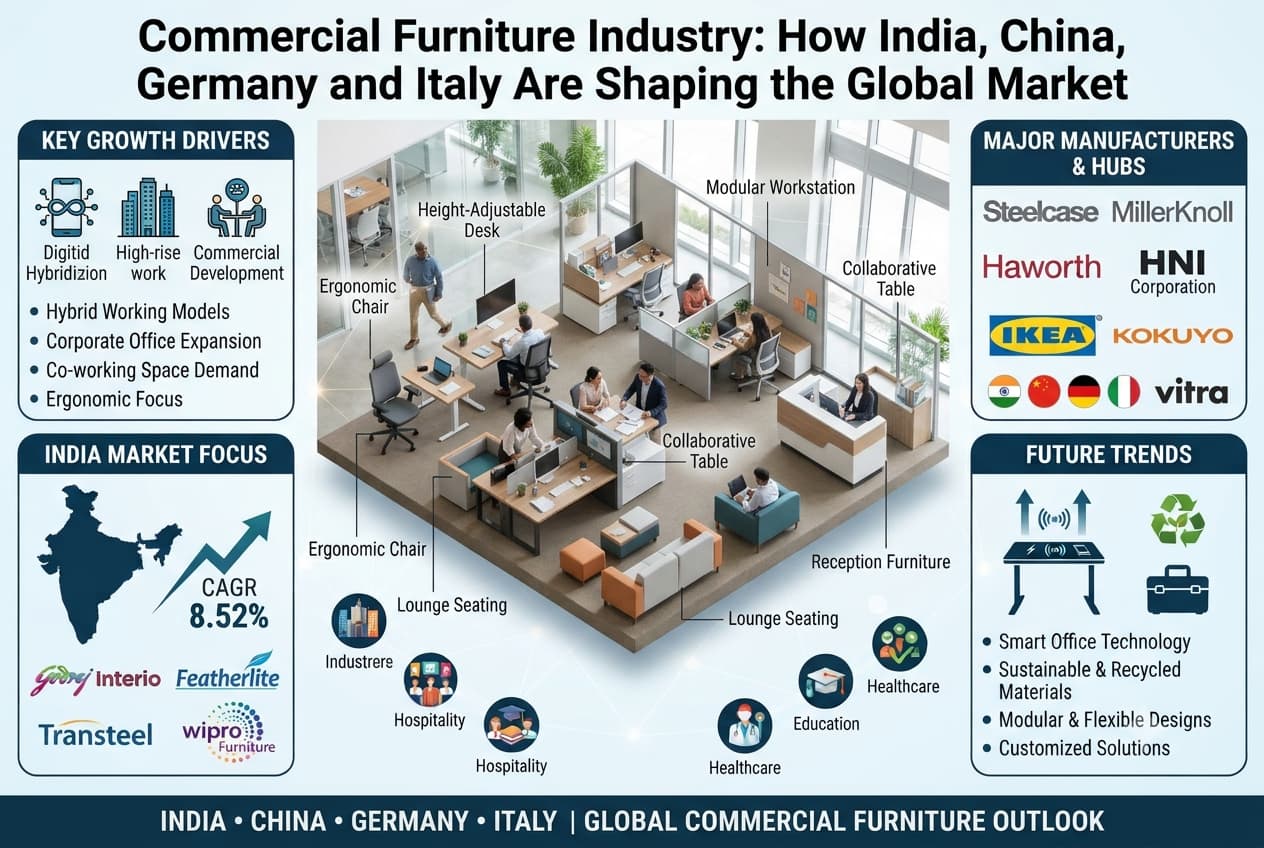
Commercial Furniture Industry: How India, China, Germany and Italy Are Shaping the Global Market
Case Study

Commercial Furniture Industry: How India, China, Germany and Italy Are Shaping the Global Market

Office and Commercial Furniture Industry: Market Growth, Leading Companies and Future Trends in India, China, Germany and the USA Introduction to the Office and Commercial Furniture Industry The office and commercial furniture industry is an important segment of the global furniture, fittings, fixtures and interior infrastructure market. Countries such as India, China, Germany, the United States, Italy and Japan play significant roles in furniture manufacturing, product innovation, international trade and commercial infrastructure development. Leading companies such as Godrej Interio, Steelcase, MillerKnoll, Haworth, HNI Corporation, IKEA, Herman Miller, Kinnarps and Kokuyo are contributing to the industry's growth through modern designs, ergonomic products and advanced workplace solutions. Office and commercial furniture includes office desks, executive tables, conference tables, ergonomic chairs, workstations, storage cabinets, reception furniture, modular partitions, filing systems, classroom furniture, hotel furniture and furniture for retail and healthcare establishments. The market is changing as businesses adopt flexible working arrangements, modern office layouts, collaborative workspaces and technology-integrated furniture. Increasing investment in corporate offices, educational institutions, hotels, hospitals, coworking spaces and commercial buildings is creating new demand for functional and aesthetically designed furniture. Manufacturers are also focusing on comfort, durability, space optimisation, sustainability and customisation. These developments are creating business opportunities for furniture manufacturers, hardware suppliers, interior designers, component manufacturers and commercial furniture distributors. Global Market Growth and Changing Workplace Requirements The global office furniture market represents a substantial segment of the commercial interiors industry. Depending on the products and applications included, its estimated value is approximately USD 60–70 billion in the mid-2020s. Industry forecasts generally indicate annual growth of around 4–6% over the coming years, although estimates vary between market research methodologies. Several factors are supporting this expansion. Corporate office construction, commercial real estate development, educational infrastructure and hospitality investments are increasing the requirement for furniture solutions. The growth of hybrid working is also influencing product demand. Companies are redesigning offices to provide collaborative spaces, meeting areas, shared desks and comfortable employee environments instead of relying entirely on traditional individual workstations. Important market developments include: Increasing demand for ergonomic chairs and height-adjustable desks. Expansion of modular workstations and flexible office furniture. Growing preference for compact and multifunctional products. Rising investment in coworking and managed office spaces. Greater adoption of sustainable and recyclable materials. Increasing demand for customised furniture in commercial projects. The industry is also witnessing growing integration of electrical charging points, cable management, smart lighting and adjustable mechanisms into modern office furniture. India's Office Furniture Market and Commercial Infrastructure Development India is one of the fastest-growing markets for office and commercial furniture in Asia. Expansion of IT companies, banking institutions, multinational corporations, startups, educational organisations and coworking spaces is creating significant demand for modern workplace furniture. The Indian office furniture market was estimated at approximately USD 4.81 billion in 2025 and is projected to reach around USD 7.78 billion by 2031 , representing an estimated CAGR of 8.52% during 2026–2031. Major Indian companies operating in this segment include: Godrej Interio: A major manufacturer of office chairs, workstations, executive desks, storage systems and institutional furniture. Featherlite: Known for ergonomic chairs, modular workstations and corporate furniture solutions. Nilkamal: Offers office seating, storage products, institutional furniture and commercial furnishing solutions. Transteel: Specialises in office workstations, executive furniture, ergonomic seating and workplace interiors. Wipro Furniture: Provides office furniture and workspace solutions for corporate and institutional customers. Durian: Offers office desks, executive furniture, chairs and commercial interior products. Herman Miller India: Provides premium ergonomic seating and modern workplace furniture. Bengaluru, Mumbai, Delhi-NCR, Hyderabad, Pune and Chennai are important commercial furniture demand centres because of their expanding corporate office markets and technology business ecosystems. International Brands and Leading Manufacturing Countries The international office furniture market includes companies recognised for product engineering, ergonomic research, design innovation and large-scale manufacturing. Some prominent global brands include: Steelcase (USA): Offers office seating, workstations, collaborative furniture and workplace planning solutions. MillerKnoll (USA): Known for premium office furniture, ergonomic chairs and contemporary workplace designs. Haworth (USA): Manufactures office seating, modular workstations and flexible workplace furniture. HNI Corporation (USA): Supplies office furniture, seating, desks and commercial interior solutions. IKEA (Sweden): Offers affordable desks, office chairs, storage furniture and modular workplace products. Kokuyo (Japan): Specialises in office furniture, stationery and workplace solutions. Okamura Corporation (Japan): Manufactures ergonomic chairs, office desks and commercial furniture. Kinnarps (Sweden): Focuses on sustainable office furniture and workplace interior solutions. Vitra (Switzerland): Known for premium office seating, design-led furniture and commercial interiors. China remains a major global furniture manufacturing centre because of its extensive production capacity, component availability and export infrastructure. Germany and Italy are important for premium furniture design, precision engineering and specialised commercial interiors. Japan and South Korea contribute through ergonomic product development, compact designs and advanced manufacturing, while the United States remains a major market for premium corporate furniture and workplace solutions. Product Innovation and Modern Commercial Furniture Designs The office furniture industry is moving beyond conventional desks and chairs towards integrated workplace solutions. Ergonomic Office Chairs: Adjustable seating, lumbar support, breathable materials, headrests and flexible armrests are becoming important features for employee comfort. Modular Workstations: These systems allow companies to modify office layouts according to workforce size, department requirements and available space. Executive and Conference Furniture: Premium desks, meeting tables, boardroom chairs and reception furniture are essential for corporate offices, hotels and business establishments. Storage and Filing Systems: Lockers, cabinets, mobile pedestals and document storage solutions help organisations maintain organised work environments. Smart Office Furniture: Modern desks increasingly include wireless charging, electrical outlets, cable management and height-adjustment mechanisms. Manufacturers are also introducing lightweight materials, metal frames, engineered wood, laminates, recycled plastics and sustainable upholstery to improve product performance and design flexibility. Changing Workplace Trends and Commercial Demand Hybrid working and flexible office arrangements are changing how companies purchase furniture. Instead of traditional fixed seating arrangements, many businesses are adopting shared workstations, collaborative meeting areas, quiet zones and multipurpose spaces. Coworking operators require furniture that is durable, modular and easy to reconfigure. Hotels and hospitality businesses need reception counters, conference tables, lounge seating and customised commercial interiors. Educational institutions are increasing demand for classroom desks, computer tables, library furniture and institutional seating. Hospitals and healthcare facilities also require specialised furniture designed for durability, hygiene and efficient space utilisation. Online furniture sales, virtual product demonstrations and customised commercial furniture solutions are creating additional opportunities for manufacturers and distributors. Business Opportunities and International Trade The office and commercial furniture industry offers opportunities across manufacturing, distribution, interior design, hardware production and project execution. India has considerable potential to expand its presence in international markets through the export of office chairs, modular workstations, wooden furniture, metal cabinets, conference tables and furniture components. Important business opportunities include: Manufacturing ergonomic office chairs and adjustable desks. Supplying modular furniture to IT companies and coworking operators. Producing customised furniture for hotels and educational institutions. Exporting office furniture to the Middle East, Africa and neighbouring Asian markets. Manufacturing furniture hardware, hinges, handles, slides and adjustment mechanisms. Providing turnkey commercial interior furnishing solutions. The expansion of organised furniture manufacturing and digital distribution is also creating opportunities for small and medium-sized enterprises. Major Challenges Facing Furniture Manufacturers Despite strong market potential, the industry faces several challenges affecting manufacturers, suppliers and distributors. Raw material costs: Fluctuations in timber, steel, aluminium, foam, plastics and upholstery prices affect production expenses. Unorganised competition: Local manufacturers and low-cost suppliers create pricing pressure in the market. Quality consistency: Maintaining uniform product quality, durability and finishing across large orders remains challenging. Transportation costs: Bulky furniture products involve significant packaging, storage and delivery expenses. Changing customer preferences: Companies increasingly expect customised designs, faster delivery and flexible installation. Import dependency: Certain specialised mechanisms, ergonomic components and premium materials depend on international suppliers. Sustainability requirements: Manufacturers face increasing pressure to use responsibly sourced materials and reduce production waste. Companies must improve manufacturing efficiency, product testing, inventory management and after-sales support to remain competitive. Future Outlook: Smart, Sustainable and Flexible Office Furniture The future of office and commercial furniture is expected to be shaped by workplace technology, sustainability, employee comfort and modern commercial infrastructure. India is projected to experience faster growth than several mature furniture markets as corporate offices, global capability centres, startups and managed workspaces expand. Important future developments include: Wider adoption of ergonomic and height-adjustable furniture. Growing demand for modular and multifunctional workstations. Integration of wireless charging and smart electrical systems. Increased use of recycled and environmentally responsible materials. Expansion of premium office seating and collaborative furniture. Growth in customised furniture manufacturing and online sales. Greater demand for furniture rental and refurbishment services. Manufacturers are also likely to invest in automated cutting, CNC machining, precision fabrication, digital design and advanced surface-finishing technologies. Conclusion The office and commercial furniture industry is becoming an important part of global commercial infrastructure and modern workplace development. Companies such as Godrej Interio, Featherlite, Nilkamal, Steelcase, MillerKnoll, Haworth, IKEA, Kokuyo and Kinnarps are contributing to market development through innovation, ergonomic designs and advanced furniture solutions. India, China, Germany, Italy, Japan, Sweden and the United States will continue to influence global manufacturing, design and commercial furniture consumption. Although raw material costs, unorganised competition and supply-chain challenges remain important concerns, increasing investments in corporate offices, coworking spaces, hospitality and educational infrastructure provide significant growth opportunities. The industry's long-term direction will be driven by smart furniture, ergonomic comfort, modular designs, sustainable materials and customised commercial solutions, making office and commercial furniture an increasingly valuable segment of the global furniture and fittings industry.

#OfficeFurniture#CommercialFurniture#OfficeInteriors
Md Ashfaque
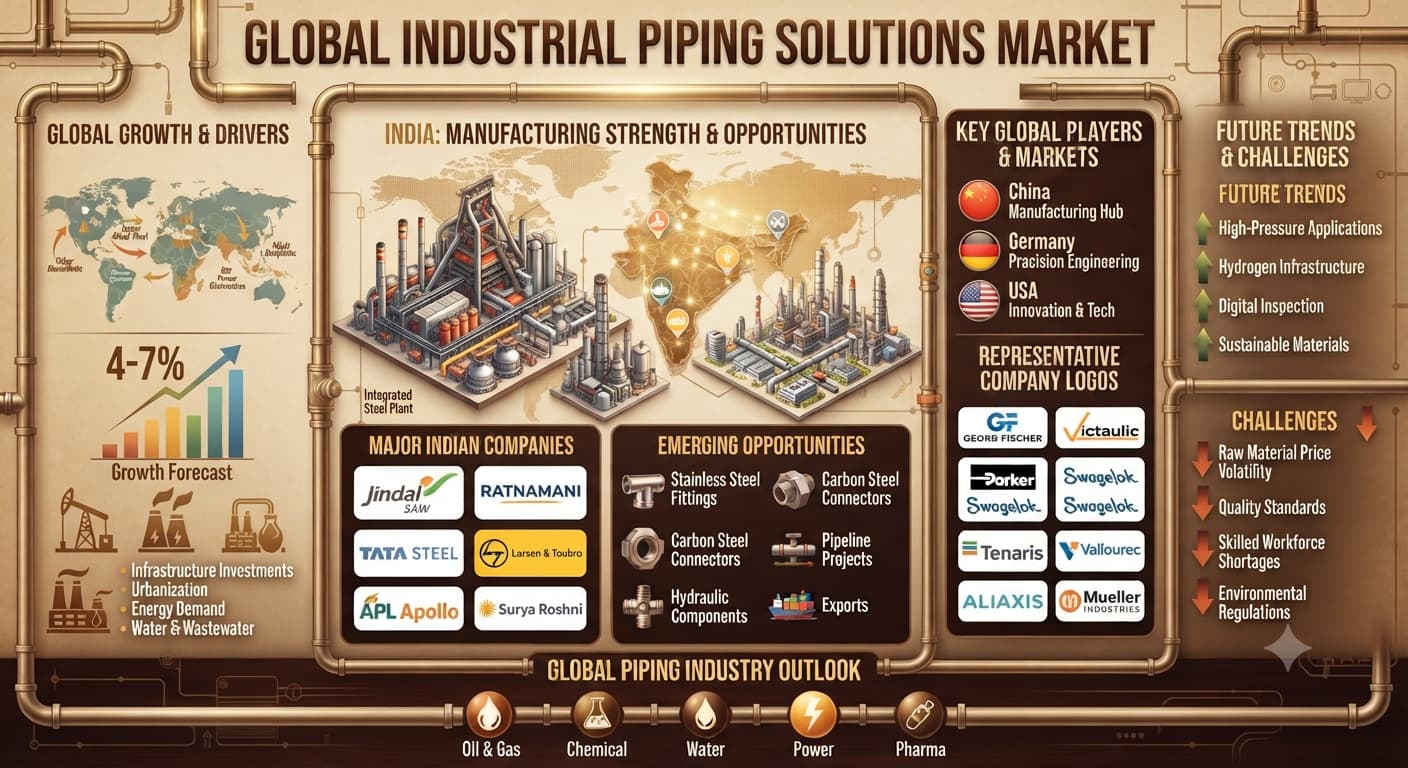
Industrial Piping Solutions Market: Global Growth, Major Manufacturers and Emerging Opportunities in India, China, Germany and the USA
Case Study

Industrial Piping Solutions Market: Global Growth, Major Manufacturers and Emerging Opportunities in India, China, Germany and the USA

Industrial Piping Systems: An Essential Part of Global Infrastructure The industrial piping systems and fittings industry is a fundamental segment of the global building, construction and engineering sector. Countries such as India, China, Germany, Japan, Italy and the United States are important markets for industrial pipes, tubes, connectors and specialised fittings. Leading companies including Jindal SAW, Ratnamani Metals & Tubes, Welspun Corp, Tata Steel, Georg Fischer, Victaulic, Parker Hannifin, Swagelok and Tenaris are contributing to the industry's development through manufacturing expansion, engineering innovation and advanced product solutions. Industrial pipes and tube fittings are used to transport liquids, gases, steam, chemicals, petroleum products and other materials across industrial facilities. Products such as elbows, tees, reducers, couplings, flanges, bends, unions, connectors and caps are essential for creating safe and efficient pipeline networks. Demand for these products is increasing with the development of oil refineries, power plants, chemical industries, manufacturing facilities, water treatment projects and urban infrastructure. Industrial buyers are increasingly prioritising product durability, corrosion resistance, pressure handling capacity and compliance with international quality standards. Global Market Expansion and Industry Growth Drivers The global industrial pipe fittings market is expanding as infrastructure investments and industrial activities increase across developed and emerging economies. Depending on the product categories included, the broader global pipe fittings market is estimated to be worth several tens of billions of dollars. Market forecasts vary by research methodology, but the wider pipe fittings segment is generally expected to experience annual growth of approximately 4–7% over the coming years. Stainless steel fittings, specialised alloy products and high-pressure connectors are gaining importance because of their applications in demanding industrial environments. Several factors are supporting market development: Expansion of oil and natural gas transportation networks. Increasing investments in water supply and wastewater treatment. Growth of chemical and petrochemical manufacturing. Construction of power plants and industrial facilities. Rising demand for advanced hydraulic and fluid-handling systems. Replacement of ageing pipelines and industrial equipment. Carbon steel, stainless steel, alloy steel, copper, brass, PVC, CPVC and HDPE are among the commonly used materials. Their selection depends on operating pressure, temperature, chemical exposure, installation conditions and project requirements. India's Manufacturing Strength and Infrastructure Demand India is becoming an increasingly important market for industrial pipes, tubes and fittings because of infrastructure development, manufacturing expansion and investments in energy and water management. The country's crude steel production reached approximately 150 million tonnes in 2024, supporting the availability of raw materials for several engineering and industrial applications. Growth in petroleum pipelines, industrial corridors, urban water supply, construction and power generation is creating demand for specialised piping products. Major Indian companies operating in related product segments include: Jindal SAW: Manufactures large-diameter pipes and related products for oil, gas, water and infrastructure projects. Ratnamani Metals & Tubes: Specialises in stainless steel, carbon steel and alloy steel pipes and tubes. Welspun Corp: Supplies large-diameter line pipes for energy and infrastructure applications. APL Apollo Tubes: Manufactures structural steel tubes and hollow sections used in construction and engineering. Tata Steel: Supplies steel products and materials used in industrial manufacturing. Surya Roshni: Produces steel pipes and related infrastructure products. Larsen & Toubro: Provides engineering and construction services involving complex industrial piping installations. India also has a substantial base of small and medium-sized manufacturers producing flanges, elbows, reducers, bends, couplings and threaded connectors. These businesses support domestic industries and international supply chains. Product Categories Transforming Industrial Piping Solutions Industrial pipe and tube fittings are manufactured in different materials, shapes and specifications to meet the requirements of various industries. Stainless Steel Pipe Fittings: These fittings are widely used in pharmaceutical plants, food processing, chemical industries, marine applications and petroleum refineries. Their corrosion resistance, durability and ability to withstand demanding operating conditions make them suitable for specialised installations. Carbon Steel Pipe Fittings: Carbon steel elbows, tees, flanges, reducers and couplings are commonly used in oil and gas pipelines, power plants, construction projects and heavy engineering. Their mechanical strength and cost-effectiveness make them important industrial components. Alloy Steel Fittings: These products are designed for high-temperature and high-pressure environments. They are particularly important in thermal power plants, petrochemical facilities, refineries and specialised industrial equipment. Plastic Pipe Fittings: PVC, CPVC and HDPE fittings are increasingly used in water distribution, irrigation, drainage, sewage treatment and chemical transportation. Their lightweight construction and resistance to corrosion support wider adoption. Hydraulic and Instrumentation Fittings: Compression fittings, threaded connectors, hydraulic couplings and precision tube fittings are essential for industrial machinery, automotive equipment, aerospace systems and hydraulic applications. International Manufacturers and Leading Industrial Markets Global competition is driven by companies offering specialised engineering products, precision manufacturing and reliable fluid transportation solutions. China is a major manufacturing centre for metal pipe fittings, industrial connectors and plastic piping products. Companies such as Midea are not relevant to this specialised segment, while manufacturers including Chinese steel and piping producers support large-scale industrial supply chains. Other important international companies include: Georg Fischer, Switzerland: Industrial piping systems, plastic fittings and fluid management solutions. Victaulic, USA: Mechanical pipe joining systems, grooved couplings and specialised connectors. Swagelok, USA: Instrumentation fittings, valves and precision fluid system components. Parker Hannifin, USA: Hydraulic fittings, industrial connectors and motion-control products. Tenaris, Luxembourg: Steel pipes and tubular products for energy and industrial applications. Vallourec, France: Specialised seamless steel tubes for energy and industrial sectors. Aliaxis, Belgium: Plastic piping systems for infrastructure and industrial applications. Mueller Industries, USA: Copper, brass and other metal piping components. Germany and Italy are recognised for precision engineering and specialised metal fittings. Japan and South Korea contribute advanced manufacturing technologies and high-quality industrial components. China and India have significant opportunities in large-scale manufacturing and international exports. Rising Demand Across Industrial Applications Industrial piping products are essential for the operation of several major industries. The oil and gas sector requires specialised pipes, flanges, bends and connectors for drilling, refining, storage and transportation. These components must withstand demanding pressure and temperature conditions. Chemical and petrochemical plants depend on corrosion-resistant fittings to transport chemicals, solvents and industrial fluids safely. Stainless steel and specialised alloy products are particularly important in these applications. Water infrastructure is another major demand segment. Municipal water supply networks, wastewater treatment plants, desalination facilities and irrigation systems require large quantities of metal and plastic fittings. Power generation facilities use industrial piping components in boilers, cooling systems, steam lines and thermal management installations. Renewable energy projects, hydrogen infrastructure and battery manufacturing facilities are also creating specialised demand. The pharmaceutical and food processing industries require hygienic stainless steel connections that support contamination control, cleaning and safe material handling. International Trade and New Business Opportunities The industrial fittings market provides opportunities for manufacturers, exporters, distributors and engineering suppliers. China, India, Germany, Japan, Italy and the United States participate in international supply chains through the production and distribution of industrial piping products. Indian manufacturers have opportunities to expand exports of stainless steel fittings, carbon steel connectors, hydraulic components, flanges, elbows and specialised industrial products. Important business opportunities include: Manufacturing customised industrial fittings for engineering projects. Supplying corrosion-resistant components to chemical industries. Exporting precision-engineered connectors and hydraulic fittings. Developing specialised products for renewable energy installations. Supplying replacement components to refineries and power plants. Manufacturing plastic fittings for water and wastewater infrastructure. Small and medium-sized manufacturers can also benefit by supplying industrial contractors, machinery manufacturers, engineering companies and international distributors. Challenges Affecting Industrial Fittings Manufacturers Despite growing demand, manufacturers face several challenges that influence production costs, profitability and market competitiveness. Raw material fluctuations: Changes in steel, nickel, chromium, copper and aluminium prices directly affect manufacturing expenses. Quality standards: Industrial buyers require compliance with dimensional tolerances, material specifications and pressure-testing requirements. International competition: Manufacturers from China, India, Germany and Italy compete on pricing, quality and delivery schedules. Manufacturing investment: Forging, casting, machining, welding and testing facilities require substantial capital. Supply-chain dependency: Specialised alloys, precision equipment and certain electronic components can depend on international suppliers. Skilled workforce shortages: Advanced machining, welding, inspection and quality-control operations require trained professionals. Environmental regulations: Energy consumption, industrial waste and manufacturing emissions are increasing compliance requirements. Companies must strengthen quality management, improve production efficiency and develop reliable supplier networks to overcome these bottlenecks. Future Growth Opportunities and Technology Trends The future of the industrial pipe and tube fittings industry is expected to remain promising as countries increase investments in infrastructure, energy security, industrial manufacturing and water management. India is likely to become an increasingly important manufacturing destination because of its expanding engineering capabilities, domestic steel ecosystem and infrastructure requirements. China will continue to play a significant role in international manufacturing, while Germany, Japan, Italy and South Korea will remain important for specialised engineering products. Some important future developments include: Greater adoption of corrosion-resistant stainless steel and advanced alloys. Increasing demand for high-pressure pipeline components. Development of hydrogen transportation and storage infrastructure. Expansion of water treatment and wastewater management projects. Automated forging, machining and precision manufacturing. Digital inspection and advanced product testing. Sustainable manufacturing and recyclable piping materials. Specialised fittings for semiconductor, battery and renewable energy facilities. The growing importance of carbon capture, hydrogen energy and advanced industrial manufacturing could create additional demand for specialised piping technologies. Conclusion The industrial pipe and tube fittings industry is an essential part of global construction, infrastructure, energy and manufacturing development. Companies such as Jindal SAW, Ratnamani Metals & Tubes, Welspun Corp, Georg Fischer, Victaulic, Parker Hannifin, Swagelok and Tenaris are helping strengthen the international industrial supply chain. India, China, Germany, Japan, Italy and the United States will continue to influence the market through manufacturing investments, engineering innovation and international trade. Despite challenges involving raw material prices, production costs and quality requirements, the industry offers considerable long-term opportunities. Demand for durable, precision-engineered and corrosion-resistant products will support manufacturers, suppliers, exporters and industrial distributors.

#IndustrialPipeFittings#TubeFittings#IndustrialPiping
Sushil Shroff
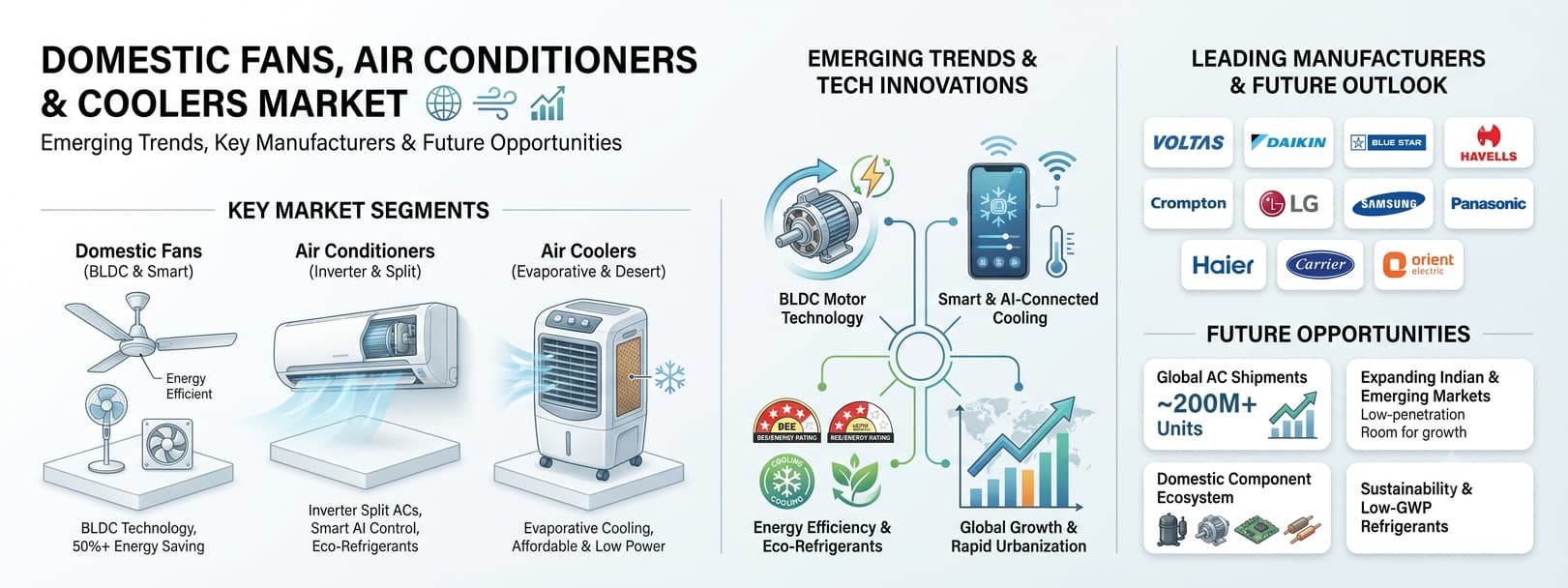
Domestic Fans, Air Conditioners and Coolers Market: Emerging Trends, Key Manufacturers and Future Opportunities
Case Study

Domestic Fans, Air Conditioners and Coolers Market: Emerging Trends, Key Manufacturers and Future Opportunities

Introduction to the Domestic Fans, AC and Coolers Industry The domestic fans, air conditioners, air coolers and their components industry is an important segment of the global consumer electronics and home appliances market. Rising temperatures, changing climatic conditions, urbanisation, increasing disposable incomes and growing demand for comfortable indoor environments are driving the expansion of this sector. Countries such as India, China, Japan, South Korea, the United States, Germany and Thailand play significant roles in manufacturing, technology development and consumption. Leading companies such as Voltas, Havells, Crompton, Orient Electric, Blue Star, Daikin, LG Electronics, Samsung, Panasonic, Haier, Mitsubishi Electric and Carrier are strengthening their market positions through energy-efficient products, advanced cooling technologies and smart home solutions. India is emerging as an important market because of its tropical climate, expanding middle-class population, infrastructure development and increasing penetration of residential air conditioning. At the same time, China remains a major global manufacturing centre for fans, air conditioners, compressors, motors, electronic controls and cooling components. The industry is gradually shifting from conventional electrical appliances towards energy-efficient, environmentally responsible and digitally connected cooling solutions. This transformation is creating new opportunities for manufacturers, component suppliers, distributors and technology providers. Global Market Growth and Industry Development The global domestic cooling appliances market is experiencing steady expansion, supported by rising demand for air conditioning and ventilation products. The broader air conditioning market is estimated to be worth more than USD 150 billion in the mid-2020s, although market estimates vary depending on whether commercial systems, industrial equipment and related services are included. The residential air conditioning segment is benefiting from increasing household adoption, particularly in developing economies. The market is expected to maintain an approximate annual growth rate of 5–8% over the coming years, depending on the product category and geographical region. Domestic fans continue to represent a large-volume market because they are relatively affordable, consume less electricity than most air conditioners and are suitable for households across different income groups. Ceiling fans, table fans, pedestal fans, exhaust fans and wall-mounted fans remain essential products in countries with warm and tropical climates. Air coolers are particularly important in India, Pakistan, Bangladesh, parts of Africa and the Middle East. Their comparatively lower purchase price and electricity consumption make them attractive alternatives to air conditioners in dry and semi-arid regions. The industry is also witnessing increasing demand for BLDC fans, inverter air conditioners, portable cooling appliances and smart temperature-control systems. Indian Domestic Fans and Air Conditioning Market India is one of the most promising markets for domestic cooling appliances. Rising summer temperatures, increasing electricity access, residential construction, expanding urban populations and changing consumer preferences are encouraging households to purchase cooling equipment. India's room air conditioner market is estimated to have annual sales in the range of 10–12 million units in recent years, with sales varying according to weather conditions, replacement demand and economic activity. The country's residential air conditioning penetration remains relatively low compared with developed economies, indicating substantial long-term growth potential. The domestic fan market is also well established, with annual demand running into several tens of millions of units. Replacement purchases, new housing projects and demand for energy-saving appliances continue to support sales. Important Indian companies include: Voltas: A leading Indian air conditioning brand offering residential ACs, inverter technology and cooling solutions. Blue Star: Known for air conditioning products, refrigeration equipment and commercial cooling systems. Havells India: Offers ceiling fans, BLDC fans, exhaust fans and other electrical appliances. Crompton Greaves Consumer Electricals: A major participant in domestic fans, pumps, lighting and household appliances. Orient Electric: Manufactures ceiling fans, decorative fans, air coolers and other electrical products. Usha International: Has a strong presence in ceiling fans, table fans, pedestal fans and air coolers. V-Guard Industries: Operates in electrical appliances, fans and selected cooling categories. Indian manufacturers are increasingly focusing on premium fans, energy-efficient motors, inverter compressors, improved air filtration and connected appliance features. Leading Global Companies and Manufacturing Countries China is one of the largest manufacturing and export centres for domestic cooling appliances. Companies such as Midea, Gree, Haier and Hisense have extensive product portfolios covering residential air conditioners, fans, compressors and smart cooling equipment. Japan is recognised for advanced air conditioning engineering, energy management and product reliability. Daikin, Mitsubishi Electric, Panasonic and Sharp are important companies in this market. Japanese manufacturers have invested significantly in inverter systems, heat pumps and environmentally improved refrigerant technologies. South Korea has a strong position in premium consumer electronics and connected home appliances. LG Electronics and Samsung Electronics offer residential air conditioners with intelligent controls, inverter technology and smart home integration. The United States is an important market for residential HVAC systems, central air conditioning and energy-efficient cooling equipment. Major companies include Carrier Global, Trane Technologies and Rheem Manufacturing . European countries such as Germany, Italy and France contribute through engineering, heating and cooling technology, energy management and specialised component manufacturing. Thailand and Vietnam are also important manufacturing locations because of their growing electronics and appliance production ecosystems. Major Product Categories and Technological Advancements The domestic cooling industry includes several product categories, each serving different consumer requirements. 1. Domestic Fans Ceiling fans remain among the most widely used electrical appliances in Indian households. Table fans, pedestal fans, wall fans, exhaust fans and decorative fans are also gaining popularity. The introduction of Brushless Direct Current (BLDC) technology is transforming this segment. BLDC fans offer lower electricity consumption, improved motor efficiency, remote-control operation and longer operating life. Premium decorative fans and smart ceiling fans are also creating additional opportunities. 2. Air Conditioners Residential air conditioners are available in window, split, inverter split, portable and multi-split configurations. Split ACs dominate modern household demand because of their quieter operation, design flexibility and improved cooling performance. Inverter technology is becoming increasingly popular because it adjusts compressor speed according to cooling requirements. This can reduce electricity consumption compared with conventional fixed-speed systems under suitable operating conditions. 3. Air Coolers Air coolers are widely used in areas with hot and relatively dry climates. Desert coolers, personal coolers, tower coolers and commercial-grade evaporative coolers serve different room sizes and customer requirements. Manufacturers are introducing improved cooling pads, larger water tanks, automatic water-level controls, inverter-compatible operation and remote-control features. 4. Cooling Components and Spare Parts The component industry is equally important for the development of this sector. Compressors, copper tubes, aluminium fins, fan motors, capacitors, thermostats, printed circuit boards, refrigerants, cooling pads, plastic housings and electronic control systems form an essential part of manufacturing and maintenance operations. Demand for quality spare parts is also increasing because of the growing installed base of cooling appliances and the need for regular servicing. Energy Efficiency and Smart Cooling Trends Energy efficiency is becoming a major purchasing consideration for consumers. Rising electricity tariffs and increasing awareness of household energy consumption are encouraging buyers to select appliances with better efficiency ratings. In India, the Bureau of Energy Efficiency's star-labelling framework plays an important role in guiding consumers towards energy-saving fans and air conditioners. Manufacturers are investing in improved motors, compressors, heat exchangers and electronic control systems to meet increasingly demanding efficiency standards. Smart cooling is another emerging trend. Wi-Fi-enabled air conditioners, mobile application controls, voice assistance, programmable timers and intelligent temperature sensors are improving convenience. Artificial intelligence-based features are also entering premium appliance categories. These systems can optimise cooling patterns, identify operating abnormalities and adjust performance according to usage conditions. Environmental sustainability is becoming increasingly important. Manufacturers are gradually adopting refrigerants with lower global warming potential, improving product recyclability and reducing manufacturing waste. International Trade and Manufacturing Opportunities International manufacturing and trade are central to the cooling appliance industry. China has a strong position in compressors, motors, electronic components, cooling systems and finished appliances. India is expanding its domestic manufacturing capabilities through investments in assembly facilities, component production and supply-chain development. Japan and South Korea contribute advanced technologies, particularly in inverter compressors, electronic controls and energy management. European manufacturers focus on efficient cooling systems, environmental compliance and premium appliance engineering. The United States represents a significant consumer market for residential cooling equipment, replacement components and advanced HVAC solutions. For Indian manufacturers, opportunities exist in exporting ceiling fans, air coolers, motors, copper components, electrical accessories and air conditioning spare parts to neighbouring Asian countries, Africa and the Middle East. The development of domestic component ecosystems can also reduce import dependence and improve the competitiveness of Indian-made products. Major Challenges and Industry Bottlenecks Despite strong growth opportunities, the industry faces several operational and commercial challenges. High electricity consumption: Conventional cooling appliances can increase household electricity expenses, particularly during prolonged summer periods. Raw material price fluctuations: Copper, aluminium, steel, plastics and electronic components directly influence manufacturing costs. Import dependence: Certain compressors, semiconductor components, advanced controllers and specialised electronic parts remain dependent on international supply chains. Seasonal demand: Air conditioners and air coolers experience significant sales fluctuations depending on weather conditions and summer intensity. Intense competition: Established international brands, Indian manufacturers and lower-priced regional players compete aggressively on pricing, distribution and product features. Environmental regulations: Refrigerant transitions, energy-efficiency standards and electronic waste management requirements increase compliance and product-development costs. After-sales service: Installation quality, availability of technicians, replacement parts and timely maintenance remain important concerns, especially in smaller cities. Counterfeit spare parts: Low-quality replacement components can affect appliance performance, durability and consumer safety. Manufacturers must address these challenges through stronger supplier networks, improved quality control, local component development and better service infrastructure. Future Outlook of the Domestic Cooling Appliances Industry The future of the domestic fans, air conditioners and air coolers industry is expected to remain positive as climate change, rising temperatures, urban development and household electrification increase the need for efficient cooling solutions. According to the International Energy Agency, global air conditioner shipments reached approximately 200 million units in 2024 , around 25% higher than five years earlier. This highlights the growing importance of cooling appliances across residential and commercial markets. India is expected to remain one of the fastest-growing markets. Increasing household purchasing power, low residential AC penetration, smart-city development and expanding housing construction will create opportunities for both established brands and emerging manufacturers. Some important future developments include: Greater adoption of BLDC ceiling fans and energy-efficient motors. Increasing demand for inverter and smart air conditioners. Development of affordable cooling appliances for rural and semi-urban households. Wider use of environmentally improved refrigerants. Expansion of domestic compressor, motor and electronic component manufacturing. Growth in online appliance sales and digital after-sales services. Increasing demand for maintenance, repair and replacement components. The Indian government's manufacturing initiatives and production-linked incentives for selected white goods components can further support domestic manufacturing, investment and employment generation. Conclusion The domestic fans, air conditioners, air coolers and components industry is undergoing significant technological and commercial transformation. Companies such as Voltas, Blue Star, Havells, Crompton, Orient Electric, Daikin, LG, Samsung, Midea and Haier are contributing to market development through product innovation, manufacturing expansion and energy-efficient technologies. India, China, Japan, South Korea, the United States and European manufacturing economies will continue to play important roles in shaping the global cooling appliance industry. Although raw material costs, import dependence, seasonal demand and environmental regulations remain important challenges, the long-term growth outlook is encouraging. Increasing demand for affordable cooling, smart appliances and energy-efficient products will create new business opportunities for manufacturers, suppliers, distributors, service providers and component manufacturers. The industry is therefore expected to remain an important part of the global consumer electronics and home appliances ecosystem, with innovation, affordability, sustainability and energy efficiency becoming its major competitive advantages.
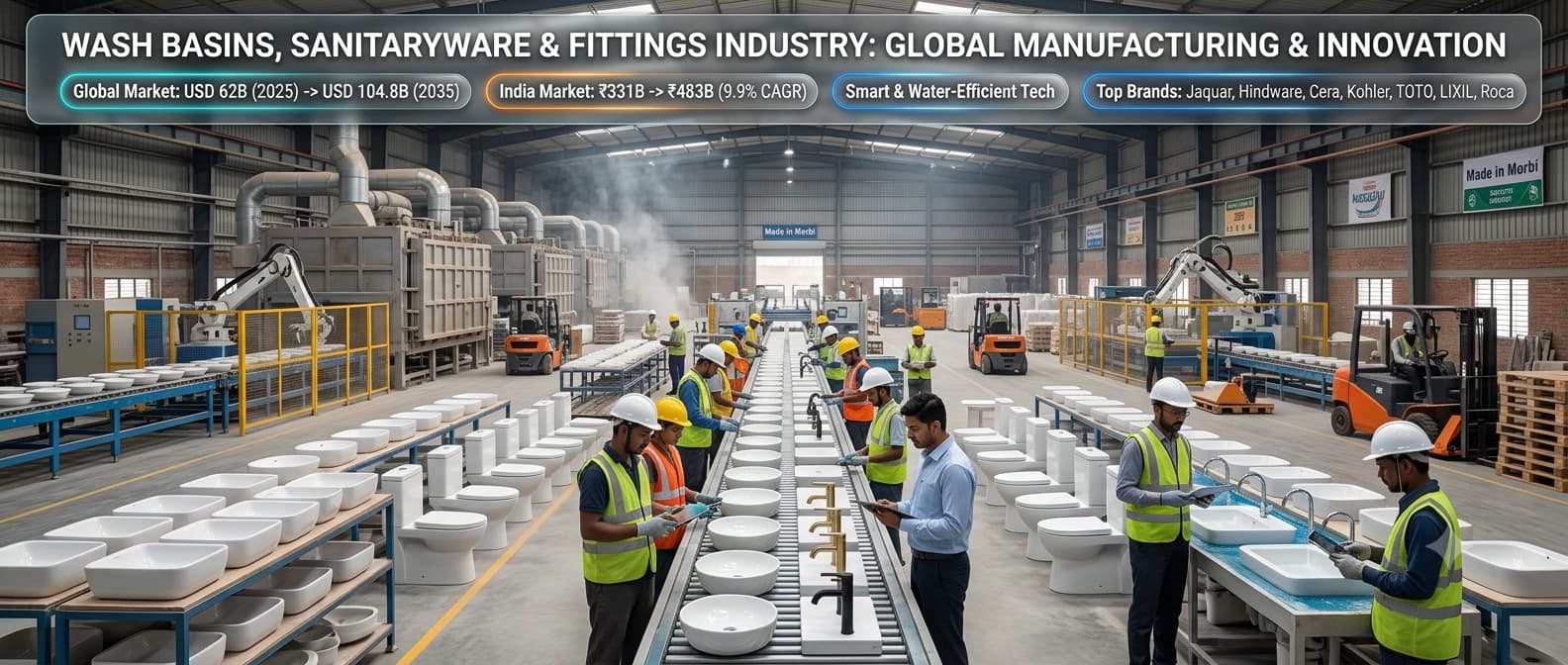
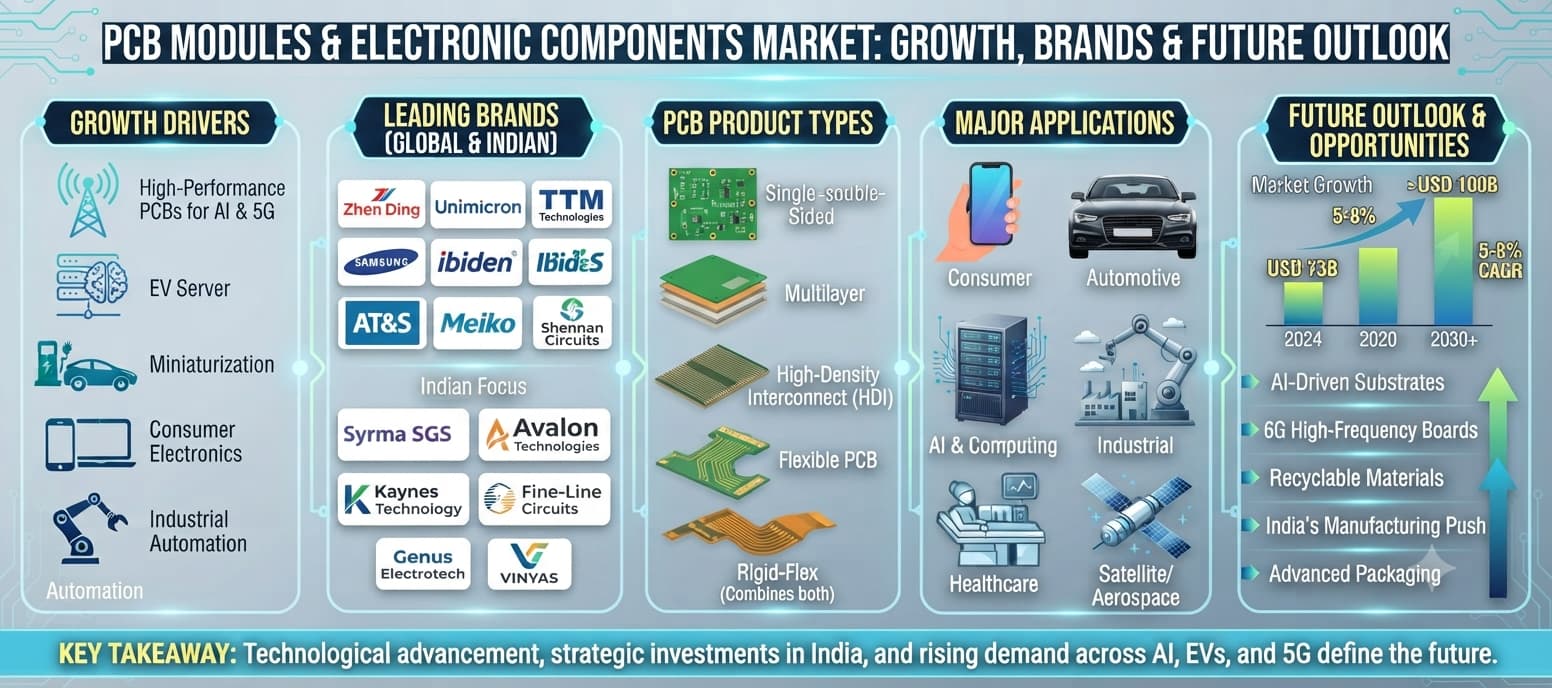
#ConsumerElectronics#CoolingAppliances#AirConditioners
Nazakat ali
Solar and Renewable Energy Industry: Growth, Leading Companies and Market Trends in India, China, USA and Germany
Case Study

Solar and Renewable Energy Industry: Growth, Leading Companies and Market Trends in India, China, USA and Germany

Introduction to the Solar and Renewable Energy Industry The solar and renewable energy industry is becoming one of the most important segments of the global electrical machinery, devices, equipment and components market. Countries such as India, China, the United States, Germany, Japan and Brazil are investing heavily in solar power, wind energy, hydropower, battery storage and energy conservation technologies. Leading companies including JinkoSolar, LONGi Green Energy, Trina Solar, JA Solar, Adani Green Energy, Tata Power Solar, First Solar and Sungrow are contributing to the development of renewable energy infrastructure through advanced equipment, efficient solar modules, inverters and energy management solutions. The growing demand for electricity, increasing environmental awareness, rising fossil fuel costs and government initiatives are accelerating the adoption of clean energy technologies. Solar panels, photovoltaic modules, solar inverters, lithium-ion batteries, solar water heaters, wind turbines, energy-efficient motors and smart energy management systems are witnessing increasing demand across residential, commercial, industrial and agricultural sectors. The renewable energy sector is also creating new opportunities for electrical equipment manufacturers, technology developers, engineering companies, installation contractors and component suppliers. With continuous technological improvements and expanding infrastructure, the industry is moving towards a more sustainable and decentralised energy ecosystem. Global Renewable Energy Market Growth and Industry Trends The global renewable energy industry has experienced significant expansion over the last decade. Global renewable electricity generation capacity reached approximately 5,155 GW by the end of 2025, representing nearly 49.5% of total installed electricity generation capacity worldwide. Between 2015 and 2025, renewable energy capacity increased by approximately 179%, reflecting a compound annual growth rate (CAGR) of around 10.8%. Solar photovoltaic technology has become the leading contributor to renewable energy expansion. In 2025, global solar PV capacity additions exceeded 600 GW, taking cumulative installed solar capacity to approximately 2,800 GW. Solar power accounted for more than three-quarters of new renewable capacity additions during the year, while wind energy contributed approximately 20%. Several factors are supporting this expansion: Increasing investments in utility-scale solar power projects. Growing demand for rooftop solar installations. Technological improvements in photovoltaic modules. Expansion of battery energy storage systems. Government incentives and renewable energy targets. Increasing adoption of electric vehicles and energy-efficient equipment. Rising demand for reliable electricity in industrial and commercial sectors. China continues to dominate global renewable energy manufacturing and installation, while India, the United States, Germany, Brazil and Japan are strengthening their renewable energy infrastructure. Solar Energy Equipment and Technological Developments Solar energy equipment represents one of the largest and fastest-developing segments of the renewable energy industry. Solar photovoltaic systems convert sunlight into electricity through semiconductor-based solar cells. Modern solar installations include solar panels, mounting structures, DC cables, charge controllers, inverters, batteries, monitoring devices and electrical protection equipment. Manufacturers are increasingly focusing on advanced technologies such as TOPCon, HJT and back-contact solar cells to improve power generation efficiency and reduce electricity production costs. Some important developments include: TOPCon Technology: Provides improved conversion efficiency and better performance under different operating conditions. Bifacial Solar Modules: Generate electricity from both front and rear surfaces, improving overall energy output. Heterojunction Technology: Combines different semiconductor layers to improve efficiency and temperature performance. Flexible Solar Panels: Support applications in portable devices, specialised buildings and certain transportation systems. Smart Solar Inverters: Improve electricity conversion, system monitoring and grid integration. These technological improvements are increasing the commercial attractiveness of solar energy for households, factories, warehouses, commercial buildings and large-scale power generation projects. Leading Solar and Renewable Energy Companies Worldwide China holds a strong position in global solar manufacturing, particularly in photovoltaic cells, wafers, modules and related electrical components. Companies such as JinkoSolar, LONGi Green Energy, JA Solar, Trina Solar, Tongwei Solar and Astronergy have established significant manufacturing and international distribution networks. JinkoSolar is recognised for its high-volume solar module manufacturing and advanced photovoltaic technologies. LONGi Green Energy focuses on high-efficiency solar cells and modules, while JA Solar and Trina Solar supply solar products for residential, commercial and utility-scale applications. Other important international companies include: First Solar (USA): Specialises in thin-film photovoltaic solar modules. Canadian Solar (Canada): Operates across solar module manufacturing, project development and energy storage. Hanwha Qcells (South Korea): Manufactures solar cells and photovoltaic modules. Sungrow (China): A major manufacturer of solar inverters and energy storage solutions. Vestas (Denmark): A leading global manufacturer of wind turbines. Siemens Energy (Germany): Provides energy generation, transmission and grid-related technologies. The competitive landscape is expanding beyond solar panel manufacturing. Companies are increasingly investing in battery storage, hybrid renewable energy projects, smart grids, power electronics and integrated energy management solutions. India's Solar and Renewable Energy Industry India has emerged as one of the world's major renewable energy markets because of its growing electricity requirements, favourable solar conditions and government-supported clean energy programmes. The country is targeting 500 GW of non-fossil fuel-based electricity capacity by 2030, creating significant opportunities for domestic manufacturers and international investors. India's total renewable energy installed capacity, including large hydropower, reached approximately 274.68 GW in March 2026. Solar energy capacity increased dramatically from just 2.82 GW in March 2014 to approximately 150.26 GW in March 2026. This represents more than 53 times growth in solar installation capacity over twelve years. India's domestic solar manufacturing ecosystem is also expanding. Solar module manufacturing capacity increased from approximately 2.3 GW in 2014 to around 172 GW by March 2026. Important Indian companies operating in this sector include: Adani Green Energy: Develops large-scale solar, wind and hybrid renewable energy projects. Tata Power Solar: Provides solar modules, rooftop systems and engineering solutions. Waaree Energies: Manufactures solar photovoltaic modules and supplies renewable energy products. Vikram Solar: Focuses on solar module manufacturing and project solutions. Premier Energies: Manufactures solar cells and photovoltaic modules. Suzlon Energy: Operates in wind turbine manufacturing and renewable energy solutions. Borosil Renewables: Manufactures specialised solar glass used in photovoltaic modules. Government initiatives supporting rooftop solar, agricultural solar pumps, domestic manufacturing and renewable power procurement are further strengthening the Indian market. Wind Energy, Battery Storage and Energy Conservation Products Although solar power receives significant attention, wind energy and energy storage are equally important for developing a reliable renewable electricity system. Wind turbines use aerodynamic blades, generators, gearboxes, power converters and control systems to produce electricity. Countries including China, the United States, Germany, India, Denmark and Brazil are important markets for wind power development. Battery energy storage is another rapidly expanding segment. Lithium-ion batteries, battery management systems, inverters and energy storage containers help store surplus renewable electricity and supply power when solar or wind generation decreases. Leading companies such as CATL, BYD, Tesla, Sungrow and Fluence are active in battery manufacturing and energy storage solutions. Energy conservation products are also gaining importance across industrial and commercial applications. These include: LED lighting systems and energy-efficient electrical fittings. Variable frequency drives and energy-efficient motors. Smart electricity meters and monitoring devices. Solar water heaters and heat pumps. Power factor correction equipment. Intelligent building management systems. High-efficiency transformers and power distribution equipment. These products help reduce electricity consumption, improve operational efficiency and lower long-term energy expenditure. Major Countries Driving Industry Development China remains the dominant manufacturing centre for solar panels, photovoltaic cells, batteries and several renewable energy components. Its extensive industrial ecosystem and large-scale production capabilities give it a major competitive advantage. The United States is investing in domestic solar manufacturing, battery technology, wind energy and advanced electricity infrastructure. Germany continues to support renewable energy adoption through solar installations, wind power and energy-efficient industrial technologies. India is becoming an important manufacturing and consumption market, supported by domestic production expansion and increasing electricity demand. Japan is focusing on advanced solar technologies, battery storage and energy-efficient equipment, while Brazil is strengthening its renewable electricity mix through hydropower, solar and wind projects. The growing participation of these countries is encouraging international partnerships, technology transfers, equipment manufacturing and cross-border investments. Challenges and Bottlenecks in the Renewable Energy Industry Despite strong growth, the solar and renewable energy industry faces several operational and economic challenges. Raw Material Dependency: Solar panel manufacturing requires polysilicon, silver, aluminium, copper and other specialised materials. Price fluctuations and supply chain concentration can affect production costs. High Initial Investment: Solar parks, wind farms, battery storage facilities and transmission infrastructure require substantial capital investment, creating difficulties for smaller businesses and project developers. Power Storage Limitations: Solar and wind generation depend on weather conditions. Insufficient battery storage can create difficulties in maintaining a consistent electricity supply. Grid Infrastructure: Many regions require modern transmission lines, substations, smart meters and grid management systems to accommodate increasing renewable electricity generation. International Competition: Strong manufacturing concentration in China creates competitive pressure for solar equipment manufacturers in India, Europe and the United States. Land and Environmental Concerns: Large renewable energy projects require significant land, while installation, recycling and disposal of solar panels and batteries create additional environmental considerations. Policy and Financing Risks: Changes in government incentives, import duties, project approvals and electricity purchase agreements can affect investment decisions and project profitability. Addressing these challenges will require stronger domestic manufacturing, improved recycling facilities, advanced battery technologies and modern electricity distribution infrastructure. Future Outlook of the Solar and Renewable Energy Industry The future of the solar and renewable energy industry looks promising as countries increase their focus on energy security, sustainability and electricity cost reduction. Solar photovoltaic installations, wind energy projects, battery storage systems and energy conservation equipment are expected to remain major growth drivers. The integration of artificial intelligence, smart grids, Internet of Things (IoT) devices and automated energy management systems will improve electricity monitoring, consumption forecasting and operational efficiency. Green hydrogen, floating solar plants, offshore wind farms, advanced battery chemistry and vehicle-to-grid technologies could create additional business opportunities over the coming years. India is particularly well positioned to benefit from this transformation because of its expanding electricity market, manufacturing capabilities and renewable energy ambitions. Companies investing in solar modules, inverters, batteries, electrical protection devices, smart meters and energy-efficient machinery can find opportunities across domestic and international markets. Overall, the solar, renewable energy and energy conservation products industry is transitioning from an alternative energy segment into a major component of the global electrical equipment and power infrastructure market. Continuous innovation, investment in manufacturing and improvements in energy storage will play an important role in determining the industry's long-term growth.

#SolarEnergy#RenewableEnergy#SolarPower
vivek dwivedi
Stone Tiles and Flooring Market: Global Growth, Top Manufacturers and Emerging Opportunities in India and Turkey
Case Study

Stone Tiles and Flooring Market: Global Growth, Top Manufacturers and Emerging Opportunities in India and Turkey

Introduction to the Stone Tiles and Flooring Industry The global stone tiles and flooring industry is an important segment of the building and construction sector, supporting residential, commercial, industrial and infrastructure development. Countries such as India, China, Italy, Turkey, Spain and Brazil are major participants in natural stone extraction, processing, tile manufacturing and international trade. Leading companies such as Kajaria Ceramics (India), Somany Ceramics (India), Mohawk Industries (USA), RAK Ceramics (UAE), Florim (Italy), Atlas Concorde (Italy) and Grupo Lamosa (Mexico) are contributing to the industry's growth through product innovation, advanced manufacturing and modern flooring solutions. Stone tiles and flooring products are widely used in homes, hotels, shopping malls, airports, offices, hospitals and public infrastructure. The industry includes natural materials such as marble, granite, limestone, slate, sandstone and travertine, along with engineered stone, porcelain tiles and other decorative flooring solutions. Growing urbanisation, rising disposable incomes, real estate development and increasing demand for premium interiors are supporting the expansion of this market. Consumers are increasingly looking for flooring products that combine durability, attractive designs, easy maintenance and long-term value. The industry is also evolving through digital printing, large-format slabs, advanced surface finishing and sustainable stone-processing technologies. These developments are creating new opportunities for manufacturers, exporters, distributors, architects and construction companies. Global Market Growth and Industry Trends The global flooring industry represents a substantial international market, with demand coming from new construction, renovation and commercial infrastructure projects. Natural stone flooring occupies an important premium segment, while ceramic and porcelain tiles serve a much broader range of residential and commercial applications. The global ceramic tiles market is estimated to be worth more than USD 200 billion in the middle of the 2020s, although valuations vary according to product categories and research methodologies. The wider flooring market is expected to expand steadily, supported by construction activity and replacement demand. Many industry forecasts indicate mid-single-digit annual growth for major flooring categories over the coming years. Asia-Pacific remains one of the strongest regions because of large-scale construction and manufacturing activity in China and India. Europe continues to hold an important position in premium ceramic and natural stone products, particularly through Italian and Spanish manufacturers. Some important trends influencing the industry include: Large-Format Tiles and Slabs: Large porcelain slabs and natural stone panels are gaining popularity in luxury homes, hotels and commercial spaces. Digital Printing Technology: Advanced printing techniques allow manufacturers to reproduce marble, granite, wood and concrete-inspired designs with greater visual detail. Premium Natural Stone: Marble, granite and travertine remain popular in luxury interiors, exterior cladding and architectural projects. Anti-Slip Flooring: Demand for slip-resistant surfaces is increasing in bathrooms, kitchens, hospitals, public buildings and outdoor spaces. Sustainable Manufacturing: Water recycling, dust control, energy-efficient kilns and responsible quarrying are becoming important industry priorities. Major Stone-Producing and Tile-Manufacturing Countries Different countries have developed specialised strengths in stone extraction, processing and flooring production. China: China is one of the world's largest ceramic tile manufacturing and consumption markets. Its large industrial capacity, advanced production facilities and competitive pricing make it a major supplier to international markets. Chinese manufacturers are active in porcelain tiles, granite products, engineered stone and decorative flooring. India: India has abundant natural stone resources, particularly granite, marble, sandstone and limestone. Rajasthan, Gujarat, Karnataka, Andhra Pradesh and Tamil Nadu are important stone-producing and processing regions. Indian manufacturers supply domestic construction projects as well as overseas buyers. Italy: Italy is internationally recognised for premium marble, sophisticated ceramic tiles and advanced surface designs. Companies such as Florim, Atlas Concorde, Marazzi and Laminam have established strong positions in premium architectural and interior applications. Turkey: Turkey is an important source of natural marble, travertine and limestone. Its geographical position supports exports to Europe, the Middle East and other international markets. Spain: Spain has a strong ceramic tile manufacturing industry, with companies such as Porcelanosa, Pamesa and Grespania. Spanish manufacturers are known for decorative surfaces, porcelain products and contemporary flooring designs. Brazil: Brazil is recognised for its granite and natural stone resources. The country supplies a wide variety of colours and patterns to international construction and interior design markets. Leading Companies and Brands in the Industry Global competition is driven by manufacturers that combine product quality, design innovation, production capacity and distribution networks. Kajaria Ceramics (India): Manufactures ceramic and vitrified tiles for residential and commercial flooring. Somany Ceramics (India): Offers floor tiles, wall tiles, glazed vitrified tiles and sanitaryware. Mohawk Industries (USA): A major global flooring manufacturer with ceramic, porcelain, carpet and other flooring products. RAK Ceramics (UAE): Produces ceramic and porcelain tiles, sanitaryware and related surface solutions. Florim (Italy): Specialises in premium porcelain surfaces and architectural applications. Atlas Concorde (Italy): Manufactures high-quality porcelain and ceramic tiles for residential and commercial projects. Grupo Lamosa (Mexico): Operates in ceramic tiles and other building material categories. Cosentino (Spain): Known for engineered and mineral-based surfaces, including Silestone and Dekton. Levantina (Spain): Specialises in natural stone products, including marble and granite. Polycor (Canada): Produces natural stone materials for architectural and construction applications. These companies compete through product differentiation, international distribution, manufacturing efficiency and investment in advanced surface technologies. Stone Tiles and Flooring Industry in India India is one of the important global markets for natural stone and ceramic flooring products. Rising residential construction, commercial property development, infrastructure investment and renovation activities are increasing demand for flooring materials. The country has a diverse natural stone industry, with Rajasthan playing a major role in marble and sandstone production, while Karnataka, Tamil Nadu and Andhra Pradesh are important granite centres. India's ceramic tile industry is also a significant manufacturing and export segment. Morbi in Gujarat has emerged as a major ceramic tile manufacturing hub, supplying products to domestic and international markets. India consumed approximately 1.7 billion square metres of ceramic tiles in 2023, accounting for around 10.9% of global consumption. Its ceramic tile exports reached approximately 589 million square metres in the same year, representing around 21.4% of global exports. This demonstrates India's growing importance in international tile trade. ISO/TC 189 CERAMIC TILES The Indian natural stone export business also has a strong international presence. Demand from the United States, Vietnam, the United Arab Emirates, Europe and other markets supports exports of granite, marble and processed stone products. Major Indian companies include Kajaria Ceramics, Somany Ceramics, Asian Granito India, Cera Sanitaryware, Pokarna, R.K. Marble and Bhandari Marble. The combination of domestic construction demand, manufacturing capacity and export opportunities is creating scope for new investments in stone cutting, polishing, surface finishing, engineered stone and customised flooring solutions. Key Factors Driving Industry Growth Several developments are creating new opportunities for stone tile and flooring manufacturers. 1. Rapid Urbanisation and Construction: Growing urban populations are increasing demand for residential apartments, commercial complexes, hotels and infrastructure projects. This directly supports the consumption of flooring and decorative stone products. 2. Premium Interior Design: Homeowners, architects and property developers are increasingly choosing marble, granite, porcelain and designer tiles for premium interiors. Large-format flooring and customised stone surfaces are becoming popular. 3. Renovation and Replacement Demand: Ageing residential and commercial buildings require flooring upgrades and renovation. This creates recurring demand for tiles, natural stone, polished surfaces and installation materials. 4. Export Market Expansion: India, China, Turkey, Italy and Spain have established international trade networks. Competitive manufacturing costs, specialised designs and natural stone availability are helping suppliers reach overseas markets. 5. Technological Advancements: Automated cutting machines, digital printing, waterjet processing and advanced polishing equipment are improving production efficiency, product consistency and design possibilities. Challenges and Bottlenecks in the Industry Despite its growth potential, the stone tiles and flooring industry faces several operational and commercial challenges. High Raw Material Costs: Natural stone extraction, transportation and processing require significant investment. Fuel, electricity and machinery expenses also influence product pricing. Environmental Concerns: Quarrying and stone processing can generate dust, waste and water pollution. Manufacturers must invest in responsible extraction and waste management. Transportation Difficulties: Marble, granite and large-format slabs are heavy and fragile, making packaging, storage and transportation expensive. International Competition: Manufacturers from China, India, Italy, Spain and Turkey compete on pricing, design, quality and delivery timelines. Changing Consumer Preferences: Customers increasingly demand customised patterns, premium finishes and durable surfaces at competitive prices. Quality Consistency: Natural stones have variations in colour, texture and patterns. Maintaining consistent product quality across large projects can be difficult. Unorganised Market Competition: Smaller manufacturers and local suppliers often operate with limited quality standardisation, creating pricing pressure for organised brands. Another major challenge is the dependence on construction cycles. Economic slowdowns, higher interest rates and reduced real estate investment can temporarily affect demand for premium flooring products. Future Outlook of the Stone Tiles and Flooring Industry The future of the global stone tiles and flooring industry is expected to remain promising as construction, infrastructure and modern interior development continue to expand. The global natural stone market was valued at approximately USD 10.6 billion in 2025 and is projected to reach USD 16.9 billion by 2033, reflecting an estimated compound annual growth rate of 6.1% between 2026 and 2033. Asia-Pacific accounted for approximately 48.1% of the market in 2025, highlighting the region's importance in natural stone production and consumption. Grand View Research Several emerging developments are expected to influence future industry growth: Large-Format Porcelain Slabs: Increasing demand for seamless flooring, kitchen countertops and wall applications will create opportunities for advanced slab manufacturers. Eco-Friendly Flooring: Recycled materials, responsible quarrying and water-efficient processing will become more important. Digital Surface Technology: Advanced printing and finishing techniques will allow manufacturers to develop realistic marble, wood and natural stone-inspired designs. Premium Natural Stone: Marble, granite and travertine will continue attracting demand in luxury homes, hotels and commercial properties. Outdoor Flooring Solutions: Weather-resistant, anti-slip and heavy-duty stone products will gain importance in landscaping, pathways and public infrastructure. International Business Opportunities: Indian manufacturers can expand exports through improved quality, competitive pricing and stronger international distribution networks. India is particularly well positioned to benefit from these developments because of its natural stone resources, established ceramic manufacturing clusters and expanding construction sector. Companies investing in modern processing equipment, product innovation, export infrastructure and sustainable manufacturing practices can strengthen their international competitiveness. Conclusion The global stone tiles and flooring industry is evolving through technological advancements, changing architectural preferences and increasing construction activity. India, China, Italy, Turkey, Spain and Brazil remain important countries for natural stone production, ceramic tile manufacturing and international trade. Leading companies such as Kajaria Ceramics, Somany Ceramics, Mohawk Industries, RAK Ceramics, Florim, Atlas Concorde and Cosentino are contributing to the industry's development through innovative products and advanced manufacturing capabilities. Although raw material costs, environmental regulations, transportation expenses and international competition remain significant challenges, the long-term outlook is encouraging. Growing demand for premium interiors, durable flooring, large-format tiles and sustainable building materials will continue creating opportunities for manufacturers, exporters, distributors and construction businesses worldwide.

#StoneTiles#StoneFlooring#NaturalStone
Dipanjan Saha
Door, Window Frame, Panel and Shutters Industry: Market Growth, Leading Companies and Future Opportunities in India, China, Germany and the USA
Case Study

Door, Window Frame, Panel and Shutters Industry: Market Growth, Leading Companies and Future Opportunities in India, China, Germany and the USA

Introduction to the Door, Window Frame, Panel and Shutters Industry The door, window frame, panel and shutters industry is an important segment of the global building and construction sector. Countries such as India, China, Germany, the United States, Italy and the United Kingdom are major markets for manufacturing, supplying and installing residential, commercial and industrial building components. Leading companies such as JELD-WEN (United States), ASSA ABLOY (Sweden), Andersen Corporation (United States), Pella Corporation (United States), VEKA (Germany), REHAU (Germany) and DCM Shriram (India) are contributing to the industry's development through product innovation, advanced materials and energy-efficient designs. Doors, windows, frames, panels and shutters are essential building elements that provide security, privacy, insulation, ventilation and architectural appeal. The industry includes products manufactured from wood, aluminium, steel, uPVC, glass, composite materials and engineered polymers. Demand is increasing due to rapid urbanisation, infrastructure development, residential construction, commercial real estate expansion and renovation activities. Modern consumers are also showing greater interest in durable, weather-resistant, low-maintenance and aesthetically appealing building products. The industry is gradually moving beyond traditional wooden doors and metal frames towards advanced solutions such as insulated aluminium windows, uPVC frames, fire-resistant doors, automated shutters and smart security systems. Global Market Growth and Industry Trends The global doors and windows market represents a significant part of the construction materials industry. Its growth is supported by new housing projects, commercial buildings, industrial facilities and replacement demand in developed economies. Depending on product coverage and research methodology, estimates for the global doors and windows market generally place its value in the range of approximately USD 200–250 billion during the middle of the 2020s. The broader market is expected to maintain a healthy expansion trajectory, with several forecasts indicating annual growth in the mid-single-digit range through the next decade. Asia-Pacific is one of the most important regional markets because of large-scale construction activity in China, India and Southeast Asia. North America and Europe remain significant markets due to renovation projects, energy-efficiency regulations and demand for premium building materials. Some important trends shaping the industry include: Energy-Efficient Windows: Double-glazed and triple-glazed windows are gaining popularity because they reduce heat transfer and improve indoor comfort. Aluminium and uPVC Frames: These materials are increasingly preferred for their durability, weather resistance and relatively low maintenance requirements. Smart Doors and Shutters: Automated locking, remote access, motion sensors and motorised shutters are becoming more common in modern buildings. Fire-Resistant Products: Commercial complexes, hospitals, factories and high-rise buildings are increasing demand for certified fire-rated doors and safety systems. Modern Architectural Designs: Minimalist frames, large glass panels, sliding doors and customised finishes are influencing consumer preferences. Major Materials Used in Doors, Windows, Frames and Panels Material selection plays an important role in determining product durability, cost, appearance, insulation and maintenance requirements. Wood: Wooden doors and frames remain popular in residential buildings, luxury interiors and premium architectural projects. Engineered wood, plywood, MDF and laminated panels are widely used for interior applications. However, moisture, termites and maintenance requirements can affect long-term performance. Aluminium: Aluminium is widely used for window frames, sliding doors, partitions and commercial building facades. Its lightweight structure, corrosion resistance and strength make it suitable for modern architectural designs. uPVC: Unplasticised polyvinyl chloride is gaining popularity in residential and commercial construction. uPVC windows and doors offer thermal insulation, sound reduction, weather resistance and relatively low maintenance. Steel: Steel doors and frames are commonly used in industrial buildings, factories, warehouses, hospitals and security-sensitive locations. Their strength and fire-resistant product options make them suitable for demanding applications. Glass and Composite Materials: Toughened glass, laminated glass, fibre-reinforced materials and composite panels are increasingly used in modern buildings. These products support contemporary designs while improving strength, insulation and functional performance. Leading Companies and Brands in the Global Industry The international market includes established manufacturers specialising in doors, window systems, architectural hardware, panels and automated shutter solutions. ASSA ABLOY (Sweden): A major global manufacturer of door opening solutions, access control systems, security doors and architectural hardware. JELD-WEN (USA): Manufactures interior and exterior doors, windows and related building products. Andersen Corporation (USA): Known for premium residential windows, patio doors and energy-efficient building solutions. Pella Corporation (USA): Offers residential and commercial windows, entry doors and sliding door systems. VEKA (Germany): Specialises in uPVC window and door profiles. REHAU (Germany): Supplies polymer-based window systems, door profiles and building solutions. YKK AP (Japan): Manufactures aluminium windows, doors, curtain walls and architectural building products. LIXIL Corporation (Japan): Operates across sanitary products, building materials, windows, doors and housing solutions. Fenesta (India): A recognised Indian brand in uPVC and aluminium windows and doors. Aparna Venster (India): Manufactures uPVC windows and door systems for residential and commercial applications. Competition among these manufacturers is increasingly focused on product quality, customisation, energy efficiency, installation services and technological innovation. Growth of the Indian Door, Window and Panel Industry India is becoming an attractive market for door, window, frame, panel and shutter manufacturers because of housing demand, urban development and infrastructure investment. The Indian market includes organised manufacturers, regional fabricators, hardware suppliers, contractors and local woodworking businesses. Residential construction represents a major demand segment, while commercial offices, hotels, hospitals, educational institutions and industrial facilities create additional opportunities. India's door and frame market has demonstrated consistent expansion. Industry estimates placed the all-material door market at approximately USD 1.1 billion and the frame market at USD 700 million in 2023. Both segments are projected to expand significantly by 2028. The Indian window and frame market was estimated at approximately USD 700 million in 2023, with projections indicating growth to USD 1 billion by 2028. The increasing use of PVC and uPVC products is an important contributor to this development. Major Indian companies and brands include Fenesta, DCM Shriram, CenturyPly, Greenply Industries, Godrej Enterprises Group, Aparna Enterprises, NCL VEKA and Encraft India. Government-backed housing development, smart city projects, industrial corridors and commercial infrastructure expansion are supporting demand. The renovation market is also gaining importance as homeowners replace traditional doors and windows with modern aluminium, uPVC and engineered wood alternatives. Challenges and Bottlenecks in the Industry Despite favourable growth opportunities, manufacturers face several challenges that influence production, distribution and profitability. Raw Material Price Volatility: Aluminium, steel, timber, glass, PVC resins and hardware components experience price fluctuations, affecting manufacturing costs. Intense Market Competition: Local fabricators and unorganised manufacturers often compete through lower prices, creating pressure on branded companies. Quality and Installation Issues: Incorrect measurements, poor sealing, weak fittings and improper installation can reduce product performance and customer satisfaction. Environmental Regulations: Manufacturers face increasing pressure to adopt sustainable materials, responsible timber sourcing and environmentally efficient production processes. Import Dependency: Certain specialised hardware, automated systems, machinery and advanced materials depend on international suppliers. Changing Consumer Preferences: Customers increasingly expect customised designs, better insulation, durability and modern finishes without significant increases in cost. Skilled Labour Shortages: Advanced aluminium fabrication, glazing, automated shutter installation and precision fitting require trained professionals. In India, the large presence of unorganised manufacturers remains an important challenge. Building consumer confidence through standardised quality, warranties and professional installation will be essential for organised market growth. Future Outlook and Emerging Opportunities The future of the door, window frame, panel and shutters industry will be shaped by sustainable construction, modern architecture, automation and energy-efficient building technologies. Demand for double-glazed windows, thermally insulated aluminium systems, reinforced uPVC profiles, fire-rated doors and soundproof window solutions is expected to increase. These products are particularly relevant for urban residential developments, high-rise buildings, hotels and commercial offices. Smart technology will also create new business opportunities. Motorised roller shutters, automated sliding doors, digital locking systems and remote-controlled window solutions are likely to become more common in premium residential and commercial projects. Another promising development is the growing adoption of sustainable building materials. Recycled aluminium, responsibly sourced timber, recyclable polymers and low-emission composite panels can help manufacturers meet changing environmental expectations. India has significant potential to expand domestic manufacturing and exports. Companies investing in modern fabrication equipment, advanced product designs, quality testing and professional installation networks can strengthen their market position. International demand from the Middle East, Africa and Southeast Asia may also create opportunities for Indian suppliers. Conclusion The global door, window frame, panel and shutters industry is evolving alongside changes in construction technology, urban lifestyles and architectural preferences. India, China, Germany, Japan and the United States remain important markets for manufacturing and innovation. Leading companies such as ASSA ABLOY, JELD-WEN, Andersen, VEKA, REHAU, YKK AP, Fenesta and Aparna Venster are contributing to the development of advanced building solutions. Although raw material costs, competition, installation quality and sustainability requirements remain major challenges, the industry's long-term outlook is positive. Manufacturers focusing on product innovation, energy efficiency, durability, automation and customised building solutions are expected to find significant opportunities in the expanding global construction market.

#BuildingAndConstruction#DoorsAndWindows#DoorManufacturing
Surojit Saha
SpaceX & Starmind: The $250 Billion Orbital AI Hyperscale Revolution
Industry Report

SpaceX & Starmind: The $250 Billion Orbital AI Hyperscale Revolution

US regulators authorize SpaceX to deploy 1 million Starmind satellites for space-based AI data centers. Explore market impacts, valuation shifts, regulatory deadlines, and orbital risks. The Federal Communications Commission (FCC) granted regulatory clearance allowing SpaceX to construct and deploy up to one million low-Earth orbit (LEO) satellites . Operating under the program name Starmind , the network represents the first regulatory framework designed to migrate high-density artificial intelligence processing into space. The authorization grants SpaceX operational use of radiofrequency spectrum—specifically the 18.8–19.3 GHz downlink and 28.6–29.1 GHz uplink bands—to provide backup telemetry, tracking, and control (TT&C). These radio links serve as emergency failsafes for an architecture primarily interconnected via high-throughput inter-satellite laser links. Core Problem: Terrestrial Grid, Water, and Land Constraints The shift toward space-based execution directly addresses severe operational limits facing land-based hyperscale facilities: Electrical Infrastructure Stress: Modern multi-gigawatt AI training hubs overload regional power grids, triggering local regulatory restrictions on energy allocation. Orbital platforms harvest continuous solar energy in sun-synchronous orbits without drawing from municipal power infrastructure. Resource Consumption: Terrestrial data centers consume millions of gallons of water daily for evaporative cooling towers. Orbital units operate in a vacuum, relying entirely on closed-loop thermal transfer and infrared radiative cooling panels. Zoning & Permitting Delays: Land acquisition, local environmental reviews, and transmission line buildouts can extend land-based project timelines by years. Orbital deployment leverages SpaceX’s existing Starship launch cadences to scale infrastructure dynamically. Milestones & Mandatory Timelines The FCC license sets strict, non-negotiable deployment targets to prevent spectrum squatting and manage orbital congestion: November 2033 (7-Year Launch Mandate): SpaceX must successfully orbit and operate its initial Starmind hardware. November 2035 (10% Operational Milestone): A minimum of 100,000 active compute satellites must be operating in LEO. November 2038 (50% Operational Milestone): The constellation must reach at least 500,000 operational units . November 2040 (14-Year Completion Deadline): Full constellation scale must be achieved. Failure to meet interim targets results in an automatic, pro-rata reduction of total authorized constellation size. Commercial Structure, Capital Outlay, and Market Ecosystem Rather than functioning as a direct government supply contract, the license enables SpaceX to operate as an off-grid infrastructure provider for commercial AI developers: Infrastructure Outlay: Building, deploying, and replenishing a massive constellation over a multi-decade horizon carries estimated capital costs exceeding $150 billion to $250 billion . Launch Vehicle Dependencies: The financial and physical feasibility of the project relies entirely on reducing launch cost per kilogram using SpaceX’s fully reusable Starship architecture. Addressable Market Growth: By deploying orbital hardware, SpaceX expands beyond telecom and launch transport into the multi-hundred-billion-dollar enterprise cloud execution market. Technical, Environmental, and Operational Risks Space Debris and Orbital Density: Adding up to one million satellites to LEO—where roughly 17,000 active and inactive objects operate today—substantially increases orbital collision risks. Autonomous collision-avoidance systems must manage continuous evasive maneuvers to mitigate Kessler syndrome risks. Vacuum Thermal Management: In space, heat cannot be dissipated via convection or liquid evaporation. High-wattage AI accelerators require specialized fluid loops that transfer internal heat to large radiator wings, which radiate energy as infrared light. Astronomy Interference: Astronomical organizations have raised concerns regarding optical reflections disrupting ground-based visual surveys, alongside thermal radiation interfering with sensitive infrared space telescopes. Debris Disposal Enforcement: The FCC has required SpaceX to submit detailed disposal plans. Satellites operating above standard atmospheric drag altitudes must demonstrate verified de-orbit capabilities to avoid adding long-term space junk to graveyard orbits. BONC Network November 26th, 2026

#SpaceX#Starmind#AIDataCenters
BONC NETWORK
Poundland Collapse: 11,000 Jobs at Risk -  A 36-Year Retail Giant Falls
General Updates

Poundland Collapse: 11,000 Jobs at Risk - A 36-Year Retail Giant Falls

Poundland enters administration as 600 stores and 11,000 jobs face uncertainty. Explore the financial crisis, ownership dispute and UK retail impact. A Major Setback for Britain's High Street One of Britain's most recognisable discount retailers, Poundland, entered administration on 25 November 2026 , following unsuccessful negotiations to secure a rescue buyer. The development puts approximately 11,000 jobs and around 600 stores across the UK and Ireland at risk. Its Irish operations trade under the Dealz brand. AlixPartners has been appointed as administrator and will explore options to sell the business, its stores or other assets, either individually or as a complete operation. Importantly, administration does not mean immediate closure. All stores and distribution centres remain open while potential buyers and restructuring options are considered. The timing is particularly difficult, with the collapse occurring just weeks before Christmas, a critical trading period for retailers and their suppliers. From a Single Store to a National Retail Brand Founded in Burton upon Trent in 1990, Poundland built its identity around a simple proposition: everyday products at affordable prices. From household essentials and groceries to toiletries, stationery, cleaning products and seasonal merchandise, the retailer established itself as a destination for price-conscious consumers. Its single-price retail model helped it expand across British high streets and shopping centres, eventually establishing an international presence through Dealz in Ireland. However, the retail environment changed significantly. Competition from B&M, Home Bargains, Savers, Aldi, Lidl, supermarkets and online retailers increasingly challenged Poundland's pricing advantage and customer proposition. Ownership Changes and the Road to Administration Poundland's financial difficulties intensified under changing ownership. In June 2025, Polish retail group Pepco Group sold the business to US investment firm Gordon Brothers for a nominal £1. Gordon Brothers reportedly provided approximately £85 million in financing and initiated a restructuring programme involving store closures, operational changes and cost reductions. More than 100 stores were subsequently closed, while the company pursued a reported £100 million cost-saving programme. Despite these efforts, a rescue sale process launched in September 2026 failed to secure an agreement acceptable to the owner. Potential buyers, including Martin Property Group and Zachert Private Equity, explored options, but negotiations ultimately broke down. The Financial Paradox: Improving Operations, Yet Running Out of Funding One of the most striking aspects of Poundland's collapse is that its operating performance had reportedly improved. Management had highlighted better trading and a return to profitability. Nevertheless, the business remained vulnerable to inflation, weaker margins, supplier pressures and insufficient working capital. A major dispute emerged over shareholder lending and repayment expectations during the attempted sale process. Poundland's access to certain funding facilities and bank accounts was reportedly withdrawn in October 2026, further complicating its ability to replenish inventory and maintain normal operations. Gordon Brothers has defended its financial support and restructuring efforts, while critics have questioned its handling of the rescue negotiations. The disagreement has attracted parliamentary scrutiny, with lawmakers seeking explanations over the ownership strategy, funding arrangements and rejected takeover proposals. The situation demonstrates an important business reality: improving profitability does not necessarily guarantee adequate liquidity or long-term financial stability. 11,000 Jobs and an Extensive Supplier Network Under Pressure The immediate concern extends beyond Poundland's employees. Store workers, management teams, warehouse staff, distribution personnel and logistics partners face uncertainty over their future. The consequences could also spread across thousands of suppliers, manufacturers and service providers dependent on the retailer's purchasing network. If the administrators sell stores individually, some locations may continue operating under new ownership. However, closures and workforce reductions remain possible. For smaller suppliers, delayed payments, cancelled orders and lost retail contracts could create additional cash-flow problems. What Happens Next? AlixPartners will assess offers for Poundland as a complete business or through the sale of individual assets and store groups. Established retailers could acquire selected locations, allowing commercially attractive stores to continue trading. However, a break-up would potentially mark the end of Poundland's existing national operating structure, even if its brand survives through a smaller network. The outcome will depend on buyer interest, store profitability, property leases, inventory levels and supplier arrangements. A Warning for Britain's Discount Retail Sector Poundland's administration highlights the growing pressures on traditional physical retail. Rising wages, energy bills, transportation expenses, procurement costs and intense price competition are squeezing margins. Discount retail remains an attractive consumer segment, particularly during periods of economic uncertainty. However, affordable pricing must be supported by efficient procurement, inventory management, strong supplier relationships and sustainable financing. Competitors with stronger purchasing power, operational scale and better-controlled supply chains may find opportunities to expand through the acquisition of Poundland's stores. The Bigger Picture Poundland's collapse is more than the failure of a discount retailer. It raises wider questions about private investment ownership, corporate restructuring, supplier protection and the financial resilience of Britain's high streets. The immediate priority is to protect employees, preserve viable stores and minimise the impact on suppliers and local communities. Poundland's story delivers a significant business lesson: a recognised brand, customer demand and improving operational performance cannot ensure survival without sustainable funding, liquidity and a commercially viable ownership strategy. BONC Network November 26th, 2026

#Poundland#UKRetail#RetailIndustry
BONC NETWORK
Airbus & BYD: Two Strategic Moves Reshaping the Global Aerospace and Automotive Industries
General Updates

Airbus & BYD: Two Strategic Moves Reshaping the Global Aerospace and Automotive Industries

Explore Airbus's U.S. space business sale to Cerberus and BYD's proposed French factory acquisition, financial impact and global industry implications. 1. What's more focused for Executives Two significant developments involving Airbus, Cerberus Capital Management, BYD and Ineos Automotive highlight the changing dynamics of global industrial ownership. On November 24, 2026, Airbus announced an agreement to sell its U.S. Space Systems business to American investment firm Cerberus Capital Management. Separately, Chinese automotive manufacturer BYD entered exclusive negotiations to acquire Ineos Automotive's Hambach manufacturing facility in France. Although these transactions concern different industries, they share a common objective: restructuring industrial assets to improve market access, strengthen regional manufacturing capabilities and respond to changing geopolitical and economic conditions. Airbus is streamlining its international space operations, Cerberus is expanding into strategic American satellite manufacturing, BYD is pursuing a stronger European production presence, and Ineos is reassessing its international manufacturing footprint. 2. Announcement Dates and Transaction Timelines Airbus–Cerberus The agreement was announced on November 24, 2026, with completion expected by the end of 2026, subject to customary closing conditions. The transaction covers Airbus's U.S. Space Systems business, headquartered in Merritt Island, Florida. The operation has approximately 200,000 square feet of manufacturing infrastructure and a history of producing and launching more than 650 satellites. BYD–Ineos On November 24, 2026, BYD confirmed exclusive negotiations to acquire Ineos Automotive's Hambach plant in north-eastern France. Unlike the Airbus transaction, this remains a proposed acquisition rather than a completed sale. Employee consultations, commercial negotiations and regulatory requirements remain important conditions. Neither company has disclosed the purchase price or a definitive completion date. 3. Airbus–Cerberus: Reshaping the Space Industry Airbus is one of the world's leading aerospace and defence manufacturers, operating across commercial aviation, military aircraft, helicopters, satellites and space technologies. Its U.S. Space Systems business provides satellite engineering, manufacturing, integration and testing capabilities for commercial and government customers. For Cerberus, the acquisition provides access to an established manufacturing platform, specialised engineering talent and long-standing customer relationships. The investment firm intends to develop the business through additional investment in engineering, product development and domestic supply-chain capabilities. The transaction also reflects Airbus's wider space-sector restructuring. Its separate strategic combination of space activities with Leonardo and Thales is intended to strengthen European competitiveness, improve operating efficiency and build greater technological independence. The U.S. disposal should therefore be viewed as a portfolio restructuring decision rather than an exit by Airbus from the global space industry. 4. Cerberus: The Financial and Strategic Opportunity Cerberus Capital Management is an American alternative investment firm with interests across private equity, credit, real estate and industrial investments. Satellite manufacturing is an attractive strategic sector because demand is expanding across defence, secure communications, navigation, intelligence, weather monitoring and commercial connectivity. The industry is also moving towards more distributed satellite networks, creating opportunities for manufacturers with established production capabilities. Cerberus is acquiring an existing industrial platform rather than building one from scratch. Its future performance will depend on winning new government and commercial contracts, maintaining engineering talent, controlling production costs and investing in next-generation satellite technologies. 5. BYD–Ineos: Why the French Factory Matters BYD's proposed acquisition of the Hambach plant could significantly strengthen its European manufacturing strategy. Located in north-eastern France, close to the German border, the facility has a long automotive manufacturing history. Originally developed for Smart vehicle production, it was acquired by Ineos Automotive from Mercedes-Benz in 2020. Ineos subsequently adapted the facility to manufacture its Grenadier off-road SUV, with production beginning in 2022. The plant employs just under 900 people. For BYD, the acquisition offers access to established production infrastructure, skilled workers and European supplier networks. Potential advantages include: Faster entry into European manufacturing. Reduced logistics and distribution costs. Better proximity to European customers. Greater flexibility in responding to trade barriers. Opportunities to strengthen local sourcing. Access to an established automotive industrial ecosystem. BYD has indicated its intention to maintain production and support employment at the facility. However, the future vehicle portfolio, production volumes and investment commitments have not been publicly finalised. 6. BYD's Growth: From Battery Manufacturer to Global Automotive Powerhouse Founded in 1995, BYD initially focused on rechargeable battery manufacturing. Its entry into automotive manufacturing in 2003 marked a major diversification. The company subsequently developed electric vehicles, plug-in hybrids, battery systems, commercial vehicles and energy-storage solutions. The introduction of its F3DM plug-in hybrid in 2008 was an important milestone in its electrification strategy. Over time, investments in Blade Battery technology, vertically integrated manufacturing and electric powertrains strengthened its international competitiveness. BYD has increasingly moved beyond exporting finished vehicles towards establishing regional manufacturing operations. Its international expansion includes manufacturing investments and projects in Thailand, Brazil and Hungary, among other markets. The proposed Hambach acquisition would complement this strategy by giving BYD another potential production base within Europe. 7. Ineos Automotive: A Changing Manufacturing Strategy Ineos Automotive entered the vehicle industry in 2017, developing rugged off-road vehicles under the Grenadier brand. Its acquisition of the Hambach facility in 2020 provided an established manufacturing base. Production began in 2022, followed by the introduction of the Quartermaster pickup. However, operating at competitive scale in the premium off-road segment presents challenges involving production costs, international demand and distribution. The United States is an important market for Ineos. Its plans to begin manufacturing Grenadier and Quartermaster vehicles there in 2028 indicate a strategic shift towards producing closer to major customers. The proposed Hambach sale could allow Ineos to monetise an industrial asset while reorganising its international manufacturing footprint. 8. Potential Financial Impact Neither transaction has a publicly disclosed purchase price. Therefore, precise acquisition valuations, projected returns and immediate financial gains cannot yet be established. Nevertheless, the potential financial implications are significant. For Airbus: The disposal could generate cash proceeds, reduce operational complexity and allow management to concentrate resources on strategic aerospace and European space activities. For Cerberus: The investment offers potential long-term earnings from satellite manufacturing, government contracts, commercial space programmes and expanded engineering capabilities. However, substantial investment will be required. For BYD: Acquiring an operational factory could reduce the time and infrastructure costs associated with building a new European manufacturing facility. Future returns will depend on production utilisation, vehicle demand, modernisation costs and local sourcing. For Ineos: The proposed sale could release capital and support its planned U.S. manufacturing expansion. Its financial outcome will depend on the acquisition terms and transitional production arrangements. 9. What Will Change Across Global Industries? Aerospace and defence: The Airbus transaction could strengthen the independent American satellite manufacturing ecosystem, creating opportunities for domestic electronics, engineering, precision manufacturing and component suppliers. European automotive manufacturing: BYD's potential French production base could intensify competition for established manufacturers such as Volkswagen, Stellantis, Renault and other electric vehicle producers. Global supply chains: Both transactions reinforce the growing importance of regional manufacturing, secure sourcing, technological independence and proximity to customers. Industrial ownership: Manufacturing facilities are increasingly valued for their location, workforce, technology and strategic importance, rather than simply their production capacity. 10. Practical Challenges and Regulatory Risks The Airbus–Cerberus transaction must address customer-contract continuity, security clearances, sensitive intellectual property, technology-transfer restrictions and workforce retention. The acquired business will need to maintain existing programmes while developing an independent commercial strategy. For BYD, the immediate challenge is completing negotiations and employee consultations. Further investment may be needed to modernise equipment, integrate battery and powertrain systems, establish supplier relationships and adapt production lines. European governments also face a delicate balance between attracting foreign investment, protecting domestic manufacturing and maintaining technological independence. Local manufacturing does not automatically exempt a foreign-owned company from all trade restrictions, tariffs or regulatory obligations. Ineos, meanwhile, must ensure that its planned U.S. manufacturing operation is commercially viable and that the transition does not disrupt existing customer deliveries. 11. Changing Geopolitical and Economic Dynamics United States: Cerberus's acquisition aligns with the growing emphasis on domestic space infrastructure, national security and resilient satellite supply chains. France: The BYD proposal offers an opportunity to preserve an established automotive facility, retain industrial employment and attract additional investment. Europe: BYD's manufacturing ambitions could intensify pressure on European manufacturers to improve battery economics, production efficiency and electric vehicle competitiveness. China: BYD's strategy reflects a broader shift among Chinese manufacturers from exporting products towards establishing regional manufacturing and supplier networks. Global industry: Companies are increasingly aligning production locations with customer markets, regulatory conditions and geopolitical priorities. 12. What Should Businesses and Investors Watch Next? For Airbus and Cerberus, the key indicators will be transaction completion, future investment commitments, new satellite contracts and operational continuity. For BYD and Ineos, attention should focus on final acquisition terms, employee consultations, factory investment, production agreements and the selection of future vehicle models. Suppliers in aerospace electronics, satellite components, batteries, automotive electronics, powertrains and precision engineering could benefit from the resulting industrial restructuring. 13. What's for the Future: The Next Phase of Global Industrial Competition The Airbus–Cerberus and BYD–Ineos developments represent more than two corporate ownership changes. They illustrate how international businesses are repositioning technology, manufacturing capacity, capital and supply chains to compete in an increasingly complex global economy. Airbus's U.S. space operation offers Cerberus an established platform in a strategically important technology sector. BYD's proposed Hambach acquisition could strengthen its European manufacturing presence, while Ineos prepares to realign production towards the American market. The next industrial advantage may not simply belong to the company producing the best product. It may belong to the company that controls the right technology, operates in the right geography and builds the strongest regional industrial network.

#Airbus#BYD#Cerberus
Global Bserve
Huawei Ascend, Cambricon, and the Chinese AI Silicon Ecosystem: Navigating the Post-Nvidia Shift
Market Study

Huawei Ascend, Cambricon, and the Chinese AI Silicon Ecosystem: Navigating the Post-Nvidia Shift

The Trillion-Parameter Question: Can Brute-Force Silicon Outrun a Tech Blockade? Will domestic silicon deliver true technological autonomy—or will infrastructure bottlenecks turn national self-reliance into a high-voltage vanity project? Can China’s semiconductor supply chain actually achieve full self-sufficiency in high-performance computing, or are we just watching multi-patterned 7nm chips pretend to be next-gen accelerators? How will domestic AI clusters survive the staggering environmental, thermal, and electrical reality of running sprawling, power-hungry, lower-density silicon arrays at scale—without causing regional grid blackouts? What operational compromises do Chinese tech giants silently accept when ripping out Nvidia’s seamless CUDA software ecosystem to rebuild on unproven domestic software layers? The Grand Pivot: Replacing Global Fab Supremacy with Domestic Hustle As Washington tightens export controls to shut down everything from physical GPU shipments to offshore cloud rental loopholes, Beijing is staging the ultimate structural pivot. Tech giants, state-backed telecom operators, and research labs are being urged—or rather, instructed—to abandon Western silicon entirely. The official triumph? In the first half of 2026, shipments of domestic non-GPU accelerators (NPUs and ASICs) reportedly surpassed standard GPUs in mainland China. Leading this sudden domestic renaissance is Huawei’s Ascend AI platform , flanked by an eager coalition of local players: Cambricon Technology , Alibaba T-Head , Baidu Kunlunxin , and Biren Technology . The hardware is flowing, the political mandates are clear, and the data centers are packed. But beneath the celebratory headlines, the ultimate test remains: Can domestic engineering make up for missing global supply chains, or is China merely trading its Nvidia dependency for a mountain of operational debt? The Sustainability Trap: Environmental, Electrical, and Thermal Fallout Before evaluating silicon benchmarks, we must address the elephant in the server room: the staggering physics of running brute-forced silicon at scale. Energy Intensity and Power-Grid Strain: Because domestic foundries cannot print transistors with the sub-3nm density of TSMC, domestic chips require significantly larger die surface areas and higher voltage to achieve target processing speeds. Data centers hosting Ascend clusters consume an estimated 40% to 60% more electricity per TFLOP generated compared to Western equivalents. Scaling these clusters to train trillion-parameter models exponentially inflates grid loads, putting regional carbon-neutrality targets at risk and triggering severe industrial energy draws across Western China's data-center hubs. Extreme Thermal Output and Cooling Demands: Pushing multi-patterned 7nm dies to their absolute clock limits produces unprecedented heat. Maintaining these clusters requires specialized direct-to-chip liquid cooling networks and massive heat-exchange units. This drives Power Usage Effectiveness (PUE) metrics up and severely increases regional water consumption for evaporative cooling towers. The Environmental Toll of Fabrication Scrap: Deprived of Extreme Ultraviolet (EUV) lithography tools, domestic fabs rely on multi-patterning using legacy Deep Ultraviolet (DUV) machines. This complex manufacturing dance drives silicon wafer defect rates to 55%–65% . The resulting e-waste, wasted chemical etchants, and discarded silicon represent a massive environmental tax per functional accelerator produced. Regulatory Deadlines and Implementation Milestones The timetable for China's AI hardware transition has shifted from a relaxed multi-year strategy into a high-stakes sprint: September 18, 2025: Huawei formally releases its multi-year compute roadmap, setting expectations for the rollout of the Ascend 950 generation. Q1 2026: Volume deployments begin for the Ascend 950PR accelerator, primarily targeted at low-precision inference and model execution. October 28, 2026: A Huawei Ascend 950 thousand-card supernode goes live in Wuhan, while developers like DeepSeek prepare to pre-train frontier models on the high-density Ascend 950DT platform. November 19, 2026: The U.S. Bureau of Industry and Security (BIS) enforces new cloud rental restrictions, effectively accelerating domestic migration across Chinese hyper-scalers. Silicon Architecture: Compensating for Low Density with Super-Clustering How do Chinese engineers fight back when locked out of the world’s best semiconductor foundries? By treating the entire data center as a single giant chip. Silicon Compute Realities (Ascend 910C & 950 Series): The Ascend 910C acts as the foundational workhorse for mainland cloud providers, delivering FP16 compute roughly comparable to Nvidia’s legacy A100. The Ascend 950 Series (950PR / 950DT) ups the ante with 1 PFLOPS of dense FP8 compute , utilizing custom precision formats (HiF8) designed to accelerate large language model prefill and decoding phases. System-Level Scaling via SuperPoD Interconnects: Since single dies lag behind Nvidia’s Blackwell architecture, Huawei clusters thousands of NPUs via near-packaged optical interconnects (NPO) and proprietary high-speed networking. Architectures like the Atlas 950 SuperPoD combine up to 8,192 NPUs into a logical supernode, allowing Chinese tech giants to execute trillion-parameter Mixture-of-Experts (MoE) training runs completely free of Western hardware. Software Ecosystem Friction (CANN vs. CUDA): Huawei’s heterogeneous software layer, CANN (Compute Architecture for Neural Networks) , serves as the primary domestic answer to Nvidia’s CUDA. While CANN has matured with native PyTorch backend integration and day-zero adaptation for open-source stacks like vLLM and DeepSeek toolchains, engineers still face frequent software bugs, compiler errors, and manual kernel rewrites when migrating off CUDA. Market Metrics: The Financial Footprint of Hardware Localization Market Share Reversal: During the first half of 2026, Nvidia’s historical stranglehold on mainland Chinese chip shipments slipped to 34% (678,000 units). Huawei surged to 28% (572,000 units), while local competitors Alibaba T-Head (7%), Cambricon (5%), Baidu Kunlunxin (4%), and Hygon (3%) captured the remaining pie. Production Scaling Targets: Huawei targeted domestic production of 1.5 million Ascend units in 2026 (up 87.5% from 800,000 in 2025). Meanwhile, Cambricon targeted an annual production run of 500,000 AI chips for its flagship Siyuan series. The Global Compute Disparity: Despite impressive domestic gains, China’s total domestic H100-equivalent compute output still accounts for just ~3.8% of global high-end GPU output, underscoring the massive scale gap that remains between domestic production and total international compute capacity. Production Bottlenecks: The Manufacturing Wall No amount of engineering cleverness can completely bypass the physical limits of semiconductor fabrication: Foundry Lithography Limitations (SMIC Process Nodes): Semiconductor Manufacturing International Corporation (SMIC) fabricates advanced Ascend dies using DUV immersion lithography paired with multi-patterning. Without EUV lithography, functional wafer yields on 7nm-class nodes sit at an estimated 35% to 45% , multiplying unit manufacturing costs and capping total monthly wafer output. High-Bandwidth Memory (HBM) Sanctions: Modern AI accelerators rely on high-density HBM (HBM3/HBM3e) to eliminate memory transfer bottlenecks. Export controls prohibit global leaders (SK Hynix, Samsung, Micron) from shipping advanced HBM dies to restricted Chinese firms. While domestic initiatives led by ChangXin Memory Technologies (CXMT) are scaling up, domestic thermal dissipation, stack density, and bandwidth limits remain the single biggest bottleneck capping chip-level throughput. The Non-GPU Competitive Landscape Huawei (HiSilicon): Ascend 910C / 950 Series — Serves as the national backbone for cloud supernodes and frontier model training. Cambricon Technology: Siyuan 590 / 690 Series — Targets high-efficiency enterprise cloud inference, computer vision, and commercial AI workloads. Alibaba T-Head: Zhenyue / Hanguang ASICs — Customized hyperscale hardware built specifically for internal e-commerce and cloud recommendation engines. Baidu Kunlunxin: Kunlun R300 / R500 — Fully integrated into Baidu’s search engines, autonomous driving platforms, and Ernie model workloads. Biren Technology: BR100 / BR104 Series — High-performance GPGPU architectures targeted at general-purpose data center clusters. Sector Impact Analysis Primary Impacted Sector: Domestic Cloud Providers and AI Developers Hyperscalers and research labs bear the immediate brunt of the shift. Building foundation models on lower-density silicon requires larger physical data center footprints, bigger power budgets, and constant software tuning to manage node-level failures across sprawling clusters. Secondary Sector Impact: Domestic Semiconductor Equipment Manufacturers: Local foundries (SMIC) and domestic toolmakers receive guaranteed state-backed orders and capital injections, accelerating long-term supply-chain localization. Western Enterprise AI Startups: Benefit from falling global GPU spot rental rates as surplus Nvidia hardware originally intended for Chinese cloud leases floods Western markets. Strategic Mitigation Plan For Enterprise AI Developers: Framework-Agnostic Abstraction: Standardize codebase development on open, portable software layers (like PyTorch and Triton) to decouple model code from CUDA dependencies. Model Quantization: Apply 4-bit and 8-bit precision techniques to reduce memory bandwidth reliance during inference. For Hardware Designers & Foundries: Optical Scale-Out Expansion: Invest heavily in near-packaged optics (NPO) and inter-chip optical buses to link multiple smaller, high-yield dies into larger logical units. Localized Chiplet Packaging: Accelerate domestic 2.5D/3D interposer packaging initiatives to combine logic and domestic memory chips without relying on overseas advanced packaging lines.

#HuaweiAscend#ChinaTech#NvidiaAlternatives
Vikas Garg
Washington Tightens Nvidia GPU Access to Curb Chinese AI Expansion - Closing the Cloud Loophole
Industry Report

Washington Tightens Nvidia GPU Access to Curb Chinese AI Expansion - Closing the Cloud Loophole

U.S. Export Controls Extend Downstream to Targeted Remote Cloud Rentals, Intermediary Hubs, and Global Data Center Infrastructure The United States government tightened chip export controls to close the remote access loophole that allowed Chinese entities to train advanced artificial intelligence models. Previous regulations blocked the physical shipment of cutting-edge hardware—such as Nvidia’s H100, H200, and Blackwell B300 accelerators—directly into mainland China. However, Chinese tech developers circumvented these restrictions by renting high-performance computing clusters hosted in third-country data centers. The updated framework shifts enforcement responsibility directly onto semiconductor distributors, server integrators, and specialized cloud providers (known as neoclouds). Sellers are now under mandate to cut off supply to any data center operator that rents GPU capacity to Chinese clients. Key Timelines and Regulatory Dates Regulatory Publication: The U.S. Commerce Department’s Bureau of Industry and Security issued the interim final rule on November 16, 2026. Immediate Implementation: The rule went into effect on November 19, 2026, upon formal publication in the Federal Register. The 90-Day Compliance Window: Cloud and data center operators received a 90-day grace period to audit tenant rosters, unwind active contracts with Chinese entities, or apply for explicit Commerce Department authorization under a policy of presumption of denial. Shipments Halted: By late November 2026, major server integrators froze shipments of advanced Nvidia AI servers to key intermediary hubs—specifically Singapore, Malaysia, Thailand, and Indonesia. Public Comment Deadline: The Bureau of Industry and Security will accept public comments and industry feedback on the interim framework through January 19, 2027. Operational and Compliance Changes The regulatory shift fundamentally alters how overseas data centers lease compute capacity and handle hardware procurement. Mandatory Ownership Caps: Nvidia and its primary distribution channels instructed third-party cloud providers that Chinese clients must account for no more than 49% of their total customer base, requiring that at least 51% of compute capacity serve non-Chinese entities. Third-Party Supply Chains Managed as Police Controls: Chip manufacturers no longer audit only direct buyers; they require distributors to police end-user utilization. If a neocloud rents a single rack of accelerators to a restricted firm, its hardware allocations are terminated entirely. Know Your Customer Protocols: Data center operators must execute continuous compliance verification, tracing ultimate beneficial ownership to confirm that remote shell companies, foreign joint ventures, or offshore subsidiaries are not acting on behalf of mainland Chinese parent corporations. Sudden Capacity Liquidation: Providers with heavy exposure to Chinese leases must immediately reallocate thousands of top-tier GPUs—such as Nvidia B300 units priced at approximately $600,000 per rack—to Western or regional enterprise customers. Quantitative Financial Impact and Market Metrics Surcharges and Black-Market Premiums: Inside China’s domestic market, smuggled high-end Nvidia servers command extreme price markups. Top-tier B300 racks with international list prices of approximately $600,000 have traded on China's shadow market for $2.54 million to $2.80 million—a premium of more than 400% over standard list prices. GPU Spot Rental Rate Shifts: The sudden flooding of compute capacity onto the non-Chinese market—as regional cloud providers drop Chinese tenants—caused an immediate 7% decline in global spot rental rates for high-end AI compute clusters. Regional Revenue Exposure: Infrastructure markets in Southeast Asia face immediate revenue contraction. For perspective, Nvidia’s primary corporate billing hub in Singapore logged over $100 billion in total revenue during 2025, driven largely by regional data center expansions that catered heavily to international AI workloads. Practical Challenges in Enforcement Corporate Masking and Shell Entities: Identifying foreign compute tenants is complicated by complex corporate structures. Chinese AI developers routinely establish multi-layered holding entities in jurisdictions like Dubai, Singapore, or the Cayman Islands to obfuscate beneficial ownership. Workload Anonymity: Virtualized cloud access obscures the specific underlying algorithms running on a remote cluster. Data center operators struggle to distinguish benign commercial software workloads from sensitive AI foundation model training strictly through network telemetry. Audit Execution Delays: Neocloud operators lack uniform technical guidelines from regulatory agencies, leaving data centers scrambling to implement identity verification systems before the 90-day grace period expires. Primary Impacted Sector: Overseas Neoclouds and Data Centers Specialized cloud providers operating in Southeast Asian hubs suffer the most direct financial damage. Many of these infrastructure providers took on high debt loads to acquire hardware based on long-term compute reservation contracts signed by Chinese tech firms. Abruptly canceling these leases creates immediate revenue shortfalls, unused server capacity, and heightened debt-default risks. Impact on Related Sectors: Chinese AI Developers: Chinese artificial intelligence labs and commercial tech companies face a severe hardware deficit. Lacking access to top-tier compute clusters abroad forces developers to extend training cycles for new models or rewrite software stacks for less efficient domestic hardware. Western AI Startups: Small-to-mid-sized Western AI startups benefit in the short term from falling rental prices and higher hardware availability as operators discount surplus compute capacity to replace lost Chinese revenue. Hardware Manufacturers and Integrators: Chipmakers like Nvidia and server vendors like Supermicro face near-term supply chain rerouting costs and inventory holds. However, overall global demand for AI hardware remains higher than total production capacity, allowing redirected hardware to be absorbed over time by clients in North America, Europe, and the Middle East. Strategic Mitigation Plans for Key Stakeholders For Data Center Operators and Neoclouds: Re-anchoring Customer Portfolios: Rapidly restructure commercial sales efforts to focus on North American, European, and Gulf-region enterprise clients, reducing reliance on East Asian demand below regulatory thresholds. Automated Identity and Access Management: Deploy hardware-level telemetry, strict IP geolocation tracking, and third-party corporate verification to continuously audit end-user compute access. For Chinese AI Developers: Transition to Domestic Architectures: Accelerate software porting to domestic hardware alternatives, such as Huawei's Ascend processors, despite lower per-chip efficiency and missing software tools. Algorithmic Efficiency and Quantization: Focus engineering resources on model compression, low-bit precision quantization, and distributed training to maximize output from existing, older hardware stocks. For Hardware Distributors and Integrators: Contractual Safeguards: Insert strict compliance termination clauses into server sales agreements, allowing distributors to instantly reclaim hardware or halt maintenance contracts if an operator violates export rules.

#Nvidia#ExportControls#USChinaTechWar
Vikas Garg
Bitcoin Bleeds $5 Billion in ETF Exits as Gold and Silver Crack Under Fed Hike Fears
Market Study

Bitcoin Bleeds $5 Billion in ETF Exits as Gold and Silver Crack Under Fed Hike Fears

A resurgent U.S. dollar, 4.3% American GDP growth, and a near-certain December rate hike have triggered a synchronized rout across both digital gold and physical bullion—wiping out billions in institutional bets. For years, macro investors operated on a simple playbook: if traditional fiat assets wobble or inflation refuses to cool, capital rotates into two reliable shelters— digital gold (Bitcoin) or physical bullion (gold and silver). On Wednesday, November 25, 2026, both shelters fractured simultaneously. Driven by scorching U.S. economic growth, sticky inflation, and a strengthening U.S. dollar, institutional desks aggressively unwound non-yielding alternative assets ahead of the U.S. Thanksgiving holiday. Bitcoin slipped below the $58,000–$59,000 zone (trading near $58,601 ), pushing its total market capitalization under $1.2 trillion and extending a punishing drawdown of roughly 30% over the past month —and more than 50% off its October 2025 all-time high of ~$126,000 . At the exact same moment, traditional precious metals buckled under macro gravity. Spot gold broke beneath the psychological $3,500 floor to hit a fresh one-year low near $3,482 per ounce , while spot silver extended its two-day slide below $39.40 per ounce , touching its weakest level since September 2025. 1. Inside Bitcoin’s Historic $5 Billion Institutional Exodus Unlike earlier crypto pullbacks driven by retail leverage, November’s slide has been defined by sustained, methodical institutional redemptions across U.S. spot exchange-traded funds: Shattering Monthly Outflow Records: Net withdrawals from U.S. spot Bitcoin ETFs reached roughly $4.94 billion to $5 billion in November through Tuesday, marking six consecutive sessions of net redemptions—including $570 million pulled on Monday and another $231.6 million on Tuesday alone. BlackRock’s IBIT Leads the Bleed: BlackRock’s flagship iShares Bitcoin Trust (IBIT) —the industry’s largest fund—has absorbed the brunt of the selling. IBIT shed $509.34 million on Monday (representing 89% of that day’s total industry outflows) and another $175.3 million on Tuesday, bringing its cumulative November redemptions close to $4 billion —the worst monthly outflow streak in the fund's history. Broad-Based ETF Weakness: No major U.S. spot Bitcoin ETF recorded net inflows on Tuesday. Fidelity’s FBTC lost $44.03 million , ARK 21Shares ( ARKB ) shed $15.8 million , and Bitwise ( BITB ) gave up $10.34 million , pushing year-to-date net ETF flows deep into negative territory. Liquidity Vacuum Heading Into Year-End: As Koinly CEO Robin Singh warned following the break below $60,000, thinning year-end holiday liquidity and a lack of immediate upside catalysts leave Bitcoin vulnerable to testing the low $50,000s if ETF redemptions persist. 2. Bullion & MCX Futures Hit Multi-Month Lows Precious metals offered zero insulation from the cross-asset sell-off, with both global spot markets and Indian domestic contracts registering steep losses: Global Bullion Breaks Key Support: After dropping more than 5% on Tuesday, spot silver extended losses to breach $39.40/oz , caught between a stronger greenback and fears that fresh U.S. tariff proposals will weigh on global industrial demand. Meanwhile, spot gold’s break below $3,500/oz to $3,482/oz erased months of defensive gains. Sharp Repricing in Indian Markets: On India’s Multi Commodity Exchange (MCX), December gold futures tumbled 3.22% late Wednesday to ₹1,18,384 per 10 grams (after hovering near ₹1,21,900–₹1,22,250 in morning trade). MCX silver contracts plunged 4.80% to ₹1,38,400 per kilogram . In physical retail markets across New Delhi and Mumbai, 24-karat gold rates slid toward ₹1,22,060–₹1,22,340 per 10 grams , while fine silver dropped to roughly ₹1,44,810–₹1,45,270 per kilogram . Central Banks vs. Tactical Traders: Notably, while tactical futures and ETF traders are liquidating positions on rate fears, structural sovereign demand remains intact—with global central banks accumulating roughly 675 tonnes of physical gold despite the price correction. 3. The Macro Trigger: Hot U.S. Growth & A 97.8% Bet on a Fed Hike The common catalyst squeezing both digital assets and bullion is a dramatic repricing of Federal Reserve policy ahead of its final meeting of 2026 on December 8–9 : Overheating U.S. Economy: Revised U.S. Bureau of Economic Analysis (BEA) figures released Wednesday showed Q3 2026 GDP growth surging to an annualized 4.3% —sharply above the initial 3.4% estimate—driven by robust business capex, consumer spending (+4.2%), and real domestic demand expanding at its fastest pace since Q2 2021. Inflation Drifting Above Target: October Personal Consumption Expenditures (PCE) data confirmed that price pressures remain stubbornly above the Fed’s 2% mandate, leaving policymakers little room to ease. Rate-Hike Certainty: Following the GDP and inflation releases, the CME FedWatch tool showed traders pricing in a 97.8% probability of a 25-basis-point interest rate hike at the December FOMC meeting. When real interest rates rise and guaranteed cash yields remain elevated, non-yielding assets—whether stored in a cold crypto wallet or a London bullion vault—face an immediate opportunity-cost penalty. 4. Technical Levels & What Investors Should Watch Next Market technicians and commodity desks are closely monitoring critical support and resistance thresholds as thin Thanksgiving holiday trading sets in: Bitcoin ($58,600): Holding above the $55,000–$56,000 psychological zone is critical to prevent cascading liquidations in crypto-linked equities and derivatives. MCX Gold (₹1,18,384 / 10g): Analysts at Enrich Money note that with the Relative Strength Index (RSI) hovering near deeply oversold territory (~25), immediate technical floor support sits at ₹1,17,500–₹1,18,500 , while bulls must reclaim ₹1,26,300 to neutralize downward momentum. MCX Silver (₹1,38,400 / kg): Following the breakdown below the ₹1,47,000–₹1,49,000 support band, immediate downside support lies at ₹1,33,000–₹1,35,000 , with an oversold RSI near 23 signaling heightened two-way volatility. Until U.S. Treasury yields peak and institutional ETF outflows stabilize after the December 8–9 Federal Reserve decision, alternative safe havens are likely to remain on the defensive. Team BONC Network November 26th, 2026

#Bitcoin#CryptoCrash#GoldPrice
BONC NETWORK
Top 10 Global Consulting Firms Shaping Enterprise Strategy in 2026
Market Study

Top 10 Global Consulting Firms Shaping Enterprise Strategy in 2026

McKinsey & Company , Boston Consulting Group (BCG) , Bain & Company , Accenture , Deloitte , PwC , EY , and KPMG anchor an executive intelligence report on scale, financial growth trajectories, key clientele profiles, and global headquarters across Strategy, Technology, and Big Four Advisory. Executive Highlights & Key Data Coverage Aggregate Scale: The top 10 global consulting firms command an estimated aggregate advisory and technology integration footprint exceeding $280 Billion . Largest Tech & IT Integrator: Accenture delivered $74.18 Billion in total revenue for FY2026 ( +5% YoY in local currency), with consulting-specific new bookings reaching $40.86 Billion . Largest Big Four Advisory Network: Deloitte reported aggregate global revenues of $74.5 Billion for FY2026 ( +3.8% YoY in local currency), backed by its massive consulting and risk advisory practices. Pure-Play Strategy Benchmark: McKinsey & Company maintains its position as the premier strategy firm with an estimated scale of ~$16.0 Billion (2023 self-disclosed baseline), closely followed by Boston Consulting Group (BCG) reporting $14.4 Billion for 2025 ( +7% YoY ). AI Transformation Shift: High-growth advisory segments in 2026 are heavily skewed toward AI architecture, digital supply chain, sovereign cloud, and enterprise reinvention. 1. Top 10 Global Consulting Firms: Detailed Profiles 1. McKinsey & Company Global Headquarters: New York City, New York, United States Revenue & Growth Metrics: Estimated ~$16.0 Billion baseline (last self-disclosed revenue; private partnership). Employs over 45,000 professionals across 130+ global offices. Major Clientele: Fortune 500 C-suite executives, foreign governments, global central banks, sovereign wealth funds, multinational healthcare majors, and private equity conglomerates. Core Focus: High-stakes corporate strategy, cross-border M&A, public sector transformation, and enterprise AI strategy. 2. Boston Consulting Group (BCG) Global Headquarters: Boston, Massachusetts, United States Revenue & Growth Metrics: $14.4 Billion in 2025 revenue ( +7% YoY growth, marking 22 consecutive years of growth). AI and tech-driven advisory now accounts for over 40% of total revenue. Major Clientele: Global tech enterprises, consumer product giants, industrial manufacturers, pharmaceutical leaders, and financial institutions. Core Focus: Growth strategy, digital transformation, BCG X (tech build and design), and corporate capability building. 3. Bain & Company Global Headquarters: Boston, Massachusetts, United States Revenue & Growth Metrics: Estimated annual revenue of ~$7.5 Billion . Operates with over 17,500 employees across 65+ offices worldwide. Major Clientele: Top-tier Private Equity buyout funds, sovereign wealth investors, global technology firms, and retail/FMCG leaders. Core Focus: Private equity due diligence, commercial strategy, Net Promoter Score (NPS) optimization, and cost transformation. 4. Accenture (Consulting & Reinvention Services) Global Headquarters: Dublin, Ireland Revenue & Growth Metrics: Total revenue of $74.18 Billion in FY2026 ( +5% YoY in local currency), with Consulting new bookings standing at $40.86 Billion . Total global workforce exceeds 814,000 professionals. Major Clientele: 91 of the Fortune Global 100, including bp, global telecommunication operators, cloud hyper-scalers, financial institutions, and automotive original equipment manufacturers (OEMs). Core Focus: Enterprise AI implementation, cloud modernization, business reinvention, and tech ecosystem integration. 5. Deloitte (Consulting & Advisory) Global Headquarters: London, United Kingdom (Global Executive Office: New York City, US) Revenue & Growth Metrics: $74.5 Billion aggregate global revenue for FY2026 ( +3.8% YoY in local currency). The Consulting practice represents the largest revenue driver within the firm's global network. Major Clientele: Global banking institutions, public sector agencies, defense departments, energy conglomerates, and life sciences companies. Core Focus: Enterprise Resource Planning (ERP) transformation, human capital advisory, risk management, and cyber resilience. 6. PwC (PricewaterhouseCoopers Strategy& / Advisory) Global Headquarters: London, United Kingdom Revenue & Growth Metrics: Aggregate global network revenues exceeding $55.4 Billion (FY2024–FY2025 reporting baselines), with Advisory practices driving sustained mid-single-digit growth. Major Clientele: Multinational financial services firms, energy transition companies, healthcare networks, and global technology vendors. Core Focus: Deals advisory, Strategy& management consulting, tax and legal alignment, and operational restructuring. 7. EY (Ernst & Young Advisory / EY-Parthenon) Global Headquarters: London, United Kingdom Revenue & Growth Metrics: Aggregate global network revenues exceeding $51.2 Billion , anchored by EY-Parthenon for strategy and transaction advisory. Major Clientele: Middle-market and mega-cap private equity firms, aerospace and defense contractors, industrial manufacturers, and tech scale-ups. Core Focus: Transaction strategy, capital allocation, supply chain optimization, and digital risk management. 8. KPMG (Advisory & Strategy) Global Headquarters: Amstelveen, Netherlands Revenue & Growth Metrics: Aggregate global network revenues of ~$36.6 Billion , with steady expansion across management and technology consulting lines. Major Clientele: Regional and global commercial banks, insurance providers, government entities, and infrastructure developers. Core Focus: Regulatory compliance, forensic advisory, IT transformation, and financial restructuring. 9. Oliver Wyman (Marsh McLennan Group) Global Headquarters: New York City, New York, United States Revenue & Growth Metrics: Generates ~$3.0 Billion+ in annual revenue operating as the flagship management consulting unit of Marsh McLennan. Major Clientele: Global investment banks, central regulators, commercial airlines, logistics providers, and retail conglomerates. Core Focus: Financial services risk, capital markets strategy, aviation/aerospace advisory, and health policy. 10. Roland Berger Global Headquarters: Munich, Germany Revenue & Growth Metrics: Estimated annual revenue of ~$1.1 Billion , operating as the premier independent European strategy firm with 3,000+ employees across 35 countries. Major Clientele: European industrial and automotive OEMs, clean tech developers, infrastructure operators, and public sector ministries. Core Focus: Automotive transformation, industrial manufacturing strategy, energy transition, and restructuring. 2. Structural Industry Trends in 2026 AI Ecosystem Integration over Pure Strategy: Strategy consultancies are rapidly expanding their engineering and technical footprints. For instance, over 40% of BCG's revenue now stems from AI and technology practice areas. Reinvention Services & Ecosystem Partnerships: Large tech integrators like Accenture leverage strategic partnerships with major technology vendors (accounting for ~65% of revenue) to deliver end-to-end operational execution. Geopolitical & Supply Chain Advisory: Corporate boards are heavily engaging consulting firms to navigate shifting trade tariffs, sovereign cloud mandates, and global economic decoupling.

#ManagementConsulting#GlobalBusiness#EnterpriseStrategy
Consulting Expert
GLOBAL BENCHMARKING LEADERS: 2026 Scale, Growth & Revenue Metrics Across Strategy, Tech & ESG
Expert Review

GLOBAL BENCHMARKING LEADERS: 2026 Scale, Growth & Revenue Metrics Across Strategy, Tech & ESG

Mapping the multi-billion dollar benchmarking ecosystem: From Gartner's $6.44B tech research TTM to BCG's $14.4B strategy scale and Mercer's total rewards standard. Executive Summary & Market Snapshot Benchmarking has evolved from simple peer comparisons into a critical enterprise capability driving digital transformation, AI adoption, total rewards structuring, and ESG compliance. Across global markets, five primary pillars define the benchmarking landscape: Strategy & Operations , Technology & IT Research , Talent & Compensation , Process Classification & Quality , and ESG & Sustainability . While public reporting standards vary across private partnerships, publicly traded entities, and non-profits, combining official regulatory filings, press disclosures, and market estimations highlights a benchmarking ecosystem generating over $60 Billion in aggregate advisory and research value. Key Performance Indicators & 2026 Financial Metrics Market Scale Leader (Strategy & Ops): McKinsey & Company — ~$16.0B (2023 self-disclosed; private partnership does not release annual figures). Highest Disclosed Commercial Growth: Boston Consulting Group (BCG) — $14.4B in 2025 revenue ( +7% YoY growth, marking 22 consecutive years of growth). Pure-Play Tech Benchmarking Authority: Gartner — $6.444B Trailing Twelve-Month (TTM) revenue as of Q3 2026 ( -0.24% YoY ), following $6.497B in FY2025 ( +3.67% YoY ). Public Pure-Play Tech Research Guidance: Forrester Research — Full-year 2026 revenue guidance of $350.0M to $360.0M ( -11.8% to -9.3% YoY decline). Strategic Private Equity & Value Benchmark: Bain & Company — ~$7.5B estimated annual scale. Human Capital & Rewards Benchmark: Mercer — ~$5.8B estimated segment revenue across talent, benefits, and executive pay. Risk, Capital & Benefits Benchmark: Willis Towers Watson (WTW) — ~$5.2B segment scale across total rewards and human capital. Executive & Organizational Design: Korn Ferry — ~$2.75B estimated organizational and leadership capability benchmarking footprint. Process Standardization Pioneer: APQC — Non-profit standard-bearer managing the Process Classification Framework (PCF®) covering 1,200+ business processes. Global Corporate Accountability: World Benchmarking Alliance (WBA) — Assessing 2,000+ keystone multinationals against UN Sustainable Development Goals (SDGs). Detailed Organizational Breakdown 1. McKinsey & Company Pillar: Strategy, Operations & Global Industry Benchmarks Core Competency: Operational performance diagnostics, cost-curve modeling, macro productivity benchmarks, and digital transformation audits. Scale & Financial Profile: Estimated ~$16.0B in baseline revenue (last self-disclosed in 2023). Maintains a global workforce exceeding 45,000 across 130+ cities. Strategic Value: Provides executive teams and boardrooms with high-stakes peer benchmarks for capital allocation, organizational restructuring, and industry consolidation. 2. Boston Consulting Group (BCG) Pillar: Strategic Capabilities, Digital & Value-Creation Benchmarking Core Competency: Enterprise value creation, digital/AI maturity benchmarks, operational efficiency, and commercial strategy. Scale & Financial Profile: Official $14.4B revenue for 2025 ( +7% YoY growth), expanding over 40% of its business into tech, data, and AI-driven capability benchmarking. Strategic Value: Highly regarded for benchmarking tech adoption trajectories, corporate portfolio performance, and growth capability indices. 3. Bain & Company Pillar: Commercial Excellence, Private Equity & Cost Benchmarking Core Competency: Net Promoter Score (NPS) customer satisfaction benchmarks, commercial due diligence, and cost-structure optimization. Scale & Financial Profile: Estimated annual scale of ~$7.5B . Employs over 17,500 professionals worldwide. Strategic Value: The primary benchmarking partner for private equity buyout funds, evaluating acquisition targets against industry performance baselines. 4. Mercer Pillar: Talent, Compensation & Global Workforce Rewards Benchmarking Core Competency: Total rewards surveys, global compensation grids, mobility benchmarking, and workforce capability mapping. Scale & Financial Profile: Operates as a flagship subsidiary of Marsh McLennan, commanding an estimated ~$5.8B segment footprint. Strategic Value: Sets global standards for corporate pay scales, executive compensation, benefits parity, and workforce demographic indexing across 130+ markets. 5. Gartner Pillar: IT Research, AI Platforms & Enterprise Tech Benchmarks Core Competency: Technology vendor evaluation via Magic Quadrants, Hype Cycles, IT spending benchmarks, and CIO decision frameworks. Scale & Financial Profile: Publicly traded (NYSE: IT); recorded $6.444B TTM revenue ending Q3 2026 ( -0.24% YoY ) and $6.497B in FY2025 ( +3.67% YoY ). Global Technology Sales Contract Value (GTS CV) reached $4.0B in 2026. Strategic Value: The universal baseline for IT software selection, cloud architecture benchmarking, and enterprise technology procurement. 6. Willis Towers Watson (WTW) Pillar: Human Capital, Benefits & Financial Risk Benchmarking Core Competency: Organizational risk, employee benefits valuation, executive pay benchmarking, and capital modeling. Scale & Financial Profile: Publicly traded (NASDAQ: WTW); human capital and total rewards segment generates ~$5.2B annually. Strategic Value: Enables enterprise HR leaders and compensation committees to benchmark health, risk, and benefit programs against peer peer groups. 7. Korn Ferry Pillar: Leadership, Executive Compensation & Org Design Core Competency: Executive leadership benchmarks, succession planning metrics, organizational structure modeling, and job grading. Scale & Financial Profile: Publicly traded (NYSE: KFY); advisory and talent solution revenue stands at ~$2.75B . Strategic Value: Provides algorithmic job-evaluation frameworks (Hay Group method) to benchmark leadership capabilities and compensation structures. 8. Forrester Research Pillar: Customer Experience (CX), B2B Buying & Tech Benchmarks Core Competency: Forrester Wave™ vendor reviews, Customer Experience Index (CX Index™), B2B Revenue Waterfall™ metrics, and tech buyer surveys. Scale & Financial Profile: Publicly traded (NASDAQ: FORR); 2026 full-year GAAP revenue guidance stands at $350.0M to $360.0M ( -11.8% to -9.3% YoY ), with Q3 2026 contract value at $281.9M . Strategic Value: Evaluates customer-centricity, go-to-market execution, and emerging software adoption across consumer and enterprise markets. 9. APQC (American Productivity & Quality Center) Pillar: Operational & Business Process Benchmarking Core Competency: Process Classification Framework (PCF®), cycle-time databases, unit-cost benchmarks, and process excellence metrics. Scale & Financial Profile: Member-based non-profit research institute providing open and proprietary benchmarking databases covering 45+ industries. Strategic Value: Provides the foundational taxonomy used by global corporations to define, standardize, and benchmark business processes from end to end. 10. World Benchmarking Alliance (WBA) Pillar: ESG, Corporate Sustainability & SDG Benchmarks Core Competency: Evaluating the world’s 2,000 most influential companies ("Keystones") on climate transition, human rights, digital inclusion, and nature impact. Scale & Financial Profile: Multi-stakeholder non-profit organization funded by global philanthropic foundations and government agencies. Strategic Value: Establishes free, publicly accessible benchmarks holding global corporations accountable to UN Sustainable Development Goals. Market Dynamics & Selection Strategy for C-Suite Decision Makers Selecting the appropriate benchmarking partner depends on the specific operational objective: For IT Infrastructure, AI & Software Architecture: Leverage Gartner or Forrester to evaluate vendor capability maturity, software pricing, and ROI expectations. For Corporate Strategy, Restructuring & Unit Cost Control: Partner with McKinsey , BCG , or Bain for deep operational benchmarking and portfolio optimization. For Total Rewards, Executive Compensation & Hiring: Deploy Mercer , WTW , or Korn Ferry to benchmark pay structures and benefits competitiveness globally. For Business Process Standardization: Utilize APQC’s Process Classification Framework to map operational workflows before undertaking major ERP or AI automation implementations. For Corporate Governance & Sustainability: Reference World Benchmarking Alliance standards to align corporate ESG disclosures with global regulatory expectations.

#GlobalBenchmarking#Gartner#BCG
Consulting Expert