Mapping the multi-billion dollar benchmarking ecosystem: From Gartner's $6.44B tech research TTM to BCG's $14.4B strategy scale and Mercer's total rewards standard.
Executive Summary & Market Snapshot
Benchmarking has evolved from simple peer comparisons into a critical enterprise capability driving digital transformation, AI adoption, total rewards structuring, and ESG compliance. Across global markets, five primary pillars define the benchmarking landscape: Strategy & Operations, Technology & IT Research, Talent & Compensation, Process Classification & Quality, and ESG & Sustainability.
While public reporting standards vary across private partnerships, publicly traded entities, and non-profits, combining official regulatory filings, press disclosures, and market estimations highlights a benchmarking ecosystem generating over $60 Billion in aggregate advisory and research value.
Key Performance Indicators & 2026 Financial Metrics
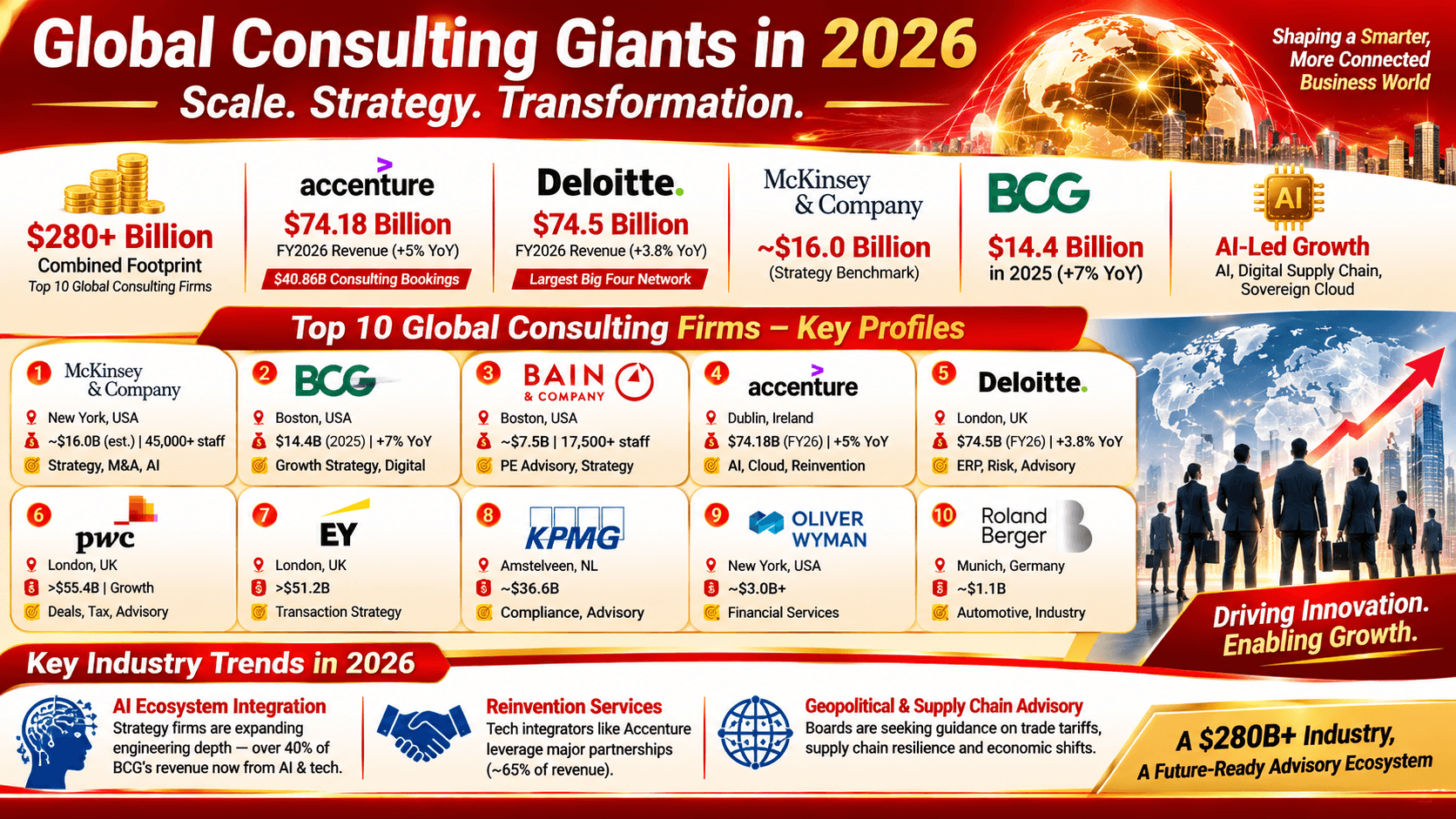
Market Scale Leader (Strategy & Ops): McKinsey & Company — ~$16.0B (2023 self-disclosed; private partnership does not release annual figures).
Highest Disclosed Commercial Growth: Boston Consulting Group (BCG) — $14.4B in 2025 revenue (+7% YoY growth, marking 22 consecutive years of growth).
Pure-Play Tech Benchmarking Authority: Gartner — $6.444B Trailing Twelve-Month (TTM) revenue as of Q3 2026 (-0.24% YoY), following $6.497B in FY2025 (+3.67% YoY).
Public Pure-Play Tech Research Guidance: Forrester Research — Full-year 2026 revenue guidance of $350.0M to $360.0M (-11.8% to -9.3% YoY decline).
Strategic Private Equity & Value Benchmark: Bain & Company — ~$7.5B estimated annual scale.
Human Capital & Rewards Benchmark: Mercer — ~$5.8B estimated segment revenue across talent, benefits, and executive pay.
Risk, Capital & Benefits Benchmark: Willis Towers Watson (WTW) — ~$5.2B segment scale across total rewards and human capital.
Executive & Organizational Design: Korn Ferry — ~$2.75B estimated organizational and leadership capability benchmarking footprint.
Process Standardization Pioneer: APQC — Non-profit standard-bearer managing the Process Classification Framework (PCF®) covering 1,200+ business processes.
Global Corporate Accountability: World Benchmarking Alliance (WBA) — Assessing 2,000+ keystone multinationals against UN Sustainable Development Goals (SDGs).
Detailed Organizational Breakdown
1. McKinsey & Company
Pillar: Strategy, Operations & Global Industry Benchmarks
Core Competency: Operational performance diagnostics, cost-curve modeling, macro productivity benchmarks, and digital transformation audits.
Scale & Financial Profile: Estimated ~$16.0B in baseline revenue (last self-disclosed in 2023). Maintains a global workforce exceeding 45,000 across 130+ cities.
Strategic Value: Provides executive teams and boardrooms with high-stakes peer benchmarks for capital allocation, organizational restructuring, and industry consolidation.
2. Boston Consulting Group (BCG)
Pillar: Strategic Capabilities, Digital & Value-Creation Benchmarking
Core Competency: Enterprise value creation, digital/AI maturity benchmarks, operational efficiency, and commercial strategy.
Scale & Financial Profile: Official $14.4B revenue for 2025 (+7% YoY growth), expanding over 40% of its business into tech, data, and AI-driven capability benchmarking.
Strategic Value: Highly regarded for benchmarking tech adoption trajectories, corporate portfolio performance, and growth capability indices.
3. Bain & Company
Pillar: Commercial Excellence, Private Equity & Cost Benchmarking
Core Competency: Net Promoter Score (NPS) customer satisfaction benchmarks, commercial due diligence, and cost-structure optimization.
Scale & Financial Profile: Estimated annual scale of ~$7.5B. Employs over 17,500 professionals worldwide.
Strategic Value: The primary benchmarking partner for private equity buyout funds, evaluating acquisition targets against industry performance baselines.
4. Mercer
Pillar: Talent, Compensation & Global Workforce Rewards Benchmarking
Core Competency: Total rewards surveys, global compensation grids, mobility benchmarking, and workforce capability mapping.
Scale & Financial Profile: Operates as a flagship subsidiary of Marsh McLennan, commanding an estimated ~$5.8B segment footprint.
Strategic Value: Sets global standards for corporate pay scales, executive compensation, benefits parity, and workforce demographic indexing across 130+ markets.
5. Gartner
Pillar: IT Research, AI Platforms & Enterprise Tech Benchmarks
Core Competency: Technology vendor evaluation via Magic Quadrants, Hype Cycles, IT spending benchmarks, and CIO decision frameworks.
Scale & Financial Profile: Publicly traded (NYSE: IT); recorded $6.444B TTM revenue ending Q3 2026 (-0.24% YoY) and $6.497B in FY2025 (+3.67% YoY). Global Technology Sales Contract Value (GTS CV) reached $4.0B in 2026.
Strategic Value: The universal baseline for IT software selection, cloud architecture benchmarking, and enterprise technology procurement.
6. Willis Towers Watson (WTW)
Pillar: Human Capital, Benefits & Financial Risk Benchmarking
Core Competency: Organizational risk, employee benefits valuation, executive pay benchmarking, and capital modeling.
Scale & Financial Profile: Publicly traded (NASDAQ: WTW); human capital and total rewards segment generates ~$5.2B annually.
Strategic Value: Enables enterprise HR leaders and compensation committees to benchmark health, risk, and benefit programs against peer peer groups.
7. Korn Ferry
Pillar: Leadership, Executive Compensation & Org Design
Core Competency: Executive leadership benchmarks, succession planning metrics, organizational structure modeling, and job grading.
Scale & Financial Profile: Publicly traded (NYSE: KFY); advisory and talent solution revenue stands at ~$2.75B.
Strategic Value: Provides algorithmic job-evaluation frameworks (Hay Group method) to benchmark leadership capabilities and compensation structures.
8. Forrester Research
Pillar: Customer Experience (CX), B2B Buying & Tech Benchmarks
Core Competency: Forrester Wave™ vendor reviews, Customer Experience Index (CX Index™), B2B Revenue Waterfall™ metrics, and tech buyer surveys.
Scale & Financial Profile: Publicly traded (NASDAQ: FORR); 2026 full-year GAAP revenue guidance stands at $350.0M to $360.0M (-11.8% to -9.3% YoY), with Q3 2026 contract value at $281.9M.
Strategic Value: Evaluates customer-centricity, go-to-market execution, and emerging software adoption across consumer and enterprise markets.
9. APQC (American Productivity & Quality Center)
Pillar: Operational & Business Process Benchmarking
Core Competency: Process Classification Framework (PCF®), cycle-time databases, unit-cost benchmarks, and process excellence metrics.
Scale & Financial Profile: Member-based non-profit research institute providing open and proprietary benchmarking databases covering 45+ industries.
Strategic Value: Provides the foundational taxonomy used by global corporations to define, standardize, and benchmark business processes from end to end.
10. World Benchmarking Alliance (WBA)
Pillar: ESG, Corporate Sustainability & SDG Benchmarks
Core Competency: Evaluating the world’s 2,000 most influential companies ("Keystones") on climate transition, human rights, digital inclusion, and nature impact.
Scale & Financial Profile: Multi-stakeholder non-profit organization funded by global philanthropic foundations and government agencies.
Strategic Value: Establishes free, publicly accessible benchmarks holding global corporations accountable to UN Sustainable Development Goals.
Market Dynamics & Selection Strategy for C-Suite Decision Makers
Selecting the appropriate benchmarking partner depends on the specific operational objective:
For IT Infrastructure, AI & Software Architecture: Leverage Gartner or Forrester to evaluate vendor capability maturity, software pricing, and ROI expectations.
For Corporate Strategy, Restructuring & Unit Cost Control: Partner with McKinsey, BCG, or Bain for deep operational benchmarking and portfolio optimization.
For Total Rewards, Executive Compensation & Hiring: Deploy Mercer, WTW, or Korn Ferry to benchmark pay structures and benefits competitiveness globally.
For Business Process Standardization: Utilize APQC’s Process Classification Framework to map operational workflows before undertaking major ERP or AI automation implementations.
For Corporate Governance & Sustainability: Reference World Benchmarking Alliance standards to align corporate ESG disclosures with global regulatory expectations.