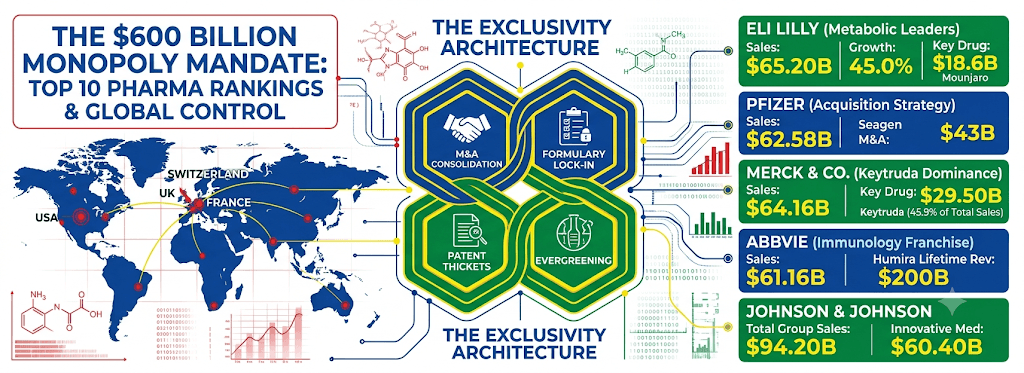
The upper echelon of the global pharmaceutical market is locked into a high-concentration structure, where the top ten corporate entities generate over $600 billion in cumulative annual sales.
Leading the global revenue rankings is Eli Lilly, which achieved $65.20 billion in annual revenue, registering an industry-topping single-year organic growth rate of 45.0%. This expansion was driven almost entirely by its metabolic portfolio: $18.6 billion from Mounjaro and $9.0 billion from Zepbound.
Close behind, Pfizer generated $62.58 billion in total revenue, managing to stabilize its top-line post-pandemic operations through its $43 billion acquisition of Seagen.
AbbVie captured third place with $61.16 billion in revenue, sustained by its next-generation immunology assets: Skyrizi contributed $10 billion in annualized sales (growing 30.9% year-over-year), while Rinvoq generated $5.0 billion (up 23.3%).
Johnson & Johnson achieved $94.20 billion in total group revenues, with its Innovative Medicine (pharmaceuticals) division accounting for $60.40 billion. This segment grew by 6.1%, led by oncology blockbuster Darzalex at $12.4 billion and Tremfya at $6.0 billion.
AstraZeneca generated $58.74 billion—posting an 8.0% growth rate—fueled by its oncology platform, including Tagrisso.
Merck & Co. recorded $64.16 billion in total enterprise sales, with $58.14 billion derived directly from drug sales. Merck’s single immuno-oncology treatment, Keytruda, reached $29.50 billion in sales—making it the highest-selling drug on Earth and accounting for 45.9% of Merck’s entire corporate revenue.
Roche generated $74.90 billion in enterprise revenue, with its core Pharmaceuticals Division delivering $57.57 billion, supported by Ocrevus at $4.30 billion and Vabysmo at $2.50 billion.
Swiss partner Novartis delivered $54.53 billion by targeting specialized radioligands and cardiovascular platforms like Entresto.
Bristol Myers Squibb posted $48.19 billion, anchored by Opdivo.
Rounding out the top ten, Sanofi S.A. generated $47.42 billion, heavily anchored by its immunology blockbuster Dupixent, which delivered $10.70 billion in half-year sales alone while growing at 30.8%.
The Structural Engine of Monopolistic Growth
Monopolistic control across the top ten players is maintained through deliberate legal and financial strategies rather than free-market competition.
The foundation of this control is the Patent Thicket. A prominent example is AbbVie's primary asset Humira, which was ring-fenced by 132 granted secondary patents out of 247 patent applications. This legal perimeter successfully blocked biosimilar entry into the United States market for 20 years, allowing AbbVie to extract over $200 billion in cumulative lifetime revenue from a single drug molecule. Similarly, Merck has secured over 120 patent filings surrounding Keytruda, extending its exclusive pricing power far beyond its primary compound expiration milestone.
The second key tactic is Acquisition over Discovery. The top ten pharma firms allocate an average of 15% to 28% of net revenues to R&D, but a massive portion of this capital functions as private equity. The top ten giants executed over $140 billion in clinical-stage M&A investments, acquiring late-stage biotechnology assets at Phase II or Phase III milestones rather than bearing early-stage discovery risk.
Third, revenue stability is reinforced through Pay-for-Delay Settlements. Historical antitrust analyses reveal that branded pharmaceutical manufacturers have engaged in financial arrangements with prospective generic entrants that offer up to 30% to 50% of monopoly profits in royalty or supply-chain agreements. In exchange, the generic entrant defers product launches by 3 to 7 years, keeping consumer pricing artificially high.
Engineering Unbreakable Global Dependencies
Beyond legal exclusivity, the top ten pharmaceutical companies have engineered structural, physical, and financial dependencies throughout the global healthcare ecosystem.
Manufacturing & Bioreactor Monopolization: While generic small-molecule pills cost less than $0.05 per dose to synthesize, modern complex biologics and GLP-1 peptide chains require advanced bioreactor facilities costing between $500 million and $2 billion per site. The top ten firms control an estimated 70% of global commercial-scale mammalian cell culture capacity. This creates a high capital barrier, preventing low-income nations or secondary competitors from manufacturing biosimilars even when legal compulsory licenses are granted.
Clinical Trial & Regulatory Hegemony: Securing global marketing approval across regulatory bodies like the US FDA, European EMA, and Chinese NMPA requires global Phase III trials. The median cost of executing a successful Phase III trial program across 5,000 to 10,000 patients now ranges between $300 million and $1.1 billion. Independent biotech firms holding novel targets find it nearly impossible to finance these trials independently, forcing over 80% of independent biotechs to license their assets to top ten pharma players to reach international markets.
Formulary Lock-In via PBM Rebate Bundling: In the United States—the world's most lucrative market, accounting for 45% of global drug spending—the top ten players utilize portfolio rebate bundling with Pharmacy Benefit Managers (PBMs). A PBM managing tens of millions of patient lives is offered gross-to-net price concessions and volume rebates of 40% to 65% across established multi-billion dollar franchises, provided that the PBM grants exclusive, Tier-1 formulary access to the manufacturer’s entire product catalog. This practice effectively blocks lower-cost generic alternatives from gaining market access.
Through a combination of structural patent thickets, manufacturing dominance, and aggressive capital deployment, the top ten pharmaceutical corporations have insulated their financial positions. They ensure that even as individual patents expire, the broader system of global dependency guarantees sustained revenues.
November 2026