Yttrium's Ninefold Price Shock: How China's Export Controls Are Reshaping Global Critical-Mineral Supply Chains
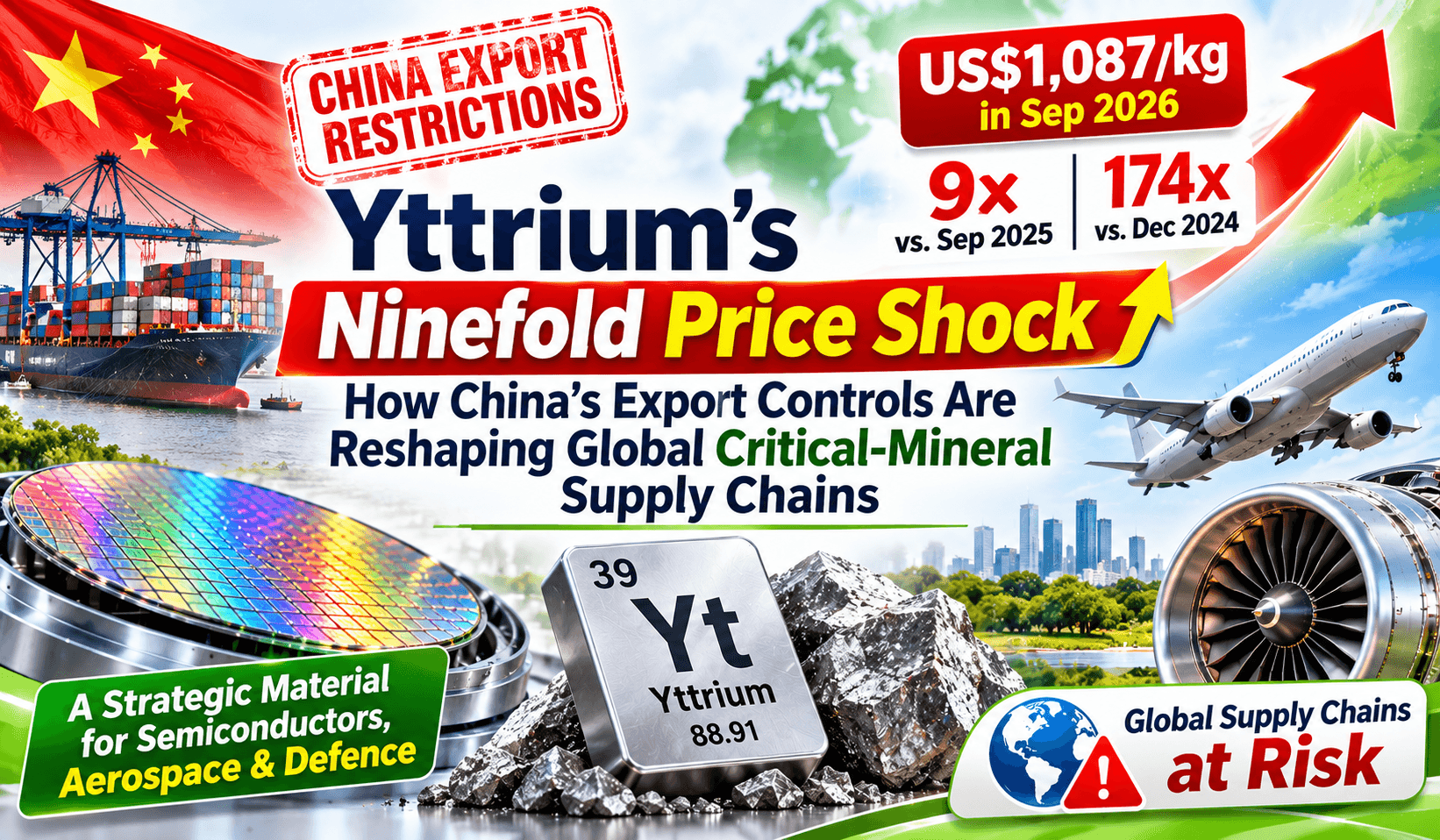
A Rare Earth Becomes a Global Economic Flashpoint The global critical-minerals market is facing another major supply-chain disruption as yttrium, a specialised rare-earth element, experiences an extraordinary increase in international prices following China's export restrictions. In September 2026, yttrium traded at approximately US$1,087 per kilogram in the European market , representing a ninefold increase compared with September 2025. Even more strikingly, the reported price was approximately 174 times its level at the end of 2024, before China's export restrictions began significantly affecting international availability. The price escalation is not simply a commodity-market development. Yttrium is an important input for semiconductor manufacturing equipment, aircraft engine components, advanced ceramics, lasers, optical technologies and defense-related applications. With China maintaining restrictions on selected rare-earth exports, manufacturers across Japan, the United States, Europe and other industrial economies are facing higher procurement costs, sourcing uncertainty and growing pressure to diversify their supply chains. The situation demonstrates how a relatively specialised industrial material can become a strategic economic concern when its production and processing are concentrated in a limited number of countries. What Makes Yttrium So Important? Yttrium is one of the 17 rare-earth elements and is particularly valuable because of its chemical and physical properties. Although it is not as widely discussed as lithium, cobalt or neodymium, yttrium plays an important role in several advanced industrial applications. Its major uses include: 1. Semiconductor manufacturing: Yttrium oxide-based materials are used in specialised coatings for semiconductor manufacturing equipment. These coatings help protect components exposed to demanding plasma environments, supporting equipment durability and manufacturing consistency. 2. Aerospace and aircraft engines: Yttrium-based ceramic materials are used in thermal barrier coatings that help protect turbine components from extreme operating temperatures. 3. Defense and advanced technologies: Yttrium is used in specialised optical materials, lasers and technologies that support defense and precision engineering applications. 4. Electronics and lighting: Its compounds are used in phosphors, LEDs, capacitors and other electronic applications. 5. Advanced ceramics and industrial applications: Yttrium oxide is used in high-performance ceramics, optical glass, fibre-optic technologies and specialised materials. The importance of yttrium lies not necessarily in the volume consumed but in the difficulty of replacing its performance in certain applications. For manufacturers, a shortage of even relatively small quantities can create problems when the material is essential to a qualified production process. The Ninefold Price Surge: Understanding the Numbers The latest price movement highlights the severity of the supply disruption. According to Argus Media data reported by Nikkei and Seoul Economic Daily, the European-market price of yttrium reached approximately US$1,087 per kilogram in September 2026. The reported comparison is significant: September 2025: The comparable price was approximately one-ninth of the September 2026 level, implying roughly US$121 per kilogram. September 2026: Approximately US$1,087 per kilogram. Year-on-year movement: Approximately nine times the previous year's price, equivalent to an increase of around 800%. Compared with December 2024: Approximately 174 times higher. The domestic Chinese market has remained substantially cheaper, with the reported international price exceeding 100 times the corresponding Chinese-market level. This growing difference between domestic Chinese prices and international prices illustrates the widening gap between material availability inside China and access to export markets. Japan is experiencing an equally concerning development in its import costs. According to Japanese Ministry of Finance trade data reported in November 2026, Japan imported approximately 294 tonnes of yttrium oxide during January–September 2026 , representing a decline of around 70% compared with the corresponding period in 2025. At the same time, Japan's September import unit price for yttrium oxide was approximately 64 times its level a year earlier. It is important to distinguish these figures: the US$1,087 benchmark refers to yttrium metal in the European market, whereas Japan's 64-fold increase relates to its import unit price for yttrium oxide. They are different product and pricing measurements, not directly interchangeable market quotations. Nevertheless, both indicators point towards the same underlying problem: international availability is tightening while procurement costs are rising dramatically. China's Export Restrictions: The Beginning of the Supply Disruption The current crisis can be traced to China's decision on April 4, 2025, to introduce export controls covering seven rare-earth elements, including yttrium. The restrictions cover relevant metals, oxides, alloys, compounds and associated products. Under the licensing framework, exporters must obtain government approval before shipping controlled materials to international customers. The measures emerged during escalating trade tensions between China and the United States, following Washington's tariff actions and broader restrictions affecting Chinese technology-related trade. Although the restrictions were presented through China's export-control and national-security framework, their impact extended well beyond the immediate trade dispute. Manufacturers that had traditionally relied on Chinese-origin materials suddenly faced additional documentation, approval requirements, uncertain delivery schedules and reduced availability. The pressure subsequently spread across international markets. Japan experienced additional difficulties in January 2026 when China tightened controls affecting dual-use exports destined for Japanese companies. A further development came on November 9, 2026, when China extended the suspension of certain other rare-earth export restrictions until January 10, 2027. However, this should not be interpreted as a complete relaxation of rare-earth controls. The April 2025 restrictions covering yttrium and six other elements remain in force. This distinction is particularly important for international buyers expecting a rapid recovery in supplies. Why China Holds Such Significant Influence China's position in the rare-earth industry extends beyond mining. Its strength lies in the integrated supply chain covering extraction, separation, refining, processing and the production of specialised materials. According to the US Geological Survey's 2026 Mineral Commodity Summaries, estimated global mine production of yttrium contained in rare-earth mineral concentrates was approximately 10,000–15,000 tonnes in 2025. China produced most of the estimated global yttrium supply, while Myanmar also contributed a significant share. Separately, the International Energy Agency estimates that China accounted for approximately 61% of global mined rare-earth production and 91% of global refining and processing capacity for major rare earths in 2024. The latter figures cover the broader rare-earth industry rather than yttrium alone, but they demonstrate the scale of China's influence over the processing infrastructure. This concentration creates a major vulnerability. Even when other countries possess rare-earth deposits, establishing commercially viable separation and refining facilities requires specialised technologies, investment, environmental clearances and time. Mining a mineral is only one stage of the supply chain. Converting it into high-purity material suitable for semiconductor and aerospace applications is considerably more demanding. Countries Facing the Greatest Impact Japan: The Most Visible Supply-Chain Pressure Japan has emerged as one of the most directly affected economies. The country's semiconductor, electronics and aerospace manufacturing industries depend on reliable supplies of specialised materials. The 70% decline in yttrium oxide import volumes during January–September 2026 highlights the seriousness of the situation. Japanese companies are now exploring alternative procurement arrangements involving the United States, South Korea, Germany, Turkey and Estonia. Shin-Etsu Chemical is also planning an investment exceeding ¥35 billion in a Fukui Prefecture facility capable of refining 16 rare-earth elements, including yttrium. However, diversification will not happen immediately. Companies must establish reliable processing capabilities, qualify alternative materials and secure long-term supply arrangements. United States: Aerospace and Semiconductor Exposure The United States is another major economy facing considerable exposure. According to the USGS, the country had 100% net import reliance for yttrium in 2025, with no fully commercial domestic facility for separating or refining the material. Shipping records for 2021–2024 indicated that approximately 70% of US imports of yttrium alloys, compounds and metals came from China. Germany accounted for 11%, Austria 8% and South Korea 4%. The supply disruption became particularly visible in trade data. According to Chinese customs figures analysed by the Center for Strategic and International Studies, Chinese exports of yttrium to the United States fell to just 17 tonnes during the eight months from April to December 2025, compared with 333 tonnes during the preceding eight-month period. That represents a reduction of approximately 95%. The impact has been felt by aerospace suppliers and specialist coating manufacturers, some of which have reportedly rationed supplies or suspended production activities. The wider semiconductor industry is also exposed because yttrium-based materials support specialised manufacturing equipment. South Korea: A Potential Alternative With Its Own Supply Vulnerability South Korea is increasingly becoming part of Japan's alternative sourcing strategy. However, there is an important complication. South Korea does not have commercial domestic yttrium mining and remains heavily dependent on Chinese-origin rare-earth materials. Korea Customs Service figures indicate that China accounted for approximately 89.4% of South Korea's imports of rare-earth raw materials, including yttrium, during the first nine months of 2025. Therefore, increased Japanese imports arriving from South Korea do not necessarily represent newly diversified mineral origins. These shipments may involve existing inventories, materials processed in South Korea or third-country supplies routed through Korean businesses. This distinction highlights why the country of shipment and the actual country of mineral origin must not be confused. Germany and Europe: Pressure on Advanced Manufacturing European industrial economies are also exposed to the disruption. Germany is particularly relevant because of its automotive, aerospace, engineering and advanced manufacturing industries. The USGS identified Germany among the leading destinations for China's yttrium exports in 2025. European manufacturers are exposed to higher international procurement prices and uncertainty surrounding future deliveries. However, the wider rare-earth trade picture is not uniform. CSIS analysis indicates that European rare-earth import flows recovered more strongly than US flows following the initial restrictions. The impact therefore varies by material, supplier, application and individual manufacturer's inventory position. India: An Opportunity to Strengthen Domestic Capabilities India's position deserves attention as the country expands its ambitions in electronics, defense, advanced manufacturing and strategic minerals. India possesses rare-earth-bearing mineral resources, particularly monazite in beach-sand deposits, and has established domestic extraction and refining activities through IREL. However, the availability of rare-earth resources does not automatically translate into commercial production of every individual rare-earth material at the required purity and scale. World Bank trade data for 2025 show that India imported approximately 993 tonnes under HS code 280530, covering rare-earth metals, scandium and yttrium. China supplied approximately 823 tonnes, or nearly 83% by weight. This classification covers multiple materials and does not isolate yttrium imports. It should therefore be treated as an indication of broader supply-chain exposure rather than a specific yttrium dependency measurement. India's opportunity lies in expanding domestic separation, refining, recycling and specialised material-processing capabilities while developing diversified international supply partnerships. Why Replacing Chinese Supplies Will Not Be Easy The present disruption has accelerated global efforts to reduce dependence on China. However, alternative supply chains cannot be established simply by identifying new mining locations. The industry requires: Commercially viable mining and mineral-concentrate production. Advanced separation and purification technologies. Consistent high-purity material quality. Long-term customer qualification and testing. Environmentally compliant processing facilities. Reliable transportation, inventory and procurement networks. Yttrium is especially challenging because its importance is concentrated in specialised industrial applications where material specifications and performance requirements are demanding. Even when alternative sources become available, manufacturers may need substantial time to validate their suitability. Consequently, international buyers are likely to focus on a combination of strategic inventories, long-term supply agreements, recycling and investment in alternative processing infrastructure. What Comes Next for the Global Market? The direction of the yttrium market will depend on several developments. First, China's export licensing decisions will remain a major influence on international availability. Second, Japan, the United States and European economies will need to accelerate their investments in alternative refining and processing capabilities. Third, manufacturers will increasingly evaluate the cost of maintaining strategic inventories against the financial risk of production interruptions. Fourth, the expansion of semiconductor manufacturing, aerospace production and defense-related technologies will continue to support demand for specialised materials. Finally, new investments in rare-earth extraction and recycling could gradually improve supply diversification, although meaningful capacity expansion will take time. Conclusion: A Small Mineral With Major Global Economic Consequences Yttrium's extraordinary price increase demonstrates that global industrial competitiveness depends on much more than finished products, technology and manufacturing capacity. It also depends on access to specialised raw materials that may be difficult to replace. China's export restrictions have exposed vulnerabilities across semiconductor manufacturing, aerospace, defense and advanced electronics, forcing major economies to reconsider their sourcing strategies. Japan's declining import volumes, the United States' supply constraints and South Korea's dependence on Chinese-origin materials demonstrate that diversification is no longer simply a long-term policy objective. It is becoming an immediate industrial priority. For India and other emerging manufacturing economies, the situation presents an opportunity to develop stronger domestic capabilities in rare-earth processing and advanced materials. The larger lesson is clear: Control over critical minerals is increasingly becoming a source of industrial and geopolitical influence. As the race for advanced semiconductors, aerospace technologies and strategic manufacturing intensifies, the availability of materials such as yttrium could become just as important as the technologies they help produce.