• Home

Business

  • Dashboard
  • My Products
  • Edit Business
  • My Groups

Explore

  • Articles
  • Community
  • Careers
  • Blogs
BONC logoGet it on Google Play

Products

  • Pricing
  • Explore Industry
  • Explore Category
  • Explore Product
  • About Us

About BONC

  • FAQs
  • Terms and Condition
  • Privacy Policy
  • Refund Policy
  • Blogs

OFFICE LOCATION

Costipro Technologies Pvt. Ltd, Unit no. 235 to 245, Supremework Workspace, 2nd Floor, ILD Trade Center, Sector 47, Sohna Road, Gurgaon, Haryana - 122018

© 2025 - 2026 BONC Network. All rights reserved

BONC Logo
  • Home

Business

  • Dashboard
  • My Products
  • Edit Business
  • My Groups

Explore

  • Articles
  • Community
  • Careers
  • Blogs

Financial Titans: Inside the Top 10 Wealthiest Families in the World

ResearchBy Vikas Garg · 21 Oct 2026
Financial Titans: Inside the Top 10 Wealthiest Families in the World

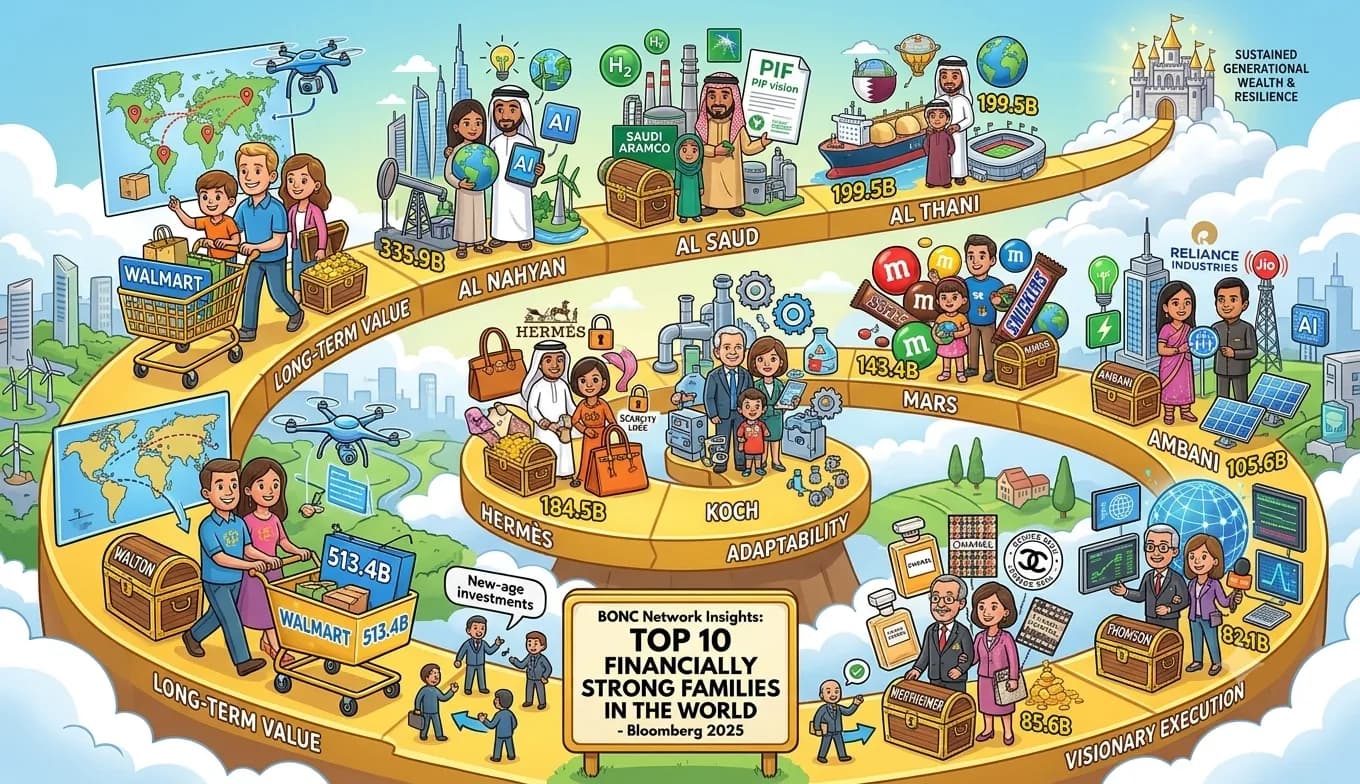
When evaluating long-term financial success, conversations typically focus on individual billionaires. However, the most resilient financial legacies belong to family dynasties that have built, scaled, and protected enterprises across multiple generations, transforming local ventures into global economic powerhouses.

According to Bloomberg’s ranking, the world’s 25 richest families hold a combined estimated wealth of $2.9 trillion—a significant increase driven by public market performance, robust consumer demand, and strategic diversification. Examining these top 10 dynasties reveals how specific operating models, high-impact mergers, and adaptive pivots into new-age solutions have preserved their fortunes.

1. The Walton Family (USA)

  • Estimated Wealth: $513.4 billion

  • Core Enterprise: Walmart

  • Generations: 3

  • Key Business Operations & Expansion: Founded by Sam Walton, Walmart operates the world's largest retail and wholesale corporation. The family's sustained dominance is built on massive supply-chain efficiency, high-volume inventory turnover, and aggressive pricing strategies.

  • New-Age & Strategic Shifts: To combat digital disruption and rival e-commerce giants, the Waltons aggressively expanded Walmart's digital footprint through omnichannel retail, automated fulfillment centers, and investments in cloud infrastructure, fintech services, and drone delivery logistics.

2. The Al Nahyan Family (UAE)

  • Estimated Wealth: $335.9 billion

  • Core Enterprise: Abu Dhabi Sovereign Wealth & State Industrial Interests

  • Generations: 3

  • Key Business Operations & Expansion: As the ruling royal family of Abu Dhabi, their financial strength is anchored by massive petroleum reserves managed through sovereign investment vehicles like the Abu Dhabi Investment Authority (ADIA) and Mubadala Investment Company.

  • New-Age & Strategic Shifts: Operating with a long-term post-oil vision, the family has funneled billions into artificial intelligence, renewable energy initiatives, semiconductor manufacturing, and global tech venture capital funds to diversify away from hydrocarbons.

3. The Al Saud Family (Saudi Arabia)

  • Estimated Wealth: $213.6 billion

  • Core Enterprise: Saudi Arabian Oil Company (Saudi Aramco) & State Assets

  • Generations: 3

  • Key Business Operations & Expansion: The Saudi royal family commands immense economic gravity primarily through control of Saudi Aramco, one of the world's most profitable energy corporations, alongside expansive state-backed real estate and industrial holdings.

  • New-Age & Strategic Shifts: Through the Public Investment Fund (PIF), the dynasty is spearheading Vision 2030, driving mega-projects like NEOM, investing heavily in green hydrogen, global sports infrastructure, and next-generation tech startups.

4. The Al Thani Family (Qatar)

  • Estimated Wealth: $199.5 billion

  • Core Enterprise: State Energy & International Investments

  • Generations: 8

  • Key Business Operations & Expansion: Qatar’s ruling family derives its strength from the nation's colossal liquefied natural gas (LNG) reserves, managed via the Qatar Investment Authority (QIA).

  • New-Age & Strategic Shifts: The family has methodically converted energy windfalls into global trophy assets, high-profile real estate across major financial capitals, and strategic stakes in international banking, telecommunications, and green tech enterprises.

5. The Hermès Family (France)

  • Estimated Wealth: $184.5 billion

  • Core Enterprise: Hermès International

  • Generations: 6

  • Key Business Operations & Expansion: Built on ultra-exclusive luxury goods, leather craftsmanship (such as the Birkin and Kelly bags), and ready-to-wear fashion, the family maintains tight corporate control to safeguard brand exclusivity over mass production.

  • New-Age & Strategic Shifts: Unlike competitors that lean heavily into mass-market digital exposure, Hermès has maintained strict scarcity models while upgrading digital clienteling platforms and investing heavily in sustainable, ethically sourced luxury materials.

6. The Koch Family (USA)

  • Estimated Wealth: $150.5 billion

  • Core Enterprise: Koch Industries

  • Generations: 3

  • Key Business Operations & Expansion: Operating as one of the largest private conglomerates in the world, Koch Industries spans petroleum refining, chemicals, polymers, fiber, forest products, and electronic components.

  • New-Age & Strategic Shifts: The family has continuously executed multi-billion-dollar acquisitions and internal restructuring to pivot toward industrial software, medical technology investments, and market-based venture capital initiatives.

7. The Mars Family (USA)

  • Estimated Wealth: $143.4 billion

  • Core Enterprise: Mars, Incorporated

  • Generations: 5

  • Key Business Operations & Expansion: Globally renowned for confectionery giants like M&M’s, Snickers, and Wrigley, the family engineered massive horizontal expansion into pet care, veterinary health services, and food manufacturing.

  • New-Age & Strategic Shifts: Recent major corporate maneuvers include multi-billion-dollar acquisitions in veterinary diagnostics and pet health data platforms, positioning the company securely inside high-growth consumer health sectors.

8. The Ambani Family (India)

  • Estimated Wealth: $105.6 billion

  • Core Enterprise: Reliance Industries Limited (RIL)

  • Generations: 2

  • Key Business Operations & Expansion: Founded by Dhirubhai Ambani and scaled under Mukesh Ambani, Reliance transitioned from a textile player into an energy and petrochemical giant before executing a historic expansion into organized retail and digital telecom services (Reliance Jio).

  • New-Age & Strategic Shifts: The family is currently driving a massive green energy transition—investing heavily in solar, hydrogen, and battery storage infrastructure—while scaling up 5G/6G digital ecosystems and AI-driven consumer tech platforms.

9. The Wertheimer Family (France)

  • Estimated Wealth: $85.6 billion

  • Core Enterprise: Chanel

  • Generations: 3

  • Key Business Operations & Expansion: The brothers Alain and Gérard Wertheimer own the legendary luxury fashion house Chanel, maintaining private ownership that emphasizes long-term brand equity, haute couture, and premium fragrances.

  • New-Age & Strategic Shifts: The family has focused on selective digital integration, experiential retail flagships, and minority venture investments in sustainable fashion startups and alternative textile material developers.

10. The Thomson Family (Canada)

  • Estimated Wealth: $82.1 billion

  • Core Enterprise: Thomson Reuters

  • Generations: 3

  • Key Business Operations & Expansion: Controlled through their investment vehicle Woodbridge Company, the family derives its wealth primarily from a majority stake in Thomson Reuters, providing essential data, legal software, tax compliance tools, and financial market media globally.

  • New-Age & Strategic Shifts: The company has undergone a major software-as-a-service (SaaS) and AI transformation, acquiring legal tech platforms and integrating generative AI tools into core regulatory and workflow products.

Strategic Takeaways on Generational Wealth Preservation

Analyzing these dynasties highlights that maintaining colossal wealth requires far more than passive asset holding. Whether through the heavy capital reallocation seen in the Ambani and Al Nahyan families or the steadfast brand preservation practiced by Hermès and Chanel, long-term survival depends heavily on calculated diversification, disciplined operational execution, and the agility to embrace new-age industrial solutions ahead of market shifts.
#GenerationalWealth#FamilyDynasties#BillionaireFamilies#GlobalBusiness#WealthManagement#BusinessEmpires#WaltonFamily#AmbaniFamily#AlNahyan#Hermes#RelianceIndustries#Walmart#BusinessStrategy#NewAgeInvestments#WealthPreservation#BONCNetwork#Bloomberg2025#BusinessOutlook

Comments

No comments yet

Be the first to share your thoughts.

Latest Articles

View all

Company Articles

  • Best Door Hinges, Window Hinges, Stainless Steel, Brass & Mild Steel Hardware Fittings Supplier in India | INDIAN HARDWARE

    Best Door Hinges, Window Hinges, Stainless Steel, Brass & Mild Steel Hardware Fittings Supplier in India | INDIAN HARDWARE

    Ashik Mondol · 4 months ago

  • Premium Wash Basins, Sanitaryware & Bathroom Fittings for Residential and Commercial Projects | M/S SUPREME MARKETING

    Premium Wash Basins, Sanitaryware & Bathroom Fittings for Residential and Commercial Projects | M/S SUPREME MARKETING

    Rajesh Agarwal · 4 months ago

  • The Architecture of Adaptability: How the Post-Pandemic Era Rewrote the Corporate Playbook

    The Architecture of Adaptability: How the Post-Pandemic Era Rewrote the Corporate Playbook

    Vikas Garg · 4 months ago

  • Premium Roofing Materials, Floor & Wall Tiles, Roofing Fittings and False Ceiling Solutions in India | MURLI ENTERPRISES

    Premium Roofing Materials, Floor & Wall Tiles, Roofing Fittings and False Ceiling Solutions in India | MURLI ENTERPRISES

    Atanu Das · 4 months ago

  • Premium Marble, Granite, Ceramic & Porcelain Tiles Supplier in India | JAIN MARBLE CENTRE

    Premium Marble, Granite, Ceramic & Porcelain Tiles Supplier in India | JAIN MARBLE CENTRE

    Sonu Jha · 4 months ago

Networking Articles

  • Strategic Manufacturing in the Natural & Ayurvedic Sector: Third-Party vs. Job Work vs. In-House

    Strategic Manufacturing in the Natural & Ayurvedic Sector: Third-Party vs. Job Work vs. In-House

    Mihaana Personal care · 126 years ago

  • The Agentic Economy: Finance and Accounting Complete the Great Migration in Q3 2026

    The Agentic Economy: Finance and Accounting Complete the Great Migration in Q3 2026

    BONC NETWORK · 126 years ago

  • HIGH ALERT: Is Your Credit Card Safe? The Silent Surge in Phone & POS Payment Frauds

    HIGH ALERT: Is Your Credit Card Safe? The Silent Surge in Phone & POS Payment Frauds

    Pooja Sharma · 126 years ago

  • Is India’s Property Market Heading Towards a Recession in 2026?

    Is India’s Property Market Heading Towards a Recession in 2026?

    Vikas Garg · 126 years ago

  • Apples-to-Oranges Comparison: Why Context Matters More Than Numbers

    Apples-to-Oranges Comparison: Why Context Matters More Than Numbers

    Maheshwar Prasad Prasad · 126 years ago

More from Vikas Garg

Is India’s Property Market Heading Towards a Recession in 2026?
Market Study

Is India’s Property Market Heading Towards a Recession in 2026?

India’s real estate market has experienced an extended phase of robust expansion, but 2026 presents a more nuanced picture. With property price appreciation outpacing wage growth in key urban hubs, affordability hurdles, and rising inventory in selective segments, a critical question emerges: Is the property market moving toward a recession, or simply entering a disciplined correction and consolidation phase? What Is Happening in the Market? The national numbers for 2026 show steady resilience mixed with localized caution. Across the top eight primary cities, cumulative housing sales for the first nine months reached 258,238 units , holding flat compared to the previous year. Meanwhile, overall residential inventory across major urban centers ticked upward, with available stock hovering near 5.31 lakh to 6.31 lakh units , driven by aggressive new project launches. Average residential prices across top markets have crossed the ₹9,700 per sq. ft. mark (reflecting a ~7% year-on-year increase). This divergence indicates that overall buyer demand has not collapsed, but the velocity of absorption varies drastically by city, micro-market, and price bracket. Why Is the Market Slowing Down? Several fundamental economic pressures are tempering market momentum: The Affordability Gap: In several high-growth micro-markets, capital values have surged faster than household disposable incomes, compressing the pool of active, first-time home buyers. Financing and Cost of Capital: With broader monetary tightening cycles keeping borrowing costs elevated, home loan interest rates demand a higher out-of-pocket commitment, leading buyers to exercise greater caution before finalizing transactions. Supply Mismatch: New project completions have heavily favored luxury and ultra-luxury configurations, whereas mid-income and affordable housing supply has faced tighter demand compression. Micro-Market Trends & Price Appreciation (2026 Data Analysis) Real estate performance in 2026 is hyper-local. Evaluating specific city trends reveals stark differences in pricing and momentum: Delhi-NCR & Gurugram: NCR has experienced distinct movements, with overall sales adjusting dynamically (recording 10,712 units in Q3), while price appreciation remains among the highest nationally at 12% to 15% year-on-year . Gurugram continues to do the heavy lifting: premium corridors like Golf Course Extension Road, Southern Peripheral Road (SPR), and Dwarka Expressway have witnessed massive long-term gains (30% to 50%+ appreciation over recent cycles), pushing average prices in prime sectors near ₹18,500+ per sq. ft. Noida has also maintained steady traction with ~7% to 11% price growth, backed by commercial expansion and proximity to the upcoming Jewar Airport region. Mumbai Metropolitan Region (MMR): MMR remains India's undisputed volume and revenue leader, recording approximately 31,750 units sold in recent quarters and holding the largest share of national real estate revenue (~28.4%). Driven by continuous infrastructure upgrades and redevelopment projects, average prices stand firm around ₹37,064 per sq. ft. in core zones, alongside active supply in peripheral nodes like Navi Mumbai and Thane. Bengaluru: Bengaluru stands out as one of the country's most resilient markets, registering a 11% to 24% year-on-year price appreciation alongside steady sales growth (~12% increase in key quarters). Powered by stable GCC and tech sector employment, micro-markets along expanding metro lines continue to see healthy end-user absorption, though new launches lean increasingly into the ₹80 lakh to ₹2.5 crore bracket. Hyderabad: Hyderabad has displayed aggressive supply dynamics, recording a 15% year-on-year sales jump in key quarters alongside a massive surge in new launches (up over 120% annually). With average prices appreciating at a steady ~3% to 8% and 97% of new supply targeted above ₹80 lakh, the city is betting heavily on premium and upscale integrated developments. Will Property Prices Fall in 2026? A broad, nationwide price crash remains unlikely. Instead, the market is displaying stark bifurcation: High-Demand Micro-Markets: Premium properties backed by robust infrastructure delivery—such as upcoming metro lines and expressway expansions—continue to command steady end-user absorption. Correction-Prone Pockets: Overpriced projects or over-supplied micro-markets are facing extended inventory clearance times. In these segments, developers are increasingly relying on flexible payment subventions, festive discounts, and customized incentives to move inventory. My Take: A Healthy Reality Check The core concern for 2026 is not an imminent market crash, but whether asset valuations are disconnecting from what ordinary, salaried homebuyers can realistically sustain. A resilient real estate ecosystem requires a fine equilibrium between developer pricing expectations and consumer purchasing power. While macro pressures and higher inventory create localized stagnation, disciplined adjustments by developers can stabilize the market organically. Ultimately, India’s real estate landscape in 2026 is navigating a phase of structural adjustment rather than a confirmed nationwide recession . For both home-buyers and long-term capital allocators, data-backed research, careful asset selection, and long-term horizons remain the ultimate safeguards against market noise.

#MarketCorrection#RealEstateRecession#PropertyPrices
Vikas Garg