• Home

Business

  • Dashboard
  • My Products
  • Edit Business
  • My Groups

Explore

  • Articles
  • Community
  • Careers
  • Blogs
BONC logoGet it on Google Play

Products

  • Pricing
  • Explore Industry
  • Explore Category
  • Explore Product
  • About Us

About BONC

  • FAQs
  • Terms and Condition
  • Privacy Policy
  • Refund Policy
  • Blogs

OFFICE LOCATION

Costipro Technologies Pvt. Ltd, Unit no. 235 to 245, Supremework Workspace, 2nd Floor, ILD Trade Center, Sector 47, Sohna Road, Gurgaon, Haryana - 122018

© 2025 - 2026 BONC Network. All rights reserved

BONC Logo
  • Home

Business

  • Dashboard
  • My Products
  • Edit Business
  • My Groups

Explore

  • Articles
  • Community
  • Careers
  • Blogs

Strategic Manufacturing in the Natural & Ayurvedic Sector: Third-Party vs. Job Work vs. In-House

ResearchBy Mihaana Personal care · 23 Oct 2026
Strategic Manufacturing in the Natural & Ayurvedic Sector: Third-Party vs. Job Work vs. In-House

The natural wellness and Ayurvedic markets are at a defining crossroads. As modern consumers demand uncompromising purity, strict clean-label standards, and proven botanical efficacy, brand founders and executive teams face a critical operational dilemma: Which manufacturing architecture best balances product integrity, supply chain reliability, and capital efficiency?

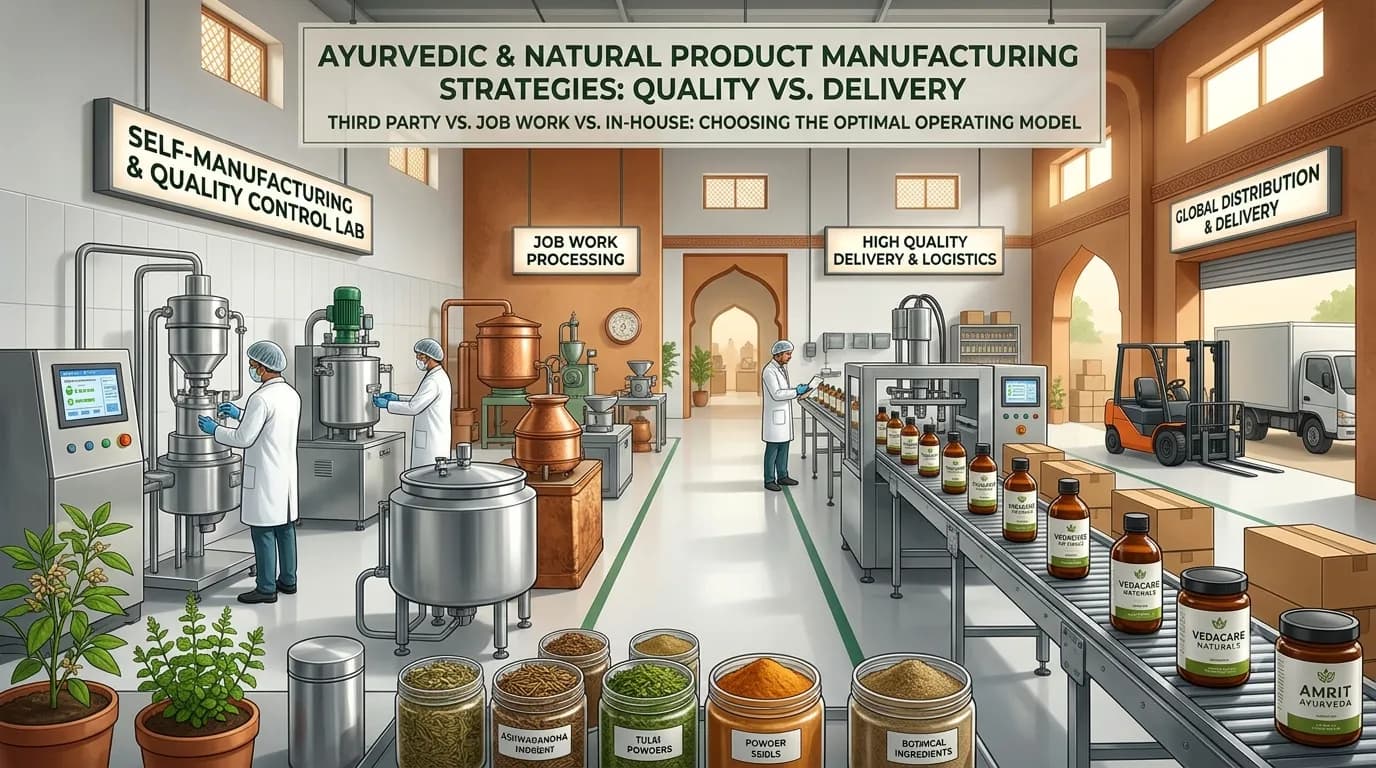
Navigating this choice requires examining three distinct operating models: Third-Party Contract Manufacturing, Job Work Processing, and In-House (Self) Manufacturing.

1. Third-Party Contract Manufacturing (The Turnkey Model)

Under this model, the brand outsources the entire end-to-end production lifecycle to an established manufacturing partner.

  • How It Works: The partner manages raw material procurement, packaging, formulation, and quality assurance under their own manufacturing licenses and GMP certifications.

  • The Pros: Extremely low upfront capital expenditure (CapEx), rapid speed-to-market, and immediate operational scalability.

  • The Cons: Lower control over ingredient sourcing and pricing transparency. Without rigorous oversight, vendors may substitute lower-grade extracts to protect margins.

  • Best For: Early-stage brands, D2C startups, and agile companies testing new product categories.

2. Job Work Processing (The Hybrid Control Model)

Job work represents a strategic middle ground where the brand owner retains absolute control over raw materials and primary formulations, while outsourcing physical processing, blending, and packaging.

  • How It Works: The brand sources, audits, and supplies its own botanical extracts, essential oils, and active ingredients directly to a licensed processing facility.

  • The Pros: Total control over ingredient quality and active standardization (crucial for Ayurveda), combined with lower capital requirements than building a dedicated plant.

  • The Cons: Requires a complex two-step supply chain, active inventory management, and careful coordination of production line schedules.

  • The Alignment: Ideal for premium wellness brands that refuse to compromise on raw ingredient purity but wish to avoid heavy factory overhead.

3. In-House / Self-Manufacturing (The Vertically Integrated Model)

In this model, the brand owns, operates, and maintains its own dedicated manufacturing facility, cleanrooms, and analytical testing laboratories.

  • How It Works: Total capital and technical ownership of machinery, real estate, labor, and compliance infrastructure.

  • The Pros: Absolute control over farm-to-lab traceability, immediate batch variable adjustments, maximum intellectual property protection, and optimized gross margins at scale.

  • The Cons: Immense capital outlay, high fixed overhead costs (OpEx), complex regulatory maintenance, and slow initial setup timelines (12 to 18 months).

  • Best For: Well-capitalized, established enterprises with high volume, stable distribution channels, and proprietary manufacturing techniques.

Key Pillars for High-Quality Ayurvedic & Natural Products

When scaling premium natural formulations, three operational dimensions dictate success:

  1. Active Standardization: Natural actives (such as withanolides in Ashwagandha or curcuminoids in Turmeric) vary widely by harvest. In-house and job work models excel here because the brand can mandate specific suppliers and verify active content before processing.

  2. Batch Consistency: Variations in aroma, viscosity, and color undermine consumer trust. Owned facilities provide instant turnaround on process tweaks, whereas third-party partners require strict operational SLAs to maintain consistency.

  3. Delivery Agility: Meeting retail and D2C demand spikes requires reliable lead times. Turnkey third-party lines offer the fastest restock cycles, while self-manufacturing provides guaranteed priority over production schedules.

Strategic Verdict: Which Model Fits Your Brand?

  • Choose Third-Party if your primary goal is capital-efficient market entry, rapid prototyping, and aggressive marketing focus. (Tip: Mandate independent third-party lab testing for heavy metals and active assays before dispatch).

  • Choose Job Work if ingredient purity and active ingredient integrity are central to your brand promise, but you want to avoid factory ownership. (Tip: Station an internal quality assurance auditor on-site during full production runs).

  • Choose In-House if you have achieved massive scale, possess proprietary processing technology, and require complete vertical integration to protect trade secrets and long-term margins.

How is your leadership team balancing manufacturing agility and quality control in your current product lineup? Let’s discuss in the comments below!

#USMarkets#FinancialNews#StockMarket#BusinessNews#Ayurveda#NaturalProducts#Manufacturing#SupplyChain#SupplyChainManagement#BusinessStrategy#Leadership

Comments

No comments yet

Be the first to share your thoughts.

Latest Articles

View all

Company Articles

  • Best Door Hinges, Window Hinges, Stainless Steel, Brass & Mild Steel Hardware Fittings Supplier in India | INDIAN HARDWARE

    Best Door Hinges, Window Hinges, Stainless Steel, Brass & Mild Steel Hardware Fittings Supplier in India | INDIAN HARDWARE

    Ashik Mondol · 4 months ago

  • Premium Wash Basins, Sanitaryware & Bathroom Fittings for Residential and Commercial Projects | M/S SUPREME MARKETING

    Premium Wash Basins, Sanitaryware & Bathroom Fittings for Residential and Commercial Projects | M/S SUPREME MARKETING

    Rajesh Agarwal · 4 months ago

  • The Architecture of Adaptability: How the Post-Pandemic Era Rewrote the Corporate Playbook

    The Architecture of Adaptability: How the Post-Pandemic Era Rewrote the Corporate Playbook

    Vikas Garg · 4 months ago

  • Premium Roofing Materials, Floor & Wall Tiles, Roofing Fittings and False Ceiling Solutions in India | MURLI ENTERPRISES

    Premium Roofing Materials, Floor & Wall Tiles, Roofing Fittings and False Ceiling Solutions in India | MURLI ENTERPRISES

    Atanu Das · 4 months ago

  • Premium Marble, Granite, Ceramic & Porcelain Tiles Supplier in India | JAIN MARBLE CENTRE

    Premium Marble, Granite, Ceramic & Porcelain Tiles Supplier in India | JAIN MARBLE CENTRE

    Sonu Jha · 4 months ago

Networking Articles

  • The Agentic Economy: Finance and Accounting Complete the Great Migration in Q3 2026

    The Agentic Economy: Finance and Accounting Complete the Great Migration in Q3 2026

    BONC NETWORK · 126 years ago

  • HIGH ALERT: Is Your Credit Card Safe? The Silent Surge in Phone & POS Payment Frauds

    HIGH ALERT: Is Your Credit Card Safe? The Silent Surge in Phone & POS Payment Frauds

    Pooja Sharma · 126 years ago

  • Financial Titans: Inside the Top 10 Wealthiest Families in the World

    Financial Titans: Inside the Top 10 Wealthiest Families in the World

    Vikas Garg · 126 years ago

  • Is India’s Property Market Heading Towards a Recession in 2026?

    Is India’s Property Market Heading Towards a Recession in 2026?

    Vikas Garg · 126 years ago

  • Apples-to-Oranges Comparison: Why Context Matters More Than Numbers

    Apples-to-Oranges Comparison: Why Context Matters More Than Numbers

    Maheshwar Prasad Prasad · 126 years ago

More from Mihaana Personal care

Ayurveda: The Ancient Science of Life and Its Timeless Importance for Every Family
Research

Ayurveda: The Ancient Science of Life and Its Timeless Importance for Every Family

Ayurveda and the Family — A Natural Bond The family is the first unit of society, and it is within the family that health habits are formed, passed down, and sustained. Ayurveda has always been a household science in India. Grandmothers offering turmeric milk to a child with a cold, applying coconut oil to hair, recommending fasting on certain days, or brewing ginger and tulsi tea during seasonal changes — these are all Ayurvedic practices woven seamlessly into daily family life, often without being labelled as such. Benefits of Ayurveda For Children: Ayurveda provides safe, natural approaches to building immunity from an early age. Herbal formulations like Chyawanprash , warm oils for massage ( Abhyanga ), and easily digestible foods strengthen growing bodies without the side effects often associated with pharmaceutical interventions. For Adults: The pressures of modern professional life — stress, irregular eating, sleeplessness, and sedentary habits — are among the biggest health threats today. Ayurveda offers practical tools: adaptogenic herbs like Ashwagandha for stress, Triphala for digestive health, and Brahmi for mental clarity. Practices like oil pulling, tongue scraping, and mindful eating are simple yet profoundly effective daily habits that adults can integrate without disrupting their routines. For Women: Ayurveda places special emphasis on women's health — from menstrual wellness and pregnancy care to post-natal recovery and menopause management. Herbs like Shatavari support hormonal balance and reproductive health naturally. Ayurvedic self-care rituals also nurture mental and emotional well-being, often neglected in the rush of everyday life. For the Elderly: As the body ages, maintaining mobility, cognitive health, and vitality becomes paramount.

#ayurveda#mihaana#naturalproducts
Vikas Garg
Case Study

Ayurveda Meet Modern Science: A Global Shift Toward Natural, Knowledge-Driven Wellness

Ayurveda Meets Modern Science: A Global Shift Toward Natural, Knowledge-Driven Wellness For thousand of years, Ayurveda — literally "the science of life" — has guided how millions live, eat, heal and age. What was once seen as folk tradition is now entering laboratories, hospitals, wellness apps and global policy rooms. Around the world, people are no longer choosing between ancient wisdom and modern medicine; they are learning to combine them. This article explores how Ayurveda is being adopted alongside modern science, how it is becoming a knowledge service rather than a closed tradition, why Japan stands out as a model of natural and traditional culture, and what positive changes this shift can bring to your life. The Rise of Ayurveda as a Global Knowledge Service From Oral Tradition to Open Knowledge Ayurveda was historically passed down through families, gurukuls and handwritten manuscripts. Today, that knowledge is being digitized, structured and shared at scale. Classical texts are being translated and placed online, research foundations are building open-access databases, and peer-reviewed journals now publish Ayurvedic case reports and clinical studies. This transformation matters. When knowledge is documented and made searchable, it stops being a mystery and becomes a service — something a doctor in Berlin, a yoga teacher in California or a new mother in Tokyo can actually use. Knowledge Services Powering the Wellness Economy The modern wellness movement runs on information. People want to understand what they put on their skin and into their bodies. Ayurvedic knowledge services — blogs, courses, consultations, dosha quizzes, ingredient explainers — answer that demand. When tradition becomes teachable, it becomes trustworthy. Brands today don't just sell oils and herbs; they educate. A consumer learning why a dry scalp needs a different oil than an oily scalp, or how a newborn massage supports sleep and circulation, is far more likely to adopt these practices for life. How the World Is Blending Ayurveda With Modern Science Integrative Medicine Goes Mainstream The most important global trend is integration — using traditional and modern systems together rather than treating them as rivals. The World Health Organization has actively supported this direction, establishing a Global Centre for Traditional Medicine in India and hosting its first Traditional Medicine Global Summit alongside a G20 health meeting. The WHO has noted that the vast majority of its member states already use some form of traditional medicine and want better evidence to guide its safe, equitable use. Research Is Catching Up Scientific institutions are increasingly studying the biochemistry behind Ayurvedic theories — examining herbs, formulations and lifestyle practices through clinical trials and laboratory analysis. It's worth being honest here: the evidence base is still maturing. Some Ayurvedic practices have promising scientific support, while others await rigorous testing. The healthiest global attitude is neither blind faith nor blanket dismissal — it is curiosity backed by evidence. That balanced mindset is exactly what's driving credible adoption. Why People Are Choosing This Path Across continents, the motivations look similar: • Fewer harsh chemicals in daily skincare and personal care. • Preventive, lifestyle-first approaches to health rather than purely reactive treatment. • Personalization — Ayurveda's focus on individual constitution (dosha) fits perfectly with the modern appetite for tailored wellness. • Sustainability — plant-based, locally sourced ingredients align with environmental values. Japan: A Living Model of Traditional and Natural Culture If you want to see how a modern, high-tech nation can honor traditional and natural medicine, look at Japan. Kampo: Traditional Medicine Inside a Modern Health System Japan practices Kampo (漢方) — a traditional herbal medicine system adapted from Chinese medicine and refined over centuries to suit Japanese needs. What makes Japan remarkable is that Kampo isn't fringe; it is woven into the national healthcare system. Standardized and Trusted Around 148 Kampo formulations are approved for reimbursement under Japan's National Health Insurance, and the Japanese Pharmacopoeia lists scores of approved herbal ingredients. These medicines are produced under strict, pharmaceutical-grade manufacturing standards — meaning a herbal remedy carries the same quality assurance as a conventional drug. Doctors Actually Prescribe It This is not symbolic. A nationwide study found that a large majority of registered Japanese physicians prescribe Kampo medicines. In Japan, a patient might receive a modern diagnostic test and a traditional herbal formula in the very same clinic — integration in its truest sense. A Culture That Lives Naturally Japan's affinity for natural wellness goes far beyond medicine. Consider: • Centuries-old herbal apothecaries still run by the same families across dozens of generations — living proof of continuity between past and present. • Forest bathing (shinrin-yoku), now studied worldwide for its stress-reducing effects. • Mindful diets rich in fermented foods, green tea and seasonal eating. • A deep cultural respect for ritual, balance and longevity — values Ayurveda shares almost exactly. Japan demonstrates a powerful truth: embracing tradition does not mean rejecting science. It means letting both raise the standard of life. Why You Should Adopt Ayurvedic and Natural Living It Treats You as a Whole Person Modern medicine excels at fixing acute problems. Ayurveda excels at daily balance — sleep, digestion, stress, skin and energy. Together they cover both the emergency and the everyday. It Builds Habits, Not Just Cures An Ayurvedic routine (dinacharya) — oiling the hair, massaging the body, eating mindfully, sleeping on rhythm — turns wellness into a daily practice rather than an occasional rescue. These small rituals compound into lasting health. It Respects Your Skin and Your Planet Choosing natural, herb-based personal care means fewer synthetic additives on your body and a lighter footprint on the earth. For many families, that peace of mind is reason enough. The Positive Changes This Shift Brings For Individuals • Healthier skin and hair through gentle, plant-based care. • Lower stress and better sleep via mindful routines. • Greater body literacy — you understand your own constitution and needs. • Confidence that comes from informed, intentional choices. For Communities and Culture • Preservation of ancient knowledge for future generations. • Support for natural, often local, supply chains and small producers. • A bridge between cultures — Indian Ayurveda, Japanese Kampo, Indonesian Jamu and others enriching one another. For the Future of Medicine The biggest change is philosophical. The world is moving from "traditional or modern" to "traditional and modern." This integrative future promises healthcare that is preventive, personalized, evidence-aware and humane — drawing on the best of five-thousand-year-old wisdom and cutting-edge research at once. Final Thoughts Ayurveda's global moment is not about nostalgia. It is about relevance. As knowledge services make ancient wisdom accessible, as modern science tests and validates what works, and as cultures like Japan prove that tradition and technology can thrive together, more people are discovering a calmer, cleaner, more balanced way to live. You don't have to abandon modern medicine to embrace natural wellness — you simply have to open the door to both. Start small: a mindful routine, a natural oil, a more intentional meal. The science of life, after all, was always meant to be lived.

Vikas Garg