The Agentic Economy: Finance and Accounting Complete the Great Migration in Q3 2026
Industry ReportBy BONC NETWORK · 22 Oct 2026

##AIInFinance#FinanceTransformation#AgenticAI#FutureOfWork#GBS#ManagedServices#FinTech2026#GlobalBusinessServices#EnterpriseAI#AccountingAutomation#FinancialOperations#ContinuousClose#CFOInsights#boncnetwork
Comments
No comments yet
Be the first to share your thoughts.
More from BONC NETWORK
Research
Top 10 Pharma Quarterly Revenue (Global & India)
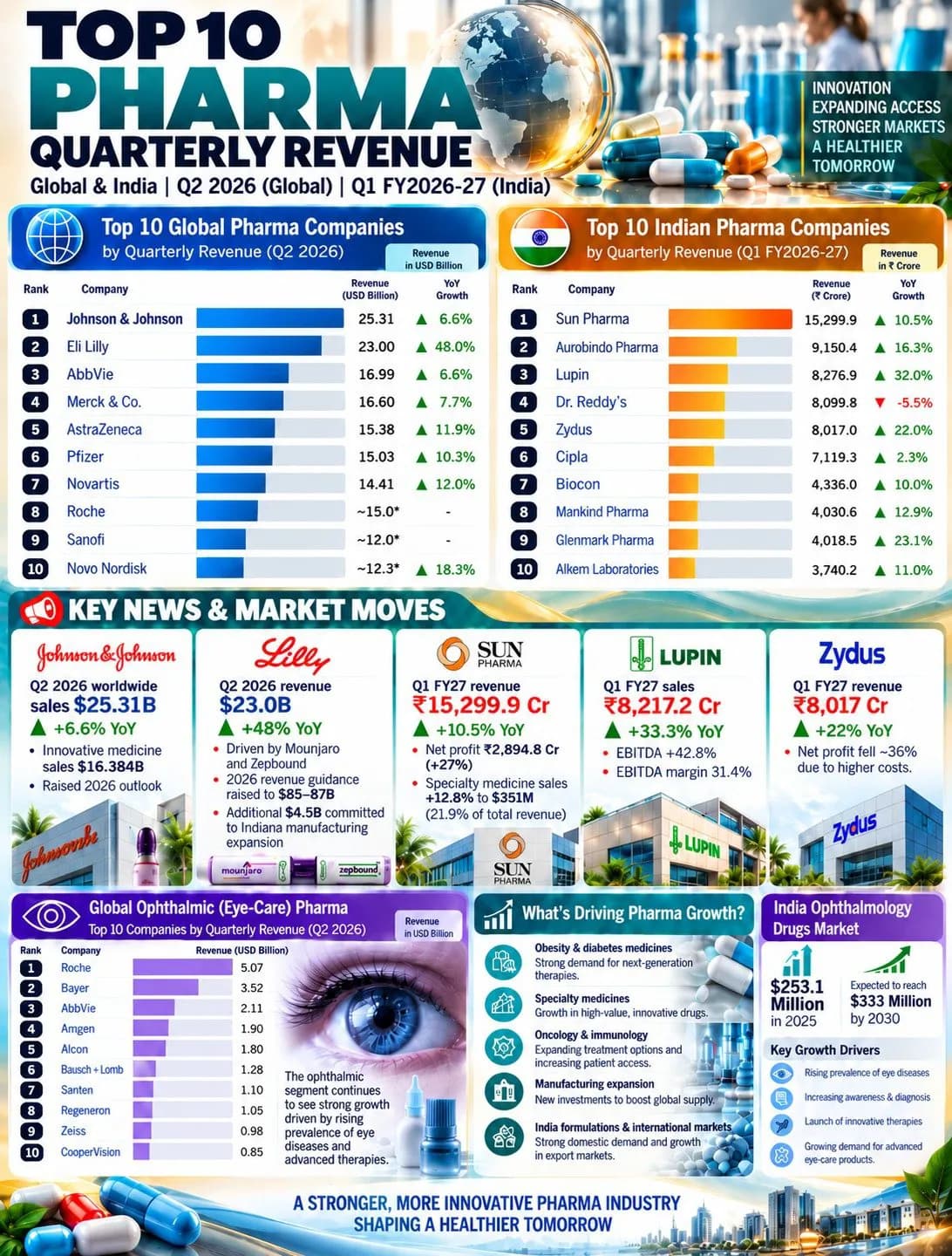
1. Global Market Leadership (Q2 2026) Top 3 Global Players: Johnson & Johnson leads with $25.31B (+6.6% YoY), followed closely by Eli Lilly at $23.00B (+48.0% YoY) and AbbVie at $16.99B (+6.6% YoY). Massive Growth Drivers: Eli Lilly surged +48% YoY, driven by strong demand for obesity and diabetes treatments like Mounjaro and Zepbound. Eli Lilly also raised its 2026 revenue guidance to $85B–$87B. 2. Indian Pharma Landscape (Q1 FY2026–27) Top Performers: Sun Pharma leads the Indian market with ₹15,299.9 Cr (+10.5% YoY), followed by Aurobindo Pharma at ₹9,150.4 Cr (+16.3% YoY) and Lupin at ₹8,276.9 Cr (+32.0% YoY). Profitability Highlights: Sun Pharma: Net profit surged to ₹2,894.8 Cr (+27% YoY), with specialty medicine sales reaching $351M (21.9% of total revenue). Lupin: Recorded a +33.3% YoY sales surge with EBITDA up +42.8% (31.4% EBITDA margin). Zydus: Grew revenue by +22% YoY to ₹8,017 Cr, though net profit fell ~36% due to higher operational costs. 3. Focus Segment: Ophthalmic (Eye-Care) Market Global Leaders: Roche leads global ophthalmic revenue at $5.07B, followed by Bayer ($3.52B) and AbbVie ($2.11B). India Growth Outlook: The Indian ophthalmic drugs market is projected to expand from $253.1M in 2025 to $333M by 2030. Growth Drivers: Driven by higher eye disease prevalence, increased diagnosis/awareness, and rapid adoption of innovative therapies. 4. Key Strategic Growth Drivers Across the Industry Metabolic Therapies: High demand for obesity and diabetes care globally. Specialty & Oncology: Specialty medicines and oncology/immunology expansion are driving higher margins. Supply Chain & Infrastructure: Heavy investments in global manufacturing expansion (e.g., Lilly’s $4.5B Indiana expansion commitment). Domestic & Export Strength: Balanced growth across Indian domestic formulations and key international markets.
#globalpharma#boncnetwork#india
Research
BONC Network Business Outlook: October Week 4
The global and domestic economic landscapes are currently being shaped by a complex interplay of energy shocks, aggressive monetary tightening, and evolving artificial intelligence (AI) investments. According to the latest insights from the BONC Network , businesses must navigate significant volatility driven by geopolitical tensions in the Middle East, fluctuating currency values, and shifting central bank policies. 1. Top Global Business Developments & Energy Watch Geopolitical conflicts have directly impacted global energy markets. The ongoing conflict and shipping disruptions near the Strait of Hormuz—highlighted by multiple commercial vessel attacks—have triggered a major energy shock. Oil Prices: Brent crude settled at $109.55 for December delivery, hovering near a five-month high and well above pre-conflict levels of around $70. Sanctions and Strategic Reserves: To help cap soaring prices, the US temporarily eased key sanctions and tariffs on Russia to allow global diesel distribution, while France announced plans to release up to 100 million barrels of crude and diesel reserves over four months. Central Bank Tightening: Global monetary policy remains restrictive. The US Federal Reserve raised rates to 3.75–4.00% , and the European Central Bank (ECB) lifted its deposit rate to 2.50% , officially signaling that the era of aggressive rate cuts has ended. 2. Global Technology and Financial Markets Financial markets are experiencing heightened volatility, balancing AI-driven growth optimism against fiscal pressures. AI and Tech Sector: Despite a temporary tech sell-off driven by investor skepticism over massive AI capital expenditures, indices like the Nasdaq quickly rebounded by 1.1%. Major tech developments, such as Anthropic preparing for a historic IPO, continue to dictate market-level risk. Macro Indicators: US Consumer Price Index (CPI) inflation rose to 3.7% in September, driven heavily by a 34.2% year-on-year surge in gasoline prices. Meanwhile, the International Monetary Fund (IMF) projects global economic growth at 3.1% for 2026 and 3.4% for 2027 , accompanied by an anticipated global inflation rate of 4.7% in 2026. 3. India Economic Update and Market Movements Domestically, the Indian economy is balancing robust corporate activity against inflationary pressures and currency fluctuations. Market Performance: Indian equity benchmarks saw a downturn, with the Sensex falling 876 points (1.17%) to 73,852.90 and the Nifty dropping 1.11% to 22,888.95. While private banks faced downward pressure, Public Sector Undertaking (PSU) banks surged 2.5% on the back of strong earnings. IT and Corporate Earnings: TCS reported strong Q2 revenues of $7.64 billion (up 2.8% YoY in constant currency), with annualized AI revenue crossing $3.1 billion (representing over 10% of total revenue). Infosys is slated to report amidst broader industry challenges concerning discretionary spending and AI-led pricing pressures. Inflation and Monetary Policy: India's CPI inflation climbed to 5.54% in September (with food inflation touching 7.74%), prompting the Reserve Bank of India (RBI) to raise its repo rate by 25 basis points to 5.50% and shift toward a stance of "calibrated tightening". Despite these pressures, the IMF revised India's full-year growth forecast upward to 7.0% . Currency Interventions: The Indian Rupee slid to an intra-period low of 96.78 against the US dollar before recovering to 94.92 following aggressive interventions by the RBI, which deployed an estimated $75–80 billion through dollar sales and swap windows. 4. Capital Markets and Upcoming IPO Boom India's primary market is witnessing historic momentum, highlighted by major public offerings. Jio Platforms IPO: Jio Platforms launched its massive ₹30,213 crore issue (priced between ₹1,065 and ₹1,119 per share), marking India's largest-ever IPO and surpassing Hyundai India's previous record. Broader IPO Activity: Total capital raised via IPOs in 2026 has reached ₹1.1 lakh crore, with approximately 12 firms—including Zetwerk and Awaida Electro—planning October offerings. 5. Outlook and Strategic Recommendations According to the BONC Network market outlook, investors and enterprises should prepare for distinct sectoral winners and headwinds: Sectors Likely to Grow: PSU banks, capital-market intermediaries (brokers and asset management companies riding the IPO boom), energy security and storage, defense, electronics manufacturing, and export-oriented IT/AI services. Sectors Facing Challenges: Oil marketing companies, airlines, paints, chemicals, food-heavy FMCG, rural-dependent retail, and rate-sensitive sectors like real estate and autos. Key Watchpoints: Businesses should closely monitor upcoming corporate earnings, central bank decisions (Fed and ECB meetings), trajectory of the Rupee near the 97 mark, Brent crude fluctuations around $100, and ongoing developments regarding US-India trade policies. The BONC Network advises enterprises to adopt practical risk-management steps—such as hedging currency exposures, stress-testing operations against $100 crude scenarios, and locking in financing ahead of further potential rate hikes. Strategic Analysis & Recommendations 1. Macroeconomic & Geopolitical Impact Analysis Energy Vulnerability: The Strait of High-stakes disruption near Hormuz has locked Brent crude near $109.55/barrel . For import-heavy economies like India, this introduces persistent inflationary pressures, widening fiscal deficits, and severe cost pushbacks on manufacturing and logistics. Monetary Tightening Constraints: With the US Federal Reserve targeting 3.75%–4.00% and the RBI shifting to "calibrated tightening" with a repo rate hike to 5.50% , liquidity is tightening globally. Capital is aggressively migrating toward the US dollar, placing unprecedented pressure on emerging-market currencies like the Indian Rupee (which tested near the 96.78 level before RBI stabilization). 2. Sectoral Winners & Vulnerabilities (The BONC Network Outlook) Sector Category with Market Trajectory followed by Underlying Driver / Risk PSU Banks & Capital Markets ( 🟢 Growth) - Strong asset quality, robust earnings, and high liquidity riding the wave of India's historic IPO boom (e.g., Jio Platforms' ₹30,213 crore issue). Energy Security, Defense & Electronics ( 🟢 Growth) - Backed by active domestic demand, strategic state investments, and extensive private sector capital allocation. Export IT & AI Services ( 🟢 Growth) - Benefiting from a favorable currency exchange rate (Rupee near 95–96), though real-time pricing pressure and discretionary spending slowdowns require cautious selectivity. Oil Marketing, Aviation, Paints & Chemicals ( 🔴 Challenge) - Highly vulnerable to elevated crude oil costs ($100+ Brent) and currency depreciation overheads. Rate-Sensitive Sectors (Real Estate, Autos, FMCG) ( 🔴 Challenge) - Pressured by high borrowing costs, rising mortgage rates (7.40%), and rural consumer price inflation exceeding 6%. 3. Recommended Action Plan for Businesses To safeguard profit margins and capitalize on emerging opportunities in this volatile cycle, enterprises within the BONC Network ecosystem should execute the following steps: Hedge Currency and Commodity Exposure Immediately Action: Lock in forward covers for foreign exchange liabilities to mitigate the risk of further rupee fluctuations against the US dollar. Deadline/Next Step: Instruct your finance team by the end of the week to review upcoming import-export payment cycles against a projected $100 crude baseline . Stress-Test Working Capital at $100+ Crude Action: Run financial simulations assuming logistics and raw material costs remain elevated through Q4. Deadline/Next Step: Identify operational redundancies and optimize supply chain routes within the next 14 days. Secure Financing Ahead of Further Rate Hikes Action: With HSBC and other major institutions forecasting additional rate hikes (potentially another bump by December), corporate borrowers should lock in long-term credit lines immediately. Deadline/Next Step: Negotiate fixed-rate credit facilities with banking partners before upcoming central bank decisions on October 28–29 . Leverage Digital B2B Ecosystems for Supply Chain Resiliency Action: Diversify domestic supplier and vendor networks to counter localized inflation and input shortages. Deadline/Next Step: Actively utilize platforms like the BONC Network to source alternative domestic channel partners, digital vendors, and verified distributors to compress procurement turnaround times.
#BONCNetwork#GlobalEconomy#Geopolitics
Market Study
BONC Network Newsletter - October 2026 Week 3rd
The October Week 3 newsletter from BONC Network delivers a comprehensive macro-economic assessment, balancing global market volatility against India’s domestic resilience. Globally, persistent energy pressures—highlighted by Brent crude averaging $104/bbl due to Middle East supply risks—combined with central bank tightening have shaped a cautious international outlook, with the IMF projecting global growth at 3.0% for 2026. Domestically, however, the Indian economy displays robust momentum, underscored by a raised FY27 GDP growth forecast of 7.1%, a strengthening manufacturing PMI of 55.1 in September, and landmark capital market activities such as the upcoming Jio Platforms IPO. Key Highlights Global Markets & Energy: Brent crude averaged $104/bbl over the last two weeks of Q3 driven by Hormuz supply risks, while major central banks like the US Federal Reserve and ECB maintain tight monetary stances to combat inflation. Global Growth & Policy Shifts: The IMF adjusted its 2026 global growth forecast down to 3.0%, and evolving US trade policies—such as Section 301 tariffs—continue to create unpredictable trade terms for international exporters. India’s Economic Indicators: India’s Q1 real GDP grew at 7.8% (April–June), with retail inflation (CPI) registering at 4.82% in August and the RBI maintaining a calibrated tightening stance with a repo rate of 5.50%. Capital Markets & Sector Performance: Robust primary market activity is highlighted by strong subscription rates for upcoming and ongoing issues like the Jio Platforms IPO, alongside strong tech sector milestones such as TCS reporting $3.1 billion in annualized AI revenue. Sectors to Watch: IT and AI services, data infrastructure, and core manufacturing are poised for growth, whereas oil-dependent industries, auto, real estate, and US-dependent exporters face near-term cost and borrowing challenges. Note:- BONC Network team tries best to capture the true to the source information but accuracy can be still subjective as per change in time and period.
#boncnetwork#newsletter#globalfinance
Market Study
BONC Network Newsletter - October Week 2 Business & Market Update
Hello BONC Network Users Welcome to the October Week 2 edition of the BONC Network Newsletter! Here is your curated snapshot of key global business developments, market trends, and economic updates shaping the landscape this month. 🌐 Top 5 Global Business Highlights Iran War & Hormuz Energy Shock Tensions persist after the rejection of proposals to reopen the Strait of Hormuz. With approximately one-fifth of global oil normally passing through the strait, the blockade has driven oil prices to $101.31/bbl (+55% YoY), continuing to fuel global inflation and currency pressures. US Federal Reserve Rate Hike The Fed raised its target rate by 25 bps to 3.75%–4.00%, citing elevated inflation. 16 out of 18 FOMC members anticipate at least one more hike this year, maintaining upward pressure on global borrowing costs. IMF Trims Global Growth Outlook Global growth is projected at 3.0% for 2026 and 3.4% for 2027. Global public debt is approaching 100% of GDP, limiting fiscal policy flexibility worldwide. US Tariff Policy Restructuring Following the striking down of IEEPA tariffs in February and the expiration of Section 122 surcharges in July, a new Section 301 duty (10%–12.5%) across ~60 economies has been implemented. Central Bank Tightening & Rising Bond Yields Rate increases across the US, UK, and Japan have pushed US 10-Year Treasury yields near two-decade highs (5.25%), driving capital movements from emerging markets. 📊 Global Market Snapshot & Economic Indicators S&P 500: 7,651.54 (+0.5% in Sept) Dow Jones: 50,906.05 (-4.3% in Sept) Nasdaq: 26,861.06 (+1.9% in Sept) Gold: $4,185/oz Indian Rupee: ~96.31 per USD (near record low) 🇮🇳 India Business Update Strong Economic Growth: Real GDP grew 7.8% in Q1 FY27 (above the 7% estimate), driven by Manufacturing (9.2%) and Services (10.0%). Inflation & PMI: CPI rose to 4.82% in August (with food inflation at 5.95%), while Manufacturing PMI stood at 52.8. Exports & IPOs: Merchandise exports surged 17% in April–July FY27, reaching a record $44.2B in July. The primary market remains active with potential IPO proceeds of ~₹25,000 Cr targeted for September. RBI Monetary Policy: The Repo Rate stands at 5.25%, with the market watching closely for upcoming MPC decisions. 💡 Sectoral Outlook for India Growth Opportunities: Capital Goods & Infrastructure, Textiles/Apparel (benefiting from trade agreements), Renewables, and Services. Watch Areas & Challenges: Auto and margin-sensitive sectors facing fuel/input cost pressures, and export sectors navigating foreign tariff adjustments. 📅 Key Upcoming Dates to Watch Oct 7: RBI MPC Decision Oct 13: US CPI & IMF Outlook Release Oct 28: Next Fed Meeting & Rate Decision Nov 30: India Q2 GDP Data Release Thank you for being a valued part of the BONC Network community.
#boncnetwork#newsletter#globalnews
Market Study
BONC Network Newsletter - September 2026 Week 5
Welcome to BONC Network What has happened in Global business in the last week of September 2026 - Let's uncover it. Do subscribe for regular overview by BONC Network editorial team on Global Business and financial market weekly.
#boncnetwork#newsletter#globalbusiness