Morocco’s Rise Signals a New Investment Landscape in Africa: Manufacturing, Infrastructure and Economic Reforms Reshape Investor Priorities
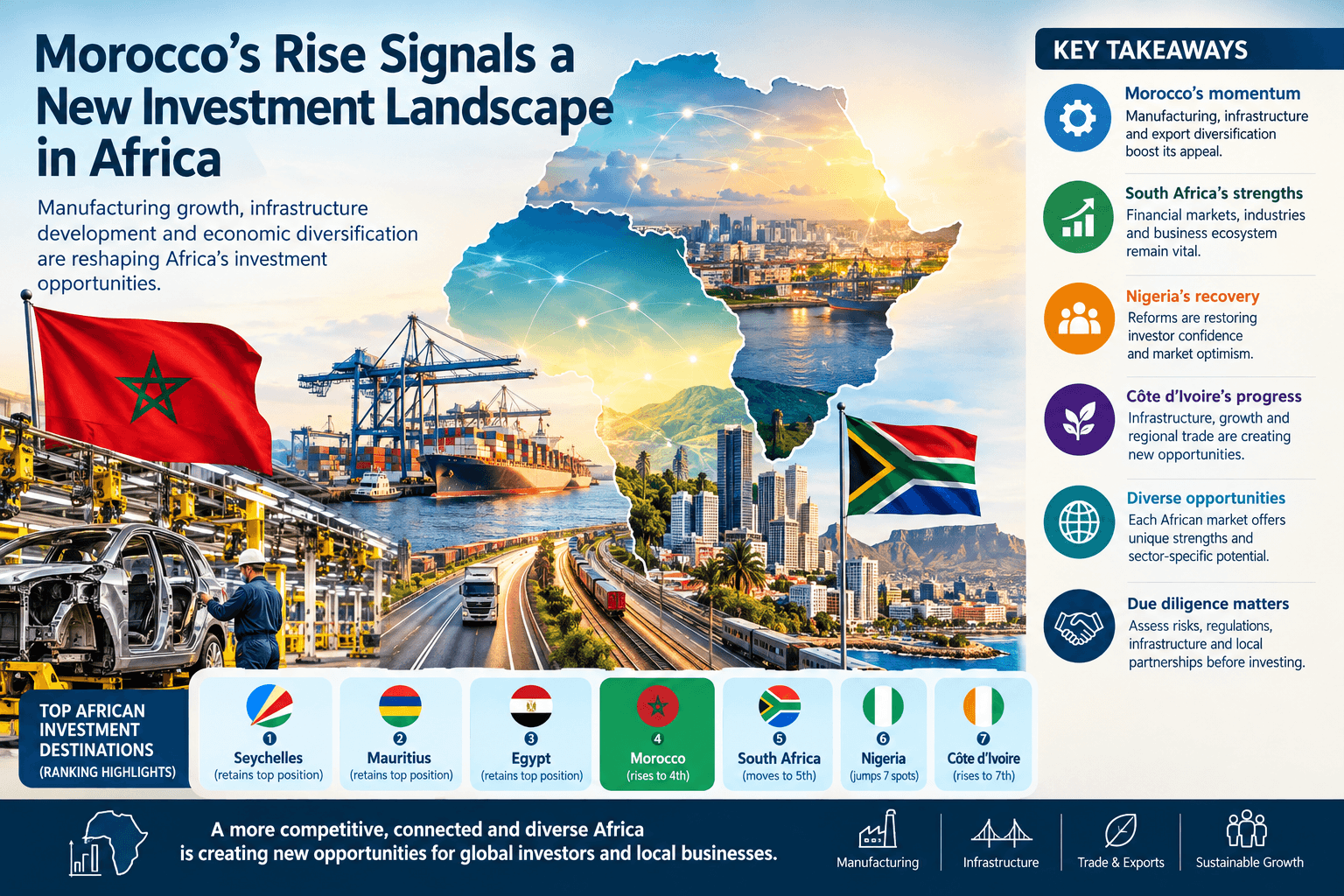
Africa’s investment landscape is evolving as countries strengthen their industrial capabilities, modernise infrastructure and compete for international capital. Morocco’s growing appeal highlights this shift. According to an assessment by Rand Merchant Bank (RMB), a subsidiary of FirstRand Ltd., Morocco has overtaken South Africa to become Africa’s fourth-most attractive investment destination. The development reflects a broader change in how investors assess opportunities across the continent. Market size remains important, but infrastructure, policy stability, manufacturing capacity, export access and the ease of conducting business are increasingly influential. Morocco’s progress illustrates how sustained investment in industrial development and international trade connections can improve a country’s position. Meanwhile, South Africa continues to offer significant advantages, including a sophisticated financial sector, established industries and a substantial consumer market. The changing rankings do not necessarily indicate that one economy has replaced another in overall strength. Instead, they demonstrate how different countries are positioning themselves to attract capital in an increasingly competitive global environment. Key Takeaways Morocco’s manufacturing capabilities and export-oriented strategy are strengthening its investment appeal. Infrastructure investment and industrial development can help attract long-term capital. South Africa remains an important economic centre despite increased competition. Nigeria, Côte d’Ivoire, Egypt, Mauritius and other markets offer distinct investment opportunities. Investors increasingly evaluate operational conditions, market access and economic resilience alongside market size. Africa’s long-term potential depends on productive investment, skills development, infrastructure and stronger regional trade. Morocco’s Manufacturing Strategy Gains Momentum One of the principal factors supporting Morocco’s investment profile is its focus on manufacturing. Rather than relying exclusively on traditional economic activities, the country has worked to develop industries that can participate in international supply chains. Automotive manufacturing is an important example. Morocco has attracted investment in vehicle assembly and automotive components, helping establish industrial ecosystems that connect manufacturers, suppliers, logistics providers and exporters. This approach can generate benefits beyond the factories themselves. Component manufacturers, packaging companies, industrial equipment suppliers, transport operators and technical service providers may also find opportunities as production networks expand. Morocco’s aerospace activities, renewable-energy ambitions and other industrial initiatives further demonstrate its efforts to diversify economic activity. However, the long-term benefits depend on productivity, local supplier development, workforce capabilities and the ability of domestic businesses to move into higher-value activities. Investment pointer: Businesses considering Morocco should assess opportunities across the wider manufacturing ecosystem, not only among major international manufacturers. Supporting industries and specialised services can be important parts of the value chain. Infrastructure Strengthens Morocco’s Competitive Position Reliable infrastructure is central to investment decisions. Manufacturers and exporters need efficient transport, dependable utilities, access to ports and predictable movement of goods. Morocco has invested in transport links, port capacity and industrial zones to support trade and manufacturing. Its geographic position between Europe and Africa can also be advantageous for companies seeking to diversify production locations and serve multiple markets. Infrastructure improvements can reduce logistical friction, support industrial clustering and make it easier for companies to connect with suppliers and customers. These advantages are particularly relevant for export-oriented businesses operating under tight delivery schedules. Nevertheless, infrastructure quality should be evaluated at the project level. Access, cost, capacity and reliability may differ between locations and industrial zones. Investors must also consider energy costs, water availability, workforce access and the time required to establish operations. Investment pointer: Companies exploring Morocco should compare industrial locations based on total operating costs, logistics access, utilities, labour availability and proximity to target customers. South Africa Remains a Major Economic Force Morocco’s rise in investment attractiveness should not be interpreted as a decline in the overall importance of South Africa. The country continues to possess substantial economic strengths, including developed financial markets, established professional services, industrial capabilities and a broad business ecosystem. South Africa has experience across mining, manufacturing, agriculture, financial services, technology and retail. Its established corporate sector and financial infrastructure can support investors seeking access to sophisticated business services and regional opportunities. At the same time, challenges involving infrastructure reliability, logistics performance, economic growth and policy uncertainty can influence investor confidence. Addressing these constraints is important for improving competitiveness and encouraging new productive investment. South Africa’s investment outlook therefore depends not only on its existing strengths but also on its ability to improve operating conditions, expand infrastructure capacity and create an environment in which businesses can plan with greater certainty. Investment pointer: Investors should distinguish between country-level perceptions and sector-specific fundamentals. South Africa may remain highly competitive in particular industries even as other African economies improve their relative positions. Nigeria: Scale and Market Potential Nigeria remains a major market because of its population, entrepreneurial activity and broad consumer demand. Its economy offers opportunities across consumer goods, agriculture, financial technology, telecommunications, energy and business services. The size of the domestic market can attract companies seeking long-term growth. Local production, distribution networks and services adapted to consumer needs may offer routes into the economy. However, market size alone does not guarantee commercial success. Currency volatility, inflation, infrastructure constraints, financing costs and regulatory complexity can affect business performance. Companies considering Nigeria need detailed assessments of customer purchasing power, pricing, foreign-exchange exposure, payment systems and distribution capabilities. Investment pointer: Businesses should build realistic operating scenarios and evaluate how currency movements, logistics costs and financing requirements could affect profitability. Côte d’Ivoire and the Growth of West Africa Côte d’Ivoire has developed an increasingly important role in West Africa, supported by economic activity, infrastructure development and its position within regional commercial networks. Agriculture and related processing industries remain significant, while construction, consumer services, logistics and manufacturing can offer opportunities as urbanisation and business activity expand. For international companies, the country may provide a platform for exploring wider regional demand. Yet entering a market successfully requires understanding local regulations, customer preferences, distribution arrangements and competitive conditions. Regional expansion should not be treated as a uniform strategy. Countries within West Africa have different currencies, regulatory frameworks, commercial practices and levels of infrastructure development. Investment pointer: Businesses should evaluate Côte d’Ivoire both as a domestic market and as a possible starting point for a carefully planned regional strategy. Other African Markets Offer Different Advantages Africa’s investment landscape cannot be understood through a single ranking. Countries offer different combinations of market access, specialist capabilities, natural resources, financial services and economic conditions. Mauritius, for example, has developed a profile in financial and professional services. Egypt offers a large domestic market and industrial opportunities, while Seychelles has a distinctive position in tourism and selected services. Other economies may offer opportunities linked to agriculture, renewable energy, mining, digital services or regional trade. The attractiveness of each destination depends on the investor’s industry, investment horizon and business objectives. Smaller economies can be competitive in specialised activities even when they cannot match the scale of larger markets. Conversely, a large economy may offer significant demand but require more complex distribution, financing and operational arrangements. Investment pointer: Companies should identify the business outcome they need before selecting a destination. A market suited to manufacturing exports may not be the best choice for consumer retail, financial services or resource-based projects. What Investment Attractiveness Rankings Really Measure Investment rankings provide useful comparisons, but they should be interpreted carefully. They generally assess a combination of economic, financial, institutional and business-related indicators. The precise methodology depends on the organisation producing the ranking. A country’s position may reflect its projected economic opportunities, market conditions, investment climate or other measures. It does not automatically represent the amount of foreign investment received, the profitability of individual projects or the absence of risk. Investors should also distinguish between investment attractiveness, actual capital inflows and realised economic outcomes. A country may attract considerable interest without every announced project proceeding to completion. For this reason, the reported change in Morocco’s position is best understood as a signal of evolving investor priorities rather than definitive proof that Morocco is superior to South Africa across all economic measures. Readers should consult the latest RMB report to verify the ranking, publication date and methodology before citing the figures in a business or investment decision. Supply-Chain Diversification Creates New Opportunities Global businesses have been reassessing how they manufacture, source and distribute products. Factors such as geopolitical uncertainty, transport disruption, changing trade policies and the need for greater supply-chain resilience have encouraged some companies to consider additional production locations. African economies that can provide reliable infrastructure, skilled workers, competitive operating costs and access to target markets may benefit from this shift. Morocco’s industrial development illustrates how manufacturing capacity and international connectivity can support participation in cross-border supply chains. Other African economies may also benefit where their capabilities align with industry requirements. However, supply-chain diversification involves more than selecting a country with lower costs. Businesses must examine supplier quality, delivery reliability, workforce training, customs procedures, access to finance and the availability of supporting industries. Investment pointer: Investors should assess whether a location can meet long-term operational requirements, rather than basing decisions solely on labour costs or short-term incentives. Opportunities for Small and Medium-Sized Businesses Large manufacturers and international investors are not the only businesses that can benefit from Africa’s changing investment environment. Small and medium-sized enterprises may find opportunities by serving the suppliers, distributors and service providers associated with expanding industries. Potential areas include industrial maintenance, packaging, warehousing, transport, business software, technical consulting, workforce training, equipment supply and professional services. Companies entering new markets may also need local partners who understand customer behaviour, compliance requirements and distribution channels. This can create opportunities for domestic businesses with specialised knowledge and reliable delivery capabilities. At the same time, smaller firms must carefully manage payment terms, working capital, contract obligations and customer concentration. Winning a contract with a major company can create growth opportunities, but it can also place pressure on cash flow and production capacity. Investment pointer: SMEs should identify a specific capability they can deliver competitively, develop credible business documentation and build relationships with potential buyers, suppliers and industry partners. Due Diligence Remains Essential Even in countries experiencing positive investment momentum, investors must conduct thorough due diligence. Key considerations include: Regulatory environment: Understand business registration, licensing, taxation, employment rules and sector-specific requirements. Financial exposure: Evaluate currency movements, interest rates, financing availability and repatriation arrangements where relevant. Infrastructure: Confirm the availability and reliability of electricity, water, transport, telecommunications and industrial facilities. Market demand: Validate customer requirements, purchasing power, competition and realistic sales forecasts. Local partnerships: Assess prospective partners’ financial standing, reputation, operational capability and contractual commitments. Workforce: Examine labour availability, skills, training needs and employment obligations. Political and economic conditions: Consider policy changes, trade arrangements and country-specific risks. Sustainability: Evaluate environmental requirements, resource availability and the long-term resilience of the proposed operation. Incentives and favourable rankings can support a business case, but they should never replace independent analysis. Investors should also verify the terms of any incentive directly with the relevant authorities and qualified advisers. Africa’s Investment Future: Competition and Collaboration The changing positions of African investment destinations reflect a continent with diverse economic opportunities and increasingly differentiated business environments. Morocco’s progress demonstrates the potential value of sustained industrial development, infrastructure investment and international trade integration. South Africa continues to offer established capabilities and a substantial business ecosystem. Nigeria brings market scale, while Côte d’Ivoire and other economies offer opportunities shaped by their regional roles and sector strengths. The next phase of investment growth will depend on whether countries can translate investor interest into productive capacity, sustainable employment, stronger domestic businesses and broader economic participation. Infrastructure, skills, regulatory predictability, access to finance and regional cooperation will remain important. So will the ability of domestic firms to participate in supply chains instead of remaining on the margins of investment-led growth. For businesses, the key is not to follow rankings blindly. It is to identify where their products, services, expertise and capital can solve real problems and generate sustainable value. Conclusion Morocco’s reported move ahead of South Africa in RMB’s assessment of Africa’s most attractive investment destinations highlights the changing dynamics of the continent’s economy. Manufacturing growth, infrastructure development and export diversification are helping Morocco strengthen its position in international business discussions. South Africa, meanwhile, retains important advantages that continue to make it relevant to investors. Other markets across the continent offer distinct opportunities depending on the sector, scale and purpose of an investment. The broader lesson is that Africa should not be viewed as a single investment market. Its economies differ significantly in capabilities, risks, consumer demand and business conditions. For investors and businesses, long-term success will depend on informed market selection, rigorous due diligence and the ability to develop strong local relationships. As competition for investment continues, countries that combine credible policies with productive infrastructure and a supportive business environment will be better placed to convert opportunity into lasting economic growth. Synopsis Morocco’s reported rise above South Africa in RMB’s assessment of Africa’s investment destinations highlights the growing importance of manufacturing, infrastructure and export diversification. This article explores Morocco’s industrial strategy, South Africa’s continuing economic strengths, opportunities in Nigeria and Côte d’Ivoire, and the wider factors shaping investment across Africa. It also examines supply-chain diversification, opportunities for SMEs and the importance of due diligence when entering new markets.