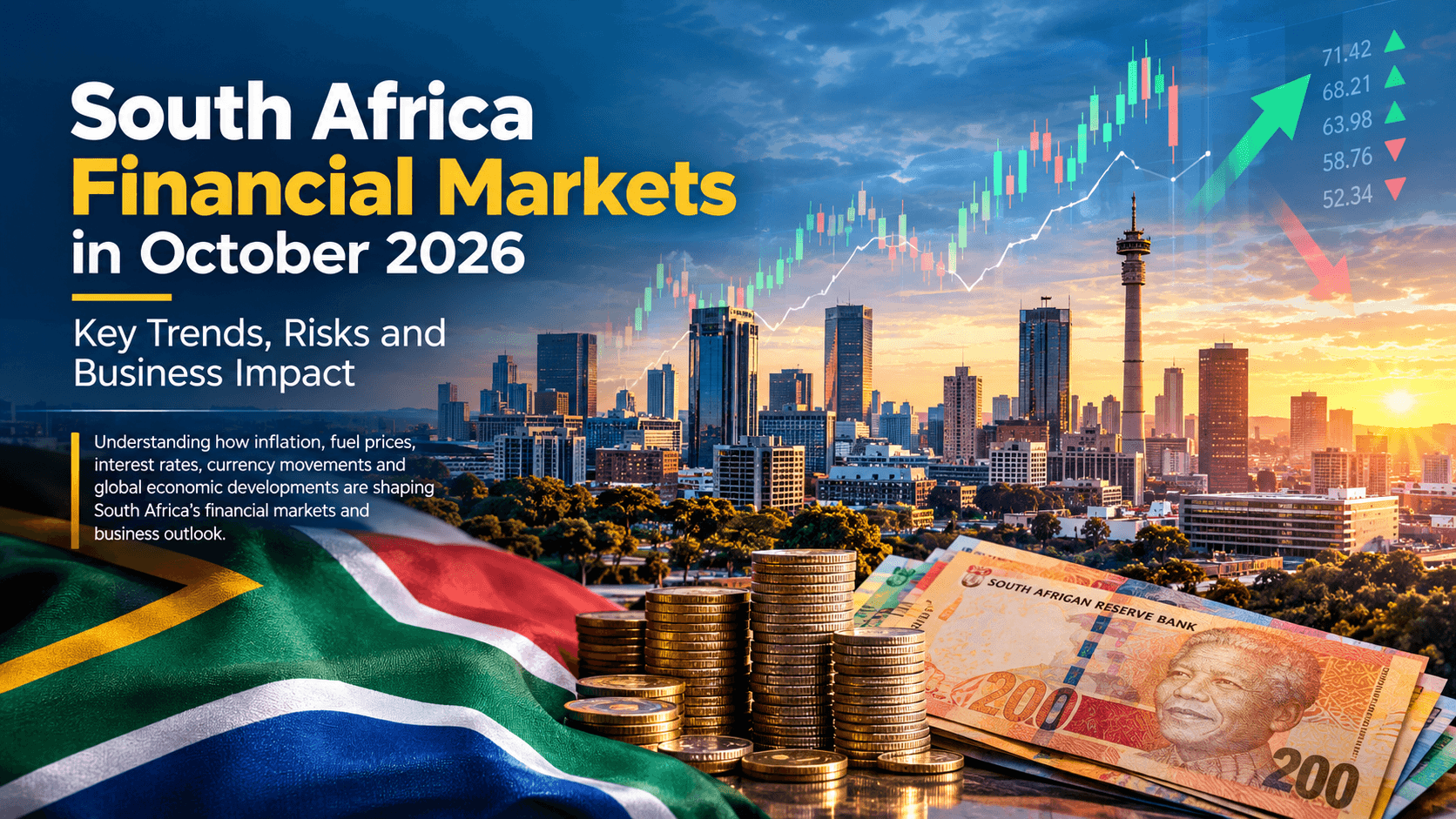
South Africa’s financial markets are navigating a challenging combination of rising energy costs, inflation uncertainty, currency fluctuations and changing investor expectations. At the same time, developments in government finances have offered some encouragement, creating a mixed outlook for businesses, consumers and investors.
October 2026 is an important period for understanding how international events affect South Africa’s domestic economy. Fuel prices, interest rates, the rand, commodity markets and government borrowing all influence the cost of doing business and the direction of financial markets.
This original article examines these developments in an editorial format, with relevant images for use in a business publication or on BONC Network.
1. South Africa’s financial market: a mixed economic outlook
South Africa’s economy is being shaped by two competing forces. Improved government revenue expectations and efforts to manage public debt could strengthen investor confidence. However, higher fuel costs, inflation risks and relatively modest economic growth continue to challenge businesses and households.
Financial markets respond not only to current economic conditions but also to expectations about what may happen next. Investors are assessing whether inflation will remain elevated, whether the currency can stabilise and whether government measures will translate into sustainable economic improvements.
For businesses, the immediate priority is managing costs and cash flow while remaining prepared for changes in demand, borrowing costs and international trade conditions.
2. Inflation and rising fuel prices
Fuel prices are an important channel through which international economic developments affect South African consumers and companies.
South Africa relies heavily on imported petroleum products, making domestic fuel costs sensitive to global oil prices and the exchange rate. When fuel becomes more expensive, the consequences extend beyond motorists to freight operators, food distributors, manufacturers and retailers.
Higher transportation costs can increase the price of everyday goods. Households may respond by reducing discretionary purchases, while businesses must decide whether to absorb additional expenses or pass some of them on to customers.
Consumer inflation reached 4.5% year-on-year in September 2026, according to reporting published in October. Higher fuel costs could add further pressure to the next inflation reading.
For smaller businesses, the challenge is particularly significant: operating expenses may rise faster than sales, reducing already limited profit margins.
3. Interest rates and their effect on businesses
Interest rates influence the cost of borrowing, household spending, business investment and financial-market valuations.
The South African Reserve Bank’s October monetary policy review reported a policy rate of 7.25% following a cumulative 50-basis-point increase during the review period. The bank also projected economic growth of approximately 1.2% for 2026.
The central bank faces a difficult balance. Higher interest rates can help contain inflation, but they also increase the cost of financing homes, vehicles, inventory and business expansion.
For businesses considering new equipment, additional employees or expansion into new markets, financing costs become an important part of investment decisions. Consumers facing higher loan repayments may have less money available for shopping, travel and other services.
If inflation begins to ease sustainably, the outlook for future rate reductions could improve. If fuel costs continue to feed into broader prices, borrowing conditions may remain restrictive for longer.
4. The rand and international investor confidence
The rand is a key indicator of how domestic and international developments interact. Its value can change in response to US interest-rate expectations, global investor sentiment, commodity prices and political or geopolitical uncertainty.
A weaker rand makes imported fuel, machinery, electronics and other foreign-currency-priced products more expensive. Businesses that depend on imported materials may experience increased costs, while exporters earning foreign currency can receive more rand for their overseas revenue.
A stronger rand can reduce some import costs and ease inflation pressure, although it may reduce the local-currency value of foreign earnings for exporters.
Businesses trading between South Africa and India should pay particular attention to the rand–rupee exchange rate. Currency movements can affect purchasing costs, contract pricing, margins and the competitiveness of products in both markets.
5. How the Johannesburg stock market is being affected
The Johannesburg Stock Exchange (JSE) reflects a wide range of businesses, so the same economic developments can have very different effects across sectors.
Banking and financial services: Higher interest rates may support some lending margins, but they can also increase repayment pressure and weaken demand for credit. Banks must balance potential revenue benefits against credit risks and slower economic activity.
Mining and commodities: Companies producing gold, platinum-group metals and other resources may benefit from favourable commodity prices. However, profitability also depends on operating expenses, production volumes, electricity supply, transport infrastructure and global demand.
Retail and consumer businesses: Rising fuel and borrowing costs can reduce household purchasing power. Retailers may need to compete more strongly on price, convenience and value to protect sales.
Manufacturing and logistics: Higher fuel, freight and imported-input costs can squeeze margins. Businesses that cannot easily adjust prices may face particular difficulties.
Property and income-focused investments: Changes in interest rates and bond yields can affect property valuations, financing expenses and the relative appeal of income-generating investments.
The key point is that a market-wide recovery does not mean every company is performing well. Investors need to distinguish between sector trends and the financial position of individual businesses.
6. Government finances and investor confidence
South Africa’s mid-term budget update on 21 October 2026 provided an important signal for the financial community. The government projected that revenue for the 2026/27 financial year would be R17.1 billion higher than forecast in February.
The government is also aiming to narrow the budget deficit over the medium term and stabilise public debt.
Stronger revenue and credible fiscal management can help reassure investors about the government’s ability to meet its financial obligations. If borrowing requirements become more manageable, government bonds could benefit, while improved confidence may support investment over time.
However, higher revenue alone does not resolve the country’s longer-term economic challenges. Debt-servicing costs, unemployment, infrastructure constraints and weak growth remain important concerns.
The sustainability of the improvement will depend on whether revenue gains continue, spending remains disciplined and the economy develops a stronger capacity to generate jobs and investment.
7. International oil prices and global trade
South Africa’s financial outlook is closely connected to international trade and energy markets. Disruptions to oil supplies, geopolitical tensions and changes in global demand can affect the cost of imports and the earnings of exporters.
Higher oil prices increase the cost of transporting goods and operating fuel-intensive businesses. If the rand weakens at the same time, the impact on local costs can be even greater.
International trade conditions also create opportunities. Businesses that export competitively priced goods may benefit from overseas demand, while importers may need to renegotiate supplier terms or revise pricing strategies.
For companies involved in South Africa–India trade, three areas deserve particular attention: exchange-rate exposure, freight costs and the timing of purchase orders. Clear contract terms and realistic financial planning can help reduce uncertainty.
8. Which sectors face the greatest pressure, and where could opportunities emerge?
The October environment creates different risks and opportunities across the economy.
Transport and logistics: Fuel-price increases can raise delivery expenses and reduce margins.
Consumer goods and retail: Households may focus on essential products and become more price-sensitive.
Manufacturing: Higher energy, freight and imported-material costs can make production more expensive.
Mining and commodity exports: Selected producers may benefit from favourable international prices, depending on their costs and production levels.
Financial services: Banks, bond investors and other financial institutions may see opportunities, but outcomes will depend on inflation, credit quality and market expectations.
Import and export businesses: Companies that manage exchange-rate risk and supply-chain costs effectively may be better positioned to remain competitive.
These are potential economic effects, not guarantees of investment performance. Actual results depend on individual businesses, market prices and future developments.
9. What should businesses and investors watch in November?
The next phase of the market outlook will depend on several developments.
The Reserve Bank’s interest-rate decision: Investors will assess whether inflation risks justify further tightening or whether rates can remain unchanged.
The next inflation figures: These will help show how much of the fuel-price shock is passing into the wider economy.
Rand and oil-price movements: Currency stability and energy costs will influence imported inflation, corporate expenses and trade competitiveness.
Government budget implementation: Investors will look for evidence that stronger revenue expectations translate into more sustainable public finances.
Corporate earnings and business activity: Company results will help establish whether businesses are managing higher costs or experiencing weaker demand.
For businesses, the practical response is to review cash-flow forecasts, monitor supplier prices, manage currency exposure and avoid assuming that recent market movements will continue in the same direction.
10. Conclusion: a market balancing resilience and uncertainty
South Africa’s financial environment in October 2026 reflects both encouraging developments and continuing economic pressures. Improved government revenue expectations provide a positive signal, but rising fuel costs, inflation uncertainty, borrowing expenses and modest growth remain important challenges.
The direction of the market over the coming months will depend on whether inflation moderates, the rand becomes more stable, international energy costs ease and the government maintains credible fiscal management.
For companies, disciplined cost management and careful financial planning will be essential. For investors, understanding differences between sectors and evaluating individual businesses will be more useful than relying on a single market headline.
The central message is clear: South Africa’s financial resilience will depend not only on currency movements or stock-market performance, but also on its ability to control inflation, strengthen public finances, improve business conditions and generate sustainable economic growth.
Sources and editorial note
The article is original editorial writing, informed by publicly reported economic developments. For factual verification and further reading, consult:
South African Reserve Bank — Official website and monetary policy publications.
National Treasury of South Africa — Budget documents and fiscal policy updates.
Johannesburg Stock Exchange — Market information and listed-company resources.
Publication note: The text has been written from scratch and does not intentionally reproduce third-party article passages. Names of institutions are used for factual identification. This is not a guarantee of legal clearance, and market figures should be checked against official releases before publication.