The U.S. Food and Drug Administration (FDA) has officially mandated safety labeling changes across the entire class of glucagon-like peptide-1 receptor agonists (GLP-1 RAs) and dual-agonist therapies. This regulatory decision introduces a formal warning regarding non-arteritic anterior ischemic optic neuropathy (NAION), a serious and rare eye condition linked to potential permanent vision loss. The decision follows a mounting body of observational research and postmarketing surveillance reports tying blockbuster diabetes and weight-loss drugs—such as Ozempic, Wegovy, Mounjaro, and Zepbound—to optic nerve vascular complications.
What Is NAION and Why Is It a Serious Concern?
Non-arteritic anterior ischemic optic neuropathy is a rare medical condition commonly referred to as an "eye stroke." It occurs when there is a sudden decrease or cessation of blood flow through the short posterior ciliary arteries directly supplying the head of the optic nerve. Without consistent arterial blood flow, optic nerve tissue experiences rapid acute ischemia, leading to axonal swelling, structural compromise, and tissue infarction.
Clinical Presentation and Symptoms to Watch For
Sudden Painless Vision Loss: The primary hallmark of NAION is an acute drop in vision without physical eye pain. Patients frequently notice visual deficits immediately upon waking up due to nocturnal drops in systemic arterial pressure.
Visual Field Defects: Affected individuals often develop altitudinal deficits, where whole sections of vision—most commonly the lower half—appear missing, shadowed, or blurred. Blind spots and severe tunnel vision can also develop.
Color Distortion and Sharpness Impairment: Central sharpness drops noticeably, accompanied by dyschromatopsia, where colors appear faded, washed out, or distorted.
Contralateral Eye Risk: Once NAION occurs in one eye, clinical data indicates a heightened cumulative statistical risk of 15% to 24% over five years for the same condition to strike the fellow eye.
Overlapping Pre-existing Risk Factors
The biological vulnerability to NAION overlaps heavily with the underlying health conditions GLP-1 medications are designed to treat:
Long-standing Type 2 Diabetes Mellitus with microvascular changes
Systemic Hypertension (high blood pressure)
Obstructive Sleep Apnea and nocturnal hypoxic episodes
Elevated Body Mass Index (Obesity)
Active tobacco smoking, hyperlipidemia, and underlying kidney disease
Affected Medications: A Class-Wide FDA Mandate
Unlike prior European regulatory reviews by the European Medicines Agency (EMA) Pharmacovigilance Risk Assessment Committee (PRAC)—which concentrated primarily on semaglutide—the FDA's directive applies broadly across all approved GLP-1 receptor agonists and dual-agonist medications.
Semaglutide Formulations: Ozempic (weekly injection for diabetes), Wegovy (weekly injection for chronic weight management), and Rybelsus (daily oral tablet).
Tirzepatide Dual Agonists: Mounjaro (weekly GIP/GLP-1 injection for diabetes) and Zepbound (weekly GIP/GLP-1 injection for weight loss).
Liraglutide Products: Victoza (daily injection for diabetes) and Saxenda (daily injection for weight management).
Dulaglutide Products: Trulicity (weekly injection for glycemic control and cardiovascular risk reduction).
Fixed Combination Therapies: Xultophy (combining degludec insulin and liraglutide) and Soliqua (combining glargine insulin and lixisenatide).
Other Formulations: Generic exenatide formulations and newer non-peptide oral candidates like orforglipron (Foundayo).
The Scientific Spark: Real-World Data and Risk Metrics
The catalyst for regulatory action was accelerated by a landmark cohort study published in July 2024 in JAMA Ophthalmology, led by researchers at Mass Eye and Ear in Boston.
Type 2 Diabetes Cohort: Patients prescribed semaglutide for diabetes exhibited a cumulative 36-month NAION incidence rate of 8.9%, compared to 1.8% among patients on non-GLP-1 antidiabetic drugs. This yielded a statistical Hazard Ratio (HR) of 4.28 (95% CI: 1.62–11.29).
Overweight and Obesity Cohort: Patients taking semaglutide for weight management demonstrated a 36-month cumulative incidence rate of 6.7%, compared to 0.8% in those prescribed non-GLP-1 weight-loss medications. This represented a Hazard Ratio (HR) of 7.64 (95% CI: 2.21–26.36).
Baseline Population Context: In the general unmedicated population over 50 years of age, baseline NAION incidence remains rare, ranging between 2.3 and 10.3 cases per 100,000 person-years.
Scientific Debate: Direct Causation vs. Confounding by Indication
Medical researchers and pharmaceutical leaders remain divided over whether GLP-1 drugs directly trigger optic nerve ischemia or if observed correlations stem from observational bias:
Proposed Direct Mechanisms: Researchers hypothesize that rapid shifts in blood glucose could trigger abrupt changes in optic disk microvascular autoregulation. Alternatively, GLP-1 induced nocturnal blood pressure drops could impair perfusion pressure at the optic nerve head.
Confounding by Indication: Opposing clinical experts argue that patients prescribed GLP-1 therapies inherently possess higher rates of severe baseline vascular risk factors, including poorly controlled diabetes, severe obesity, and sleep apnea, all of which independently increase NAION risk.
Manufacturer Statements: Companies such as Novo Nordisk and Eli Lilly maintain that large-scale randomized controlled clinical trial data encompassing tens of thousands of participants have not established a direct cause-and-effect link, reinforcing confidence in the overall therapeutic benefit-risk balance of these treatments.
Action Steps and Clinical Management Guidelines
To ensure safety while preserving cardiovascular and metabolic benefits, clinical guidelines highlight clear directions for clinicians and patients.
Immediate Recommendations for Patients and Providers
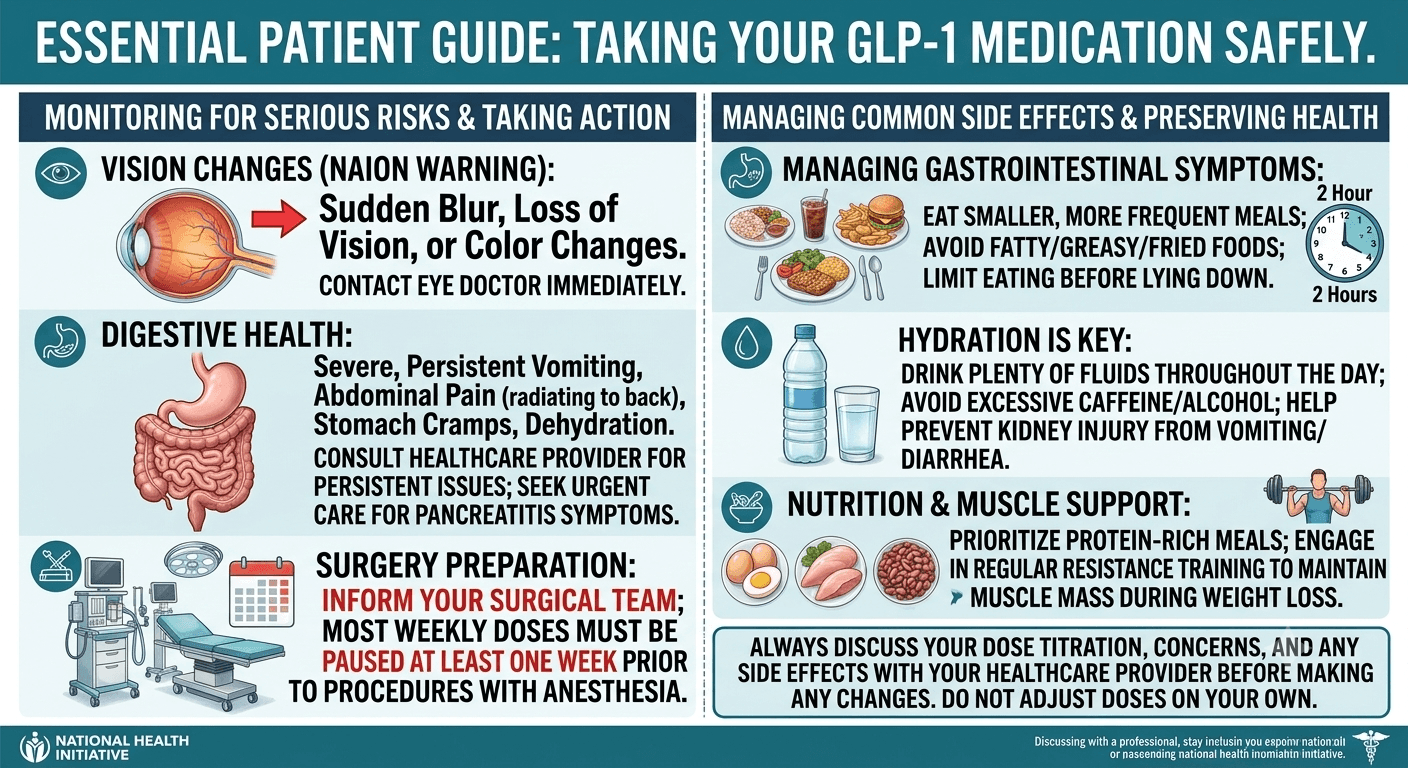
Seek Emergency Evaluation: Anyone experiencing sudden, painless vision loss, blurred spots, or altered color vision should contact a healthcare professional or seek emergency medical evaluation immediately.
Ophthalmologic Referral: If NAION is suspected, doctors are advised to order an immediate referral to a specialist or neuro-ophthalmologist for baseline disk examination.
Weighing Treatment Continuation: For patients diagnosed with NAION while taking a GLP-1 RA, clinicians must evaluate stopping the drug by weighing individual microvascular risks against essential benefits like glycemic control and cardiovascular protection.
Medical Disclaimer
Disclaimer: This article is intended solely for informational, educational, and news reporting purposes. It does not constitute formal medical advice, clinical diagnosis, or treatment recommendations. Individuals currently taking or considering glucagon-like peptide-1 (GLP-1) receptor agonist or dual-agonist medications should never alter, pause, or discontinue their prescribed dosage without direct consultation with a qualified healthcare provider. Anyone experiencing sudden vision changes, visual field loss, or acute side effects should seek immediate medical evaluation from an ophthalmologist or emergency healthcare facility.