• Home

Business

  • Dashboard
  • My Products
  • Edit Business
  • My Groups

Explore

  • Articles
  • Community
  • Careers
  • Blogs
BONC logo
Get it on Google Play

Products

  • Pricing
  • Explore Industry
  • Explore Category
  • Explore Product
  • About Us

About BONC

  • FAQs
  • Terms and Condition
  • Privacy Policy
  • Refund Policy
  • Blogs

OFFICE LOCATION

Costipro Technologies Pvt. Ltd, Unit no. 235 to 245, Supremework Workspace, 2nd Floor, ILD Trade Center, Sector 47, Sohna Road, Gurgaon, Haryana - 122018

© 2025 - 2026 BONC Network. All rights reserved

BONC Logo
  • Home

Business

  • Dashboard
  • My Products
  • Edit Business
  • My Groups

Explore

  • Articles
  • Community
  • Careers
  • Blogs

Boardroom Independence, Brought to You by the White House: How Trump "Made the Deal" to Rescue Nvidia’s Indispensable CEO

Executive CommentaryBy Global Bserve · 24 Nov 2026

After 11 days of moral outrage and a $1 trillion market panic, Nvidia’s directors suddenly discovered that corporate governance rules are optional when the President calls.

For nearly two weeks, Nvidia’s Board of Directors tried to play the part of a textbook corporate governance body. Following revelations on November 12, 2026, that co-founder and CEO Jensen Huang had engaged in an extramarital affair with an executive at Megaspeed—a Singaporean firm suspected by U.S. intelligence of links to Chinese espionage—alongside undisclosed relationships with Nvidia staff, the board accepted his resignation. Directors named CFO Colette Kress interim chief executive, formed an oversight committee, and signaled that Huang’s departure was permanent.

Then Wall Street suffered its worst weekly rout since the 2008 financial crisis, the White House picked up the phone, and Nvidia’s board abruptly discovered the art of forgiveness. On Monday, November 23, directors unanimously reinstated Huang with immediate effect—proving that in modern Silicon Valley, "board independence" lasts right up until a trillion-dollar market cap starts wobbling and the President of the United States intervenes.

"I Made the Deal": The White House Steps In

If there was any illusion that Nvidia’s dramatic U-turn was an organic boardroom reassessment, President Donald Trump promptly demolished it. Celebrating the news on Truth Social and bragging to CNBC on Monday, Trump openly claimed credit for strong-arming the chipmaker’s directors: "I spoke to them, let me put it that way," Trump said. "And I convinced them… I made the deal".

To give Nvidia’s board the political cover it desperately needed, senior administration officials assured directors that restoring Huang posed "no national security risk". Simultaneously, the Commerce Department moved to isolate the supply-chain embarrassment by formally placing Megaspeed on a U.S. trade blacklist over allegations of illicitly funneling restricted AI chips to China.

For investors, the episode exposed the true hierarchy of power governing the AI economy:

  • Wall Street Panic as Policy Catalyst: Nvidia’s plunge during Huang’s 11-day exile dragged down the S&P 500 and Nasdaq, prompting Trump to argue that Huang’s leadership is indispensable to U.S. economic competitiveness.

  • A $952 Billion Relief Rally—With Strings Attached: Markets cheered the executive override on Monday, sending Nvidia shares up more than 31% to close at $165.05 (lifting its market cap back near $3.98 trillion) and igniting the strongest single-day rally for the Nasdaq (+6.5%) and S&P 500 (+4.7%) since April 2025. Yet by Tuesday, Nvidia shares slipped more than 4% in early trading as institutional desks digested the incoming political storm.

Capitol Hill Erupts Over Conflicts and National Security

Far from putting the scandal to rest, Trump’s personal rescue mission has united Democrats and key Republicans in rare bipartisan outrage—turning a corporate governance failure into an explosive Washington investigation.

  • Conflict-of-Interest Scrutiny: Financial disclosures filed with the Office of Government Ethics revealed that Trump held up to 370,000 shares of Nvidia stock—meaning the President personally gained up to $15 million on Monday alone from the very stock surge his lobbying engineered. Senate Democratic Leader Chuck Schumer vowed sweeping investigations into Trump, Huang, and Nvidia executives, accusing the administration of putting "financial interests and the needs of his billionaire buddies before our national security" and pointing to a $25 million donation from Nvidia accepted during a May trip to Beijing.

  • Republican Pushback: Even GOP lawmakers broke ranks. Texas Senator John Cornyn publicly mocked the board’s statement on X ("No national security risk? Based on what?"), while Nebraska Senator Pete Ricketts declared that Huang’s behavior "does not support reinstatement". Louisiana Senator John Kennedy—who memorably quipped that Huang’s affair was "the most expensive sex since Helen of Troy"—criticized government meddling in private CEO picks while targeting Commerce Secretary Howard Lutnick over delayed export restrictions on Megaspeed.

  • Incoming Congressional Gauntlet: Incoming House Oversight Chair Robert Garcia warned that Trump’s involvement "raises serious national security and corruption questions," while incoming Senate Banking Chair Elizabeth Warren demanded to know who inside the administration cleared Huang’s return.

What It Means for Investors: Founder Immunity Meets Regulatory Crossfire

Nvidia’s board is attempting to patch over its credibility crisis by pairing Huang’s return with a new National Security and Export Control Oversight Committee and an external search for a Chief Compliance Officer. For shareholders, however, the takeaway is unmistakable:

  1. Zero Succession Bench: Three decades of Huang running a flat organization with no groomed successor left Nvidia’s board helpless when crisis struck. Without him, the company’s valuation suffered an immediate key-person collapse.

  2. A Permanent Political Target: By relying on presidential intervention to bypass its own conduct standards, Nvidia traded short-term market panic for long-term regulatory warfare. Huang still faces a closed-door transcribed interview with three House committees on December 1 and a high-stakes public grilling before the Senate Banking Committee alongside Commerce Secretary Howard Lutnick on December 3.

Jensen Huang may have his corner office back, and Wall Street may have its favorite AI rally intact—but between DOJ probes, congressional subpoenas, and a board whose independence now carries a presidential asterisk, Nvidia’s second act begins under the brightest, harshest spotlight in corporate America.

#Nvidia#NVDA#JensenHuang#DonaldTrump#CorporateGovernance#KeyPersonRisk#WallStreet#InvestorInsights#Semiconductors#usapresident

Comments

No comments yet

Be the first to share your thoughts.

Latest Articles

View all

Company Articles

  • Wash Basins, Sanitaryware & Fittings Industry: India, China, USA, Japan and Europe Driving Growth Through Innovation and Modern Construction

    Wash Basins, Sanitaryware & Fittings Industry: India, China, USA, Japan and Europe Driving Growth Through Innovation and Modern Construction

    Bubai Roy · a day ago

  • PCB Modules and Electronic Components Market: Growth Drivers, Leading Brands and Future Outlook

    PCB Modules and Electronic Components Market: Growth Drivers, Leading Brands and Future Outlook

    RANA ELECTRONICS · a day ago

  • Commercial Furniture Industry: How India, China, Germany and Italy Are Shaping the Global Market

    Commercial Furniture Industry: How India, China, Germany and Italy Are Shaping the Global Market

    Md Ashfaque · a day ago

  • Industrial Piping Solutions Market: Global Growth, Major Manufacturers and Emerging Opportunities in India, China, Germany and the USA

    Industrial Piping Solutions Market: Global Growth, Major Manufacturers and Emerging Opportunities in India, China, Germany and the USA

    Sushil Shroff · a day ago

  • Domestic Fans, Air Conditioners and Coolers Market: Emerging Trends, Key Manufacturers and Future Opportunities

    Domestic Fans, Air Conditioners and Coolers Market: Emerging Trends, Key Manufacturers and Future Opportunities

    Nazakat ali · a day ago

Networking Articles

  • SpaceX & Starmind: The $250 Billion Orbital AI Hyperscale Revolution

    SpaceX & Starmind: The $250 Billion Orbital AI Hyperscale Revolution

    BONC NETWORK · few months ago

  • Poundland Collapse: 11,000 Jobs at Risk -  A 36-Year Retail Giant Falls

    Poundland Collapse: 11,000 Jobs at Risk - A 36-Year Retail Giant Falls

    BONC NETWORK · few months ago

  • Airbus & BYD: Two Strategic Moves Reshaping the Global Aerospace and Automotive Industries

    Airbus & BYD: Two Strategic Moves Reshaping the Global Aerospace and Automotive Industries

    Global Bserve · few months ago

  • Altria & Imperial Brands: The $157 Billion Consolidation of Big Tobacco

    Altria & Imperial Brands: The $157 Billion Consolidation of Big Tobacco

    SevenO17 Technologies · few months ago

  • Huawei Ascend, Cambricon, and the Chinese AI Silicon Ecosystem: Navigating the Post-Nvidia Shift

    Huawei Ascend, Cambricon, and the Chinese AI Silicon Ecosystem: Navigating the Post-Nvidia Shift

    Vikas Garg · few months ago

More from Global Bserve

Airbus & BYD: Two Strategic Moves Reshaping the Global Aerospace and Automotive Industries
General Updates

Airbus & BYD: Two Strategic Moves Reshaping the Global Aerospace and Automotive Industries

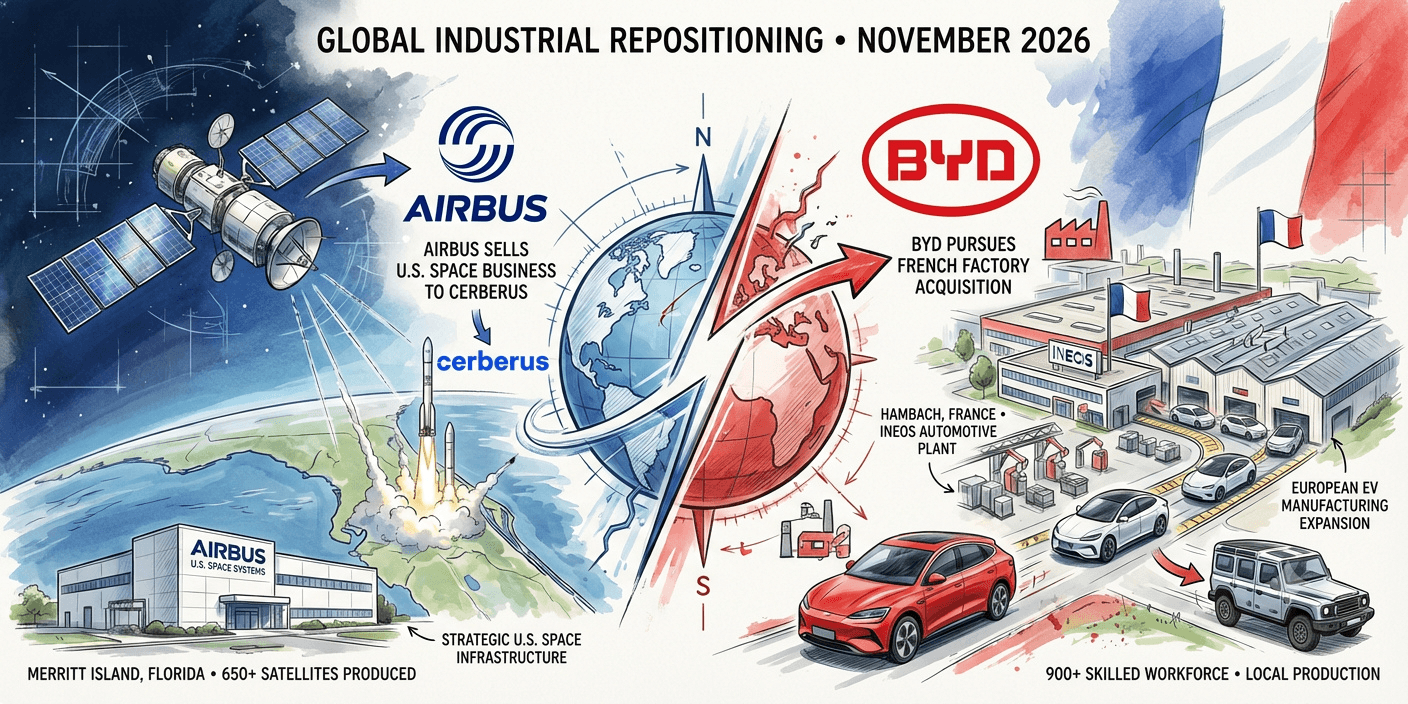
Explore Airbus's U.S. space business sale to Cerberus and BYD's proposed French factory acquisition, financial impact and global industry implications. 1. What's more focused for Executives Two significant developments involving Airbus, Cerberus Capital Management, BYD and Ineos Automotive highlight the changing dynamics of global industrial ownership. On November 24, 2026, Airbus announced an agreement to sell its U.S. Space Systems business to American investment firm Cerberus Capital Management. Separately, Chinese automotive manufacturer BYD entered exclusive negotiations to acquire Ineos Automotive's Hambach manufacturing facility in France. Although these transactions concern different industries, they share a common objective: restructuring industrial assets to improve market access, strengthen regional manufacturing capabilities and respond to changing geopolitical and economic conditions. Airbus is streamlining its international space operations, Cerberus is expanding into strategic American satellite manufacturing, BYD is pursuing a stronger European production presence, and Ineos is reassessing its international manufacturing footprint. 2. Announcement Dates and Transaction Timelines Airbus–Cerberus The agreement was announced on November 24, 2026, with completion expected by the end of 2026, subject to customary closing conditions. The transaction covers Airbus's U.S. Space Systems business, headquartered in Merritt Island, Florida. The operation has approximately 200,000 square feet of manufacturing infrastructure and a history of producing and launching more than 650 satellites. BYD–Ineos On November 24, 2026, BYD confirmed exclusive negotiations to acquire Ineos Automotive's Hambach plant in north-eastern France. Unlike the Airbus transaction, this remains a proposed acquisition rather than a completed sale. Employee consultations, commercial negotiations and regulatory requirements remain important conditions. Neither company has disclosed the purchase price or a definitive completion date. 3. Airbus–Cerberus: Reshaping the Space Industry Airbus is one of the world's leading aerospace and defence manufacturers, operating across commercial aviation, military aircraft, helicopters, satellites and space technologies. Its U.S. Space Systems business provides satellite engineering, manufacturing, integration and testing capabilities for commercial and government customers. For Cerberus, the acquisition provides access to an established manufacturing platform, specialised engineering talent and long-standing customer relationships. The investment firm intends to develop the business through additional investment in engineering, product development and domestic supply-chain capabilities. The transaction also reflects Airbus's wider space-sector restructuring. Its separate strategic combination of space activities with Leonardo and Thales is intended to strengthen European competitiveness, improve operating efficiency and build greater technological independence. The U.S. disposal should therefore be viewed as a portfolio restructuring decision rather than an exit by Airbus from the global space industry. 4. Cerberus: The Financial and Strategic Opportunity Cerberus Capital Management is an American alternative investment firm with interests across private equity, credit, real estate and industrial investments. Satellite manufacturing is an attractive strategic sector because demand is expanding across defence, secure communications, navigation, intelligence, weather monitoring and commercial connectivity. The industry is also moving towards more distributed satellite networks, creating opportunities for manufacturers with established production capabilities. Cerberus is acquiring an existing industrial platform rather than building one from scratch. Its future performance will depend on winning new government and commercial contracts, maintaining engineering talent, controlling production costs and investing in next-generation satellite technologies. 5. BYD–Ineos: Why the French Factory Matters BYD's proposed acquisition of the Hambach plant could significantly strengthen its European manufacturing strategy. Located in north-eastern France, close to the German border, the facility has a long automotive manufacturing history. Originally developed for Smart vehicle production, it was acquired by Ineos Automotive from Mercedes-Benz in 2020. Ineos subsequently adapted the facility to manufacture its Grenadier off-road SUV, with production beginning in 2022. The plant employs just under 900 people. For BYD, the acquisition offers access to established production infrastructure, skilled workers and European supplier networks. Potential advantages include: Faster entry into European manufacturing. Reduced logistics and distribution costs. Better proximity to European customers. Greater flexibility in responding to trade barriers. Opportunities to strengthen local sourcing. Access to an established automotive industrial ecosystem. BYD has indicated its intention to maintain production and support employment at the facility. However, the future vehicle portfolio, production volumes and investment commitments have not been publicly finalised. 6. BYD's Growth: From Battery Manufacturer to Global Automotive Powerhouse Founded in 1995, BYD initially focused on rechargeable battery manufacturing. Its entry into automotive manufacturing in 2003 marked a major diversification. The company subsequently developed electric vehicles, plug-in hybrids, battery systems, commercial vehicles and energy-storage solutions. The introduction of its F3DM plug-in hybrid in 2008 was an important milestone in its electrification strategy. Over time, investments in Blade Battery technology, vertically integrated manufacturing and electric powertrains strengthened its international competitiveness. BYD has increasingly moved beyond exporting finished vehicles towards establishing regional manufacturing operations. Its international expansion includes manufacturing investments and projects in Thailand, Brazil and Hungary, among other markets. The proposed Hambach acquisition would complement this strategy by giving BYD another potential production base within Europe. 7. Ineos Automotive: A Changing Manufacturing Strategy Ineos Automotive entered the vehicle industry in 2017, developing rugged off-road vehicles under the Grenadier brand. Its acquisition of the Hambach facility in 2020 provided an established manufacturing base. Production began in 2022, followed by the introduction of the Quartermaster pickup. However, operating at competitive scale in the premium off-road segment presents challenges involving production costs, international demand and distribution. The United States is an important market for Ineos. Its plans to begin manufacturing Grenadier and Quartermaster vehicles there in 2028 indicate a strategic shift towards producing closer to major customers. The proposed Hambach sale could allow Ineos to monetise an industrial asset while reorganising its international manufacturing footprint. 8. Potential Financial Impact Neither transaction has a publicly disclosed purchase price. Therefore, precise acquisition valuations, projected returns and immediate financial gains cannot yet be established. Nevertheless, the potential financial implications are significant. For Airbus: The disposal could generate cash proceeds, reduce operational complexity and allow management to concentrate resources on strategic aerospace and European space activities. For Cerberus: The investment offers potential long-term earnings from satellite manufacturing, government contracts, commercial space programmes and expanded engineering capabilities. However, substantial investment will be required. For BYD: Acquiring an operational factory could reduce the time and infrastructure costs associated with building a new European manufacturing facility. Future returns will depend on production utilisation, vehicle demand, modernisation costs and local sourcing. For Ineos: The proposed sale could release capital and support its planned U.S. manufacturing expansion. Its financial outcome will depend on the acquisition terms and transitional production arrangements. 9. What Will Change Across Global Industries? Aerospace and defence: The Airbus transaction could strengthen the independent American satellite manufacturing ecosystem, creating opportunities for domestic electronics, engineering, precision manufacturing and component suppliers. European automotive manufacturing: BYD's potential French production base could intensify competition for established manufacturers such as Volkswagen, Stellantis, Renault and other electric vehicle producers. Global supply chains: Both transactions reinforce the growing importance of regional manufacturing, secure sourcing, technological independence and proximity to customers. Industrial ownership: Manufacturing facilities are increasingly valued for their location, workforce, technology and strategic importance, rather than simply their production capacity. 10. Practical Challenges and Regulatory Risks The Airbus–Cerberus transaction must address customer-contract continuity, security clearances, sensitive intellectual property, technology-transfer restrictions and workforce retention. The acquired business will need to maintain existing programmes while developing an independent commercial strategy. For BYD, the immediate challenge is completing negotiations and employee consultations. Further investment may be needed to modernise equipment, integrate battery and powertrain systems, establish supplier relationships and adapt production lines. European governments also face a delicate balance between attracting foreign investment, protecting domestic manufacturing and maintaining technological independence. Local manufacturing does not automatically exempt a foreign-owned company from all trade restrictions, tariffs or regulatory obligations. Ineos, meanwhile, must ensure that its planned U.S. manufacturing operation is commercially viable and that the transition does not disrupt existing customer deliveries. 11. Changing Geopolitical and Economic Dynamics United States: Cerberus's acquisition aligns with the growing emphasis on domestic space infrastructure, national security and resilient satellite supply chains. France: The BYD proposal offers an opportunity to preserve an established automotive facility, retain industrial employment and attract additional investment. Europe: BYD's manufacturing ambitions could intensify pressure on European manufacturers to improve battery economics, production efficiency and electric vehicle competitiveness. China: BYD's strategy reflects a broader shift among Chinese manufacturers from exporting products towards establishing regional manufacturing and supplier networks. Global industry: Companies are increasingly aligning production locations with customer markets, regulatory conditions and geopolitical priorities. 12. What Should Businesses and Investors Watch Next? For Airbus and Cerberus, the key indicators will be transaction completion, future investment commitments, new satellite contracts and operational continuity. For BYD and Ineos, attention should focus on final acquisition terms, employee consultations, factory investment, production agreements and the selection of future vehicle models. Suppliers in aerospace electronics, satellite components, batteries, automotive electronics, powertrains and precision engineering could benefit from the resulting industrial restructuring. 13. What's for the Future: The Next Phase of Global Industrial Competition The Airbus–Cerberus and BYD–Ineos developments represent more than two corporate ownership changes. They illustrate how international businesses are repositioning technology, manufacturing capacity, capital and supply chains to compete in an increasingly complex global economy. Airbus's U.S. space operation offers Cerberus an established platform in a strategically important technology sector. BYD's proposed Hambach acquisition could strengthen its European manufacturing presence, while Ineos prepares to realign production towards the American market. The next industrial advantage may not simply belong to the company producing the best product. It may belong to the company that controls the right technology, operates in the right geography and builds the strongest regional industrial network.

#Airbus#BYD#Cerberus
Global Bserve
Morocco’s Rise Signals a New Investment Landscape in Africa: Manufacturing, Infrastructure and Economic Reforms Reshape Investor Priorities
Industry Report

Morocco’s Rise Signals a New Investment Landscape in Africa: Manufacturing, Infrastructure and Economic Reforms Reshape Investor Priorities

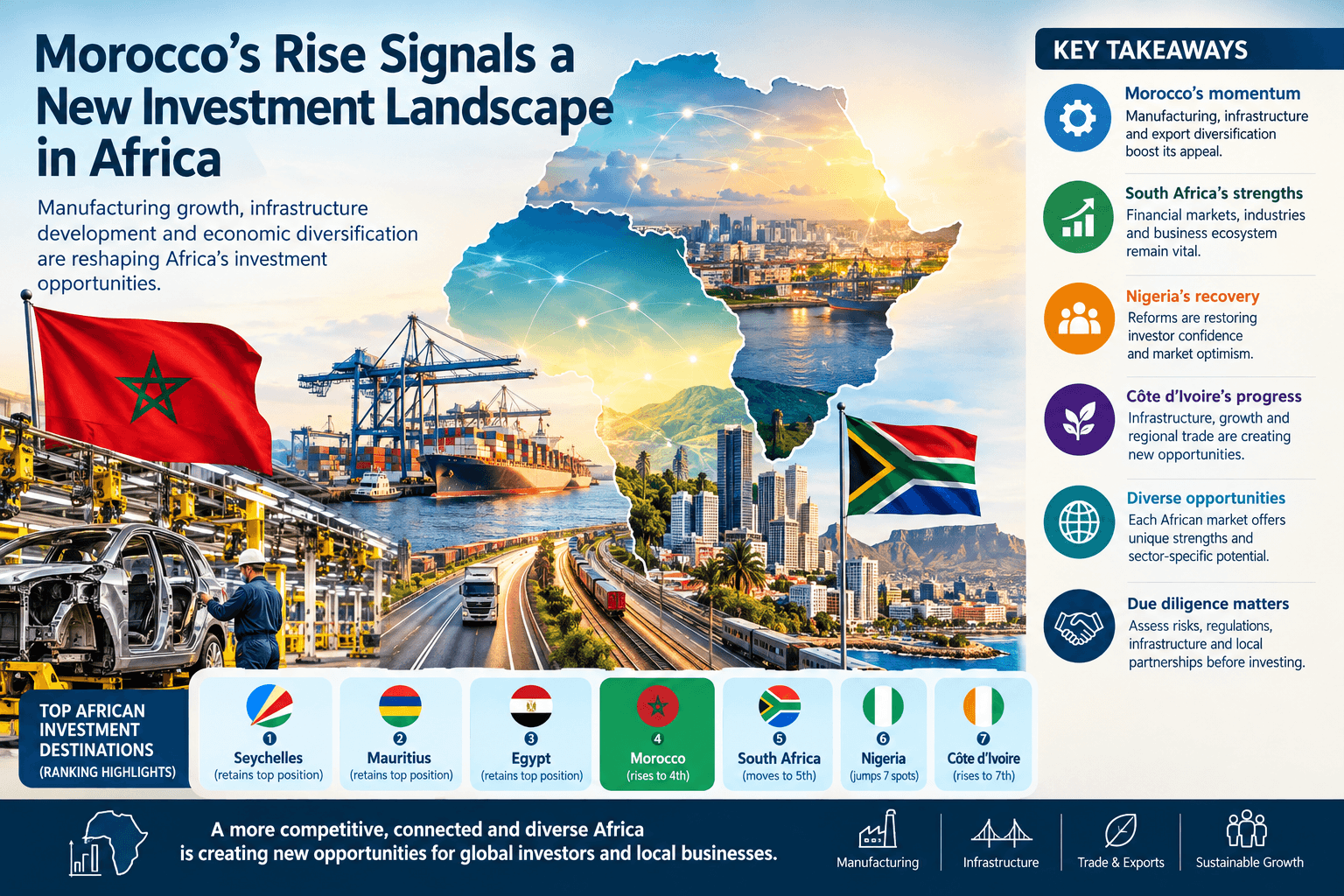
Africa’s investment landscape is evolving as countries strengthen their industrial capabilities, modernise infrastructure and compete for international capital. Morocco’s growing appeal highlights this shift. According to an assessment by Rand Merchant Bank (RMB), a subsidiary of FirstRand Ltd., Morocco has overtaken South Africa to become Africa’s fourth-most attractive investment destination. The development reflects a broader change in how investors assess opportunities across the continent. Market size remains important, but infrastructure, policy stability, manufacturing capacity, export access and the ease of conducting business are increasingly influential. Morocco’s progress illustrates how sustained investment in industrial development and international trade connections can improve a country’s position. Meanwhile, South Africa continues to offer significant advantages, including a sophisticated financial sector, established industries and a substantial consumer market. The changing rankings do not necessarily indicate that one economy has replaced another in overall strength. Instead, they demonstrate how different countries are positioning themselves to attract capital in an increasingly competitive global environment. Key Takeaways Morocco’s manufacturing capabilities and export-oriented strategy are strengthening its investment appeal. Infrastructure investment and industrial development can help attract long-term capital. South Africa remains an important economic centre despite increased competition. Nigeria, Côte d’Ivoire, Egypt, Mauritius and other markets offer distinct investment opportunities. Investors increasingly evaluate operational conditions, market access and economic resilience alongside market size. Africa’s long-term potential depends on productive investment, skills development, infrastructure and stronger regional trade. Morocco’s Manufacturing Strategy Gains Momentum One of the principal factors supporting Morocco’s investment profile is its focus on manufacturing. Rather than relying exclusively on traditional economic activities, the country has worked to develop industries that can participate in international supply chains. Automotive manufacturing is an important example. Morocco has attracted investment in vehicle assembly and automotive components, helping establish industrial ecosystems that connect manufacturers, suppliers, logistics providers and exporters. This approach can generate benefits beyond the factories themselves. Component manufacturers, packaging companies, industrial equipment suppliers, transport operators and technical service providers may also find opportunities as production networks expand. Morocco’s aerospace activities, renewable-energy ambitions and other industrial initiatives further demonstrate its efforts to diversify economic activity. However, the long-term benefits depend on productivity, local supplier development, workforce capabilities and the ability of domestic businesses to move into higher-value activities. Investment pointer: Businesses considering Morocco should assess opportunities across the wider manufacturing ecosystem, not only among major international manufacturers. Supporting industries and specialised services can be important parts of the value chain. Infrastructure Strengthens Morocco’s Competitive Position Reliable infrastructure is central to investment decisions. Manufacturers and exporters need efficient transport, dependable utilities, access to ports and predictable movement of goods. Morocco has invested in transport links, port capacity and industrial zones to support trade and manufacturing. Its geographic position between Europe and Africa can also be advantageous for companies seeking to diversify production locations and serve multiple markets. Infrastructure improvements can reduce logistical friction, support industrial clustering and make it easier for companies to connect with suppliers and customers. These advantages are particularly relevant for export-oriented businesses operating under tight delivery schedules. Nevertheless, infrastructure quality should be evaluated at the project level. Access, cost, capacity and reliability may differ between locations and industrial zones. Investors must also consider energy costs, water availability, workforce access and the time required to establish operations. Investment pointer: Companies exploring Morocco should compare industrial locations based on total operating costs, logistics access, utilities, labour availability and proximity to target customers. South Africa Remains a Major Economic Force Morocco’s rise in investment attractiveness should not be interpreted as a decline in the overall importance of South Africa. The country continues to possess substantial economic strengths, including developed financial markets, established professional services, industrial capabilities and a broad business ecosystem. South Africa has experience across mining, manufacturing, agriculture, financial services, technology and retail. Its established corporate sector and financial infrastructure can support investors seeking access to sophisticated business services and regional opportunities. At the same time, challenges involving infrastructure reliability, logistics performance, economic growth and policy uncertainty can influence investor confidence. Addressing these constraints is important for improving competitiveness and encouraging new productive investment. South Africa’s investment outlook therefore depends not only on its existing strengths but also on its ability to improve operating conditions, expand infrastructure capacity and create an environment in which businesses can plan with greater certainty. Investment pointer: Investors should distinguish between country-level perceptions and sector-specific fundamentals. South Africa may remain highly competitive in particular industries even as other African economies improve their relative positions. Nigeria: Scale and Market Potential Nigeria remains a major market because of its population, entrepreneurial activity and broad consumer demand. Its economy offers opportunities across consumer goods, agriculture, financial technology, telecommunications, energy and business services. The size of the domestic market can attract companies seeking long-term growth. Local production, distribution networks and services adapted to consumer needs may offer routes into the economy. However, market size alone does not guarantee commercial success. Currency volatility, inflation, infrastructure constraints, financing costs and regulatory complexity can affect business performance. Companies considering Nigeria need detailed assessments of customer purchasing power, pricing, foreign-exchange exposure, payment systems and distribution capabilities. Investment pointer: Businesses should build realistic operating scenarios and evaluate how currency movements, logistics costs and financing requirements could affect profitability. Côte d’Ivoire and the Growth of West Africa Côte d’Ivoire has developed an increasingly important role in West Africa, supported by economic activity, infrastructure development and its position within regional commercial networks. Agriculture and related processing industries remain significant, while construction, consumer services, logistics and manufacturing can offer opportunities as urbanisation and business activity expand. For international companies, the country may provide a platform for exploring wider regional demand. Yet entering a market successfully requires understanding local regulations, customer preferences, distribution arrangements and competitive conditions. Regional expansion should not be treated as a uniform strategy. Countries within West Africa have different currencies, regulatory frameworks, commercial practices and levels of infrastructure development. Investment pointer: Businesses should evaluate Côte d’Ivoire both as a domestic market and as a possible starting point for a carefully planned regional strategy. Other African Markets Offer Different Advantages Africa’s investment landscape cannot be understood through a single ranking. Countries offer different combinations of market access, specialist capabilities, natural resources, financial services and economic conditions. Mauritius, for example, has developed a profile in financial and professional services. Egypt offers a large domestic market and industrial opportunities, while Seychelles has a distinctive position in tourism and selected services. Other economies may offer opportunities linked to agriculture, renewable energy, mining, digital services or regional trade. The attractiveness of each destination depends on the investor’s industry, investment horizon and business objectives. Smaller economies can be competitive in specialised activities even when they cannot match the scale of larger markets. Conversely, a large economy may offer significant demand but require more complex distribution, financing and operational arrangements. Investment pointer: Companies should identify the business outcome they need before selecting a destination. A market suited to manufacturing exports may not be the best choice for consumer retail, financial services or resource-based projects. What Investment Attractiveness Rankings Really Measure Investment rankings provide useful comparisons, but they should be interpreted carefully. They generally assess a combination of economic, financial, institutional and business-related indicators. The precise methodology depends on the organisation producing the ranking. A country’s position may reflect its projected economic opportunities, market conditions, investment climate or other measures. It does not automatically represent the amount of foreign investment received, the profitability of individual projects or the absence of risk. Investors should also distinguish between investment attractiveness, actual capital inflows and realised economic outcomes. A country may attract considerable interest without every announced project proceeding to completion. For this reason, the reported change in Morocco’s position is best understood as a signal of evolving investor priorities rather than definitive proof that Morocco is superior to South Africa across all economic measures. Readers should consult the latest RMB report to verify the ranking, publication date and methodology before citing the figures in a business or investment decision. Supply-Chain Diversification Creates New Opportunities Global businesses have been reassessing how they manufacture, source and distribute products. Factors such as geopolitical uncertainty, transport disruption, changing trade policies and the need for greater supply-chain resilience have encouraged some companies to consider additional production locations. African economies that can provide reliable infrastructure, skilled workers, competitive operating costs and access to target markets may benefit from this shift. Morocco’s industrial development illustrates how manufacturing capacity and international connectivity can support participation in cross-border supply chains. Other African economies may also benefit where their capabilities align with industry requirements. However, supply-chain diversification involves more than selecting a country with lower costs. Businesses must examine supplier quality, delivery reliability, workforce training, customs procedures, access to finance and the availability of supporting industries. Investment pointer: Investors should assess whether a location can meet long-term operational requirements, rather than basing decisions solely on labour costs or short-term incentives. Opportunities for Small and Medium-Sized Businesses Large manufacturers and international investors are not the only businesses that can benefit from Africa’s changing investment environment. Small and medium-sized enterprises may find opportunities by serving the suppliers, distributors and service providers associated with expanding industries. Potential areas include industrial maintenance, packaging, warehousing, transport, business software, technical consulting, workforce training, equipment supply and professional services. Companies entering new markets may also need local partners who understand customer behaviour, compliance requirements and distribution channels. This can create opportunities for domestic businesses with specialised knowledge and reliable delivery capabilities. At the same time, smaller firms must carefully manage payment terms, working capital, contract obligations and customer concentration. Winning a contract with a major company can create growth opportunities, but it can also place pressure on cash flow and production capacity. Investment pointer: SMEs should identify a specific capability they can deliver competitively, develop credible business documentation and build relationships with potential buyers, suppliers and industry partners. Due Diligence Remains Essential Even in countries experiencing positive investment momentum, investors must conduct thorough due diligence. Key considerations include: Regulatory environment: Understand business registration, licensing, taxation, employment rules and sector-specific requirements. Financial exposure: Evaluate currency movements, interest rates, financing availability and repatriation arrangements where relevant. Infrastructure: Confirm the availability and reliability of electricity, water, transport, telecommunications and industrial facilities. Market demand: Validate customer requirements, purchasing power, competition and realistic sales forecasts. Local partnerships: Assess prospective partners’ financial standing, reputation, operational capability and contractual commitments. Workforce: Examine labour availability, skills, training needs and employment obligations. Political and economic conditions: Consider policy changes, trade arrangements and country-specific risks. Sustainability: Evaluate environmental requirements, resource availability and the long-term resilience of the proposed operation. Incentives and favourable rankings can support a business case, but they should never replace independent analysis. Investors should also verify the terms of any incentive directly with the relevant authorities and qualified advisers. Africa’s Investment Future: Competition and Collaboration The changing positions of African investment destinations reflect a continent with diverse economic opportunities and increasingly differentiated business environments. Morocco’s progress demonstrates the potential value of sustained industrial development, infrastructure investment and international trade integration. South Africa continues to offer established capabilities and a substantial business ecosystem. Nigeria brings market scale, while Côte d’Ivoire and other economies offer opportunities shaped by their regional roles and sector strengths. The next phase of investment growth will depend on whether countries can translate investor interest into productive capacity, sustainable employment, stronger domestic businesses and broader economic participation. Infrastructure, skills, regulatory predictability, access to finance and regional cooperation will remain important. So will the ability of domestic firms to participate in supply chains instead of remaining on the margins of investment-led growth. For businesses, the key is not to follow rankings blindly. It is to identify where their products, services, expertise and capital can solve real problems and generate sustainable value. Conclusion Morocco’s reported move ahead of South Africa in RMB’s assessment of Africa’s most attractive investment destinations highlights the changing dynamics of the continent’s economy. Manufacturing growth, infrastructure development and export diversification are helping Morocco strengthen its position in international business discussions. South Africa, meanwhile, retains important advantages that continue to make it relevant to investors. Other markets across the continent offer distinct opportunities depending on the sector, scale and purpose of an investment. The broader lesson is that Africa should not be viewed as a single investment market. Its economies differ significantly in capabilities, risks, consumer demand and business conditions. For investors and businesses, long-term success will depend on informed market selection, rigorous due diligence and the ability to develop strong local relationships. As competition for investment continues, countries that combine credible policies with productive infrastructure and a supportive business environment will be better placed to convert opportunity into lasting economic growth. Synopsis Morocco’s reported rise above South Africa in RMB’s assessment of Africa’s investment destinations highlights the growing importance of manufacturing, infrastructure and export diversification. This article explores Morocco’s industrial strategy, South Africa’s continuing economic strengths, opportunities in Nigeria and Côte d’Ivoire, and the wider factors shaping investment across Africa. It also examines supply-chain diversification, opportunities for SMEs and the importance of due diligence when entering new markets.
#AfricaInvestment#Morocco#SouthAfrica
Global Bserve