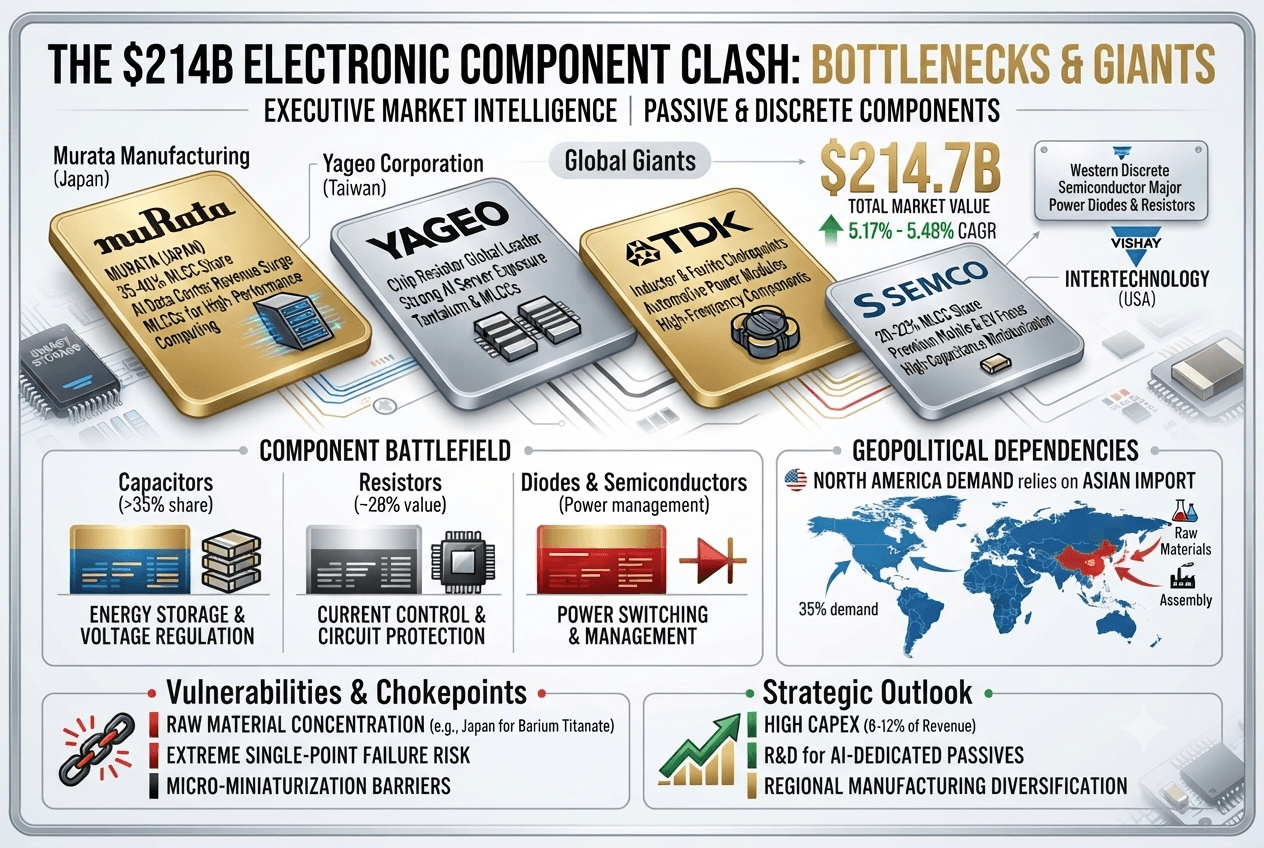
Global Electronics Component Industry 2026–2030: AI Boom, Critical Component Shortages and the Battle for Supply-Chain Dominance
Key financial numbers: The industry is entering a high-growth phase
The latest reported financial results from major manufacturers reveal how rapidly demand is shifting towards advanced passive and power electronic components.
Murata Manufacturing | Japan
¥1.09 trillion | First-half FY2027 revenue | +20.8% YoY
FY2027 revenue forecast: ¥2.26 trillion, representing 23.4% growth. Capacitor revenue is forecast to increase 36.3%.
TDK Corporation | Japan
¥1.56 trillion | First-half FY2027 revenue | +31.9% YoY
Passive component revenue reached ¥358.0 billion, growing 25.3%. Its passive component operating profit increased 167.9%.
Samsung Electro-Mechanics | South Korea
₩3.76 trillion | Q3 2026 revenue | +30% YoY
Operating profit reached ₩691 billion, increasing 165%. Its component division generated ₩1.883 trillion in quarterly sales.
Vishay Intertechnology | United States
$1.29 billion | Q3 2026 company-wide book-to-bill ratio
Management reported strengthening AI server and power demand, alongside tighter supply conditions for selected inductors and resistors.
Reporting-period clarification: Murata and TDK figures cover April–September 2026; Samsung figures are for July–September 2026. Vishay's figure above is an order-to-billing indicator, not revenue growth.
Global industry leaders: Who controls the critical component ecosystem?
The competitive landscape is concentrated across a handful of technologically advanced manufacturing economies.
Passive component leaders
Murata Manufacturing – Japan: Advanced MLCCs, inductors, EMI filters and electronic modules.
TDK Corporation – Japan: Capacitors, inductors, ferrite materials, sensors and magnetic components.
Samsung Electro-Mechanics – South Korea: High-capacitance MLCCs and advanced electronic substrates.
YAGEO Corporation – Taiwan: Resistors, capacitors, inductors and circuit protection products.
Taiyo Yuden – Japan: High-performance capacitors and inductors.
Vishay Intertechnology – United States: Passive components and discrete semiconductors.
Kyocera AVX – Japan/United States: Tantalum, ceramic and specialised capacitors.
Panasonic Industry – Japan: Film capacitors, aluminium capacitors and electronic materials.
Walsin Technology – Taiwan: Chip resistors, MLCCs and inductors.
Nichicon – Japan: Aluminium electrolytic and film capacitors.
Discrete semiconductor and power electronics leaders
Infineon Technologies – Germany: MOSFETs, IGBTs and SiC power devices.
STMicroelectronics – Europe: Power transistors, rectifiers and automotive semiconductors.
onsemi – United States: Silicon carbide, MOSFETs and power management.
ROHM Semiconductor – Japan: SiC devices, power MOSFETs and diodes.
Nexperia – Netherlands: Discrete transistors, diodes and MOSFETs.
Littelfuse – United States: Circuit protection and power semiconductor technologies.
These companies do not compete in identical product categories. Their collective importance comes from controlling different stages of the electronic component supply chain, from materials and manufacturing to qualified components for high-reliability applications.
1. What exactly is driving the component market?
Passive and discrete components are the foundation of modern electronics. They may not receive the same attention as GPUs and processors, but virtually every electronic product depends on them.
Passive components manage electrical energy and signals:
MLCCs: Power stabilisation, filtering and voltage regulation.
Aluminium and tantalum capacitors: Energy storage and power conditioning.
Film capacitors: EV inverters, industrial drives and renewable energy.
Inductors: Power conversion, current regulation and noise suppression.
Resistors: Current control, sensing and precision circuits.
Discrete semiconductor components control the movement of electricity:
MOSFETs: Switching and power conversion.
IGBTs: Industrial drives, EVs and high-power applications.
SiC devices: High-efficiency EV and industrial power systems.
Diodes and rectifiers: Current conversion and protection.
TVS devices: Protection against electrical surges.
The most important market shift is towards components that can withstand higher power densities, greater temperatures, faster switching frequencies and increasingly demanding operating conditions.
2. The biggest demand opportunity: High-end MLCCs and power components
Critical component watch
Multilayer Ceramic Capacitors (MLCCs) are emerging as one of the most strategically important components in the AI infrastructure supply chain.
Advanced GPU servers require thousands of capacitors to maintain stable voltage delivery. As processing capacity increases, the supporting electrical architecture becomes more complex.
A notable example is the reported specification change in AMD's MI450 platform. The requirement for a particular 47μF MLCC specification reportedly increased from 1,440 to 10,544 units per board.
That is an increase of approximately 632% for that particular component specification.
NVIDIA's Vera Rubin platform has also been associated with an increase in a particular 100μF MLCC requirement, from 320 to 500 units.
These examples illustrate the growing component intensity of advanced AI computing. They should not be interpreted as equivalent increases in total capacitor demand across every GPU platform.
Other areas experiencing demand pressure include:
High-capacitance and high-voltage MLCCs.
High-current inductors and power chokes.
Polymer tantalum and specialised capacitors.
Automotive-grade power MOSFETs.
Silicon carbide and IGBT devices.
High-reliability resistors and protection components.
The shortage problem is primarily specification-driven. Conventional commodity components may remain available while advanced, tightly qualified products face extended delivery periods.
3. Why AI is changing the economics of the industry
The AI revolution is expanding the electronics component market through several interconnected developments.
GPU and accelerator expansion: More powerful AI processors require sophisticated voltage regulation, higher-capacitance MLCCs and advanced power-delivery systems.
Hyperscale data centres: Companies such as NVIDIA, Microsoft, Amazon and Google are expanding infrastructure that consumes substantial quantities of supporting electronic components.
Custom AI processors: ASIC development by major cloud companies creates additional demand beyond conventional GPU platforms.
Power and cooling infrastructure: High-density data centres require increasingly sophisticated power supplies, conversion systems, monitoring and protection electronics.
TDK's first-half FY2027 performance provides a particularly strong indicator. Its passive components business generated ¥358 billion in sales, with capacitor revenue increasing 32.4% year-on-year. The company also raised its full-year financial outlook following stronger AI data-centre demand.
The implication is significant: AI is creating demand not just for computing chips, but for the entire electrical ecosystem supporting those chips.
4. Global manufacturing dominance and economic dependencies
The component industry is geographically concentrated, with different countries controlling important capabilities.
Japan: Advanced ceramic materials, MLCCs, inductors and precision manufacturing. Murata, TDK and Taiyo Yuden are central players.
South Korea: High-end MLCC manufacturing and advanced electronic substrates, led by Samsung Electro-Mechanics.
Taiwan: A major base for passive components, including Yageo and Walsin, alongside its broader semiconductor ecosystem.
China: Large-scale electronics manufacturing, raw-material processing and expanding domestic component production. Its influence over several critical material supply chains is strategically important.
United States: One of the largest demand centres for AI infrastructure, defense electronics and cloud computing, alongside domestic suppliers such as Vishay and onsemi.
Europe: Particularly important for automotive power semiconductors, industrial electronics and high-reliability components through Infineon, STMicroelectronics and Nexperia.
India: An emerging manufacturing opportunity, supported by electronics production, EV adoption, renewable energy, defense procurement and semiconductor development.
The key vulnerability is the mismatch between demand and production geography. A considerable share of advanced component manufacturing is concentrated in East Asia, while some of the world's largest technology customers are based in the United States and Europe.
5. US–Iran conflict: How geopolitical tensions threaten electronics supply chains
The US–Iran conflict adds a significant risk to an already interconnected global manufacturing ecosystem.
The principal transmission channels are:
Energy costs: Ceramic processing, metal refining and semiconductor manufacturing depend on stable energy supplies. Oil and gas disruptions can increase production costs across Asia and Europe.
Shipping disruptions: Instability around the Strait of Hormuz can increase freight rates, insurance premiums and transportation uncertainty.
Raw materials: Nickel, palladium, silver, specialised chemicals and industrial gases are important inputs across different component categories. Price movements or supply restrictions can affect manufacturing economics.
Defense demand: Military modernisation increases demand for ruggedised capacitors, power semiconductors, protection devices and high-reliability electronics.
Inflation and currency exposure: Higher energy costs and exchange-rate fluctuations can affect component pricing, profitability and procurement budgets.
Other major risks include:
US–China technology restrictions and tariffs.
Potential disruption around Taiwan.
Russia–Ukraine-related energy and commodity volatility.
Earthquakes and natural disasters affecting Japanese and Taiwanese manufacturing.
Export restrictions involving critical minerals and specialised industrial materials.
One important distinction: the Middle East is not the principal production base for advanced MLCCs. The conflict's impact is predominantly transmitted through energy, transportation, commodity prices and global economic uncertainty.
6. Market size and growth: Where is the opportunity?
Market estimates vary depending on whether research firms include interconnects, connectors and other electronic products alongside passive components.
For a broader market reference, Grand View Research estimates the passive and interconnecting electronic components market at approximately US$206.8 billion in 2026, potentially reaching US$258 billion by 2030, representing approximately 5.1% CAGR.
A narrower passive electronic components estimate from Mordor Intelligence places the 2026 market at approximately US$48.45 billion, with a projected increase to US$63.27 billion by 2031, representing approximately 5.48% CAGR.
These are differently defined markets and should not be combined.
My strategic outlook for 2026–2030:
General-purpose passive components: Moderate, mid-single-digit growth.
Advanced MLCCs: Stronger growth, driven by AI computing and automotive electronics.
Inductors and power capacitors: Attractive expansion opportunities.
SiC and advanced power discretes: Structural growth from electrification and industrial applications.
Defense and aerospace components: Increasing strategic importance.
Automotive electronics: Continued expansion through ADAS, EVs and power management.
The fastest-growing opportunities are likely to be specialised products rather than the entire commodity component market.
7. Who stands to benefit, and who faces the greatest challenges?
The strongest beneficiaries are likely to be manufacturers with advanced technology, established customer qualifications, high production yields and the ability to expand capacity.
Murata, TDK and Samsung Electro-Mechanics are strategically positioned in advanced passive components.
Yageo, Walsin and Vishay have opportunities across broader passive component categories.
Infineon, STMicroelectronics, onsemi and ROHM are positioned to benefit from power semiconductor demand.
The greatest pressure may fall on smaller electronics manufacturers, distributors and assemblers that lack long-term procurement agreements.
When specialised components become constrained, large AI and automotive customers can secure production allocations through strategic partnerships. Smaller buyers may encounter longer lead times, higher procurement prices and limited supplier choices.
8. The road ahead: 2027–2030
Five developments will determine the next phase of competition:
Capacity expansion: Investment in advanced MLCCs, capacitors, inductors and power semiconductors.
Supply-chain diversification: Multiple qualified suppliers and geographically distributed manufacturing.
Material innovation: Greater efficiency, alternative materials and improved component designs.
Strategic procurement: Long-term agreements, inventory planning and stronger supplier relationships.
Manufacturing localisation: New investments in India, Southeast Asia, Europe and North America.
India represents an interesting long-term opportunity. Its electronics manufacturing expansion could encourage domestic production of capacitors, resistors, inductors, power modules and discrete components.
However, becoming globally competitive will require specialised materials, precision manufacturing, capital investment, technology partnerships and international quality certifications.
Conclusion: The next global electronics battle may be fought over components rather than chips
The world has been competing aggressively for semiconductor capacity, advanced GPUs and AI processors. But the next supply-chain challenge may emerge from the smaller components that make these technologies function.
AI infrastructure, electric mobility, defense modernisation, renewable energy and industrial automation are collectively increasing demand for advanced passive and discrete components.
The 2026 financial performance of leading manufacturers demonstrates that this is becoming a significant growth opportunity. Yet manufacturing concentration, specialised production requirements and geopolitical disruptions could create persistent bottlenecks.
The next winners in the global electronics industry may not necessarily be the companies making the fastest processors. They could be the companies controlling the essential components, materials and manufacturing technologies that keep those processors running.