Global Electronics Backbone: Market Analysis of Critical Passive & Discrete Component Giants - Capacitors, Resistors, Diodes, and Inductors
The global technology hardware sector relies on an underlying foundation of foundational electronic building blocks: Capacitors, Resistors, Diodes, and Inductors. While central processing units and graphics accelerators generate headlines, every artificial intelligence server, electric vehicle, telecommunications base station, and connected mobile platform requires thousands of passive and discrete active components to manage voltage, filter noise, and regulate electrical currents.
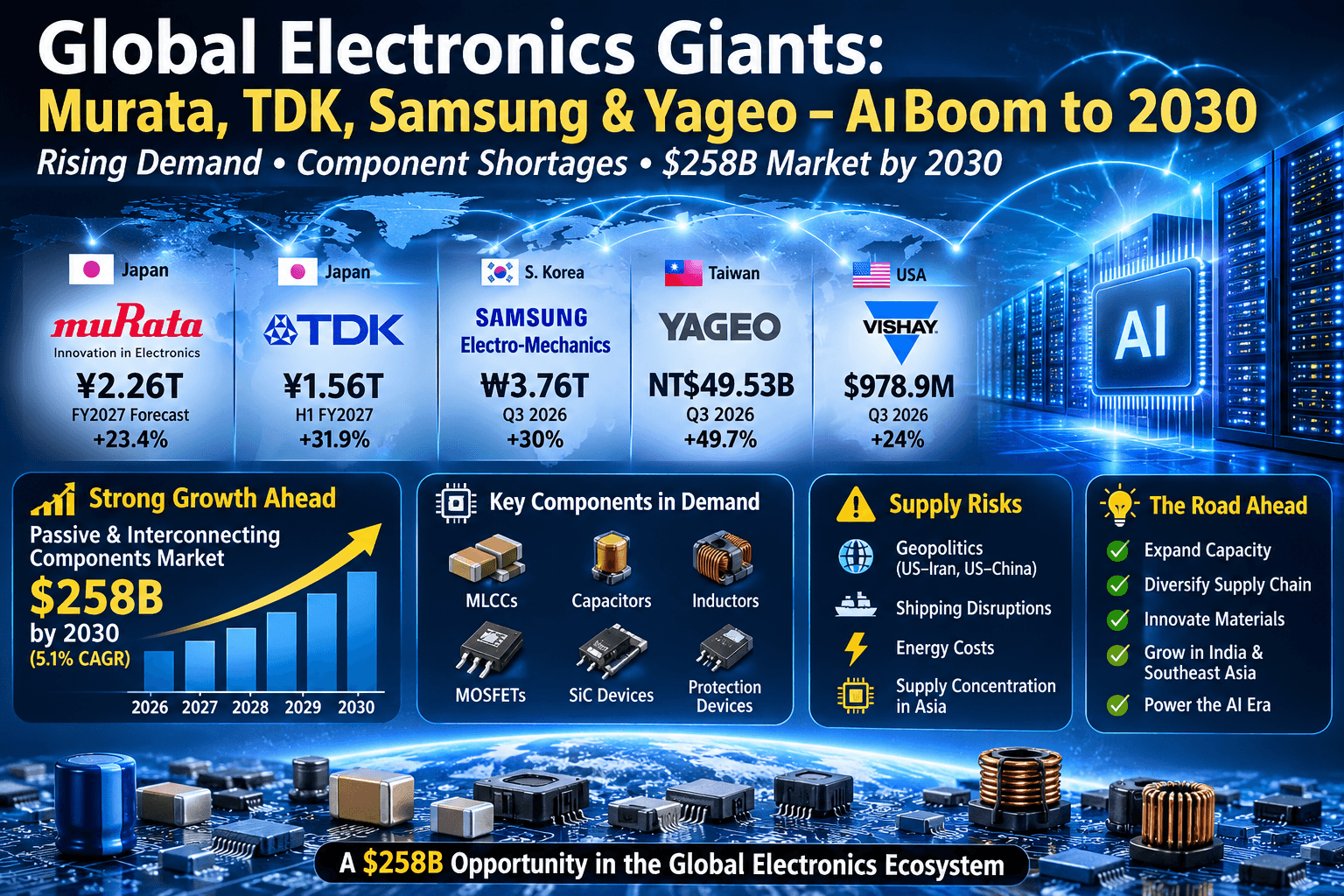
The global market for these critical electronic components stands at $214.7 billion, growing at a compound annual growth rate (CAGR) of 5.17% to 5.48%. Driven by high-density AI server power demands, automotive electrification, and 5G infrastructure, this market represents one of the most concentrated hardware supply chains in the global economy.
Revenue Profiles of Key Global Exporters
Market control in the passive and discrete component domain is held by a specialized group of multinational manufacturers:
Murata Manufacturing Co., Ltd. (Japan)
Financial Performance: Murata stands as the world's largest passive component manufacturer. For fiscal year 2026, Murata projected full-year consolidated revenues of ¥2.11 trillion ($13.6 billion) with an operating profit guidance raised to ¥430 billion ($2.77 billion). Quarterly revenue reached a record ¥502.3 billion ($3.24 billion), up 20.7% year-on-year, driven by a 110% surge in AI data center component demand.
Market Standing: Murata commands 35% to 40% of the global Multi-Layer Ceramic Capacitor (MLCC) market, serving as a critical single-node supplier to Apple, Samsung, and global automotive OEMs.
Yageo Corporation (Taiwan)
Financial Performance: Taiwan's leading passive component exporter reported strong momentum, with third-quarter 2026 gross profit reaching NT$ 20.31 billion ($630 million)—an 18.6% quarter-on-quarter increase and a 69.6% year-on-year surge. First-quarter 2026 revenue grew 22.7% year-on-year to NT$ 38.17 billion ($1.19 billion), delivering a net profit jump of 44.6% to NT$ 8.04 billion ($250 million).
Market Standing: Following strategic acquisitions of KEMET and Pulse Electronics, Yageo ranks among the top three MLCC suppliers globally and holds the world’s largest production capacity for surface-mount chip resistors. Over 30% of its specialized tantalum capacitor revenue is tied directly to AI server infrastructure.
TDK Corporation (Japan)
Financial Performance & Standing: TDK commands approximately 10% to 12% of the global passive components market. It generates multi-billion-dollar quarterly revenues through near-monopolistic control over advanced high-frequency inductors, ferrite cores, and automotive-certified passive power modules.
Samsung Electro-Mechanics (SEMCO, South Korea)
Financial Performance & Standing: Operating as Samsung’s specialized hardware component arm, SEMCO controls 20% to 22% of the global MLCC market, generating significant quarterly earnings by supplying high-capacitance miniature components for premium mobile devices and battery management systems.
Vishay Intertechnology Inc. (USA / Global)
Financial Performance & Standing: A foundational western titan in discrete semiconductors, power diodes, and precision thin-film resistors, Vishay maintains an annual revenue run rate of approximately $3.4 billion, heavily serving high-reliability defense, aerospace, and European industrial automation sectors.
Component Segment Dynamics & Growth Drivers
The passive and discrete component ecosystem is divided into three core functional categories:
Capacitors (Energy Storage & Voltage Regulation): Capacitors represent the largest single product category, holding over 35% of overall market share. MLCCs dominate overall unit production. A standard internal combustion vehicle uses roughly 3,000 MLCCs, whereas modern battery electric vehicles require over 10,000 MLCCs to smooth balancing currents across 800V architecture and battery management systems.
Resistors (Current Control & Circuit Protection): Resistors account for roughly 28% of total market value. Surface-mount chip resistors command a 47.3% share of the resistor category. Demand is driven by industrial automation, IoT sensor nodes, and thin-film precision resistors that experience less than 0.1% drift over decade-long lifespans.
Diodes & Discrete Power Semiconductors: Discrete active components—including Schottky, transient voltage suppression (TVS), and high-voltage Silicon Carbide (SiC) power diodes—are expanding rapidly. These components manage high-power switching in solar inverters, EV fast chargers, and high-efficiency server power supply units.
Geographic Distribution & Major Economic Dependencies
The production and regional consumption of passive components highlight significant global economic dependencies:
North America (35% Market Share): Commands the highest market demand by value, driven by hyperscale AI data center deployments, defense contracting, and high-spec automotive designs. However, North American original equipment manufacturers (OEMs) remain almost entirely reliant on Asian imports for raw passive component volume.
Asia-Pacific (30% to 41% Market Share): Serves as the global manufacturing core. China accounts for 18% of global consumption due to its role as the world's primary consumer electronics assembly hub. Japan retains near-total dominance over high-purity chemical raw materials (such as barium titanate ceramic powders) and specialized manufacturing machinery.
Europe (25% Market Share): Led by Germany (accounting for 12% of European consumption), European demand is concentrated in high-reliability automotive-grade passives (AEC-Q200 standards) and industrial automation.
Critical Supply Chain Vulnerabilities & Industry Roadblocks
Despite strong multi-year revenue growth, component suppliers face several structural challenges:
Raw Material Volatility & Sourcing Tightness: High-reliability ceramic and tantalum capacitors rely on volatile raw material supply chains. Rising global prices for silver, copper, and specialized tantalum ore from regulatory-sensitive regions continue to squeeze manufacturing margins.
Extreme Single-Point-of-Failure Dependencies: Passive components are frequently treated as commodity parts, yet a shortage of a single $0.02 surface-mount capacitor or diode can halt the assembly of a $100,000 electric vehicle or a multi-million-dollar AI server rack.
Capacity Bottlenecks in Ultra-Miniaturized Specifications: Advanced low-power IoT applications and 5G radios require micro-components as small as 0.16 mm by 0.08 mm (006003-inch format). Only a few suppliers globally possess the precision sintering and thermal technology to manufacture at these microscopic scales.
Strategic Outlook & The Way Forward
Entering the late 2020s, global component giants are executing multi-billion-dollar capital expenditure programs—typically allocating 8% to 12% of annual revenue to capex. Key strategic priorities include:
Accelerating AI Data Center Product Lines: Hyperscale AI hardware shifts toward 800V DC architectures, creating urgent demand for silicon capacitors, high-frequency inductors, and low-ESR ceramic components capable of operating at extreme temperatures without power degradation.
Regional Manufacturing Diversification: To mitigate geopolitical risks and tariff pressures, Japanese and Taiwanese giants are expanding production footprint capacity into Southeast Asia (Vietnam, Thailand, Malaysia) and co-locating specialized lines nearer to European and American automotive hubs.
High-Voltage Automotive Powertrain Support: As 800V battery architectures become the standard for electric mobility, component leaders are doubling production lines for high-ripple ceramic capacitors and specialized current-sense resistors.
The Bottom Line: As software and artificial intelligence continue to transform global industries, high-tech systems remain fundamentally dependent on physical hardware. The financial strength, raw material access, and manufacturing yields of Murata, Yageo, TDK, and SEMCO will dictate the scaling pace of next-generation computing and mobility worldwide.