Mitsui Chemicals–JSR Mega Deal: A ¥1.84 Trillion Bet on the Future of Semiconductor Manufacturing
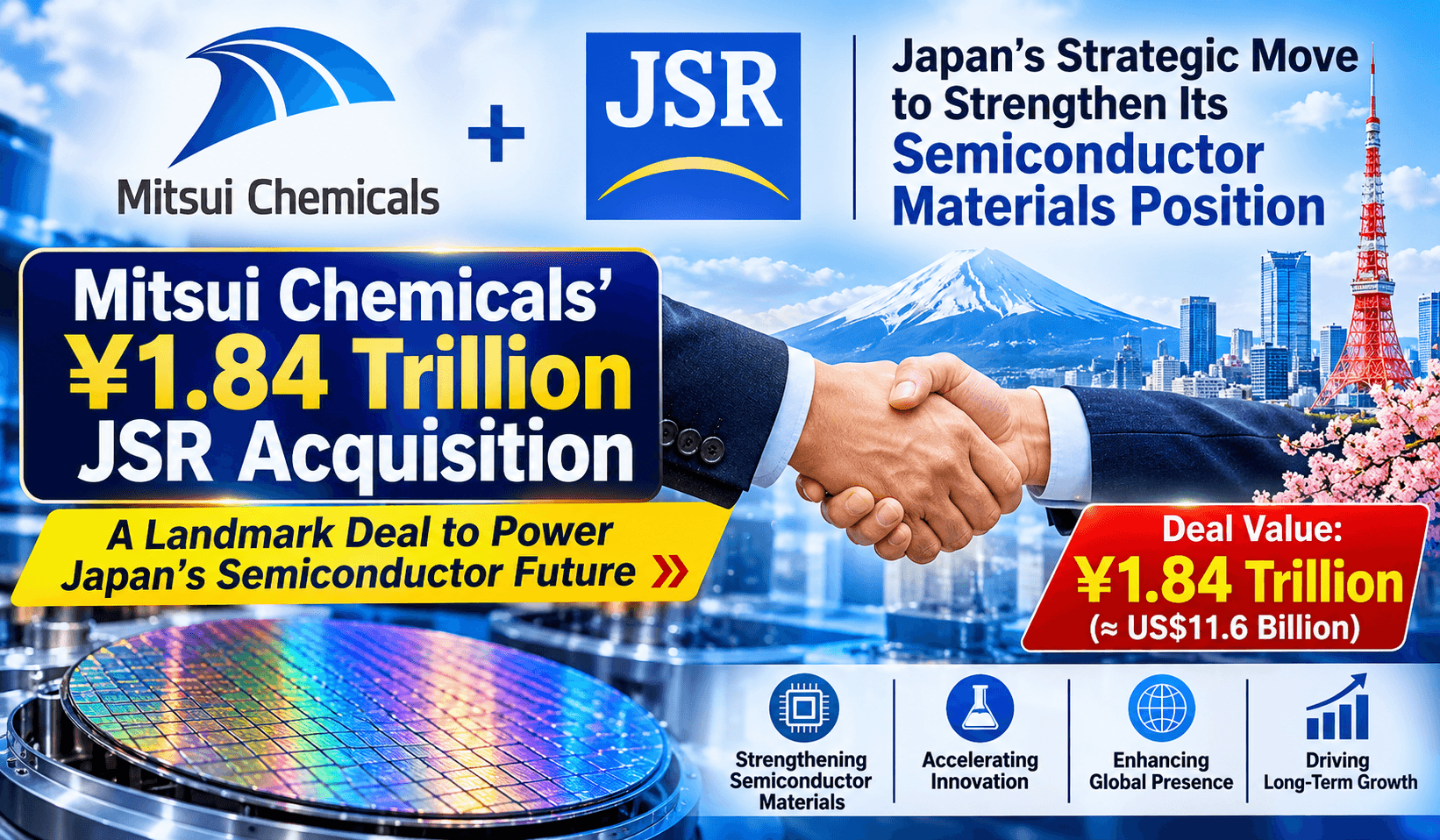
Beyond Chemicals and Corporate Expansion: How a Landmark Acquisition Could Reshape Japan's Position in the Global Semiconductor and AI Supply Chain. A Landmark Acquisition With Global Implications Japan's chemical and semiconductor industries are entering a significant phase of strategic transformation, as Mitsui Chemicals has agreed to acquire JSR Corporation in a transaction valued at approximately ¥1.84 trillion (around US$11.6 billion). Announced on November 9, 2026, the acquisition represents one of the largest transactions in Japan's chemical industry and signals a renewed effort to strengthen the country's position in the increasingly competitive global semiconductor materials market. The transaction involves Mitsui Chemicals and the Development Bank of Japan (DBJ) acquiring JSR from investment funds managed by JIC Capital, a subsidiary of the state-backed Japan Investment Corporation (JIC). While the headline value is substantial, the significance of this transaction extends well beyond its financial scale. It reflects a broader industrial strategy: securing advanced materials technologies, strengthening domestic manufacturing capabilities, accelerating research and development, and positioning Japanese companies to benefit from the next generation of semiconductor production. With artificial intelligence, high-performance computing, data centres and advanced electronics driving demand for increasingly sophisticated chips, the materials used to manufacture semiconductors have become strategically important. This acquisition could therefore represent a major development not only for the companies involved but also for Japan's long-term industrial competitiveness. Understanding the ¥1.84 Trillion Transaction The announced transaction is valued at approximately ¥1.84 trillion, equivalent to around US$11.6 billion. Mitsui Chemicals has entered into a share purchase agreement to acquire JSR's shares alongside the Development Bank of Japan. The transaction includes an equity value of approximately ¥1.3921 trillion, which includes DBJ's planned ¥200 billion investment, alongside approximately ¥447.9 billion in interest-bearing debt and other items. Under the proposed ownership structure, Mitsui Chemicals is expected to hold 100% of JSR's voting rights following completion. DBJ's investment will ultimately be represented through non-voting preferred shares. The acquisition is planned to be financed through a ¥1.64 trillion bridge loan from Mitsui Chemicals' principal financial institutions, together with DBJ's ¥200 billion investment. The final consideration remains subject to adjustments at closing. The agreement was signed on November 9, 2026. Completion is currently targeted for the second half of the fiscal year ending March 2028, subject to the required competition-law and foreign-investment approvals and other conditions. This distinction is important: the companies have signed an acquisition agreement, but ownership has not yet formally transferred. Why JSR Is Such an Important Acquisition Target To understand the strategic value of this deal, it is necessary to understand what JSR brings to the semiconductor industry. Founded in 1957, JSR has developed a strong international presence in advanced materials, particularly in products used in semiconductor manufacturing. One of its most strategically important businesses is semiconductor photoresists. Photoresists are light-sensitive chemical materials used in the semiconductor lithography process. During chip manufacturing, these materials help transfer extremely intricate circuit patterns onto silicon wafers. As semiconductor manufacturers move towards increasingly smaller and more sophisticated chip architectures, the precision, performance and reliability of photoresist materials become critical. JSR operates in this specialised segment, supplying materials that support advanced semiconductor production processes. Its broader portfolio also includes display-related and optical materials, alongside plastics and other specialised products. The company's technological expertise, customer relationships, research capabilities and international market presence make it a strategically valuable addition to Mitsui Chemicals. In a semiconductor ecosystem where manufacturing performance depends not only on equipment and chip design but also on highly specialised materials, JSR offers capabilities that are difficult to replicate quickly. The Semiconductor Industry: Why Timing Matters The global semiconductor industry is undergoing a fundamental transformation. Artificial intelligence applications, cloud computing, autonomous technologies, high-performance computing, smartphones, industrial automation and advanced communication systems are increasing the demand for more powerful and efficient semiconductor devices. The expansion of AI infrastructure has particularly increased attention on advanced chips, high-bandwidth memory, sophisticated packaging technologies and next-generation manufacturing processes. However, producing advanced semiconductors requires more than sophisticated fabrication equipment. It depends on an interconnected ecosystem involving: Semiconductor manufacturing equipment. Advanced lithography technologies. Photoresists and specialty chemicals. Silicon wafers and photomasks. Electronic-grade materials. Advanced packaging materials. Research, testing and quality-control capabilities. This is where JSR becomes strategically important. The company operates in a specialised materials segment that directly supports the manufacturing processes used by leading semiconductor producers. By bringing JSR into its group, Mitsui Chemicals aims to strengthen its exposure to a market that is becoming increasingly important to the global technology industry. The transaction also reflects an important shift in industrial strategy: companies are increasingly competing not just to manufacture finished products but to secure critical technologies and materials that support the entire production ecosystem. Mitsui Chemicals' Strategic Vision: Combining Complementary Technologies The acquisition is closely connected to Mitsui Chemicals' long-term business transformation strategy, known as VISION 2030. The company has been working to strengthen its higher-value specialty chemicals businesses while reviewing its broader business portfolio. JSR is expected to become a core component of Mitsui Chemicals' Information and Communications Technology (ICT) Solutions business. The strategic opportunity lies in combining complementary product portfolios. In semiconductor front-end manufacturing, JSR's advanced photoresists can complement Mitsui Chemicals' photomask-protection materials, including its MITSUI PELLICLE™ products. In back-end semiconductor processes, JSR's thick-film resist capabilities can complement Mitsui Chemicals' ICROS™ tape products and other materials used in advanced packaging applications. This combination could allow the companies to offer a broader range of solutions to semiconductor manufacturers. Instead of approaching customers with individual materials, the enlarged group could develop more integrated product offerings across multiple stages of semiconductor production. The intended benefits include: Stronger research and development capabilities. Broader semiconductor material portfolios. Improved global customer engagement. Greater opportunities for joint product development. Enhanced manufacturing and supply capabilities. Better positioning in advanced semiconductor applications. Mitsui Chemicals has identified approximately ¥40 billion in additional annual profit by fiscal 2035 as a target from growth and synergy opportunities associated with the transaction. However, achieving this target will depend on successful integration, market conditions, customer demand and the ability to translate technological advantages into commercial growth. Japan's Semiconductor Ambitions: A Bigger Industrial Picture The acquisition should also be viewed within the wider context of Japan's semiconductor strategy. Japan has historically played an important role in the global semiconductor supply chain, particularly in semiconductor equipment, specialty chemicals, materials, silicon wafers and precision manufacturing technologies. Although the country has faced greater competition in semiconductor fabrication over the years, its position in critical upstream materials remains strategically significant. Companies such as JSR and other Japanese specialty materials producers support semiconductor manufacturers across different regions. The acquisition could strengthen Japan's ability to consolidate important technologies and create a more competitive domestic semiconductor materials platform. It also reflects the growing importance of supply-chain resilience. Governments and industrial companies increasingly recognise that access to advanced materials and manufacturing technologies is essential to economic security and technological independence. For Japan, strengthening its semiconductor materials ecosystem is therefore both an industrial opportunity and a strategic priority. The proposed acquisition could help establish a stronger Japanese supplier with broader capabilities, greater research resources and an enhanced international presence. The Financial Challenge: A Major Opportunity With a Significant Debt Burden While the strategic rationale is compelling, the financial structure of the transaction deserves close attention. The acquisition is substantially debt-funded. Mitsui Chemicals plans to raise approximately ¥1.64 trillion through bridge financing, while DBJ will contribute ¥200 billion. The company has acknowledged that its net debt-to-EBITDA multiple is expected to temporarily exceed four times following completion. This represents a significant financial commitment and introduces additional pressure on the company's balance sheet. The challenge will be to ensure that the acquisition generates sufficient operating cash flow and business growth to justify the capital deployed. Mitsui Chemicals will also need to manage refinancing, integration expenditure, investment requirements and the financial performance of its existing businesses. The company has outlined plans to transition from bridge financing towards more permanent funding arrangements and restore its financial position. The transaction therefore carries two distinct dimensions. On one side, it offers an opportunity to establish a stronger position in a strategically important technology market. On the other, it introduces financial leverage that must be carefully managed over the coming years. The success of this acquisition will depend on whether the anticipated business benefits can translate into sustainable profitability without placing excessive pressure on the company's financial stability. Portfolio Transformation: More Than an Acquisition Another important aspect of the announcement is Mitsui Chemicals' wider portfolio restructuring. The company is reviewing the structure of its Basic & Green Materials business and has expanded the scope of its proposed separation to include Mobility Solutions. The broader objective is to create a more focused business structure and improve the competitiveness of its different operating segments. The acquisition of JSR complements this direction by increasing Mitsui Chemicals' exposure to specialty chemicals and high-value semiconductor materials. JSR has also been reviewing its Life Sciences operations, which have been treated as non-core within its portfolio strategy. Potential divestments and restructuring initiatives could allow the enlarged group to concentrate resources on businesses with stronger strategic alignment and growth potential. This suggests that Mitsui Chemicals is not simply purchasing another company to increase its size. It is attempting to reshape its business portfolio around areas where advanced technologies, specialised materials and long-term industrial demand could create stronger competitive advantages. What Could This Mean for the Global Semiconductor Supply Chain? The acquisition could have implications beyond Japan. Semiconductor production is highly interconnected, with major manufacturers and technology companies operating across the United States, Europe, Taiwan, South Korea, Japan and other markets. Materials suppliers play an essential role in maintaining production quality, process consistency and manufacturing efficiency. By combining Mitsui Chemicals' existing materials portfolio with JSR's expertise, the enlarged organisation could become a more significant supplier to semiconductor manufacturers internationally. Potential developments include: 1. Stronger competition among materials suppliers A broader product portfolio could improve the group's competitive position against other international semiconductor materials companies. 2. Greater investment in next-generation materials Combining research teams and technological resources could accelerate the development of advanced photoresists and other materials required for future chip manufacturing. 3. More integrated customer solutions Semiconductor manufacturers may benefit from a supplier capable of addressing a wider range of material requirements across front-end and back-end production processes. 4. Stronger Japanese industrial positioning The deal could reinforce Japan's role as an important source of advanced semiconductor manufacturing materials. 5. Potential changes in industry consolidation The transaction may encourage further strategic partnerships, investments and consolidation within the global semiconductor materials sector. Nevertheless, the actual impact will depend on how successfully the combined businesses integrate their operations and maintain customer confidence. Risks and Challenges That Cannot Be Overlooked Despite the strategic advantages, several challenges remain. First, the scale of the financing introduces considerable balance-sheet risk. A debt-heavy acquisition requires careful financial management, especially if semiconductor demand experiences a cyclical slowdown. Second, technological integration will be important. Combining research capabilities, production processes and customer relationships across two established organisations can take time. Third, the semiconductor materials market is highly specialised. Product qualification, reliability testing and customer approval processes can be lengthy. New commercial opportunities may therefore take time to translate into revenue. Fourth, global competition remains intense. Established international materials companies continue investing in research, innovation and manufacturing capabilities. Finally, the transaction remains subject to regulatory clearances. Competition-law and foreign-investment reviews could influence the timing or conditions of completion. Investors will therefore need to evaluate the acquisition not only through its strategic ambitions but also through its execution, financing and long-term financial returns. What Investors and the Industry Should Watch Next Several developments will determine how this transaction progresses. Regulatory approvals and the final acquisition timetable. The transition from bridge financing to permanent funding. Mitsui Chemicals' ability to manage its post-acquisition debt levels. Progress towards the targeted ¥40 billion annual incremental profit by fiscal 2035. Integration of JSR's research, manufacturing and customer operations. Potential divestment of non-core businesses. New product development in advanced semiconductor materials. Global demand for AI chips, advanced lithography and semiconductor packaging. These indicators will provide a clearer picture of whether the acquisition can deliver the long-term benefits anticipated by Mitsui Chemicals. Conclusion: A Strategic Bet on the Future of Semiconductor Materials Mitsui Chemicals' proposed ¥1.84 trillion acquisition of JSR represents more than a major corporate transaction. It is a strategic bet on the growing importance of advanced materials in the global semiconductor industry. By combining Mitsui Chemicals' established specialty materials capabilities with JSR's expertise in advanced photoresists and semiconductor technologies, the company aims to establish a stronger position in a market that is becoming increasingly critical to AI, high-performance computing and next-generation electronics. For Japan, the transaction could reinforce its position in one of the most strategically important segments of the global technology supply chain. For Mitsui Chemicals, however, the opportunity comes with a substantial financial commitment, significant integration requirements and the responsibility of delivering the promised business synergies. The real measure of success will not be the size of the acquisition announcement, but whether the combined organisation can translate its technological strengths into sustained innovation, stronger customer relationships and long-term profitability. The semiconductor race is no longer defined only by who manufactures the most advanced chips. It is also about who controls the materials, technologies and capabilities that make those chips possible. Mitsui Chemicals' proposed acquisition of JSR is a clear reflection of that changing industrial landscape. Team BONC Network November 14th, 2026