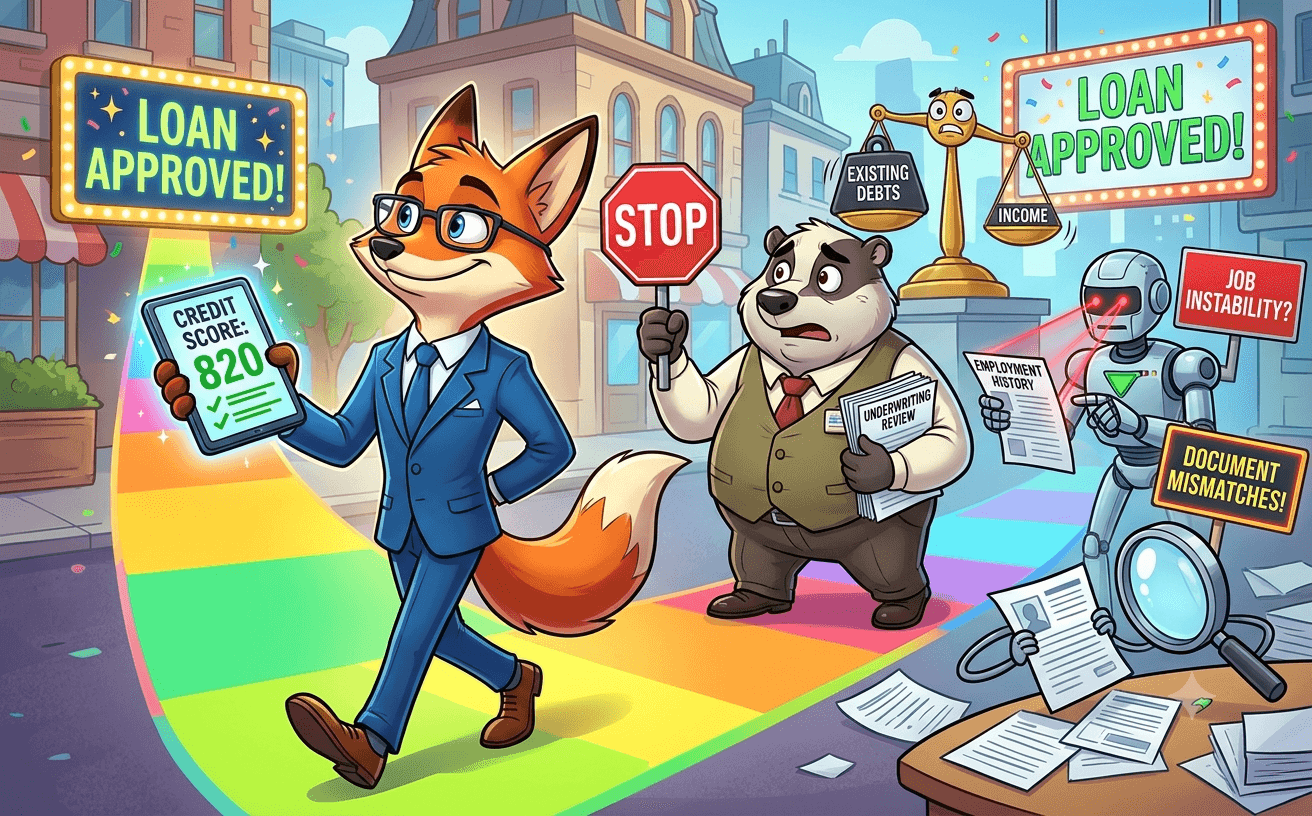
The short answer is no. A high or "good" credit score does not guarantee loan approval.
While credit bureaus and financial marketing campaigns heavily promote the narrative that a score above 750 (or 740 in Western models like FICO) is a golden ticket to borrowing, reality tells a different story. Industry data indicates that between 15% to 30% of loan applicants with "good" or "excellent" credit scores are ultimately declined or face unexpected loan curtailment across institutional lenders.
A credit score is designed to be an initial automated gateway, not a final underwriting verdict. It serves as a filter that determines whether an application moves forward for deeper human or algorithmic scrutiny. Once past that first gate, a completely different set of financial metrics takes over—and that is where hidden rejections happen.
Understanding the Numbers: Acceptability Rates and Data Reality
To understand why good scores still face rejections, it helps to look at aggregate credit funnel data:
The Entry Gate: Roughly 60% to 70% of retail loan applications cleared by automated bureau checks possess scores above the lender's baseline requirement.
The Final Conversion Gap: Out of those applicants with prime scores, roughly 1 in 5 still fail to walk away with a disbursed loan due to secondary underwriting filters.
The Impact of Multiple Enquiries: Industry figures show that an applicant with a 780 score who triggers 4 or more hard inquiries within a 30-day window experiences an approval drop-off of nearly 45%, as automated risk models reclassify them as "credit-hungry" or financially distressed.
What's Hiding Behind the Score: Stage-Level Rejections
Loan underwriting is a multi-layered screening funnel. Rejections happen at distinct stages of evaluation, often long after the credit score has given the green light.
Stage 1: The Automated Bureau and Rule Engine Filter
At the moment you hit submit, an automated core banking system pulls your credit report. If your score clears the threshold, you pass this stage. However, hidden traps here include "thin files" (a high score derived from just one active credit card with minimal history) or latent inquiries that automated rules flag instantly.
Stage 2: The Capacity and DTI (Debt-to-Income) Verification
This is the most common graveyard for high-score applications. Lenders do not just care if you paid past debts; they care about what is left over today.
The FOIR Rule: Most institutional lenders enforce a Fixed Obligation to Income Ratio (FOIR) or Debt-to-Income (DTI) cap of 40% to 50%.
If you earn a net monthly income of $5,000 but your existing housing, car, and credit card minimum payments already total $2,300, your remaining buffer is too thin. Even with an 800 credit score, a lender will reject the application because your mathematical repayment capacity is maxed out.
Stage 3: Stability and Employment Verification
Underwriters look deeply at professional stability. Red flags that trigger silent rejections at this stage include:
Being on job probation or changing employment frequently within the last 6 to 12 months.
Working for unlisted, unverified, or small partnership firms that do not meet internal corporate risk tiers.
Being self-employed or a gig worker whose declared taxable income on tax returns conflicts sharply with cash flows shown on bank statements.
Stage 4: Document Forensics and Banking Integrity
The final stage involves physical or algorithmic document validation. Underwriters inspect bank statements line by line. Rejections occur here due to:
Involuntary Bounces: Even one bounced electronic payment or insufficient funds (NSF) occurrence in the preceding 3 to 6 months signals operational cash flow stress.
KYC and Identity Mismatches: Minor discrepancies—such as a middle name missing on a tax document, an unupdated address on an identity proof, or mismatched employer names between a salary slip and a bank credit—cause verification engines to reject files automatically.
Hidden Non-Credit Factors That Trigger Rejections
Beyond the formal stages, lenders evaluate systemic risk factors that do not appear anywhere on a credit report:
Geographic and Pin-Code Restrictions: Lenders maintain internal risk maps. If you reside in a neighborhood or postal code historically associated with high default rates, fraud clusters, or unstable local economies, your loan can be declined regardless of your personal financial history.
Industry-Specific Blacklisting: During economic downturns or sector shifts, lenders dynamically restrict lending to specific industries (such as hospitality, early-stage startups, or contractual gig sectors). If your employer falls into a restricted category, your credit score is bypassed by macro-policy.
The Purpose of Borrowing: Some unsecured loan products carry internal policy restrictions regarding how funds are deployed. Stating high-risk intents—such as speculative investing, cryptocurrency purchases, or clearing other unsecured debts—can cause an underwriter to decline an otherwise prime file.
How to Safeguard Your Application
A rejection is rarely random; it is a symptom of a metric failing outside the credit score bubble. To ensure a high score translates into a guaranteed approval:
Audit Your DTI: Keep your total monthly debt obligations well below 40% of your net verified income before applying for new credit.
Space Out Applications: Avoid applying to multiple institutions simultaneously, as each hard inquiry chips away at lender confidence.
Scrub Your Documentation: Ensure complete alignment across your employment records, bank statements, tax returns, and identity proofs to pass verification checks without friction.
Core Takeaway
A high credit score is a crucial entry ticket, but it is not a guarantee of loan approval. Modern underwriting relies on a multi-tiered evaluation process where non-credit factors—such as Debt-to-Income (DTI) ratio, income stability, documentation consistency, and internal lender risk policies—carry equal or greater weight than your three-digit bureau score.
Ultimately, maintaining a prime credit score clears the first hurdle, but securing approval requires managing your broader financial footprint: keeping existing debts low relative to income, maintaining stable employment documentation, and avoiding rapid successive applications.