• Home

Business

  • Dashboard
  • My Products
  • Edit Business
  • My Groups

Explore

  • Articles
  • Community
  • Careers
  • Blogs
BONC logo
Get it on Google Play

Products

  • Pricing
  • Explore Industry
  • Explore Category
  • Explore Product
  • About Us

About BONC

  • FAQs
  • Terms and Condition
  • Privacy Policy
  • Refund Policy
  • Blogs

OFFICE LOCATION

Costipro Technologies Pvt. Ltd, Unit no. 235 to 245, Supremework Workspace, 2nd Floor, ILD Trade Center, Sector 47, Sohna Road, Gurgaon, Haryana - 122018

© 2025 - 2026 BONC Network. All rights reserved

BONC Logo
  • Home

Business

  • Dashboard
  • My Products
  • Edit Business
  • My Groups

Explore

  • Articles
  • Community
  • Careers
  • Blogs

📉 NVIDIA STOCK FALLS 7% AS INVESTORS AWAIT JENSEN HUANG’S FATE

Case StudyBy Global Business Outlook · 13 Nov 2026
📉 NVIDIA STOCK FALLS 7% AS INVESTORS AWAIT JENSEN HUANG’S FATE

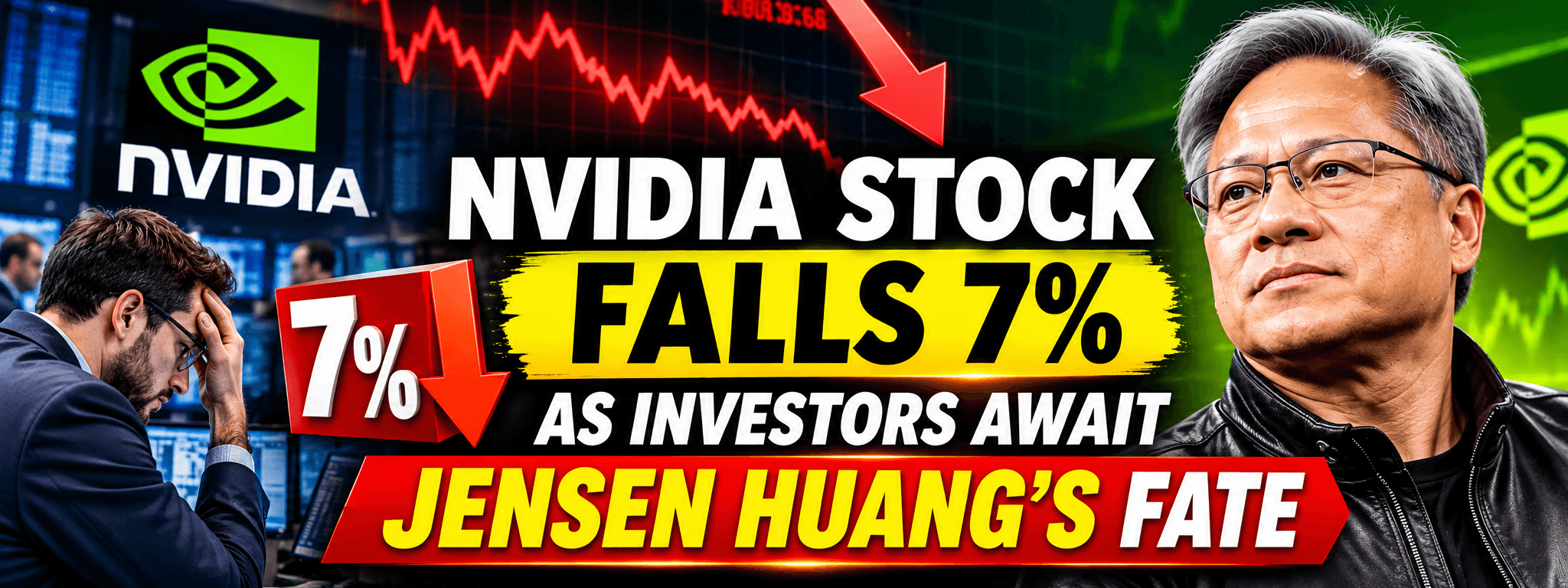
Nvidia witnessed a sharp decline in its share price amid growing uncertainty surrounding its leadership and the future of CEO Jensen Huang. The development attracted attention across global financial markets, as investors assessed the potential impact on the company's AI business and semiconductor leadership.

📊 TECHNOLOGY & BUSINESS HIGHLIGHTS

1. 📉 Nvidia Shares Experience a Major Decline

  • Nvidia shares dropped approximately 7.6% during trading on November 12.

  • Leadership uncertainty triggered concerns among investors.

  • The stock later recovered some losses and closed down approximately 4.3%.

2. 🏢 Major Leadership Change at Nvidia

  • Nvidia announced Jensen Huang's resignation on November 12, 2026.

  • CFO Colette Kress was appointed interim CEO.

  • The board is considering permanent leadership arrangements.

3. 🤖 Jensen Huang's Contribution to AI

  • Huang co-founded Nvidia in 1993.

  • He transformed Nvidia into a leading semiconductor company.

  • Nvidia GPUs power AI development, cloud computing and advanced data centres.

4. 🌐 Impact on Global Technology Stocks

  • Nvidia's stock decline affected sentiment across the semiconductor sector.

  • Investors are monitoring competing companies such as AMD.

  • Market uncertainty could influence investment decisions across the AI industry.

5. 💼 Investor Confidence and Market Concerns

  • Investors are closely monitoring Nvidia's succession plans.

  • Future AI chip demand remains an important market factor.

  • The company's ability to maintain its competitive position is under scrutiny.

📈 BUSINESS & INDUSTRY IMPACT

  • AI Industry: Leadership uncertainty could influence confidence across the global AI ecosystem.

  • Semiconductor Market: Competitors may gain opportunities as investors evaluate alternative chipmakers.

  • Investor Sentiment: Leadership changes can influence stock valuations and investment decisions.

  • Data Centres: Businesses will monitor Nvidia's future AI chip supply and technology roadmap.

  • Global Competition: Semiconductor companies may benefit from changing market expectations.

🔍 WHAT COMES NEXT?

  • Nvidia's board will focus on permanent leadership arrangements.

  • Colette Kress will oversee the company during the interim period.

  • Investors will monitor upcoming financial results and AI chip demand.

  • Nvidia's ability to maintain market leadership will remain a major focus.

❓ THE BIG QUESTION

Can Nvidia maintain its global AI leadership following Jensen Huang's departure, or will this transition create new opportunities for competing semiconductor companies?


#Nvidia#NvidiaStock#NvidiaShares#JensenHuang#NvidiaNews#StockMarketNews#StockMarketUpdates#ArtificialIntelligence#AINews#AIIndustry#SemiconductorIndustry#TechnologyNews#GlobalMarkets#WallStreet#InvestorConfidence#TechStocks#Chipmaker#AMD#BusinessNews#BONCNetwork

Comments

No comments yet

Be the first to share your thoughts.

Latest Articles

View all

Company Articles

  • Best Door Hinges, Window Hinges, Stainless Steel, Brass & Mild Steel Hardware Fittings Supplier in India | INDIAN HARDWARE

    Best Door Hinges, Window Hinges, Stainless Steel, Brass & Mild Steel Hardware Fittings Supplier in India | INDIAN HARDWARE

    Ashik Mondol · few months ago

  • Premium Wash Basins, Sanitaryware & Bathroom Fittings for Residential and Commercial Projects | M/S SUPREME MARKETING

    Premium Wash Basins, Sanitaryware & Bathroom Fittings for Residential and Commercial Projects | M/S SUPREME MARKETING

    Rajesh Agarwal · few months ago

  • The Architecture of Adaptability: How the Post-Pandemic Era Rewrote the Corporate Playbook

    The Architecture of Adaptability: How the Post-Pandemic Era Rewrote the Corporate Playbook

    Vikas Garg · few months ago

  • Premium Roofing Materials, Floor & Wall Tiles, Roofing Fittings and False Ceiling Solutions in India | MURLI ENTERPRISES

    Premium Roofing Materials, Floor & Wall Tiles, Roofing Fittings and False Ceiling Solutions in India | MURLI ENTERPRISES

    Atanu Das · few months ago

  • Premium Marble, Granite, Ceramic & Porcelain Tiles Supplier in India | JAIN MARBLE CENTRE

    Premium Marble, Granite, Ceramic & Porcelain Tiles Supplier in India | JAIN MARBLE CENTRE

    Sonu Jha · few months ago

Networking Articles

  • Apple’s Nanosheet Era : The Hard Reality of 2nm Silicon

    Apple’s Nanosheet Era : The Hard Reality of 2nm Silicon

    Vikas Garg · few months ago

  • SHOPRITE AND INVESTEC JOIN FORCES TO TRANSFORM SOUTH AFRICA'S RETAIL BANKING LANDSCAPE

    SHOPRITE AND INVESTEC JOIN FORCES TO TRANSFORM SOUTH AFRICA'S RETAIL BANKING LANDSCAPE

    Global Business Outlook · few months ago

  • ⚡ THE RARE-EARTH SHOCK: YTTRIUM PRICES EXPLODE AS CHINA TIGHTENS GLOBAL SUPPLY

    ⚡ THE RARE-EARTH SHOCK: YTTRIUM PRICES EXPLODE AS CHINA TIGHTENS GLOBAL SUPPLY

    Global Business Outlook · few months ago

  • 🏦 JAPAN'S BANKING GIANTS RAISE PROFIT FORECASTS AS HIGHER INTEREST RATES BOOST EARNINGS

    🏦 JAPAN'S BANKING GIANTS RAISE PROFIT FORECASTS AS HIGHER INTEREST RATES BOOST EARNINGS

    Global Business Outlook · few months ago

  • Yttrium's Ninefold Price Shock: How China's Export Controls Are Reshaping Global Critical-Mineral Supply Chains

    Yttrium's Ninefold Price Shock: How China's Export Controls Are Reshaping Global Critical-Mineral Supply Chains

    Vikas Garg · few months ago

More from Global Business Outlook

SHOPRITE AND INVESTEC JOIN FORCES TO TRANSFORM SOUTH AFRICA'S RETAIL BANKING LANDSCAPE
Industry Report

SHOPRITE AND INVESTEC JOIN FORCES TO TRANSFORM SOUTH AFRICA'S RETAIL BANKING LANDSCAPE

South Africa's banking industry is witnessing a new wave of competition as retail giant Shoprite joins hands with Investec to expand its financial services business. The proposed partnership aims to bring convenient, affordable and accessible banking solutions to millions of consumers through Shoprite's extensive retail network and Investec's established banking infrastructure. 🏦 A STRATEGIC PARTNERSHIP WITH BIG AMBITIONS Under the proposed arrangement, Investec will become the banking sponsor for an expanded transactional account offering through Shoprite Financial Services. The partnership is expected to introduce a debit card, giving customers greater flexibility in managing everyday payments and financial transactions. Rather than establishing its own bank, Shoprite will use Investec's existing banking licence, infrastructure and regulatory capabilities to expand its financial services portfolio. 📊 WHAT THE PARTNERSHIP BRINGS TO THE TABLE Key areas and how expected developments should happened and targeted Banking services - Expanded transactional accounts Debit card - New payment flexibility Digital banking - Wider digital payment solutions Customer reach - Access through Shoprite's retail network Banking infrastructure - Powered by Investec Market expansion - Greater participation in retail banking 📱 SHOPRITE'S BIG MOVE INTO DIGITAL FINANCE Shoprite has gradually expanded beyond traditional grocery retailing by developing financial products that address customers' everyday needs. Its existing Money Market account already serves more than 4 million customers, providing services such as money transfers, cash deposits, withdrawals and bill payments. The planned debit card could represent another important step in transforming Shoprite's financial services into a broader everyday banking ecosystem. 💼 WHY INVESTEC IS ENTERING THE PARTNERSHIP For Investec, the agreement creates an opportunity to reach a significantly wider consumer market without building an entirely new mass-market retail banking operation. The partnership could help the bank: Expand its presence in South Africa's digital payments ecosystem. Increase access to retail deposits. Reach new customer segments. Strengthen its existing banking infrastructure's commercial potential. Generate additional growth opportunities beyond its traditional private banking market. ⚔️ BANKING COMPETITION IS HEATING UP South Africa's banking industry is becoming increasingly competitive as retailers, financial institutions and telecommunications companies explore new ways to deliver financial products. The Shoprite-Investec alliance could create additional competitive pressure for established retail banking players such as Capitec, particularly in everyday transactions and affordable banking services. However, the partnership's long-term success will depend on customer adoption, competitive fees, service reliability and the convenience of its digital offering. 🌍 ECONOMIC AND BUSINESS IMPACT The expansion of retail-linked banking could have wider implications for South Africa's financial ecosystem. Greater access to transactional accounts and digital payment services may encourage financial inclusion, improve payment convenience and support consumers who regularly use retail stores for everyday financial activities. For businesses, the growing connection between retail and banking could also create opportunities in digital payments, financial technology, customer loyalty and transaction-based services. THE BIGGER PICTURE The Shoprite and Investec partnership reflects a significant shift in how financial services are delivered. Traditional boundaries between retail companies and banks are becoming less distinct as businesses use established customer networks and technology to expand into financial markets. Although regulatory approval is still required and a launch date has not been announced, the alliance could become an important development in South Africa's retail banking transformation.

#Shoprite#Investec#SouthAfrica
Global Business Outlook
⚡ THE RARE-EARTH SHOCK: YTTRIUM PRICES EXPLODE AS CHINA TIGHTENS GLOBAL SUPPLY
Case Study

⚡ THE RARE-EARTH SHOCK: YTTRIUM PRICES EXPLODE AS CHINA TIGHTENS GLOBAL SUPPLY

🔴 9X PRICE SURGE. A GROWING INDUSTRIAL WARNING. A major supply-chain disruption is emerging in the global rare-earth market as yttrium prices surge amid China's export restrictions. The sharp increase is putting pressure on Japanese manufacturers that depend on specialised materials for semiconductor equipment, aerospace components and advanced industrial production. THE MARKET SHOCK IN NUMBERS Market indicator Latest development European yttrium prices9X higher year-on-year European market price$1,087 per kg Japan's import volume Down approximately 70%Japan's import unit price64X higher year-on-year Shin-Etsu investment Over ¥35 billion 🌐 WHY THE WORLD IS PAYING ATTENTION CHINA'S SUPPLY CONTROL Export restrictions introduced by China have disrupted the availability of critical rare-earth materials. Manufacturers are increasingly competing for limited supplies, making procurement more expensive and unpredictable. JAPAN'S INDUSTRIAL EXPOSURE Japan's semiconductor and advanced manufacturing sectors face growing pressure to secure alternative sources. Lower import volumes are increasing concerns about long-term supply stability. THE TECHNOLOGY CONNECTION Yttrium plays an important role in specialised semiconductor equipment coatings and aerospace applications. A prolonged shortage could increase manufacturing costs and complicate production planning. 🏭 CORPORATE RESPONSE: THE SHIFT TOWARDS ALTERNATIVE SUPPLY Shin-Etsu Chemical is planning an investment exceeding ¥35 billion in a Japanese rare-earth refining facility. The initiative reflects a wider industrial effort to strengthen domestic processing capacity and reduce reliance on concentrated overseas supply chains. 📉 WHO COULD FEEL THE IMPACT? SEMICONDUCTORS — Higher material costs could increase equipment manufacturing expenses. AEROSPACE — Specialised high-temperature coatings may face procurement pressure. AUTOMOTIVE — Supply-chain uncertainty could affect manufacturers using advanced materials. MINING & REFINING — Alternative suppliers and processing companies could attract new investment. 🌍 COMMODITY OUTLOOK The yttrium crisis highlights a larger change in global trade: access to critical minerals is becoming a strategic economic advantage. Japan and other industrial economies are likely to accelerate investment in alternative sourcing, recycling and domestic refining. BOTTOM LINE: China's control over rare-earth supply is creating a new industrial cost challenge. The companies and countries that secure reliable alternative supplies could gain a significant competitive advantage in the next phase of global manufacturing.

#RareEarthCrisis#Yttrium#ChinaTrade
Global Business Outlook
🏦 JAPAN'S BANKING GIANTS RAISE PROFIT FORECASTS AS HIGHER INTEREST RATES BOOST EARNINGS
Case Study

🏦 JAPAN'S BANKING GIANTS RAISE PROFIT FORECASTS AS HIGHER INTEREST RATES BOOST EARNINGS

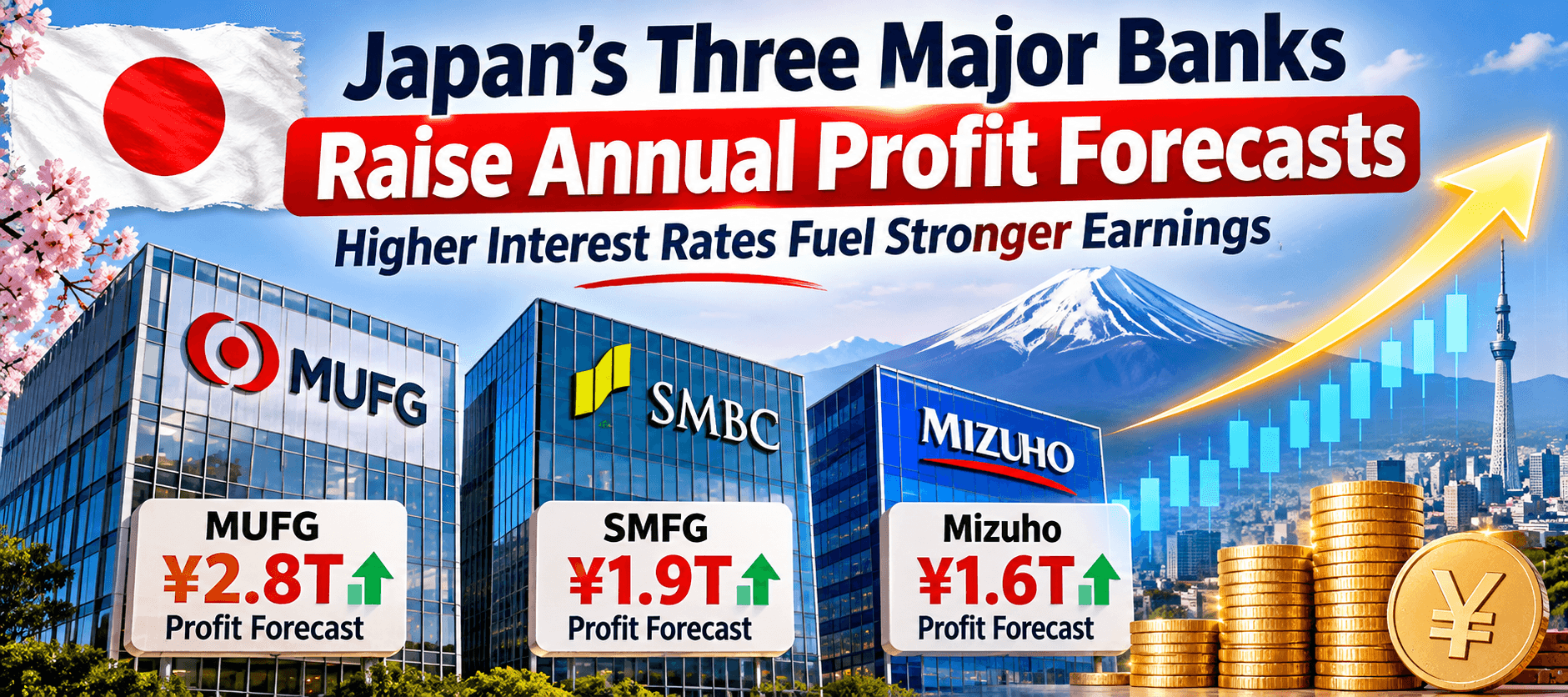
Japan's banking sector is demonstrating strong financial momentum as the country's three largest banking groups raise their full-year earnings forecasts, reflecting improved profitability, higher interest rates and stronger corporate lending activity. The three major financial institutions — Mitsubishi UFJ Financial Group (MUFG), Sumitomo Mitsui Financial Group (SMFG) and Mizuho Financial Group — are benefiting from a changing monetary environment in Japan. Higher domestic interest rates are improving lending margins, while growing demand for corporate financing is supporting their overall business performance. 📊 THE NUMBERS THAT MATTER 💴 MUFG: Raised its annual net profit forecast to ¥2.8 trillion. 💴 Mizuho Financial Group: Increased its forecast to ¥1.6 trillion. 💴 SMFG: Raised its annual profit outlook to ¥1.9 trillion. 📈 Shareholder Returns: Mizuho and SMFG expanded their respective share buyback programmes to ¥400 billion each. 📈 WHAT IS DRIVING THE PROFIT GROWTH? 🏦 1. Higher Interest Rates Strengthen Banking Margins Japan's gradual shift away from its prolonged low-interest-rate environment is creating better earning opportunities for commercial banks. Higher lending rates can improve the difference between interest earned on loans and interest paid on deposits, supporting net interest income. 💼 2. Stronger Corporate Lending Activity Demand for business financing, infrastructure investment and corporate expansion is supporting lending operations. This is providing Japanese banks with additional opportunities to generate interest income and expand their financial services. 💹 3. Growing Shareholder Returns The expansion of share buyback programmes reflects confidence in earnings performance and capital management. These initiatives can improve shareholder value by reducing the number of outstanding shares. ⚠️ THE RISKS BANKS ARE WATCHING Despite stronger earnings expectations, Japan's financial institutions face potential challenges. A slowdown in artificial intelligence infrastructure investment could affect corporate lending demand, while global market volatility, credit risks and changing interest-rate expectations may influence future profitability. 🌏 WHAT DOES THIS MEAN FOR JAPAN'S ECONOMY? The improved earnings outlook highlights the changing structure of Japan's financial sector. Stronger bank profitability could support business investment, improve financial-market confidence and strengthen the country's corporate financing environment. However, sustained growth will depend on economic stability, responsible lending and the ability of businesses to maintain investment momentum. 🔍 THE BIGGER PICTURE Japan's major banks are entering a new earnings environment in which higher interest rates and stronger financial activity are creating opportunities for expansion. Their latest profit upgrades underline the growing importance of the banking sector in Japan's economic recovery and long-term financial competitiveness.

#JapanBanking#JapaneseEconomy#MUFG
Global Business Outlook
South African Rand Holds Firm at R16.50/$ as Markets Price In Anticipated SARB Interest Rate Cut
Data Analysis

South African Rand Holds Firm at R16.50/$ as Markets Price In Anticipated SARB Interest Rate Cut

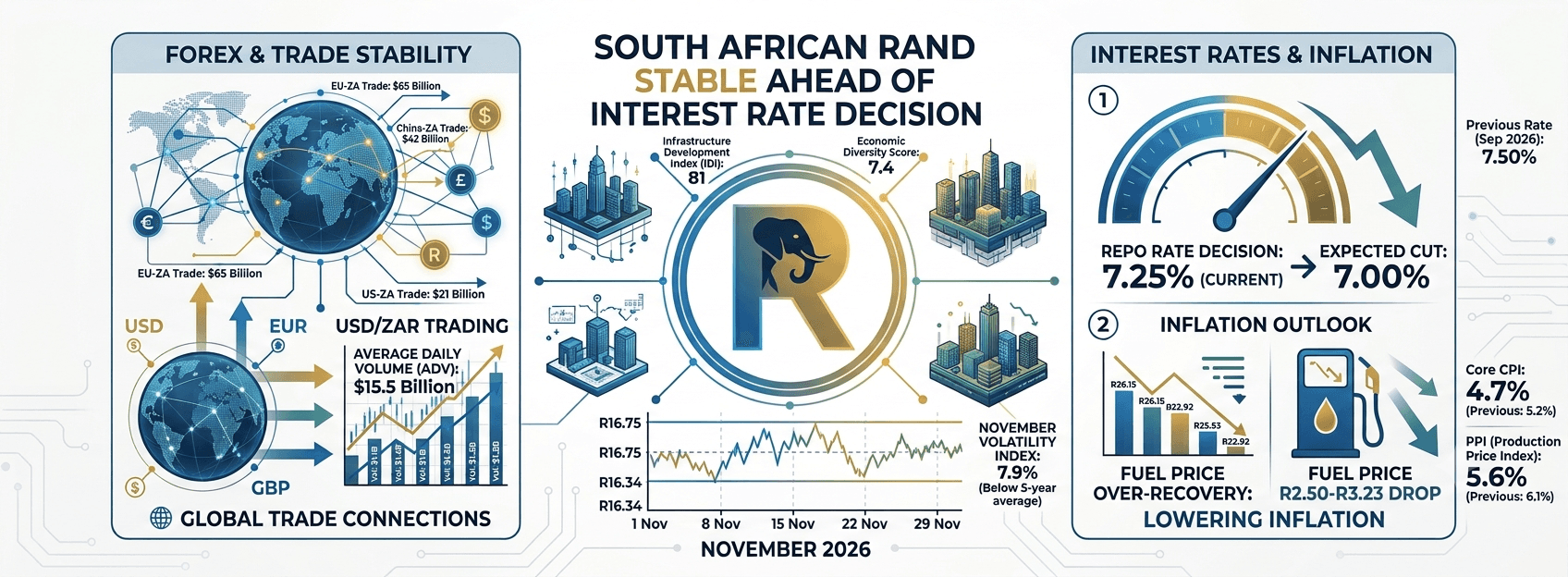
The South African Rand (ZAR) demonstrated remarkable range-bound resilience through November 2026, consolidating within a narrow trade corridor of R16.34/$ to R16.75/$ . FX traders and institutional investors remained largely in a holding pattern, balancing post-US election global market adjustments against the upcoming South African Reserve Bank (SARB) Monetary Policy Committee (MPC) rate announcement. Macroeconomic Snapshot & Key Data Points Exchange Rate Trajectory: The Rand traded near a central anchor of R16.50/$ . It peaked at a monthly high of R16.34/$ early in the month following U.S. election clarity before easing to R16.75/$ amid pre-MPC positioning. Current Repo Rate: 7.25% (Prime Rate at 10.75%), following cumulative 50 bps rate hikes introduced across mid-2026 to counter temporary energy and import price pressures. MPC Consensus: Financial markets heavily price in a 25 bps rate reduction to 7.00% , signaling the potential wind-down of the 2026 tightening cycle. Sovereign Bond Yields: Yields on South Africa's benchmark 10-year government bonds (2035s) eased 13.5 basis points to 8.33% , reflecting lowered domestic risk premiums and sustained capital inflows into local-currency debt. Inflation & Energy Over-Recovery: Central Energy Fund (CEF) data highlights significant fuel over-recovery, indicating upcoming petrol price reductions of R2.50 to R3.23 per litre for December—providing a strong structural tailwind for headline CPI disinflation. Strategic Drivers Keeping the Rand Stable Easing Safe-Haven USD Demand: Post-election political clarity in the United States softened international greenback buying pressure, affording emerging market currencies—particularly high-yielding ones like the Rand—a broader buffer. Falling Global Energy Overhead: Waning oil supply pressures reduced South Africa's overall import bill, moderating trade deficit strain and improving current account performance. High Real Yield Differential: The SARB’s proactive monetary stance earlier in 2026, paired with structural commitments outlined in the Medium-Term Budget Policy Statement (MTBPS), maintained an attractive real yield differential for carry-trade participants. Industry & Sectoral Impact 1. Retail & Consumer Goods Impact: Positive outlook. Details: Anticipated SARB rate cuts—coupled with substantial petrol price drops in December—will free up consumer disposable income. Retailers benefit from eased supply chain transport costs and improved consumer sentiment ahead of the festive shopping season. 2. Mining & Mineral Exports Impact: Neutral to Moderately Restrictive. Details: A steady Rand near R16.34–R16.50/$ prevents sharp windfall profits for commodity exporters relative to prior weaker exchange rates. However, cost predictability for equipment imports and fuel overheads provides operational stability. 3. Banking & Financial Services Impact: Highly Sensitive. Details: Lower interest rates will modestly compress Net Interest Margins (NIMs) for commercial lenders. Conversely, a lower rate environment mitigates non-performing loan (NPL) ratios and improves private-sector credit demand. 4. Energy & Import-Intensive Manufacturing Impact: Favorable. Details: Stable FX conditions reduce input cost volatility for imported machinery, electronic components, and raw materials, stabilizing profit margins for local manufacturers. Governing Body Actions to Curb Volatility & Inflation: SARB Inflation Target Alignment: The central bank lowered its inflation target focus to 3% (±1%) to permanently lower price expectations and protect the Rand's buying power long-term. Active Rate Adjustments: The MPC raised the policy rate to 7.25% in September 2026 to absorb geopolitical oil shocks, maintaining real yield appeal for foreign investors. Fiscal Reform & MTBPS Targets: National Treasury's Medium-Term Budget Policy Statement reinforced fiscal discipline and sovereign debt containment to stabilize local risk premiums and bond yields. Energy & Port Operations Overhaul: The government continues executing structural supply chain and freight logistics reforms to permanently reduce imported transport and input overhead costs. November 2026, Johannesburg

#BONC#BONCit#SouthAfricanRand
Global Business Outlook
South Africa’s Mining Output Plunges 10.7%: Logistics & Global Headwinds Drag Sector Down
Industry Report

South Africa’s Mining Output Plunges 10.7%: Logistics & Global Headwinds Drag Sector Down

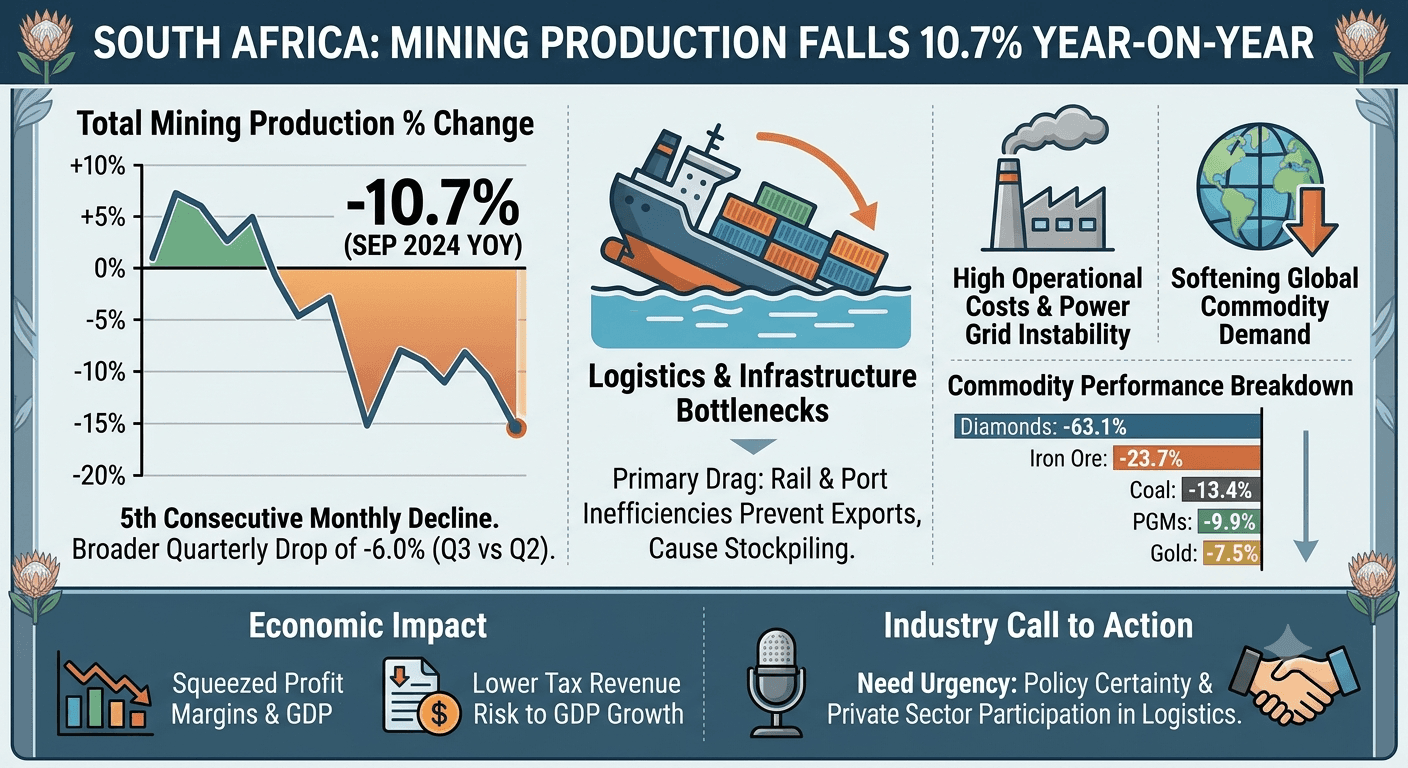
South Africa’s mining industry recorded a sharp 10.7% year-on-year drop in production , marking its fifth consecutive monthly decline and one of the steepest single-month contractions since late 2022. The figures highlight deep structural issues—such as freight rail disruptions, port congestion, and escalating power costs—alongside softening global commodity demand. Total mineral sales at current prices also fell 4.1% year-on-year , reflecting pressure on both production volumes and market realisations. South African Mining Production (Key Statistics) Year-on-Year Production Growth │ -10.7% Quarterly Production Decline (Q3 vs Q2) │ -6.0% Year-on-Year Mineral Sales Drop │ -4.1% Month-on-Month Rebound (Sep vs Aug) │ +2.8% Commodity Breakdown: Winners & Losers The contraction hit 10 out of 12 mining sub-sectors, with industrial and precious metals taking the heaviest blows. Diamonds: Surged downward with a 63.1% decline year-on-year as reduced global consumer demand and synthetic diamond competition pressured rough stone markets. Iron Ore: Production dropped 23.7% , driven by severe logistics bottlenecks on Transnet’s export rail corridors. Coal: Output contracted by 13.4% , impacted by supply-chain limits and shifting global energy demand. Platinum Group Metals (PGMs): Fell 9.9% year-on-year. PGMs remain the single largest structural drag on quarterly performance, reducing overall mining sector output by 3.5 percentage points during the quarter. Gold: Decreased 7.5% , continuing a long-term decline in output due to deep-level mining challenges and lower ore grades. Building Materials & Other Metals: Fell 12.5% and 11.6% respectively. The Outliers Chromium Ore: Rose 13.1% year-on-year. Manganese Ore: Gained 12.8% year-on-year. Both minerals benefited from sustained demand in global ferroalloy and steel production markets. On a month-on-month basis, seasonally adjusted mining output saw a 2.8% increase in September compared to August , providing modest short-term relief despite broader quarterly contraction. Economic Implications & Industry Challenges The sustained slump in mining output directly threatens South Africa's macroeconomic performance: GDP & Fiscal Pressures: Mining directly generates ~6% of South Africa's nominal GDP and accounts for over 14% of corporate tax receipts. A 6.0% quarterly decline in Q3 production threatens third-quarter growth figures and government revenue collections. Logistics Bottlenecks: State infrastructure challenges—specifically inefficiencies in Transnet's freight rail lines and port operations—prevent miners from moving mined stock to ports, resulting in stockpiling and reduced output. Operational Cost Burden: Rising electricity tariffs from Eskom, alongside deep-level operational complexities, continue to squeeze profit margins across major producers. Industry bodies, including the Junior Mining Council (JMC) and the Minerals Council South Africa , continue to call for urgent policy certainty, expedited private sector participation in logistics infrastructure, and streamlined regulatory approvals to attract foreign direct investment.

#Mining#SouthAfrica#MiningIndustry
Global Business Outlook
ELON MUSK EXPRESSES INTEREST IN HIRING JENSEN HUANG AS NVIDIA FACES MAJOR LEADERSHIP SHAKE-UP
Case Study

ELON MUSK EXPRESSES INTEREST IN HIRING JENSEN HUANG AS NVIDIA FACES MAJOR LEADERSHIP SHAKE-UP

Tesla and SpaceX founder Elon Musk has expressed interest in hiring Nvidia's former CEO Jensen Huang, stating that it would be an "honor" to bring him on board. Musk made the remark on social media platform X after a user suggested that he hire Huang amid growing uncertainty surrounding Nvidia's leadership. The development gained further attention after Nvidia announced Huang's resignation on November 12, 2026. The leadership change has attracted attention across the global technology industry, given Huang's significant contribution to the development of artificial intelligence and semiconductor technology. TECHNOLOGY & BUSINESS HIGHLIGHTS 1. 🚀 Elon Musk Shows Interest in Jensen Huang Musk responded positively to a social media post suggesting he hire Huang. His statement reflects public support, but no formal job offer or recruitment agreement has been announced. 2. 🏢 Major Leadership Change at Nvidia Jensen Huang resigned as Nvidia's CEO on November 12, 2026. CFO Colette Kress has been appointed interim CEO while the board considers a permanent successor. 3. 🤖 Jensen Huang's Contribution to AI Huang co-founded Nvidia in 1993 and led its transformation into a major global semiconductor company. Nvidia's GPUs have become essential to AI development, cloud computing and advanced data centres. 4. ⚡ Musk's Expanding AI Ambitions Musk is leading major technology initiatives through Tesla and SpaceX. AI computing infrastructure, autonomous driving, robotics and advanced semiconductor development remain important business priorities. 5. 📉 Market & Industry Reactions Nvidia shares experienced significant pressure following the leadership developments. Investors are monitoring the company's succession plans and the potential impact on its AI business. BUSINESS & INDUSTRY IMPACT AI Industry: Huang's departure introduces a significant leadership transition at a company central to the global AI ecosystem. Semiconductor Market: Nvidia's future leadership and business strategy could influence investor confidence and competition in the chip industry. Technology Collaboration: Musk's public remarks have generated discussion about potential future connections between leading AI and semiconductor businesses. Investor Sentiment: Markets will closely monitor Nvidia's leadership succession and its ability to maintain its competitive position. WHAT COMES NEXT? Nvidia's board will focus on selecting permanent leadership and maintaining business continuity following Huang's departure. Meanwhile, Musk has not announced any formal hiring proposal, leaving the possibility of future collaboration uncertain. THE BIG QUESTION Could Jensen Huang's next professional chapter involve Elon Musk's technology empire, and what would such a move mean for the future of the global AI industry?

#Nvidia#NvidiaNews#ArtificialIntelligence
Global Business Outlook
QUALCOMM INDIA JOB CUTS: OVER 1,000 ROLES AT RISK AS GLOBAL RESTRUCTURING HITS TECH WORKFORCE
Case Study

QUALCOMM INDIA JOB CUTS: OVER 1,000 ROLES AT RISK AS GLOBAL RESTRUCTURING HITS TECH WORKFORCE

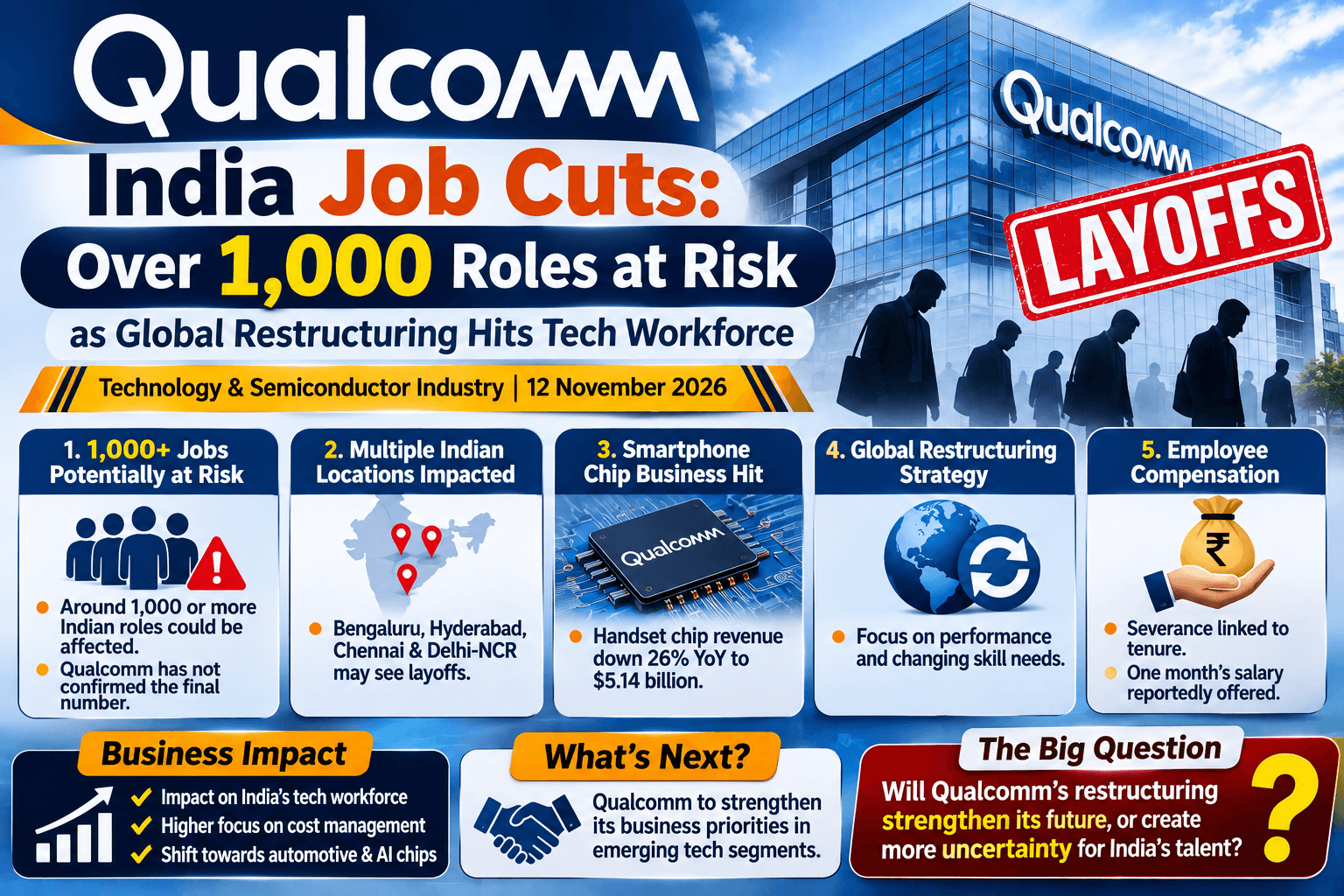
US-based semiconductor giant Qualcomm has begun workforce reductions in India as part of a broader global restructuring strategy, putting more than 1,000 jobs potentially at risk. The reported layoffs began at the company's Bengaluru facility on 9 November 2026, with further reductions expected across engineering and research operations in Hyderabad, Chennai and Delhi-NCR. The development highlights growing pressure on the global technology workforce as companies reassess business priorities, operating costs and future skill requirements. WORKFORCE & BUSINESS HIGHLIGHTS 1. 👥 More Than 1,000 Jobs Potentially at Risk Around 1,000 or more Indian roles could be affected, according to industry estimates. Qualcomm has not officially confirmed the final number of job cuts. 2. 🏢 Multiple Indian Locations Affected Bengaluru witnessed the first reported round of layoffs. Hyderabad, Chennai and Delhi-NCR operations could also face workforce reductions. 3. 📉 Pressure on Smartphone Chip Business Qualcomm's handset chip revenue declined 26% year-on-year to $5.14 billion. Weaker smartphone demand and rising memory costs are creating business challenges. 4. 🌐 Global Restructuring Strategy CEO Cristiano Amon described the workforce reduction as performance-focused. Business priorities, organisational requirements and changing skill needs are also part of the restructuring considerations. 5. 💼 Employee Compensation Reports indicate affected employees may receive severance linked to their tenure. An additional month's salary has reportedly been offered for early acceptance of separation documents. Qualcomm has not officially confirmed these terms. BUSINESS & INDUSTRY IMPACT Technology Workforce: The layoffs highlight increasing uncertainty for India's specialised engineering and semiconductor workforce. Cost Management: Workforce restructuring reflects the pressure on global technology companies to improve operational efficiency. Industry Transformation: Qualcomm's expansion into automotive chips, data centres and AI infrastructure reflects changing priorities beyond smartphones. Indian Tech Sector: The development could influence hiring trends and workforce planning across India's semiconductor industry. WHAT COMES NEXT? Qualcomm will focus on strengthening its business priorities and expanding into emerging technology segments, including automotive computing and AI infrastructure. The impact of the restructuring on India's engineering workforce will become clearer as the process progresses. THE BIG QUESTION Will Qualcomm's global restructuring strengthen its future technology business, or create further uncertainty for India's semiconductor talent market?

#Qualcomm#QualcommIndia#JobCuts
Global Business Outlook
💳 Fiserv Upgrades Project Elevate Target to $1 Billion
Case Study

💳 Fiserv Upgrades Project Elevate Target to $1 Billion

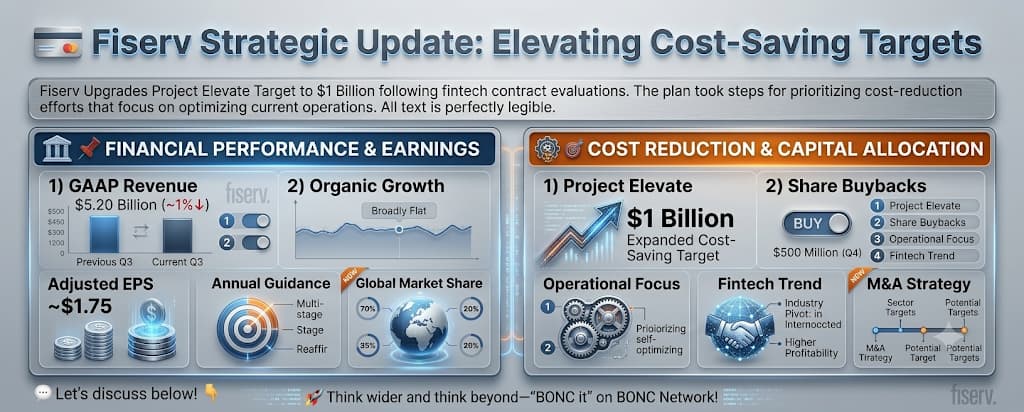
Financial technology provider Fiserv has delivered its third-quarter 2026 financial results, reporting GAAP revenue of $5.20 billion alongside an expanded efficiency strategy. The company escalated its Project Elevate cost-saving target to $1 billion while maintaining its full-year outlook and signaling key shareholder returns. ⚡ SECTION A — Financial Results & Guidance 🔹 01. Revenue Topline Quarterly GAAP revenue reached $5.20 Billion , representing a modest 1% decline year-on-year. 🔹 02. Organic Performance Organic revenue growth remained broadly flat during the third quarter. 🔹 03. Per-Share Earnings Delivered an adjusted earnings per share (EPS) of ~$1.75 . 🔹 04. Guidance Outlook Management officially reaffirmed and maintained its full-year financial target outlook. 📈 SECTION B — Efficiency Strategy & Capital Allocation 🔹 01. Project Elevate Expansion Increased the total target of its Project Elevate cost-saving initiative to $1 Billion . 🔹 02. Share Repurchases Indicated plans to execute approximately $500 Million in fourth-quarter share buybacks. 🔹 03. Core Priority Enhancing operational efficiency and margin optimization remains management's central focus. 🔹 04. Industry Significance Underscores the broader shift toward operational discipline and profitability across the global Fintech landscape. 👇 Let’s discuss below! Think wider and think beyond—“BONC it” on BONC Network!

#Fiserv#FI#Fintech
Global Business Outlook