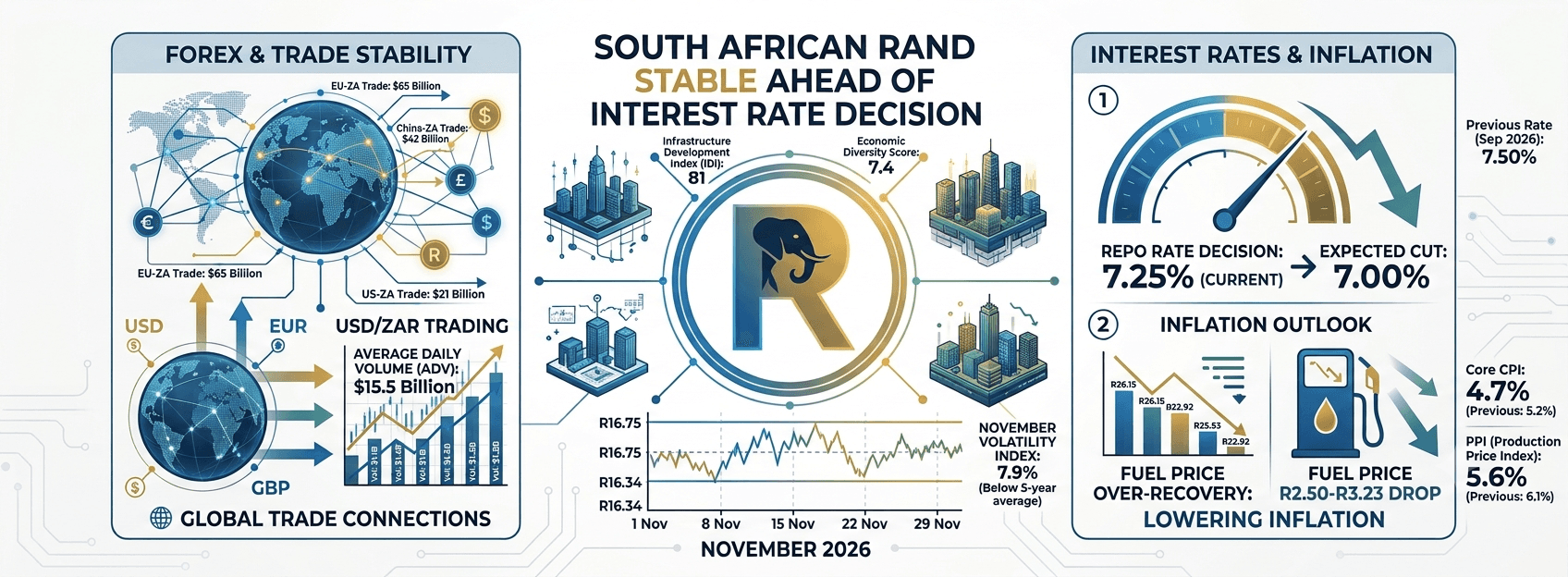
The South African Rand (ZAR) demonstrated remarkable range-bound resilience through November 2026, consolidating within a narrow trade corridor of R16.34/$ to R16.75/$. FX traders and institutional investors remained largely in a holding pattern, balancing post-US election global market adjustments against the upcoming South African Reserve Bank (SARB) Monetary Policy Committee (MPC) rate announcement.
Macroeconomic Snapshot & Key Data Points
Exchange Rate Trajectory: The Rand traded near a central anchor of R16.50/$. It peaked at a monthly high of R16.34/$ early in the month following U.S. election clarity before easing to R16.75/$ amid pre-MPC positioning.
Current Repo Rate: 7.25% (Prime Rate at 10.75%), following cumulative 50 bps rate hikes introduced across mid-2026 to counter temporary energy and import price pressures.
MPC Consensus: Financial markets heavily price in a 25 bps rate reduction to 7.00%, signaling the potential wind-down of the 2026 tightening cycle.
Sovereign Bond Yields: Yields on South Africa's benchmark 10-year government bonds (2035s) eased 13.5 basis points to 8.33%, reflecting lowered domestic risk premiums and sustained capital inflows into local-currency debt.
Inflation & Energy Over-Recovery: Central Energy Fund (CEF) data highlights significant fuel over-recovery, indicating upcoming petrol price reductions of R2.50 to R3.23 per litre for December—providing a strong structural tailwind for headline CPI disinflation.
Strategic Drivers Keeping the Rand Stable
Easing Safe-Haven USD Demand: Post-election political clarity in the United States softened international greenback buying pressure, affording emerging market currencies—particularly high-yielding ones like the Rand—a broader buffer.
Falling Global Energy Overhead: Waning oil supply pressures reduced South Africa's overall import bill, moderating trade deficit strain and improving current account performance.
High Real Yield Differential: The SARB’s proactive monetary stance earlier in 2026, paired with structural commitments outlined in the Medium-Term Budget Policy Statement (MTBPS), maintained an attractive real yield differential for carry-trade participants.
Industry & Sectoral Impact
1. Retail & Consumer Goods
Impact: Positive outlook.
Details: Anticipated SARB rate cuts—coupled with substantial petrol price drops in December—will free up consumer disposable income. Retailers benefit from eased supply chain transport costs and improved consumer sentiment ahead of the festive shopping season.
2. Mining & Mineral Exports
Impact: Neutral to Moderately Restrictive.
Details: A steady Rand near R16.34–R16.50/$ prevents sharp windfall profits for commodity exporters relative to prior weaker exchange rates. However, cost predictability for equipment imports and fuel overheads provides operational stability.
3. Banking & Financial Services
Impact: Highly Sensitive.
Details: Lower interest rates will modestly compress Net Interest Margins (NIMs) for commercial lenders. Conversely, a lower rate environment mitigates non-performing loan (NPL) ratios and improves private-sector credit demand.
4. Energy & Import-Intensive Manufacturing
Impact: Favorable.
Details: Stable FX conditions reduce input cost volatility for imported machinery, electronic components, and raw materials, stabilizing profit margins for local manufacturers.
Governing Body Actions to Curb Volatility & Inflation:
SARB Inflation Target Alignment: The central bank lowered its inflation target focus to 3% (±1%) to permanently lower price expectations and protect the Rand's buying power long-term.
Active Rate Adjustments: The MPC raised the policy rate to 7.25% in September 2026 to absorb geopolitical oil shocks, maintaining real yield appeal for foreign investors.
Fiscal Reform & MTBPS Targets: National Treasury's Medium-Term Budget Policy Statement reinforced fiscal discipline and sovereign debt containment to stabilize local risk premiums and bond yields.
Energy & Port Operations Overhaul: The government continues executing structural supply chain and freight logistics reforms to permanently reduce imported transport and input overhead costs.
November 2026, Johannesburg