• Home

Business

  • Dashboard
  • My Products
  • Edit Business
  • My Groups

Explore

  • Articles
  • Community
  • Careers
  • Blogs
BONC logoGet it on Google Play

Products

  • Pricing
  • Explore Industry
  • Explore Category
  • Explore Product
  • About Us

About BONC

  • FAQs
  • Terms and Condition
  • Privacy Policy
  • Refund Policy
  • Blogs

OFFICE LOCATION

Costipro Technologies Pvt. Ltd, Unit no. 235 to 245, Supremework Workspace, 2nd Floor, ILD Trade Center, Sector 47, Sohna Road, Gurgaon, Haryana - 122018

© 2025 - 2026 BONC Network. All rights reserved

BONC Logo
  • Home

Business

  • Dashboard
  • My Products
  • Edit Business
  • My Groups

Explore

  • Articles
  • Community
  • Careers
  • Blogs

Welcome to BONC Network

Start building your Networking Ecosystem

  • Industry
  • Category
  • Products
  • People
  • Groups
  • Videos

Can't find what you're sourcing?

Post your requirement once and verified vendors come to you. Raise an RFQ, RFI or RFP in a couple of minutes.

  1. 1Post your requirement
  2. 2Verified vendors respond
  3. 3Compare and close
Lodha Camelot - Luxury LivingJSW
Fortune Rice
Homeland Regalia - Mohali
Lodha Camelot - Luxury LivingJSW
Fortune Rice
Homeland Regalia - Mohali
Lodha Camelot - Luxury LivingJSW
Fortune Rice
Homeland Regalia - Mohali
Lodha Camelot - Luxury LivingJSW
Fortune Rice
Homeland Regalia - Mohali
Lodha Camelot - Luxury LivingJSW
Fortune Rice
Homeland Regalia - Mohali
Lodha Camelot - Luxury LivingJSW
Fortune Rice
Homeland Regalia - Mohali
U
BBONC NETWORK
BONC NETWORK

Industry Report · few months ago

BONC Network Newsletter - India & Global Business Outlook (November Week 1, 2026)

The November Week 1 edition of the BONC Network Newsletter provides a comprehensive global and Indian business outlook, highlighting key economic trends, market volatilities, and strategic opportunities. The primary themes dominating the global landscape include escalating oil prices due to the ongoing Iran war, a hawkish US Federal Reserve balancing inflation and rate expectations, record-high US bond yields, a market correction in Big Tech AI stocks, and slowing global GDP growth forecasts . On the domestic front, India navigates macro headwinds through resilient industrial activity, strong tax collections, and robust capital markets, alongside strategic policy shifts and upcoming key watch-events for businesses. Key Section Summaries 1. Global Developments & Macro Trends Oil Markets & Iran Conflict: The US-Israel conflict with Iran drove Brent crude to a high of around $113.10–$114+ in October (up 13.6% for the month) before settling at $109.98 on November 2. This volatility significantly impacts global inflation, central bank policies, and India's import bills (with India importing over 88% of its crude). US Federal Reserve Policy: The Fed held rates at 3.75%–4.00% on October 28 following a 25 bps hike in September. With persistent inflation (CPI at 3.7% YoY) and rare dissenting votes, markets have priced in roughly an 85% probability of a December rate hike. US Bond Yields: The 10-year US Treasury yield peaked near 5.36% in early October and hovered around 5.01% by late October, pushing the 30-year mortgage rate to approximately 7.24% and tightening global borrowing costs. AI Stock Correction & Tech Spending: High-flying AI tech stocks faced a significant correction in late October. The Nasdaq dropped 7.8% from its record highs, and Big Tech companies faced scrutiny over massive AI capital spending (e.g., Meta raising 2026 capex to $135–$145 billion) yielding negative free cash flows for several giants. Global Economic Growth: UNCTAD and the IMF project global GDP growth to slow down from 3.5% in 2025 to 3.1% in 2026, driven by geopolitical tensions, energy disruptions, and tightening financial conditions. 2. Financial Markets & Asset Updates Equities: US markets experienced volatility with the S&P 500 closing around 7,663 in late October, while India's Sensex gained 2.73% in October to close at 74,459.53 (and Nifty rising 1.91% to 23,053.10). Commodities & Currencies: Gold hovered around $4,005 on October 30 under rate-hike pressures, Bitcoin dipped below $80,000 in late October, and the Indian Rupee fluctuated between ₹94.9 and ₹96.9 per USD alongside foreign capital outflows of ₹3.08 trillion from Indian equities in 2026. 3. India Business & Policy Updates Monetary & Fiscal Position: The Reserve Bank of India (RBI) raised its repo rate by 25 bps to 5.50% (its first hike since Feb 2023). India's CPI inflation stands at 5.54% and WPI at 11.39%. Meanwhile, GST collections rose 14.7% YoY to ₹2.03 lakh crore in September. Capital Markets & Startups: IPO activity surged, led by Jio Platforms' ₹30,213-crore issue, contributing to a total of ₹44,451 crore in mainboard IPOs in October. Startup funding reached $2.2 billion in Q3 (up 5% YoY), with AI startups surging 265% to $438 million. Trade & External Policies: Upcoming trade milestones include the India-EU FTA targeted before the end of 2026, alongside ongoing management of US tariff regimes and the Carbon Border Adjustment Mechanism (CBAM). 4. Strategic Market Outlook Growth Sectors: Domestic demand & manufacturing, defence & electronics, power & renewables, IT services, capital markets, upstream oil & gas, and AI startups. Vulnerable Sectors: Oil marketing companies & airlines, crude derivatives, rate-sensitive sectors, unhedged dollar debt, steel & aluminium exporters, food processors, and late-stage startups. Key Events to Watch: US midterm elections (Nov 3), India's October CPI (Nov 12), the Fed meeting (Dec 9), RBI policy, and the Union Budget 2027. As the global economy navigates the crosscurrents of shifting central bank policies, energy volatility, and high-stakes technological evolution, agility and foresight remain your greatest competitive advantages. Whether you are managing risk in rate-sensitive sectors, capitalizing on India's robust domestic momentum, or monitoring the shifting dynamics of Big Tech and AI, staying informed is the key to staying ahead. Thank you for reading the BONC Network Newsletter . We invite you to share your insights, discussions, and updates by " BONC it " on the platform. Stay informed. Stay ahead. November, 3rd, 2026 Team BONC Network

BBONC NETWORK
BONC NETWORK

Industry Report · few months ago

BONC Network Newsletter - India & Global Business Outlook (October Week 5, 2026)

India & Global Business Outlook: Navigating Macro Pressures, AI Shifts, and Market Volatility (October Week 5, 2026) The October Week 5, 2026, business outlook highlights a complex macroeconomic environment marked by rising global energy prices, US monetary tightening, and a cooling AI stock rally. Domestically, India faces tighter monetary conditions following the RBI's repo rate hike to 5.50%, foreign capital outflows, and currency pressure, even as robust infrastructure investments, record-breaking IPO activity like Jio Platforms, and strong manufacturing PMIs signal resilient domestic fundamentals. Businesses must closely monitor inflation prints, global supply chains, and shifting trade tariffs. Key Pointers for Your Article 1. Top 5 Global Business News Surging Oil Prices: Brent crude hit a 5-month high near $115–$120 a barrel driven by escalating Middle East tensions and shipping disruptions in the Strait of Hormuz. US Monetary Tightening & Inflation: The US Federal Reserve rate hike cycle continues with yields on 10-year and 30-year Treasuries holding firm at 5.0% and 5.3% respectively, while September CPI inflation re-accelerated to 3.7% YoY. AI Equity Correction: Concerns over AI spending and funding sustainability triggered a sell-off, pulling the Nasdaq down 2.6% and spilling over into broader cyclical markets. Unconventional Gold Slump: Gold prices slipped 4.2% to around $4,010—briefly dipping below $4,000—as high real interest rates favored safe-haven cash and treasury yields despite wartime risks. 2. India Macroeconomics & Markets RBI Rate Hike & Inflation: The RBI raised the repo rate by 25 bps to 5.50% (its first increase since February 2023), with September CPI inflation ticking up to 5.54% (food inflation at 7.74%). Rupee & Forex Reserves: Foreign exchange reserves fell by roughly $65 billion over six weeks to $721 billion, with the rupee weakening toward the 94.94–96.78 range against the dollar. Record IPO Milestone: Jio Platforms launched India’s biggest-ever IPO aiming to raise ₹30,213 crore, drawing a record-breaking $77 billion in institutional-led bids. Robust PMI & Investments: HSBC flash composite PMI rose to a 4-month high of 56.7, while Union Bank of India projected ~16.24 lakh crore in investments across AI, semiconductors, and defence over the next 3 to 5 years. 3. Global Policies & Trade Watch US Tariffs: Most Indian goods continue to face standard duties plus a 10% Section 301 tariff under ongoing trade negotiations. EU CBAM Impact: With the EU Carbon Border Adjustment Mechanism in its definitive phase, Indian steel and aluminium exporters face mounting transition pressures without exemptions. Russian Energy Relief: Potential sanctions relief on Russian crude and diesel could help ease India's import bill, provided global price volatility remains contained. 4. Sectoral Market Outlook Likely to Grow: Defence, semiconductors, data centres, power equipment, upstream oil & gas, export-oriented IT services, and domestic consumer services. Likely to Struggle: Rate-sensitive sectors (real estate, NBFCs), oil marketing companies, airlines, import-heavy businesses, and EU-bound steel/aluminium exporters. Key Watchpoints: Upcoming US Fed and ECB decisions, India's October CPI print (forecast near 6.2%), Brent oil price trajectories, and corporate debt/hedging strategies. Team BONC Network

R
Rudra Singh

Case Study · few months ago

The Rise of Physical AI: Humanoid Robots and the Next Industrial Frontier

Executive Summary For years, AI existed purely in the digital realm—generating text, analyzing data, and automating software workflows. Today, the most significant frontier is Physical AI: embedding complex Vision-Language-Action (VLA) models into mobile, humanoid, and industrial hardware to operate autonomously in the physical world. The Challenge: From Screens to Physical Space Bridging the gap between digital intelligence and physical execution has been a monumental hurdle: Sensory-Motor Integration: Translating abstract instructions into precise, real-time physical movements (like grasping fragile objects or navigating uneven terrain) requires high-frequency feedback loops. Varied and Unstructured Environments: Unlike static factory arms, humanoid robots must operate alongside humans in chaotic, unpredictable, and changing spaces. Compute at the Edge: Training these systems requires vast simulated environments, while running them requires massive local processing power on on-board hardware. The Architecture: Vision-Language-Action (VLA) Models At the core of Physical AI is a shift away from pre-programmed trajectories to adaptive, general-purpose reasoning: Perceptual Foundation: Large-scale vision-language models capture and understand 3D spaces, objects, and human gestures. Physics and Action Simulation: Millions of iterations are practiced in physics-based simulation environments (like digital twins) to learn motor skills without risking hardware. Real-Time Adaptation: On-board AI processors run neural networks that allow the robot to adjust its path, grip, and task sequence on the fly based on what it senses. Market Impact Labor Support in Hazardous Roles: Industries from logistics to heavy manufacturing are deploying humanoid robots for repetitive, physically demanding, or dangerous tasks, such as material handling and assembly. The Autonomous Supply Chain: The line between software and physical task execution is blurring, with warehouse robots dynamically responding to inventory shifts. Hardware-Software Convergence: Value is rapidly moving toward platforms that seamlessly integrate advanced AI with robust robotic hardware, creating a brand-new multi-billion-dollar industrial market.

The Rise of Physical AI: Humanoid Robots and the Next Industrial Frontier
R
Rudra Singh

Case Study · few months ago

From Chatbots to Action: How Autonomous Multi-Agent Workflows Are Redefining Enterprise Operations

Executive Summary The AI market has crossed a critical inflection point: the transition from conversational interfaces to autonomous multi-agent systems. While 2023–2024 centered on chat-based interfaces and retrieval-augmented generation (RAG), today's high-impact deployments orchestrate specialized AI agents capable of planning, tool use, and self-correcting task execution across enterprise software stacks. The Challenge: Beyond Static Q&A First-generation generative AI implementations faced significant limitations in enterprise environments: Human-in-the-Loop Bottlenecks: Standard chat assistants still required human operators to manually transfer outputs into downstream systems (CRMs, ERPs, ticketing tools). Hallucinations in Complex Logic: Single-prompt LLMs struggled when executing multi-step mathematical, procedural, or data-reconciliation tasks. Siloed Context: Models operated in isolation from real-time enterprise APIs and internal state machines. The Architecture: Coordinated Agentic Systems Modern agentic architectures address these bottlenecks by decomposing complex objectives into discrete, coordinated workflows: Planner Agent: Ingests high-level business goals and breaks them into sequential sub-tasks. Tool-Executor Agents: Interface directly with production APIs, SQL databases, and internal microservices using structured function calling. Critic & Validator Agents: Continuously verify intermediate outputs against compliance rules, schema definitions, and guardrails before committing changes. Key Outcomes & Market Impact 80%+ Reduction in Process Latency: Multi-agent workflows automate complex back-office workflows—such as automated threat triage in SecOps and multi-source vendor reconciliation in finance—reducing turnaround times from hours to seconds. Lower Failure Rates: Deterministic validation layers reduce ungrounded outputs by anchoring every state transition to verifiable system telemetry. Shift in Software Economics: Value is shifting away from generic LLM wrappers toward specialized platforms with deep domain integrations and reliable multi-step execution.

From Chatbots to Action: How Autonomous Multi-Agent Workflows Are Redefining Enterprise Operations
PPrince Gupta
Prince Gupta

Case Study · few months ago

How Artificial Intelligence Is Transforming B.Tech Placements: Opportunities, Challenges and the Future of Engineering Students

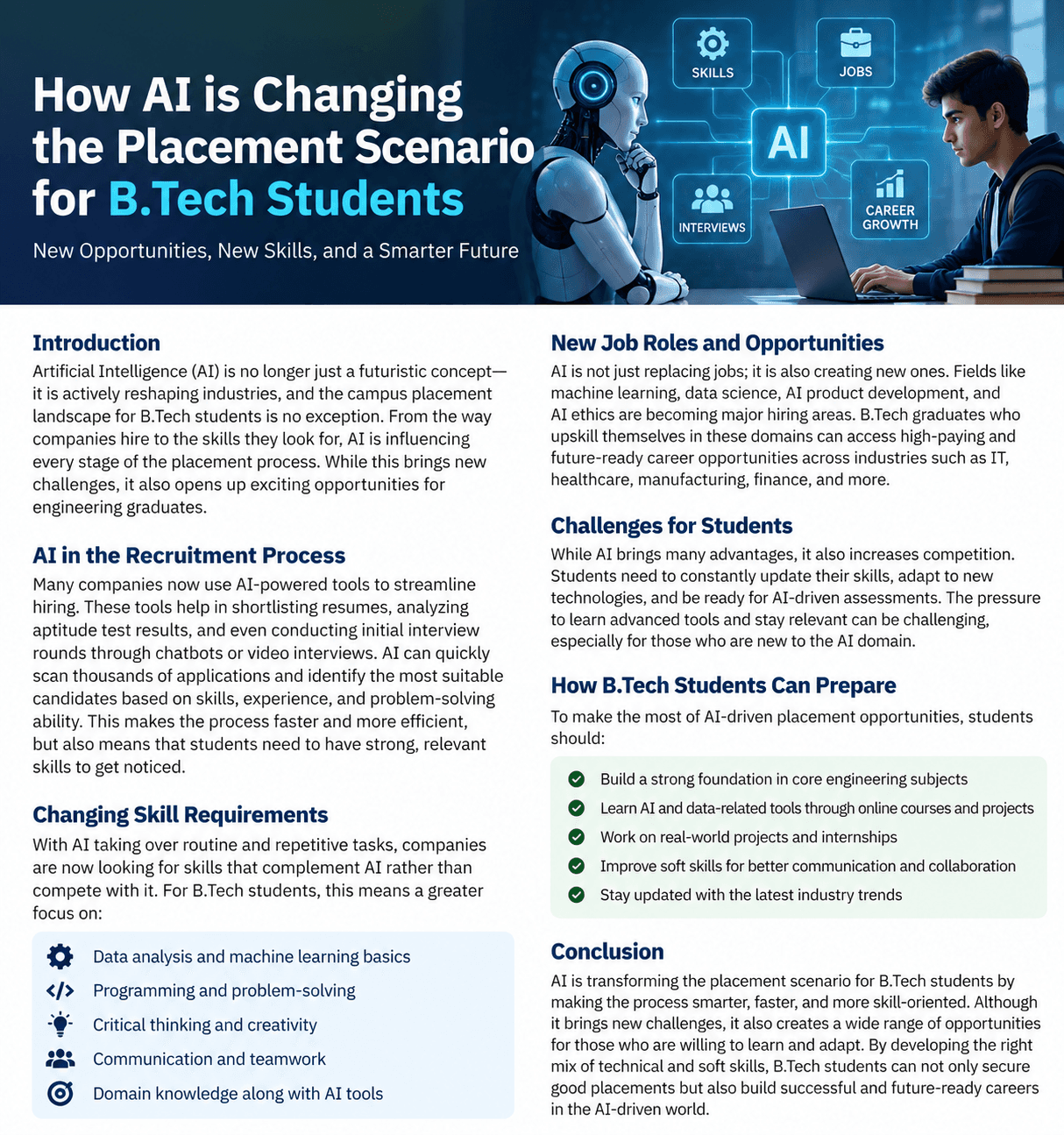
Introduction Artificial Intelligence (AI) is rapidly transforming the world of technology, education, and employment. From automating everyday tasks to developing advanced software solutions, AI has become an important part of modern industries. One area experiencing significant change is campus recruitment, especially for Bachelor of Technology ( B.Tech ) students. In recent years, companies have started looking beyond traditional academic qualifications and focusing more on practical skills, problem-solving abilities, adaptability, and knowledge of emerging technologies. As a result, AI is influencing how companies hire engineering graduates and what they expect from freshers. For B.Tech students, AI brings both exciting opportunities and new challenges. Understanding these changes is essential for building a successful career in the technology-driven job market. 1. How AI Is Changing the Placement Process Artificial Intelligence is transforming the traditional campus placement process. Many organisations are using AI-powered recruitment tools to make hiring faster and more efficient. Some common applications include: AI-based resume screening: Companies use AI tools to analyse resumes and shortlist candidates based on relevant skills, qualifications, and experience. Automated assessments: AI-powered platforms help conduct coding tests, aptitude assessments, and technical evaluations. AI-based interviews: Some recruitment platforms use AI to assist with interview scheduling, candidate assessment, and initial screening. Skill matching: AI helps recruiters identify candidates whose technical abilities match specific job requirements. These technologies are making recruitment more data-driven and efficient. However, candidates must still demonstrate genuine technical knowledge, communication skills, and problem-solving abilities. 2. Increasing Demand for AI-Related Skills One of the biggest changes in B.Tech placements is the growing demand for knowledge of emerging technologies. Companies are increasingly looking for graduates who understand areas such as: Artificial Intelligence and Machine Learning Data Science and Data Analytics Python and Java Programming Cloud Computing Cybersecurity Internet of Things (IoT) Generative AI and Prompt Engineering Although these skills are particularly valuable in technology-related roles, students from different engineering branches can also benefit from understanding how AI applies to their respective fields. For example, mechanical engineering students can explore AI-based automation, while electronics students can learn about intelligent embedded systems and robotics. 3. Will AI Reduce Job Opportunities for B.Tech Students? One of the biggest concerns among engineering students is whether AI will replace human jobs. The reality is more complex. AI can automate repetitive tasks, assist with software development, and improve productivity. This may reduce demand for certain routine tasks and change the responsibilities associated with some entry-level positions. However, AI is also creating new career opportunities in fields such as: Machine Learning Engineering AI Development Data Engineering Robotics and Automation AI Research and Development Cloud and AI Infrastructure AI Security and Governance Rather than completely replacing engineers, AI is changing the nature of engineering work. Professionals who can use AI effectively while applying their own technical knowledge are likely to have an advantage. 4. How B.Tech Students Can Prepare for AI-Driven Placements To remain competitive, engineering students should start preparing for the changing recruitment environment from their first or second year. Here are some important steps: 1. Build Strong Programming Fundamentals Learn programming languages such as Python, Java, or C++. Focus on understanding logic, data structures, algorithms, and problem-solving rather than simply memorising code. 2. Learn AI and Machine Learning Basics Understand fundamental concepts of AI, machine learning, data analysis, and generative AI. Online courses and practical tutorials can help students get started. 3. Work on Real-World Projects Build projects that solve practical problems. Examples include AI-powered chatbots, smart attendance systems, recommendation systems, and data analysis applications. 4. Develop Communication Skills Technical knowledge alone is not enough. Good communication, teamwork, presentation skills, and confidence play an important role during placement interviews. 5. Build a Strong Portfolio Maintain a professional LinkedIn profile and a GitHub account showcasing your projects, coding skills, internships, and certifications. 6. Use AI Tools Responsibly Learn to use AI tools for research, debugging, learning, and productivity. However, avoid depending entirely on AI-generated answers. Companies value candidates who understand the concepts behind their work. 5. The Importance of Human Skills in the Age of AI Even as AI becomes more advanced, human skills remain essential in the workplace. Companies continue to value creativity, leadership, critical thinking, decision-making, adaptability, and emotional intelligence. AI can generate suggestions and analyse large amounts of information, but humans are responsible for evaluating results, understanding real-world situations, making ethical decisions, and solving complex problems. Therefore, B.Tech students should develop both technical expertise and interpersonal skills to become well-rounded professionals. 6. What Does the Future of B.Tech Placements Look Like? The future of engineering placements will increasingly focus on skills, practical knowledge, and the ability to adapt to technological changes. Employers may place greater importance on project experience, internships, technical portfolios, problem-solving abilities, and familiarity with AI-powered tools. Students who combine strong engineering fundamentals with knowledge of AI and other emerging technologies can explore opportunities across software development, manufacturing, healthcare, finance, automation, and many other industries. The traditional approach of depending only on academic marks and theoretical knowledge may no longer be sufficient. Continuous learning and practical experience will become increasingly important. Conclusion Artificial Intelligence is not simply changing the way companies work; it is also reshaping the future of B.Tech placements. While automation may affect certain traditional job roles, AI is creating new career opportunities and increasing the demand for technology-driven skills. For engineering students, the best approach is not to fear AI but to understand it, learn how to use it, and develop skills that complement it. Students who focus on programming, practical projects, communication, critical thinking, and continuous learning will be better prepared to face the changing placement landscape. The future belongs not to those who compete against Artificial Intelligence, but to those who learn to work intelligently with it.

How Artificial Intelligence Is Transforming B.Tech Placements: Opportunities, Challenges and the Future of Engineering Students
A
Ankit Udaypuriya

Market Study · few months ago

Disinvestment in India – Q3 FY 2025–26: Driving Economic Growth and Business Opportunities

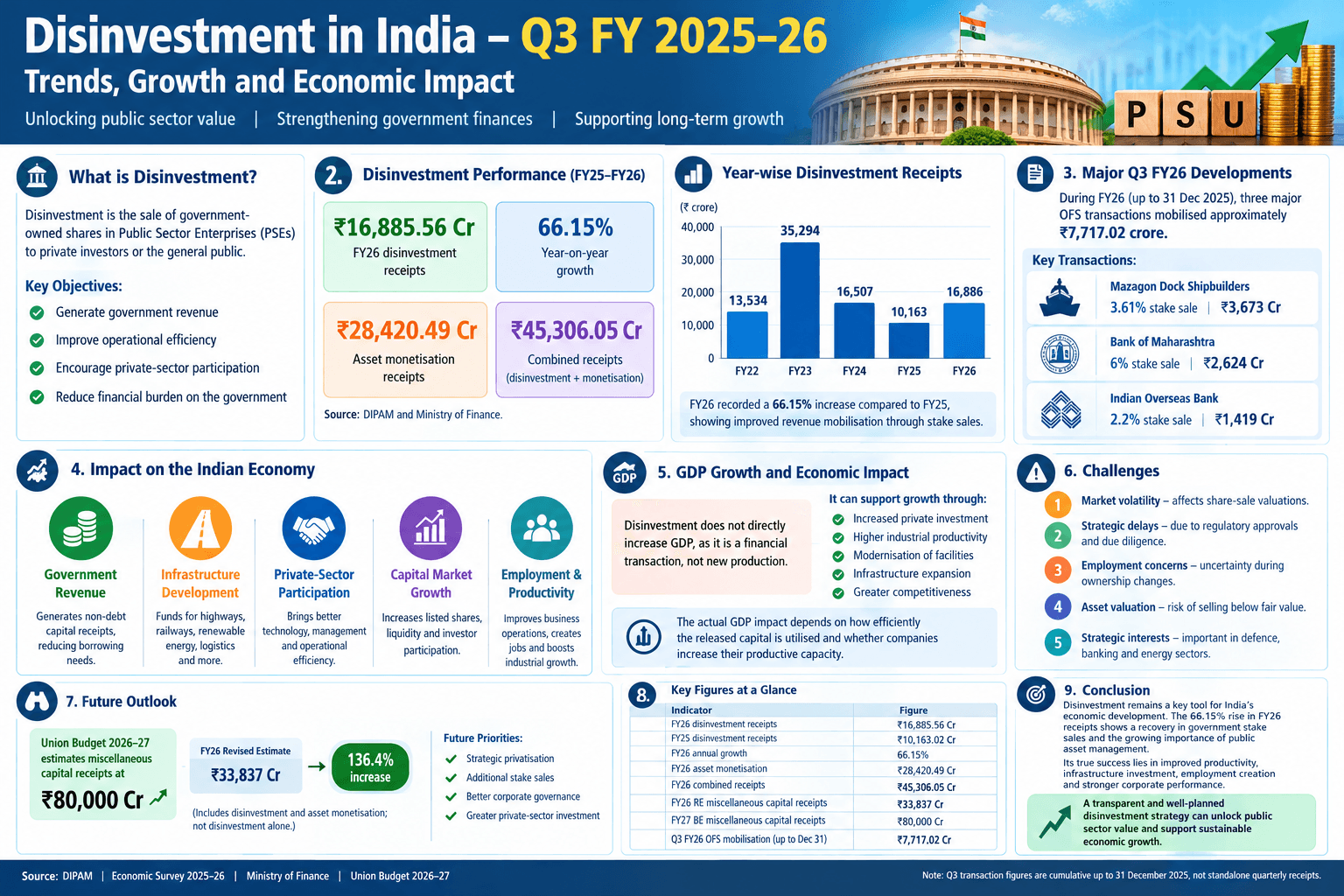
Disinvestment has emerged as an important strategy for strengthening India's economy, improving government finances and encouraging private-sector participation. Through the sale of government-owned shares in Public Sector Enterprises (PSEs), the government aims to unlock public-sector value, improve operational efficiency and create new investment opportunities. During FY 2025–26, India's disinvestment receipts reached approximately ₹16,885.56 crore, compared with ₹10,163.02 crore in FY 2024–25, representing an impressive 66.15% year-on-year increase. The third quarter also witnessed significant developments through Offer for Sale (OFS) transactions involving Mazagon Dock Shipbuilders, Bank of Maharashtra and Indian Overseas Bank, which mobilized approximately ₹7,717.02 crore cumulatively up to December 31, 2025. Disinvestment can contribute to economic development by encouraging private investment, improving corporate governance, supporting technological advancement and creating opportunities for infrastructure and manufacturing expansion. In this evolving business environment, BONC Networ k plays a role in strengthening B2B connections by helping businesses explore opportunities with manufacturers, suppliers and potential business partners. Through business networking and sourcing opportunities, BONC Network supports companies looking to expand their operations, discover new product categories and build stronger commercial relationships. Such connections can complement India's broader industrial growth and private-sector development. However, disinvestment also faces challenges such as market volatility, employment concerns, asset valuation risks and delays in strategic transactions. Looking ahead, India's strategy is expected to focus on strategic privatization, better asset utilization and stronger private-sector participation. The Union Budget 2026–27 estimates miscellaneous capital receipts at ₹80,000 crore. Overall, disinvestment is more than a revenue-generation exercise; it can strengthen public finances, attract investment, improve productivity and create new opportunities for businesses, supporting India's long-term economic growth.

Disinvestment in India – Q3 FY 2025–26: Driving Economic Growth and Business Opportunities
BBONC NETWORK
BONC NETWORK

Industry Report · few months ago

India’s Strategic $22 Billion Defense Modernization Surge

In an assertive push to safeguard national sovereignty, enhance multi-domain deterrence capabilities, and systematically reshape the regional balance of power, New Delhi has granted in-principle administrative approval for a massive ₹2.12 trillion ($22.27 billion) military spending blueprint . This major financial outlay comes at a critical juncture as continuous strategic requirements along the 3,488-kilometer Line of Actual Control (LAC) with China necessitate high-altitude defense readiness, advanced technological integration, and high-velocity battle-space awareness. Rather than relying purely on legacy force deployments, India’s latest defense modernization initiative signals a profound structural shift: integrating autonomous domain dominance, deep surveillance networks, localized defense-industrial manufacturing, and rapid-response tactical infrastructure across key border sectors. Chaired by the Union Ministry of Defence under the Defence Acquisition Council (DAC), this move accords Acceptance of Necessity (AoN) to a spectrum of cutting-edge land, air, and maritime defense platforms. Key Strategic Pillars Driving the $22 Billion Capital Deployment Multi-Domain Capability Overhaul: Directs capital across high-altitude artillery systems, autonomous counter-drone shields, long-range loitering munitions, and specialized naval electronic countermeasures. Indigenous Sourcing Imperative: Targets an ambitious 82% domestic procurement reserve , channeling the vast majority of production mandates toward public sector defense units and domestic technology conglomerates. Accelerated Sanction Velocity: Pushes cumulative military procurement clearances past ₹3.70 trillion ($40+ billion) within a single fiscal year timeframe, reflecting unprecedented administrative agility in clearing defense hardware acquisitions. Asymmetric Technological Balance: Focuses heavily on network-centric warfare tools, real-time aerial sensor integration, counter-UAS platforms, and intelligent target acquisition to neutralize force-asymmetry challenges across rugged Himalayan geography. Detailed Data Breakdown and Fiscal Metrics The newly sanctioned budget framework builds upon India’s expanding national defense capital expenditure allocation. To understand the scale, velocity, and focus of this massive rollout, examine the foundational figures driving this authorization: Total DAC Clearance Approval: ₹2,12,000 Crore ($22.27 Billion USD) dedicated primarily to capital acquisition, advanced tech integration, and border hardware modernization. Cumulative Fiscal Approvals: ₹3,70,000 Crore cleared across recent administrative procurement cycles, marking one of the fastest capital sanction drives in modern Indian defense history. Global Procurement Standing: India accounts for approximately 8.2% of global major arms imports , making it the world’s second-largest defense importer—a posture New Delhi intends to systematically transform via localized procurement mandates. Domestic Defense Sector Allocation: Over ₹1,73,800 Crore (~$18.2 Billion) of the new outlay is reserved explicitly for Indian original equipment manufacturers (OEMs), defense technology innovators, and private engineering firms. Core Impact Areas: Modernization in Focus 1. High-Altitude Surveillance, Tactical UAVs, and Loitering Munitions A substantial portion of the approved capital explicitly targets aerial domain awareness and precision strike capability. Strategic acquisitions focus on long-range Unmanned Aerial Systems (UAS) capable of continuous, all-weather reconnaissance across high-altitude border regions including Eastern Ladakh, Sikkim, and Arunachal Pradesh. These platforms will operate alongside long-range kamikaze drone systems and Integrated Surveillance and Strike Systems, ensuring squad-level visibility coupled with instantaneous real-time strike capabilities. 2. Counter-Drone Shields and Air Defense Systems Recognizing the rapid proliferation of unmanned strike threats and drone swarms in modern theater warfare, New Delhi is deploying multi-layered air defense systems. Approvals cover Very Short-Range Air Defense Systems (VSHORADS) alongside Platform-Based Counter-Unmanned Aerial Systems (C-UAS). These systems combine electronic warfare jamming suites with kinetic interception capabilities to secure forward bases, logistical choke points, and tactical staging areas along sensitive border frontiers. 3. Precision Long-Range Firepower and Tactical Mobility High-altitude standoff experience along mountain corridors has underscored the vital importance of high-mobility heavy firepower. The procurement plan includes Self-Propelled Tracked Gun Systems, High Mobility Vehicles (HMVs) for troop and supply transit across rugged terrain, Gun Shot Response Systems (GSRS) for instantaneous counter-battery detection, and specialized Light Multi-Role Helicopters (LMRH) tailored for high-altitude vertical insertion. 4. Naval Dominance and Maritime Security While land and air boundaries require immediate reinforcement, India continues to secure its maritime flank across the Indian Ocean Region (IOR). The Navy receives capital allocations for Active Offboard Decoy Systems (AODS) and major naval defense platforms, protecting carrier strike groups and surface assets against anti-ship missile threats and submarine tracking. 5. Tactical Weather Intelligence and Border Infrastructure Support Modern high-altitude defense warfare relies on accurate environmental data. The Air Force segment of the capital package incorporates Mobile X-Band Doppler Weather Radars, enabling precision flight planning, artillery trajectory calculations, and missile guidance under dynamic Himalayan atmospheric conditions. Industrial Strategy: Local Manufacturing vs. Global Technology Fusion India’s defense modernization strategy relies on a balanced dual-track model. Under the Make in India and Atmanirbhar Bharat policies, domestic manufacturing receives priority allocation, fostering an ecosystem of domestic defense suppliers. Concurrently, the rapid evolution of modern defense hardware encourages global technology partnerships. International aerospace and defense contractors are engaging in technology transfers, joint design ventures, and co-production agreements covering specialized optics, radar sensors, micro-electronics, and jet propulsion systems. Geopolitical Outlook and Regional Deterrence New Delhi’s approval of $22 billion in military procurement reinforces a long-term strategic principle: border stability is fundamentally linked to unshakeable defensive strength. By directing capital into high-tech ISR, autonomous drone networks, air defense coverage, and high-altitude mobility, India reinforces its operational posture along its northern borders. As these capital clearances transition into signed production contracts and active deployments over the coming quarters, the Indian Armed Forces are set to gain greater technological autonomy, higher battlefield agility, and resilient multi-theater readiness. Team BONC Network October 26, 2026

India’s Strategic $22 Billion Defense Modernization Surge
BBONC NETWORK
BONC NETWORK

Industry Report · few months ago

Nvidia’s $12.9B Hugging Face Deal - DOJ Expands Antitrust Inquiry

Executive Summary Transaction Value: $12.93 billion total transaction value, comprising approximately $11.9 billion in equity/cash value and a $1 billion operational retention fund. Core Investigation Target: The U.S. Department of Justice (DOJ) is investigating whether acquiring the dominant open-source repository gives a single hardware manufacturer total control over the primary distribution pipeline for artificial intelligence software. Broader Regulatory Probe: The Hugging Face acquisition has been formally tied into a multi-year antitrust investigation into semiconductor supply chain dominance, which also targets previous transactions including SchedMD ($2025$), Run:ai, and talent/licensing arrangements with Groq ($20 billion aggregate framework). Target Completion: The acquisition is projected to close in the first half of 2027 , pending antitrust approvals. Federal antitrust regulators at the U.S. Department of Justice have formally expanded an active, multi-pronged anti-monopoly probe into the high-performance computing hardware sector, focusing heavily on Nvidia’s definitive $12.93 billion agreement to acquire Hugging Face. The regulatory scrutiny focuses on platform neutrality, open access, and software distribution across global AI infrastructure. Key Scrutiny Vectors Under Inquiry Control of AI Distribution Hubs: Antitrust regulators are examining whether acquiring the world's largest open-source hub—hosting millions of datasets, open-weight models, and developer tools—creates a single chokehold over developer software distribution networks. Cross-Architecture Hardware Neutrality: Regulatory officials are questioning whether post-acquisition software optimizations could give proprietary accelerator processing units unfair technical advantages over competing processing chips or alternative cloud platforms. Pattern of Infrastructure Consolidation: The DOJ inquiry incorporates the Hugging Face deal into a broader review of hardware and software acquisitions, including supercomputing workload management tool SchedMD, efficiency software creator Run:ai, and high-value technology licensing/hiring deals with Groq. Industry Impact & Platform Guarantees In response to federal inquiries, executive leadership has maintained that Hugging Face will remain an open, platform-neutral hub supporting third-party hardware architectures, competing cloud networks, and open frameworks. While no formal enforcement action or injunction has been filed, regulators continue to solicit feedback from competing hardware developers and cloud providers to determine if platform ownership threatens market competition across the digital supply chain. Industry Impact Analysis: Developers & Cloud Infrastructure The Department of Justice’s probe into Nvidia’s $12.93 billion acquisition of Hugging Face highlights structural shifts across the broader software and hardware supply chains. Below is an examination of how this inquiry and potential acquisition directly affect open-source developers and third-party cloud infrastructure providers. Impact on Open-Source AI Developers Neutrality and Platform Independence: Hugging Face acts as the central hub for open-weight models, hosting over millions of shared datasets, model weights, and application spaces. Developers rely on its vendor-agnostic foundation. The primary concern among open-source builders is whether default optimization layers will subtly favor CUDA-native acceleration over open frameworks. Developer Workflow Integration: Nvidia’s integration could streamline deployment pipelines by embedding specialized libraries directly into standard Hugging Face workflows. While this improves performance out-of-the-box for standard compute setups, developers using non-standard or custom accelerator architectures fear increased integration friction. Preservation of Open Access: Regulators are examining whether free-tier hosting, open model repositories, and public spaces will remain fully subsidized or shift toward monetized, hardware-bound enterprise features over time. Impact on Third-Party Cloud Providers Hyperscaler Competition: Major cloud platforms—such as Amazon Web Services, Google Cloud, and Microsoft Azure—rely heavily on Hugging Face hosted container instances. Ownership by a single hardware manufacturer raises strategic questions about compute-tier neutrality and direct cloud partnership dynamics. Alternative Hardware Providers: Emergent processing unit manufacturers and custom silicon designers face potential distribution bottlenecks if model optimization presets default to established proprietary chip architecture. Deployment Portability: Enterprise cloud architects are increasingly evaluating containerized, multi-repository strategies to prevent vendor lock-in and ensure models can be seamlessly migrated across diverse infrastructure environments. Long-Term Market Implications Federal regulatory oversight serves as a stabilizing force to ensure that commitments to vendor-neutral distribution, open model hosting, and cross-architecture interoperability are enforced throughout the multi-year approval process.

Nvidia’s $12.9B Hugging Face Deal - DOJ Expands Antitrust Inquiry
GGlobal Bserve
Global Bserve

Industry Report · few months ago

Morocco’s Rise Signals a New Investment Landscape in Africa: Manufacturing, Infrastructure and Economic Reforms Reshape Investor Priorities

Africa’s investment landscape is evolving as countries strengthen their industrial capabilities, modernise infrastructure and compete for international capital. Morocco’s growing appeal highlights this shift. According to an assessment by Rand Merchant Bank (RMB), a subsidiary of FirstRand Ltd., Morocco has overtaken South Africa to become Africa’s fourth-most attractive investment destination. The development reflects a broader change in how investors assess opportunities across the continent. Market size remains important, but infrastructure, policy stability, manufacturing capacity, export access and the ease of conducting business are increasingly influential. Morocco’s progress illustrates how sustained investment in industrial development and international trade connections can improve a country’s position. Meanwhile, South Africa continues to offer significant advantages, including a sophisticated financial sector, established industries and a substantial consumer market. The changing rankings do not necessarily indicate that one economy has replaced another in overall strength. Instead, they demonstrate how different countries are positioning themselves to attract capital in an increasingly competitive global environment. Key Takeaways Morocco’s manufacturing capabilities and export-oriented strategy are strengthening its investment appeal. Infrastructure investment and industrial development can help attract long-term capital. South Africa remains an important economic centre despite increased competition. Nigeria, Côte d’Ivoire, Egypt, Mauritius and other markets offer distinct investment opportunities. Investors increasingly evaluate operational conditions, market access and economic resilience alongside market size. Africa’s long-term potential depends on productive investment, skills development, infrastructure and stronger regional trade. Morocco’s Manufacturing Strategy Gains Momentum One of the principal factors supporting Morocco’s investment profile is its focus on manufacturing. Rather than relying exclusively on traditional economic activities, the country has worked to develop industries that can participate in international supply chains. Automotive manufacturing is an important example. Morocco has attracted investment in vehicle assembly and automotive components, helping establish industrial ecosystems that connect manufacturers, suppliers, logistics providers and exporters. This approach can generate benefits beyond the factories themselves. Component manufacturers, packaging companies, industrial equipment suppliers, transport operators and technical service providers may also find opportunities as production networks expand. Morocco’s aerospace activities, renewable-energy ambitions and other industrial initiatives further demonstrate its efforts to diversify economic activity. However, the long-term benefits depend on productivity, local supplier development, workforce capabilities and the ability of domestic businesses to move into higher-value activities. Investment pointer: Businesses considering Morocco should assess opportunities across the wider manufacturing ecosystem, not only among major international manufacturers. Supporting industries and specialised services can be important parts of the value chain. Infrastructure Strengthens Morocco’s Competitive Position Reliable infrastructure is central to investment decisions. Manufacturers and exporters need efficient transport, dependable utilities, access to ports and predictable movement of goods. Morocco has invested in transport links, port capacity and industrial zones to support trade and manufacturing. Its geographic position between Europe and Africa can also be advantageous for companies seeking to diversify production locations and serve multiple markets. Infrastructure improvements can reduce logistical friction, support industrial clustering and make it easier for companies to connect with suppliers and customers. These advantages are particularly relevant for export-oriented businesses operating under tight delivery schedules. Nevertheless, infrastructure quality should be evaluated at the project level. Access, cost, capacity and reliability may differ between locations and industrial zones. Investors must also consider energy costs, water availability, workforce access and the time required to establish operations. Investment pointer: Companies exploring Morocco should compare industrial locations based on total operating costs, logistics access, utilities, labour availability and proximity to target customers. South Africa Remains a Major Economic Force Morocco’s rise in investment attractiveness should not be interpreted as a decline in the overall importance of South Africa. The country continues to possess substantial economic strengths, including developed financial markets, established professional services, industrial capabilities and a broad business ecosystem. South Africa has experience across mining, manufacturing, agriculture, financial services, technology and retail. Its established corporate sector and financial infrastructure can support investors seeking access to sophisticated business services and regional opportunities. At the same time, challenges involving infrastructure reliability, logistics performance, economic growth and policy uncertainty can influence investor confidence. Addressing these constraints is important for improving competitiveness and encouraging new productive investment. South Africa’s investment outlook therefore depends not only on its existing strengths but also on its ability to improve operating conditions, expand infrastructure capacity and create an environment in which businesses can plan with greater certainty. Investment pointer: Investors should distinguish between country-level perceptions and sector-specific fundamentals. South Africa may remain highly competitive in particular industries even as other African economies improve their relative positions. Nigeria: Scale and Market Potential Nigeria remains a major market because of its population, entrepreneurial activity and broad consumer demand. Its economy offers opportunities across consumer goods, agriculture, financial technology, telecommunications, energy and business services. The size of the domestic market can attract companies seeking long-term growth. Local production, distribution networks and services adapted to consumer needs may offer routes into the economy. However, market size alone does not guarantee commercial success. Currency volatility, inflation, infrastructure constraints, financing costs and regulatory complexity can affect business performance. Companies considering Nigeria need detailed assessments of customer purchasing power, pricing, foreign-exchange exposure, payment systems and distribution capabilities. Investment pointer: Businesses should build realistic operating scenarios and evaluate how currency movements, logistics costs and financing requirements could affect profitability. Côte d’Ivoire and the Growth of West Africa Côte d’Ivoire has developed an increasingly important role in West Africa, supported by economic activity, infrastructure development and its position within regional commercial networks. Agriculture and related processing industries remain significant, while construction, consumer services, logistics and manufacturing can offer opportunities as urbanisation and business activity expand. For international companies, the country may provide a platform for exploring wider regional demand. Yet entering a market successfully requires understanding local regulations, customer preferences, distribution arrangements and competitive conditions. Regional expansion should not be treated as a uniform strategy. Countries within West Africa have different currencies, regulatory frameworks, commercial practices and levels of infrastructure development. Investment pointer: Businesses should evaluate Côte d’Ivoire both as a domestic market and as a possible starting point for a carefully planned regional strategy. Other African Markets Offer Different Advantages Africa’s investment landscape cannot be understood through a single ranking. Countries offer different combinations of market access, specialist capabilities, natural resources, financial services and economic conditions. Mauritius, for example, has developed a profile in financial and professional services. Egypt offers a large domestic market and industrial opportunities, while Seychelles has a distinctive position in tourism and selected services. Other economies may offer opportunities linked to agriculture, renewable energy, mining, digital services or regional trade. The attractiveness of each destination depends on the investor’s industry, investment horizon and business objectives. Smaller economies can be competitive in specialised activities even when they cannot match the scale of larger markets. Conversely, a large economy may offer significant demand but require more complex distribution, financing and operational arrangements. Investment pointer: Companies should identify the business outcome they need before selecting a destination. A market suited to manufacturing exports may not be the best choice for consumer retail, financial services or resource-based projects. What Investment Attractiveness Rankings Really Measure Investment rankings provide useful comparisons, but they should be interpreted carefully. They generally assess a combination of economic, financial, institutional and business-related indicators. The precise methodology depends on the organisation producing the ranking. A country’s position may reflect its projected economic opportunities, market conditions, investment climate or other measures. It does not automatically represent the amount of foreign investment received, the profitability of individual projects or the absence of risk. Investors should also distinguish between investment attractiveness, actual capital inflows and realised economic outcomes. A country may attract considerable interest without every announced project proceeding to completion. For this reason, the reported change in Morocco’s position is best understood as a signal of evolving investor priorities rather than definitive proof that Morocco is superior to South Africa across all economic measures. Readers should consult the latest RMB report to verify the ranking, publication date and methodology before citing the figures in a business or investment decision. Supply-Chain Diversification Creates New Opportunities Global businesses have been reassessing how they manufacture, source and distribute products. Factors such as geopolitical uncertainty, transport disruption, changing trade policies and the need for greater supply-chain resilience have encouraged some companies to consider additional production locations. African economies that can provide reliable infrastructure, skilled workers, competitive operating costs and access to target markets may benefit from this shift. Morocco’s industrial development illustrates how manufacturing capacity and international connectivity can support participation in cross-border supply chains. Other African economies may also benefit where their capabilities align with industry requirements. However, supply-chain diversification involves more than selecting a country with lower costs. Businesses must examine supplier quality, delivery reliability, workforce training, customs procedures, access to finance and the availability of supporting industries. Investment pointer: Investors should assess whether a location can meet long-term operational requirements, rather than basing decisions solely on labour costs or short-term incentives. Opportunities for Small and Medium-Sized Businesses Large manufacturers and international investors are not the only businesses that can benefit from Africa’s changing investment environment. Small and medium-sized enterprises may find opportunities by serving the suppliers, distributors and service providers associated with expanding industries. Potential areas include industrial maintenance, packaging, warehousing, transport, business software, technical consulting, workforce training, equipment supply and professional services. Companies entering new markets may also need local partners who understand customer behaviour, compliance requirements and distribution channels. This can create opportunities for domestic businesses with specialised knowledge and reliable delivery capabilities. At the same time, smaller firms must carefully manage payment terms, working capital, contract obligations and customer concentration. Winning a contract with a major company can create growth opportunities, but it can also place pressure on cash flow and production capacity. Investment pointer: SMEs should identify a specific capability they can deliver competitively, develop credible business documentation and build relationships with potential buyers, suppliers and industry partners. Due Diligence Remains Essential Even in countries experiencing positive investment momentum, investors must conduct thorough due diligence. Key considerations include: Regulatory environment: Understand business registration, licensing, taxation, employment rules and sector-specific requirements. Financial exposure: Evaluate currency movements, interest rates, financing availability and repatriation arrangements where relevant. Infrastructure: Confirm the availability and reliability of electricity, water, transport, telecommunications and industrial facilities. Market demand: Validate customer requirements, purchasing power, competition and realistic sales forecasts. Local partnerships: Assess prospective partners’ financial standing, reputation, operational capability and contractual commitments. Workforce: Examine labour availability, skills, training needs and employment obligations. Political and economic conditions: Consider policy changes, trade arrangements and country-specific risks. Sustainability: Evaluate environmental requirements, resource availability and the long-term resilience of the proposed operation. Incentives and favourable rankings can support a business case, but they should never replace independent analysis. Investors should also verify the terms of any incentive directly with the relevant authorities and qualified advisers. Africa’s Investment Future: Competition and Collaboration The changing positions of African investment destinations reflect a continent with diverse economic opportunities and increasingly differentiated business environments. Morocco’s progress demonstrates the potential value of sustained industrial development, infrastructure investment and international trade integration. South Africa continues to offer established capabilities and a substantial business ecosystem. Nigeria brings market scale, while Côte d’Ivoire and other economies offer opportunities shaped by their regional roles and sector strengths. The next phase of investment growth will depend on whether countries can translate investor interest into productive capacity, sustainable employment, stronger domestic businesses and broader economic participation. Infrastructure, skills, regulatory predictability, access to finance and regional cooperation will remain important. So will the ability of domestic firms to participate in supply chains instead of remaining on the margins of investment-led growth. For businesses, the key is not to follow rankings blindly. It is to identify where their products, services, expertise and capital can solve real problems and generate sustainable value. Conclusion Morocco’s reported move ahead of South Africa in RMB’s assessment of Africa’s most attractive investment destinations highlights the changing dynamics of the continent’s economy. Manufacturing growth, infrastructure development and export diversification are helping Morocco strengthen its position in international business discussions. South Africa, meanwhile, retains important advantages that continue to make it relevant to investors. Other markets across the continent offer distinct opportunities depending on the sector, scale and purpose of an investment. The broader lesson is that Africa should not be viewed as a single investment market. Its economies differ significantly in capabilities, risks, consumer demand and business conditions. For investors and businesses, long-term success will depend on informed market selection, rigorous due diligence and the ability to develop strong local relationships. As competition for investment continues, countries that combine credible policies with productive infrastructure and a supportive business environment will be better placed to convert opportunity into lasting economic growth. Synopsis Morocco’s reported rise above South Africa in RMB’s assessment of Africa’s investment destinations highlights the growing importance of manufacturing, infrastructure and export diversification. This article explores Morocco’s industrial strategy, South Africa’s continuing economic strengths, opportunities in Nigeria and Côte d’Ivoire, and the wider factors shaping investment across Africa. It also examines supply-chain diversification, opportunities for SMEs and the importance of due diligence when entering new markets.


Morocco’s Rise Signals a New Investment Landscape in Africa: Manufacturing, Infrastructure and Economic Reforms Reshape Investor Priorities
CConsulting Expert
Consulting Expert

Industry Report · few months ago

Dubai's Strategic Leap: Sheikh Hamdan Approves $544M Urban Plan, Sustainable Population Policy, and Digital Authorisation System

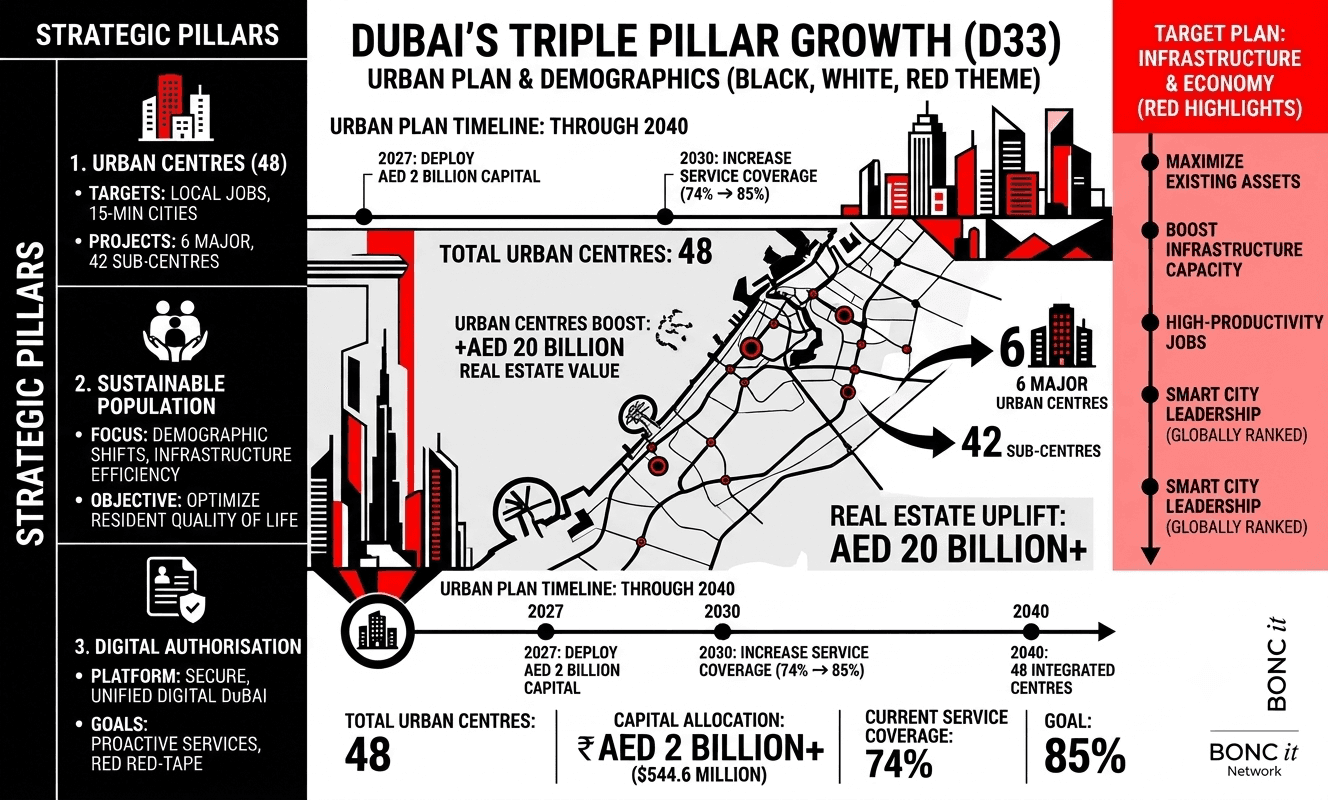
The Executive Council of Dubai, led by Sheikh Hamdan bin Mohammed bin Rashid Al Maktoum—Crown Prince of Dubai, Deputy Prime Minister, and Minister of Defense—has rolled out a comprehensive multi-pillar policy package. Designed to synchronize urban growth, demographic management, and digital government infrastructure, the sweeping initiatives aim to generate an estimated AED 20 billion boost in real estate values while setting new global benchmarks for urban living and digital public services. Q: What was announced? Dubai’s Executive Council, led by Sheikh Hamdan, approved a major three-part policy package covering urban center redevelopment, sustainable demographic planning, and digital government authorizations. Q: Where is the money going? Over AED 2 billion ($544.6M) will fund the Urban Centres Development Plan , targeting 48 specific districts (6 main hubs + 42 sub-centers). The goal is to bring public service coverage in these zones from 74% to 85% and reduce transit times between homes and workplaces. Q: What is the financial upside? Real estate valuations in these 48 targeted areas are projected to jump by AED 20 billion ($5.45B) by 2040. Q: How does the new Digital Authorisation System work? Using UAE PASS , individuals and businesses can digitally grant authorization to third parties for low-risk transactions—completely eliminating traditional notary public visits and paper processes while maintaining 100% fraud protection. 1. The Urban Centres Development Plan ($544.6 Million Investment) At the forefront of the announcement is a capital allocation exceeding AED 2 billion ($544.6 million) through 2040, aimed at restructuring 48 urban districts across the emirate. Decentralized Footprint: The blueprint targets 6 main urban centres and 42 supporting sub-centres , encompassing roughly 12 percent of Dubai’s total urban area. Infrastructure Enhancement: Public service and municipal coverage across these designated zones is projected to rise from 74 percent to 85 percent. Economic Valuation: Beyond localized community development, the plan is structured to unlock an estimated AED 20 billion in property value uplift , bridging the physical gap between residential districts and employment hubs. 2. Sustainable Population Planning Policy Complementing the spatial development strategy, the Executive Council approved the Sustainable Population Planning Policy , a data-driven framework linking demographic shifts directly to economic and urban forecasting. Anticipating Growth: The policy leverages advanced population forecasts to project future service and infrastructure needs, ensuring development aligns with the realities of a cosmopolitan community comprising over 200 nationalities. Targeting High-Productivity Jobs: By aligning population growth with the targets of the Dubai Economic Agenda (D33) , the framework supports job creation in high-productivity sectors, attracts global talent, raises average family incomes, and reinforces local purchasing power. Optimizing Existing Assets: The initiative focuses on maximizing the efficiency and sustainability of current infrastructure, ensuring municipal growth matches the aspirations of both citizens and residents. 3. Digital Authorisation System for Individuals and Companies To advance public sector digital transformation, the Council approved a new Digital Authorisation System , operated via a unified platform developed by Digital Dubai. Paperless Delegations: The system enables individuals and companies to securely authorize third parties to complete low-risk government transactions on their behalf without requiring traditional notary public or legal attestation procedures. Security & Efficiency: Built on UAE PASS digital identity verification, the platform targets a 100 percent digital experience, complete effectiveness in mitigating fraud and operational disputes, and a 90 percent score on the Customer Effort Index. Global Smart City Standing: Coming on the heels of Dubai ranking second globally in the 2026 Smart City Index , the system reinforces the emirate's push toward frictionless, real-time, paperless government administration. In Brief: A Unified Blueprint for Future Growth Dubai’s latest policy approvals reflect an integrated governance approach where spatial infrastructure, demographic planning, and digital administration operate as a single engine. By combining heavy capital deployment in regional urban centers with advanced population forecasting and secure digital tools, Dubai continues to cement its competitive edge as a global hub for talent, investment, and enterprise. In tandem with a data-backed Sustainable Population Policy, Dubai is setting a global benchmark for how digital-first infrastructure directly powers economic competitiveness. Dubai | October 27, 2026

Dubai's Strategic Leap: Sheikh Hamdan Approves $544M Urban Plan, Sustainable Population Policy, and Digital Authorisation System

Discover Connections

View All
BBONC NETWORK
BONC NETWORK

Analysis · few months ago

Anthropic’s Landmark S-1 Public Filing: Scale, Financial Liabilities, and Mission Governance

San Francisco / Global Tech Analysis | October 27, 2026 The registration statement filed by Anthropic —the artificial intelligence research organization and developer behind the Claude model family—has provided the global financial and technology sectors with an unprecedented look into the hyper-scale economics driving frontier AI. Anthropic's S-1 prospectus reveals an operational landscape defined by rapid revenue acceleration, immense noncancelable computing obligations, non-cash equity accounting adjustments, and a specialized corporate governance framework designed to balance commercial expansion with AI safety mandates. As the organization prepares for an initial public offering targeting a valuation between $1.5 trillion and $2 trillion , this analysis breaks down the core structural insights from the filing. 1. Top-Line Acceleration vs. Noncancelable Infrastructure Liabilities The central structural tension highlighted in Anthropic's prospectus is the direct link between enterprise software adoption and long-term capital commitments required to sustain foundation models. Key Qualitative Insights: Explosive Top-Line Trajectory: Demonstrating strong commercial product-market fit, Anthropic reported $16.3 billion in revenue for the first half of the year , representing a fourteen-fold (1,300%+) increase compared to $1.16 billion in the same period the previous year. This growth is primarily driven by enterprise integration of the Claude API suite, agentic developer workflows, and expanding enterprise spending across key corporate cohorts. Long-Term Infrastructure Locking: To support its training and inference requirements, Anthropic disclosed more than $475 billion in compute capacity agreements with multi-year cloud partners. The filing notes that these contracts are overwhelmingly noncancelable , obligating the organization to fixed hardware and energy outlays over extended horizons regardless of future market fluctuations. Capital-Intensive Model Economics: Securing hundreds of billions in infrastructure commitments highlights that competitiveness in frontier AI is directly bound to capital depth, data center access, and power supply allocation. Servicing these fixed obligations requires Anthropic to sustain continuous revenue growth at scale. 2. The Profitability Paradox: Operational Focus vs. Non-Cash Accounting Adjustments Anthropic’s financial disclosures present a distinction between core operational results and total reported net income. Key Qualitative Insights: Accounting Loss Mechanics: The prospectus reported a net loss of $80.7 billion for the first half of the year. The filing clarifies that roughly $72.4 billion of this total stems from non-cash accounting adjustments related to the fair-value remeasurement of convertible instruments and equity obligations as the enterprise valuation rose. These charges represent equity accounting entries rather than direct operational cash burn. Underlying Operational Execution: Anthropic recorded an operating loss of $693 million against $16.3 billion in revenue during the first half. This operational performance indicates that direct serving, unit-level inference costs, and baseline administrative expenses are stabilizing as revenue volume expands. Balance Sheet Liquidity Buffer: To manage capital outlays and maintain operational runway, Anthropic holds $112.4 billion in cash and cash equivalents . This liquidity reserve provides a buffer to cover ongoing compute commitments and support research and development initiatives. 3. Public Offering Architecture, Governance, and Risk Profile The capital structure of the proposed offering and the explicit risk disclosures position Anthropic in a unique category among public market technology listings. Key Qualitative Insights: Landmark Offering Scope: Aiming to raise approximately $100 billion at a targeted public valuation of $1.5 trillion to $2.0 trillion , the offering is designed to fund next-generation compute clusters, custom hardware access, and global enterprise operations. Mission-Oriented Governance: Operating as a Public Benefit Corporation (PBC), Anthropic incorporates unusual governance arrangements that prioritize safe and aligned AI development over short-term financial optimization. These mechanisms leave ordinary public equity holders with limited voting control over strategic and safety policies, requiring public investors to align with management’s long-term governance mission. Explicit Disclosure of Systemic Threats: The prospectus details risks associated with frontier AI deployment, including potential vulnerabilities related to automated cyber exploits, biological information synthesis, and alignment challenges in autonomous agentic systems. The filing also highlights external dependencies such as semiconductor export controls, regional regulatory divergence, and power grid infrastructure availability. Conclusion: A Benchmark for Frontier AI Capital Markets Anthropic’s S-1 filing demonstrates the scale and structural complexity of modern AI development. The prospectus presents an enterprise achieving rapid revenue growth alongside long-term infrastructure commitments and non-cash equity accounting adjustments. As Anthropic moves toward its public debut with specialized governance structures intact, its financial execution will serve as a primary indicator for how public equity markets price hyper-growth, long-term capital liabilities, and technological governance.

Anthropic’s Landmark S-1 Public Filing: Scale, Financial Liabilities, and Mission Governance
BBONC NETWORK
BONC NETWORK

Industry Report · few months ago

Democratic and Trustworthy Technology Forum | Taipei | October 27, 2026

Fortifying Democratic Tech Supply Chains: Key Outcomes from the 2026 Democratic and Trustworthy Technology Forum As advanced technologies reshape global geopolitics, democratic nations are prioritizing secure, transparent, and resilient supply lines. On October 27, 2026, Taiwan’s Ministry of Foreign Affairs (MOFA) co-hosted the Democratic and Trustworthy Technology Forum alongside the Formosa Club in Taipei. The high-level event brought together nearly 50 parliamentarians and security experts representing 19 European nations alongside Taiwanese decision-makers. Discussions focused on joint initiatives across artificial intelligence (AI), uncrewed aerial systems (drones), and the construction of trusted, non-authoritarian hardware ecosystems. Event at a Glance Event Title: Democratic and Trustworthy Technology Forum Date: October 27, 2026 Location: Taipei, Taiwan Co-Hosts: Ministry of Foreign Affairs of Taiwan & The Formosa Club Delegation Composition: European Parliament representatives, national lawmakers from 19 European countries, and leading Taiwanese technology and security strategists. Key Focus Areas & Core Outcomes 1. Trustworthy Artificial Intelligence Governance Participants emphasized that the advancement of AI demands strict compliance with democratic values, transparent algorithms, and robust data protection standards. Ethics and Standard-Setting: Establishing shared operational guidelines to ensure AI deployment remains transparent, traceable, and protected against algorithmic manipulation or unauthorized access. Industrial & Robotic Cyber Defense: Collaborating on hardware security architecture to shield automated manufacturing, industrial robotics, and critical public infrastructure from foreign cyber exploits. 2. Autonomous Drone Systems and Critical Infrastructure Protection Unmanned aerial and underwater assets emerged as critical strategic priorities for both commercial resilience and security. Joint Technical Innovation: Attendees advocated for accelerated research and co-production of commercial and security drone systems, ensuring software and components originate from trusted partners. Subsea Communications Vulnerabilities: Panels highlighted the security of undersea fiber-optic communication cables as vital to international digital stability. Delegates recommended joint deployment of unmanned underwater vehicles (UUVs) to monitor and protect subsea transmission cables. 3. Resilient "Non-Red" Supply Chains Given Taiwan’s central role in global semiconductor fabrication and advanced technology production, delegates focused on protecting critical supply networks. Decoupling from High-Risk Suppliers: Creating "non-red" technology corridors that eliminate dependency on vendors operating under non-democratic regulatory frameworks. Strengthening Europe–Taiwan Synergies: Aligning Taiwan's specialized microelectronics and hardware design sector with Europe’s strategic autonomy objectives to insulate international trade against geopolitical disruptions. Strategic Alignment Delegates affirmed that technological security directly reinforces national sovereignty. European participants highlighted Taiwan's indispensable role as a high-tech manufacturing partner, emphasizing that establishing shared, secure standards for critical technologies ensures economic stability and defends shared democratic values worldwide. Over 50 European Parliament Members Visit Taiwan This news video reports directly on the October 27 forum in Taipei, covering the delegation of European lawmakers discussing joint AI and drone supply chain initiatives with Taiwanese representatives. As critical technologies redefine global geopolitics, Taiwan’s MOFA and the Formosa Club convened European lawmakers and security leaders in Taipei to forge resilient, non-authoritarian supply chains for AI and unmanned systems.

Democratic and Trustworthy Technology Forum | Taipei | October 27, 2026
BBONC NETWORK
BONC NETWORK

Trend Insight · few months ago

Inside the $1 Trillion+ Defense Shift: AI Drones, Nuclear Modernization, and Record Budgets

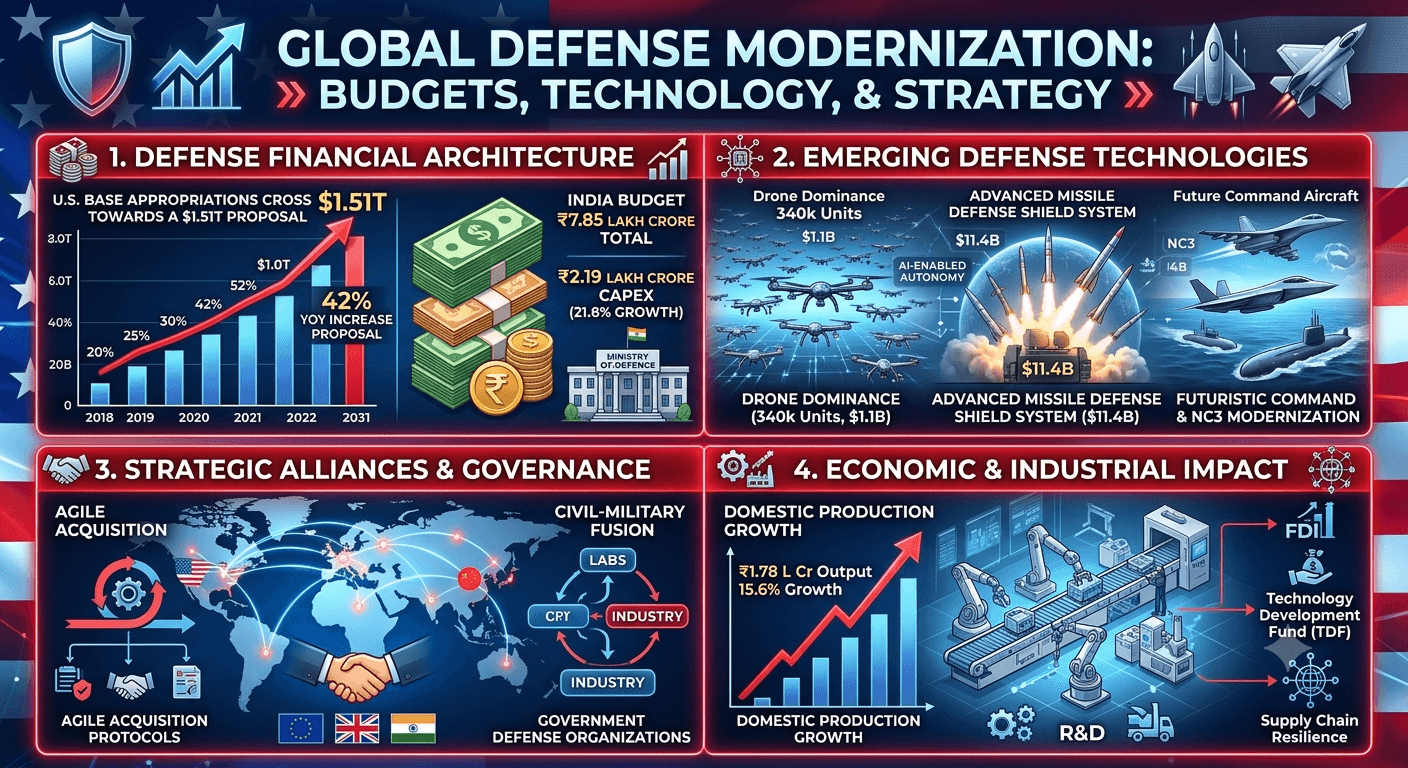
The Global Defense Modernization Paradigm: Budgetary Expansion, Technological Breakthroughs, and Strategic Realignment The global defense landscape is experiencing a structural transition characterized by rapid technological integration, record-breaking defense allocations, and a strategic pivot from traditional deterrence toward multi-domain, highly autonomous, and network-centric warfare. Leading powers and international defense bodies are executing unprecedented modernizations to address complex geopolitical dynamics, supply chain vulnerabilities, and the emergence of asymmetric threat vectors. At the center of this transformation is a massive reallocation of financial capital toward capital expenditure, research and development (R&D), and civil-military technological fusion. This comprehensive analysis covers global budgetary dynamics, emerging technology implementations, institutional governance changes, and key financial and strategic metrics shaping global defense policy. 1. Global Defense Financial Architecture & Budget Allocations Recent national budget releases highlight an aggressive upward trajectory in overall defense spending, with significant growth shifted toward long-term modernization projects, capital outlays, and advanced platform acquisitions. Key Financial Insights & Capital Breakdown United States Budgetary Acceleration: The U.S. defense spending framework passed a historic milestone by crossing $1.0 trillion in FY 2026, with an ambitious FY 2027 proposal of $1.51 trillion representing a 42% year-over-year increase . The FY 2027 discretionary request accounts for $1.15 trillion (a 28% baseline increase ), supplemented by $350 billion in mandatory reconciliation funding. Capital allocation focuses heavily on strategic modernization, including over $756.8 billion allocated to industrial capabilities, $75+ billion to space-based assets, and $20+ billion to cyber defense infrastructure. India's Modernization Shift: The Ministry of Defence received an all-time high allocation of ₹7.85 lakh crore ($85.7 billion) for FY 2026–27, marking a 15.2% YoY overall increase . Capital expenditure (CapEx) experienced a significant 21.8% growth , reaching ₹2.19 lakh crore ($23.9 billion) , excluding civil outlays. CapEx now accounts for 37.7% of the total defense budget (excluding pensions), signaling a deliberate departure from revenue-heavy operational maintenance toward next-generation hardware and platform inductions. Revenue expenditure for operational readiness and troop maintenance stands at ₹3.65 lakh crore ($39.9 billion) —a 16.6% increase —with ₹88,053 crore ($9.62 billion) earmarked specifically for repairs, stores, and civil works. 2. Emerging Technologies and Operational Capabilities Military forces are transitioning from hardware-centric platforms to software-defined, autonomous, and artificial intelligence-enabled environments. Modern battlefields prioritize speed, scalability, distributed lethality, and operational survivability. Primary Focus Areas Autonomous Unmanned Aerial Systems (UAS) & Drone Dominance: Mass Procurement Scale: Tactical doctrine is heavily focusing on uncrewed systems. Initiatives like the $1.1 billion Drone Dominance Programme aim to field approximately 340,000 small, weaponized, and autonomous UAS to forward combat units. Funding Allocation Growth: Global counter-UAS and autonomous technology budgets have tripled, with tactical drone/counter-drone investments reaching $74 billion in U.S. requests. Advanced Missile Systems & Integrated Air Defense: Terminal and Exo-Atmospheric Shielding: Allocation for missile defense includes $11.4 billion earmarked for Terminal High Altitude Area Defense (THAAD) interceptors (procuring 857 units , with a baseline of 450+ interceptors annually through 2031). Ground-Based Midcourse Defense (GMD): Midcourse defense R&D funding expanded by 83.2% , growing from $764 million to $1.4 billion . Glide-Phase Interceptors & Advanced Sensors: Glide-phase interceptor programs rose to $214 million ( +15.6% ), while specialized tracking sensor development saw a 372.6% increase from $183 million to $865 million . Nuclear Modernization & Strategic Command, Control, and Communications (NC3): Sea-Based Deterrence: Funding for the Trident II Life Extension Program escalated to $3.9 billion , while W93 warhead Mark 7 aeroshell R&D expanded from $619 million to $841 million ( +35.8% ). Airborne Command Platforms: NC3 survivability investments increased the Survivable Airborne Operations Center (E-4 replacement) budget from $1.8 billion to $2.2 billion ( +22.2% ) and the E-130J platform (E-6B Mercury replacement) from $1.2 billion to $1.9 billion ( +58.3% ). Naval Fleet Expansion & Maritime Subsurface Deterrence: Maritime force structure emphasizes stealth frigates and nuclear-powered ballistic missile submarines (SSBNs). Recent operational developments include the commissioning of the 3rd Arihant-class SSBN ( INS Aridaman ) and completion of the P-75 submarine series ( INS Vaghsheer ), supporting a strategic goal of an operational 170+ vessel fleet . 3. Institutional Governance, Policy Frameworks, and Strategic Alliances Government defense organizations, ministries, and procurement agencies are overhauling procedural regulations to accelerate technological adoption and strengthen domestic industrial ecosystems. Strategic Governance Initiatives Transition to Agile Acquisition Protocols: Military organizations are replacing rigid acquisition frameworks with Agile Acquisition Protocols . This procedural evolution allows rapid spiral development, iterative prototyping, and continuous software deployment rather than requiring fully locked hardware specifications prior to initial production. Institutionalizing Civil-Military Fusion: National defense authorities are establishing formal Civil-Military Fusion Frameworks to bridge commercial technology sectors and defense laboratories. This approach accelerates the deployment of dual-use technological advances, including quantum computing, generative AI, edge computing, and commercial satellite communications. Partnering initiatives, such as the Development cum Production Partner (DcPP) Model , have engaged over 134 corporate entities alongside major R&D organizations, producing 2,180+ technology transfer agreements and opening 2,780+ intellectual property rights (IPRs) to private defense manufacturers. Bi-Lateral Security Coalitions & Bilateral Pacts: Strategic realignments include landmark international security pacts, such as the EU-India Security and Defence Partnership , which expanded cross-border cooperation in cyber resilience, maritime domain awareness, space domain tracking, and joint supply chain security. 4. Economic Dynamics: Indigenization, R&D, and Foreign Direct Investment Defense industrial policies are prioritizing domestic production capacity, supply chain self-reliance, and reduced dependency on foreign Original Equipment Manufacturers (OEMs). Industrial Base Growth Highlights Domestic Manufacturing Output: Annual domestic defense output reached ₹1,78,000 crore ($19.4 billion) , representing a 15.6% YoY growth over the previous year's ₹1,54,071 crore , and an aggregate 110% expansion compared to FY 2020–21 ( ₹84,643 crore ). Deep-Tech R&D Funding: Governments are deploying targeted venture funding mechanisms, such as an additional ₹500 crore corpus directed to the Technology Development Fund (TDF) , supporting active deep-tech developments in microelectronics, stealth materials, and autonomous algorithms. Foreign Direct Investment (FDI) & Co-Development: Cumulative FDI inflows into defense manufacturing reached ₹6,670.59 crore , supported by regulatory adjustments such as Basic Customs Duty (BCD) exemptions on raw materials and components imported for domestic Aircraft Parts Manufacturing and Maintenance, Repair, and Overhaul (MRO) facilities. 5. Strategic Outlook and Future Challenges While increased funding and accelerated technological deployment enhance operational capabilities, defense sectors globally encounter critical operational and structural challenges: Pensions and Revenue Absorption Balance: High personnel costs and pension liabilities (accounting for ₹1.71 lakh crore in specific major budgets) continue to compete with capital modernization accounts. Industrial Absorptive Capacity: Domestic manufacturing bases must balance rapid technological integration with quality assurance and supply chain scaling to prevent delivery bottlenecks. Multi-Domain Command Integration: Achieving unified operational execution across joint forces requires standardizing legal, logistical, administrative, and software systems across ground, air, naval, cyber, and space domain commands. BONC Network

Inside the $1 Trillion+ Defense Shift: AI Drones, Nuclear Modernization, and Record Budgets
BBONC NETWORK
BONC NETWORK

Industry Report · few months ago

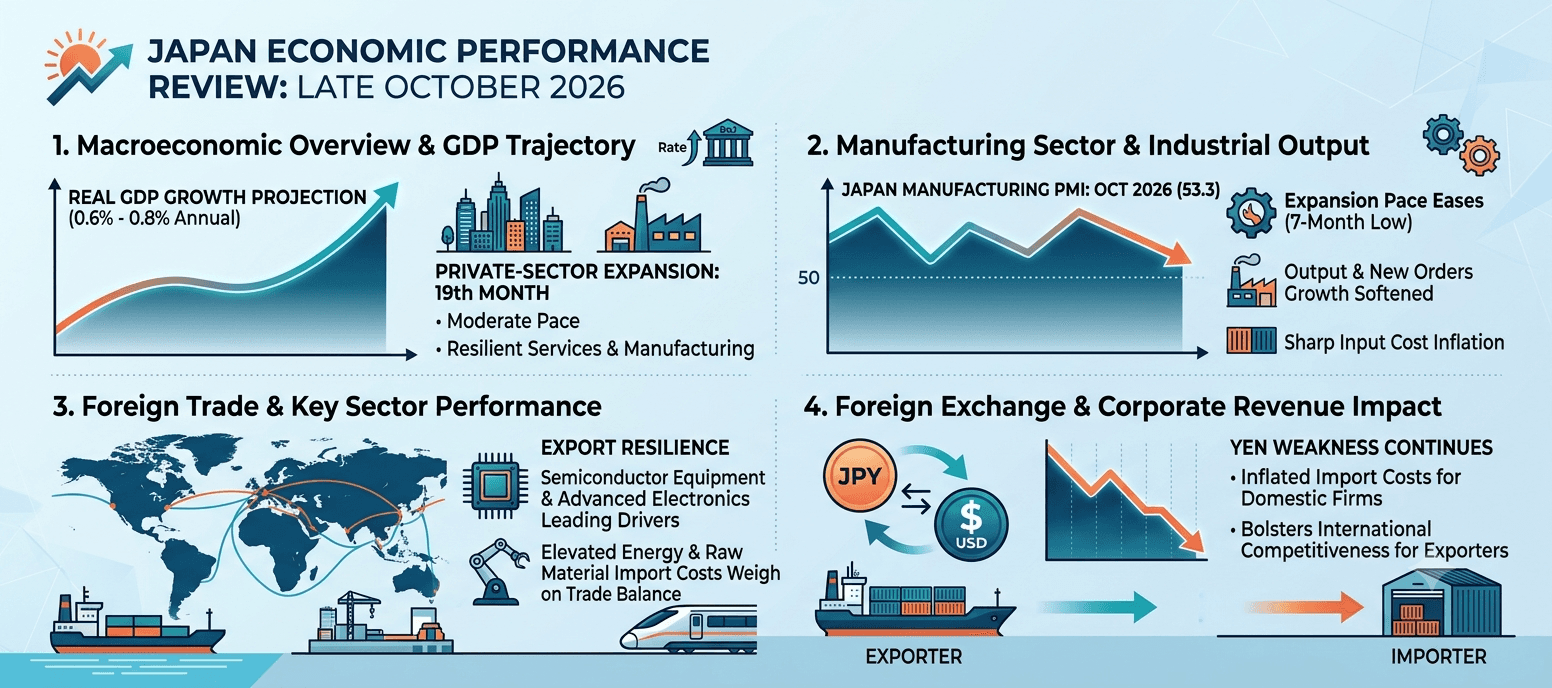
Japan Economic Performance: Late October 2026 Review

1. Macroeconomic Overview & GDP Trajectory Growth Stability & Projections: Real GDP growth is maintaining a moderate pace, projected within the 0.6 percent to 0.8 percent annual range. Private-sector expansion continued for its 19th consecutive month, anchored by resilient activity across both services and manufacturing. Monetary Policy Landscape & Bank of Japan: With core inflation persisting above target thresholds and wage increases taking firm root across smaller regional and national enterprises, the Bank of Japan maintains a hawkish bias, closely monitoring incoming data for potential interest rate adjustments heading toward year-end. Domestic Cost Pressures: Surging input costs and imported commodity pressures continue to challenge domestic purchasing power, prompting cautious consumer spending patterns while employment growth shows moderate gains. 2. Manufacturing Sector & Industrial Output Purchasing Managers Index (PMI) Trends: S&P Global data for late October 2026 shows the Japan Manufacturing PMI easing to 53.3 from 54.1 in September, marking a seven-month low in expansion pace while remaining comfortably above the crucial 50-point threshold. Output & New Orders: Growth in factory output and new order inflows slowed to their softest rates since March, driven by moderating domestic demand and selective global client caution. Input Costs & Supply Chains: Manufacturers experienced sharp input cost inflation and extended supplier delivery times, leading firms to accelerate safety stock building and push inventory accumulation to near four-year highs. 3. Foreign Trade & Key Sector Performance Export Resilience: Foreign sales continue to provide vital support to the corporate sector, propelled heavily by robust global demand for high-end technology, industrial automation, and artificial intelligence infrastructure. Technology & Automotive Sectors: Semiconductor equipment and advanced electronics remain leading export growth drivers, while automotive manufacturers navigate mixed international volumes alongside high-margin pricing strategies in Western markets. Import Costs & Trade Balance: Elevated energy and raw material import costs—compounded by regional transport disruptions—continue to weigh on the national trade balance, resulting in persistent import bill expansions and narrow trade deficits. 4. Foreign Exchange & Corporate Revenue Impact Yen Valuation & Exchange Dynamics: The Japanese yen continues to trade within a weaker band against the US dollar, creating distinct pressures across different segments of the economy. Exporter Margins vs. Import Bills: While the weaker currency significantly inflates raw material, fuel, and energy import costs for domestic-focused enterprises, it bolsters international price competitiveness for major Japanese industrial exporters, effectively cushioning corporate revenues and net earnings. As Japan navigates the final stretch of October 2026, balancing technology-driven export resilience against mounting import costs and imminent monetary policy shifts, proactive strategic adaptation remains paramount. Organizations must closely monitor currency fluctuations, manage supply chain pressures, and prepare for evolving interest rate environments to secure long-term operational stability.

Japan Economic Performance: Late October 2026 Review
BBONC NETWORK
BONC NETWORK

Market Study · few months ago

South Africa Financial Markets in October 2026: Key Trends, Risks and Business Impact

South Africa’s financial markets are navigating a challenging combination of rising energy costs, inflation uncertainty, currency fluctuations and changing investor expectations. At the same time, developments in government finances have offered some encouragement, creating a mixed outlook for businesses, consumers and investors. October 2026 is an important period for understanding how international events affect South Africa’s domestic economy. Fuel prices, interest rates, the rand, commodity markets and government borrowing all influence the cost of doing business and the direction of financial markets. This original article examines these developments in an editorial format, with relevant images for use in a business publication or on BONC Network. 1. South Africa’s financial market: a mixed economic outlook South Africa’s economy is being shaped by two competing forces. Improved government revenue expectations and efforts to manage public debt could strengthen investor confidence. However, higher fuel costs, inflation risks and relatively modest economic growth continue to challenge businesses and households. Financial markets respond not only to current economic conditions but also to expectations about what may happen next. Investors are assessing whether inflation will remain elevated, whether the currency can stabilise and whether government measures will translate into sustainable economic improvements. For businesses, the immediate priority is managing costs and cash flow while remaining prepared for changes in demand, borrowing costs and international trade conditions. 2. Inflation and rising fuel prices Fuel prices are an important channel through which international economic developments affect South African consumers and companies. South Africa relies heavily on imported petroleum products, making domestic fuel costs sensitive to global oil prices and the exchange rate. When fuel becomes more expensive, the consequences extend beyond motorists to freight operators, food distributors, manufacturers and retailers. Higher transportation costs can increase the price of everyday goods. Households may respond by reducing discretionary purchases, while businesses must decide whether to absorb additional expenses or pass some of them on to customers. Consumer inflation reached 4.5% year-on-year in September 2026, according to reporting published in October. Higher fuel costs could add further pressure to the next inflation reading. For smaller businesses, the challenge is particularly significant: operating expenses may rise faster than sales, reducing already limited profit margins. 3. Interest rates and their effect on businesses Interest rates influence the cost of borrowing, household spending, business investment and financial-market valuations. The South African Reserve Bank’s October monetary policy review reported a policy rate of 7.25% following a cumulative 50-basis-point increase during the review period. The bank also projected economic growth of approximately 1.2% for 2026. The central bank faces a difficult balance. Higher interest rates can help contain inflation, but they also increase the cost of financing homes, vehicles, inventory and business expansion. For businesses considering new equipment, additional employees or expansion into new markets, financing costs become an important part of investment decisions. Consumers facing higher loan repayments may have less money available for shopping, travel and other services. If inflation begins to ease sustainably, the outlook for future rate reductions could improve. If fuel costs continue to feed into broader prices, borrowing conditions may remain restrictive for longer. 4. The rand and international investor confidence The rand is a key indicator of how domestic and international developments interact. Its value can change in response to US interest-rate expectations, global investor sentiment, commodity prices and political or geopolitical uncertainty. A weaker rand makes imported fuel, machinery, electronics and other foreign-currency-priced products more expensive. Businesses that depend on imported materials may experience increased costs, while exporters earning foreign currency can receive more rand for their overseas revenue. A stronger rand can reduce some import costs and ease inflation pressure, although it may reduce the local-currency value of foreign earnings for exporters. Businesses trading between South Africa and India should pay particular attention to the rand–rupee exchange rate. Currency movements can affect purchasing costs, contract pricing, margins and the competitiveness of products in both markets. 5. How the Johannesburg stock market is being affected The Johannesburg Stock Exchange (JSE) reflects a wide range of businesses, so the same economic developments can have very different effects across sectors. Banking and financial services: Higher interest rates may support some lending margins, but they can also increase repayment pressure and weaken demand for credit. Banks must balance potential revenue benefits against credit risks and slower economic activity. Mining and commodities: Companies producing gold, platinum-group metals and other resources may benefit from favourable commodity prices. However, profitability also depends on operating expenses, production volumes, electricity supply, transport infrastructure and global demand. Retail and consumer businesses: Rising fuel and borrowing costs can reduce household purchasing power. Retailers may need to compete more strongly on price, convenience and value to protect sales. Manufacturing and logistics: Higher fuel, freight and imported-input costs can squeeze margins. Businesses that cannot easily adjust prices may face particular difficulties. Property and income-focused investments: Changes in interest rates and bond yields can affect property valuations, financing expenses and the relative appeal of income-generating investments. The key point is that a market-wide recovery does not mean every company is performing well. Investors need to distinguish between sector trends and the financial position of individual businesses. 6. Government finances and investor confidence South Africa’s mid-term budget update on 21 October 2026 provided an important signal for the financial community. The government projected that revenue for the 2026/27 financial year would be R17.1 billion higher than forecast in February. The government is also aiming to narrow the budget deficit over the medium term and stabilise public debt. Stronger revenue and credible fiscal management can help reassure investors about the government’s ability to meet its financial obligations. If borrowing requirements become more manageable, government bonds could benefit, while improved confidence may support investment over time. However, higher revenue alone does not resolve the country’s longer-term economic challenges. Debt-servicing costs, unemployment, infrastructure constraints and weak growth remain important concerns. The sustainability of the improvement will depend on whether revenue gains continue, spending remains disciplined and the economy develops a stronger capacity to generate jobs and investment. 7. International oil prices and global trade South Africa’s financial outlook is closely connected to international trade and energy markets. Disruptions to oil supplies, geopolitical tensions and changes in global demand can affect the cost of imports and the earnings of exporters. Higher oil prices increase the cost of transporting goods and operating fuel-intensive businesses. If the rand weakens at the same time, the impact on local costs can be even greater. International trade conditions also create opportunities. Businesses that export competitively priced goods may benefit from overseas demand, while importers may need to renegotiate supplier terms or revise pricing strategies. For companies involved in South Africa–India trade, three areas deserve particular attention: exchange-rate exposure, freight costs and the timing of purchase orders. Clear contract terms and realistic financial planning can help reduce uncertainty. 8. Which sectors face the greatest pressure, and where could opportunities emerge? The October environment creates different risks and opportunities across the economy. Transport and logistics: Fuel-price increases can raise delivery expenses and reduce margins. Consumer goods and retail: Households may focus on essential products and become more price-sensitive. Manufacturing: Higher energy, freight and imported-material costs can make production more expensive. Mining and commodity exports: Selected producers may benefit from favourable international prices, depending on their costs and production levels. Financial services: Banks, bond investors and other financial institutions may see opportunities, but outcomes will depend on inflation, credit quality and market expectations. Import and export businesses: Companies that manage exchange-rate risk and supply-chain costs effectively may be better positioned to remain competitive. These are potential economic effects, not guarantees of investment performance. Actual results depend on individual businesses, market prices and future developments. 9. What should businesses and investors watch in November? The next phase of the market outlook will depend on several developments. The Reserve Bank’s interest-rate decision: Investors will assess whether inflation risks justify further tightening or whether rates can remain unchanged. The next inflation figures: These will help show how much of the fuel-price shock is passing into the wider economy. Rand and oil-price movements: Currency stability and energy costs will influence imported inflation, corporate expenses and trade competitiveness. Government budget implementation: Investors will look for evidence that stronger revenue expectations translate into more sustainable public finances. Corporate earnings and business activity: Company results will help establish whether businesses are managing higher costs or experiencing weaker demand. For businesses, the practical response is to review cash-flow forecasts, monitor supplier prices, manage currency exposure and avoid assuming that recent market movements will continue in the same direction. 10. Conclusion: a market balancing resilience and uncertainty South Africa’s financial environment in October 2026 reflects both encouraging developments and continuing economic pressures. Improved government revenue expectations provide a positive signal, but rising fuel costs, inflation uncertainty, borrowing expenses and modest growth remain important challenges. The direction of the market over the coming months will depend on whether inflation moderates, the rand becomes more stable, international energy costs ease and the government maintains credible fiscal management. For companies, disciplined cost management and careful financial planning will be essential. For investors, understanding differences between sectors and evaluating individual businesses will be more useful than relying on a single market headline. The central message is clear: South Africa’s financial resilience will depend not only on currency movements or stock-market performance, but also on its ability to control inflation, strengthen public finances, improve business conditions and generate sustainable economic growth. Sources and editorial note The article is original editorial writing, informed by publicly reported economic developments. For factual verification and further reading, consult: South African Reserve Bank — Official website and monetary policy publications . Reuters — International financial and economic reporting . National Treasury of South Africa — Budget documents and fiscal policy updates . Johannesburg Stock Exchange — Market information and listed-company resources . Publication note: The text has been written from scratch and does not intentionally reproduce third-party article passages. Names of institutions are used for factual identification. This is not a guarantee of legal clearance, and market figures should be checked against official releases before publication.


South Africa Financial Markets in October 2026: Key Trends, Risks and Business Impact
MMihaana Personal care
Mihaana Personal care

Research · few months ago

Strategic Manufacturing in the Natural & Ayurvedic Sector: Third-Party vs. Job Work vs. In-House

The natural wellness and Ayurvedic markets are at a defining crossroads. As modern consumers demand uncompromising purity, strict clean-label standards, and proven botanical efficacy, brand founders and executive teams face a critical operational dilemma: Which manufacturing architecture best balances product integrity, supply chain reliability, and capital efficiency? Navigating this choice requires examining three distinct operating models: Third-Party Contract Manufacturing , Job Work Processing , and In-House (Self) Manufacturing . 1. Third-Party Contract Manufacturing (The Turnkey Model) Under this model, the brand outsources the entire end-to-end production lifecycle to an established manufacturing partner. How It Works: The partner manages raw material procurement, packaging, formulation, and quality assurance under their own manufacturing licenses and GMP certifications. The Pros: Extremely low upfront capital expenditure (CapEx), rapid speed-to-market, and immediate operational scalability. The Cons: Lower control over ingredient sourcing and pricing transparency. Without rigorous oversight, vendors may substitute lower-grade extracts to protect margins. Best For: Early-stage brands, D2C startups, and agile companies testing new product categories. 2. Job Work Processing (The Hybrid Control Model) Job work represents a strategic middle ground where the brand owner retains absolute control over raw materials and primary formulations, while outsourcing physical processing, blending, and packaging. How It Works: The brand sources, audits, and supplies its own botanical extracts, essential oils, and active ingredients directly to a licensed processing facility. The Pros: Total control over ingredient quality and active standardization (crucial for Ayurveda), combined with lower capital requirements than building a dedicated plant. The Cons: Requires a complex two-step supply chain, active inventory management, and careful coordination of production line schedules. The Alignment: Ideal for premium wellness brands that refuse to compromise on raw ingredient purity but wish to avoid heavy factory overhead. 3. In-House / Self-Manufacturing (The Vertically Integrated Model) In this model, the brand owns, operates, and maintains its own dedicated manufacturing facility, cleanrooms, and analytical testing laboratories. How It Works: Total capital and technical ownership of machinery, real estate, labor, and compliance infrastructure. The Pros: Absolute control over farm-to-lab traceability, immediate batch variable adjustments, maximum intellectual property protection, and optimized gross margins at scale. The Cons: Immense capital outlay, high fixed overhead costs (OpEx), complex regulatory maintenance, and slow initial setup timelines (12 to 18 months). Best For: Well-capitalized, established enterprises with high volume, stable distribution channels, and proprietary manufacturing techniques. Key Pillars for High-Quality Ayurvedic & Natural Products When scaling premium natural formulations, three operational dimensions dictate success: Active Standardization: Natural actives (such as withanolides in Ashwagandha or curcuminoids in Turmeric) vary widely by harvest. In-house and job work models excel here because the brand can mandate specific suppliers and verify active content before processing. Batch Consistency: Variations in aroma, viscosity, and color undermine consumer trust. Owned facilities provide instant turnaround on process tweaks, whereas third-party partners require strict operational SLAs to maintain consistency. Delivery Agility: Meeting retail and D2C demand spikes requires reliable lead times. Turnkey third-party lines offer the fastest restock cycles, while self-manufacturing provides guaranteed priority over production schedules. Strategic Verdict: Which Model Fits Your Brand? Choose Third-Party if your primary goal is capital-efficient market entry, rapid prototyping, and aggressive marketing focus. (Tip: Mandate independent third-party lab testing for heavy metals and active assays before dispatch). Choose Job Work if ingredient purity and active ingredient integrity are central to your brand promise, but you want to avoid factory ownership. (Tip: Station an internal quality assurance auditor on-site during full production runs). Choose In-House if you have achieved massive scale, possess proprietary processing technology, and require complete vertical integration to protect trade secrets and long-term margins. How is your leadership team balancing manufacturing agility and quality control in your current product lineup? Let’s discuss in the comments below!

Strategic Manufacturing in the Natural & Ayurvedic Sector: Third-Party vs. Job Work vs. In-House
BBONC NETWORK
BONC NETWORK

Industry Report · few months ago

The Agentic Economy: Finance and Accounting Complete the Great Migration in Q3 2026

By the close of the third quarter of 2026, the global corporate ecosystem finalized a foundational migration. The experimental phase of Generative AI ended, replaced by universal integration within the Finance and Accounting (F&A) function. If the early 20s were characterized by fragmented "island automation" using basic robots, Q3 2026 marked the maturation of Agentic Finance—where autonomous AI agents operate directly inside ERP environments like SAP S/4HANA, Oracle Cloud ERP, and Workday, managing the full transaction lifecycle without prerequisite human intervention. ​This evolution is fundamentally reshaping shared business models and Managed Business Services (MBS), driven by a corporate obsession with structural cost optimization and the pursuit of "zero-latency financial books.." ​The Anatomy of Transformation: Major Players and Strategic Shifts ​The Global Business Services (GBS) model, formerly rooted in low-cost headcount arbitrage, completed its multi-year pivot toward technological orchestration. Managed Business Services and BPO leaders—such as Genpact, Accenture, Deloitte, EXL Service, and Helpware—have fundamentally restructured their service delivery models. ​To remain competitive, these outsourcing giants have largely abandoned traditional full-time equivalent (FTE) billing models. In Q3 2026, MBS contracts are now structured entirely around "Outcome-as-a-Service." Enterprise clients no longer purchase headcount; they purchase guaranteed operational outcomes, such as a standardized cost per closed period, a static accuracy percentage, or a metric linked to cash flow optimization. To maintain their own operational margins under these outcome-linked contracts, service providers have automated up to 85% of transactional workflows. ​Data from late 2026 indicates that 65% of global finance hubs have now institutionalized centralized AI governance bodies to supervise these agentic workflows, moving the role of finance teams from "data processors" to "governors of automated systems." ​The Financial Realities: Compressing Costs and Eliminating Errors ​The financial impact of this agentic migration is visible across enterprise balance sheets. The pursuit of cost optimization through automation is no longer theoretical; it is realized across major corporate finance departments. ​In transactional areas, the data shows a dramatic drop in operational overhead: ​Accounts Payable (AP) Efficiency: Across global enterprises, the fully loaded cost of processing an invoice in Accounts Payable has fallen from a manual baseline of roughly $13.50 down to a stabilized average of $2.98. AP agents operating within platforms like BlackLine and Workiva read invoices, auto-match purchase orders, calculate tax jurisdictions, and execute payments, routing only severe anomalies to human controllers. ​Accuracy & Error Reduction: While manual data entry historically carried a 1% to 5% error rate—creating substantial downstream reconciliation workloads—AI agent accuracy in Q3 2026 has stabilized above 99.5% for standard transactional posting. ​Continuous Compliance Audit: Traditional audit sampling (reviewing 10% to 15% of records) has been replaced by 100% continuous compliance monitoring. Secondary AI auditing agents evaluate every transaction in real-time against statutory frameworks (such as IFRS 16/17 and ASC 842), reducing financial reporting compliance errors by 78%. ​Corporate Milestones: Achieving the Continuous Close ​Several major technology and cloud giants—including Microsoft, Amazon, Cisco, and Oracle—have set distinct benchmarks that define the new F&A landscape by using embedded AI engines to execute real-time intercompany eliminations and automated multi-currency reconciliations throughout the month. ​The Continuous Close: By automating complex reconciliations in real time throughout the operating period, the traditional "month-end crunch" has largely disappeared. The standard corporate close window has compressed from 8–10 business days down to 3–5 days—a 30% to 50% speed improvement across major global entities. ​Advisory Capacity Expansion: F&A teams leveraging agentic workflows report reallocating ~8.5% of total working hours away from routine production and data extraction toward high-value strategic advisory, scenario planning, and capital allocation modeling. This shift effectively unlocks approximately 7 weeks of additional advisory capacity per employee annually, directly enhancing executive decision-making.

The Agentic Economy: Finance and Accounting Complete the Great Migration in Q3 2026
P
Pooja Sharma

Whitepaper · few months ago

HIGH ALERT: Is Your Credit Card Safe? The Silent Surge in Phone & POS Payment Frauds

The rapid digitalization of global commerce has fundamentally altered how capital moves. However, this friction-free convenience has also catalyzed a sophisticated, multi-billion-dollar cybercrime industry. Modern payment fraud is no longer limited to crude card theft; it relies on high-tech skimming, deepfake voice cloning, and engineered psychological manipulation across voice, physical, and digital channels. Maintaining total vigilance is no longer optional—it is a critical necessity for preserving personal financial security and organizational credit lines. Critical Data Takeaways The Impersonation Crisis: Over 70% of digital payment frauds in India stem from social engineering—specifically voice phishing (vishing) where scammers exploit fear, urgency, or authority to extract One-Time Passwords (OTPs), PINs, or card CVVs. Surging Fraud Values: Reserve Bank of India (RBI) annual financial data indicates that while overall volume incident rates fluctuate due to tighter two-factor authentication (2FA), total financial fraud exposure exceeds ₹48,000 Crore , emphasizing that targeted high-value card compromises are becoming more severe. The Account Takeover Shift: Unlike Western markets where stolen card data is traded on darknet forums for direct e-commerce checkout, local cybercriminals focus on Account Takeover (ATO) —using deceptive tele-calling to gain full mobile banking app control. Channel-by-Channel Prevention & Precautionary Exercises 1. Vigilance on Phone Calls (Vishing, Deepfakes & Fraud Calls) Scammers frequently impersonate bank fraud managers, credit officers, or telecom executives claiming an urgent verification is required to halt suspicious transactions, increase credit limits, or prevent account blocking. The Absolute Zero-Trust Rule: No legitimate bank, card network (Visa, Mastercard, RuPay), or authorized channel partner will EVER ask for your 3-digit CVV, 4-digit ATM PIN, net-banking password, or OTP over a phone call. Verify Telecom Identifiers: Under telecom regulatory mandates, official banking calls utilize registered commercial headers (such as the 1600 prefix). Treat calls from standard 10-digit mobile numbers claiming to represent bank compliance teams as hostile. Enforce a 5-Minute Pause: Scammers rely on panic to bypass critical thinking. Always disconnect, wait two minutes, and dial the customer service hotline printed on the physical back of your credit card. 2. Safeguards During Physical Payments (POS Terminals & Dining) Physical point-of-sale (POS) environments remain vulnerable to hardware skimming, card-swapping, and shoulder surfing. Line-of-Sight Enforcement: At restaurants, petrol pumps, or retail counters, never let your card leave your vision. Demand that staff bring the portable POS terminal to your table, or walk directly to the billing desk. Physical Pad Shielding: Always cover the keypad with your non-dominant hand when typing your 4-digit PIN. Overhead micro-cameras installed at compromised ATMs or billing counters can capture exposed PIN entries. Leverage NFC Contactless Tap: Use Near Field Communication (NFC) Tap-to-Pay for transactions up to regulatory limits (e.g., ₹5,000). Contactless payments encrypt card data dynamically, bypassing physical magstripe readers where skimmers operate. 3. Sharing Card Details Over the Phone (Hotels, Bookings & Services) Sharing card details over telephone lines carries severe exposure risks if the receiving agent's line or environment is unsecured. Never Verbalize Security Codes: Never read your CVV or OTP aloud over an open line. Demand Encrypted Payment Gateways: Instruct the merchant to transmit an official IVR (Interactive Voice Response) prompt or a verified payment gateway link via official SMS/Email channels. Deploy Single-Use Virtual Cards: Utilize your bank’s mobile application to generate temporary, single-use virtual cards set to the exact transaction amount. Once processed, the virtual card auto-destructs, neutralizing subsequent theft attempts. 4. Precautions When Applying for Credit Cards Over the Phone Applying for new credit cards through tele-sales channels requires strict operational checks to avoid identity theft and fake agent schemes. Verify Direct Sales Associate (DSA) Accreditation: Confirm that the calling agency holds an active, verified DSA agreement with the issuing bank. Ask for official agent registration IDs and demand written communication sent from an official bank or accredited partner email domain. Zero Upfront Fees: Authorized channels and issuing banks do not collect cash, upfront processing fees, or personal UPI transfers during credit card sourcing. Any demand for payment during an application is an immediate fraud signal. Watermark All Application Copies: When transmitting KYC identity documents (PAN, Aadhaar, bank statements), overlay a prominent physical or digital watermark: "Submitted exclusively for [Bank Name] Credit Card Application - [Date]" The Right Path: Compliant DSA Operations & Sourcing Standards Navigating credit card applications securely requires sourcing through accredited, fully compliant Direct Sales Associate (DSA) channels. Established partners protect consumer privacy through structured operational frameworks: Institutional Governance & Compliance: Accredited DSA channels operate under formal corporate empanelment agreements with major national banks, adhering strictly to RBI guidelines, TRAI telemarketer registration standards, and bank Model Codes of Conduct. Encrypted Sourcing Architecture: Compliant distribution partners submit applicant KYC data directly into secured bank application programming interfaces (APIs). Data is not stored locally on personal devices or unsecured drives, mitigating data breach risks. No Sensitivity Creep: Accredited onboarding executives adhere strictly to compliance protocols—never requesting operational passwords, PINs, CVVs, or transaction OTPs during application processing. Immediate Emergency Protocol for Suspected Fraud If you suspect your credit card credentials have been compromised or identify unauthorized billing entries: Instant Freeze via Banking App: Open your bank’s official mobile app and toggle the card setting to "Disabled" or "Frozen" instantly. Dial Emergency Helpline / 1930: Report the unauthorized transaction to your bank's 24/7 fraud helpline immediately. In India, register the cybercrime incident at cybercrime.gov.in or call the National Cyber Crime Helpline at 1930 . Invoke the 3-Day Zero Liability Rule: Under RBI mandate guidelines, reporting an unauthorized electronic payment transaction within 3 working days protects the cardholder from financial liability, ensuring full reimbursement from the issuing bank. Summary Checklist for Card Safety Never reveal your CVV, PIN, or OTP on voice calls. Never let your card out of sight during physical store or dining payments. Always verify DSA credentials and watermark identity proofs when applying for new credit lines. Always freeze your card immediately via mobile banking if an anomaly occurs.

HIGH ALERT: Is Your Credit Card Safe? The Silent Surge in Phone & POS Payment Frauds
A
Amit Singhal

Whitepaper · few months ago

Arumai Healthcare vs. Mass Market: Why Cold-Extraction Matters

The global consumer landscape is undergoing a permanent structural pivot. Consumers across India, North America, Europe, and the Middle East are shifting from reactive, synthetic pharmaceuticals toward preventative, plant-based remedies. At the center of this movement is the $14.3 Billion Ayurvedic wellness industry—where liquid extracts ( Ras and juices) represent one of the fastest-growing categories. However, rapid market expansion has exposed a critical industry flaw: Mass production compromises therapeutic efficacy. Traditional high-volume manufacturing often relies on high-heat thermal extraction (80°C–100°C), heavy water dilution (up to 85%), added refined sugars, and synthetic preservatives—destroying up to 70% of sensitive bioactive compounds (saponins, flavonoids, and heat-labile vitamins) before the product ever reaches the consumer. The Arumai Healthcare Paradigm Shift To address this efficacy gap, Arumai Healthcare and Biotech (Karnal, Haryana) is bridging 5,000-year-old classical Ayurvedic wisdom with modern biotechnological processing. By replacing thermal boiling with Bio-Preserved Cold-Extraction Technology , Arumai retains 88% to 94% of active phytonutrients , delivering zero-added-sugar, highly concentrated, and standardized botanical elixirs across core therapeutic areas: Arjun Chhal Ras: Advanced cardiovascular and endothelial support. Brahmi Ras: Neuroprotective support and cognitive enhancement. Karela Jamun Ras: Glycemic regulation and metabolic balance. Giloy Wheat Grass Ras: Immunomodulation and cellular detoxification. Aloe Vera Ras: Gastrointestinal recovery and systemic anti-inflammation. Strategic Key Takeaways in the Full Report: Market Growth & Dynamics: Analysis of the global Ayurvedic liquid extract sector (CAGR 15.6%). The Efficacy Matrix: Direct comparison between mass-market thermal extraction vs. bio-preserved cold extraction. Regulatory & Quality Standards: Deep-dive into HPLC batch fingerprinting, heavy metal safety, and WHO-GMP compliance. Global Expansion Roadmap: The 2026–2030 strategy for international exports and clinical trial validation.

VVikas Garg
Vikas Garg

Research · few months ago

Financial Titans: Inside the Top 10 Wealthiest Families in the World

When evaluating long-term financial success, conversations typically focus on individual billionaires. However, the most resilient financial legacies belong to family dynasties that have built, scaled, and protected enterprises across multiple generations, transforming local ventures into global economic powerhouses. According to Bloomberg’s ranking, the world’s 25 richest families hold a combined estimated wealth of $2.9 trillion—a significant increase driven by public market performance, robust consumer demand, and strategic diversification. Examining these top 10 dynasties reveals how specific operating models, high-impact mergers, and adaptive pivots into new-age solutions have preserved their fortunes. 1. The Walton Family (USA) Estimated Wealth: $513.4 billion Core Enterprise: Walmart Generations: 3 Key Business Operations & Expansion: Founded by Sam Walton, Walmart operates the world's largest retail and wholesale corporation. The family's sustained dominance is built on massive supply-chain efficiency, high-volume inventory turnover, and aggressive pricing strategies. New-Age & Strategic Shifts: To combat digital disruption and rival e-commerce giants, the Waltons aggressively expanded Walmart's digital footprint through omnichannel retail, automated fulfillment centers, and investments in cloud infrastructure, fintech services, and drone delivery logistics. 2. The Al Nahyan Family (UAE) Estimated Wealth: $335.9 billion Core Enterprise: Abu Dhabi Sovereign Wealth & State Industrial Interests Generations: 3 Key Business Operations & Expansion: As the ruling royal family of Abu Dhabi, their financial strength is anchored by massive petroleum reserves managed through sovereign investment vehicles like the Abu Dhabi Investment Authority (ADIA) and Mubadala Investment Company. New-Age & Strategic Shifts: Operating with a long-term post-oil vision, the family has funneled billions into artificial intelligence, renewable energy initiatives, semiconductor manufacturing, and global tech venture capital funds to diversify away from hydrocarbons. 3. The Al Saud Family (Saudi Arabia) Estimated Wealth: $213.6 billion Core Enterprise: Saudi Arabian Oil Company (Saudi Aramco) & State Assets Generations: 3 Key Business Operations & Expansion: The Saudi royal family commands immense economic gravity primarily through control of Saudi Aramco, one of the world's most profitable energy corporations, alongside expansive state-backed real estate and industrial holdings. New-Age & Strategic Shifts: Through the Public Investment Fund (PIF), the dynasty is spearheading Vision 2030, driving mega-projects like NEOM, investing heavily in green hydrogen, global sports infrastructure, and next-generation tech startups. 4. The Al Thani Family (Qatar) Estimated Wealth: $199.5 billion Core Enterprise: State Energy & International Investments Generations: 8 Key Business Operations & Expansion: Qatar’s ruling family derives its strength from the nation's colossal liquefied natural gas (LNG) reserves, managed via the Qatar Investment Authority (QIA). New-Age & Strategic Shifts: The family has methodically converted energy windfalls into global trophy assets, high-profile real estate across major financial capitals, and strategic stakes in international banking, telecommunications, and green tech enterprises. 5. The Hermès Family (France) Estimated Wealth: $184.5 billion Core Enterprise: Hermès International Generations: 6 Key Business Operations & Expansion: Built on ultra-exclusive luxury goods, leather craftsmanship (such as the Birkin and Kelly bags), and ready-to-wear fashion, the family maintains tight corporate control to safeguard brand exclusivity over mass production. New-Age & Strategic Shifts: Unlike competitors that lean heavily into mass-market digital exposure, Hermès has maintained strict scarcity models while upgrading digital clienteling platforms and investing heavily in sustainable, ethically sourced luxury materials. 6. The Koch Family (USA) Estimated Wealth: $150.5 billion Core Enterprise: Koch Industries Generations: 3 Key Business Operations & Expansion: Operating as one of the largest private conglomerates in the world, Koch Industries spans petroleum refining, chemicals, polymers, fiber, forest products, and electronic components. New-Age & Strategic Shifts: The family has continuously executed multi-billion-dollar acquisitions and internal restructuring to pivot toward industrial software, medical technology investments, and market-based venture capital initiatives. 7. The Mars Family (USA) Estimated Wealth: $143.4 billion Core Enterprise: Mars, Incorporated Generations: 5 Key Business Operations & Expansion: Globally renowned for confectionery giants like M&M’s, Snickers, and Wrigley, the family engineered massive horizontal expansion into pet care, veterinary health services, and food manufacturing. New-Age & Strategic Shifts: Recent major corporate maneuvers include multi-billion-dollar acquisitions in veterinary diagnostics and pet health data platforms, positioning the company securely inside high-growth consumer health sectors. 8. The Ambani Family (India) Estimated Wealth: $105.6 billion Core Enterprise: Reliance Industries Limited (RIL) Generations: 2 Key Business Operations & Expansion: Founded by Dhirubhai Ambani and scaled under Mukesh Ambani, Reliance transitioned from a textile player into an energy and petrochemical giant before executing a historic expansion into organized retail and digital telecom services (Reliance Jio). New-Age & Strategic Shifts: The family is currently driving a massive green energy transition—investing heavily in solar, hydrogen, and battery storage infrastructure—while scaling up 5G/6G digital ecosystems and AI-driven consumer tech platforms. 9. The Wertheimer Family (France) Estimated Wealth: $85.6 billion Core Enterprise: Chanel Generations: 3 Key Business Operations & Expansion: The brothers Alain and Gérard Wertheimer own the legendary luxury fashion house Chanel, maintaining private ownership that emphasizes long-term brand equity, haute couture, and premium fragrances. New-Age & Strategic Shifts: The family has focused on selective digital integration, experiential retail flagships, and minority venture investments in sustainable fashion startups and alternative textile material developers. 10. The Thomson Family (Canada) Estimated Wealth: $82.1 billion Core Enterprise: Thomson Reuters Generations: 3 Key Business Operations & Expansion: Controlled through their investment vehicle Woodbridge Company, the family derives its wealth primarily from a majority stake in Thomson Reuters, providing essential data, legal software, tax compliance tools, and financial market media globally. New-Age & Strategic Shifts: The company has undergone a major software-as-a-service (SaaS) and AI transformation, acquiring legal tech platforms and integrating generative AI tools into core regulatory and workflow products. Strategic Takeaways on Generational Wealth Preservation Analyzing these dynasties highlights that maintaining colossal wealth requires far more than passive asset holding. Whether through the heavy capital reallocation seen in the Ambani and Al Nahyan families or the steadfast brand preservation practiced by Hermès and Chanel, long-term survival depends heavily on calculated diversification, disciplined operational execution, and the agility to embrace new-age industrial solutions ahead of market shifts.

Financial Titans: Inside the Top 10 Wealthiest Families in the World
VVikas Garg
Vikas Garg

Market Study · few months ago

Is India’s Property Market Heading Towards a Recession in 2026?

India’s real estate market has experienced an extended phase of robust expansion, but 2026 presents a more nuanced picture. With property price appreciation outpacing wage growth in key urban hubs, affordability hurdles, and rising inventory in selective segments, a critical question emerges: Is the property market moving toward a recession, or simply entering a disciplined correction and consolidation phase? What Is Happening in the Market? The national numbers for 2026 show steady resilience mixed with localized caution. Across the top eight primary cities, cumulative housing sales for the first nine months reached 258,238 units , holding flat compared to the previous year. Meanwhile, overall residential inventory across major urban centers ticked upward, with available stock hovering near 5.31 lakh to 6.31 lakh units , driven by aggressive new project launches. Average residential prices across top markets have crossed the ₹9,700 per sq. ft. mark (reflecting a ~7% year-on-year increase). This divergence indicates that overall buyer demand has not collapsed, but the velocity of absorption varies drastically by city, micro-market, and price bracket. Why Is the Market Slowing Down? Several fundamental economic pressures are tempering market momentum: The Affordability Gap: In several high-growth micro-markets, capital values have surged faster than household disposable incomes, compressing the pool of active, first-time home buyers. Financing and Cost of Capital: With broader monetary tightening cycles keeping borrowing costs elevated, home loan interest rates demand a higher out-of-pocket commitment, leading buyers to exercise greater caution before finalizing transactions. Supply Mismatch: New project completions have heavily favored luxury and ultra-luxury configurations, whereas mid-income and affordable housing supply has faced tighter demand compression. Micro-Market Trends & Price Appreciation (2026 Data Analysis) Real estate performance in 2026 is hyper-local. Evaluating specific city trends reveals stark differences in pricing and momentum: Delhi-NCR & Gurugram: NCR has experienced distinct movements, with overall sales adjusting dynamically (recording 10,712 units in Q3), while price appreciation remains among the highest nationally at 12% to 15% year-on-year . Gurugram continues to do the heavy lifting: premium corridors like Golf Course Extension Road, Southern Peripheral Road (SPR), and Dwarka Expressway have witnessed massive long-term gains (30% to 50%+ appreciation over recent cycles), pushing average prices in prime sectors near ₹18,500+ per sq. ft. Noida has also maintained steady traction with ~7% to 11% price growth, backed by commercial expansion and proximity to the upcoming Jewar Airport region. Mumbai Metropolitan Region (MMR): MMR remains India's undisputed volume and revenue leader, recording approximately 31,750 units sold in recent quarters and holding the largest share of national real estate revenue (~28.4%). Driven by continuous infrastructure upgrades and redevelopment projects, average prices stand firm around ₹37,064 per sq. ft. in core zones, alongside active supply in peripheral nodes like Navi Mumbai and Thane. Bengaluru: Bengaluru stands out as one of the country's most resilient markets, registering a 11% to 24% year-on-year price appreciation alongside steady sales growth (~12% increase in key quarters). Powered by stable GCC and tech sector employment, micro-markets along expanding metro lines continue to see healthy end-user absorption, though new launches lean increasingly into the ₹80 lakh to ₹2.5 crore bracket. Hyderabad: Hyderabad has displayed aggressive supply dynamics, recording a 15% year-on-year sales jump in key quarters alongside a massive surge in new launches (up over 120% annually). With average prices appreciating at a steady ~3% to 8% and 97% of new supply targeted above ₹80 lakh, the city is betting heavily on premium and upscale integrated developments. Will Property Prices Fall in 2026? A broad, nationwide price crash remains unlikely. Instead, the market is displaying stark bifurcation: High-Demand Micro-Markets: Premium properties backed by robust infrastructure delivery—such as upcoming metro lines and expressway expansions—continue to command steady end-user absorption. Correction-Prone Pockets: Overpriced projects or over-supplied micro-markets are facing extended inventory clearance times. In these segments, developers are increasingly relying on flexible payment subventions, festive discounts, and customized incentives to move inventory. My Take: A Healthy Reality Check The core concern for 2026 is not an imminent market crash, but whether asset valuations are disconnecting from what ordinary, salaried homebuyers can realistically sustain. A resilient real estate ecosystem requires a fine equilibrium between developer pricing expectations and consumer purchasing power. While macro pressures and higher inventory create localized stagnation, disciplined adjustments by developers can stabilize the market organically. Ultimately, India’s real estate landscape in 2026 is navigating a phase of structural adjustment rather than a confirmed nationwide recession . For both home-buyers and long-term capital allocators, data-backed research, careful asset selection, and long-term horizons remain the ultimate safeguards against market noise.

Is India’s Property Market Heading Towards a Recession in 2026?
BBONC NETWORK
BONC NETWORK

Research · few months ago

BONC Network Business Outlook: October Week 4

The global and domestic economic landscapes are currently being shaped by a complex interplay of energy shocks, aggressive monetary tightening, and evolving artificial intelligence (AI) investments. According to the latest insights from the BONC Network , businesses must navigate significant volatility driven by geopolitical tensions in the Middle East, fluctuating currency values, and shifting central bank policies. 1. Top Global Business Developments & Energy Watch Geopolitical conflicts have directly impacted global energy markets. The ongoing conflict and shipping disruptions near the Strait of Hormuz—highlighted by multiple commercial vessel attacks—have triggered a major energy shock. Oil Prices: Brent crude settled at $109.55 for December delivery, hovering near a five-month high and well above pre-conflict levels of around $70. Sanctions and Strategic Reserves: To help cap soaring prices, the US temporarily eased key sanctions and tariffs on Russia to allow global diesel distribution, while France announced plans to release up to 100 million barrels of crude and diesel reserves over four months. Central Bank Tightening: Global monetary policy remains restrictive. The US Federal Reserve raised rates to 3.75–4.00% , and the European Central Bank (ECB) lifted its deposit rate to 2.50% , officially signaling that the era of aggressive rate cuts has ended. 2. Global Technology and Financial Markets Financial markets are experiencing heightened volatility, balancing AI-driven growth optimism against fiscal pressures. AI and Tech Sector: Despite a temporary tech sell-off driven by investor skepticism over massive AI capital expenditures, indices like the Nasdaq quickly rebounded by 1.1%. Major tech developments, such as Anthropic preparing for a historic IPO, continue to dictate market-level risk. Macro Indicators: US Consumer Price Index (CPI) inflation rose to 3.7% in September, driven heavily by a 34.2% year-on-year surge in gasoline prices. Meanwhile, the International Monetary Fund (IMF) projects global economic growth at 3.1% for 2026 and 3.4% for 2027 , accompanied by an anticipated global inflation rate of 4.7% in 2026. 3. India Economic Update and Market Movements Domestically, the Indian economy is balancing robust corporate activity against inflationary pressures and currency fluctuations. Market Performance: Indian equity benchmarks saw a downturn, with the Sensex falling 876 points (1.17%) to 73,852.90 and the Nifty dropping 1.11% to 22,888.95. While private banks faced downward pressure, Public Sector Undertaking (PSU) banks surged 2.5% on the back of strong earnings. IT and Corporate Earnings: TCS reported strong Q2 revenues of $7.64 billion (up 2.8% YoY in constant currency), with annualized AI revenue crossing $3.1 billion (representing over 10% of total revenue). Infosys is slated to report amidst broader industry challenges concerning discretionary spending and AI-led pricing pressures. Inflation and Monetary Policy: India's CPI inflation climbed to 5.54% in September (with food inflation touching 7.74%), prompting the Reserve Bank of India (RBI) to raise its repo rate by 25 basis points to 5.50% and shift toward a stance of "calibrated tightening". Despite these pressures, the IMF revised India's full-year growth forecast upward to 7.0% . Currency Interventions: The Indian Rupee slid to an intra-period low of 96.78 against the US dollar before recovering to 94.92 following aggressive interventions by the RBI, which deployed an estimated $75–80 billion through dollar sales and swap windows. 4. Capital Markets and Upcoming IPO Boom India's primary market is witnessing historic momentum, highlighted by major public offerings. Jio Platforms IPO: Jio Platforms launched its massive ₹30,213 crore issue (priced between ₹1,065 and ₹1,119 per share), marking India's largest-ever IPO and surpassing Hyundai India's previous record. Broader IPO Activity: Total capital raised via IPOs in 2026 has reached ₹1.1 lakh crore, with approximately 12 firms—including Zetwerk and Awaida Electro—planning October offerings. 5. Outlook and Strategic Recommendations According to the BONC Network market outlook, investors and enterprises should prepare for distinct sectoral winners and headwinds: Sectors Likely to Grow: PSU banks, capital-market intermediaries (brokers and asset management companies riding the IPO boom), energy security and storage, defense, electronics manufacturing, and export-oriented IT/AI services. Sectors Facing Challenges: Oil marketing companies, airlines, paints, chemicals, food-heavy FMCG, rural-dependent retail, and rate-sensitive sectors like real estate and autos. Key Watchpoints: Businesses should closely monitor upcoming corporate earnings, central bank decisions (Fed and ECB meetings), trajectory of the Rupee near the 97 mark, Brent crude fluctuations around $100, and ongoing developments regarding US-India trade policies. The BONC Network advises enterprises to adopt practical risk-management steps—such as hedging currency exposures, stress-testing operations against $100 crude scenarios, and locking in financing ahead of further potential rate hikes. Strategic Analysis & Recommendations 1. Macroeconomic & Geopolitical Impact Analysis Energy Vulnerability: The Strait of High-stakes disruption near Hormuz has locked Brent crude near $109.55/barrel . For import-heavy economies like India, this introduces persistent inflationary pressures, widening fiscal deficits, and severe cost pushbacks on manufacturing and logistics. Monetary Tightening Constraints: With the US Federal Reserve targeting 3.75%–4.00% and the RBI shifting to "calibrated tightening" with a repo rate hike to 5.50% , liquidity is tightening globally. Capital is aggressively migrating toward the US dollar, placing unprecedented pressure on emerging-market currencies like the Indian Rupee (which tested near the 96.78 level before RBI stabilization). 2. Sectoral Winners & Vulnerabilities (The BONC Network Outlook) Sector Category with Market Trajectory followed by Underlying Driver / Risk PSU Banks & Capital Markets ( 🟢 Growth) - Strong asset quality, robust earnings, and high liquidity riding the wave of India's historic IPO boom (e.g., Jio Platforms' ₹30,213 crore issue). Energy Security, Defense & Electronics ( 🟢 Growth) - Backed by active domestic demand, strategic state investments, and extensive private sector capital allocation. Export IT & AI Services ( 🟢 Growth) - Benefiting from a favorable currency exchange rate (Rupee near 95–96), though real-time pricing pressure and discretionary spending slowdowns require cautious selectivity. Oil Marketing, Aviation, Paints & Chemicals ( 🔴 Challenge) - Highly vulnerable to elevated crude oil costs ($100+ Brent) and currency depreciation overheads. Rate-Sensitive Sectors (Real Estate, Autos, FMCG) ( 🔴 Challenge) - Pressured by high borrowing costs, rising mortgage rates (7.40%), and rural consumer price inflation exceeding 6%. 3. Recommended Action Plan for Businesses To safeguard profit margins and capitalize on emerging opportunities in this volatile cycle, enterprises within the BONC Network ecosystem should execute the following steps: Hedge Currency and Commodity Exposure Immediately Action: Lock in forward covers for foreign exchange liabilities to mitigate the risk of further rupee fluctuations against the US dollar. Deadline/Next Step: Instruct your finance team by the end of the week to review upcoming import-export payment cycles against a projected $100 crude baseline . Stress-Test Working Capital at $100+ Crude Action: Run financial simulations assuming logistics and raw material costs remain elevated through Q4. Deadline/Next Step: Identify operational redundancies and optimize supply chain routes within the next 14 days. Secure Financing Ahead of Further Rate Hikes Action: With HSBC and other major institutions forecasting additional rate hikes (potentially another bump by December), corporate borrowers should lock in long-term credit lines immediately. Deadline/Next Step: Negotiate fixed-rate credit facilities with banking partners before upcoming central bank decisions on October 28–29 . Leverage Digital B2B Ecosystems for Supply Chain Resiliency Action: Diversify domestic supplier and vendor networks to counter localized inflation and input shortages. Deadline/Next Step: Actively utilize platforms like the BONC Network to source alternative domestic channel partners, digital vendors, and verified distributors to compress procurement turnaround times.

MMaheshwar Prasad
Maheshwar Prasad

Whitepaper · few months ago

Apples-to-Oranges Comparison: Why Context Matters More Than Numbers

Comparison is an essential part of business decision-making . Organizations regularly evaluate their performance against competitors, industry standards, and market leaders to identify opportunities for improvement. However, comparisons do not always provide a fair or accurate picture. One of the most common mistakes is making an apples-to-oranges comparison—evaluating two things that may appear similar but differ significantly in their characteristics, circumstances, or objectives. For instance, comparing the revenue of a growing startup with that of an established multinational company may reveal a significant difference in numbers, but it does not necessarily reflect differences in efficiency or business potential. The real value of comparison lies not in identifying who performs better, but in understanding the factors that influence performance. Understanding the Apples-to-Oranges Concept An apples-to-oranges comparison occurs when two organizations, products, processes, or situations are evaluated using the same criteria without considering their fundamental differences. Consider two retail businesses. One focuses on affordable products and high sales volumes, while the other specializes in premium products with higher profit margins. Judging their success solely by the number of products sold would overlook their different business strategies. The first may lead in sales volume, while the second may generate greater profit per transaction. Both businesses can be successful in their respective markets. This highlights a simple but important principle: similar numbers do not always represent similar business realities. Why Such Comparisons Can Be Misleading In business, performance is influenced by several interconnected factors. Company size, available resources, market conditions, customer expectations, technology, and operational strategies all shape results. When these factors are ignored, comparisons can create unrealistic expectations and lead to poor decisions. For example, a small manufacturing business may compare its production costs with those of a large corporation. The corporation might benefit from advanced automation, bulk purchasing, and established supply chains. Expecting the smaller business to achieve identical cost efficiency without comparable resources would be unrealistic. Similarly, comparing two marketing agencies solely by their number of clients may overlook differences in project complexity, client value, service quality, and long-term relationships. The problem is not the comparison itself, but the absence of context. The Challenge in Business Benchmarking Benchmarking is designed to help organizations learn from successful practices and improve their performance. However, its effectiveness depends heavily on selecting appropriate reference points. When businesses compare themselves with organizations operating under completely different conditions, benchmarking can become misleading. A company may identify a performance gap without understanding the structural reasons behind it. As a result, management might introduce unnecessary cost reductions, unrealistic targets, or strategies that do not align with the organization's capabilities. This is why benchmarking should go beyond surface-level indicators. Rather than simply asking, "Why are they performing better than us?" businesses should ask, "What factors contribute to their performance, and which of those practices are relevant to our situation?" This shift in perspective transforms benchmarking from a competitive exercise into a meaningful learning process. How to Make Comparisons More Meaningful Effective comparisons require a balance between measurable data and practical understanding. 1. Establish a Clear Purpose Before comparing performance, organizations should identify what they want to evaluate, whether it is profitability, productivity, operational efficiency, or customer satisfaction. 2. Compare Relevant Performance Indicators The selected metrics should reflect the actual business objective. Revenue alone, for example, may not provide a complete picture without considering costs and profitability. 3. Consider Differences in Business Conditions Factors such as company size, market reach, resources, customer segments, and operating environments should be considered before drawing conclusions. 4. Maintain Consistency in Data Comparisons should use clearly defined metrics, reliable information, and similar reporting periods to avoid misleading results. 5. Focus on Insights Rather Than Rankings The objective should be to identify practical improvements rather than simply determine which organization performs better. A Different Perspective: Is Every Comparison Necessary? Businesses often assume that comparing themselves with industry leaders is the best way to achieve growth. While external comparisons can provide valuable insights, they should not become the only measure of success. Every organization has its own strengths, priorities, and long-term vision. A smaller company may offer personalized customer experiences that larger competitors struggle to provide. A business with slower growth may maintain stronger financial stability than one expanding aggressively. These differences deserve recognition rather than being treated as weaknesses. Sometimes, the most meaningful comparison is not between two competing businesses, but between an organization's current performance and its own previous achievements. After all, sustainable progress is not always about outperforming others. It is about making better decisions, strengthening existing capabilities, and improving consistently. Conclusion Apples-to-oranges comparisons demonstrate why numbers alone cannot tell the complete story. In business, benchmarking, and performance evaluation, meaningful comparisons require an understanding of the circumstances behind the results. Ignoring these differences can lead to unrealistic expectations and decisions that may harm long-term growth. Organizations should therefore approach comparisons with clarity, fairness, and a willingness to look beyond surface-level performance. The purpose of comparison should not be to prove who is better, but to understand what can be learned and how that knowledge can lead to meaningful improvement. Ultimately, the smartest businesses are not those that compare everything. They are the ones that know what is worth comparing—and why.


Apples-to-Oranges Comparison: Why Context Matters More Than Numbers
BBONC NETWORK
BONC NETWORK

Market Study · few months ago

BONC Network Newsletter - October 2026 Week 3rd

The October Week 3 newsletter from BONC Network delivers a comprehensive macro-economic assessment, balancing global market volatility against India’s domestic resilience. Globally, persistent energy pressures—highlighted by Brent crude averaging $104/bbl due to Middle East supply risks—combined with central bank tightening have shaped a cautious international outlook, with the IMF projecting global growth at 3.0% for 2026. Domestically, however, the Indian economy displays robust momentum, underscored by a raised FY27 GDP growth forecast of 7.1%, a strengthening manufacturing PMI of 55.1 in September, and landmark capital market activities such as the upcoming Jio Platforms IPO. Key Highlights Global Markets & Energy: Brent crude averaged $104/bbl over the last two weeks of Q3 driven by Hormuz supply risks, while major central banks like the US Federal Reserve and ECB maintain tight monetary stances to combat inflation. Global Growth & Policy Shifts: The IMF adjusted its 2026 global growth forecast down to 3.0%, and evolving US trade policies—such as Section 301 tariffs—continue to create unpredictable trade terms for international exporters. India’s Economic Indicators: India’s Q1 real GDP grew at 7.8% (April–June), with retail inflation (CPI) registering at 4.82% in August and the RBI maintaining a calibrated tightening stance with a repo rate of 5.50%. Capital Markets & Sector Performance: Robust primary market activity is highlighted by strong subscription rates for upcoming and ongoing issues like the Jio Platforms IPO, alongside strong tech sector milestones such as TCS reporting $3.1 billion in annualized AI revenue. Sectors to Watch: IT and AI services, data infrastructure, and core manufacturing are poised for growth, whereas oil-dependent industries, auto, real estate, and US-dependent exporters face near-term cost and borrowing challenges. Note:- BONC Network team tries best to capture the true to the source information but accuracy can be still subjective as per change in time and period.

SShweta Mishra
Shweta Mishra

Industry Report · few months ago

AI IN BUSINESS: 7 INDUSTRIES EXPERIENCING MAJOR CHANGES

How Artificial Intelligence Is Reshaping the Way Businesses Operate Artificial Intelligence is moving beyond experimentation. Businesses across industries are using AI to automate repetitive tasks, analyze complex data, improve customer experiences, and support faster decision-making. Here are 7 industries where AI is creating significant opportunities. 01. HEALTHCARE Medical image analysis and clinical decision support AI-assisted drug discovery Administrative automation and patient support 02. FINANCE & BANKING Fraud detection and transaction monitoring Risk assessment and financial forecasting AI-powered customer service 03. MANUFACTURING 🏭 Predictive maintenance for industrial equipment Automated quality inspection Production planning and supply chain optimization 04. RETAIL & E-COMMERCE Personalized product recommendations Demand forecasting and inventory management AI-powered shopping assistants 05. EDUCATION Personalized learning experiences AI-assisted tutoring and feedback Administrative support for educators 06. LOGISTICS & SUPPLY CHAIN Route and delivery optimization Warehouse automation Shipment demand forecasting 07. SOFTWARE & IT AI-assisted software development and testing Automated IT support Cybersecurity threat detection WHAT DOES THIS MEAN FOR BUSINESSES? AI is not simply about replacing manual work. Its greatest potential lies in helping people make better-informed decisions, reduce repetitive workloads, and focus on higher-value activities. However, successful adoption requires reliable data, human oversight, privacy safeguards, and clear business objectives. THE BIG TAKEAWAY The competitive advantage won't come from adopting AI just because it's trending. It will come from identifying the right problems and applying AI where it creates measurable value. 💬 Which industry do you think will experience the biggest transformation from AI?

AI IN BUSINESS: 7 INDUSTRIES EXPERIENCING MAJOR CHANGES
BBONC NETWORK
BONC NETWORK

Research · few months ago

Top 10 Pharma Quarterly Revenue (Global & India)

1. Global Market Leadership (Q2 2026) ​Top 3 Global Players: Johnson & Johnson leads with $25.31B (+6.6% YoY), followed closely by Eli Lilly at $23.00B (+48.0% YoY) and AbbVie at $16.99B (+6.6% YoY). ​Massive Growth Drivers: Eli Lilly surged +48% YoY, driven by strong demand for obesity and diabetes treatments like Mounjaro and Zepbound. Eli Lilly also raised its 2026 revenue guidance to $85B–$87B. ​2. Indian Pharma Landscape (Q1 FY2026–27) ​Top Performers: Sun Pharma leads the Indian market with ₹15,299.9 Cr (+10.5% YoY), followed by Aurobindo Pharma at ₹9,150.4 Cr (+16.3% YoY) and Lupin at ₹8,276.9 Cr (+32.0% YoY). ​Profitability Highlights: ​Sun Pharma: Net profit surged to ₹2,894.8 Cr (+27% YoY), with specialty medicine sales reaching $351M (21.9% of total revenue). ​Lupin: Recorded a +33.3% YoY sales surge with EBITDA up +42.8% (31.4% EBITDA margin). ​Zydus: Grew revenue by +22% YoY to ₹8,017 Cr, though net profit fell ~36% due to higher operational costs. ​3. Focus Segment: Ophthalmic (Eye-Care) Market ​Global Leaders: Roche leads global ophthalmic revenue at $5.07B, followed by Bayer ($3.52B) and AbbVie ($2.11B). ​India Growth Outlook: The Indian ophthalmic drugs market is projected to expand from $253.1M in 2025 to $333M by 2030. ​Growth Drivers: Driven by higher eye disease prevalence, increased diagnosis/awareness, and rapid adoption of innovative therapies. ​4. Key Strategic Growth Drivers Across the Industry ​Metabolic Therapies: High demand for obesity and diabetes care globally. ​Specialty & Oncology: Specialty medicines and oncology/immunology expansion are driving higher margins. ​Supply Chain & Infrastructure: Heavy investments in global manufacturing expansion (e.g., Lilly’s $4.5B Indiana expansion commitment). ​Domestic & Export Strength: Balanced growth across Indian domestic formulations and key international markets.

Top 10 Pharma Quarterly Revenue (Global & India)
BBONC NETWORK
BONC NETWORK

Market Study · few months ago

BONC Network Newsletter - October Week 2 Business & Market Update

Hello BONC Network Users Welcome to the October Week 2 edition of the BONC Network Newsletter! Here is your curated snapshot of key global business developments, market trends, and economic updates shaping the landscape this month. 🌐 Top 5 Global Business Highlights Iran War & Hormuz Energy Shock Tensions persist after the rejection of proposals to reopen the Strait of Hormuz. With approximately one-fifth of global oil normally passing through the strait, the blockade has driven oil prices to $101.31/bbl (+55% YoY), continuing to fuel global inflation and currency pressures. US Federal Reserve Rate Hike The Fed raised its target rate by 25 bps to 3.75%–4.00%, citing elevated inflation. 16 out of 18 FOMC members anticipate at least one more hike this year, maintaining upward pressure on global borrowing costs. IMF Trims Global Growth Outlook Global growth is projected at 3.0% for 2026 and 3.4% for 2027. Global public debt is approaching 100% of GDP, limiting fiscal policy flexibility worldwide. US Tariff Policy Restructuring Following the striking down of IEEPA tariffs in February and the expiration of Section 122 surcharges in July, a new Section 301 duty (10%–12.5%) across ~60 economies has been implemented. Central Bank Tightening & Rising Bond Yields Rate increases across the US, UK, and Japan have pushed US 10-Year Treasury yields near two-decade highs (5.25%), driving capital movements from emerging markets. 📊 Global Market Snapshot & Economic Indicators S&P 500: 7,651.54 (+0.5% in Sept) Dow Jones: 50,906.05 (-4.3% in Sept) Nasdaq: 26,861.06 (+1.9% in Sept) Gold: $4,185/oz Indian Rupee: ~96.31 per USD (near record low) 🇮🇳 India Business Update Strong Economic Growth: Real GDP grew 7.8% in Q1 FY27 (above the 7% estimate), driven by Manufacturing (9.2%) and Services (10.0%). Inflation & PMI: CPI rose to 4.82% in August (with food inflation at 5.95%), while Manufacturing PMI stood at 52.8. Exports & IPOs: Merchandise exports surged 17% in April–July FY27, reaching a record $44.2B in July. The primary market remains active with potential IPO proceeds of ~₹25,000 Cr targeted for September. RBI Monetary Policy: The Repo Rate stands at 5.25%, with the market watching closely for upcoming MPC decisions. 💡 Sectoral Outlook for India Growth Opportunities: Capital Goods & Infrastructure, Textiles/Apparel (benefiting from trade agreements), Renewables, and Services. Watch Areas & Challenges: Auto and margin-sensitive sectors facing fuel/input cost pressures, and export sectors navigating foreign tariff adjustments. 📅 Key Upcoming Dates to Watch Oct 7: RBI MPC Decision Oct 13: US CPI & IMF Outlook Release Oct 28: Next Fed Meeting & Rate Decision Nov 30: India Q2 GDP Data Release Thank you for being a valued part of the BONC Network community.

SSarthak Bokade
Sarthak Bokade

Market Study · few months ago

Iran War Triggers Global Energy Shock

The Strait of Hormuz blockade is disrupting global oil flows, driving energy prices higher and intensifying inflation, interest-rate pressures, currency volatility, and broader risks across the world economy.

Iran War Triggers Global Energy Shock
BBONC NETWORK
BONC NETWORK

Market Study · few months ago

BONC Network Newsletter - September 2026 Week 5

Welcome to BONC Network What has happened in Global business in the last week of September 2026 - Let's uncover it. Do subscribe for regular overview by BONC Network editorial team on Global Business and financial market weekly.

A
Arya Kumari

Case Study · few months ago

AI in Healthcare

AI can help doctors and healthcare organizations analyze medical images, identify potential diseases, monitor patients, and assist in medical research. AI can also help researchers analyze large datasets to discover potential treatments and understand diseases.

A
Arya Kumari

Analysis · few months ago

Artificial Intelligence: Transforming the Future of Technology

Artificial Intelligence (AI) has become one of the most transformative technologies of the modern era. From smartphones and online shopping to healthcare, finance, education, and transportation, AI is increasingly becoming a part of our everyday lives. It enables machines and software systems to perform tasks that traditionally require human intelligence, such as understanding language, recognizing images, analyzing information, making predictions, and solving complex problems.

A
Ahla Thasni

Case Study · few months ago

Generative AI for Drug Discovery & Biomolecules: Transforming Healthcare Through AI

Generative Artificial Intelligence is becoming an important technology in drug discovery and life sciences. Traditional drug development can take many years and requires significant financial investment because researchers need to identify promising molecules, test their effectiveness, evaluate safety, and conduct multiple stages of clinical research. Generative AI provides a new approach by learning patterns from biological, chemical, and molecular data and generating new possibilities that researchers can investigate. Rather than replacing scientists, I believe AI can act as a powerful research assistant that helps scientists explore a much larger number of possibilities in less time. How Generative AI Can Support Drug Discovery One of the most promising applications is molecule generation . Generative models can learn the structural patterns of existing compounds and propose new molecular structures with desired properties. Researchers can then evaluate these candidates through computational and laboratory experiments. AI can also help with drug-target interaction prediction . Understanding how a potential drug molecule interacts with a protein or biological target is an important part of drug discovery. Machine learning and deep learning models can analyze large datasets to identify patterns that may not be easily discovered through conventional methods. Another important area is protein structure and biomolecule analysis . Modern AI models can help researchers understand protein structures and relationships between biological sequences and functions. This can provide valuable information for identifying potential therapeutic targets. Generative AI can also contribute to virtual screening and drug optimization . Instead of experimentally testing every possible compound, AI can prioritize candidates based on predicted characteristics such as binding affinity, toxicity, stability, and other relevant properties. Researchers can then focus laboratory resources on the most promising candidates. Technologies Involved A wide range of AI technologies can contribute to this field, including: Machine Learning and Deep Learning Generative AI models Transformer architectures Graph Neural Networks Natural Language Processing Molecular representation learning Protein and DNA sequence modeling Large-scale biological and chemical datasets Graph-based approaches are particularly interesting because molecules can naturally be represented as graphs, where atoms are nodes and chemical bonds are edges. This allows machine learning models to learn relationships within molecular structures. Potential Impact on Healthcare The biggest potential advantage of Generative AI is accelerating the early stages of drug discovery . AI can help researchers search through enormous chemical and biological spaces more efficiently and identify promising candidates earlier. It could also support the development of more personalized treatments by analyzing relationships between biological characteristics and treatment responses. In the long term, combining AI with laboratory automation, high-throughput screening, and biomedical research could create a much more efficient drug discovery pipeline. However, I do not think AI should be viewed as a system that independently discovers and approves medicines. Healthcare requires extremely high levels of reliability, validation, and safety. Challenges and Risks Generative AI also introduces important challenges. The quality of an AI system depends heavily on the quality and diversity of its training data. Incomplete or biased datasets can result in unreliable predictions. AI-generated molecules also cannot simply be assumed to be safe or effective. They must undergo computational validation, laboratory testing, preclinical evaluation, and clinical trials. Another challenge is explainability . Researchers and regulators need to understand why a model recommends a particular molecule or biological target. Privacy, data security, intellectual property, regulatory compliance, and responsible AI governance are also important considerations. There is also a risk of over-relying on AI-generated results. A model prediction should be treated as a hypothesis that requires scientific validation, not as a guaranteed scientific conclusion. My Perspective In my view, the most valuable role of Generative AI in drug discovery is to expand the capabilities of researchers rather than replace them . A scientist may have limited time and resources to investigate potential molecules, while an AI system can rapidly analyze large datasets and generate numerous hypotheses. The strongest future approach will be a human-AI collaboration model where AI performs large-scale analysis, prediction, and candidate generation, while scientists provide domain expertise, experimental validation, interpretation, and ethical judgment. I am particularly interested in this area because it demonstrates how AI can move beyond chatbots and content generation into fields where it can potentially address complex real-world problems. The combination of AI, biology, chemistry, and automation could significantly influence the future of healthcare. Future Outlook I believe the next stage of AI-driven drug discovery will involve increasingly integrated systems combining Generative AI, multimodal biological data, molecular simulations, laboratory automation, and continuous model improvement . As these technologies mature, AI could help researchers explore previously difficult-to-reach areas of biology and identify promising therapeutic approaches more efficiently. However, responsible development, scientific validation, transparency, and regulatory oversight will remain essential. Overall, Generative AI has the potential to transform drug discovery from a predominantly trial-and-error process into a more data-driven, computationally guided, and efficient scientific process. Its greatest impact will come when advanced AI capabilities are combined with human scientific expertise and rigorous experimental validation.




A
Arya Kumari

Case Study · few months ago

BPSC 2026: A Comprehensive Guide to the Bihar Civil Services Examination

The Bihar Public Service Commission (BPSC) conducts one of India's most competitive state-level civil service examinations, drawing lakhs of aspirants each year for the prestigious Combined Competitive Examination (CCE). With the 72nd BPSC CCE notification for 2026 already released, here is a complete overview for every serious aspirant. What is BPSC? Established in 1949 under Article 315 of the Indian Constitution, the Bihar Public Service Commission serves as the state's primary recruitment body, functioning as the state-level equivalent of the UPSC . It conducts the Combined Competitive Examination to fill Group A and Group B gazetted positions in the Bihar state administration .

L
Lucky Alshan Khan

Case Study · few months ago

How AI Is Changing Organizations’ Expectations from Software Developers

The rapid adoption of generative AI and AI-based coding platforms is changing the way software is developed. Tools such as AI coding assistants can generate boilerplate code, suggest implementations, explain errors, and help developers refactor existing code. However, this does not mean that software engineering is becoming less important. Instead, the expectations from developers are changing. In the past, a significant amount of development time could be spent writing repetitive code. Today, a developer can use AI to generate an initial implementation of a REST API, database model, or validation layer within minutes. For example, an AI tool can generate an Express or .NET API endpoint based on a requirement. However, the developer still needs to determine whether the API follows appropriate authentication, validation, error-handling, and security practices. This creates a shift from “How quickly can you write the code?” to “Can you understand the problem and make the right engineering decisions?” Consider a simple e-commerce application. An AI tool may generate a function for processing an order correctly under normal conditions. But a developer must think about questions such as: What happens if the payment succeeds but the database update fails? Can the same order be processed twice? Is sensitive customer information protected? How will the system behave when thousands of users place orders simultaneously? These are not simply coding problems. They require an understanding of system design, databases, concurrency, security, scalability, and business requirements. AI-generated code also needs to be reviewed carefully. Developers cannot assume that code is correct simply because it compiles or passes a basic test. An implementation may contain inefficient database queries, insecure input handling, unnecessary dependencies, or edge cases that the AI did not consider. For example, an AI assistant might generate a database query that works perfectly with a few hundred records but performs poorly when the database grows to millions of records. An experienced developer should be able to identify the potential bottleneck, examine indexing and query complexity, and improve the design. Therefore, I believe AI-based coding platforms will increase the value of developers who can reason, review, design, test, and take responsibility for the software they build. AI can significantly reduce the time required to implement an idea, but it does not remove the need to understand that idea. Organizations will increasingly look for engineers who can combine AI-assisted development with strong fundamentals, critical thinking, system understanding, communication, and responsible decision-making. In my view, the future is not AI replacing developers, but developers who effectively use AI becoming more productive than developers who do not. The competitive advantage will come from knowing when to use AI, when to question its output, and when human engineering judgment must take over.

S
Saurabh Maurya

Case Study · few months ago

From ML Models to Production: Why MLOps and Continuous Model Governance Matter

From ML Models to Production: Why MLOps and Continuous Model Governance Matter Machine Learning is often introduced as a simple workflow: Collect data → Train a model → Check accuracy → Deploy it. But in a real-world application, this is only the beginning. A model can achieve 95% accuracy during development and still become a poor production system after a few months. The reason is simple: the real world does not stay the same as the training dataset. Users change their behavior. Markets change. Data sources change. New patterns appear. Sometimes even the way data is collected changes. This is where I believe MLOps and Continuous Model Governance become essential. A Good Model Is Not Always a Good Production System While learning Machine Learning, I initially found model accuracy to be one of the most important measures of success. But as I started exploring deployment and real-world applications, I realized that accuracy is only one part of the problem. Imagine an e-commerce company builds a recommendation model using customer behavior from 2025. Initially, the model performs very well. But over time, customer preferences change. New products enter the market, seasonal trends appear, and users interact differently with the platform. The model is still the same. The world around the model is not. This can cause data drift or concept drift , and eventually the model's predictions may become less reliable. So the important question is not only: “How accurate is our model?” It is also: “Is our model still working correctly in the environment where it is being used?” That shift in thinking is one of the reasons I find MLOps interesting. From Notebook to Production A Machine Learning model inside a Jupyter Notebook is useful for experimentation, but production systems require much more. A practical ML system may need: Data validation Feature preprocessing Model versioning Automated testing API integration Deployment Monitoring Logging Performance evaluation Retraining Security and access control For example, a trained model can be exposed through a FastAPI or Flask service. Docker can help package the application consistently, while Git-based workflows can help teams track changes. But deployment itself is not the finish line. Deployment is where continuous ML engineering begins. Why Model Versioning Matters Suppose a team deploys version 1.0 of a model. Later, they train version 2.0 using new data. If the new model performs badly, the team should be able to answer: Which dataset was used? Which features changed? Which preprocessing pipeline was used? Which hyperparameters were selected? Which model version is currently serving predictions? Can we safely roll back? Without proper versioning, reproducing a previous model can become surprisingly difficult. This is why I think ML systems should be treated more like software systems, where changes are tracked and reproducibility matters. CI/CD Should Not Stop at Code Traditional software development already uses CI/CD to automatically test and deploy code. Machine Learning adds another layer. An ML pipeline may need to validate: Data → Features → Model → Tests → Deployment → Monitoring For example, a new model should not automatically reach production simply because its accuracy is higher. We may also need to check: Performance on different segments Data quality Model stability Inference latency Resource requirements Fairness where relevant Security and privacy requirements A model that performs well on a benchmark but fails important real-world checks should not be promoted blindly. Monitoring Changes Everything One of the most important ideas I take from MLOps is that a deployed model needs continuous observation. Monitoring can include: Data monitoring: Are incoming features still within expected ranges? Model monitoring: Has prediction quality changed? System monitoring: Is the API responding within acceptable latency? Business monitoring: Is the model actually improving the business outcome? This last point is especially important. A model can have excellent technical metrics but provide little business value. For example, a recommendation system should not only be evaluated by an offline metric. We should also ask whether recommendations actually help users discover relevant products. Continuous Retraining — But Not Blind Retraining When model performance decreases, retraining may be necessary. However, I don't think the solution should simply be: “Performance dropped → automatically retrain → deploy.” Automatic retraining without proper validation can introduce new problems. A better approach is: Detect → Investigate → Retrain → Evaluate → Approve → Deploy → Monitor This creates a balance between automation and human judgment. Automation should reduce repetitive work, but important decisions should still have appropriate controls. Continuous Model Governance As AI becomes part of important business and public-facing systems, governance becomes increasingly important. Questions such as these cannot be ignored: What data was used to train the model? Who is responsible for the model? Can the model's decisions be audited? What happens when the model makes an incorrect prediction? Is sensitive information being handled safely? Are there measurable risks or biases? Can the model be rolled back? For me, model governance is not paperwork added after development. It should be considered during development itself. The more important the AI application, the more important this becomes. The Real Value of MLOps I don't see MLOps as simply a collection of tools. Tools such as Docker, MLflow, cloud platforms, CI/CD systems, model registries, and monitoring platforms are useful, but the bigger idea is the engineering process behind them. MLOps helps teams move from: “We trained a model.” to: “We built a reliable system that uses a model and can be maintained over time.” That is a major difference. My Perspective as a Student While working on Machine Learning projects, I have become increasingly interested in what happens after model training. Building a model is exciting, but connecting it to an application, creating an API, handling input validation, deploying it, and thinking about how it behaves outside the training environment makes the problem much more interesting to me. My experience with Python, Machine Learning, backend frameworks and deployment-oriented projects has made me realize that AI engineering sits at the intersection of Machine Learning and Software Engineering . A strong AI engineer should understand both sides. They should know how to select and evaluate a model, but also understand APIs, data pipelines, deployment, testing, monitoring, scalability and reliability. My Final Take I believe the future of Machine Learning will not be defined only by who builds the most accurate model. It will increasingly be defined by who can build reliable, observable, maintainable and responsible AI systems. The real challenge is not: “Can we build a model?” The more important challenge is: “Can we keep that model useful, reliable and trustworthy after it enters the real world?” That is where I see the real importance of MLOps and Continuous Model Governance. For me, this is also what makes AI Engineering exciting: the goal is not just to make a model work once, but to engineer a system that continues to work as the world changes.

S
Saanvi Singh

Case Study · few months ago

The Role of AI-Based Coding Tools in Transforming the Responsibilities of Software Engineers

AI based coding tools are changing the process of software development. In today's world, the use of artificial intelligence allows the generation of code, analysis of errors, provision of recommendations, creation of test cases, and understanding of unfamiliar code by software engineers. As a result, software development becomes quicker and more productive. At the same time, there is a question of how AI is changing the responsibilities of software engineers. I am sure that the role of AI will not be replacing software engineers. On the contrary, AI will transform the set of qualities required for software engineers to perform successfully. Before, programming skills were closely related to being able to code efficiently. However, now that AI coding tools have progressed and have better capabilities, programmers can dedicate less time to coding and more to problem solving, system design, and technical decision-making. For instance, AI can easily create a REST API in seconds. However, AI may not understand all the specifications of the program, which could lead to some serious bugs. For instance, the endpoint created by AI may work well in a demo version but lack authentication, rate limiting, and input validation, which will be visible only when it actually comes into use and is attacked or overloaded. In order to solve this issue, it takes the knowledge of the whole system and not just the piece of code created by the AI, which it cannot do. From my perspective as a CSE student, this innovation is an opportunity rather than a threat. When developing software, I noticed that an engineer does not need only to know how to program. It is necessary to consider the user, architecture of the system, database, security, performance, testing, and the integration of other pieces. In this case, AI can help a person with most of the tasks but an engineer needs to understand how everything works as AI cannot be accountable for his decisions. This reconfiguration will bring some expenses for engineers who use AI. Those engineers who will rely too much on AI from the very beginning of their career will miss a chance to gain real intuition that comes when a person debugs some problem or checks queries that give wrong answers. There is a huge difference between those engineers who check the generated code by AI thanks to the gained technical expertise and those who accept it without any questions due to their inability to do something else. Another way that AI influences the future of software engineering is its contribution to the growing interdisciplinary nature of software engineering. The engineers would need to become aware of various aspects related to AI, such as the nature of models, quality of data, cloud computing, cybersecurity, responsible use of AI, along with conventional programming knowledge. The mentioned points become particularly pertinent when it comes to designing applications based on AI. Therefore, the future is not about competition between the engineers and AI, but about responsible use of AI technologies. In other words, engineers would continue to build their strong foundation in programming, problem-solving, database management, algorithms, and system design, but applying AI in order to perform all tasks faster than manually. Therefore, the future engineer would most likely spend less time writing manual code, but software engineering, making decisions, trade offs, and being accountable would remain just as essential as it was before. AI can write the code. But engineers would still have to make proper decisions.

RRanjith Ranjith
Ranjith Ranjith

Case Study · few months ago

How AI and AI-Based Coding Platforms Are Changing Organizations’ Expectations

AI is changing the way organizations work, especially in the technology industry. Earlier, companies mainly expected developers to write code and solve technical problems. Today, with AI-based coding platforms and tools, writing code has become faster and easier. These tools can help developers generate code, find errors, explain complex concepts, and improve productivity. However, this does not mean that developers are no longer important. In fact, organizations now expect more from employees. Instead of only writing code, developers need to understand the problem, think logically, verify AI-generated solutions, and make the right technical decisions. AI can generate code, but it may not always understand the complete business requirement or provide the correct solution. For freshers and engineers, this means that simply knowing programming languages may not be enough. Companies increasingly value skills such as problem-solving, critical thinking, communication, creativity, and the ability to use AI tools responsibly. Developers should understand how AI works and know when to trust its output and when to verify it. In my opinion, AI-based coding platforms should be seen as assistants rather than replacements for developers . They can reduce repetitive work and help developers work faster, allowing them to focus more on solving real-world problems and creating better solutions. Overall, I believe AI is changing organizations' expectations from employees. In the future, successful engineers will not be those who only know how to code, but those who can combine technical knowledge, logical thinking, domain understanding, and AI tools to solve problems effectively

A
Adhrav Rai

Trend Insight · few months ago

How AI Coding Platforms are changing the expectations from Software Engineers!

AI coding tools have changed the way students and developers build software today.Today,Ai can generate code,write tests, explain errors and even help build complete features from a simple prompt. This makes me think that the expectations from software engineers are also changing. Coding is not the whole Job! I don't think AI makes the programming knowledge ,instead it makes the understanding code more important.For example, an AI tool can generate a Spring Boot API, but it cannot completely decide whether the API design is suitable for the actual business requirement. An engineer still has to think about the database, security, scalability, error handling and what could happen when the system fails. This shows that Software Engineering is more than just writing code. What Skills will Matter more? As AI handles more repetitive coding work,skills like problem solving,system design,debugging and understanding databases and networks will become more valuable. An AI tool might give two possible solutions to a problem,but the engineer has to decide which one is better.One might be faster,while another might be easier to maintain.Understanding these trade-offs requires engineering knowledge. I also believe fundamentals such as data structures,algorithms and databases will remain important because they help us understand and verify what AI generates. What Does This Mean for Students? As a student myself,I don't think students should avoid AI coding tools.We should learn to use them, but we should also avoid becoming completely dependent on them. If AI generates some code,we should be able to understand it,find its limitations and change it when the requirements change. For me, the biggest change is that coding is becoming easier,but engineering judgment is not . The future engineer may not be the person who writes the most code. It may be the person who can understand a problem, use AI effectively and still decide whether the solution is actually the right one.

S
Shiwangi ..

Analysis · few months ago

Generative AI for Drug Discovery and Biomolecules: Opportunities, Challenges and the Future of Healthcare

Generative AI for Drug Discovery and Biomolecules: Opportunities, Challenges and the Future of Healthcare Making drugs is a very hard and slow job. It takes a lot of research, testing and checking to make sure things work. Now Generative AI is coming up as a tool that might help researchers work faster. Of just looking at old biological data Generative AI can learn patterns from molecular and biological datasets to find new ideas. One big way to use Generative AI in drug discovery is to look for drug molecules. AI models can study how molecules are built and how they act. Then Generative AI can suggest molecular candidates that might work well. This helps researchers narrow down the list of things they need to test on in drug development. Generative AI can also help us understand things like proteins and how they talk to each other. By mixing molecular structures, biological datasets and scientific papers researchers can see links that are hard to find with old methods. Multimodal AI might be very helpful here because biological problems usually use different kinds of information at once. Large Language Models are also a deal for scientific research. Large Language Models can help researchers find and summarize papers pull out important facts and organize what they find. If we use Large Language Models with systems that can look up files the AI can give answers based on actual scientific documents instead of just guessing. We must remember that Generative AI is not a replacement, for real scientists or lab tests. We still have to check every molecule or prediction that Generative AI makes. If the training data is bad or the model is biased the results will be bad too. A prediction might look great on a computer. It might fail in a real biological setting. This is why we need to use AI in healthcare and life sciences. We must check if these systems are reliable, clear and fair. Human experts need to be the ones who look at what the AI says and make the scientific calls. I truly believe the best way to use Generative AI in drug discovery is to have AI and human experts work together. Generative AI can scan through amounts of data and come up with new ideas very fast. Then scientists can use their knowledge to test those ideas in a lab. Using Generative AI Machine Learning, biological data, molecular modeling and human brains together could change the future of making medicine.. These systems will only work if we build them in a responsible way and test them properly.

Generative AI for Drug Discovery and Biomolecules: Opportunities, Challenges and the Future of Healthcare
Kkishor kumar gupta
kishor kumar gupta

Case Study · few months ago

Generative AI Shaping Industry 2026

Artificial Intelligence (AI) is no longer just a research concept; it is actively transforming industries worldwide. From healthcare and logistics to retail and defense, AI adoption is reshaping workflows, decision‑making, and customer experiences. Healthcare: Generative AI is accelerating drug discovery and biomolecule design, reducing R&D timelines. Automotive & Logistics: Computer vision enables autonomous systems, improving safety and efficiency. Government & Private Sector: AI enhances governance, predictive analytics, and citizen services, while businesses leverage hyper‑personalization for customer engagement. Tech & Cloud: MLOps and continuous model governance ensure scalable, reliable AI deployments. Ethics: Responsible AI governance is critical to address algorithmic bias and ensure fairness. Conclusion: AI is not just a coding tool—it is a driver of global market impact. Organizations that embrace AI responsibly will gain competitive advantage, while those ignoring it risk falling behind.

Generative AI Shaping Industry 2026
B
Baihela Hussain

Case Study · few months ago

RAG Made LLMs Smarter. But Did We Make Them Safer?

Everyone is talking about RAG. And for good reason, it solved a real problem. LLMs are powerful, but they only know what they were trained on. RAG gives them access to your documents, your databases, your private knowledge. But here's the question nobody asked loudly enough: What happens to sensitive data before it reaches the vector database? Let me make this concrete. A company wants an internal AI assistant. Employees upload HR documents, customer contracts, medical records. The RAG pipeline chunks them, generates embeddings, and stores everything in a vector database. The assistant works beautifully. But now you have a new problem — one you didn't plan for. You've just created a searchable, queryable store of some of the most sensitive data in your organization. And the LLM sitting in front of it will happily retrieve and surface any of it. That's not a model problem. That's an architecture problem. That question is what led me to build LexiRedact. LexiRedact is a privacy-preserving middleware layer that sits between your application and your vector database. Before any content is embedded and stored, it: Detects PII using Microsoft Presidio (names, emails, phone numbers, medical identifiers, and more). Redacts or pseudonymizes sensitive entities. Generates embeddings from the sanitized content only. Stores the privacy-preserving version in ChromaDB. The key design decision I obsessed over wasn't detection accuracy. It was this: Privacy that destroys retrieval quality is not a solution. It's a different problem. So LexiRedact is built around a dual-pipeline approach: one path that prioritizes privacy, one that balances privacy with retrieval utility because the right tradeoff depends on what the data is and how it will be used. What the numbers look like: PII Detection F1 Score: 82.5% Sensitive data reaching the vector store: reduced by 78.9% Stack: Presidio · ChromaDB · Redis · FastEmbed · FastAPI Published as an open-source Python package: pip install lexiredact What building this actually taught me Most AI engineering conversations are about model selection, embedding quality, and retrieval strategies. Those are important. But production AI systems have a different layer of hard problems: What data are you actually storing, and should you be storing it? Who can retrieve what, and under what conditions? If your vector database is breached, what is exposed? How do you audit what your RAG system retrieved and why? These aren't model problems. They're system design and data governance problems. And they don't get solved by choosing a better LLM. The most interesting AI engineering work right now isn't happening at the model layer. It's happening in the infrastructure around it. If you're building RAG systems at your organization , I'd genuinely like to know: is data privacy part of your ingestion pipeline, or is it something you're handling downstream? Why this beats everything else on that platform: Every other post is opinion. This has a published PyPI package with a release date as evidence The hook is a problem, not a project pitch recruiters keep reading The metrics (82.5 F1, 78.9% reduction) are specific and verifiable The closing question invites engagement without begging for likes It positions you as someone who thinks about systems, not just models, which is exactly what an AI Engineer role requires Link: https://pypi.org/project/lexiredact/

RAG Made LLMs Smarter. But Did We Make Them Safer?
A
Ashviya S

Case Study · few months ago

AI and Job impact - AI WON'T TAKE YOUR CODING JOB BUT A DEVELOPER WHO USES AI WILL

A year ago, "AI will replace programmers" was the scariest sentence a junior developer could hear. Today, having sat on both sides of that fear as someone actually building apps for a living, I think the sentence is wrong — not because AI isn't powerful, but because it's aimed at the wrong target. WHAT AI ACTUALLY DOES IN A DEVELOPER'S DAY As someone working with Flutter and Node.js on real client projects, I use AI tools daily — to scaffold boilerplate, debug a stubborn error, or suggest a cleaner way to structure an API call. What it does NOT do is understand the client's actual problem, decide which architecture fits a shaky requirement that will change next sprint, or notice that a "small" feature request will quietly break three other screens. That judgment still comes from a person who understands the product, not just the syntax. CODING IS SHIFTING, NOT DISAPPEARING The job of "type code exactly as instructed" is genuinely shrinking. But that was never the valuable part of development — it was always the thinking behind the code: breaking down a vague requirement, designing data flow, catching edge cases before they become bugs. AI has actually raised the bar here. When boilerplate takes minutes instead of hours, the developer's real value moves further up — into problem-solving, system design, and reviewing what the AI produced with a critical eye. MORE OPPORTUNITY, NOT LESS — IF YOU ADAPT For freshers and junior developers especially, this is a real opening, not just a threat. AI lets a small team or a single junior developer prototype faster, ship features they couldn't have alone, and learn new stacks faster because there's now a tireless tutor available at 2 a.m. debugging a Flutter widget tree. The developers who struggle aren't the ones who use AI — they're the ones who stop understanding why the code works, treating AI output as magic instead of a draft to review. THE REAL SKILL FOR THE NEXT DECADE The industry isn't moving toward "no coders." It's moving toward developers who can direct AI well: write a clear prompt, evaluate the output, catch what it got wrong, and own the final decision. That's a higher bar than just knowing syntax — and it's one every developer, fresher or senior, can start clearing today. AI isn't fading coding out. It's fading out the part of coding that was never the hard part to begin with. Curious how other devs here are using AI day-to-day — replacing tasks, or just speeding them up?

AI and Job impact - AI WON'T TAKE YOUR CODING JOB BUT A DEVELOPER WHO USES AI WILL
N
Nakshathra MJ

Analysis · few months ago

The Changing Expectations of Organizations After AI and AI-Based Coding Platform

Artificial Intelligence is changing the way companies work, especially in the software development field. Today, AI-based coding tools can help developers write code, find errors, generate documentation, create test cases, and even suggest different ways to solve a problem. In my opinion, AI should not be seen as something that simply replaces developers. Instead, it should be used as a tool that helps developers work smarter and more efficiently. I think organizations are now starting to expect developers to be comfortable working with AI tools. Knowing programming languages is still very important, but developers also need to know how to use AI-generated solutions correctly. They should be able to check the code, understand what it is doing, find possible mistakes, and make changes when necessary. This means that problem-solving and logical thinking are becoming just as important as writing code. AI coding tools can save a lot of time on repetitive tasks. For example, developers can use them to generate basic code, fix simple errors, create test cases, or prepare documentation. This gives developers more time to focus on the parts of a project that require creativity, proper planning, and deeper technical thinking. However, I don't think developers should completely depend on AI. AI-generated code is not always correct and can sometimes contain security issues, inefficient solutions, or mistakes that may not be immediately obvious. A developer with a good understanding of programming fundamentals can identify these problems and make better decisions. Human judgment is still very important when working with real-world applications and sensitive data. AI is also changing what it means to be a good software developer. In the future, I believe developers will need to be good at understanding problems, asking the right questions, using AI tools effectively, and evaluating the solutions they receive. They will also need to keep learning because AI technologies and development tools are changing very quickly. Organizations also need to make sure their employees understand the responsible use of AI. There should be proper guidelines for handling confidential information, protecting user data, maintaining security, and checking AI-generated content before using it in real projects. Overall, I believe AI-based coding platforms will make software development faster and more efficient, but they will not remove the need for skilled developers. The best results will come from combining human creativity, technical knowledge, and problem-solving skills with the capabilities of AI. For me, learning how to work alongside AI is an important part of becoming a better software and AI engineer.

GGaurav dalal
Gaurav dalal

Analysis · few months ago

AI in Mobile Application Development: How AI Is Transforming the Future of Mobile Apps

Artificial Intelligence is changing the way mobile applications are designed, developed, and used. Mobile applications are no longer limited to displaying information or performing predefined tasks. With AI, applications can understand user needs, personalize experiences, automate tasks, and provide intelligent assistance. As a mobile developer, I believe AI will become an important part of modern mobile application development. Developers can integrate AI into applications through APIs, machine learning models, recommendation systems, natural language processing, and intelligent automation. One major impact of AI is personalization. Mobile applications can understand user preferences and provide more relevant recommendations and experiences. AI can also automate repetitive tasks and help users make better decisions. For example, an AI powered productivity application can analyze tasks, priorities, and workload to suggest a better schedule. AI is also changing the way developers build applications. AI coding assistants can help developers generate code, understand errors, debug problems, and explore different implementation approaches. However, I don't believe AI will completely replace software developers. Developers still need to understand requirements, architecture, security, performance, user experience, and the overall product. AI can increase developer productivity, but human judgment remains important. From my own experience building an AI powered iOS learning application, I have seen how AI can be combined with native mobile technologies to create more useful products. Features such as AI tutoring, document processing, automated flashcard generation, and intelligent quizzes can make a mobile application more interactive and personalized. In the future, I believe the strongest mobile applications will combine good product design, native mobile technologies, and AI capabilities. Developers who understand both mobile development and AI will be able to build applications that are not only functional but also intelligent and adaptive. The important change is therefore not "AI versus developers." It is "developers using AI to build better products." Learning how to use AI effectively while maintaining strong programming and software engineering fundamentals will be an important skill for the next generation of developers.

F
Faiz Shaikh

Trend Insight · few months ago

AI and the Future of Software Development: Will AI Replace Developers?

Artificial Intelligence is changing the way software is developed. AI-powered coding tools can now generate code, explain unfamiliar code, identify bugs, create documentation, and help developers complete repetitive tasks much faster. This naturally raises an important question: Will AI replace software developers? In my opinion, AI will replace some repetitive coding tasks, but it will not replace good software developers. Instead, it will change what is expected from developers and how software is built. AI as a Developer's Productivity Tool As a mobile application developer working with Flutter, Dart, Kotlin, and Android, I see AI as a powerful productivity tool. AI can help developers generate UI components, understand APIs, debug errors, write repetitive code, create test cases, and explore different approaches to solving a problem. This allows developers to spend more time thinking about the actual product instead of spending hours on repetitive implementation. However, generating code is only one part of software development. A developer still needs to understand the business requirements, decide how the application should be structured, design the architecture, manage application state, consider security and performance, handle edge cases, and make sure that the final implementation works reliably in the real world. What My Experience Has Taught Me While working on real-world mobile applications, I have learned that many challenging problems are not simply about writing code. In Flutter applications, I have worked with technologies such as Firebase, REST APIs, GetX, SQLite, Razorpay, and Agora for real-time voice and video calling. I have worked on e-commerce functionality, real-time data synchronization, offline-first applications, payment integrations, background processing, and production issues. In these situations, having an AI tool generate a piece of code can be useful, but the developer still needs to understand how that code fits into the complete application. Solving a production issue often requires understanding the interaction between multiple components, identifying the actual root cause, considering edge cases, and choosing a reliable solution. AI can assist with this process, but the responsibility for the final technical decision remains with the developer. AI Is Changing What Companies Expect I believe organizations will increasingly expect developers to be comfortable working with AI-based development tools. Previously, productivity was often associated with how quickly a developer could write code. In the future, productivity may depend more on how effectively a developer can use AI while still maintaining strong engineering practices. This means developers should not focus only on learning AI tools. They should also strengthen their fundamentals in programming, databases, APIs, architecture, debugging, security, and system design. A developer who understands these fundamentals can use AI much more effectively because they can evaluate whether the generated solution is actually correct, secure, maintainable, and suitable for the project. AI Will Also Create New Opportunities AI is not only automating existing work; it is also creating new areas of development. Companies are building AI-powered applications, intelligent assistants, recommendation systems, automation platforms, and AI-enabled features for existing products. This creates opportunities for developers who are willing to learn and adapt. The developers who benefit the most may not be those who compete with AI, but those who learn how to work effectively with it. The Future: AI + Developers I don't believe the future of software development is AI versus developers . I believe it is AI + developers . AI can help developers write code faster, learn unfamiliar technologies, explore solutions, and reduce repetitive work. Developers bring problem-solving ability, creativity, product understanding, architectural thinking, and responsibility for the final software. Some basic coding tasks will likely become increasingly automated. But software engineering is much more than writing code. The important skill for developers going forward will be the ability to understand problems, make good technical decisions, and use AI effectively to build reliable solutions . As a Flutter and Android developer, I see AI as an opportunity to become more productive and continuously improve my skills. Instead of worrying about whether AI will end programming careers, I believe developers should focus on learning how to use it responsibly and effectively. The future of coding may involve less time writing code and more time thinking about the right code to write.

Sswathi S
swathi S

Case Study · few months ago

AI is Creating More Opportunities for Developers

Artificial Intelligence (AI) is transforming the software industry by helping developers work faster and smarter. AI-powered tools can generate code, detect bugs, automate testing, and improve productivity. Instead of replacing developers, AI acts as an assistant that saves time and allows programmers to focus on solving real-world problems. Although AI can automate repetitive tasks, it cannot replace human creativity, logical thinking, and decision-making. Developers are still needed to design applications, understand user requirements, and build secure, high-quality software. AI is also creating new career opportunities in areas such as Machine Learning, Data Science, AI Engineering, and AI-powered mobile app development. Developers who learn AI tools and continuously improve their skills will have better career growth. In conclusion, AI is not replacing coding jobs. It is changing the way developers work and creating more opportunities for those who are willing to learn and adapt.

KKarthik Ramanadham
Karthik Ramanadham

Analysis · few months ago

The Future of Mobile Technology: Smarter, Faster, and AI-Driven

Mobile technology has evolved from simple communication devices to powerful platforms that connect people, businesses, and services worldwide. Today, smartphones are used for education, healthcare, banking, shopping, entertainment, navigation, and workplace productivity. With rapid advancements in Artificial Intelligence (AI), 5G, cloud computing, and the Internet of Things (IoT), mobile technology is entering a new era of innovation. One of the most significant trends in mobile technology is the integration of AI. Modern mobile applications are becoming more intelligent by offering personalized recommendations, voice assistants, real-time language translation, image recognition, chatbots, and predictive search. AI enhances user experience by understanding user behavior and delivering faster, more relevant services. The rollout of 5G technology has further accelerated mobile innovation. With higher speeds, lower latency, and improved connectivity, applications such as augmented reality (AR), virtual reality (VR), cloud gaming, telemedicine, and smart city solutions are becoming more practical and accessible. Mobile devices are no longer limited by hardware alone, as cloud computing enables them to perform complex tasks efficiently. Cross-platform development frameworks like Flutter have also transformed mobile app development. Developers can build high-performance applications for Android, iOS, web, and desktop using a single codebase. This approach reduces development time, lowers costs, and ensures a consistent user experience across multiple platforms. Security and privacy remain essential aspects of mobile technology. Features such as biometric authentication, secure encryption, multi-factor authentication, and AI-based fraud detection help protect user data and build trust in digital applications. Looking ahead, mobile technology will continue to evolve with innovations such as foldable devices, wearable technology, AI-powered personal assistants, edge computing, and smarter IoT integration. These advancements will create new opportunities for businesses while improving the daily lives of millions of users. As a Flutter developer, I believe the future of mobile technology lies in creating intelligent, secure, and user-centric applications. Developers who continuously learn emerging technologies and embrace AI-driven development will play a vital role in shaping the next generation of mobile experiences. In conclusion, mobile technology is not just about smartphones anymore—it is the foundation of the digital world. Its continuous evolution will drive innovation, improve connectivity, and empower businesses and individuals to achieve more in the years ahead.

The Future of Mobile Technology: Smarter, Faster, and AI-Driven
H
Harshal Dilip Bhairam

Case Study · few months ago

AI and Job Impact: AI is Creating Better Opportunities, Not Replacing Developers

Main "AI and Job Impact: AI is Creating Better Opportunities, Not Replacing Developers" topic choose karta. Reason: Flutter Developer role ke liye relevant hai. Tum daily AI use karte ho. Interview me isi topic par questions aane ke chances zyada hain. Generic "Future of AI" se zyada practical lagega. AI and Job Impact: AI is Creating Better Opportunities, Not Replacing Developers Artificial Intelligence has become one of the most transformative technologies in the software industry. Many people believe that AI will replace programmers and reduce job opportunities. However, I believe AI is changing the way developers work rather than replacing them. AI significantly improves productivity by helping developers generate code, debug applications, explain complex concepts, write documentation, and explore multiple implementation approaches in less time. This allows developers to focus more on architecture, business logic, user experience, and solving real-world problems. In mobile application development, AI tools can assist in generating Flutter widgets, suggesting optimized code, integrating APIs, and identifying bugs. However, AI cannot fully understand business requirements, user expectations, security concerns, scalability, or product strategy. These responsibilities still require human decision-making and technical knowledge. From my experience, AI works best as a development assistant rather than a replacement for developers. I regularly use AI tools such as ChatGPT, Claude, and research assistants to understand business requirements, compare technical solutions, explore implementation approaches, and improve development speed. Every AI-generated output is reviewed, modified, tested, and optimized before becoming part of the final product. The expectations of software companies are also changing. Today, organizations value developers who can quickly learn new technologies, effectively utilize AI tools, solve business problems, and deliver quality software faster. Developers who combine technical knowledge with AI-assisted workflows are becoming more productive and valuable. Rather than reducing opportunities, AI is creating new roles such as AI Product Developer, AI Integration Engineer, AI Workflow Specialist, AI Automation Engineer, and AI Application Developer. Companies are increasingly seeking professionals who can combine programming skills with AI to build practical business solutions. In conclusion, AI is not replacing software developers. Instead, it is transforming software development by increasing productivity, accelerating learning, and enabling developers to build better digital products. The future belongs to professionals who continuously learn, adapt to new technologies, and use AI responsibly to solve real-world problems.

NNavya R
Navya R

Case Study · few months ago

AI and Job Impact

When I started learning Flutter, I also started using AI. At first, I used it only to fix coding errors. Then, I started asking doubts and learning new topics with its help. It made learning a little easier for me. Sometimes AI gives good code, but I don't think we should copy everything. If we don't understand the code, it won't help us in interviews or real projects. I usually read the code and try it myself before using it. Many people say AI will replace programmers. I don't think that will happen completely. Every app is different. Developers still need to understand what the client wants, think about the best solution, test the app, and fix problems. AI can help with these tasks, but it cannot do everything on its own. I think AI is changing the way developers work. Instead of spending more time on small tasks, developers can finish them faster and spend more time solving real problems. That is a good change. As a fresher, I don't see AI as a threat. I see it as a learning partner. If we keep improving our skills and learn how to use AI properly, I believe there will be more opportunities in the future.

A
Aditya Chikane

Case Study · few months ago

AI Won’t Replace Developers It Will Redefine Them

A few years ago, learning to code meant spending hours understanding syntax, debugging errors, and searching through documentation to solve even the smallest problems. Today, things look very different. AI-powered tools can generate code, explain complex concepts, suggest optimizations, and even identify bugs within seconds. This has led to one question being asked repeatedly across classrooms, workplaces, and online communities: Will AI replace software developers? After spending time learning software development, building academic projects, and experimenting with AI tools, I have come to a different conclusion. AI is not replacing developers—it is changing how developers work. The demand for programmers who can think critically, solve problems, and build meaningful software is not disappearing. Instead, AI is becoming another tool that helps developers focus on creating better products rather than spending time on repetitive tasks. AI Is Changing the Way We Build Software Software development has never been just about writing code. Before a single line of code is written, developers spend time understanding user requirements, designing solutions, planning system architecture, and considering future scalability. These are areas where human judgment is essential. AI has become exceptionally good at supporting developers during implementation. It can suggest code snippets, generate boilerplate code, recommend improvements, and explain unfamiliar libraries. However, it still depends on the developer to provide the right direction. Without understanding the problem, AI cannot produce a reliable solution. In many ways, AI is similar to a highly capable assistant. It can speed up execution, but it still relies on human decision-making. Developers Are Becoming Problem Solvers, Not Just Coders One of the biggest shifts brought by AI is the growing importance of problem-solving skills. Earlier, technical interviews often focused heavily on writing code from scratch. While coding remains important, companies today increasingly value candidates who can understand business requirements, break down complex problems, communicate effectively, and design practical solutions. A developer who understands system design, databases, APIs, user experience, and software architecture will always have an advantage over someone who only knows syntax. AI can generate code, but it cannot fully understand why one business solution is better than another. That responsibility continues to belong to developers. AI Has Increased Productivity Rather Than Eliminated Jobs Every major technological advancement has created similar concerns. When high-level programming languages became popular, many believed assembly programmers would become obsolete. When frameworks like Flutter, React, and Spring Boot simplified development, some predicted fewer software jobs. Instead, these technologies enabled developers to build more applications in less time, creating entirely new opportunities. AI follows the same pattern. Instead of replacing developers, it allows teams to deliver products faster. Companies can now experiment with more ideas, automate repetitive work, improve software quality, and reduce development time. As productivity increases, the demand for skilled professionals who can manage larger and more complex systems also grows. History shows that technology often changes the nature of work rather than eliminating it. AI and Mobile App Development As someone interested in mobile application development, I find AI especially exciting. Modern mobile applications are becoming more intelligent than ever before. Features like voice assistants, image recognition, personalized recommendations, language translation, document scanning, and AI chatbots are becoming common expectations rather than premium features. Frameworks like Flutter make it easier to build applications across multiple platforms, while AI services provide capabilities that were difficult to implement just a few years ago. The future mobile developer will not only build attractive user interfaces but will also know how to integrate AI into everyday applications to solve real user problems. What Students Should Learn in the AI Era For students preparing to enter the software industry, AI should not be viewed as a shortcut. It should be viewed as a learning companion. While AI can explain concepts and generate examples, students still need to understand programming fundamentals, data structures, algorithms, databases, networking, and software engineering principles. These concepts form the foundation that allows developers to evaluate AI-generated solutions instead of accepting them blindly. The developers who will succeed are not those who avoid AI or depend entirely on it. They will be the ones who combine technical knowledge with AI tools to build better software more efficiently. The Human Skills That AI Cannot Replace Software is ultimately built for people. Understanding users, collaborating with teams, discussing ideas with clients, making design decisions, and taking responsibility for product quality all require human skills. Creativity, communication, leadership, empathy, and critical thinking remain difficult to automate because they involve context, experience, and judgment. A successful developer is not simply someone who writes code. It is someone who understands people, identifies problems worth solving, and delivers reliable solutions. These qualities become even more valuable as AI continues to improve. Looking Ahead The conversation should no longer be about whether AI will replace developers. A better question is: How can developers use AI to become better engineers? Every generation of technology has introduced new tools that changed how software is built. AI is simply the latest step in that journey. Developers who continue learning, adapt to new technologies, and strengthen their fundamentals will continue to find opportunities in this evolving industry. Rather than replacing software professionals, AI is encouraging them to focus on higher-value work—designing better systems, solving meaningful problems, and creating applications that improve people's lives. For students entering the industry today, this is not something to fear. It is an opportunity to build a career where human creativity and artificial intelligence work together instead of competing against each other.

R
Raghav Kumar

Case Study · few months ago

AI and Job Impact: Challenges, Opportunities, and the Future of Work

Artificial Intelligence (AI) has become one of the most transformative technologies of the modern era. From healthcare and finance to education and software development, AI is changing how organizations operate and how people perform their jobs. While some fear that AI will replace human workers, the reality is more balanced. AI is reshaping jobs by automating repetitive tasks, increasing productivity, and creating new career opportunities that require human creativity, critical thinking, and technical expertise. How AI Is Transforming Jobs AI excels at handling repetitive and data-intensive tasks. Businesses use AI-powered systems to automate customer support, analyze large datasets, generate reports, detect fraud, and improve decision-making. This allows employees to spend more time on strategic work, innovation, and solving complex business problems. For example, software developers use AI coding assistants to generate boilerplate code, identify bugs, and improve code quality. Rather than replacing developers, these tools help them work faster and focus on designing scalable and maintainable applications. New Career Opportunities As AI adoption grows, the demand for skilled professionals is increasing across multiple industries. Organizations are hiring AI Engineers, Machine Learning Engineers, Data Scientists, AI Product Managers, Prompt Engineers, AI Security Specialists, and Cloud Engineers. Traditional roles are also evolving, with AI becoming a valuable skill for software developers, digital marketers, business analysts, healthcare professionals, and educators. Professionals who continuously learn new technologies and adapt to changing industry requirements will have greater career opportunities in the AI-driven economy. Challenges of AI in the Workplace Despite its advantages, AI also presents several challenges. Routine and repetitive jobs are more likely to be automated, requiring workers to upgrade their skills. Ethical concerns such as data privacy, algorithmic bias, misinformation, and responsible AI usage are becoming increasingly important. Organizations must ensure that AI systems are transparent, secure, and compliant with legal and ethical standards. At the same time, employees should develop technical and problem-solving skills to remain competitive. AI as a Productivity Partner AI should be viewed as a productivity partner rather than a replacement for human intelligence. Human qualities such as creativity, emotional intelligence, leadership, communication, and ethical judgment cannot be fully replicated by machines. The best outcomes are achieved when AI supports human expertise instead of replacing it. In software development, AI can generate code suggestions and automate testing, but developers are still responsible for system architecture, business logic, security, performance optimization, and user experience. Preparing for the Future To succeed in an AI-driven world, professionals should focus on continuous learning. Building skills in programming, cloud computing, data analysis, cybersecurity, AI fundamentals, and communication will improve long-term career prospects. Companies should also invest in employee training to help their workforce adapt to technological advancements. Educational institutions can play an important role by integrating AI literacy, practical projects, and problem-solving skills into their curricula. Conclusion Artificial Intelligence is transforming the future of work by increasing efficiency, enabling innovation, and creating new career opportunities. Although some traditional roles may evolve or disappear, AI is also generating demand for new skills and professions. The future belongs to individuals who embrace continuous learning, adapt to technological change, and combine AI tools with human creativity and critical thinking. Rather than replacing people, AI has the potential to empower professionals and drive sustainable growth across industries.

BBrainy  Advertise
Brainy Advertise

Market Study · few months ago

Top SEO Company in Surat: Why Brainy Advertising Agency is the 1st Choice for Businesses

In today’s competitive digital landscape, achieving top rankings on Google is essential for business growth. Companies that fail to invest in a structured SEO strategy often struggle with visibility, lead generation, and long-term scalability. For businesses in Surat, selecting the right SEO partner can directly impact revenue and market position. From a professional SEO expert’s perspective, the difference between an average agency and a top SEO company lies in strategy, execution, and measurable outcomes. Brainy Advertising Agency has positioned itself as a leading SEO company in Surat by consistently delivering data-driven, result-oriented solutions. What Defines a Top SEO Company? A professional SEO agency is not defined by promises, but by its ability to execute and sustain rankings. Key factors include: Strategic Planning A clear SEO roadmap based on keyword research, competitor analysis, and search intent. Technical Expertise Strong understanding of website architecture, crawlability, indexing, and performance optimization. Content Authority Development of high-quality, relevant, and search-optimized content. Data Transparency Regular reporting with actionable insights and performance tracking. Adaptability Ability to adjust strategies based on algorithm updates and market trends. Brainy Advertising Agency meets all these criteria with a structured and scalable approach. Why Brainy Advertising Agency is the Top SEO Company in Surat 1. Data-Driven SEO Approach Brainy focuses on analytics and performance metrics rather than assumptions. Every campaign is built on: Advanced keyword research Competitor gap analysis Search intent mapping This ensures that efforts are aligned with actual market demand. 2. Strong Local SEO Expertise For businesses targeting local customers, visibility in location-based searches is critical. Brainy specializes in: Google Business Profile optimization Local keyword targeting Map (Local 3-Pack) rankings Citation and review management This significantly improves local search presence and lead generation. 3. Advanced Technical SEO Capabilities Technical SEO is the backbone of sustainable rankings. Brainy ensures: Fast-loading, mobile-optimized websites Proper indexing and crawlability Core Web Vitals optimization Structured data (schema markup) implementation These factors directly impact search engine performance and rankings. 4. Content That Matches Search Intent Modern SEO is driven by user intent. Brainy develops content that is: Keyword-optimized yet user-focused Structured for readability and engagement Designed to increase dwell time and reduce bounce rates This approach strengthens both rankings and user experience. 5. Ethical (White-Hat) SEO Practices Long-term success depends on following search engine guidelines. Brainy uses: Natural link-building strategies High-quality backlinks Ethical optimization techniques This ensures stable rankings without the risk of penalties. 6. ROI-Focused Execution SEO is not just about traffic—it’s about results. Brainy aligns its strategies with: Lead generation Conversion rate optimization Revenue growth Every campaign is designed to deliver measurable business outcomes. SEO Process Followed by Brainy Advertising Agency A structured workflow is essential for consistent results. Brainy follows a proven SEO process: 1. Research & Audit Website audit Keyword research Competitor analysis 2. Strategy Development SEO roadmap creation Content planning Target page optimization 3. Implementation On-page SEO Technical improvements Content deployment 4. Authority Building High-quality backlink acquisition Brand mentions and outreach 5. Monitoring & Optimization Performance tracking Ranking analysis Continuous improvements This systematic approach ensures scalability and long-term success. SEO vs Paid Advertising: Expert Insight While paid advertising delivers immediate traffic, it stops when the budget ends. SEO, on the other hand: Provides long-term visibility Builds brand credibility Reduces dependency on ads Generates consistent organic traffic For businesses in Surat, SEO remains the most cost-effective digital marketing strategy. Why Businesses Choose Brainy Advertising Agency From an expert standpoint, Brainy stands out due to: Proven track record of rankings Deep understanding of local markets Transparent communication Customized SEO strategies Consistent performance delivery These qualities make Brainy a reliable growth partner. Conclusion Choosing the right SEO company is a critical business decision. A well-executed SEO strategy not only improves rankings but also drives sustainable growth and long-term profitability. Brainy Advertising Agency combines technical expertise, strategic planning, and performance-driven execution, making it the top SEO company in Surat for businesses aiming to dominate search results.

Top SEO Company in Surat: Why Brainy Advertising Agency is the 1st  Choice for Businesses
MMihaana Personal care
Mihaana Personal care

Case Study · few months ago

Ayurveda Meet Modern Science: A Global Shift Toward Natural, Knowledge-Driven Wellness

Ayurveda Meet Modern Science: A Global Shift Toward Natural, Knowledge-Driven Wellness Ayurveda Meets Modern Science: A Global Shift Toward Natural, Knowledge-Driven Wellness For thousand of years, Ayurveda — literally "the science of life" — has guided how millions live, eat, heal and age. What was once seen as folk tradition is now entering laboratories, hospitals, wellness apps and global policy rooms. Around the world, people are no longer choosing between ancient wisdom and modern medicine; they are learning to combine them. This article explores how Ayurveda is being adopted alongside modern science, how it is becoming a knowledge service rather than a closed tradition, why Japan stands out as a model of natural and traditional culture, and what positive changes this shift can bring to your life. The Rise of Ayurveda as a Global Knowledge Service From Oral Tradition to Open Knowledge Ayurveda was historically passed down through families, gurukuls and handwritten manuscripts. Today, that knowledge is being digitized, structured and shared at scale. Classical texts are being translated and placed online, research foundations are building open-access databases, and peer-reviewed journals now publish Ayurvedic case reports and clinical studies. This transformation matters. When knowledge is documented and made searchable, it stops being a mystery and becomes a service — something a doctor in Berlin, a yoga teacher in California or a new mother in Tokyo can actually use. Knowledge Services Powering the Wellness Economy The modern wellness movement runs on information. People want to understand what they put on their skin and into their bodies. Ayurvedic knowledge services — blogs, courses, consultations, dosha quizzes, ingredient explainers — answer that demand. When tradition becomes teachable, it becomes trustworthy. Brands today don't just sell oils and herbs; they educate. A consumer learning why a dry scalp needs a different oil than an oily scalp, or how a newborn massage supports sleep and circulation, is far more likely to adopt these practices for life. How the World Is Blending Ayurveda With Modern Science Integrative Medicine Goes Mainstream The most important global trend is integration — using traditional and modern systems together rather than treating them as rivals. The World Health Organization has actively supported this direction, establishing a Global Centre for Traditional Medicine in India and hosting its first Traditional Medicine Global Summit alongside a G20 health meeting. The WHO has noted that the vast majority of its member states already use some form of traditional medicine and want better evidence to guide its safe, equitable use. Research Is Catching Up Scientific institutions are increasingly studying the biochemistry behind Ayurvedic theories — examining herbs, formulations and lifestyle practices through clinical trials and laboratory analysis. It's worth being honest here: the evidence base is still maturing. Some Ayurvedic practices have promising scientific support, while others await rigorous testing. The healthiest global attitude is neither blind faith nor blanket dismissal — it is curiosity backed by evidence. That balanced mindset is exactly what's driving credible adoption. Why People Are Choosing This Path Across continents, the motivations look similar: • Fewer harsh chemicals in daily skincare and personal care. • Preventive, lifestyle-first approaches to health rather than purely reactive treatment. • Personalization — Ayurveda's focus on individual constitution (dosha) fits perfectly with the modern appetite for tailored wellness. • Sustainability — plant-based, locally sourced ingredients align with environmental values. Japan: A Living Model of Traditional and Natural Culture If you want to see how a modern, high-tech nation can honor traditional and natural medicine, look at Japan. Kampo: Traditional Medicine Inside a Modern Health System Japan practices Kampo (漢方) — a traditional herbal medicine system adapted from Chinese medicine and refined over centuries to suit Japanese needs. What makes Japan remarkable is that Kampo isn't fringe; it is woven into the national healthcare system. Standardized and Trusted Around 148 Kampo formulations are approved for reimbursement under Japan's National Health Insurance, and the Japanese Pharmacopoeia lists scores of approved herbal ingredients. These medicines are produced under strict, pharmaceutical-grade manufacturing standards — meaning a herbal remedy carries the same quality assurance as a conventional drug. Doctors Actually Prescribe It This is not symbolic. A nationwide study found that a large majority of registered Japanese physicians prescribe Kampo medicines. In Japan, a patient might receive a modern diagnostic test and a traditional herbal formula in the very same clinic — integration in its truest sense. A Culture That Lives Naturally Japan's affinity for natural wellness goes far beyond medicine. Consider: • Centuries-old herbal apothecaries still run by the same families across dozens of generations — living proof of continuity between past and present. • Forest bathing (shinrin-yoku), now studied worldwide for its stress-reducing effects. • Mindful diets rich in fermented foods, green tea and seasonal eating. • A deep cultural respect for ritual, balance and longevity — values Ayurveda shares almost exactly. Japan demonstrates a powerful truth: embracing tradition does not mean rejecting science. It means letting both raise the standard of life. Why You Should Adopt Ayurvedic and Natural Living It Treats You as a Whole Person Modern medicine excels at fixing acute problems. Ayurveda excels at daily balance — sleep, digestion, stress, skin and energy. Together they cover both the emergency and the everyday. It Builds Habits, Not Just Cures An Ayurvedic routine (dinacharya) — oiling the hair, massaging the body, eating mindfully, sleeping on rhythm — turns wellness into a daily practice rather than an occasional rescue. These small rituals compound into lasting health. It Respects Your Skin and Your Planet Choosing natural, herb-based personal care means fewer synthetic additives on your body and a lighter footprint on the earth. For many families, that peace of mind is reason enough. The Positive Changes This Shift Brings For Individuals • Healthier skin and hair through gentle, plant-based care. • Lower stress and better sleep via mindful routines. • Greater body literacy — you understand your own constitution and needs. • Confidence that comes from informed, intentional choices. For Communities and Culture • Preservation of ancient knowledge for future generations. • Support for natural, often local, supply chains and small producers. • A bridge between cultures — Indian Ayurveda, Japanese Kampo, Indonesian Jamu and others enriching one another. For the Future of Medicine The biggest change is philosophical. The world is moving from "traditional or modern" to "traditional and modern." This integrative future promises healthcare that is preventive, personalized, evidence-aware and humane — drawing on the best of five-thousand-year-old wisdom and cutting-edge research at once. Final Thoughts Ayurveda's global moment is not about nostalgia. It is about relevance. As knowledge services make ancient wisdom accessible, as modern science tests and validates what works, and as cultures like Japan prove that tradition and technology can thrive together, more people are discovering a calmer, cleaner, more balanced way to live. You don't have to abandon modern medicine to embrace natural wellness — you simply have to open the door to both. Start small: a mindful routine, a natural oil, a more intentional meal. The science of life, after all, was always meant to be lived.

Business Events & Expos

View All
  • 2026 Global Tea Fair China (Shenzhen) Autumn

    2026 Global Tea Fair China (Shenzhen) Autumn

    Dec 17 - 21, 2026 • Shenzhen

  • India Pharma Global Expo 2027

    India Pharma Global Expo 2027

    Jun 11 - 13, 2027 • Hyderabad

  • Premium Brands

    • Revive Pharma
    • Saloni Kachchi Ghani Mustard Oil
    • Senzen Energy
    • Omnicomm

    Community

    View All
    Global Business OutlookPublic

    Global Business Outlook

    B2B Sales Strategy & Enterprise Deal PipelinePublic

    B2B Sales Strategy & Enterprise Deal Pipeline

    Contract Manufacturing & OEM Strategic AlliancesPublic

    Contract Manufacturing & OEM Strategic Alliances

    Warehousing, Freight & Cold Chain LogisticsPublic

    Warehousing, Freight & Cold Chain Logistics

    Public

    Quality Engineering & Operational Excellence

    Public

    Sustainable Manufacturing & Clean Tech

    Public

    Supply Chain Resilience & Global Procurement

    Public

    CFO Roundtable & Corporate Treasury

    Popular Brands

    • Ultrakrete
    • Altar Wellness

    Verified Businesses

    View All
    • APPLIED BUSINESS CONSULTING SERVICES PRIVATE LIMITED

      APPLIED BUSINESS CONSULTING SERVICES PRIVATE LIMITED

    • Exploraa Cabs

      Exploraa Cabs

    Business Events & Expos

    View All
  • 2026 Global Tea Fair China (Shenzhen) Autumn

    2026 Global Tea Fair China (Shenzhen) Autumn

    Dec 17 - 21, 2026 • Shenzhen

  • India Pharma Global Expo 2027

    India Pharma Global Expo 2027

    Jun 11 - 13, 2027 • Hyderabad

  • Top in Demand

    View All
    AC Induction Motor

    AC Induction Motor

    High Back Office Chair

    High Back Office Chair

    Keypad Mobiles

    Keypad Mobiles

    Self Priming Monoblock Pump

    Self Priming Monoblock Pump

    Baby Body Massage Oil

    Baby Body Massage Oil

    Epoxy Red Oxide Primer

    Epoxy Red Oxide Primer

    Relaxing Ayurvedic Body Massage Oil

    Relaxing Ayurvedic Body Massage Oil

    Induction Cooktop

    Induction Cooktop

    Office Automation Software Development Services

    Office Automation Software Development Services

    BoAt Earbuds

    BoAt Earbuds

    Python Software Development Services

    Python Software Development Services

    MIS Software Development

    MIS Software Development

    S

    SSD

    Mobile Software Services

    Mobile Software Services

    Billing Software Development

    Billing Software Development

    Medical Billing Software Services

    Medical Billing Software Services

    Offshore Software Development Service

    Offshore Software Development Service

    Automation Software Solution

    Automation Software Solution

    Electric Cooktop

    Electric Cooktop

    Education Software Development Services

    Education Software Development Services

    Carbon Film Resistor

    Carbon Film Resistor

    Shopping Cart Customization

    Shopping Cart Customization

    Induction Stove

    Induction Stove

    Enterprise Software

    Enterprise Software

    O

    Oil Circuit Breaker

    Business Listings

    View All
    APPLIED BUSINESS CONSULTING SERVICES PRIVATE LIMITED

    APPLIED BUSINESS CONSULTING SERVICES PRIVATE LIMITED

    ABC has earned a reputation for completing mission-critical projects with remarkable speed and precision—satisfying a diverse portfolio of Fortune 500 clients across industries including Finance, Healthcare, IT, and Telecom.

    E

    Exploraa Cabs

    M/S J.M.A. STORES PRIVATE LIMITED

    M/S J.M.A. STORES PRIVATE LIMITED

    A dealer & Franchise of Commercial Tata Vehicle since 36 Years.

    BRAINY ADVERTISE

    BRAINY ADVERTISE

    Core PillarsInnovation: Continuously exploring new trends and technological strategies to keep clients ahead of the market.Integrity: Building transparent, trust-based relationships with clients through clear communication and honest ROI tracking.Results-Driven: Focusing every creative campaign on tangible metrics, high conversions, and long-term brand equity.

    Eveout

    Eveout

    R.K Brother's Enterprises

    R.K Brother's Enterprises

    S

    SHRI SAI TELECOM

    M/S BOLT HOUSE

    M/S BOLT HOUSE

    BOLT HOUSE DEALS WITH BRANDS like TVS, Unbrako, APL, Fischer & HP

    MAA TARA UDYOG

    MAA TARA UDYOG

    Deals in Engine Water Pump, Electric Water Pump, Concrete Vibrator, Welding Machine Battery sprayer Air Compressor Etc.....

    Car Beats

    Car Beats

    Car Accessories and Interiors

    M/S SIMRAN ACCESSORIES

    M/S SIMRAN ACCESSORIES

    Deals in automobile accessories like helmet, motor bike spare parts

    SHREE SHYAM RAGHAV

    SHREE SHYAM RAGHAV

    Shree Shyam Raghav authorized Dealer of LUXURY FAUCETS. Deals in Sink , Cysteine, UPVC/CPVC Fittings , PVC Nails Clamp & Polo Bibcock. Deals in Brands like ESSCO, JAQUAR, MARC,HM VALVES..... ETC...

    M/S AKASH ENTERPRISES

    M/S AKASH ENTERPRISES

    Dealer & distributor of enamelled copper winded wire,copper ropes,cooper strips ,copper flats,submersible winding wire,enamelled Aluminium winding wire.

    ALAMDAR INTERNATIONAL

    ALAMDAR INTERNATIONAL

    ALAMDAR INTERNATIONAL are Specialist In Valves& Pipe Fittings ( IBR & non IBR)Pressure &Temperature Measuring Instruments Metallic &Non Metallic Expansion JointsWear Resistant High Alumina Ceramic & Cast Basalt LiningDeveloping Import Substitutes ProductsAll Types of Rubber Molding Product.

    MAGNET HOUSE

    MAGNET HOUSE

    Distributer and wholesaler of Pumps Panels, Cables. Deals with Crompton, Kirloskar, KSB , V- GUARD, ETC

    M

    M/S SALUJA TELECOM

    Distributor of Samsung ,realme mobile phones & the accessories.

    NIMASU EXIM PRIVATE LIMITED

    NIMASU EXIM PRIVATE LIMITED

    Nimasu Company is manufacturing and supplying LED Lights, Electrical Accessories, Electrical home & kitchen appliances under brand 'NIMASU' through dealer & distribution network in Pan India & Global Market focusing Middle East & Africa

    CHANNEY AUTO WORKS

    CHANNEY AUTO WORKS

    Channey Auto Works is a name that is counted amidst the preeminent firms that are offering a wide variety of fine quality automotive lights. We are a notable manufacturer and supplier of automobile indicator lights, automotive hood lights, automotive roof lights, automotive side lights, back tail lights, bus tail lights, and bumper lights. These automotive lights are manufactured by using the high quality raw materials, which are procured directly from our associated vendors.

    B. D. ENTERPRISES

    B. D. ENTERPRISES

    Premium Quality Rice Distributor and Biryani Rice Specialist & Suppliers. PREMIUM QUALITY BASAMATI &NON - BASMATI RICE. Distributer of DEV BHUMI GOLD.

    GUPTA BROTHERS

    GUPTA BROTHERS

    Manufacturer of office furniture,Revolving Chair, Office table, Plastic Chair

    Latest Articles

    View All
    Best Door Hinges, Window Hinges, Stainless Steel, Brass & Mild Steel Hardware Fittings Supplier in India | INDIAN HARDWARE
    Market Study

    Best Door Hinges, Window Hinges, Stainless Steel, Brass & Mild Steel Hardware Fittings Supplier in India | INDIAN HARDWARE

    The strength of any door, window, cabinet, or industrial fixture often depends on a component that many people overlook—hardware fittings. From ensuring smooth movement to providing long-term durability, hinges and hardware accessories play a crucial role in residential, commercial, and industrial construction projects. For builders, contractors, architects, furniture manufacturers, and hardware dealers seeking dependable solutions, INDIAN HARDWARE has emerged as a reliable supplier of door hinges, window hinges, stainless steel hardware fittings, brass fittings, and mild steel hardware products designed to meet modern construction and manufacturing requirements. Why Hardware Fittings Matter More Than Ever Every building is made up of thousands of components, but hardware fittings are among the few that are used daily. Whether opening a residential main door, operating a commercial office partition, or securing industrial equipment, quality hardware directly impacts functionality, safety, and user experience. Poor-quality fittings can lead to: Frequent maintenance issues Misaligned doors and windows Reduced security Rust and corrosion problems Increased replacement costs This is why construction professionals increasingly prioritize durable, precision-engineered hardware solutions that offer long service life and reliable performance. INDIAN HARDWARE: Delivering Dependable Hardware Solutions INDIAN HARDWARE serves customers with a comprehensive range of metal hardware fittings manufactured and supplied to meet varying industry demands. The company focuses on delivering products that combine durability, functionality, and value, making them suitable for multiple applications, including: Residential construction projects Commercial buildings Institutional infrastructure Furniture manufacturing Interior design installations Industrial facilities Renovation and maintenance projects By maintaining quality standards and product consistency, INDIAN HARDWARE helps customers source hardware solutions that perform efficiently under everyday usage conditions. Product Range Designed for Diverse Applications Door Hinges for Smooth and Secure Operation Doors are among the most frequently used elements of any property. Their performance largely depends on the strength and quality of the hinges installed. INDIAN HARDWARE supplies door hinges designed to offer: Smooth door movement Enhanced load-bearing capacity Long operational life Resistance to wear and tear Reliable alignment and support These hinges are suitable for residential doors, office doors, commercial entrances, wooden doors, and specialized applications where durability is essential. Window Hinges Built for Everyday Reliability Windows require fittings that can withstand repeated opening and closing while maintaining stability. The window hinges supplied by INDIAN HARDWARE are designed to support: Proper window alignment Consistent operation Structural stability Long-term functionality Reduced maintenance requirements Whether used in homes, offices, educational institutions, or industrial facilities, quality window hinges contribute significantly to user convenience and building performance. Stainless Steel Hardware Fittings Stainless steel remains one of the most preferred materials in the hardware industry due to its strength, appearance, and corrosion resistance. INDIAN HARDWARE offers stainless steel hardware fittings suitable for applications requiring: Rust resistance Durability in humid environments Modern aesthetics Low maintenance Long service life These fittings are widely used in residential interiors, commercial spaces, hospitality projects, and industrial environments. Brass Hardware Fittings Brass fittings continue to be valued for their elegant appearance and reliable performance. The brass hardware range offered by INDIAN HARDWARE is suitable for customers looking for: Attractive finishes Corrosion resistance Durability Decorative appeal Long-term reliability Brass fittings are commonly used in premium residential projects, furniture manufacturing, decorative installations, and architectural applications. Mild Steel Hardware Solutions For projects that require strength and affordability, mild steel hardware fittings remain a practical choice. INDIAN HARDWARE supplies mild steel products that deliver: Structural strength Versatile applications Cost-effectiveness Reliable performance Adaptability for various installations These fittings are commonly used across industrial, commercial, and construction sectors where durability and value are equally important. How Customers Benefit from Choosing Quality Hardware Selecting premium hardware fittings is not merely a purchasing decision—it is a long-term investment. Reduced Maintenance Costs Durable hinges and fittings require fewer repairs and replacements, helping property owners save money over time. Better User Experience Smooth operation enhances convenience for occupants and improves overall satisfaction. Improved Structural Integrity Strong hardware supports doors, windows, and fixtures more effectively, contributing to building safety and stability. Enhanced Appearance Well-designed hardware complements architectural and interior design aesthetics. Long-Term Performance Quality materials such as stainless steel, brass, and mild steel help ensure dependable performance under varying environmental conditions. Supporting Construction and Manufacturing Industries Modern infrastructure projects demand products that meet both performance expectations and project timelines. INDIAN HARDWARE supports various industries by providing hardware solutions suitable for: Builders and developers Hardware retailers Contractors Fabricators Interior designers Furniture manufacturers Architects and consultants Its diverse product portfolio enables customers to source multiple hardware requirements from a single supplier, improving procurement efficiency and project coordination. Meeting Evolving Market Expectations The hardware industry continues to evolve as customers seek stronger, longer-lasting, and aesthetically appealing products. Current market trends indicate growing demand for: Corrosion-resistant fittings Precision-engineered hinges Premium finishing options Durable construction hardware Low-maintenance metal fittings By focusing on product quality and practical functionality, INDIAN HARDWARE remains aligned with these changing market needs and customer expectations. Expanding Digital Visibility Through BONC Network As businesses increasingly leverage digital platforms to connect with buyers, suppliers, and industry professionals, online visibility has become an important part of business growth. INDIAN HARDWARE has listed its products and business on BONC Network , enabling interested customers and businesses to discover its hardware solutions more efficiently. Such platforms help create stronger connections between manufacturers, suppliers, dealers, and end users across various industries. Choosing the Right Hardware Partner When selecting a hardware supplier, customers often evaluate several factors: Product quality Material reliability Range of available products Consistency of supply Industry experience Customer support INDIAN HARDWARE continues to focus on these important aspects, helping customers source dependable hardware fittings that contribute to successful project outcomes. Conclusion From durable door hinges and reliable window hinges to stainless steel, brass, and mild steel hardware fittings, INDIAN HARDWARE offers solutions designed to support the needs of modern construction, manufacturing, and interior projects. With a commitment to quality, functionality, and customer satisfaction, the company serves a wide range of industries seeking dependable hardware products that deliver long-term value. Its presence on BONC Network further enhances accessibility for customers looking to explore professional hardware solutions and connect with established suppliers in the market. For projects where performance, durability, and reliability matter, quality hardware fittings from INDIAN HARDWARE provide the foundation for lasting results.

    #IndianHardware#DoorHinges#WindowHinges
    Ashik Mondol
    Premium Wash Basins, Sanitaryware & Bathroom Fittings for Residential and Commercial Projects | M/S SUPREME MARKETING
    Market Study

    Premium Wash Basins, Sanitaryware & Bathroom Fittings for Residential and Commercial Projects | M/S SUPREME MARKETING

    A well-designed bathroom is no longer just a functional space. It has become an essential part of residential homes, commercial establishments, hotels, offices, hospitals, and retail projects. From elegant wash basins to durable sanitaryware and premium bathroom fittings, every element contributes to comfort, hygiene, and aesthetics. When architects, builders, contractors, and homeowners look for reliable bathroom solution providers, quality products and consistent service become the top priorities. M/S SUPREME MARKETING has established itself as a dependable supplier of wash basins, sanitaryware, bathroom fittings, and accessories, catering to a wide range of residential and commercial projects. The Growing Demand for Quality Bathroom Products Modern construction trends emphasize functionality, water efficiency, durability, and visual appeal. Whether it is a luxury villa, apartment complex, shopping center, hotel, or corporate office, bathrooms are expected to combine performance with style. This demand has increased the need for suppliers who can provide comprehensive product ranges under one roof. M/S SUPREME MARKETING addresses these requirements by offering carefully selected sanitaryware and bathroom solutions that meet contemporary design and quality standards. What Customers Expect Today Today's buyers look for: Elegant and modern designs Long-lasting durability Easy maintenance and cleaning Water-efficient fittings Reliable product performance Cost-effective solutions Availability of multiple design options Meeting these expectations requires a strong product portfolio and industry expertise, both of which are key strengths of M/S SUPREME MARKETING. A Wide Range of Bathroom Solutions One of the major advantages of working with M/S SUPREME MARKETING is access to a comprehensive selection of bathroom products suitable for various applications. Premium Wash Basins Wash basins play a central role in bathroom design. Available in various styles, shapes, and sizes, they contribute to both functionality and visual appeal. The company supplies wash basins that complement different interior themes, including: Contemporary bathrooms Luxury residences Commercial washrooms Hospitality projects Institutional buildings These products are designed to offer durability while enhancing the overall aesthetics of the space. Sanitaryware for Residential and Commercial Applications High-quality sanitaryware is essential for maintaining hygiene and ensuring long-term performance. M/S SUPREME MARKETING offers sanitaryware solutions suitable for: Homes and apartments Hotels and resorts Educational institutions Healthcare facilities Corporate offices Retail establishments The focus remains on providing products that combine practical functionality with modern design preferences. Bathroom Fittings That Deliver Performance Bathroom fittings are among the most frequently used components in any property. Reliability, smooth operation, and resistance to wear are critical factors. The company's range includes fittings designed to provide: Efficient water flow Long service life Attractive finishes Corrosion resistance User-friendly operation These features help customers achieve both convenience and durability. Essential Bathroom Accessories The finishing touches often make the biggest difference. Bathroom accessories enhance organization, convenience, and visual consistency. Available accessories help create complete bathroom environments that are both practical and aesthetically pleasing. Supporting Diverse Project Requirements Every project comes with unique specifications. A residential renovation has different requirements compared to a commercial complex or hospitality project. M/S SUPREME MARKETING works with various customer segments, including: Homeowners Homeowners seek products that balance beauty, comfort, and value. The company helps customers select suitable bathroom products that align with their design preferences and budgets. Builders and Developers Large-scale residential and commercial developments require dependable supply chains and consistent product quality. By offering a broad product range, M/S SUPREME MARKETING supports project timelines and construction goals. Architects and Interior Designers Design professionals often require products that align with specific themes and project concepts. The availability of diverse designs and finishes allows greater creative flexibility. Commercial Establishments Offices, malls, restaurants, hotels, and institutions need durable bathroom solutions capable of handling heavy daily usage. The company's offerings are selected to meet these demanding environments. Why Product Quality Matters Choosing inferior sanitaryware or fittings may result in frequent repairs, maintenance costs, and customer dissatisfaction. Quality bathroom products provide several long-term benefits: Better Durability Strong materials and superior manufacturing standards help products withstand daily wear and tear. Improved Hygiene Modern sanitaryware designs support easier cleaning and maintenance, contributing to healthier environments. Enhanced Aesthetic Appeal Well-designed bathroom products improve the overall appearance and value of residential and commercial properties. Cost Savings Over Time Durable products reduce replacement frequency and maintenance expenses, delivering greater long-term value. Adapting to Modern Bathroom Trends Bathroom design trends continue to evolve. Customers increasingly prefer solutions that combine elegance with practicality. Some popular trends influencing product selection include: Minimalist bathroom designs Space-saving fixtures Contemporary basin styles Water-efficient fittings Easy-to-clean surfaces Premium finish accessories M/S SUPREME MARKETING keeps pace with these evolving preferences by offering products that align with current market demands. Digital Visibility Through BONC Network Businesses today benefit from stronger online visibility and easier customer access. To enhance its digital presence, M/S SUPREME MARKETING has listed its products and business on BONC Network, enabling potential customers to discover its offerings more efficiently. This presence helps buyers, contractors, and project decision-makers explore available solutions and connect with the company when sourcing bathroom products for upcoming projects. Delivering Value Beyond Products Successful bathroom projects depend not only on product quality but also on supplier reliability. Customers often look for businesses that understand project requirements and provide practical recommendations. M/S SUPREME MARKETING focuses on helping customers identify suitable wash basins, sanitaryware, bathroom fittings, and accessories based on application needs, project scale, and design objectives. The company's commitment to quality products and customer satisfaction contributes to its growing reputation among residential and commercial buyers. Building Better Bathrooms for Every Project Whether designing a new home, upgrading a commercial facility, or managing a large-scale construction project, selecting the right bathroom products is a crucial decision. Quality wash basins, sanitaryware, fittings, and accessories can significantly enhance functionality, hygiene, and visual appeal. With a comprehensive product portfolio and a customer-centric approach, M/S SUPREME MARKETING continues to support modern construction and renovation projects with dependable bathroom solutions. Its growing visibility through platforms such as BONC Network further enables customers to discover and access quality products that contribute to successful project outcomes. For those seeking reliable bathroom solutions that combine durability, style, and performance, M/S SUPREME MARKETING remains a valuable partner for residential and commercial requirements alike.

    #WashBasin#Sanitaryware#BathroomFittings
    Rajesh Agarwal
    The Architecture of Adaptability: How the Post-Pandemic Era Rewrote the Corporate Playbook
    Case Study

    The Architecture of Adaptability: How the Post-Pandemic Era Rewrote the Corporate Playbook

    The year 2020 did not just disrupt global markets; it permanently fractured the foundational logic of how commerce operates. If the immediate aftermath of the COVID-19 pandemic was defined by chaotic firefighting and ad-hoc survival tactics, the subsequent years leading to 2026 have witnessed a fundamental, structural rebuilding. We have transitioned from an era of physical-first dependency to an ecosystem governed by continuous digital innovation, distributed operations, and highly volatile consumer behavior. Survival no longer favors the largest or the most deeply capitalized enterprises; it favors the most adaptable. The macro-trends defining today's landscape reveal how business has evolved across operational frameworks, technological adoption, supply chain resilience, and marketplace ecosystems. 1. The Distributed Workforce and the "Outcome-Over-Presence" Paradigm The mandatory work-from-home experiments of the pandemic have solidified into a sophisticated, permanent structural change. In 2026, the corporate world has largely abandoned the binary debate of "remote versus in-office" in favor of a metrics-driven, flexible hybrid model. This evolution shifted leadership philosophies from tracking inputs (hours at a desk) to measuring outcomes (deliverables and key performance indicators). This distributed model has radically expanded corporate talent acquisition. Organizations are no longer bound by a 50-mile radius of a physical headquarters; they scout globally.However, decentralization introduced deep fragmented friction in communication and organizational culture. To counter this, forward-thinking enterprises rely heavily on comprehensive digital business ecosystems. Built to bridge the physical divide, ecosystems like the BONC Network allow dispersed operations to align smoothly by providing unified, cloud-backed spaces where supply chain communications, vendor discovery, and multi-partner networking happen autonomously in one verified location.

    #COVID#19
    Vikas Garg
    Premium Roofing Materials, Floor & Wall Tiles, Roofing Fittings and False Ceiling Solutions in India | MURLI ENTERPRISES
    Market Study

    Premium Roofing Materials, Floor & Wall Tiles, Roofing Fittings and False Ceiling Solutions in India | MURLI ENTERPRISES

    Whether it is a residential home, commercial complex, warehouse, retail showroom, or industrial facility, the quality of construction materials plays a crucial role in determining durability, aesthetics, and long-term value. From strong roofing systems to stylish floor tiles and efficient false ceiling installations, every element contributes to the overall performance and appearance of a building. MURLI ENTERPRISES has established itself as a reliable supplier of roofing materials, floor and wall tiles, roofing fittings, and false ceiling systems, catering to the diverse requirements of builders, contractors, architects, and property owners. By offering quality products across multiple construction categories, the company helps customers simplify procurement while ensuring consistent standards. Why Choosing the Right Building Materials Matters Construction projects often face challenges such as weather exposure, maintenance costs, energy efficiency concerns, and design expectations. Selecting the wrong materials can result in premature repairs, reduced structural performance, and increased operational expenses. Some of the common concerns faced by property owners include: Roof leakage and weather damage Cracked or worn-out flooring Poor interior aesthetics High maintenance requirements Inefficient ceiling systems Difficulty sourcing compatible fittings and accessories This is where a comprehensive supplier like MURLI ENTERPRISES becomes valuable by offering integrated solutions under one roof. Roofing Systems: The First Line of Protection A roof is more than just a covering. It protects occupants, equipment, and interiors from rain, heat, wind, and environmental damage. Durable Roofing Materials MURLI ENTERPRISES supplies roofing materials designed to withstand varying climatic conditions while maintaining structural integrity. Quality roofing products contribute to: Enhanced durability Better weather resistance Reduced maintenance costs Improved building lifespan Greater protection against leaks and corrosion Modern roofing systems are increasingly being chosen for their ability to combine strength with visual appeal, making them suitable for both residential and commercial projects. Essential Roofing Fittings and Accessories Even the best roofing sheets require compatible fittings for optimal performance. Roofing accessories help ensure proper installation, secure fastening, and improved durability. The range of roofing fittings available through MURLI ENTERPRISES supports efficient project execution and long-term reliability, helping contractors achieve professional installation standards. Transforming Interiors with Premium Floor and Wall Tiles Flooring and wall finishes significantly influence the overall appearance of a space. Today’s customers seek solutions that balance aesthetics, durability, and easy maintenance. Flooring That Combines Style and Strength Modern floor tiles offer a wide variety of textures, finishes, and designs suitable for: Homes Offices Hotels Educational institutions Healthcare facilities Commercial complexes MURLI ENTERPRISES supplies flooring solutions that meet both functional and decorative requirements. High-quality tiles can withstand daily wear while maintaining their appearance for years. Wall Tiles for Modern Spaces Wall tiles have become an essential design element in kitchens, bathrooms, commercial interiors, and feature walls. They provide: Easy cleaning Moisture resistance Improved hygiene Decorative appeal Long-lasting performance With evolving architectural trends, customers increasingly prefer wall tile solutions that enhance both practicality and visual impact. False Ceiling Systems: Enhancing Comfort and Design False ceilings have become an integral part of contemporary architecture. Beyond aesthetics, they contribute to improved acoustics, thermal comfort, and organized utility management. Benefits of Installing False Ceilings A professionally designed false ceiling system can provide several advantages: Better Interior Appearance False ceilings create a clean and sophisticated look while concealing electrical wiring, ducts, and structural elements. Improved Energy Efficiency They help reduce heat transfer and support better temperature control within buildings. Enhanced Acoustic Performance Commercial offices, educational facilities, and hospitality spaces often use false ceilings to reduce noise levels and improve comfort. Flexible Design Options Modern false ceiling systems are available in multiple styles, allowing architects and interior designers to achieve customized visual effects. MURLI ENTERPRISES offers solutions that align with contemporary construction and interior design requirements. Supporting Builders, Contractors, and Property Owners One of the biggest challenges in construction is coordinating multiple suppliers for different product categories. Delays, quality inconsistencies, and logistical complications can affect project timelines and budgets. By supplying roofing materials, tiles, roofing fittings, and false ceiling systems, MURLI ENTERPRISES simplifies the procurement process for customers. This comprehensive approach allows contractors and project managers to source essential materials more efficiently. Industries and Projects Served The products supplied by MURLI ENTERPRISES are suitable for a wide range of applications, including: Residential housing projects Commercial buildings Retail outlets Warehouses Industrial facilities Educational institutions Healthcare infrastructure Hospitality projects This versatility makes the company a valuable partner across various segments of the construction industry. Meeting Modern Construction Trends The construction sector continues to evolve with increasing emphasis on sustainability, aesthetics, and performance. Property developers and homeowners now seek materials that deliver long-term value while supporting modern architectural designs. Some current market preferences include: Low-maintenance building materials Energy-efficient roofing solutions Designer wall and floor tiles Durable construction components Functional false ceiling systems Integrated sourcing solutions MURLI ENTERPRISES addresses these evolving demands by offering products that align with contemporary building standards and customer expectations. Digital Visibility for Modern Businesses As buyers increasingly research products and suppliers online, digital business platforms have become important tools for industry visibility. MURLI ENTERPRISES has listed its products and business on BONC Network, allowing customers and industry professionals to discover its offerings more conveniently. Platforms such as BONC Network help bridge the gap between suppliers and potential buyers by providing accessible business information and product visibility in the digital marketplace. What Makes MURLI ENTERPRISES a Preferred Choice? Customers involved in construction and renovation projects often look for suppliers that can provide quality products, dependable availability, and a broad product range. Key strengths associated with MURLI ENTERPRISES include: Diverse construction product portfolio Roofing and ceiling expertise Quality-focused product selection Solutions for residential and commercial projects Support for contractors and builders Efficient sourcing of multiple material categories These advantages help customers streamline project execution while maintaining quality standards. Building Stronger Spaces with the Right Materials Successful construction begins with selecting materials that combine durability, functionality, and aesthetic appeal. Whether the requirement involves roofing systems, floor and wall tiles, roofing fittings, or false ceiling solutions, choosing the right supplier can significantly influence project outcomes. MURLI ENTERPRISES continues to support construction and infrastructure development by providing comprehensive building material solutions designed for modern requirements. With a product range that addresses multiple aspects of construction and interior finishing, the company helps customers create spaces that are durable, efficient, and visually appealing. Its presence on BONC Network further enhances accessibility, making it easier for businesses and customers to connect with reliable construction material solutions.

    #RoofingMaterials#FloorTiles#WallTiles
    Atanu Das
    Premium Marble, Granite, Ceramic & Porcelain Tiles Supplier in India | JAIN MARBLE CENTRE
    Market Study

    Premium Marble, Granite, Ceramic & Porcelain Tiles Supplier in India | JAIN MARBLE CENTRE

    When it comes to designing a beautiful home, office, hotel, or commercial space, the choice of flooring and surface materials plays a major role in defining both aesthetics and durability. Whether it's the timeless elegance of marble, the strength of granite, or the modern appeal of porcelain and ceramic tiles, selecting the right materials can significantly enhance the value and appearance of any property. JAIN MARBLE CENTRE has emerged as a preferred destination for customers seeking premium-quality marble, granite, ceramic tiles, porcelain tiles, and natural stone products. With a diverse product portfolio and a commitment to quality, the company serves homeowners, architects, builders, interior designers, and commercial developers looking for reliable surface solutions. Why Surface Materials Matter More Than Ever Modern construction and interior design trends focus on creating spaces that are visually appealing, durable, easy to maintain, and environmentally responsible. Flooring and wall finishes are no longer just functional elements—they have become essential design statements. High-quality stone and tile products offer several advantages: Long-lasting durability Elegant and premium appearance Low maintenance requirements Resistance to wear and tear Increased property value Versatility in residential and commercial applications This growing demand has encouraged customers to seek suppliers who can provide both variety and quality under one roof. JAIN MARBLE CENTRE addresses these requirements with an extensive range of carefully selected products. A Wide Range of Premium Marble Collections Marble continues to be one of the most sought-after materials in architecture and interior design. Its natural beauty, unique patterns, and luxurious appeal make it a favorite choice for flooring, wall cladding, countertops, and decorative applications. Popular Marble Applications Living room flooring Luxury villa interiors Hotel lobbies Staircases Temple and religious spaces Wall accents JAIN MARBLE CENTRE offers premium marble options suitable for various architectural styles, helping customers achieve elegant and sophisticated interiors. Granite: The Perfect Combination of Strength and Style Granite remains a preferred material for projects requiring exceptional durability and resistance. Its natural hardness and attractive appearance make it ideal for both indoor and outdoor applications. Benefits of Granite High resistance to scratches Heat-resistant surface Suitable for heavy foot traffic Long service life Minimal maintenance Granite products supplied by JAIN MARBLE CENTRE are selected to meet modern construction requirements while maintaining aesthetic excellence. Modern Ceramic Tiles for Contemporary Living Ceramic tiles have become increasingly popular due to their affordability, versatility, and wide variety of designs. Available in multiple colors, textures, and finishes, ceramic tiles allow homeowners and designers to create personalized interiors. Ideal Uses of Ceramic Tiles Kitchen walls Bathroom flooring Balcony spaces Living areas Commercial interiors These tiles offer practical benefits while maintaining an attractive appearance, making them suitable for a wide range of projects. Porcelain Tiles: Advanced Performance with Elegant Designs Porcelain tiles have transformed modern flooring solutions by offering superior durability and moisture resistance. They are engineered to withstand demanding environments while providing a premium visual finish. Why Choose Porcelain Tiles? Low water absorption Excellent durability Easy maintenance Wide range of finishes Suitable for indoor and outdoor use JAIN MARBLE CENTRE provides porcelain tile solutions that cater to both residential and commercial construction projects, helping customers achieve modern and stylish spaces. The Natural Beauty of Stone Products Natural stone remains unmatched in its ability to bring authenticity and character to a property. Every stone slab features unique textures and patterns created by nature, making each installation distinctive. Common Natural Stone Applications Garden pathways Exterior facades Landscape projects Feature walls Outdoor seating areas Natural stone products supplied by JAIN MARBLE CENTRE are selected for their durability, visual appeal, and suitability for diverse architectural applications. Supporting Builders, Architects, and Interior Designers Construction professionals require dependable material suppliers who can consistently provide quality products and timely support. JAIN MARBLE CENTRE works closely with industry professionals to help them source materials that align with project specifications and design objectives. The company's extensive product selection enables architects and designers to explore creative possibilities while ensuring structural and aesthetic requirements are met. Choosing the Right Material for Your Project Selecting the ideal surface material depends on several factors: For Luxury Interiors Marble offers timeless beauty and sophisticated elegance. For High-Traffic Areas Granite provides exceptional durability and strength. For Modern Homes Porcelain tiles deliver contemporary aesthetics with high performance. For Cost-Effective Design Solutions Ceramic tiles provide versatility and affordability. For Outdoor and Landscape Applications Natural stone offers durability and natural charm. Understanding these differences helps customers make informed decisions that align with their budget, style preferences, and functional needs. Digital Visibility and Industry Presence As businesses increasingly adopt digital platforms to connect with customers, visibility has become an important aspect of growth. JAIN MARBLE CENTRE has listed its products and business on BONC Network, making it easier for customers and industry professionals to discover its offerings and explore available stone and tile solutions. Platforms such as BONC Network help bridge the gap between suppliers and buyers by providing access to business information and product categories within a structured marketplace environment. What Sets JAIN MARBLE CENTRE Apart? Several factors contribute to the company's growing reputation among customers and construction professionals: Product Variety A comprehensive selection of marble, granite, ceramic tiles, porcelain tiles, and natural stone products. Quality Focus Carefully sourced materials designed to meet customer expectations. Industry Understanding Knowledge of evolving architectural and interior design trends. Customer-Centric Approach Support for homeowners, contractors, architects, and commercial developers. Reliable Solutions Products suitable for projects of varying sizes and requirements. Building Beautiful Spaces with the Right Materials The foundation of every remarkable space lies in the materials used to create it. From luxurious marble flooring and durable granite surfaces to stylish ceramic and porcelain tiles, selecting premium-quality materials ensures long-term satisfaction and visual appeal. JAIN MARBLE CENTRE continues to support residential and commercial projects by providing a diverse range of high-quality marble, granite, ceramic tiles, porcelain tiles, and natural stone products. By combining product variety, quality standards, and industry expertise, the company helps customers bring their design visions to life while meeting practical construction requirements. For those seeking reliable stone and tile solutions, JAIN MARBLE CENTRE offers products that balance beauty, performance, and lasting value.

    #JainMarbleCentre#BONCNetwork#BONCNetworkIndia
    Sonu Jha
    Best Power Transformer Manufacturer & Electronic Transformer Components Supplier in India | High-Performance Electrical Solutions by ARUN ENTERPRISES (I Power Transformer)
    Market Study

    Best Power Transformer Manufacturer & Electronic Transformer Components Supplier in India | High-Performance Electrical Solutions by ARUN ENTERPRISES (I Power Transformer)

    Electricity is the backbone of industrial growth, commercial operations, and modern infrastructure. Behind every stable power distribution system lies a critical component that often goes unnoticed—the transformer. Whether it is a manufacturing facility, a commercial complex, a renewable energy project, or an electrical equipment manufacturer, transformers play a vital role in ensuring efficient voltage regulation and uninterrupted power flow. As industries continue to expand and demand dependable electrical systems, the need for high-quality power transformers and electronic transformer components has become increasingly important. ARUN ENTERPRISES (I Power Transformer) contributes to this growing demand by manufacturing and supplying transformer solutions designed to support diverse industrial and commercial applications. Understanding the Importance of Transformers in Today's Electrical Systems Transformers are essential devices used to transfer electrical energy between circuits while maintaining efficiency and safety. They help increase or decrease voltage levels according to application requirements, ensuring electrical equipment operates smoothly and reliably. From industrial machinery and automation systems to power distribution networks and electronic devices, transformers are present in almost every sector. The quality and performance of these components directly influence energy efficiency, operational reliability, and equipment lifespan. Recognizing these industry requirements, ARUN ENTERPRISES (I Power Transformer) focuses on delivering transformer products that meet modern electrical standards and performance expectations. A Comprehensive Range of Power Transformer Solutions Different industries require different transformer specifications. A one-size-fits-all approach rarely works in electrical engineering. This is why ARUN ENTERPRISES (I Power Transformer) offers a range of transformer products and electronic transformer components designed to address varying operational needs. Power Transformers Power transformers are designed to handle high-voltage electricity transmission and distribution. These transformers are critical for power stations, industrial facilities, and large-scale infrastructure projects. Key advantages include: Efficient voltage conversion Reduced transmission losses Reliable power distribution Enhanced operational safety Long service life By focusing on engineering precision and quality manufacturing, ARUN ENTERPRISES (I Power Transformer) provides solutions that support stable electrical performance across demanding environments. Electronic Transformer Components Electronic transformer components form the foundation of many electrical and electronic systems. These components contribute significantly to transformer efficiency, durability, and overall performance. Applications include: Industrial automation systems Electrical control panels Consumer electronics Power supply units Renewable energy systems Electrical equipment manufacturing Careful component selection and manufacturing processes help ensure consistency and reliability in every application. Why Quality Matters in Transformer Manufacturing A transformer is not simply another electrical component. It is an investment that influences the efficiency and reliability of an entire electrical system. Poor-quality transformers can lead to: Voltage fluctuations Increased energy losses Frequent maintenance requirements Equipment failures Production downtime To avoid these challenges, businesses increasingly seek manufacturers that prioritize quality control, technical expertise, and dependable engineering practices. ARUN ENTERPRISES (I Power Transformer) emphasizes manufacturing standards that support product durability, operational efficiency, and dependable performance under varying load conditions. Supporting Multiple Industries Through Customized Solutions Every industry faces unique electrical challenges. A manufacturing plant may require heavy-duty power handling capabilities, while an electronics manufacturer may focus on precision transformer components. Industrial Manufacturing Factories depend on stable power supply to maintain productivity and prevent costly interruptions. High-performance transformers help support continuous machine operation and optimized energy usage. Commercial Infrastructure Shopping complexes, office buildings, educational institutions, and healthcare facilities require reliable electrical distribution systems. Proper transformer selection contributes to safe and efficient power management. Renewable Energy Projects As solar and renewable energy installations continue to grow, transformer technology plays a crucial role in converting and distributing generated electricity. Transformer components must deliver both efficiency and reliability to maximize project performance. Electrical Equipment Manufacturers Manufacturers of electrical systems and equipment rely on quality transformer components to ensure their products meet customer expectations and industry requirements. What Customers Look for in a Transformer Supplier When selecting a transformer manufacturer or supplier, customers often evaluate several important factors: Technical Expertise A supplier with industry knowledge can better understand application requirements and recommend suitable solutions. Product Reliability Consistent performance is essential, especially in critical electrical applications where downtime can result in significant financial losses. Quality Assurance Comprehensive testing and quality control processes help ensure that transformers perform as intended under real-world operating conditions. Timely Supply Reliable product availability enables businesses to maintain project schedules and operational continuity. ARUN ENTERPRISES (I Power Transformer) works to address these expectations by focusing on product quality, manufacturing consistency, and customer-oriented service. The Growing Demand for Energy-Efficient Transformer Technology Energy efficiency has become a major consideration across industries. Organizations are seeking solutions that help reduce operational costs while supporting sustainability goals. Modern transformer technology contributes to these objectives through: Lower energy losses Improved power management Better system efficiency Enhanced equipment protection Reduced maintenance requirements As energy regulations and environmental expectations continue to evolve, the importance of efficient transformer solutions is expected to grow even further. Digital Visibility and Industry Connectivity In addition to manufacturing and supplying transformer solutions, businesses today benefit from stronger digital visibility and professional networking opportunities. ARUN ENTERPRISES (I Power Transformer) has listed its products and business on BONC Network, allowing customers and industry professionals to discover its offerings more easily. Such digital business platforms help bridge the gap between manufacturers, suppliers, and potential buyers looking for specialized electrical solutions. Industry-focused platforms like BONC Network also support greater visibility for businesses operating in highly technical sectors such as transformer manufacturing and electrical component supply. Building Long-Term Value Through Reliable Electrical Solutions Electrical systems are expected to operate safely and efficiently for years. Choosing the right transformer manufacturer can significantly influence operational performance, maintenance costs, and long-term reliability. By focusing on quality manufacturing, dependable transformer products, and industry-specific requirements, ARUN ENTERPRISES (I Power Transformer) continues to serve organizations seeking reliable power transformer and electronic transformer component solutions. Conclusion The demand for dependable power distribution and efficient electrical systems continues to rise across industries. From industrial facilities and commercial infrastructure to renewable energy projects and equipment manufacturing, transformers remain a critical part of modern operations. ARUN ENTERPRISES (I Power Transformer) contributes to this essential sector by manufacturing and supplying power transformers and electronic transformer components designed to support performance, efficiency, and reliability. With a commitment to quality and a growing presence through platforms such as BONC Network, the company remains well-positioned to serve the evolving needs of today's electrical and industrial landscape.

    #PowerTransformer#TransformerManufacturer#ElectronicTransformer
    Abhishek Pandit
    The Rise of Physical AI: Humanoid Robots and the Next Industrial Frontier
    Case Study

    The Rise of Physical AI: Humanoid Robots and the Next Industrial Frontier

    Executive Summary For years, AI existed purely in the digital realm—generating text, analyzing data, and automating software workflows. Today, the most significant frontier is Physical AI: embedding complex Vision-Language-Action (VLA) models into mobile, humanoid, and industrial hardware to operate autonomously in the physical world. The Challenge: From Screens to Physical Space Bridging the gap between digital intelligence and physical execution has been a monumental hurdle: Sensory-Motor Integration: Translating abstract instructions into precise, real-time physical movements (like grasping fragile objects or navigating uneven terrain) requires high-frequency feedback loops. Varied and Unstructured Environments: Unlike static factory arms, humanoid robots must operate alongside humans in chaotic, unpredictable, and changing spaces. Compute at the Edge: Training these systems requires vast simulated environments, while running them requires massive local processing power on on-board hardware. The Architecture: Vision-Language-Action (VLA) Models At the core of Physical AI is a shift away from pre-programmed trajectories to adaptive, general-purpose reasoning: Perceptual Foundation: Large-scale vision-language models capture and understand 3D spaces, objects, and human gestures. Physics and Action Simulation: Millions of iterations are practiced in physics-based simulation environments (like digital twins) to learn motor skills without risking hardware. Real-Time Adaptation: On-board AI processors run neural networks that allow the robot to adjust its path, grip, and task sequence on the fly based on what it senses. Market Impact Labor Support in Hazardous Roles: Industries from logistics to heavy manufacturing are deploying humanoid robots for repetitive, physically demanding, or dangerous tasks, such as material handling and assembly. The Autonomous Supply Chain: The line between software and physical task execution is blurring, with warehouse robots dynamically responding to inventory shifts. Hardware-Software Convergence: Value is rapidly moving toward platforms that seamlessly integrate advanced AI with robust robotic hardware, creating a brand-new multi-billion-dollar industrial market.

    #PhysicalAI#HumanoidRobots#SmartManufacturing
    Rudra Pratap Singh
    From Chatbots to Action: How Autonomous Multi-Agent Workflows Are Redefining Enterprise Operations
    Case Study

    From Chatbots to Action: How Autonomous Multi-Agent Workflows Are Redefining Enterprise Operations

    Executive Summary The AI market has crossed a critical inflection point: the transition from conversational interfaces to autonomous multi-agent systems. While 2023–2024 centered on chat-based interfaces and retrieval-augmented generation (RAG), today's high-impact deployments orchestrate specialized AI agents capable of planning, tool use, and self-correcting task execution across enterprise software stacks. The Challenge: Beyond Static Q&A First-generation generative AI implementations faced significant limitations in enterprise environments: Human-in-the-Loop Bottlenecks: Standard chat assistants still required human operators to manually transfer outputs into downstream systems (CRMs, ERPs, ticketing tools). Hallucinations in Complex Logic: Single-prompt LLMs struggled when executing multi-step mathematical, procedural, or data-reconciliation tasks. Siloed Context: Models operated in isolation from real-time enterprise APIs and internal state machines. The Architecture: Coordinated Agentic Systems Modern agentic architectures address these bottlenecks by decomposing complex objectives into discrete, coordinated workflows: Planner Agent: Ingests high-level business goals and breaks them into sequential sub-tasks. Tool-Executor Agents: Interface directly with production APIs, SQL databases, and internal microservices using structured function calling. Critic & Validator Agents: Continuously verify intermediate outputs against compliance rules, schema definitions, and guardrails before committing changes. Key Outcomes & Market Impact 80%+ Reduction in Process Latency: Multi-agent workflows automate complex back-office workflows—such as automated threat triage in SecOps and multi-source vendor reconciliation in finance—reducing turnaround times from hours to seconds. Lower Failure Rates: Deterministic validation layers reduce ungrounded outputs by anchoring every state transition to verifiable system telemetry. Shift in Software Economics: Value is shifting away from generic LLM wrappers toward specialized platforms with deep domain integrations and reliable multi-step execution.

    #ArtificialIntelligence#AgenticAI#EnterpriseTech
    Rudra Pratap Singh
    How Artificial Intelligence Is Transforming B.Tech Placements: Opportunities, Challenges and the Future of Engineering Students
    Case Study

    How Artificial Intelligence Is Transforming B.Tech Placements: Opportunities, Challenges and the Future of Engineering Students

    Introduction Artificial Intelligence (AI) is rapidly transforming the world of technology, education, and employment. From automating everyday tasks to developing advanced software solutions, AI has become an important part of modern industries. One area experiencing significant change is campus recruitment, especially for Bachelor of Technology ( B.Tech ) students. In recent years, companies have started looking beyond traditional academic qualifications and focusing more on practical skills, problem-solving abilities, adaptability, and knowledge of emerging technologies. As a result, AI is influencing how companies hire engineering graduates and what they expect from freshers. For B.Tech students, AI brings both exciting opportunities and new challenges. Understanding these changes is essential for building a successful career in the technology-driven job market. 1. How AI Is Changing the Placement Process Artificial Intelligence is transforming the traditional campus placement process. Many organisations are using AI-powered recruitment tools to make hiring faster and more efficient. Some common applications include: AI-based resume screening: Companies use AI tools to analyse resumes and shortlist candidates based on relevant skills, qualifications, and experience. Automated assessments: AI-powered platforms help conduct coding tests, aptitude assessments, and technical evaluations. AI-based interviews: Some recruitment platforms use AI to assist with interview scheduling, candidate assessment, and initial screening. Skill matching: AI helps recruiters identify candidates whose technical abilities match specific job requirements. These technologies are making recruitment more data-driven and efficient. However, candidates must still demonstrate genuine technical knowledge, communication skills, and problem-solving abilities. 2. Increasing Demand for AI-Related Skills One of the biggest changes in B.Tech placements is the growing demand for knowledge of emerging technologies. Companies are increasingly looking for graduates who understand areas such as: Artificial Intelligence and Machine Learning Data Science and Data Analytics Python and Java Programming Cloud Computing Cybersecurity Internet of Things (IoT) Generative AI and Prompt Engineering Although these skills are particularly valuable in technology-related roles, students from different engineering branches can also benefit from understanding how AI applies to their respective fields. For example, mechanical engineering students can explore AI-based automation, while electronics students can learn about intelligent embedded systems and robotics. 3. Will AI Reduce Job Opportunities for B.Tech Students? One of the biggest concerns among engineering students is whether AI will replace human jobs. The reality is more complex. AI can automate repetitive tasks, assist with software development, and improve productivity. This may reduce demand for certain routine tasks and change the responsibilities associated with some entry-level positions. However, AI is also creating new career opportunities in fields such as: Machine Learning Engineering AI Development Data Engineering Robotics and Automation AI Research and Development Cloud and AI Infrastructure AI Security and Governance Rather than completely replacing engineers, AI is changing the nature of engineering work. Professionals who can use AI effectively while applying their own technical knowledge are likely to have an advantage. 4. How B.Tech Students Can Prepare for AI-Driven Placements To remain competitive, engineering students should start preparing for the changing recruitment environment from their first or second year. Here are some important steps: 1. Build Strong Programming Fundamentals Learn programming languages such as Python, Java, or C++. Focus on understanding logic, data structures, algorithms, and problem-solving rather than simply memorising code. 2. Learn AI and Machine Learning Basics Understand fundamental concepts of AI, machine learning, data analysis, and generative AI. Online courses and practical tutorials can help students get started. 3. Work on Real-World Projects Build projects that solve practical problems. Examples include AI-powered chatbots, smart attendance systems, recommendation systems, and data analysis applications. 4. Develop Communication Skills Technical knowledge alone is not enough. Good communication, teamwork, presentation skills, and confidence play an important role during placement interviews. 5. Build a Strong Portfolio Maintain a professional LinkedIn profile and a GitHub account showcasing your projects, coding skills, internships, and certifications. 6. Use AI Tools Responsibly Learn to use AI tools for research, debugging, learning, and productivity. However, avoid depending entirely on AI-generated answers. Companies value candidates who understand the concepts behind their work. 5. The Importance of Human Skills in the Age of AI Even as AI becomes more advanced, human skills remain essential in the workplace. Companies continue to value creativity, leadership, critical thinking, decision-making, adaptability, and emotional intelligence. AI can generate suggestions and analyse large amounts of information, but humans are responsible for evaluating results, understanding real-world situations, making ethical decisions, and solving complex problems. Therefore, B.Tech students should develop both technical expertise and interpersonal skills to become well-rounded professionals. 6. What Does the Future of B.Tech Placements Look Like? The future of engineering placements will increasingly focus on skills, practical knowledge, and the ability to adapt to technological changes. Employers may place greater importance on project experience, internships, technical portfolios, problem-solving abilities, and familiarity with AI-powered tools. Students who combine strong engineering fundamentals with knowledge of AI and other emerging technologies can explore opportunities across software development, manufacturing, healthcare, finance, automation, and many other industries. The traditional approach of depending only on academic marks and theoretical knowledge may no longer be sufficient. Continuous learning and practical experience will become increasingly important. Conclusion Artificial Intelligence is not simply changing the way companies work; it is also reshaping the future of B.Tech placements. While automation may affect certain traditional job roles, AI is creating new career opportunities and increasing the demand for technology-driven skills. For engineering students, the best approach is not to fear AI but to understand it, learn how to use it, and develop skills that complement it. Students who focus on programming, practical projects, communication, critical thinking, and continuous learning will be better prepared to face the changing placement landscape. The future belongs not to those who compete against Artificial Intelligence, but to those who learn to work intelligently with it.

    #AI#BTech#Placements
    Prince Gupta
    Disinvestment in India – Q3 FY 2025–26: Driving Economic Growth and Business Opportunities
    Market Study

    Disinvestment in India – Q3 FY 2025–26: Driving Economic Growth and Business Opportunities

    Disinvestment has emerged as an important strategy for strengthening India's economy, improving government finances and encouraging private-sector participation. Through the sale of government-owned shares in Public Sector Enterprises (PSEs), the government aims to unlock public-sector value, improve operational efficiency and create new investment opportunities. During FY 2025–26, India's disinvestment receipts reached approximately ₹16,885.56 crore, compared with ₹10,163.02 crore in FY 2024–25, representing an impressive 66.15% year-on-year increase. The third quarter also witnessed significant developments through Offer for Sale (OFS) transactions involving Mazagon Dock Shipbuilders, Bank of Maharashtra and Indian Overseas Bank, which mobilized approximately ₹7,717.02 crore cumulatively up to December 31, 2025. Disinvestment can contribute to economic development by encouraging private investment, improving corporate governance, supporting technological advancement and creating opportunities for infrastructure and manufacturing expansion. In this evolving business environment, BONC Networ k plays a role in strengthening B2B connections by helping businesses explore opportunities with manufacturers, suppliers and potential business partners. Through business networking and sourcing opportunities, BONC Network supports companies looking to expand their operations, discover new product categories and build stronger commercial relationships. Such connections can complement India's broader industrial growth and private-sector development. However, disinvestment also faces challenges such as market volatility, employment concerns, asset valuation risks and delays in strategic transactions. Looking ahead, India's strategy is expected to focus on strategic privatization, better asset utilization and stronger private-sector participation. The Union Budget 2026–27 estimates miscellaneous capital receipts at ₹80,000 crore. Overall, disinvestment is more than a revenue-generation exercise; it can strengthen public finances, attract investment, improve productivity and create new opportunities for businesses, supporting India's long-term economic growth.

    #DisinvestmentInIndia#IndiaEconomy#Q3FY2026
    Ankit Udaypuriya
    India’s Strategic $22 Billion Defense Modernization Surge
    Industry Report

    India’s Strategic $22 Billion Defense Modernization Surge

    In an assertive push to safeguard national sovereignty, enhance multi-domain deterrence capabilities, and systematically reshape the regional balance of power, New Delhi has granted in-principle administrative approval for a massive ₹2.12 trillion ($22.27 billion) military spending blueprint . This major financial outlay comes at a critical juncture as continuous strategic requirements along the 3,488-kilometer Line of Actual Control (LAC) with China necessitate high-altitude defense readiness, advanced technological integration, and high-velocity battle-space awareness. Rather than relying purely on legacy force deployments, India’s latest defense modernization initiative signals a profound structural shift: integrating autonomous domain dominance, deep surveillance networks, localized defense-industrial manufacturing, and rapid-response tactical infrastructure across key border sectors. Chaired by the Union Ministry of Defence under the Defence Acquisition Council (DAC), this move accords Acceptance of Necessity (AoN) to a spectrum of cutting-edge land, air, and maritime defense platforms. Key Strategic Pillars Driving the $22 Billion Capital Deployment Multi-Domain Capability Overhaul: Directs capital across high-altitude artillery systems, autonomous counter-drone shields, long-range loitering munitions, and specialized naval electronic countermeasures. Indigenous Sourcing Imperative: Targets an ambitious 82% domestic procurement reserve , channeling the vast majority of production mandates toward public sector defense units and domestic technology conglomerates. Accelerated Sanction Velocity: Pushes cumulative military procurement clearances past ₹3.70 trillion ($40+ billion) within a single fiscal year timeframe, reflecting unprecedented administrative agility in clearing defense hardware acquisitions. Asymmetric Technological Balance: Focuses heavily on network-centric warfare tools, real-time aerial sensor integration, counter-UAS platforms, and intelligent target acquisition to neutralize force-asymmetry challenges across rugged Himalayan geography. Detailed Data Breakdown and Fiscal Metrics The newly sanctioned budget framework builds upon India’s expanding national defense capital expenditure allocation. To understand the scale, velocity, and focus of this massive rollout, examine the foundational figures driving this authorization: Total DAC Clearance Approval: ₹2,12,000 Crore ($22.27 Billion USD) dedicated primarily to capital acquisition, advanced tech integration, and border hardware modernization. Cumulative Fiscal Approvals: ₹3,70,000 Crore cleared across recent administrative procurement cycles, marking one of the fastest capital sanction drives in modern Indian defense history. Global Procurement Standing: India accounts for approximately 8.2% of global major arms imports , making it the world’s second-largest defense importer—a posture New Delhi intends to systematically transform via localized procurement mandates. Domestic Defense Sector Allocation: Over ₹1,73,800 Crore (~$18.2 Billion) of the new outlay is reserved explicitly for Indian original equipment manufacturers (OEMs), defense technology innovators, and private engineering firms. Core Impact Areas: Modernization in Focus 1. High-Altitude Surveillance, Tactical UAVs, and Loitering Munitions A substantial portion of the approved capital explicitly targets aerial domain awareness and precision strike capability. Strategic acquisitions focus on long-range Unmanned Aerial Systems (UAS) capable of continuous, all-weather reconnaissance across high-altitude border regions including Eastern Ladakh, Sikkim, and Arunachal Pradesh. These platforms will operate alongside long-range kamikaze drone systems and Integrated Surveillance and Strike Systems, ensuring squad-level visibility coupled with instantaneous real-time strike capabilities. 2. Counter-Drone Shields and Air Defense Systems Recognizing the rapid proliferation of unmanned strike threats and drone swarms in modern theater warfare, New Delhi is deploying multi-layered air defense systems. Approvals cover Very Short-Range Air Defense Systems (VSHORADS) alongside Platform-Based Counter-Unmanned Aerial Systems (C-UAS). These systems combine electronic warfare jamming suites with kinetic interception capabilities to secure forward bases, logistical choke points, and tactical staging areas along sensitive border frontiers. 3. Precision Long-Range Firepower and Tactical Mobility High-altitude standoff experience along mountain corridors has underscored the vital importance of high-mobility heavy firepower. The procurement plan includes Self-Propelled Tracked Gun Systems, High Mobility Vehicles (HMVs) for troop and supply transit across rugged terrain, Gun Shot Response Systems (GSRS) for instantaneous counter-battery detection, and specialized Light Multi-Role Helicopters (LMRH) tailored for high-altitude vertical insertion. 4. Naval Dominance and Maritime Security While land and air boundaries require immediate reinforcement, India continues to secure its maritime flank across the Indian Ocean Region (IOR). The Navy receives capital allocations for Active Offboard Decoy Systems (AODS) and major naval defense platforms, protecting carrier strike groups and surface assets against anti-ship missile threats and submarine tracking. 5. Tactical Weather Intelligence and Border Infrastructure Support Modern high-altitude defense warfare relies on accurate environmental data. The Air Force segment of the capital package incorporates Mobile X-Band Doppler Weather Radars, enabling precision flight planning, artillery trajectory calculations, and missile guidance under dynamic Himalayan atmospheric conditions. Industrial Strategy: Local Manufacturing vs. Global Technology Fusion India’s defense modernization strategy relies on a balanced dual-track model. Under the Make in India and Atmanirbhar Bharat policies, domestic manufacturing receives priority allocation, fostering an ecosystem of domestic defense suppliers. Concurrently, the rapid evolution of modern defense hardware encourages global technology partnerships. International aerospace and defense contractors are engaging in technology transfers, joint design ventures, and co-production agreements covering specialized optics, radar sensors, micro-electronics, and jet propulsion systems. Geopolitical Outlook and Regional Deterrence New Delhi’s approval of $22 billion in military procurement reinforces a long-term strategic principle: border stability is fundamentally linked to unshakeable defensive strength. By directing capital into high-tech ISR, autonomous drone networks, air defense coverage, and high-altitude mobility, India reinforces its operational posture along its northern borders. As these capital clearances transition into signed production contracts and active deployments over the coming quarters, the Indian Armed Forces are set to gain greater technological autonomy, higher battlefield agility, and resilient multi-theater readiness. Team BONC Network October 26, 2026

    #IndiaDefense#DefenseModernization#IndianArmedForces
    BONC NETWORK
    Nvidia’s $12.9B Hugging Face Deal - DOJ Expands Antitrust Inquiry
    Industry Report

    Nvidia’s $12.9B Hugging Face Deal - DOJ Expands Antitrust Inquiry

    Executive Summary Transaction Value: $12.93 billion total transaction value, comprising approximately $11.9 billion in equity/cash value and a $1 billion operational retention fund. Core Investigation Target: The U.S. Department of Justice (DOJ) is investigating whether acquiring the dominant open-source repository gives a single hardware manufacturer total control over the primary distribution pipeline for artificial intelligence software. Broader Regulatory Probe: The Hugging Face acquisition has been formally tied into a multi-year antitrust investigation into semiconductor supply chain dominance, which also targets previous transactions including SchedMD ($2025$), Run:ai, and talent/licensing arrangements with Groq ($20 billion aggregate framework). Target Completion: The acquisition is projected to close in the first half of 2027 , pending antitrust approvals. Federal antitrust regulators at the U.S. Department of Justice have formally expanded an active, multi-pronged anti-monopoly probe into the high-performance computing hardware sector, focusing heavily on Nvidia’s definitive $12.93 billion agreement to acquire Hugging Face. The regulatory scrutiny focuses on platform neutrality, open access, and software distribution across global AI infrastructure. Key Scrutiny Vectors Under Inquiry Control of AI Distribution Hubs: Antitrust regulators are examining whether acquiring the world's largest open-source hub—hosting millions of datasets, open-weight models, and developer tools—creates a single chokehold over developer software distribution networks. Cross-Architecture Hardware Neutrality: Regulatory officials are questioning whether post-acquisition software optimizations could give proprietary accelerator processing units unfair technical advantages over competing processing chips or alternative cloud platforms. Pattern of Infrastructure Consolidation: The DOJ inquiry incorporates the Hugging Face deal into a broader review of hardware and software acquisitions, including supercomputing workload management tool SchedMD, efficiency software creator Run:ai, and high-value technology licensing/hiring deals with Groq. Industry Impact & Platform Guarantees In response to federal inquiries, executive leadership has maintained that Hugging Face will remain an open, platform-neutral hub supporting third-party hardware architectures, competing cloud networks, and open frameworks. While no formal enforcement action or injunction has been filed, regulators continue to solicit feedback from competing hardware developers and cloud providers to determine if platform ownership threatens market competition across the digital supply chain. Industry Impact Analysis: Developers & Cloud Infrastructure The Department of Justice’s probe into Nvidia’s $12.93 billion acquisition of Hugging Face highlights structural shifts across the broader software and hardware supply chains. Below is an examination of how this inquiry and potential acquisition directly affect open-source developers and third-party cloud infrastructure providers. Impact on Open-Source AI Developers Neutrality and Platform Independence: Hugging Face acts as the central hub for open-weight models, hosting over millions of shared datasets, model weights, and application spaces. Developers rely on its vendor-agnostic foundation. The primary concern among open-source builders is whether default optimization layers will subtly favor CUDA-native acceleration over open frameworks. Developer Workflow Integration: Nvidia’s integration could streamline deployment pipelines by embedding specialized libraries directly into standard Hugging Face workflows. While this improves performance out-of-the-box for standard compute setups, developers using non-standard or custom accelerator architectures fear increased integration friction. Preservation of Open Access: Regulators are examining whether free-tier hosting, open model repositories, and public spaces will remain fully subsidized or shift toward monetized, hardware-bound enterprise features over time. Impact on Third-Party Cloud Providers Hyperscaler Competition: Major cloud platforms—such as Amazon Web Services, Google Cloud, and Microsoft Azure—rely heavily on Hugging Face hosted container instances. Ownership by a single hardware manufacturer raises strategic questions about compute-tier neutrality and direct cloud partnership dynamics. Alternative Hardware Providers: Emergent processing unit manufacturers and custom silicon designers face potential distribution bottlenecks if model optimization presets default to established proprietary chip architecture. Deployment Portability: Enterprise cloud architects are increasingly evaluating containerized, multi-repository strategies to prevent vendor lock-in and ensure models can be seamlessly migrated across diverse infrastructure environments. Long-Term Market Implications Federal regulatory oversight serves as a stabilizing force to ensure that commitments to vendor-neutral distribution, open model hosting, and cross-architecture interoperability are enforced throughout the multi-year approval process.

    #AI#Antitrust#Semiconductors
    BONC NETWORK

    Explore by Category

    View All
    C
    CAD CAM Design & Consultancy

    CAD CAM Design & Consultancy

    T
    Tractor, Tractor Parts & Assemblies

    Tractor, Tractor Parts & Assemblies

    T
    Tele Conferencing & VoIP Services

    Tele Conferencing & VoIP Services

    R
    Roofing, tiles, fittings and False ceiling

    Roofing, tiles, fittings and False ceiling

    W
    Wire Mesh, Gratings, Sheets & Screen

    Wire Mesh, Gratings, Sheets & Screen

    O
    Outdoor & Garden Furniture

    Outdoor & Garden Furniture

    C
    Commercial Vehicle Spare Parts

    Commercial Vehicle Spare Parts

    C
    Cereals & Food Grains

    Cereals & Food Grains

    P
    Product R&D, Analytical Work

    Product R&D, Analytical Work

    M
    Metal Furniture

    Metal Furniture

    Latest Jobs

    View All
    COSTIPRO TECHNOLOGIES PRIVATE LIMITED

    Marketing Manager – Growth & Digital Ecosystem

    COSTIPRO TECHNOLOGIES PRIVATE LIMITED
    New Delhi, Delhi5 - 10 yrs₹9,50,000a month agoExpires 30 Nov
    Full-TimeOn-Site
    View Job
    COSTIPRO TECHNOLOGIES PRIVATE LIMITED

    Frontend Engineering Intern - Next.js (Web & Modern Interfaces)

    COSTIPRO TECHNOLOGIES PRIVATE LIMITED
    Indiaa month agoExpires 30 Nov
    InternshipRemote
    View Job
    COSTIPRO TECHNOLOGIES PRIVATE LIMITED

    Remote Customer Support & B2B Helpdesk Specialist (South Africa)

    COSTIPRO TECHNOLOGIES PRIVATE LIMITED
    Johannesburg, Gauteng1 - 7 yrs₹10,500 - ₹17,500a month agoExpires 30 Nov
    Full-TimeRemote
    View Job
    BRAINY ADVERTISE

    Graphic designer intern

    BRAINY ADVERTISE
    Surat, Gujarat8000 - 10000 yrs₹8,000 - ₹10,000few months ago
    Full-TimeOn-Site
    View Job
    COSTIPRO TECHNOLOGIES PRIVATE LIMITED

    Technical Business Analyst – Analytics & Product Insights

    COSTIPRO TECHNOLOGIES PRIVATE LIMITED
    India2 - 5 yrsfew months agoExpires tomorrow
    Full-TimeRemote
    View Job
    Mihaana Personal and Skincare products

    Distributor (Business Partner Program)

    Mihaana Personal and Skincare products
    Bengaluru, Karnataka3 - 15 yrsfew months ago
    Full-TimeHybrid
    View Job
    Mihaana Personal and Skincare products

    Digital Sales Expert (E-Commerce & D2C Lead)

    Mihaana Personal and Skincare products
    Bengaluru, Karnataka3 - 5 yrsfew months ago
    Full-TimeHybrid
    View Job
    Mihaana Personal and Skincare products

    Sales Manager (Offline & Retail Distribution)

    Mihaana Personal and Skincare products
    Bengaluru, Karnataka5 - 8 yrs₹24,000 - ₹32,000few months ago
    Full-TimeOn-Site
    View Job

    Popular Brands

    Ultrakrete

    Ultrakrete

    Premium Grouting and Adhesive

    Altar Wellness

    Altar Wellness

    B2B manufacturing

    Blogs

    View All
    Local Businesses Can Grow Their B2B Reach Through Local for Vocal and Digital Business Platforms
    Published on: 26 Aug 2026

    Local Businesses Can Grow Their B2B Reach Through Local for Vocal and Digital Business Platforms

    Support Local Businesses, Improve Digital Visibility, and Create New B2B Opportunities.

    Why Account Balance Management Matters for Businesses on BONC Network
    Published on: 09 Sep 2026

    Why Account Balance Management Matters for Businesses on BONC Network

    Power Your B2B Promotion With Smarter Balance Management

    How AI Is Revolutionizing B2B Networking and Business Growth
    Published on: 03 Aug 2026

    How AI Is Revolutionizing B2B Networking and Business Growth

    Smarter Technology, Stronger Connections, Better Business Growth.

    How Digital Supplier Discovery Is Changing Procurement for Indian Businesses
    Published on: 06 Oct 2026

    How Digital Supplier Discovery Is Changing Procurement for Indian Businesses

    Discover Better Suppliers With Smarter Digital Procurement

    The Role of Digital Networking in Building Long-Term B2B Business Relationships
    Published on: 18 Aug 2026

    The Role of Digital Networking in Building Long-Term B2B Business Relationships

    Move Beyond Transactions and Build Business Relationships That Last.

    From Product Search to Partnership How Buyers Can Build Better Supplier Relationships
    Published on: 06 Oct 2026

    From Product Search to Partnership How Buyers Can Build Better Supplier Relationships

    From Product Search to Stronger Supplier Partnerships

    How Digital Account Recharge Can Support Business Growth Through BONC Network
    Published on: 09 Sep 2026

    How Digital Account Recharge Can Support Business Growth Through BONC Network

    Turn Your Digital Balance Into Business Opportunities

    Published on: 25 Apr 2026

    How to Find Business Partners Online: A Practical Guide for Indian SMEs in 2026

    Smart Partnerships Start with Smart Online Connections

    How Manufacturers Can Build Buyer Confidence Through Detailed Digital Product Information
    Published on: 26 Oct 2026

    How Manufacturers Can Build Buyer Confidence Through Detailed Digital Product Information

    Help Buyers Make Informed Decisions With Professional Digital Catalogues.

    How Professional Skills Can Help Individuals Build Long-Term Careers in India
    Published on: 04 Nov 2026

    How Professional Skills Can Help Individuals Build Long-Term Careers in India

    Strong Workplace Skills Lead to Better Career Opportunities.

    Premium Brands

    Revive Pharma

    Revive Pharma

    B2B Manufacturer of Nutraceuticals & Herbal Products

    Saloni Kachchi Ghani Mustard Oil

    Saloni Kachchi Ghani Mustard Oil

    True Indian Taste, Best Mustard Oil Brand in India

    Senzen Energy

    Senzen Energy

    An emerging Indian company aiming to establish itself as a significant player in the electronics white goods sector

    Omnicomm

    Omnicomm

    Developer and manufacturer of complete fleet and fuel management solutions